
9 Best Power Cages For Home Gym in 2026
This post contains affiliate links. As an Amazon Associate, we earn from qualifying purchases.
The GOIMU DP01 Power Cage wins as best overall because it packs a 2000 lb weight capacity, dual independent pulley system, and 31 cable height options into a compact 17.88 sq ft footprint. For lifters wanting a complete starter setup, the Mikolo K6 Power Cage earns best all-in-one package honors. The MAJOR FITNESS F22 Power Rack takes best heavy-duty build for those prioritizing rock-solid stability.
Finding a power cage that fits your home gym means balancing capacity, available floor space, and the features you actually need. A cage that handles heavy squats might take up more room than you have, while a compact model may not include cable attachments for accessory work.
This guide is research-based, drawing on manufacturer specifications, expert round-ups, and patterns in owner feedback to help you choose confidently. We break down the nine best power cages for home gym use across different priorities and budgets.
Top 9 Power Cages For Home Gym in the Market
Certain content that appears on this site comes from Amazon. This content is provided "as is" and is subject to change or removal at any time.
The Best Power Cages For Home Gym, Reviewed
GOIMU DP01 Power Cage
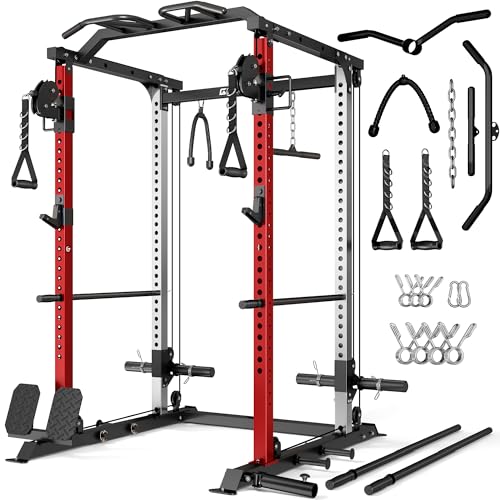
What We Like
- 2000 lb weight capacity for heavy lifting
- Dual independent pulley system for cable work
- 31 cable height options for precise positioning
- Compact footprint at 17.88 sq ft
Trade-offs
- 2×2-inch steel tubing is less rigid than 3×3-inch racks under extreme loads
- Requires 17.88 sq ft of dedicated floor space.
A 2000-pound weight capacity means this cage can handle just about any home lifter, from beginners building confidence to experienced athletes pushing heavy squats and bench presses. The real standout is the dual independent pulley system built right into the frame, which gives you cable crossover, lat pulldown, and low row functions without needing a separate machine. With 31 cable height options and 29 adjustment points on the J-hooks and safeties, you can dial in perfect positioning for exercises like shoulder presses or pull-ups. All of this fits within a compact 17.88 square foot footprint that works in garages and spare rooms alike.
The 2×2 inch steel tubing and 2000-pound capacity provide a stable platform for most home lifters, though some may prefer thicker tubing found on other racks. The 84.2 inch height is typical for a full-size cage, so check your ceiling clearance before buying. For anyone wanting a true do-everything rack without the footprint of a commercial gym, this is a space-conscious pick.
Mikolo K6 Power Cage

What We Like
- 8-in-1 design with cable crossover and lat pulldown
- True cage with 41×60 inch interior for safe in-cage lifts
- Upgraded pulley system with four white rollers
Trade-offs
- At 220 lbs, it's lighter than some competitors for stability
- 1500 lb capacity is lower than 2000 lb racks in this guide
A 1500-pound capacity and true cage design mean you can squat and bench press inside the frame without worrying about dumping a heavy barbell on yourself. That in-cage safety is the whole point of a power cage, and the K6 delivers it with a generous 41-by-60-inch interior that fits most standard benches. It also packs in a cable crossover, lat pulldown, low row station, dip bars, and a landmine mount, so you get a full gym in one package. For someone setting up a home gym from scratch and wanting to cover every major movement without buying separate pieces, this is a smart, space-efficient way to start.
The trade-off is that the 220-pound frame is lighter than the MAJOR FITNESS F22 (243 pounds), and the 1500-pound rating is below the 2000-pound cages from GOIMU and JELENS. That doesn’t mean it’s flimsy, eight reinforcing tabs help keep things steady, but if you plan to load up near its max or do explosive movements, you might feel a bit more sway. The included attachments cover a wide range of exercises, so you don’t have to hunt for extras, which saves time and hassle. It’s a complete, beginner-friendly setup that leaves room to grow, just not into the heaviest lifting territory.
MAJOR FITNESS F22 Power Rack

What We Like
- 1600 lb static capacity for heavy lifts
- Dual-triangle base reduces sway without bolting
- Independent dual-pulley system for two users
- Includes dip bars, landmine, and lat pulldown
Trade-offs
- At 243 lbs, moving it around is a chore
- 68.9-inch depth needs generous floor space
- No Smith machine or plate storage included
A 1600-pound static capacity means this rack handles serious weight without flinching, so you can squat, deadlift, or rack pull at max effort and trust the frame to hold firm. The 14-gauge steel and dual-triangle base keep it planted during heavy sets or aggressive cable work, no bolting required. That makes it a strong fit for anyone who wants a commercial-grade feel at home, especially if you train with a partner or like supersetting across the dual pulleys without waiting.
At 243 pounds, this rack is heavy enough to stay planted during hard use without bolting it to the floor. But that weight also means you’ll want a permanent spot for it, repositioning it alone is a chore. The dual-triangle base design increases floor contact area, which owners say keeps the frame stable during pull-ups or cable crossovers. If you have the space and want a foundation that won’t shift, the F22 delivers that stability without extra anchoring.
GOIMU RH01 Power Cage
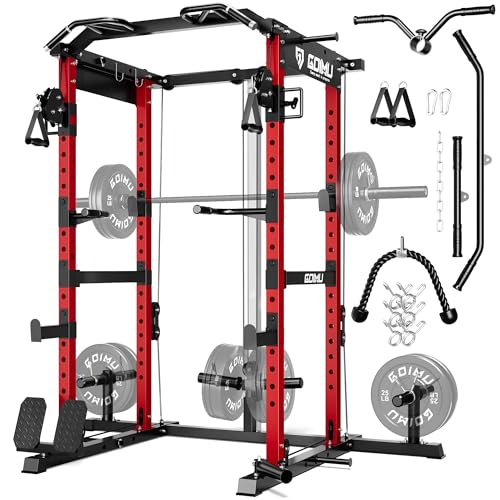
What We Like
- 2000 lb total weight capacity
- 46-inch deep interior for bench press
- 8-in-1 functions including cable crossover and lat pulldown
- Includes storage horns, hooks, and barbell holders
Trade-offs
- 2:1 cable ratio halves resistance for heavy cable work
- Large footprint needs a dedicated workout space
With a 2000-pound weight capacity, this cage stays solid during the heaviest squats and bench presses, even when you’re training alone. The 46-inch deep interior gives you room to set up a bench inside the cage for a natural pressing motion, while the included safety bars and long spotter arms catch failed reps outside the frame. If your goal is to load up the bar and push your limits safely at home, this rack gives you the structure to do it without second-guessing the hardware.
The 2:1 cable ratio makes the pulley system feel lighter than the weight stack, so you’ll need to load more plates for heavy lat pulldowns or rows. The GOIMU RH01 focuses on raw capacity and modular storage; you supply the plates and bench yourself. It’s a no-frills heavy lifter’s cage that prioritizes stability over all-in-one convenience.
SPORTSROYALS Power Cage
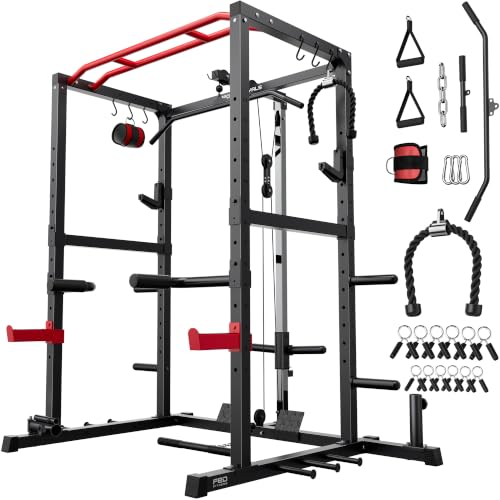
What We Like
- 1200 lb weight capacity for heavy lifts
- 500 lb pulley system for lat pulldowns and rows
- 14 adjustable height levels for versatile exercises
Trade-offs
- 56" depth requires generous floor space
- 150-pound frame is heavy to move or assemble
The pulley cable holds up to 500 pounds, which is enough for heavy lat pulldowns and seated rows, but the cage itself supports 1200 pounds for squats and bench presses. With 14 adjustable height levels, you can fine-tune the J-hooks and safety arms for exercises like bench press, rows, and overhead work. The included dip stands, landmine, and tricep rope let you train multiple muscle groups without buying extra gear.
The 150-pound frame is lighter than the Mikolo K6’s 220-pound build, so some owners report bolting it to the floor to reduce wobble during explosive lifts. At 82.6 inches tall, it fits standard ceilings, but measure your basement or garage height first. Reviewers say the detailed manual and video make assembly straightforward, though they recommend two or three people for the job.
Product photos
ULTRA FUEGO Power Cage

What We Like
- 1002 lb weight capacity
- 1.5 mm thick steel frame
- 360-degree landmine attachment
Trade-offs
- 47 inch width limits side space in tight rooms
- Requires assembly with many small parts
The included attachments, tricep rope, ankle strap, T-bar, lat pull-down bar, cable handles, J-hooks, dip bars, safety bars, six plate storage pegs, a 360-degree landmine, and four band pegs, let you walk into your garage gym and start a full-body session without buying anything else. The 1002-pound capacity and 1.5 mm steel frame give it the stability to handle heavy squats and bench presses, while the large walk-in space lets you move side to side comfortably. This cage suits anyone who wants one box of gear that covers everything from pull-ups to landmine rows right out of the box.
Product photos
JELENS S11 Power Cage

What We Like
- 2000 lb capacity in a compact frame
- Adjustable pulley system for varied exercises
- Laser-cut numbered height adjustments
Trade-offs
- 44.5-inch width limits very wide squats
- No cable crossover option like wider cages
At just 12.5 square feet of floor space, the JELENS S11 packs a 2000-pound capacity into a frame that fits where many full-size cages cannot. That compact footprint means you can squeeze a deadlift platform or a rower into the same garage corner without tripping over each other. For someone building a home gym in a tight basement or spare room, this is the cage that does not demand you rebuild the room around it.
The trade-off for that small footprint is a cage height of 79.7 inches and a width of 44.5 inches. Taller lifters doing overhead presses may find the pull-up bar a bit close to the ceiling, and wide-grip squatters might brush the uprights. Compared to the GOIMU DP01, which stands 84.2 inches tall and offers a dual independent pulley system for crossover work, the S11 is the smarter fit if your space is the limit. Just measure your ceiling first. It is a capable all-in-one that prioritizes floor-plan efficiency over absolute reach.
Product photos
pooboo P43 Power Cage

What We Like
- 35 free attachments included
- 2,000 lb weight capacity frame
- Smith machine bar with welded safety latches
- Smooth 1,000 lb pulley system
Trade-offs
- At 482.8 lb, very heavy to move
- Footprint 62.9 x 43.3 inches needs dedicated space
- Basic model lacks extra grips and bar
A 2,000-pound weight capacity frame with a built-in Smith machine bar and welded safety latches keeps the rack steady during serious squatting and pressing. The 35 attachments, including a lat pulldown bar, row bar, landmine, dip bars, and a free Olympic bar, turn it into a full gym in one corner of the garage. For someone who wants both a power cage and a guided Smith machine for safer solo lifts, this setup covers nearly every exercise you’d do at a commercial gym, minus the commute.
Once assembled, 482.8 pounds of steel doesn’t budge, so plan your placement carefully. Compared to the lighter Mikolo K6 (220 lb), this is a permanent resident, not a rearrange-friendly rack. Also, the basic P43 skips the extra lat grips, triceps rope, and ankle strap that come with the P43-Pro upgrade, so if you want the full cable accessory suite, check which version you’re ordering. For lifters who value stability and a built-in Smith machine over portability, this is a straightforward pick.
Product photos
Sunny Health & Fitness Power Rack

What We Like
- 18-point adjustable J-hooks for custom setup
- Angled pull-up bar with 8 positions
- Built-in plate storage keeps gym tidy
- 300 lb capacity on key components
Trade-offs
- No cable pulley system included
- Limited to 300 lb capacity for heavy lifters
The Sunny Health & Fitness SF-XF9931 power rack has a 300 lb capacity on its J-hooks, spotter arms, and pull-up bar, which is enough for many home gym routines like squats, bench press, and pull-ups. The 18-point adjustable J-hooks and 8-position angled pull-up bar let you customize the setup for different lifts and users. Built-in plate holders keep Olympic plates within reach and help keep the gym tidy.
This rack does not include a cable crossover or lat pulldown system, unlike some other models in its category. That keeps the unit lighter at 83 pounds, but it also means you would need to buy a separate pulley system if you want those exercises. For someone focused on barbell lifts and pull-ups, this rack provides the core features without the extra weight or complexity.
Product photos
How We Evaluated Power Cages For Home Gym
We analyzed each cage based on its published specifications, weight capacity, frame dimensions, steel tubing thickness, and included attachments. We reviewed manufacturer documentation and compared features across all nine models to understand what each cage truly offers. Patterns in owner feedback helped us identify real-world strengths and trade-offs that specs alone don’t reveal.
The three criteria that mattered most were weight capacity, footprint, and versatility. Weight capacity determines whether a cage can handle your heaviest lifts safely. Footprint dictates whether the cage fits your available floor space. Versatility, cable systems, lat pulldowns, Smith machines, and included attachments, determines how many exercises you can do without buying more gear.
An evaluation like this has limits. We can give you the facts: the numbers, the features, and what other owners consistently report. That clarity is what helps you narrow the field before you buy.
What To Look For In Power Cages For Home Gym
Choosing the right power cage comes down to matching your lifting goals with your space and budget. Start with weight capacity, then measure your room, then decide which extras matter.
Focus on weight capacity (your heaviest lift plus a safety margin), interior space (enough room to bench and squat safely), and the attachments you’ll actually use. A cage that’s too big for your room is useless, and one that’s too small for your lifts is dangerous.
Weight Capacity and Frame Construction
The weight capacity listed on a power cage tells you its maximum static load, the weight it can hold without failing. For most home lifters, a 1000 lb to 1500 lb capacity provides a comfortable margin for squats, bench presses, and deadlifts. For serious powerlifting, look for 2000 lb or higher, like the GOIMU DP01 and GOIMU RH01 offer.
Steel tubing thickness matters for rigidity. Many budget cages use 2×2-inch 14-gauge steel, while heavier-duty models step up to 3×3-inch thicker gauge. Thicker steel reduces sway during heavy lifts and keeps the rack stable over years of use. The trade-off is weight and cost, a thicker frame is harder to move and more expensive.
Interior Space and Footprint
The cage’s interior width and depth determine whether you can safely bench press and squat inside the cage. Standard cages offer around 40 inches of interior width, which fits most lifters comfortably. Wider models like the GOIMU RH01 at 46 inches deep give you extra room for bench press setup. Check your ceiling height too, most cages need enough height to accommodate a pull-up bar and tall lifters.
Attachments and Versatility
A bare power rack handles squats, bench presses, and pull-ups. Adding a cable pulley system opens up rows, triceps pushdowns, face pulls, and lat pulldowns. Some cages include lat pulldown seats and cable crossovers built in. Others offer landmine attachments, dip bars, and plate storage. The Mikolo K6 Power Cage is an 8-in-1 system that includes cable crossover and lat pulldown, making it a complete home gym in one unit.
- Measure your ceiling height before ordering, many cages require enough clearance for a pull-up bar.
- Confirm the cage’s interior width is wide enough for your bench and your squat stance.
- Check whether J-hooks, safety bars, and pull-up bars are adjustable to your preferred heights.
- Look at the included attachments: dip bars, landmine, plate storage, and pulley systems add value.
- Consider assembly time, heavier cages with many parts can take several hours to set up.
A power cage should feel like a fortress, not a compromise. Buy for the weight you plan to lift in two years, not just what you lift today.
Power Cages For Home Gym Compared
The table below compares the nine power cages across the key specs that matter most for home gym use: weight capacity, footprint, and included features.
| Product | Weight Capacity | Footprint / Dimensions | Cable / Pulley System |
|---|---|---|---|
| GOIMU DP01 Power Cage | 2000 lbs | 17.88 sq ft | Dual Independent Pulley System |
| Mikolo K6 Power Cage | 1500 lbs | L 67.5 × W 56.5 × H 86.4 in | Cable Crossover System |
| MAJOR FITNESS F22 Power Rack | 1600 lbs | 55.5 x 68.9 x 82.5 in | Dual Pulley System |
| GOIMU RH01 Power Cage | 2000 lbs | L 84.1 x W 52.4 x H 83.9 in | Cable Crossover System |
| SPORTSROYALS Power Cage | 1200 lb | 61.6"L x 56.0"W x 82.6"H | upper and lower pull-down pulley system |
| ULTRA FUEGO Power Cage | 1002 lbs | L 63.0 x W 47.0 x H 82.7 in | Optional Cable Pulley System |
| JELENS S11 Power Cage | 2000 lbs | 12.5 sq ft | Adjustable up/down pull-down |
| pooboo P43 Power Cage | 2000 lb | L 62.9 x W 43.3 x H 82.6 in | Dual Pulley Cable Crossover |
| Sunny Health & Fitness Power Rack | 300 lb | L 38.0 x W 53.0 x H 87.0 in | N/A |
Frequently Asked Questions
What is the difference between a power cage and a power rack?
A power cage is a four-post or six-post frame with safety bars that catch the barbell at the bottom of a lift, allowing you to squat and bench press alone. A power rack is often used interchangeably but can refer to a half-rack or open-frame design. Our guide on the power rack vs squat rack explains the differences between racks in more detail.
How much weight capacity do I need in a home power cage?
For most home lifters, a 1000 lb to 1500 lb capacity provides a safe margin for squats, bench presses, and deadlifts. If you plan to lift heavy or compete, look for 2000 lb or higher. The GOIMU DP01 and GOIMU RH01 both offer 2000 lb capacity for serious powerlifting.
Can I do cable exercises with a power cage?
Yes, many power cages include built-in cable pulley systems for exercises like lat pulldowns, rows, triceps pushdowns, and face pulls. The GOIMU DP01 features a dual independent pulley system with 31 cable height options, while the Mikolo K6 includes an upgraded pulley system with four white rollers. Our guide to racks with cables covers models with cable systems in depth.
How much floor space does a power cage need?
Most power cages require between 15 and 25 square feet of floor space. Compact models like the GOIMU DP01 fit in 17.88 sq ft, while larger cages need more space. Always measure your room’s width, depth, and ceiling height before purchasing.
What attachments should I get with my power cage?
Essential attachments include J-hooks, safety bars or spotter arms, and a pull-up bar. Useful add-ons include dip bars, landmine attachments, plate storage, and cable pulley systems. The ULTRA FUEGO Power Cage includes a 360-degree landmine attachment, while the pooboo P43 comes with 35 free attachments. Our guide to power rack accessories helps you choose the right add-ons for your setup.
The Bottom Line
The GOIMU DP01 Power Cage is our best overall pick for home gym owners who want a complete power cage, cable crossover, and pulley system in a compact footprint. Its 2000 lb capacity and 31 cable height options make it versatile enough for everything from heavy squats to accessory work, all in just 17.88 sq ft.
If you are starting your home gym and want an all-in-one system with cable crossover and lat pulldown, the Mikolo K6 Power Cage is the best all-in-one package. For serious powerlifters who need max stability without bolting down the rack, the MAJOR FITNESS F22 Power Rack offers a dual-triangle base that reduces sway under heavy loads. Budget-conscious lifters should look at the Sunny Health & Fitness Power Rack, which provides a solid foundation for squats, bench press, and pull-ups without extra frills.
The single most important factor when buying a power cage is matching its weight capacity and interior space to the lifts you plan to do today, and the ones you will grow into tomorrow. Buy for the strength you are building, not just the weight you can move right now.
