
10 Best Power Racks For Home Gym in 2026
This post contains affiliate links. As an Amazon Associate, we earn from qualifying purchases.
The GOIMU DP01 Power Cage is a strong overall power rack for a home gym. It packs a 2000 lb capacity, dual independent pulleys, and many height adjustments into a compact 17.88 sq ft footprint. For those who want a complete multi-station, the JELENS S11 Power Cage delivers an all-in-one setup in just 12.5 sq ft. The MAJOR FITNESS F22 Power Rack is a good pick for dual cable crossover work.
The biggest challenge with home gym power racks is balancing strength, features, and floor space. A cage that handles heavy squats might lack cable attachments, while a fully loaded station can dominate a garage or spare room. You need a rack that fits your lifts, your ceiling height, and your square footage without forcing compromises on safety or progression.
We evaluated these racks by analyzing manufacturer specs, weight capacities, footprint dimensions, and included attachments. We also studied patterns in owner feedback to understand real-world durability and ease of assembly. This guide helps you match the right rack to your training goals and available space.
Top 10 Power Racks For Home Gym in the Market
Certain content that appears on this site comes from Amazon. This content is provided "as is" and is subject to change or removal at any time.
The Best Power Racks For Home Gym, Reviewed
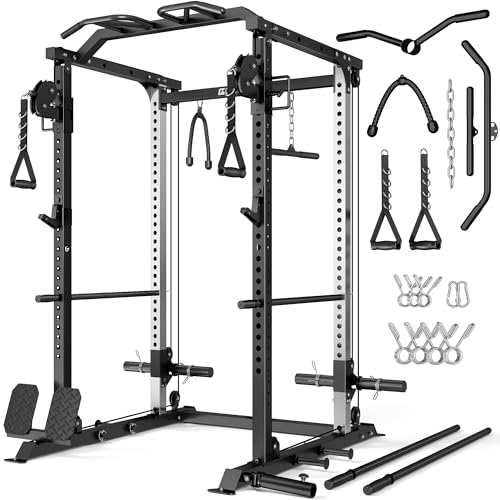
GOIMU DP01 Power Cage
What We Like
- 2000 lb capacity for heavy lifting
- Dual independent pulley system for cable work
- 31 cable and 29 J-hook height options
- Compact 17.88 sq ft footprint
Trade-offs
- 47.64 inch interior space limits very tall lifters
- No built-in weight storage included
A 2000-pound weight capacity means this rack can handle just about any home lifter’s heaviest squats and bench presses without wobbling. The clever design squeezes a full power cage, cable crossover, lat pulldown, low row, and landmine into a footprint of 17.88 square feet, making it a genuine all-in-one for tight spaces. That dual independent pulley system with 31 height settings lets you do unilateral cable work or train with a partner, which is rare in a cage this compact. For someone who wants both a squat rack and a functional trainer but only has a garage corner or spare room, this is the setup that does it all without compromise.
The trade-off for that compact size is a 47.64-inch interior depth, which is fine for most bench presses but might feel tight if you’re very tall or prefer a wide grip on rows. The 2×2 inch steel tubing is strong enough for the rated capacity, but some buyers eyeing the Titan X-3 with its 3×3 frame might wonder about long-term stiffness. Still, the GOIMU packs in cable functions that the Titan lacks entirely, and its footprint is far smaller than the MAJOR FITNESS F22’s 68.9-inch width. If you need one machine for a full-body routine and don’t have a dedicated gym room, this cage delivers more versatility per square foot than anything else at this level.
JELENS S11 Power Cage

What We Like
- 2000 lb weight capacity from heavy-duty steel
- Compact 12.5 sq ft footprint
- Smooth, quiet pulley system with steel shaft
Trade-offs
- Single pulley path limits cable crossover versatility
- 44.5" width feels narrow for some bench setups
A 2000 lb weight capacity from a 50 mm x 50 mm steel frame means this cage can handle serious loading without wobble, even as you progress past beginner weights. The eight included attachments, lat pulldown bar, cable bar, T-bar, landmine, and more, let you switch from squats to rows to triceps extensions in seconds, all within a 12.5 square foot footprint. That makes it a strong fit for anyone building a compact home gym who wants one station to cover most of their training without buying extra gear.
The JELENS S11 Power Cage covers only 12.5 square feet, so it fits neatly into a corner of a bedroom or garage without dominating the space. Its up-and-down pulley system handles lat pulldowns and seated rows smoothly, with a precision steel shaft and polished steel wire rope that keep operation quiet enough not to disturb others. For someone building a home gym on a budget, this rack bundles everything from J-hooks and safety rods to a landmine and multiple pull-down bars. That means you can start full-body training right away without buying extra accessories.
MAJOR FITNESS F22 Power Rack

What We Like
- Dual independent pulley system for two users
- 2:1 cable ratio for smooth resistance control
- Dual-triangle base reduces sway without bolting
- Includes dip bars, landmine, and lat pulldown
Trade-offs
- At 68.9 in wide, needs generous floor space
- 1600 lb static capacity is lower than some rivals
A 2:1 dual-pulley system gives you smoother cable travel and more precise resistance control, which makes this a natural fit for anyone who wants cable crossover work without dedicating a separate machine to it. The independent pulleys let two people train at once without cable interference. The dual-triangle base provides a grounded, stable feel during weighted pull-ups or aggressive cable crossovers even if you don’t bolt it to the floor. For home gym owners who value cable work alongside compound lifts, this setup replaces three machines in one compact footprint while still supporting a 1600 lb static load.
At 68.9 inches wide, this rack needs a larger floor area than the GOIMU DP01 (46.5 inches wide), but its dual-triangle base design increases floor contact for stability without bolting. The 1600 lb static capacity handles heavy squats and deadlifts, though some competitors rate 2000 lbs. If cable crossover work is a priority and you have the room, the F22 combines a weight cage, squat rack, and dual-cable crossover in one unit.
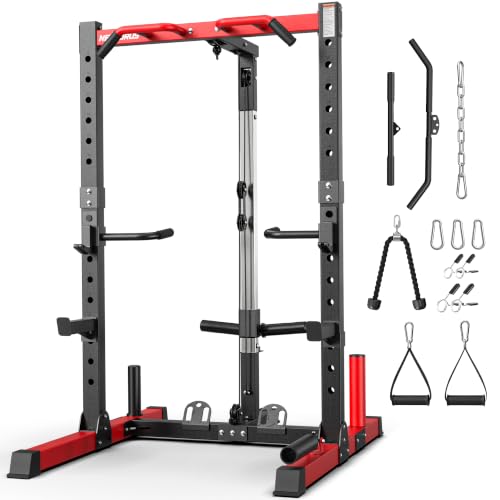
Nexaurus Power Cage
What We Like
- 1600 lb capacity with triangular steel frame
- Dual pulley system for lat pulldowns and rows
- Compact half-frame saves floor space
Trade-offs
- Wall thickness 1.5mm is thinner than some rivals
- Half-frame design offers less front-to-back stability than full cage
- Does not include weight plates, bench, or barbell
The 1600-pound load rating on a triangular-reinforced 2×2-inch alloy steel frame means this rack stays steady during heavy squats and bench presses without wobbling, even when you push near its limit. That rigid foundation, paired with a dual pulley system for lat pulldowns and cable rows, makes it a solid all-in-one station for lifters who want a stable platform without dedicating an entire room to gear. The compact half-frame footprint keeps it garage- or basement-friendly, and the built-in storage pegs organize barbell accessories and save extra floor space for daily training.
The trade-off is that the half-frame design, while space-efficient, doesn’t offer the same front-to-back bracing as a full cage like the JELENS S11, which uses a full enclosure for extra rigidity at a similar height. The 1.5mm wall thickness is adequate for most home gym work, but if you regularly load near 1600 pounds, you might prefer thicker steel. Still, for the lifter who wants heavy-duty stability in a smaller package, this rack delivers exactly what it promises.
Product photos
JELENS C12 Squat Rack

What We Like
- Reverse band peg for progressive overload
- 2000 lb capacity for heavy lifting
- All-in-one with lat pulldown and cable
- Compact 19.64 sq ft footprint
Trade-offs
- 179 lb rack still heavy to move alone
- No independent pulley arms for flyes
The dedicated upper band peg is the standout feature here, letting you use reverse band training for squats and bench presses. That means you can unload the weight at the bottom of a lift where your joints are most vulnerable, then load it fully at the top where your muscles are strongest. It is a smart way to push past plateaus without risking your shoulders or knees. This makes the rack a natural fit for anyone who wants to methodically build strength over time rather than just chase numbers.
The C12 measures 62.2 inches long, which is a standard size for a home gym cage. It provides enough space for most lifts, but if you prefer a deeper rack for walking out heavy squats, you might want to compare dimensions with other models. The 84.1-inch height means you will need to check your ceiling clearance before buying. If you are focused on progressive training and want a single station that includes a smooth dual pulley system for lat pulldowns and rows, the C12 packs a lot of smart engineering into a small footprint.
REP FITNESS PR-1100 Power Rack

What We Like
- No floor anchoring required
- Integrated pull-up bar included
- No floor anchoring needed
Trade-offs
- No floor anchor points for extra stability
- 700 lb capacity limits very heavy lifters
- No included pulley or cable attachment
The trade-off for that smaller footprint is a lower weight ceiling than some competitors like the Titan Fitness T-3 Tall Power Rack, which supports 1,100 pounds. You also won’t find built-in pulleys or cable attachments here, so if lat pulldowns and cable crossovers are non-negotiable, you would want to look at an all-in-one model like the MAJOR FITNESS F22. But if your priority is a straightforward cage that handles the core lifts safely, this Rep Fitness model delivers exactly that.
Titan Fitness T-3 Tall Power Rack

What We Like
- Westside hole spacing for precise bar placement
- 1,100 lb weight capacity for heavy lifting
- Two pull-up bar diameters for grip variety
- Laser-cut steel uprights with side bracings
Trade-offs
- 36-inch depth limits space for some exercises
- No pulley system for cable movements included
- 210 lb weight makes relocation difficult
The Titan Fitness T-3 Tall Power Rack is rated for 1,100 pounds, which means it can handle heavy squat and bench loads for most home gym users. Westside hole spacing through the bench and clean pull zone gives you 2-inch spacing above and below that zone, so you can dial in bar height more precisely than with standard 4-inch spacing. The 91-inch tall model suits lifters who want room for overhead pressing and pull-ups without bumping the ceiling.
The 36-inch depth side bracing keeps the rack compact, but that means less room inside the cage for band work or lunges compared to racks with a deeper footprint like the JELENS S11, which measures 44.5 inches deep. The T-3 comes with standard J-hooks and pull-up bars but no built-in cable system for lat pulldowns or tricep pushdowns. If you want an all-in-one machine with a pulley system, you would need to add accessories. You could also consider a different rack.
Product photos
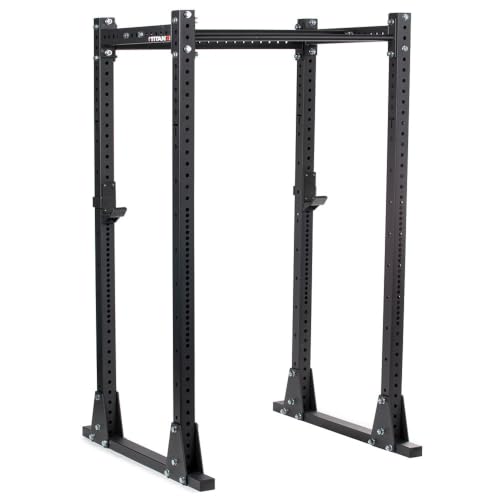
Titan Fitness X-3 Flat Foot Power Rack
What We Like
- Flat foot base, no bolting needed
- 1,650 lb rackable capacity
- Skinny and fat pull-up bars included
- Westside hole spacing for precise adjustments
Trade-offs
- 30-inch depth limits space for deep squats
- 280 lb weight makes moving it a chore
A 1,650-pound rackable capacity means this rack is built for heavy squats and bench presses without flinching, and the flat foot base keeps it planted without needing to drill into your floor. That’s a huge relief if you’re renting or just don’t want permanent holes in your garage. The Westside hole spacing gives you tiny increments for J-hook and safety bar placement, so you can dial in your setup exactly right for every lift. If you want a no-nonsense rack that stays put and lets you focus on the bar, this is the one.
Designed for lifters who prioritize heavy compound movements, this rack delivers a focused training experience without built-in cable systems. Owners who want lat pulldowns or cable rows will need to purchase those attachments separately, as the frame is optimized for squatting, benching, and pull-ups. The flat foot base provides stability without requiring floor bolts, making it suitable for garage or basement gyms where drilling into concrete isn’t an option. With a 1,650 LB rackable capacity and 6,170 LB total capacity, the structure handles demanding loads reliably. Two-person assembly is recommended for safe setup, and all necessary hardware is included.
Product photos
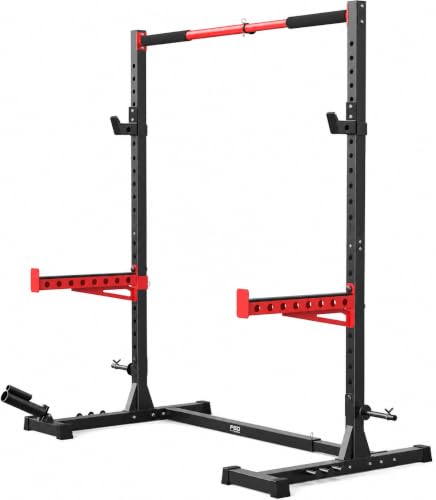
FLYBIRD SR1 Squat Rack
What We Like
- 22 precise height settings for lifts
- Adjustable width fits 6 or 7 ft barbells
- Extended 16.7" safety arms
- Includes landmine and pull-up bar
Trade-offs
- Half rack lacks full cage protection
- Half rack lacks front uprights of a full cage
A rack that holds up to 950 pounds yet fits in a footprint smaller than a standard parking space means you can squat heavy without your garage turning into a warehouse. Twenty-two height settings let you dial in the J-hooks and safety arms for squats, bench press, or shoulder press in seconds. The adjustable width accommodates both 6-foot and 7-foot barbells, and the included landmine attachment and pull-up bar turn one compact station into a full upper-body setup.
The trade-off is that half-rack design leaves you without the front uprights of a full cage, so if you fail a squat you’re relying on those 16.7-inch safety arms rather than a four-post enclosure. That’s fine for most solo lifters who bail smartly, but if you push heavy max attempts alone, a full cage like the GOIMU DP01 gives you more wraparound protection. At 68 pounds, the FLYBIRD is light enough to move around your gym but also light enough to shift if you rerack aggressively. For everyday training with room to spare, this is a smart, space-conscious pick.
Product photos
SPORTSROYALS Squat Rack
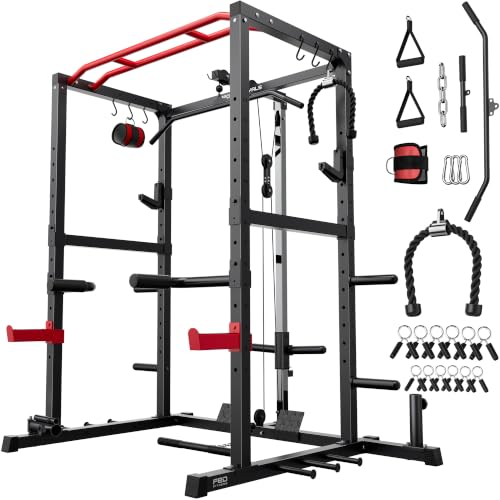
What We Like
- Integrated lat pulldown and cable system
- 1200 lb frame capacity for heavy lifts
- Built-in storage for plates, bars, and handles
Trade-offs
- 56" width requires more floor space than some racks
- 1.5mm steel is thinner than many heavy-duty cages
A 1200-pound frame capacity is enough for serious squat and bench work, but what really sets it apart is the integrated lat pulldown and cable system. With a 500-pound cable capacity and a pulley system that runs on precision bearings, you get row, pulldown, and tricep work without needing a separate machine. The included attachments cover a range of exercises, making this a true all-in-one setup for someone building a home gym on a single budget.
The trade-off comes in the frame’s weight. At 150 pounds with 1.5mm steel, it’s lighter than some competitors, so it may not feel as planted under very heavy loads. The 56-inch width also requires more floor space than narrower racks. If you plan to lift near your max and prefer a heavier base, a different cage might suit you better. But for most home gym owners who want lat pulldown capability without buying two machines, this is a smart, space-efficient pick.
Product photos
How We Evaluated Power Racks For Home Gym
Our evaluation combines manufacturer specifications, owner feedback patterns, and expert round-ups. We looked at each rack’s steel gauge, weight capacity, and frame dimensions to assess structural integrity. We also checked hole spacing, safety bar design, and whether the rack requires bolting to the floor.
The four criteria that mattered most were weight capacity, footprint, included attachments, and adjustability. A rack that holds 2000 lb is useless if it takes up your entire garage, and a compact rack is frustrating if you outgrow its capacity in six months. We prioritized racks that balance these factors for intermediate and advanced home lifters.
An evaluation based on research has limits, and long-term wear patterns emerge only after years of use. But by cross-referencing technical specs with what hundreds of owners report, we can identify which racks are reliable and which cut corners. For a deeper look at the category, our comprehensive power rack guide covers more models and use cases.
What To Look For In Power Racks For Home Gym
Choosing a power rack comes down to four pillars: capacity, space, cable systems, and adjustability. A rack that is too light or too wide will frustrate you every workout. Focus on the numbers that match your heaviest lifts and your room’s dimensions.
A power rack must safely catch a failed rep, support your heaviest lifts, and fit your ceiling height and floor area. Prioritize weight capacity over features you don’t need, and measure twice before buying.
Weight Capacity and Steel Gauge
The rack’s static and rackable weight ratings determine what you can lift safely. A 700 lb rack works for most intermediate lifters, but advanced squatters and deadlifters should look for 1000 lb or more. Steel thickness affects long-term durability, and thicker uprights resist racking and sway better under heavy loads. For a closer look at how these specs vary across models, our home power racks guide breaks down the options by capacity tier.
Footprint and Ceiling Height
Measure your available floor space and ceiling height before you buy a single bolt. A full cage needs about four feet of depth and at least four feet of width, plus clearance for loading plates. Short racks like those in our racks for low ceilings guide work in basements, while taller racks suit garages. Remember that pull-up bars and overhead cable pulleys add to the required vertical clearance.
Cable Systems and Attachments
Integrated pulley systems turn a squat rack into a full upper-body station. Look for dual independent cables if you want crossover flyes, or a single high-low pulley for lat pulldowns and rows. The cable ratio matters, a 2:1 ratio halves the weight on the stack but doubles the cable travel, giving smoother resistance. Our power racks with integrated cable systems guide covers the best models for cable training at home.
- Check that the rack’s interior width fits your bench and your wingspan for pressing.
- Confirm that J-hooks and safety bars are included, and that replacements are available.
- Measure the distance between uprights, some compact racks feel cramped for wide-grip benching.
- Look for Westside or similar close hole spacing for precise J-hook and safety bar placement.
- Verify that the rack ships in manageable boxes if you plan to assemble it alone.
A good rule of thumb: buy a rack rated for at least 1.5 times your current one-rep max squat to leave room for progression.
Power Racks For Home Gym Compared
The table below compares power racks side by side, focusing on capacity, footprint, cable systems, and standout features to help you narrow your choices.
| Product | Weight Capacity | Footprint / Dimensions | Height |
|---|---|---|---|
| GOIMU DP01 Power Cage | 2000 lbs | 17.88 sq ft | 84.2 inches |
| JELENS S11 Power Cage | 2000 lbs | 12.5 sq ft | 82.6 inches |
| MAJOR FITNESS F22 Power Rack | 1600 lb | L 55.5 x W 68.9 x H 82.5 in | 82.5 inches |
| Nexaurus Power Cage | 1600 lbs | L 59.8 x W 44.5 in | 86.2 inches |
| JELENS C12 Squat Rack | 2000 lbs | 19.64 sq ft | 84.1 inches |
| REP FITNESS PR-1100 Power Rack | 700 lbs | L 48.0 x W 48.0 x H 84.0 in | 84.0 inches |
| Titan Fitness T-3 Tall Power Rack | 1,100 lb | 36in Depth | 91 inches |
| Titan Fitness X-3 Flat Foot Power Rack | 1,650 lb | 30 in Depth | 82 in |
| FLYBIRD SR1 Squat Rack | 950 lbs | 39" L × 41.3" W | 83.0 inches |
| SPORTSROYALS Squat Rack | 1200 lbs | 61.6"L × 56.0"W × 82.6"H | 82.6 inches |
Frequently Asked Questions
What weight capacity do I need in a home gym power rack?
Most home lifters do well with a rack rated between 700 and 1100 lb. If you squat or deadlift over 400 lb, look for a higher static capacity to leave a safety margin. The GOIMU DP01 and JELENS S11 both offer 2000 lb capacity for heavy training.
Can I do cable exercises on a power rack?
Yes, many modern power racks include integrated pulley systems for lat pulldowns, rows, and cable crossovers. The MAJOR FITNESS F22 has dual independent pulleys for two users, while the SPORTSROYALS Squat Rack includes a lat pulldown and cable station in one unit.
How much floor space does a power rack need?
A compact cage like the GOIMU DP01 fits in about 18 sq ft, while wider models like the MAJOR FITNESS F22 need nearly 69 inches of width. Always measure your room’s length, width, and ceiling height before purchasing, and account for plate storage and walking space.
Do I need to bolt a power rack to the floor?
Some racks, like the REP FITNESS PR-1100 and Titan Fitness X-3 Flat Foot, are designed to be stable without bolting. Full cages with wide bases and heavy frames often don’t need anchoring, but bolting adds extra stability for heavy rack pulls or band work.
What is the difference between a power rack and a squat rack?
A power rack (or power cage) has four uprights and safety bars that catch a failed rep on all sides, while a squat rack typically has two uprights and no rear enclosure. Our power rack vs squat rack guide explains the trade-offs in safety, space, and features.
The Bottom Line
For most home gym owners, the GOIMU DP01 Power Cage is a strong overall choice. It combines a 2000 lb capacity, dual independent pulleys, and many height adjustments in a footprint that fits a small garage or spare room. If you train alone and want a complete station without buying extra attachments, the JELENS S11 Power Cage delivers squats, pulldowns, and accessories in just 12.5 square feet.
Budget-conscious lifters should look at the REP FITNESS PR-1100 for a no-frills cage that doesn’t need floor anchoring. Tall athletes will appreciate the Titan Fitness T-3 Tall Power Rack‘s Westside hole spacing and 1,100 lb capacity. The single most important factor is matching the rack’s interior dimensions and weight rating to your body size and strongest lift. Everything else is a bonus.
