
10 Best Power Racks in 2026
This post contains affiliate links. As an Amazon Associate, we earn from qualifying purchases.
The MAJOR FITNESS F22 Power Rack wins as our best overall pick. It combines a 1600 lb static capacity, a sway-reducing base design, and included accessories like a lat pulldown and dip bars into one stable package. For heavy-duty training, the MAJOR FITNESS Drone3 supports 2,500 lb loads with a dual pulley system. The Titan Fitness T-2 Series offers a budget-friendly entry point without skimping on safety features.
Choosing a power rack means committing to a permanent piece of gym equipment. You need to balance capacity, footprint, and included features against your available floor space and ceiling height. A rack that fits your space and your strength goals will serve you for years.
This guide is built from manufacturer specifications, expert round-ups, and patterns in owner feedback. We evaluated each rack on stability, capacity, included accessories, and footprint to help you find the right match for your home gym.
Top 10 Power Racks in the Market
Certain content that appears on this site comes from Amazon. This content is provided "as is" and is subject to change or removal at any time.
The Best Power Racks, Reviewed
MAJOR FITNESS F22 Power Rack

What We Like
- 1600 lb static capacity for heavy lifting
- Dual-triangle base reduces sway without bolting
- Includes landmine, dip bars, and lat pulldown
Trade-offs
- At 243 lb, moving it solo is a real chore
- 68.9-inch width needs generous floor space
For someone building a home gym who wants one station that replaces a squat rack, cable crossover, and lat pulldown machine, this is the kind of all-in-one that actually delivers on the promise.
The trade-off is size. At 68.9 inches wide and 243 pounds, you need a dedicated corner of the garage or basement, and moving it into place is a two-person job. Compared to the CAP Barbell FM-8000F Deluxe Power Rack, which weighs 97 pounds and takes up less floor space, the F22 is far more substantial but less forgiving of a small room. If you have the space and want a single station that lets you superset alone or train with a partner, this rack earns its place as the centerpiece of a serious home gym.
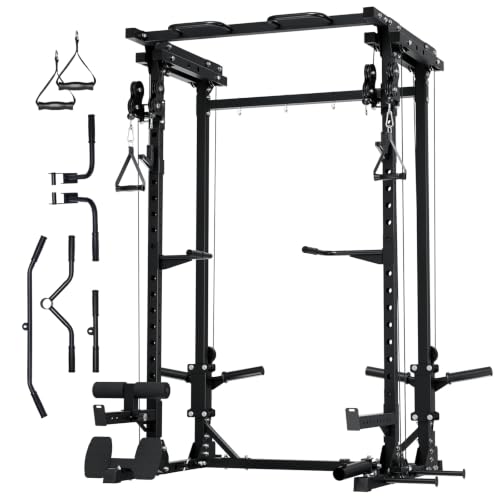
MAJOR FITNESS Drone3 Power Rack
What We Like
- 2,500-lb capacity for heavy lifting
- Dual pulley system with 2:1 and 1:1 ratios
- Linear bearing system for zero-friction bar movement
- Built-in storage keeps gear organized
Trade-offs
- 45.9-inch depth limits space for some movements
A 2,500-pound weight capacity is the kind of number that makes you stop and double-check the spec sheet. That commercial-grade steel frame means this rack can handle just about any barbell load you can throw at it, and then some. The dual pulley system with both 2:1 and 1:1 ratios gives you real flexibility, high-rep cable work for endurance one day, heavy lat pulldowns the next. Nineteen height settings on the J-hooks and safeties let you dial in the perfect starting position for squats, bench press, or overhead work, so you are not stuck guessing. This is a rack built for someone who wants to train heavy and train often, without wondering if the frame will wobble.
The trade-off for that stability is size. At 85 inches tall, this rack requires you to check your ceiling height before buying. The 45.9-inch depth is compact for a power rack, but it means you will have less room to step back for squats or set up for certain exercises compared to a deeper cage like the REP Fitness Altitude. Still, for a lifter who prioritizes raw capacity and wants a cable system built right in, the Drone3 delivers a heavy-duty package that asks very few compromises on the platform itself.
CAP Barbell FM-8000F Deluxe Power Rack

What We Like
- 12- and 14-gauge steel construction
- Three band posts per side for resistance
- ABS sleeves prevent bar scratches
- Includes two J-cups and two safety catches
Trade-offs
- 600 lb capacity limits very heavy lifters
- No pulley system for cable exercises
A 600-pound total weight capacity and dual-gauge steel frame give this rack a straightforward, no-nonsense foundation for squats, bench presses, and pull-ups. The three band posts on each side let you add resistance bands for accommodating strength work, while the ABS sleeves on the bar holders protect your Olympic bar from scratches during storage. This setup suits someone who wants a classic four-post cage without extra attachments, just the basics done with sturdy materials and reinforced gussets for stability.
At 97 pounds, this rack is lighter than some competitors, so it may shift under heavy loads if not bolted down. The Titan Fitness T-2 Series Tall has an 850-pound rackable capacity, while the MAJOR FITNESS F22 includes a dual pulley system. For a straightforward steel cage that focuses on durability, this CAP Barbell model delivers what it promises.
Titan Fitness T-2 Series Tall Power Rack
What We Like
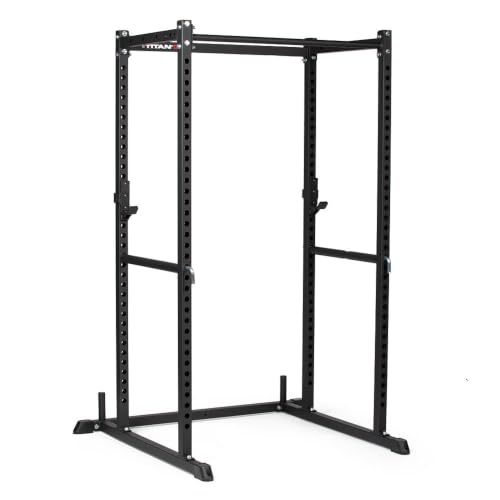
- 850 lb rackable capacity for heavy lifts
- Pin and pipe safeties catch failed reps
- J-hooks with nylon core protect bar knurling
- 83-inch height suits taller lifters
Trade-offs
- Skinny pull-up bar limits grip options
- 130-pound rack is heavy to move alone
An 850-pound rackable capacity means this rack can handle your heaviest squats and bench presses without worrying about the frame giving out. The 83-inch height gives taller lifters room to press overhead inside the rack, and the included J-hooks have a nylon core that keeps your barbell’s knurling from getting chewed up. For someone building a home gym on a tight budget, this is the rack that covers the essentials. It gives you solid steel, real safeties, and enough capacity to grow into, without loading up extras you might not need.
The T-2 is a bare-bones setup. If you want a no-frills, heavy-duty rack that leaves room in your budget for plates and a bar, this one delivers exactly what it promises.
Titan Fitness X-3 Series Flat Foot Power Rack
What We Like
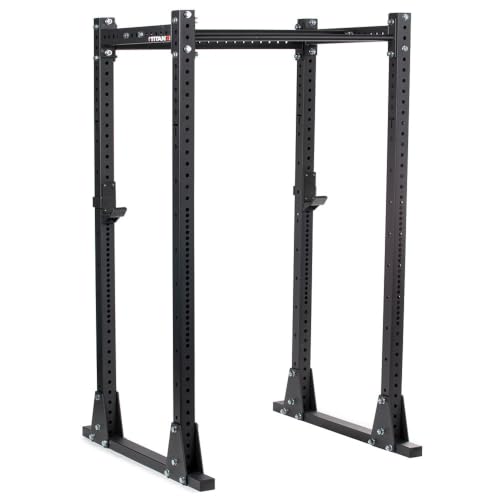
- 1,650 lb rackable capacity for heavy lifts
- Westside hole spacing for precise bar placement
- Skinny and fat pull-up bars included
- No-bolt flat foot base for stability
Trade-offs
- No cable pulley system for lat work
- No lat pulldown or cable attachment included
With a 1,650 lb rackable capacity, this rack handles serious weight without needing bolts through your floor. The flat foot base spreads the load across the ground, so you can set it up on concrete, rubber mats, or even a garage floor without drilling. Westside hole spacing gives you small adjustments for bench press and squat depth, while the two pull-up bars let you switch between a comfortable skinny grip and a fat bar that challenges your forearms. It’s built for lifters who want a sturdy, no-fuss setup and don’t want to commit to permanent floor anchors.
The 82-inch upright height is listed for this model, so users over about six feet may find pull-ups require tucking their knees. The 30-inch depth is a fixed dimension; if you prefer a deeper rack, models like the REP Fitness Altitude offer a 29-inch depth, which is actually slightly shallower. Still, if you value quick installation and a rock-solid base that won’t budge under heavy loads, this Titan Fitness model delivers exactly what it promises without the hassle of bolting down.
Valor Fitness Power Rack with Multi-Grip Pull Up Bar
What We Like
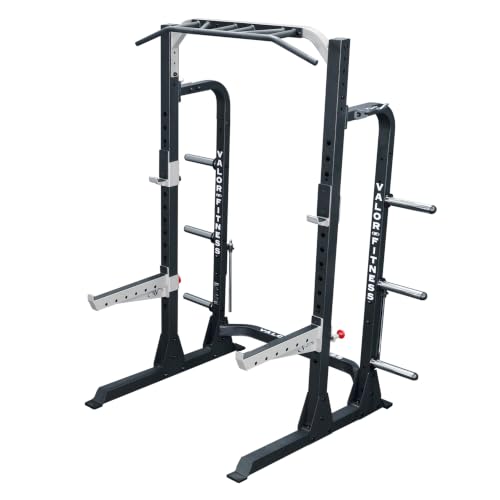
- Five pull-up grip positions
- 750 lb capacity from 11-gauge steel
- Integrated plate and barbell storage
- Adjustable J-hooks and 23" spotter arms
Trade-offs
- Heavy 280 lb frame complicates moving
- No cable pulley system included
A 750-pound capacity from an 11-gauge steel frame means this rack handles heavy squats and bench presses without wobbling, even when you push near your limits. The real standout is the multi-grip pull-up bar with five handle positions, wide, neutral, angled, and close-grip, so you can target your back, shoulders, and arms from different angles without needing extra attachments. It suits anyone who wants a straightforward, sturdy power rack that doubles as a dedicated pull-up station. This is especially true if you prefer variety in your upper-body pulling work and don’t need a cable system cluttering the space.
This rack is built like a tank at 280 pounds, so rearranging your gym layout means a real workout in itself. Compared to the Titan Fitness T-2 Series Tall Power Rack, which weighs 130 pounds and has a simpler pull-up bar, the Valor gives you more grip options and integrated storage but demands more floor commitment. If you want a cable crossover or pulley system built in, the MAJOR FITNESS F22 offers that, though at a different price tier. For lifters focused on barbell basics and varied pull-ups, this is a focused, no-nonsense setup.
Product photos
REP Fitness Altitude Power Rack
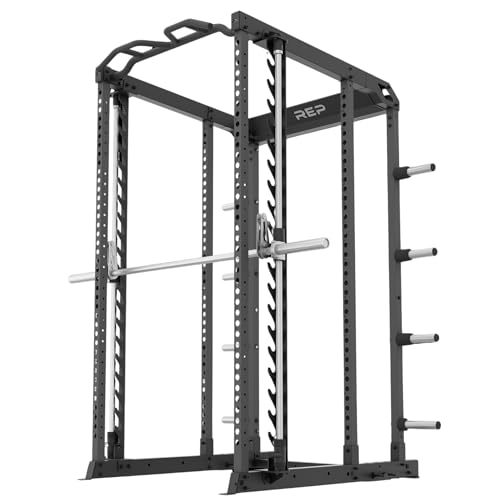
What We Like
- Modular design with cable and Smith options
- Compact 29-inch working depth
- Flip-down safeties for solo training
- Integrated system, not a mix of add-ons
Trade-offs
- 85.5 lb frame is light for heavy loads
A 29-inch working depth means this rack fits where most power racks won’t, tight garages, basement corners, or a spare bedroom. That compact footprint is the whole point of the Altitude Series: it’s a fully integrated system that lets you start with a squat rack and add a cable pulley or Smith machine later without buying a second cage. If you’re building a home gym in a space that’s more nook than warehouse, this modular approach keeps your options open. The flip-down safeties and lined attachments give you confidence lifting alone.
A 29-inch working depth keeps this rack compact enough for a garage or basement, but you will have a tighter squat setup than you would with a 55.5-inch-deep MAJOR FITNESS F22. The 85.5-pound alloy steel frame is lighter than many other racks, so you’ll want to check your floor setup before adding the Smith or cable attachment at high resistance. This is a space-first design that asks you to accept a tighter working area in return for a gym that actually fits your room.
Product photos
FLYBIRD SR1 Squat Rack
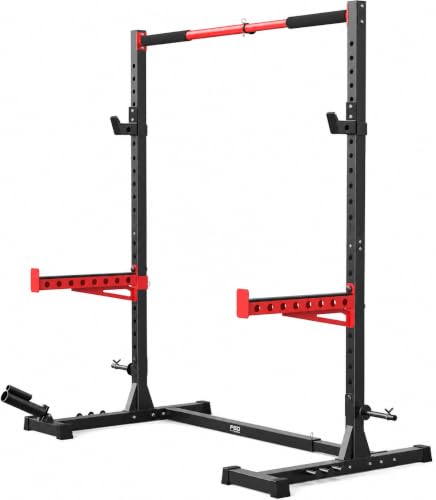
What We Like
- 16.7" extended safety arms for solo training
- Includes landmine and band pegs
- 22 precision height settings for J-hooks and safety arms
Trade-offs
- 950 lb capacity is lower than some full cages
- No pulley system for cable exercises
It suits lifters who want a stable squat stand that doesn’t lock them into a single barbell length, and the included landmine and band pegs add variety without extra purchases.
At 68 pounds, this rack is much lighter than the MAJOR FITNESS F22, which weighs 243 pounds and includes a dual pulley system. If you need a built-in cable crossover or plan to lift near the 950-pound capacity, the FLYBIRD’s simpler design may not suit you. But for focused squat, bench, and pull-up work in a compact space, the adjustable width and small footprint make it a practical option.
Product photos
SPORTSROYALS Squat Rack with LAT Pulldown
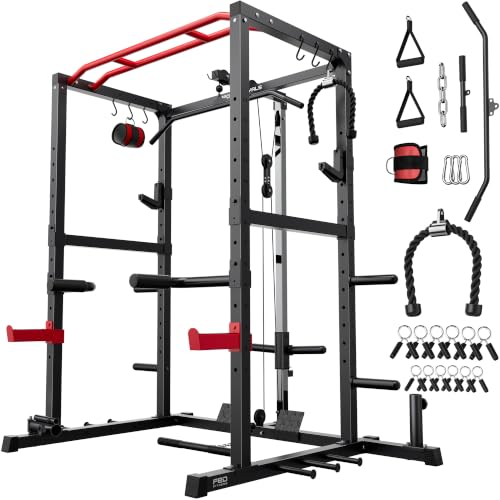
What We Like
- 1200 lb rack capacity for heavy lifts
- 500 lb pulley system with smooth movement
- 14 adjustable height levels for versatility
Trade-offs
- Shallower 56" depth limits rack space for larger users
- 150 lb unit weight is lighter than some competing racks
A 500 lb pulley capacity is rare at this price point, letting you do lat pulldowns, seated rows, and tricep work without buying a separate machine. The 1200 lb rack rating means you can squat and bench safely with most home gym plates, while the 14 height adjustments let you dial in J-hook and safety bar positions for exercises from overhead press to floor pulls. It’s a smart fit for someone who wants one station that handles both heavy compound lifts and cable accessories. You won’t need a dedicated cable tower.
At 150 lb, this rack is lighter than the 243 lb MAJOR FITNESS F22, so under a heavy squat you may feel more wobble unless you bolt it down or load the weight pegs. The 56-inch depth also means you have a shorter distance to step back for squats compared to deeper racks. For a lifter who prioritizes a built-in pulley over rock-solid heft and has a dedicated training space, this delivers real value. If you plan to lift near the 1200 lb limit or want maximum rigidity, the heavier F22 is worth the extra cost.
Product photos
GOIMU WM3-V4 Folding Power Rack

What We Like
- Folds to 4.3 sq ft for storage
- Dual independent 1:1 cable system
- 5 configurable workout modes
- 15 adjustable pulley heights
Trade-offs
- Wall-mounted design requires sturdy wall anchoring
- At 33.5 inches deep, limited for deep squats
A folded footprint of just 4.3 square feet means this rack practically disappears against a wall when you’re done, turning a cramped apartment corner or narrow garage into a real training spot. It’s built for anyone who wants a full gym, power rack, cable crossover, lat pulldown, pull-up bar, without giving up half the room. The five configurable modes let you switch from heavy squats to cable flies in seconds, and those 15 pulley heights give you the range to hit muscles from every angle. If space is your biggest constraint, this rack is worth a close look.
Wall mounting is non-negotiable: you need a solid wall and the confidence to bolt it in, since there’s no freestanding base. The folded footprint is just 4.3 square feet, so it tucks away in apartments or garages when not in use. That space-saving design means you trade a permanent footprint for a few minutes of setup each session.
Product photos
How We Evaluated Power Racks
We started by reviewing manufacturer specifications for every rack, focusing on static and rackable weight capacities, steel gauge, and footprint dimensions. Owner feedback across multiple sources helped us identify real-world issues like bolt alignment, wobble under load, and ease of assembly that specs alone cannot reveal.
Our evaluation prioritized four criteria. Stability came first: a wobbly rack is dangerous and discouraging. We looked for wide bases, heavy frames, and designs that minimize sway without requiring floor bolting. Capacity mattered next, since a rack should handle your current lifts and future progress. Included accessories like pulleys, dip bars, and landmine attachments add serious value. Finally, footprint and assembly determined whether a rack realistically fits a home gym.
A research-led evaluation has limits. We did not assemble or lift on these racks ourselves. Our recommendations are based on what the data and the community report, not on personal testing. We prioritized patterns that appeared consistently across many owners rather than isolated complaints.
What To Look For In Power Racks
Choosing a power rack means making trade-offs between capacity, stability, features, and the space you have available. Focus on what matters most for your training style.
Pick a rack with a weight capacity at least 50% above your current squat and bench max. Ensure the footprint fits your floor space with room to load plates. Prioritize steel gauge and base design over flashy add-ons.
Capacity and Steel Gauge
A rack’s weight capacity is its most important number. Look for a static capacity that exceeds your heaviest squat by a comfortable margin. Rackable capacity, what the J-hooks and safeties can hold during a failed rep, matters even more. Thicker steel (11-gauge or better) and a heavy base weight contribute directly to stability under load.
Footprint and Installation
Measure your space carefully. The rack’s depth (front to back) and width determine whether you can squat inside it comfortably. Ceiling height matters for pull-ups and overhead pressing. Some racks require bolting to the floor for stability; others use flat-foot or triangle-base designs that stay put on their own. Folding racks save space but need solid wall anchoring.
Included Attachments and Expandability
A rack that comes with a lat pulldown, dip bars, or a landmine attachment saves you money versus buying them separately. Some racks use proprietary attachments, while others accept standard 1-inch hardware. Consider whether you want to add a cable system later. Integrated pulley systems are smoother than bolt-on add-ons.
- Check the J-hook and safety design: Westside hole spacing gives you more precise bar placement.
- Look at the pull-up bar: multi-grip options add variety without extra equipment.
- Verify the safety type: pin-and-pipe safeties are simple and strong; strap safeties are quieter and protect the bar knurling.
- Confirm the rack accepts standard attachments if you plan to expand later.
A rack that matches your current strength level and has room to grow is a better investment than one that maxes out the day you set it up.
Power Racks Compared
The table below compares each power rack’s capacity, footprint, and key features side-by-side to simplify your decision.
| Product | Weight Capacity | Steel Gauge | Dimensions | Weight |
|---|---|---|---|---|
| MAJOR FITNESS F22 Power Rack | 1600 lb static | 14-gauge | 55.5 x 68.9 x 82.5 in | 243.0 lb |
| MAJOR FITNESS Drone3 Power Rack | 2,500 lbs | 2×2-inch commercial-grade | 69.5"W x 45.9"D x 85"H | N/A |
| CAP Barbell FM-8000F Deluxe Power Rack | 600 lb total | 12- and 14-gauge | 47" D x 61" W x 85" H | 97.0 pounds |
| Titan Fitness T-2 Series Tall Power Rack | 850 LB rackable | 14-gauge 2" x 2" steel | 82.0 x 11.0 x 10.0 in | 130.0 pounds |
| Titan Fitness X-3 Series Flat Foot Power Rack | 1,650 LB rackable | N/A | 82" H x 30" D | 280.0 pounds |
| Valor Fitness Power Rack with Multi-Grip Pull Up Bar | 750 lb | 11-gauge steel | 85.0 x 10.0 x 4.0 in | 280.0 pounds |
| REP Fitness Altitude Power Rack | N/A | Alloy steel | 29 x 94.1 x 90 in | 85.5 pounds |
| FLYBIRD SR1 Squat Rack | 950 lbs | 2" x 2" commercial-grade | 39" L × 41.3" W × 83" H | 68.0 lbs |
| SPORTSROYALS Squat Rack with LAT Pulldown | 1200 lb | 50×50mm steel, 1.5mm thick | 61.6"L × 56.0"W × 82.6"H | 150 lb |
| GOIMU WM3-V4 Folding Power Rack | N/A | N/A | 33.5 x 50.0 x 85.0 in | N/A |
Frequently Asked Questions
What weight capacity do I need in a power rack?
Your rack should support at least one and a half times your heaviest squat. If you squat 300 pounds, look for a rackable capacity that exceeds that. Going higher gives you room to progress without needing a new rack.
Can I set up a power rack without bolting it to the floor?
Yes. Many racks use flat-foot or triangle-base designs that stay stable without floor bolts. The MAJOR FITNESS F22 uses a dual-triangle base, and the Titan Fitness X-3 Series has a flat-foot design. These work well on concrete or rubber flooring.
What is the difference between a power rack and a squat rack?
A power rack is a full cage with four uprights, safety bars, and a pull-up bar. A squat rack has two uprights and no cage. Power racks are safer for solo training because the safeties catch a failed rep from any angle. Our power rack vs squat rack comparison covers the details.
How much floor space do I need for a power rack?
Most full-size racks need about 4 feet by 4 feet of floor space plus room to load plates. Measure your space and add 2 feet on each side for bar loading. Ceiling height should allow for pull-ups and overhead pressing.
Can I add a cable pulley system to my power rack later?
Some racks accept bolt-on cable attachments, while others require a specific add-on kit. Integrated systems like the MAJOR FITNESS Drone3 come with a pulley built in. If you want cables, look for power racks with pulley systems from the start.
The Bottom Line
The MAJOR FITNESS F22 Power Rack is the best overall choice for home lifters who want a single, stable station for heavy compound lifts with cable work included. Its 1600 lb capacity and sway-resistant base make it a serious training tool for anyone with enough floor space.
If your budget is tighter, the Titan Fitness T-2 Series Tall Power Rack delivers solid safeties and tall uprights at an affordable price. For lifters pushing heavy loads, the MAJOR FITNESS Drone3 handles 2,500 lb and adds a smooth dual pulley system for cable exercises.
The single most important factor when buying a power rack is matching its capacity and footprint to your training goals and available space. A rack that fits your room and your strength will serve you well for years.
