
How to Ask for a Gym Tour: Script, Questions, Red Flags
This post contains affiliate links. As an Amazon Associate, we earn from qualifying purchases.
Here’s how to ask for a gym tour: call or walk in during off-peak hours and say plainly, “I’m thinking about joining — could someone show me around?” Most gyms say yes on the spot. Ask for 15 minutes, name what you want to see, and bring three questions.
The how to ask for a gym tour question is the easy part. What separates a useful 15 minutes from a wasted one is what you do with them: which questions you bring, which parts of the floor you insist on seeing, and which answers should make you walk away.
What follows is the exact script, the three questions worth asking, the equipment checks that matter, and the red flags that mean the gym isn’t ready for you.
Key Takeaways
- Ask a person, not a web form. A form gets you a callback in three days; a human at the desk gets you a walkthrough in ten minutes.
- Bring three questions, not thirty. Weight limits, class schedule, and what happens when equipment breaks cover most of what matters.
- Check the posted weight limit before you ride anything. The Peloton Commercial Bike+ manual caps riders at 297 lb / 135 kg, and that figure should be posted or available on request.
- Skip the personal training package on day one. Take the free orientation or tour instead — you can always add coaching later.
- Walk the floor before you commit. If the layout confuses you now, it’ll confuse you at 6am on a Tuesday.
What to Say When You Ask for a Gym Tour
One sentence, delivered to a human at the front desk or on the phone, is all this takes. Walk in during off-peak hours (mid-morning or early afternoon on a weekday) and say: “I’m thinking about joining. Could someone show me around for 15 minutes?”
A tour request works best when it names a specific time frame and a specific purpose. The person at the desk needs two facts: how long the visit will take, and which areas of the floor matter. Fifteen minutes and a short list of equipment covers both.
Before you start: A tour involves walking a working gym floor. Keep to the marked walkways, don’t step behind a rack mid-lift, and ask before touching any machine that’s in use. A moving cable or a swinging plate doesn’t stop for a visitor.
Here’s the script, roughly in order:
- Pick your window. Mid-morning or early afternoon on a weekday is quieter than the 6pm rush. Skip this and you’ll tour a crowded floor, which tells you nothing about how the gym feels when you’d actually use it.
- Ask for a person, not a form. “Is there someone who can show me around for 15 minutes?” A web form gets you a callback in three days; a person at the desk gets you a walkthrough in ten minutes.
- Name what you want to see. Free weights, cardio, the class studio, the locker room. The person giving the tour will skip what you don’t mention.
- Ask when the tour can happen. Same day is ideal. If they push you to next week, that tells you something about staffing.
- Write down three questions before you walk in. You’ll forget at least one otherwise, and the one you forget is usually the one that matters.
The front desk at 10am on a Tuesday is quiet enough that you can hear the treadmills hum and the cable stacks settle. That’s the version of the gym you want to see. If the only time they’ll tour you is 6pm on a Monday, you’re touring a different building.
If the idea of walking up to a stranger and asking makes your stomach drop, that’s normal. There’s a whole playbook for gym staff conversations that starts with the same one-sentence request. And if you’ve never been inside a gym at all, the first gym visit is a gentler entry point than a full tour.
Which Questions Actually Tell You Something?
Three questions do most of the work: weight limits, class schedule, and what happens when equipment breaks.
The trick, much like how to ask for a gym tour, is knowing what a real answer sounds like versus a dodge. Here’s the split:
| Question | Useful answer | Dodge |
|---|---|---|
| What’s the weight limit on this machine? | A number, posted or in the manual | “It’s fine for everyone” |
| When are classes, and are they included? | A printed schedule with times | “Check the app” |
| What happens when equipment breaks? | A named process and turnaround | “We fix it fast” |
The Weight-Limit Question
Every commercial machine has a rated limit, and every gym that takes maintenance seriously knows what it is. The Peloton Commercial Bike+ manual lists 297 lb / 135 kg as the rider cap. If the tour guide can’t tell you the limit on the leg press, that’s not a knowledge gap. It’s a sign nobody has looked at the machine’s documentation since it was installed.
The Class-Schedule Question
Ask for a printed schedule, not a verbal summary. A gym that prints schedules is a gym that plans its week. A gym that says “check the app” is a gym where the schedule changes without notice. For a gym beginner, class times matter more than class variety — you want a slot you can actually hit on a Tuesday.
The Repair Question
“What happens when the cable snaps on a Tuesday morning?” is the question that separates a maintenance-led gym from a sales-led one. A useful answer names a person, a process, and a rough turnaround. “We handle it” is not an answer. Neither is “we have a guy.”
What to Check on the Equipment Itself
The Peloton Commercial Bike+ manual lists a 297 lb / 135 kg rider limit, indoor use only, and a rule that the power cable never passes under the bike. Those three lines tell you more about a gym’s maintenance culture than the lobby decor does.
What the Manual Tells You
The manual is the source of truth. It lists weight limits, operating conditions, and the maintenance schedule the gym is supposed to follow. Peloton’s manual also specifies that all maintenance must be performed by authorized personnel, so any gym that lets a member tighten their own seat post is off-script. The manual is the source of truth, and a gym that takes maintenance seriously should be able to produce the documentation for its machines on request.
You don’t need to read the whole manual on the tour. You need to know it exists and that the gym can produce it.
What the Floor Tells You
A worn cable feels gritty under the sheath when you run your hand along it, and it smells faintly of hot rubber after a busy morning. The sheath hides the fray until the day the cable snaps. A cable that looks fine at the crimp is fine. A cable that looks fuzzy at the crimp is a liability.
Here’s what to check, and why:
| Check | What to look for | Why it matters |
|---|---|---|
| Posted weight limits | A sticker or manual on the machine | Tells you the gym tracks its own equipment |
| Cable and belt condition | Fraying, glazing, or slack | Worn cables snap under load |
| Power cable routing | Never under the machine, kept dry | A cable underfoot is a trip hazard |
| Floor clearance | Room to walk around each machine | Tight spacing means crowded peak hours |
A cable fails at the crimp, not the middle. The sheath hides the fray until the day it snaps. That’s the failure point, and it’s the one a tour should look at.
Why Does the Tour Feel Awkward, and How Do You Get Past It?
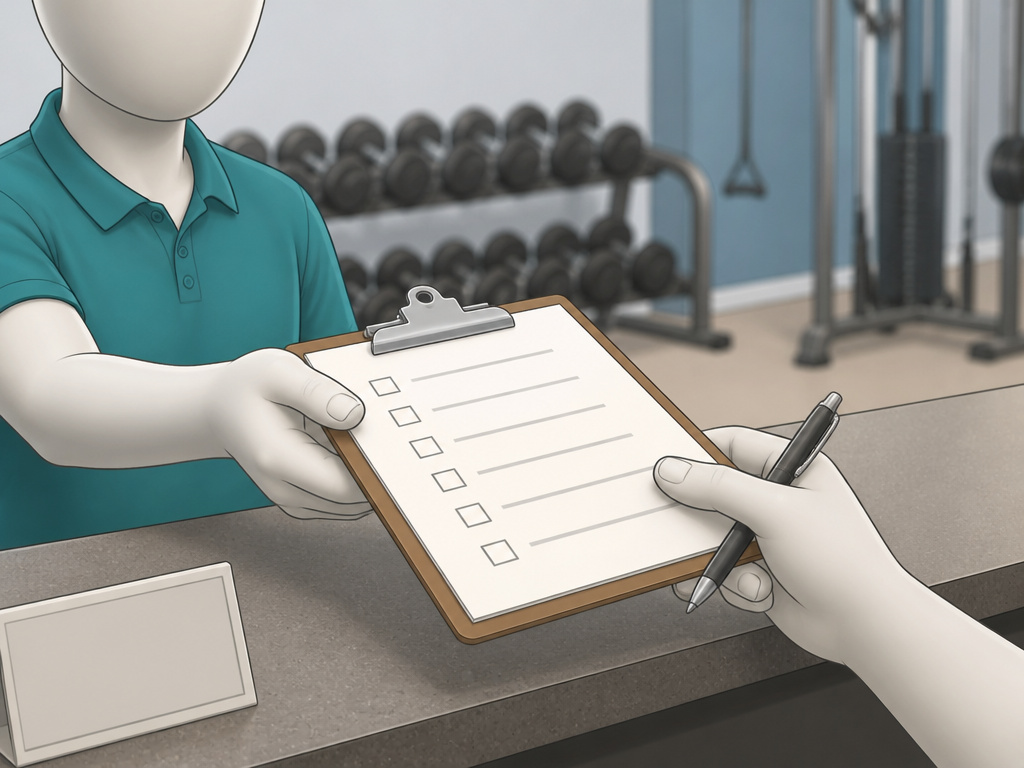
Nobody at the desk is judging you for asking. They get this request daily, and the person giving the tour is usually bored, not sizing you up.
The awkwardness comes from the mismatch between what you’re doing (asking a favor) and what you’re actually doing (evaluating a service you might pay for). Flip the frame. You’re not asking for a favor. You’re doing a site visit. The gym wants your membership; the tour is the sales process, and you’re the one evaluating it.
I’d rather see a gym’s maintenance log than its class schedule. A gym that tracks repairs is a gym that will still have working equipment in year three. A gym with a great schedule and a broken cable stack is a gym you’ll quit.
If the gym anxiety is the real blocker, the tour is actually the easiest version of the gym. You’re not working out. You’re walking and looking. That’s it.
The Red Flags That Should End the Tour Early
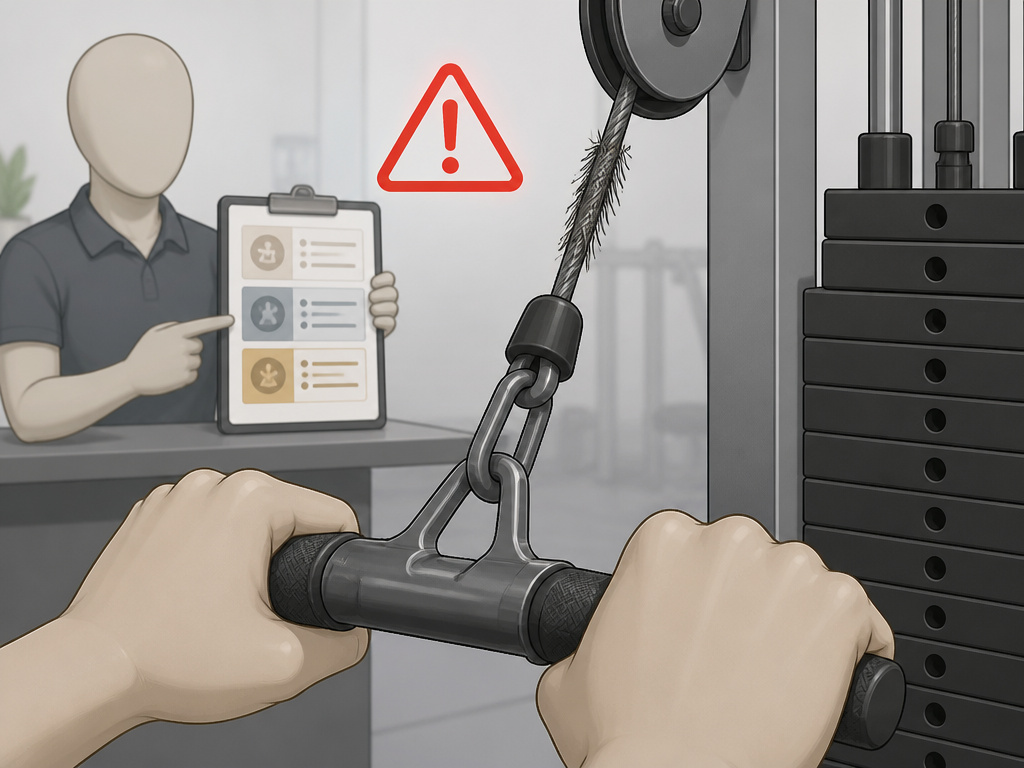
Some tours should end in the parking lot.
- No posted weight limits on any machine. If the gym can’t be bothered to label its equipment, it probably doesn’t maintain it either.
- Cables that look frayed or glazed. A worn cable is a snap waiting to happen. Walk away.
- A sales pitch before the walkthrough. If they want to talk membership tiers before showing you the floor, the tour is a sales call.
- No answer on equipment repair. “We handle it” is not an answer. Ask who handles it and how long it takes.
- A locker room that smells like a locker room. Some smell is normal. A smell that hits you at the door means the cleaning schedule is theoretical.
If the person giving the tour can’t tell you the weight limit on the leg press, the tour is a sales call. Walk away.
A locker room that smells like bleach and rubber is normal. A locker room that smells like damp towels and old sweat is a cleaning schedule that exists on paper only.
A Trainer-Led Tour vs a Front-Desk Tour
A trainer-led tour wins if you’re new to strength training and want to know which machines to start on. A front-desk tour wins if you already know what you want and just need to see the floor. Ask for the trainer if you’re new to strength training; ask for whoever’s available if you’re not.
The trainer will also try to sell you a package. That’s fine. You can say no. The gym pricing conversation happens after the tour, not during it, and it’s easier when you’ve already seen the floor.
When to Skip the Tour and Just Join
Sometimes the tour is a formality. If you’ve been to the gym before, know what you want, and the location is convenient, the tour is a box to tick, not a decision tool.
Skip the tour if all three of these are true:
- You’ve trained at a commercial gym within the last year.
- You know which equipment you’ll use on day one.
- The gym is within a 15-minute commute.
If any of those is false, take the tour. A gym near you is only convenient if the floor actually works for your routine, and you can’t know that from the website.
Frequently Asked Questions
Do I need to book a gym tour in advance?
No, but calling ahead helps. Walk-ins work at most commercial gyms during off-peak hours. A phone call gets you a specific time and a specific person, which is worth the two minutes.
What if the gym says no to a tour?
That’s a red flag, not a scheduling problem. A gym that won’t show you the floor before you join is a gym that doesn’t want you to see the floor. Try the next gym on your list.
Should I bring anything to a gym tour?
Bring three questions written down, and wear shoes you can walk in. You don’t need gym clothes. You’re not working out.
How long should a gym tour take?
Fifteen minutes is enough to see the floor, the locker room, and the class studio. If it runs longer, the guide is either thorough or selling. You’ll know which by minute ten.
What if I feel pressured to sign up on the spot?
Say “I’m going to think about it and come back tomorrow.” A gym that respects that answer is a gym worth joining. A gym that pushes back is telling you what the next two years will feel like.
The Bottom Line
One thing to try this week: call your three closest gyms and ask each the same question — “Can I come in for a 15-minute tour this week?”
The tour itself is a 15-minute conversation. The information you get out of it lasts as long as the membership. Ask the three questions, check the cables, and trust the answer you get on the repair process. That’s the whole method.
