
What Is RPE in Strength Training? Reps Left Explained
This post contains affiliate links. As an Amazon Associate, we earn from qualifying purchases.
RPE in strength training is a self-rated effort score that tells you how close a set came to failure. On the 0-10 scale, an RPE of 8 means about two good reps left in the tank, and an RPE of 9 means one.
That two-reps-left number is the whole point. It lets you pick a load on a bad-sleep Tuesday without testing anything that morning. The scale came from Swedish researcher Gunnar Borg in the 1960s, and it has spent the last two decades moving off the treadmill and into the squat rack, which is why what is rpe in strength training is a question worth answering.
What follows: the two scales you’ll actually see, whether lifters rate honestly, the %1RM chart problem, and the one habit that makes your numbers worth writing down.
Key Takeaways
- RPE 8 means two reps left, not “eight out of ten hard.” NASM ties RPE 8 to roughly two reps in reserve and RPE 9 to about one.
- The 0-10 and 6-20 scales don’t line up. A CR-10 rating of 7 has been mapped to about 70% of 1RM, while Borg 15 has been mapped to about 80%.
- The pooled validity is strong. A 2022 meta-analysis found a strong pooled validity coefficient between RPE and resistance exercise intensity.
- Rate the set before you rack it. The question is how many more reps you truly had, asked while the bar is still in your hands.
- RPE 9.5-10 is a rare tool. Progressive Rehab and Strength ties it to technical breakdown and higher injury risk, and NASM says true maximal effort should be used sparingly.
Borg 6-20 vs CR10: Which RPE Scale Fits Lifting?
Three scales show up in gyms and clinics, and they use different numbers for the same feeling. The Cleveland Clinic RPE scale guide lays out two of them side by side.
The Borg 6-20 scale runs from 6 (no exertion) to 20 (maximum effort), with 12 to 14 landing at moderate or somewhat hard. The modified CR10 scale runs 0 to 10, where 4 to 5 is moderate and 6 to 7 is high. The OMNI-RES scale uses 0 to 10 with verbal anchors, from extremely easy to extremely hard.
| Scale | Range | Anchor points | Where it fits |
|---|---|---|---|
| Borg 6-20 | 6 to 20 | 12-14 is somewhat hard | Cardio and heart rate work |
| Borg CR10 | 0 to 10 | 4-5 moderate, 6-7 high | Bodybuilding and lifting |
| OMNI-RES | 0 to 10 | Verbal cues, easy to hard | Resistance training |
Borg 6-20: Built for Heart Rate
The 15-point Borg scale was designed so the number roughly tracks your pulse. NASM puts it plainly: an RPE of 13 may line up with a heart rate near 130 beats per minute. That makes it a stand-in when you want a cardio effort check without staring at a watch.
CR10 and OMNI-RES: Built for Load
Cleveland Clinic recommends the modified CR10 for bodybuilding and muscle-focused training. The research doesn’t back that preference as firmly as you’d expect. The 2022 meta-analysis found the choice of scale had no significant effect on validity, and the Morishita review lists Borg 15-point, CR10, and OMNI-RES as all in use for resistance training without crowning one.
Scale choice barely matters once you’ve picked one, which is the practical answer to what is rpe in strength training. What matters is that you stick with the same scale long enough to calibrate your own numbers.
What RPE 8 Actually Means in Reps Left
Two reps in reserve. That is the entire content of an RPE of 8.
NASM defines reps in reserve as the number of clean reps you could still have finished when the set ended. A program asking for 2 RIR is asking you to pick a load that leaves exactly two quality reps in the tank. RPE 8 lines up with about 2 RIR, and RPE 9 with about 1.
That is the whole idea, and it is why the number beats “it felt heavy.”
- RPE 10 means nothing left. You either finished the set or you failed it.
- RPE 9 means one more rep was there, and you knew it.
- RPE 8 means two. Progressive Rehab and Strength places strength-focused work at RPE 8-9, while NASM says true maximal effort should be used sparingly.
- RPE 7 means three, which is a comfortable working set.
- RPE 5 or below means the set was easy enough that the rating carries almost no information.
Progressive Rehab and Strength says the higher the RPE, the more accurate it is, and the lower the RPE, the less accurate. The coaching team at Progressive Rehab and Strength puts it directly: the higher the RPE, the more accurate it is, and the lower the RPE, the less accurate.
I spent my first year convinced heavy sets would make me bulky fast (they didn’t). What they did was teach me the difference between a set that felt hard and a set that was actually close to failure. Those are two different animals.
You can hear the difference before you see it. An RPE 8 set still rattles the plates on the way down. An RPE 9 set goes quiet, because the bar is moving too slowly to make them clink.
Where you set the target depends on what you’re chasing.
Does RPE in Strength Training Actually Hold Up?
A 2022 meta-analysis found a strong pooled validity coefficient for RPE against resistance exercise intensity. That is a strong number by the standards of exercise science.
The RPE convergent validity systematic review by Lea and colleagues also tested whether sex, age, training status, or scale choice changed the result. None of them did.
The awkward part is in the framing. The same paper opens by calling resistance RPE validity less clear than aerobic validity, then reports a pooled coefficient as strong as the aerobic ones.
The part nobody mentions: The pooled number and the cautious framing sit in the same paper. Believe the number, and expect the gap to close as more lifting studies land.
The practical evidence behind what is rpe in strength training is easier to act on than the statistics. A 12-week program prescribed at RPE 13 to 18 on the Borg 6-20 scale produced a 58% increase in maximal leg press, a 20% gain in knee extension strength, and a 27% gain in knee extension power. A separate 12-week block at an RPE of 4 on OMNI-RES was enough to raise 1RM across seven different exercises.
That second one is worth sitting with. An RPE of 4 sounds like a light session, and it still moved the needle over twelve weeks.
The scientific rationale for RPE use published in ACSM’s Health & Fitness Journal makes the broader case: these tools have a long history in fitness testing, and clinicians and coaches can use them to shape outcomes.
The %1RM Chart Problem Nobody Warns You About
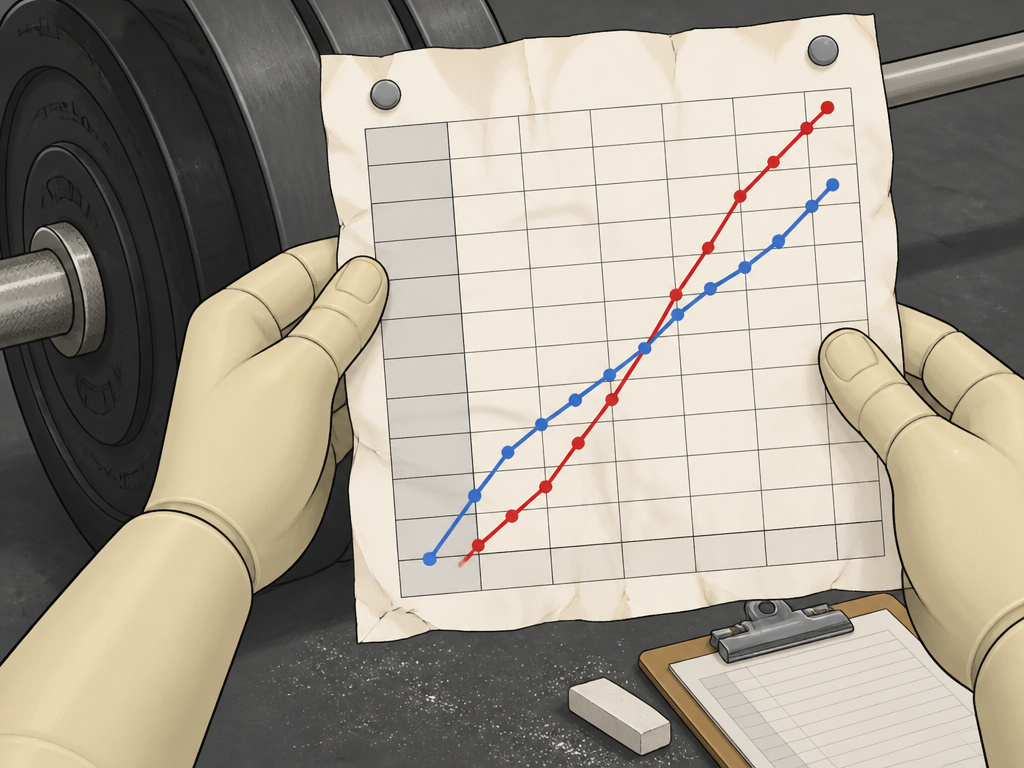
Every RPE chart pinned in a gym locker room implies a fixed exchange rate between effort and load. The review most of those charts trace back to says that exchange rate has never been confirmed.
The RPE and resistance training load intensity review by Morishita and colleagues reports two mappings that don’t reconcile. A CR-10 rating of 7 has been reported at roughly 70% of 1RM. A Borg 15-point rating of 15 has been reported at roughly 80% of 1RM.
The authors are blunt about the problem: “It has proven difficult to confirm a reliable agreement between %1RM and RPE. It is not clear if 50% of 1RM represents an RPE of 5 in all subjects.”
Two scales, two anchor points, one curve that doesn’t fit both. A chart built for a lifter using CR-10 can be badly wrong for one using the 15-point scale.
Fixed charts still have defenders. Progressive Rehab and Strength publishes goal-based ranges: RPE 8-9 for strength work, 6-7.5 for hypertrophy, 7.5-8.5 for a well-rounded block, and 9.5-10 used sparingly because it comes with technical breakdown and higher injury risk. Those ranges work as a starting compass.
I stopped handing out RPE-to-percentage charts a while back. They look precise, and precision is exactly what makes people trust them past the point where they work. Rate the set you just did, then adjust the load next week. That loop stays honest.
There’s a load-based anchor that sidesteps the whole argument. The National Strength and Conditioning Association recommends 6 to 12 reps at 67-85% of 1RM for healthy people building strength. If you can test or estimate a 1RM, you can program off percentages and use RPE as a check rather than a prescription.
How to Rate a Set Without Lying to Yourself
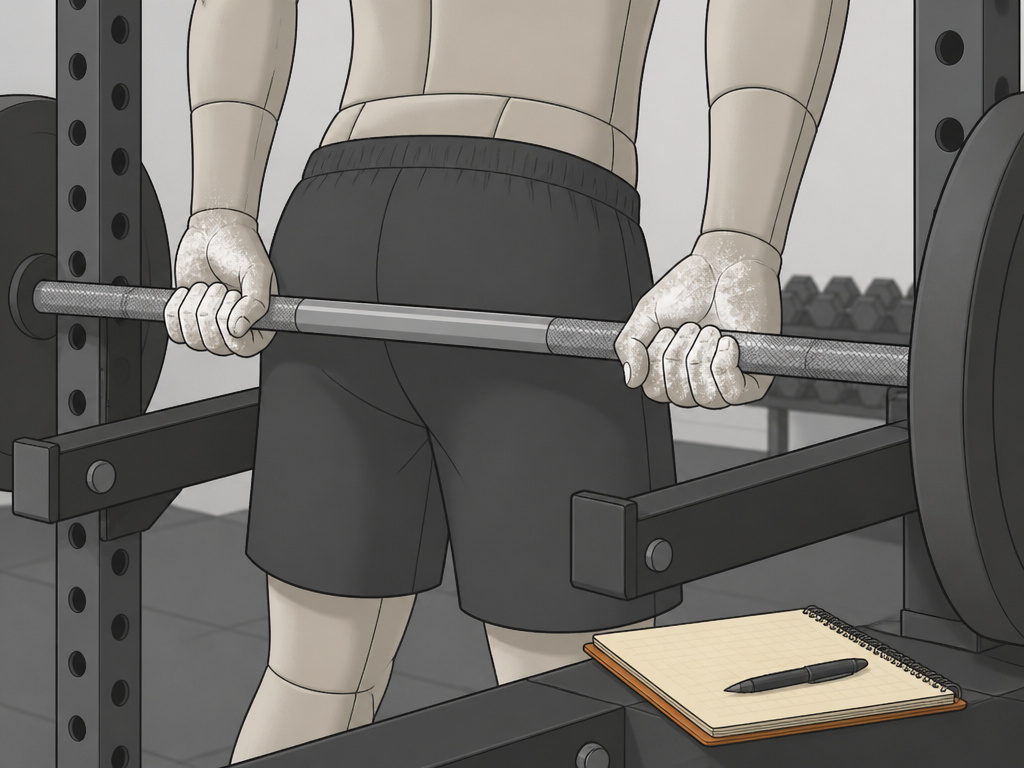
The bar is still in your hands and your legs are shaking. You rack it, take a breath, and only then decide the set was an eight. That’s the wrong order.
Before you start: A true RPE 10 set on a barbell back squat with no safeties is a bad trade. Set the safety arms at the height where your hips break parallel and do the set inside the rack, not in front of it. Lifting alone at home? Save the all-out efforts for a leg press or a cable row, where a failed rep just stops.
Setting the safety arms on a rack takes less time than the set itself. Skipping it is the shortcut I see most often in a home gym.
The Two-Second Window Before You Rack
The question is how many more clean reps you had, and it has to be asked before the bar goes back on the pins. Once you rack, the relief of the set ending inflates your estimate. How many more could you actually have done?
- Finish the rep, then hold. Stand there with the bar for two seconds and ask. Racking first loses the answer.
- Round to the nearest half point. RPE 8.5 and RPE 9 are different training decisions, and the half point is where honest lifters live.
- Write the number down next to the load. A rating with no weight and no rep count attached tells you nothing next month. I log mine for exactly this reason: number, load, and date all sit in one row.
- Compare set one to set three. If the same load went from RPE 7 to RPE 9, that’s fatigue stacking up, not a sudden loss of strength.
- Re-rate the same load next week. Half a point lower on the same weight is the quietest progress signal you’ll get.
Why Your Rating Drifts by Set Three
RPE for the same load can change the more sets you do, because fatigue accumulates inside a session. That’s the scale doing its job, reporting what your body is actually doing.
I spent a couple of years taking every working set to the point where the bar stopped moving. My first set looked fine. My third set looked like a different person was lifting it. When I started stopping at RPE 8 with one or two reps still in the tank, my bar speed stayed honest across all three sets, and my training log stopped lying to me.
RPE is a tool for keeping the third set looking like the first. That’s harder than it sounds, and it’s worth more than any single heroic set.
A three-minute break and a forty-five-second break produce very different RPE numbers on the same load.
By the third set your hands are tacky with chalk and the knurling feels sharper than it did at the start. That’s normal, and it’s one reason your rating creeps upward.
Where RPE Breaks Down: Beginners, Beta-Blockers, and Rehab
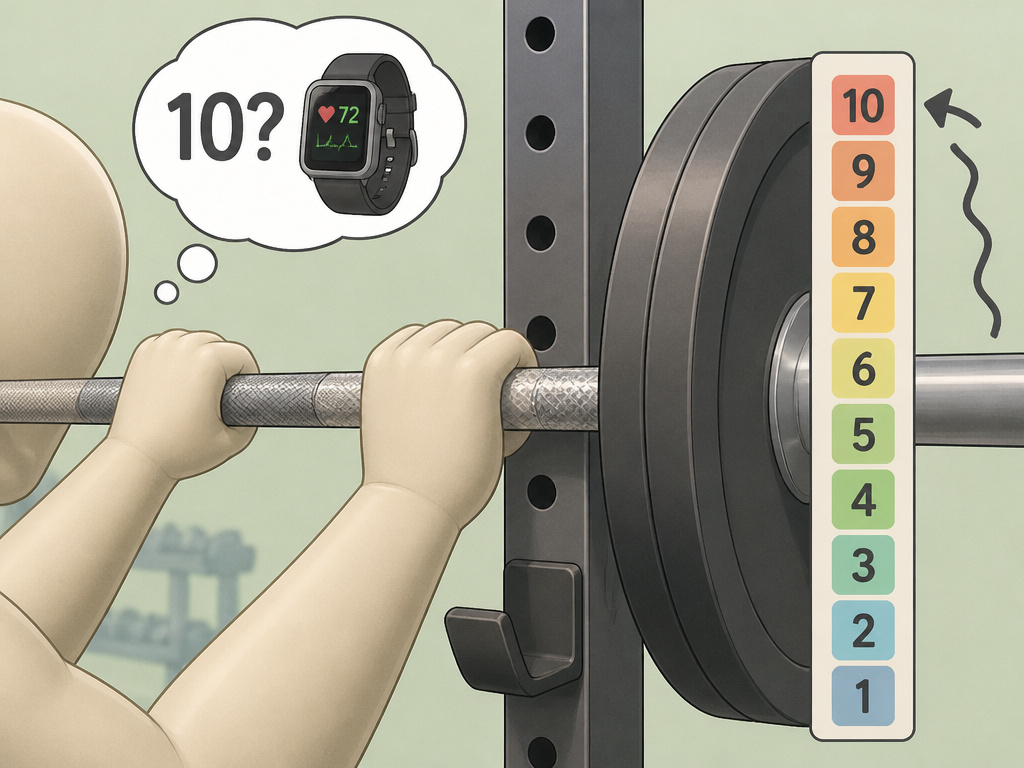
RPE is a self-report, and self-reports go wrong in predictable ways. The sources don’t fully agree on which direction the error runs.
Beginners: Overconfident or Underconfident?
Cleveland Clinic says someone new to exercise may believe they’re working out harder than their heart or breathing rate shows, while the meta-analysis found novices gave lower RPE ratings at low relative training volumes. The meta-analysis points the other way in places: at low relative training volumes, novice athletes gave lower RPE ratings than well-trained participants, and novice squatters rated lower than experienced squatters at maximal load, while Cleveland Clinic says new exercisers may overestimate their effort.
Both can be true at once. A beginner who has never been truly close to failure has no reference point, so the number floats.
NASM adds the practical version: clients need practice before they rate effort consistently, and many assume every challenging set is a 10 at first. I was that guy for longer than I’d like to admit.
- Beta-blockers and heart-rate meds. NASM and Cleveland Clinic both land here: if a medication slows your heart rate, heart-rate zones stop reflecting effort, and RPE becomes the more honest signal.
- Narrow load ranges. The meta-analysis found validity drops when a session uses a narrow spread of workloads. A fixed-weight circuit gives RPE very little to work with.
- Isometric work. Isometric actions produced the highest validity coefficients in the same review, which means your dynamic-set instincts don’t transfer cleanly.
- Rehab settings. 1RM testing needs equipment and setup a clinic often doesn’t have, so RPE carries more of the load there.
If your heart rate and your legs disagree, believe your legs. A beta-blocker flattens the number on the watch and does nothing to the burn in the set.
A chest strap gives you a cleaner beat-by-beat reading than a wrist sensor, and it’s still the wrong number to trust on a heart-rate-limiting medication.
The gaps in the evidence are worth naming. The Morishita review notes that RPE-to-load relationships are under-studied in children and older adults, and that neck and trunk muscles are under-represented compared with arms and legs. If you’re programming for a population outside healthy young adults, treat the numbers as a starting point.
The one place I still go to a true 10 is the last set of a leg press or a cable row, where a failed rep just stops. I wouldn’t do it on a heavy barbell squat with nobody else in the room.
Putting RPE to Work in Your Next Block
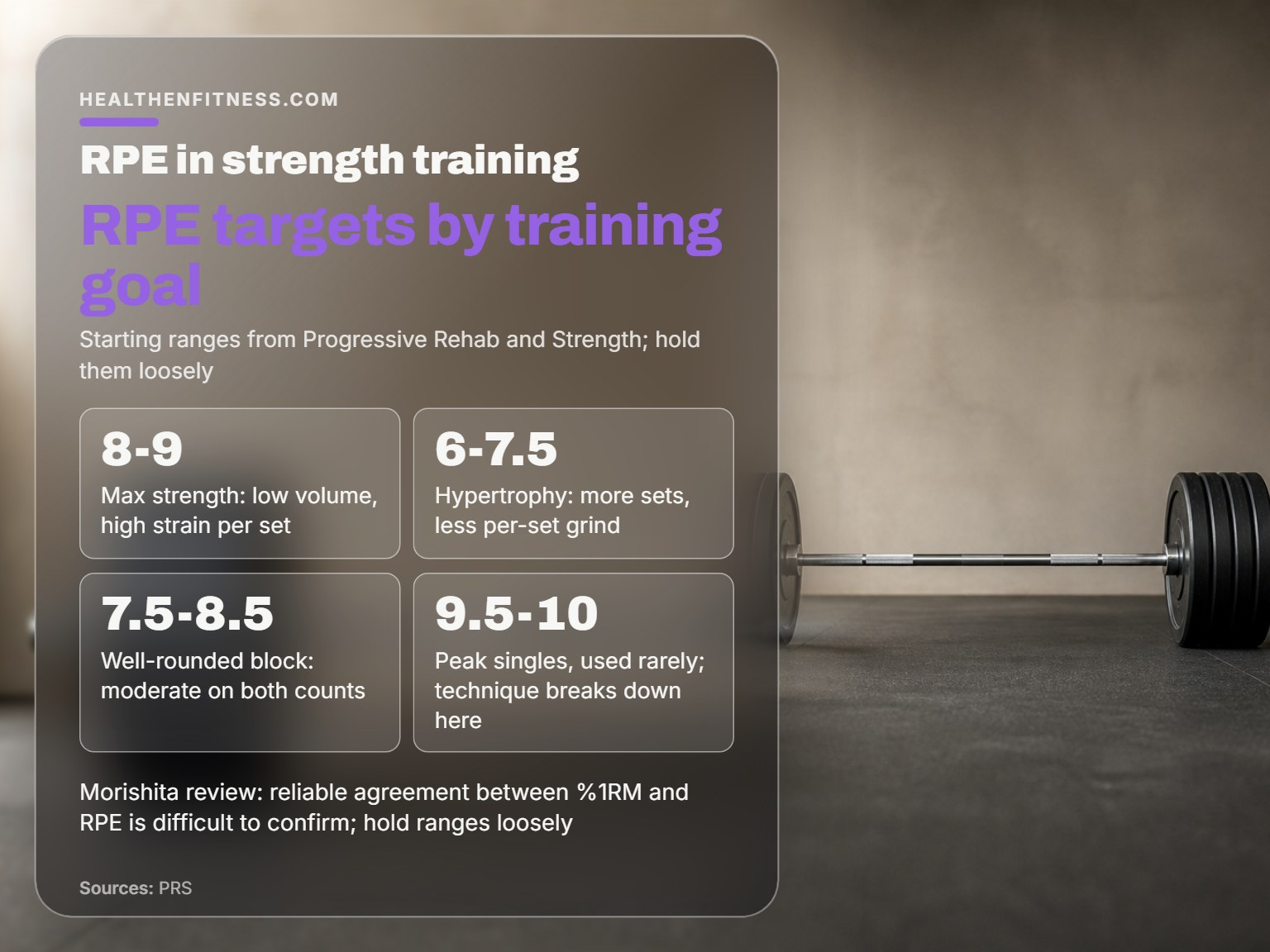
Three things make RPE useful in a program: a target range, a log, and a rule for what to do when the rating moves.
| Training goal | RPE target | Trade-off |
|---|---|---|
| Max strength | 8-9 | Low volume, high strain per set |
| Hypertrophy | 6-7.5 | More sets, less per-set grind |
| Well-rounded block | 7.5-8.5 | Moderate on both counts |
| Peak singles | 9.5-10, used rarely | Technique breaks down here |
Those ranges come from Progressive Rehab and Strength, and they’re a reasonable starting compass. Hold them loosely, because the Morishita review’s warning about %1RM mapping applies to any fixed chart, including this one.
The rule for when the rating moves is the part most people skip. If your top set was programmed at RPE 8 and it came in at 9, drop the load slightly for the back-off sets. If it came in at 7, you have room to add weight next week.
A strength phase that lives at 8-9 shouldn’t run for six months straight.
Skip this if: You’re in your first month of training and still learning what a hard set feels like. Run a fixed plan with prescribed loads for a block or two, then come back to RPE once you have a reference point.
If you want one habit and nothing else: log an RPE number next to every working set for four weeks. Use whatever you already carry, whether that’s a paper notebook or an app. Four weeks of honest numbers will teach you more about your own effort than any chart.
Frequently Asked Questions
Is RPE 8 the same as 80% of my one-rep max?
No, and this is where most charts mislead. A CR-10 rating of 7 has been mapped to roughly 70% of 1RM, and a Borg 15-point rating of 15 to roughly 80%, so the anchors don’t reconcile across scales. The Morishita review states outright that reliable agreement between %1RM and RPE has been difficult to confirm.
Should I use the 0-10 scale or the 6-20 scale?
Pick whichever you’ll actually use consistently. Cleveland Clinic recommends the modified CR10 for bodybuilding and muscle-focused training, while the 2022 meta-analysis found the choice of scale had no significant effect on validity and the Morishita review lists Borg 15-point, CR10, and OMNI-RES as all in use for resistance training without crowning one. The number you can repeat week to week beats the number that’s theoretically better.
How accurate is RPE really?
The pooled validity coefficient was strong. Accuracy improves at higher ratings and drops on high-rep sets or sessions with a narrow spread of loads. It also improves with practice, which is why NASM notes that clients need repetition before their ratings stabilize.
Can I use RPE if I take a beta-blocker?
Yes, and it may be the better option. NASM and Cleveland Clinic both point out that medications which slow heart rate make heart-rate-based training zones unreliable, so perceived effort becomes the more practical guide for prescribing and monitoring intensity.
Does RPE work for beginners?
It works, with a caveat. Sources disagree on the direction of beginner error: Cleveland Clinic notes new exercisers may overestimate their effort, while the meta-analysis found novices gave lower RPE ratings at low relative training volumes and also found no differences in RPE between trained and untrained participants during back squat, bench press and arm curl. Either way, a beginner has no reference point yet, so a few weeks of fixed loads first is worth it.
The Bottom Line
One trigger is worth memorizing: if your RPE on the same load climbs a full point between week one and week three, stop adding weight. That’s accumulated fatigue talking, and a lighter week fixes it faster than pushing through.
The first thing to do this week is small. Pick your main lift, rate every working set before you rack it, and write the number next to the weight. Do that for four weeks and you’ll have something no chart can hand you: your own calibration.
One concession. If you’re training for a competition or a sport where maximal output is the point, this conservative version will feel slow. I’m not a high-performance coach, and what’s here is built for people who want to still be lifting in five years.
RPE in strength training works best as a daily dial, not a permanent chart.
