
How to Breathe While Lifting Weights: When to Hold It
This post contains affiliate links. As an Amazon Associate, we earn from qualifying purchases.
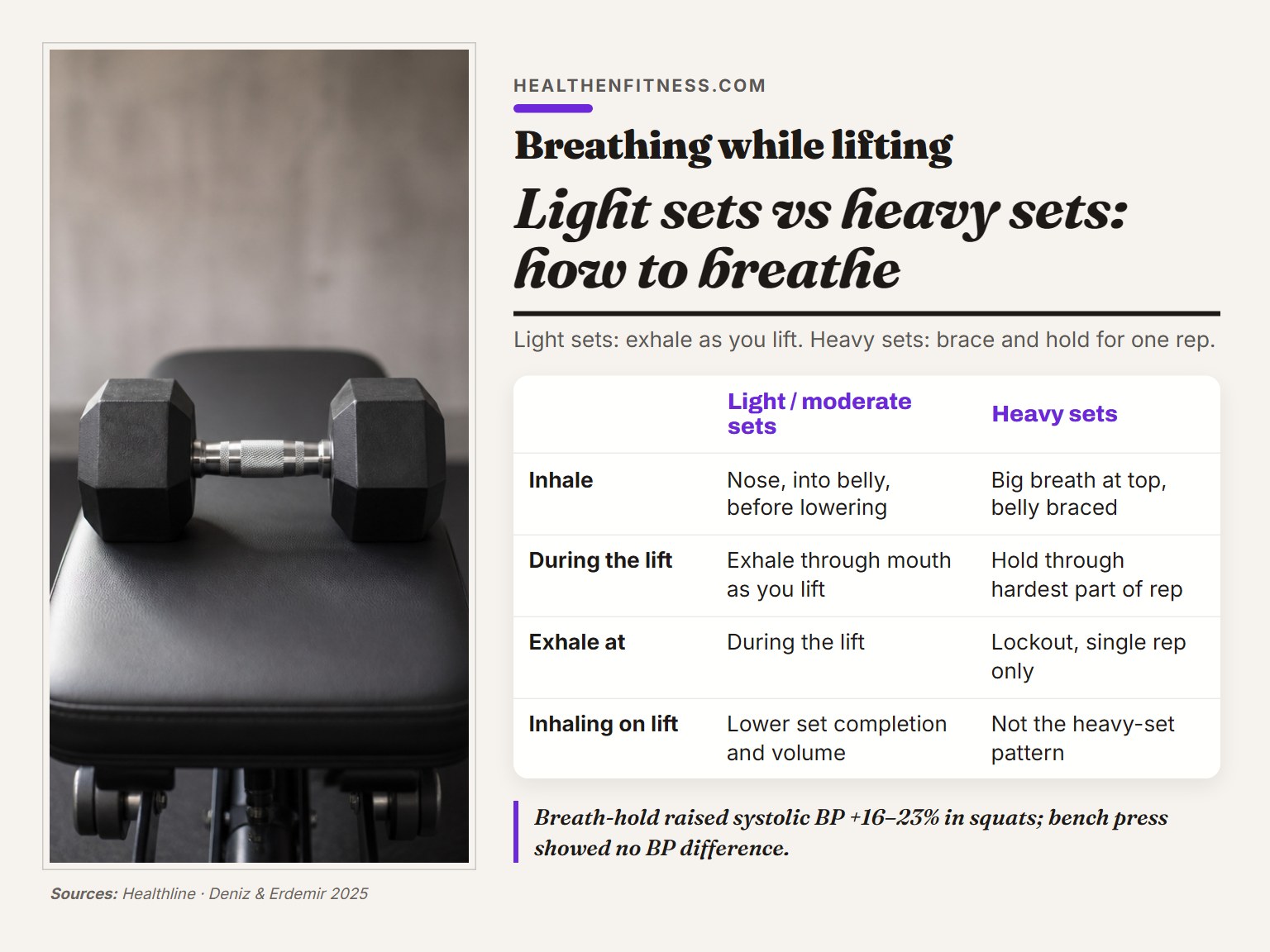
For light and moderate sets, Healthline, AARP and Gym Note Plus advise exhaling through your mouth as you drive the weight up and inhaling through your nose on the way down, while Deniz and Erdemir (2025) found that inhaling during the lifting phase lowered set completion and training volume. On heavy sets, take the breath at the top, brace, hold through the hardest part, and exhale at lockout. Inhaling on the way up costs you reps and volume.
That held breath is doing real work. A braced trunk stiffens around the spine and gives the bar something solid to push against, which is why the how to breathe while lifting weights question matters: a heavy squat feels steadier on a full chest than an empty one.
What follows is the pattern for light sets, the pattern for heavy ones, and the honest state of the evidence on breath-holding. That evidence is messier than most gym advice admits.
Key Takeaways
- Exhale as you drive the weight up. Deniz and Erdemir (2025) found that inhaling on the lift cut set completion and total training volume.
- Breath-holding’s effect on blood pressure depends on the study. A 2026 squat study in healthy young women measured systolic pressure 16-23% higher with a held breath than with controlled breathing, while Deniz & Erdemir (2025) found no significant blood pressure difference across breathing conditions in the bench press.
- Never reverse-breathe on a max attempt. Blazek (2020) measured a real drop in the load lifted.
- Set your spotter arms before the first rep, not after the bar stalls halfway up.
What Happens When You Inhale on the Way Up?
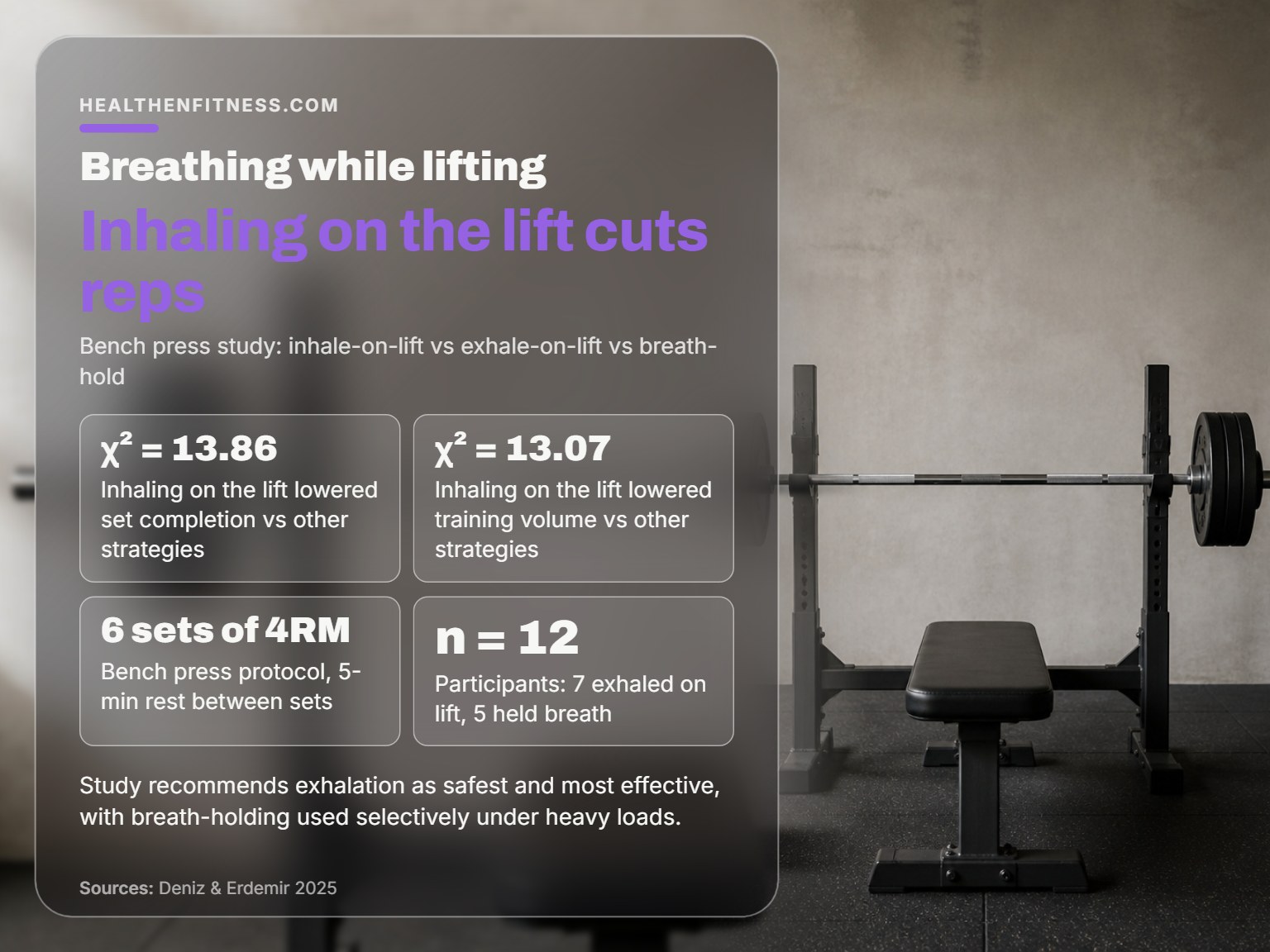
Your set falls apart, and the reason is mechanical. Deniz and Erdemir put 12 participants through six sets of 4RM bench press under three breathing conditions: exhale on the lift, inhale on the lift, and a held breath.
The trial ran 12 participants through 6 sets of 4RM bench press with 5-minute rests, comparing exhalation on the lift, inhalation on the lift, and a held breath. Inhalation during the concentric phase produced significantly lower set completion and training volume; blood pressure did not differ significantly between conditions.
Inhaling on the way up cost those lifters lower set completion and lower training volume. The authors point at mechanical stability. A chest full of air on the push changes thoracic pressure in a way that gives the trunk less to brace against, so force leaks.
You can hear it in a bad set. The breath goes in on the push, the bar slows about four inches off the chest, and the rep dies there, which is the how to breathe while lifting weights lesson in miniature.
Worth reading the method section, because the design is tighter than the sample size suggests.
None of this rescues a sloppy setup.
The Three Breathing Patterns, Head to Head
Three patterns cover nearly every set you’ll do, and they do different jobs.
| Pattern | Where it belongs | What the evidence shows |
|---|---|---|
| Exhale on the drive | Light and moderate sets, most accessory work | Highest set completion and volume in the 2025 bench trial |
| Inhale on the drive | No set where it helps | Lower set completion and volume, same trial |
| Valsalva (brace and hold) | Heavy sets of 1-5 and max attempts | Faster concentric in 1RM bench (Blazek 2020); systolic pressure up 16-23% in squats (Hummelmann 2026) |
Blazek and colleagues tested four techniques on 1RM bench press. Valsalva produced a lower concentric time than the other techniques, and lung packing shortened the sticking region more than Valsalva did.
The bench press sticking region study also found that a plain held breath with no brace increased time in the sticking region with no load benefit at all.
Where this goes sideways: Reverse breathing on a max attempt. Blazek’s group measured a drop in both absolute and relative load lifted, and it shows up as a bar that stops moving right where it used to keep going.
The authors’ own conclusion is that lung packing or Valsalva should be chosen by preference. That’s rare in this literature: a paper that declines to pick a winner.
How to Set Your Breath Before a Heavy Rep
You unrack the bar, pull air into your chest, and everything goes tight in the wrong place. The bar feels heavier than it did on the warm-up, and you haven’t moved yet.
Before you start: A held breath pushed systolic pressure up 16-23% in a squat study of healthy young women, and a long hold briefly reduces blood return to the heart and blood flow to the brain. If you have a cardiovascular condition, uncontrolled high blood pressure, or a history of retinal problems, keep holds to a beat or skip them entirely. Set your spotter arms before the first rep, not after the bar stalls.
- Set the safeties first. Pin height is where your chest still clears the bar at the bottom. Skip it and a failed rep turns into a dump you have to explain to the gym staff.
- Breathe into your belly, not your chest. Ribs down, waist widening against your belt or your own hand. Chest breathing shrugs the shoulders and takes the brace out of your trunk.
- Take the breath at the top. Before you lower, not on the way down. A breath taken mid-descent arrives too late to brace against.
- Brace against the held air. Push out from the inside, the way you’d brace for a poke in the stomach.
- Hold through the hardest part, exhale at lockout. One rep per hold. Reset and take a fresh breath before the next one.
Gym Note Plus suggests practising the brace unloaded: stand up, breathe into your belly, push out hard, hold five seconds, ten times.
It won’t fix a breath you never took.
Do You Actually Need to Hold Your Breath?
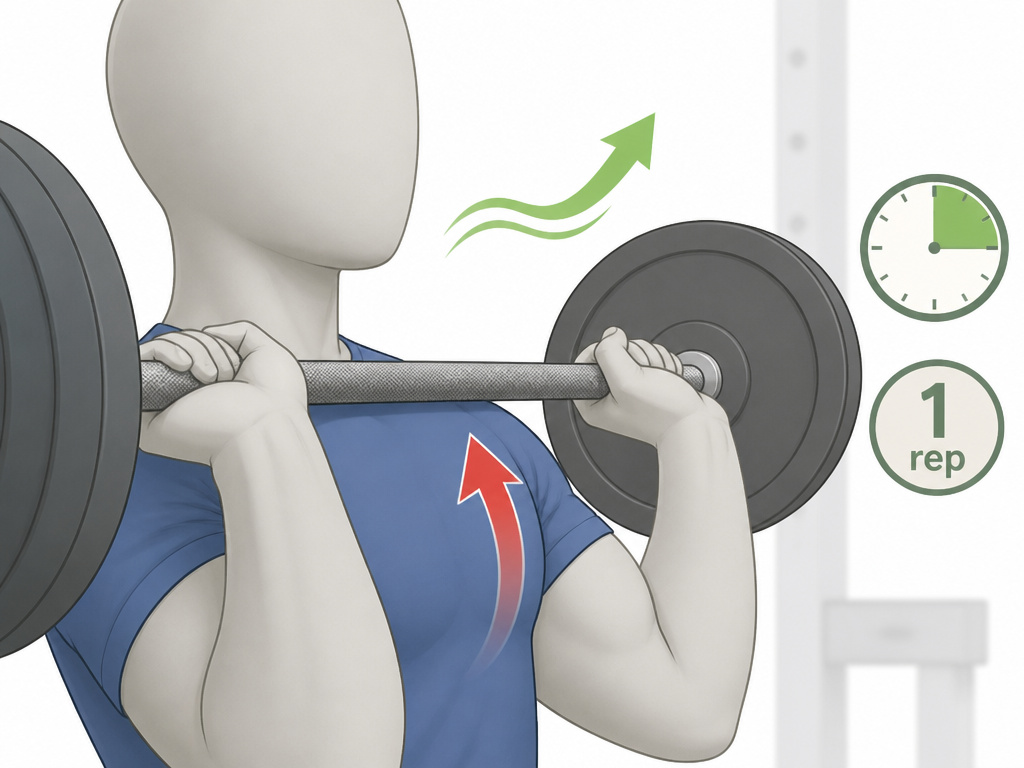
Sometimes, on one heavy rep, with the pins set. The argument in the literature is over how long “briefly” means and who it’s safe for.
AARP warns that not breathing during strength training can lead to hernias, muscle cramping, and dizziness that ends in a fall.
The research is less absolute, and it splits by population:
- Healthy young women, squats up to 50% of 10RM: a short controlled breath-hold “may represent a viable and safe strategy,” with responses in a non-critical range (Hummelmann et al. 2026).
- Trained men, 4RM bench press: exhalation is described as the safest and most effective strategy, with breath-holding reserved for selective heavy loads (Deniz & Erdemir 2025).
- Trained men, 1RM bench press: lung packing or Valsalva, chosen by preference (Blazek et al. 2020).
- Anyone with a cardiovascular condition, uncontrolled high blood pressure, or retinal history: keep holds short or skip them (Gym Note Plus).
Here’s the honest version. The blood pressure numbers don’t line up between studies, and anyone who tells you they do hasn’t read both. Deniz and Erdemir found no significant systolic or diastolic difference across breathing conditions in the bench press. Hummelmann’s group measured systolic pressure 16-23% higher with a held breath during squats.
Different lifts, different sexes, different loads. Neither study crosses over to the other, and Hummelmann’s authors state plainly that there’s a lack of comparable data in women.
Hold your breath for one rep, not one set. The pressure spike is real and it’s short. The trouble starts when a single held breath turns into six reps of nothing.
Where Your Breath Goes Wrong Mid-Set
Most failed reps start with a breath, not a muscle. I keep a written log, just exercise, weight, and reps, and it’s the reason I can tell you whether a stalled lift was sleep, volume, or a bad few weeks. It’s also the reason I missed my own breathing for years, because I never wrote it down.
| What you notice | Likely cause | Fix |
|---|---|---|
| Lightheaded, ears ringing at lockout | The hold ran long | Exhale a beat earlier, one rep per hold |
| Set dies around rep 6 of 10 | Holding breath through a high-rep set | Switch to exhale-on-the-drive above 5 reps |
| Bar stalls in the same spot every rep | Sticking region, not your lungs | Check setup and bar path first |
| Jaw and neck tight after pressing | Breathing into the chest, shoulders shrugged | Belly breath, ribs down, chin tucked |
| Grunting or pausing mid-rep | Load too heavy to breathe through | Drop the weight until you can breathe smoothly |
That last row is the useful one. AARP advises that grunting or pausing in breath is a sign you’ve jumped too high in weight, and the fix is to lower the load until you can execute the move while breathing smoothly. As a diagnostic, it’s honest.
Tight neck and jaw after a pressing session usually trace back to that same chest breath.
Easy to miss: A breath taken at the bottom of a squat or on the chest of a bench press is already too late. The brace has to exist before the load moves.
How to Breathe While Lifting Weights: Light Sets vs Heavy Sets
Everyone learns one breathing rule and applies it to every set. That rule covers about half of them.
For light and moderate sets, the consumer advice and the research agree. Healthline says inhale through your nose into your belly before the lowering phase and exhale through your mouth during the lift. AARP uses a bicep curl: exhale as you raise, inhale as you lower. Gym Note Plus says the same for anything that doesn’t need pressure.
For heavy sets, the pattern flips into a brace and a single-rep hold. That’s the half most people never get taught.
Bodyweight and cardio work has its own rhythm:
- Push-up: inhale as you lower, exhale as you press up. Healthline and AARP describe it identically.
- Running: AARP describes an in-out-out pattern, one breath in through the nose and two out through the mouth.
- Anything you can’t breathe through smoothly: the load is too heavy. Full stop.
The nose gets the nod for the inhale from both Healthline and AARP. The mouth is for the exhale, where you want volume and speed.
I’d rather watch someone exhale loudly through a set of ten than hold a perfect brace and go purple. The brace is a tool for the last few reps of a heavy set. It’s not a personality.
Frequently Asked Questions
Should you inhale or exhale when lifting weights?
Exhale as you drive the weight up, and inhale as you lower it. That covers light and moderate sets, which is most of what you’ll do. The exception is a heavy set, where you take the breath at the top and hold it through the hardest part.
Is it bad to hold your breath while lifting?
It depends on how long and how often. A single-rep hold on a heavy set is what Gym Note Plus, Hummelmann et al. (2026) and Deniz & Erdemir (2025, for selective heavy loads) describe as acceptable, while Healthline and AARP advise against holding your breath at all. Holding your breath through a whole set of ten is where the dizziness and the pressure spike come in.
Why do I get dizzy when I lift?
The usual culprit is a breath-hold that ran too long. A long hold raises pressure inside the chest, which briefly reduces blood return to the heart and blood flow to the brain. Shorten the hold and exhale slightly earlier.
Does breathing change how much weight you can lift?
Yes, and the effect is measurable. Deniz and Erdemir found that inhaling on the lift lowered set completion and total volume. Blazek found that Valsalva produced a faster concentric phase on a 1RM bench press than the other techniques tested.
Should you breathe through your nose or your mouth?
Healthline recommends the nose for the inhale and the mouth for the exhale, while AARP states the nose is the preferred way to get oxygen into the body. The nose is the preferred route for getting oxygen in, and the mouth gives you the volume and speed you want on the way out.
Can you hold your breath if you have high blood pressure?
That’s a conversation for your doctor, not a fitness article. Gym Note Plus advises keeping breath-holds short and taking them seriously if you have a cardiovascular condition, uncontrolled high blood pressure, or a history of retinal problems. The squat study that found short holds safe excluded cardiac and pulmonary patients entirely.
Before You Go
This week, take one exercise you already do and change nothing except the breath. Set the safeties, exhale on every drive, and write down whether the last rep looked the same as the first.
If you want to try a braced hold, do it on a single heavy set of three to five reps with the pins set. Don’t try it on a set of ten, and don’t try it for the first time on a max attempt.
The threshold that matters is this: if a hold leaves you lightheaded or ringing at the ears, it ran too long. That’s your signal to exhale a beat earlier, not to push through it.
And if you’re on blood pressure medication, or you’ve had a retinal issue, that’s a question for your doctor before it’s a question for the internet. The research on breath-holding has real gaps in it, and you don’t want to be the person who finds one.
