
How Much Space Do You Need for a Home Gym? Measure First
This post contains affiliate links. As an Amazon Associate, we earn from qualifying purchases.
Figure out how much space do you need for a home gym by adding the equipment footprint to the clearance around it. ACE lists 30 sq ft for a treadmill; Spatium puts the same treadmill at 88 sq ft once clearance is counted. Manufacturer manuals go further: Bowflex specifies an 8’4″ x 6’6″ free workout area.
The gap between those two treadmill numbers is the whole how much space do you need for a home gym problem. ACE measured the machine. Spatium measured the machine plus the floor you need to get on it, step off it, and fall off it without hitting anything. Both are honest answers to different questions, and mixing them up is how a treadmill ends up wedged into a room that “fit” on paper.
What follows is the four checks that actually decide whether a room works: floor area, clearance, ceiling height, and shape. Each one has a manufacturer number, a professional-body number, and at least one place where the two sources flatly contradict each other.
Key Takeaways
- Add footprint and clearance together. ACE’s 30 sq ft treadmill and Spatium’s 88 sq ft treadmill are the same machine measured two ways.
- Bowflex manuals demand an 8’4″ x 6’6″ free area for the Blaze and Motivator 2, about 54 sq ft, before you count anything else in the room.
- Clearance figures conflict. The NSCA sanctions 18 in for a home gym, Centr requires 24 in, and Bowflex specifies a full envelope instead of a per-side number.
- Ceiling height has no agreed standard. Centr asks for 8 feet; Tempo states there isn’t a specific requirement.
- Measure the door before the floor. Bowflex advises assembling the Motivator 2 where it will be used, which sidesteps the doorway question entirely.
How Much Floor Space Does a Home Gym Actually Need?
Four organizations publish a number for this, and no two of them match. ACE, the Bowflex manuals, Centr, and the NSCA are each answering a slightly different question.
A single-station home gym is listed at 35 sq ft by ACE and 25 to 49 sq ft by the NSCA. Bowflex specifies a free workout area of 8’4″ by 6’6″, about 54 sq ft, for the Blaze and Motivator 2. Centr specifies a live area of 9 by 8 ft, about 72 sq ft, for the Multi-Gym.
The spread comes from four different measurement conventions. ACE’s 2001 FitFacts sheet lists a bare footprint per machine: 30 sq ft for a treadmill, 35 for a single-station gym, 10 for a bike, 20 for a rower, 25 for a ski machine, and 50 to 200 for a multi-station gym. Those figures get added up for the room.
Spatium measures the other way. Its numbers bundle the equipment with the floor you need to use it, which is why a treadmill comes out at 88 sq ft instead of 30.
| Setup | ACE figure | Spatium figure |
|---|---|---|
| Treadmill | 30 sq ft | 88 sq ft |
| Stationary bike | 10 sq ft | 96 sq ft (bike and stretching mat) |
| Squat stand, bench, plates | not itemized | 198 sq ft |
| Power rack, bench, plates, dumbbells | not itemized | 279 sq ft |
Both methods are honest. One tells you what the machine occupies, the other tells you what the room has to give up.
This is why home gym setups that look reasonable in a photo can be impossible in a spare bedroom when you ask how much space do you need for a home gym. The photograph shows equipment. It doesn’t show the floor behind the bench.
I use ACE when I’m planning a shopping list and Spatium when I’m deciding whether a specific room works. Mixing the two is how you buy a rack that doesn’t fit.
How Much Clearance Do You Need Around Home Gym Equipment?
Three credible sources give three different answers: the NSCA sanctions 18 in, Centr requires 24 in, and Bowflex specifies a full 8’4″ x 6’6″ envelope rather than a per-side clearance.
- NSCA: 18 in (45.7 cm) of cushion in a home gym, against 3 ft (0.9 m) in a commercial facility.
- Centr: at least 24 in (0.6 m) of open space in front of the Multi-Gym and on both sides.
- Bowflex: no per-side figure at all. The Blaze and Motivator 2 manuals specify a whole 8’4″ x 6’6″ free area and leave the distribution to you.
Centr also asks that anyone else in the room stay at least 5 ft (1.5 m) away while you train, which is a bigger number than any of the three.
Eighteen inches is roughly a doorway jamb. Stand in that gap behind a bench and you’ll feel how little room it is.
Why Adding Up Clearance Overstates a Small Room
ACE’s method sums per-machine figures. Spatium argues that clearances overlap at home: the bench usually works inside the rack’s clearance, and the space you step back into from the dumbbells can be the same space you step back from the rack.
That means a room marked “too small” by a small margin may still work. It also means the reverse is common.
Common mistake: Summing the clearance for every machine in the room. Two pieces facing the same open floor share it, so adding both numbers rules out rooms that would have worked.
A home gym clearance figure is only useful if you know which method produced it.
Commercial floors answer to a different document entirely, the ACSM health fitness facility standards.
Ceiling Height Kills More Home Gym Plans Than Floor Area
Ceiling height can kill plans: Centr specifies 8 feet for its live area, while Tempo states there isn’t a specific ceiling height requirement.
Spatium says so directly: ceiling height matters for a rack and for overhead pressing, and none of its area figures account for it. Centr specifies 8 feet of height for the Multi-Gym’s live area. Tempo states there isn’t a specific ceiling height requirement, and recommends only enough room to lift a barbell overhead and perform jump squats.
Centr specifies 8 feet of height for its live area, while Tempo states there isn’t a specific ceiling height requirement and recommends only room to lift a barbell overhead and perform jump squats.
I measured the floor twice before my first rack and never once looked up. The bar cleared the joists on a strict press and clipped them on a push press, which is a sound you only need to hear once. Now the tape goes to the lowest thing overhead before it goes to the wall.
What counts as the lowest thing: a joist, a duct, a light fixture, a garage door track, or the underside of a stair. Measure to that, not to the ceiling plane.
The power rack for home gym decision comes after that measurement, not before.
I’d rather see a rack with clear air above it than a bigger rack in a room where you flinch on every press. The flinch is what makes you skip the lift.
What the All-in-One Machines Actually Ask For
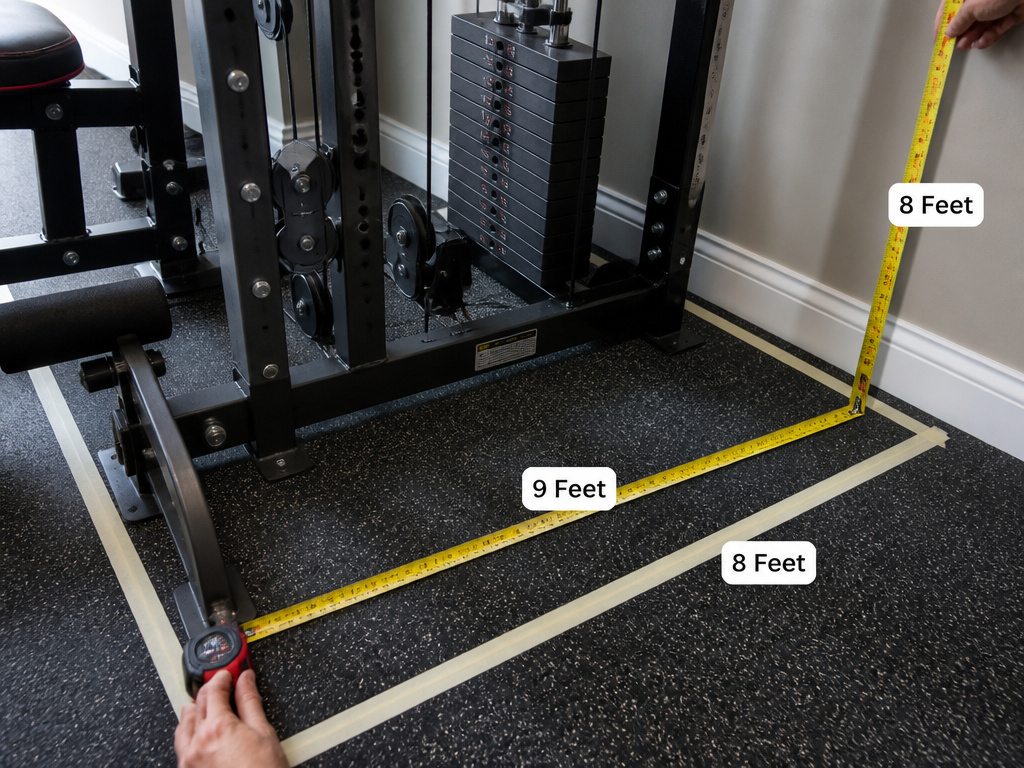
The Centr Multi-Gym asks for a live area of about 9 by 8 feet, with 8 feet of height.
That’s roughly 72 sq ft before you count the 24 inches of open space it wants in front and on both sides. The machine itself is about 5.5 by 3 by 6.7 feet and weighs 269 lbs. Maximum user weight is 300 lbs, and the weight stack gives 270 lbs of selectable resistance from a 120 lb top weight plus fifteen 10 lb plates.
Assembly is 26 steps across two hardware packs. Centr lists the machine as indoor home use only, one user at a time, with teenagers aged 13 to 17 supervised.
The Footprint Is the Least Useful Number on the Spec Sheet
Tempo publishes three footprints. Starter is 2’2″ x 1’4″, Plus is 3’2″ x 1’4″, and Pro is 4’2″ x 1’4″. Those numbers are tiny.
The workout space is the number that matters. Starter needs 6′ x 8′. Plus and Pro both need 6′ x 10′.
If the workout space is what rules you out, a home gym for small spaces usually means a folding bench and a rack that lives against a wall.
The Bowflex Blaze and Motivator 2 sit in the same family. Both manuals specify the same 8’4″ x 6’6″ free area, and the Blaze caps the user at 300 lbs (136 kg). The Elite manual voids the warranty for damage from users over that same 300 lb figure.
The part nobody mentions: The Centr Multi-Gym weighs 269 lbs. That weight arrives in two hardware packs and 26 assembly steps, and it doesn’t get lighter once it’s built.
Here’s my bias, for what it’s worth: I’d put the money into a rack and a bar first. If you’re going the all-in-one route anyway, the Centr Multi-Gym is the sensible pick when you have 9 by 8 feet and 8 feet of ceiling. The Bowflex Blaze is the one to look at if you want resistance without a spotter and you have the free area its manual specifies.
Can You Put a Home Gym in a Garage?
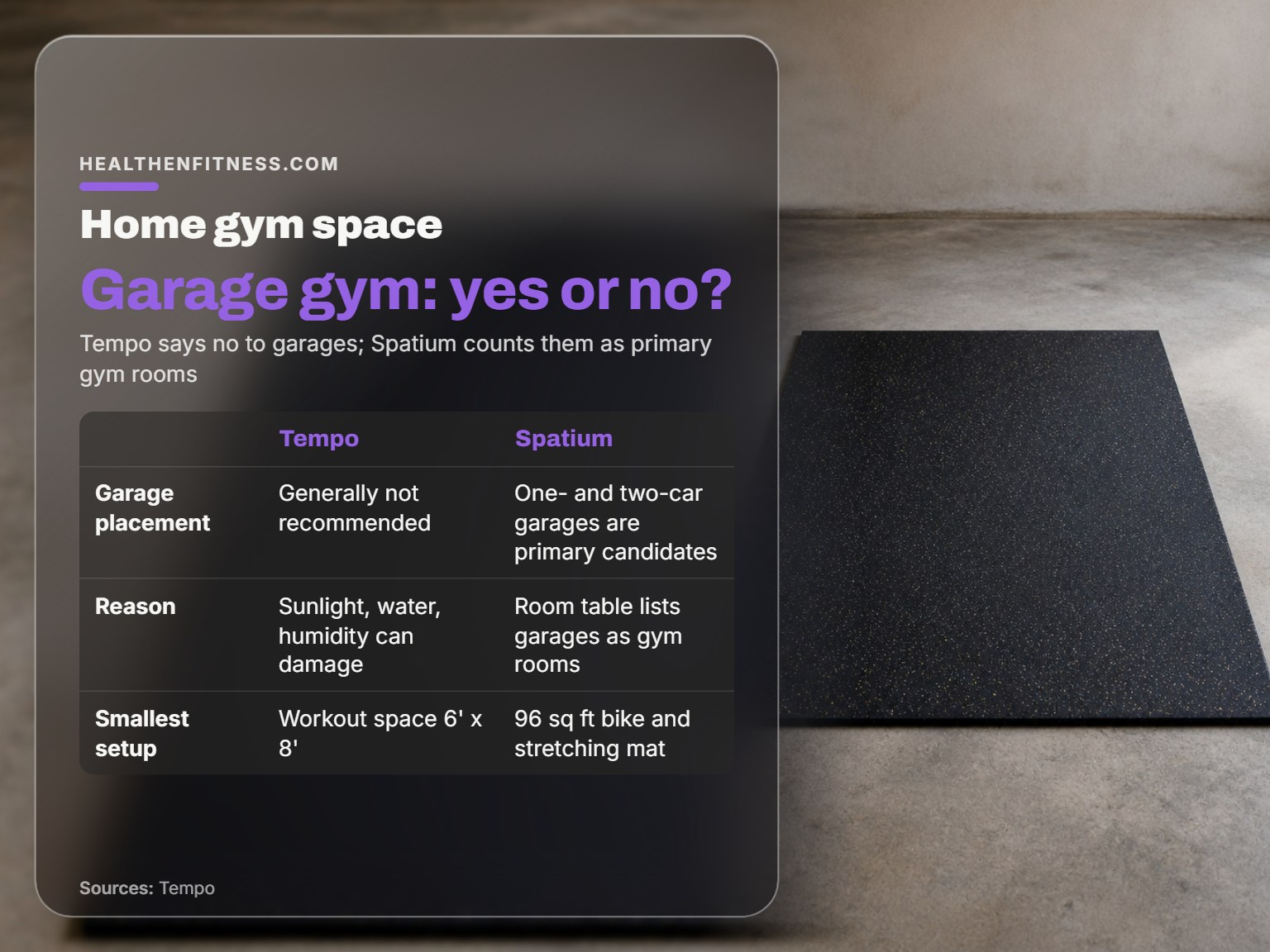
Tempo generally does not recommend garage placement, while Spatium’s room table treats one-car and two-car garages as primary home-gym candidates.
Tempo’s support documentation states plainly that it generally does not recommend placing the unit outdoors or in a garage, because sunlight, water, and excess humidity can cause undue damage. Tempo’s support documentation states plainly that it generally does not recommend placing the unit outdoors or in a garage, because sunlight, water, and excess humidity can cause undue damage. Centr is indoor home use only and must not be used or stored outdoors or near water.
Spatium’s room table treats a one-car garage (12 x 20) and a two-car garage (20 x 20) as primary home-gym candidates. Its smallest setup, a bike and stretching mat, needs 96 sq ft and leaves 144 sq ft in a one-car garage.
Both positions hold. A garage gym built around a rack and a barbell has no electronics, no sensor, and nothing to fog up. A machine with a screen and a 3D camera is a different proposition in an unheated space.
Rubber mat first, machine second. A concrete slab pulls moisture out of the air, and a mat is the cheapest thing in the room that protects everything standing on it.
Does a Room That Fits on Paper Actually Fit?
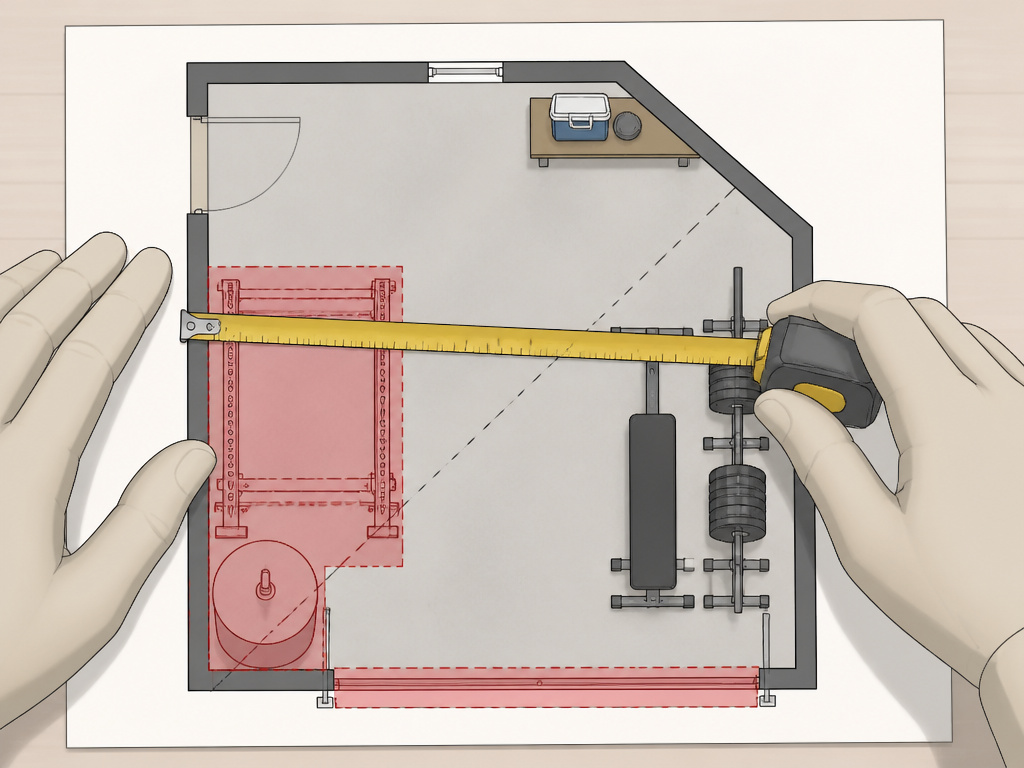
You measure the room, the figures work, the equipment arrives, and the water heater is exactly where the rack was going to stand.
Spatium flags this directly: a garage door, a water heater, or a sloped ceiling over half the room can rule out a setup that passes an area check. Area is not shape.
Bowflex takes the blunt route. The Motivator 2 manual advises assembling the unit in the location where you intend to use it, which sidesteps the doorway question altogether.
The traps that show up most often:
- A garage door track that drops below the ceiling line, right where the bar path goes.
- A water heater, furnace, or softener in the corner the plan assigned to plates.
- A sloped ceiling over half the room, which cuts usable height without changing the area.
- A doorway or stair turn the assembled unit won’t pass through.
| Symptom | Likely cause | Fix |
|---|---|---|
| Bar clips the ceiling on overhead press | Ceiling height never checked | Measure to the lowest obstruction first |
| Rack fits the room but won’t go in | Assembled unit won’t pass the doorway | Assemble in place, as Bowflex advises |
| Machine sits in a sunlit bay | Sensor and humidity exposure | Move it, or pick a different machine |
| You step back into a water heater | Area check passed, shape check skipped | Draw the floor plan, not the square footage |
There’s a second layer after the fit. The NSCA recommends a see-through gate at the entryway, locking any doors or windows that access the exercise area when equipment isn’t in use, and disabling equipment between sessions: unplugging treadmill cords, removing weight pins, and taking plates off bars.
A small home gym organization plan that starts with the floor plan saves you from buying storage twice. Plate trees and home gym storage eat floor as well as hold weight.
Where this goes sideways: Passing the area check and skipping the shape check. You end up with a machine that fits the room and blocks the only path to the fuse box.
How to Measure a Room Before You Buy Anything
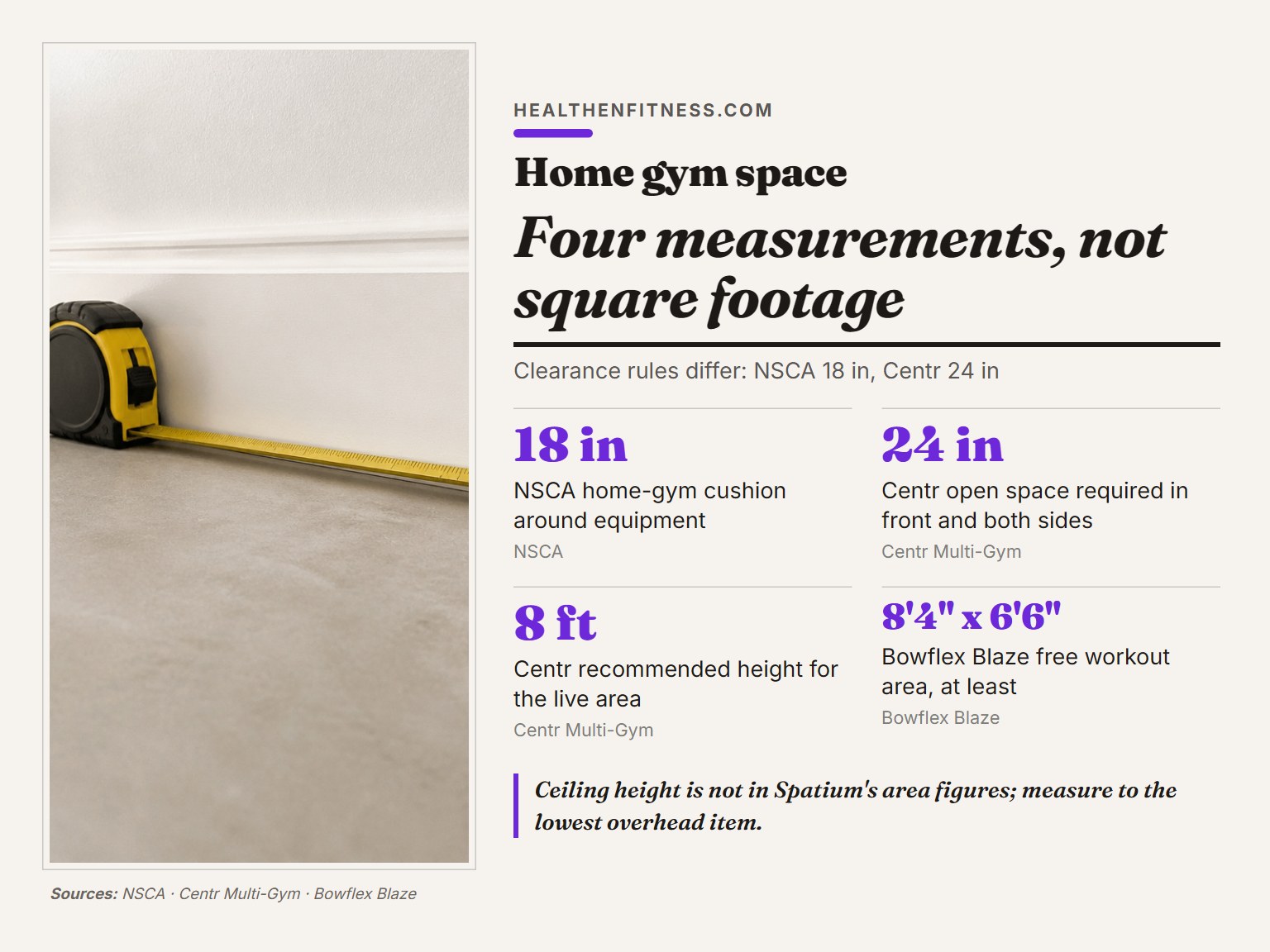
Four measurements decide this. None of them is square footage.
Before you start: A rack that isn’t on a hard, level surface will rock under load, and Bowflex specifies a hard, level surface for the Blaze. Keep children and pets clear of outlets and equipment, and confirm that any outlet near the equipment has GFCI protection.
- Measure wall to wall at floor level. Listing dimensions round up, and baseboards, skirting, and a closet return all eat into the number you actually have.
- Measure to the lowest thing overhead. A joist, duct, or light fixture sets the real limit, and Spatium notes that ceiling height isn’t in any of its area figures.
- Measure every doorway and stair turn on the route in. Bowflex advises assembling the Motivator 2 where it will be used, which removes the problem entirely.
- Tape the footprint on the floor and walk the clearance. The NSCA sanctions 18 inches while Centr requires 24 inches, and the two feel very different underfoot.
- Check the power. The NSCA recommends outlets with 110- and 220-voltage capability and GFCI protection.
- Check light and reflection if the machine has a sensor. Tempo warns that excessive sunlight and mirror reflections can affect its 3D sensor’s motion tracking.
- Leave the tape down for a week. Tape on a carpet reads differently at 6am than it does on a floor plan, and you’ll find the corner you keep clipping with your hip.
The small-space home gym planning worksheet from CUNY Pressbooks walks through a movement-envelope test, which is a more honest check than a square-footage table.
The rest of a home gym setup gets easier once the room passes these checks.
Frequently Asked Questions
Is 10 x 10 enough for a home gym?
Spatium’s smallest setup, a bike and a stretching mat, needs 96 sq ft. In a 10 x 10 room that leaves just 4 sq ft of floor. A 10 x 10 room is smaller than that, so it works only if the bike folds or lives against a wall.
How much clearance should I leave around equipment?
The NSCA sanctions 18 in (45.7 cm) for a home gym. Centr requires at least 24 in (0.6 m) in front and on both sides of its Multi-Gym. Bowflex skips per-side figures and specifies a whole 8’4″ x 6’6″ free area instead. Use the number from the manual of the machine you actually own.
Do I need a specific ceiling height?
Centr specifies 8 feet for the Multi-Gym’s live area. Tempo states there isn’t a specific ceiling height requirement and recommends only enough room to lift a barbell overhead and perform jump squats. Spatium notes that ceiling height matters for a rack and overhead pressing but isn’t included in its area figures.
Can a home gym go in a garage?
For a rack and a barbell, yes. Spatium’s room table treats one-car and two-car garages as primary candidates. For powered equipment, check the manual: Tempo generally does not recommend garage placement because sunlight, water, and humidity can damage the unit, and Centr lists its Multi-Gym as indoor home use only.
How much space does a treadmill need?
ACE lists 30 sq ft. Spatium lists 88 sq ft once clearance is included. The difference is the floor you need to get on and off the deck, which ACE’s footprint figure doesn’t count.
How much space does a power rack need?
Spatium puts a squat stand, bench and plates setup at 198 sq ft. Add an adjustable bench, a weight tree, and a three-tier dumbbell rack and the same setup comes to 279 sq ft.
The Bottom Line
All of this changes if the machine has a motor or a sensor. A rack and a barbell don’t care about humidity, sunlight, or whether the room is a garage. A Tempo does, and Tempo says so directly.
One thing to try this week: measure to the lowest thing overhead, tape the footprint on the floor, and leave it there for seven days. If you trip over the tape twice, the room is telling you something no square-footage table can.
And if you’re choosing between a bigger machine and a better room, take the room. Racks and bars get upgraded. Floor space doesn’t.
