
Olympic Barbell vs Standard Barbell: Which to Buy?
This post contains affiliate links. As an Amazon Associate, we earn from qualifying purchases.
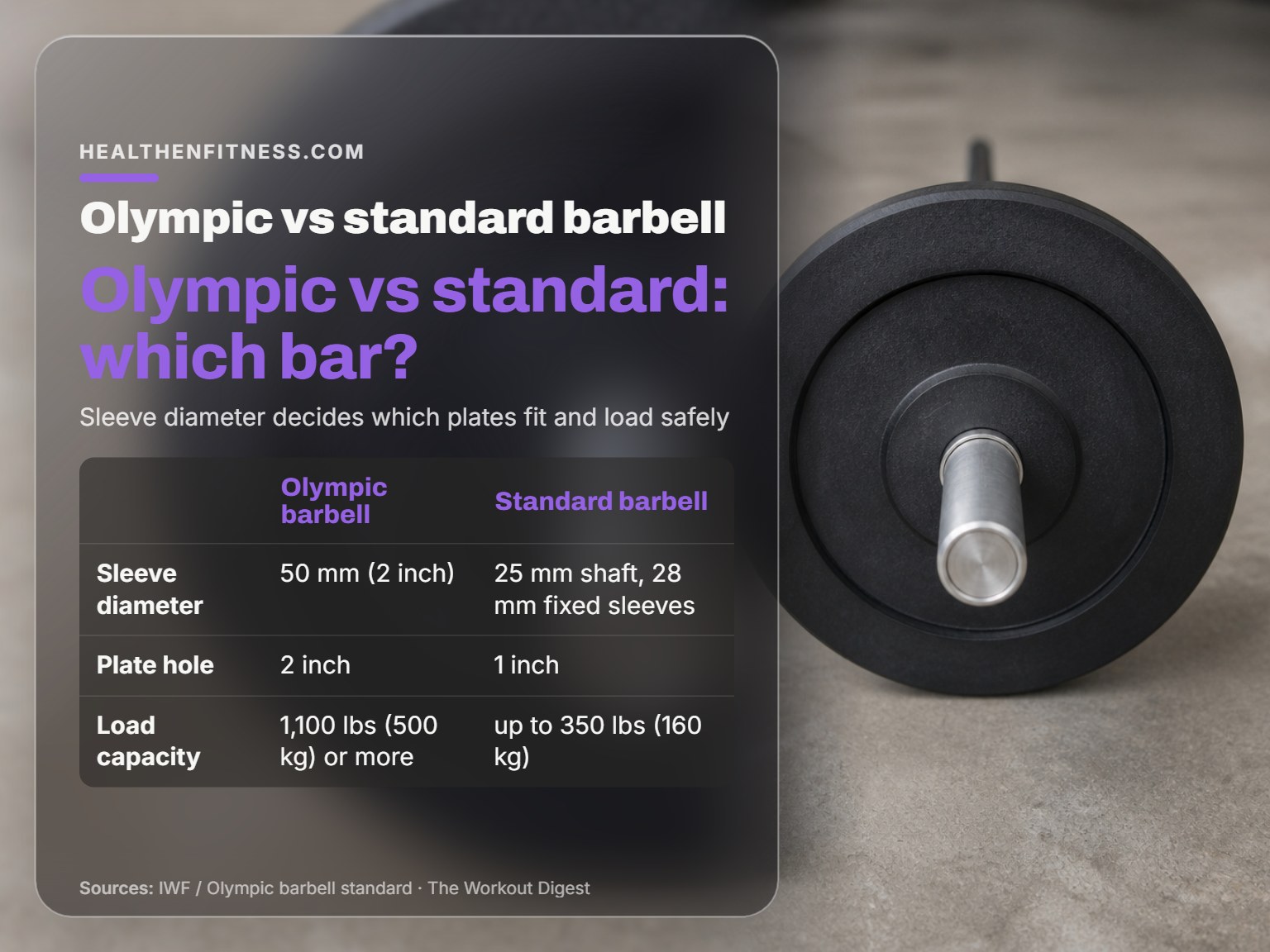
The olympic barbell vs standard barbell split starts at the sleeves: an Olympic bar carries 50 mm (2 inch) rotating sleeves on a 20 kg (44 lb) men’s bar, while a standard bar has a 1 inch (25 mm) fixed shaft and no rulebook governing its size or weight.
That missing rulebook is why the numbers below contradict each other. Titan Fitness lists 33 pounds as typical for a standard bar. Strong Home Gym puts the range at 15 to 25 pounds. Both describe the same category of product, and neither is wrong, because the olympic barbell vs standard barbell question has nothing to be wrong against.
What follows is the spec sheet the sources do agree on, the places they split, and a straight answer on which bar earns a spot in your garage.
Key Takeaways
- Olympic bars are the only barbells here with a real standard. The IWF fixes men’s bars at 20 kg, 2,200 mm, and a 28 mm shaft, with a 50 mm sleeve on both men’s and women’s bars.
- No agency polices standard barbells. Weight, length, and diameter vary by maker, which is why published capacity claims vary so widely between sellers.
- Rotating sleeves are the functional difference. They move torque into a bushing instead of your wrist, and fixed sleeves can’t do it.
- Buy the Olympic bar if you plan to keep lifting. Fringe Sport says buy an Olympic bar rather than a standard one, while The Manual recommends a standard bar for lighter loads and small home gyms and Compound Fitness recommends a standard bar and plates below a $500 total spend.
- Learn on an empty bar first. Adding plates before the bar path repeats is how beginners build a squat they have to unlearn.
What the IWF Spec Sheet Actually Fixes
The IWF is the only body in this comparison that publishes numbers a manufacturer has to hit. Men’s competition bars weigh 20 kg (44 lb), measure 2,200 mm overall, and carry a 28 mm shaft. Women’s bars weigh 15 kg (33 lb), measure 2,010 mm, and use a 25 mm shaft.
An Olympic barbell is defined by its sleeve: 50 mm in diameter, rotating on bushings or bearings, and matched to plates bored to the same 50 mm. Men’s competition bars weigh 20 kg with a 28 mm shaft; women’s bars weigh 15 kg with a 25 mm shaft. Both measure 50 mm at the sleeve.
Both use that same 50 mm sleeve, which is the part that decides whether your plates fit. Titan Fitness puts the acceptable sleeve range at 48 mm to 50 mm and notes that anything wider won’t take standard Olympic plates. A sleeve that oversizes makes loading unsafe as you add weight, which is the olympic barbell vs standard barbell distinction in practice.
Buy a bar for general training and you’ll see the thicker end of that range.
Men’s and Women’s Bars Are Not the Same Bar
The 25 mm shaft on a women’s bar isn’t a scaled-down men’s bar. It’s a separate spec. Strong Home Gym explains the thinner shaft exists because weightlifting uses a hook grip, where the thumb wraps the bar and has to close around it.
The Workout Digest adds a detail most comparison pages skip: women’s Olympic bars carry no central knurling at all. That matters if you’re shopping a used bar and assuming the two are interchangeable.
| Spec | Olympic barbell | Standard barbell |
|---|---|---|
| Men’s weight | 20 kg (44 lb), IWF | 15 to 25 lb, most sources |
| Women’s weight | 15 kg (33 lb), IWF | Not separately specified |
| Shaft diameter | 28 mm men’s, 25 mm women’s | 25 mm (1 inch) |
| Sleeve diameter | 50 mm, rotating | 25 mm, fixed |
| Plate hole | 2 inch | 1 inch |
| Governing standard | IWF | None |
Why Do Sources Disagree So Much on Standard Barbell Specs?
Four sources, four different weight ceilings, one product category. That’s the whole problem with the word “standard.”
Here’s the capacity spread as published:
| Source | Standard bar capacity |
|---|---|
| Titan Fitness | up to 200 lb |
| Fringe Sport | 100 to 200 lb |
| ACTIVE.com | about 350 lb |
| Kustom Kit | 300 to 500 lb |
| Xpeed Australia | under 200 kg |
| Compound Fitness | 100 to 200 kg |
The same thing happens with weight. The Manual says 15 to 25 pounds. ACTIVE.com says up to 45 pounds. Titan Fitness gives a range of 11 to 22 pounds. Compound Fitness says 10 to 15 kg. Iron Bull Strength and Fringe Sport both land on 15 to 25 pounds.
Length is just as loose. Titan Fitness says 3 feet to 7 feet. Xpeed Australia says 5, 6, or 7 feet. Strong Home Gym and Fringe Sport both say 5 to 6 feet. Compound Fitness says 1.5 to 1.8 m.
I’ve stopped treating any single barbell weight capacity figure as gospel for a standard bar. The Workout Digest puts the reason plainly: there is no regulating agency enforcing size and weight on standard barbells. The number on the box is the seller’s own claim.
Easy to miss: A standard bar’s stated capacity and its real capacity are different numbers, and several sources put the real ceiling well below the highest published figures.
The Sleeve Is the Whole Ballgame
Sleeve rotation is the difference you feel on rep one. Everything else about the two bars is a consequence of it.
Here’s the mechanism. On a rotating sleeve, the plates stay put while the bar turns inside them. The twisting force goes into a bushing or a bearing rather than into your wrist and elbow. On a fixed sleeve, that force has nowhere to go but through your arms. The Manual and Fringe Sport both describe rotation as the reason Olympic bars are safer for fast, dynamic lifts.
I won’t put a beginner on a bar with fixed sleeves for cleans. The lift looks fine for a few reps, then the wrist starts complaining, and they decide cleans hurt. The bar was the problem.
Bushings vs Bearings
Both are ways to let the sleeve spin, and for general training the difference is smaller than the marketing suggests. Strong Home Gym’s take is that bushings are more than enough for most people and show up in plenty of multipurpose Olympic bars. The Manual notes rotation comes from either one.
Where this goes wrong is loading. Olympic plates on a standard bar slide around, and The Workout Digest is blunt about the consequence: shifting weight puts dangerous strain on your body. Fringe Sport points out that adapter sleeves exist to bridge the gap, but adds that you should keep adapter loads light. That’s a workaround, not a solution.
The Knurling Argument Nobody Settles
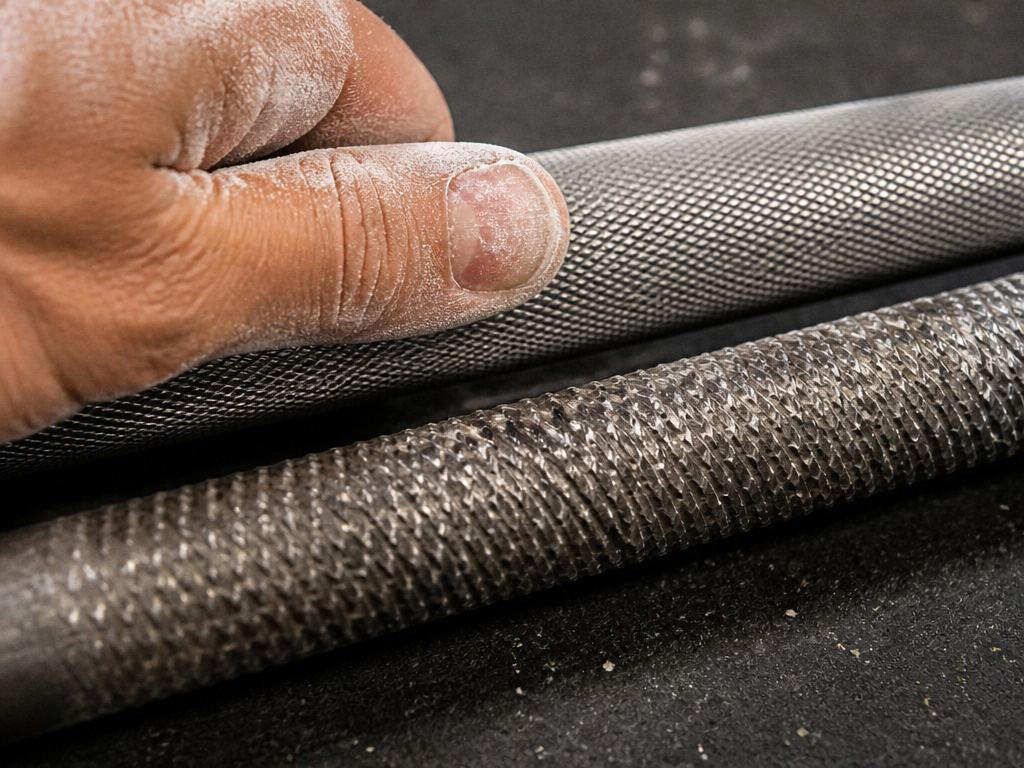
You’ll read that Olympic bars have a smooth center and that they have an aggressive center knurl. Both claims are in print, from companies selling bars.
ACTIVE.com says Olympic bars usually have a smooth center to prevent scraping. Compound Fitness describes Olympic knurling as aggressive with dual marks. Iron Bull Strength says Olympic bars may feature a center knurl for squatting. The Workout Digest settles part of it by noting women’s Olympic bars have no central knurling at all.
The standard-versus-Olympic comparison splits the same way. Fringe Sport says standard bar knurling tends to be thicker and more pronounced, with Olympic knurling lighter. The Workout Digest agrees: standard pronounced, Olympic much finer. Compound Fitness calls Olympic knurling aggressive and standard knurling light or absent.
Run a thumb across a competition bar and the pattern feels like fine sandpaper. A cheap standard bar feels closer to a wood rasp. That texture difference is the whole disagreement in one touch.
Match the knurl to the lift, not to the price tag. A sharp center knurl is a squat feature. Take that same bar into a set of cleans and it will scrape your neck on every rep.
What Do PSI Ratings Actually Tell You?
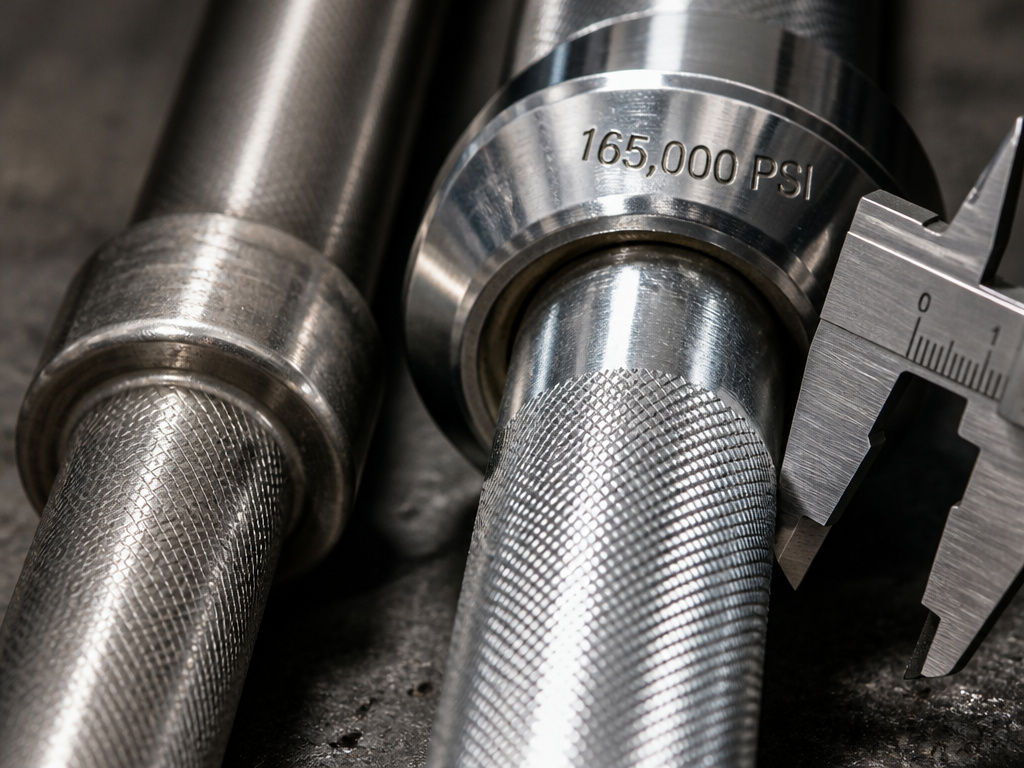
165,000 PSI is the number Iron Bull Strength calls the floor for an Olympic bar. PSI here means the tensile strength of the steel, or how much pull the metal takes before it yields.
Iron Bull puts the ideal at 180,000 PSI for Olympic-style lifts. Compound Fitness breaks the market into tiers that line up with that:
- 120,000 to 150,000 PSI: budget standard bars.
- 165,000 to 180,000 PSI: budget Olympic bars.
- 190,000 to 210,000 PSI: mid-range Olympic bars.
- 220,000 PSI and up: premium and competition bars.
For load numbers to compare against, Fringe Sport rates its Men’s Wonder Bar at 1,600 lb and the Women’s Wonder Bar at 1,000 lb. Those are the manufacturer’s own figures for its own products, which is the only kind of capacity claim worth trusting.
Durability tracks the same ladder. Compound Fitness puts Olympic bars at 5 to 15 years in commercial use and standard bars at 1 to 3 years in a home setting. If you’re comparing barbell types before you commit, that lifespan gap is the number that decides the purchase.
Which Bar Should You Buy for a Home Gym?
Fringe Sport says don’t buy a standard barbell at any stage of the garage gym game, while The Manual recommends a standard bar for lighter loads and small home gyms and Compound Fitness recommends a standard bar and plates below a $500 total spend. The Workout Digest says a standard bar is fine when you’re starting out, cheap and good enough to get the job done. Both are arguing from the same facts and reaching opposite advice.
A lifter I worked with sat right in the middle of that argument. He felt unsteady under a bar from the first session and quietly assumed barbells weren’t for him. We put dumbbells in his hands instead. When he came back to the bar, the setup clicked, because the stability work had already happened.
That story is why I don’t push anyone straight onto a loaded bar. It’s also why I’d still tell you to buy the Olympic one.
Before you start: Check the sleeve diameter before you load a single plate, because a 2 inch plate on a 1 inch sleeve will slide and shift mid-rep. Never mix plate types on one bar, and never trust an adapter sleeve above light loads. If the bar has been sitting in a garage, inspect the sleeve for rust before you put your hands on it.
Here’s the order I’d work through:
- Measure your space. A men’s Olympic bar runs 2,200 mm, so a small room may not fit one safely.
- Check what plates you own or can get. A 1 inch plate collection locks you toward a standard bar unless you’re replacing plates too.
- Pick a PSI tier you’ll actually outgrow slowly. Iron Bull’s 165,000 PSI floor is a reasonable entry point.
- Confirm sleeve diameter and rotation before anything else. Everything downstream depends on it.
- Start with the empty bar and stay there until every rep looks identical.
If You’re Buying New, Here’s the Short List
For a general-purpose home bar, choose one built to the competition dimensions in the table above, which means your plates and your technique transfer if you ever lift somewhere else. If you mostly squat, bench, and deadlift, a powerlifting bar is the stiffer, slower-spinning tool for that job. Just know what you’re buying: The Workout Digest is right that powerlifting bars are IPF-regulated and are not Olympic bars, despite the interchangeable way most pages use the terms.
At the premium end, competition-platform bars are built to the highest standards. For someone lifting three times a week in a garage, that’s more bar than the job requires, and I’d rather see the money go toward plates and a rack. If you want to compare options side by side, these best Olympic barbells and this roundup of Olympic barbells for home gym setups cover the current field.
When a Standard Barbell Is Actually the Right Call
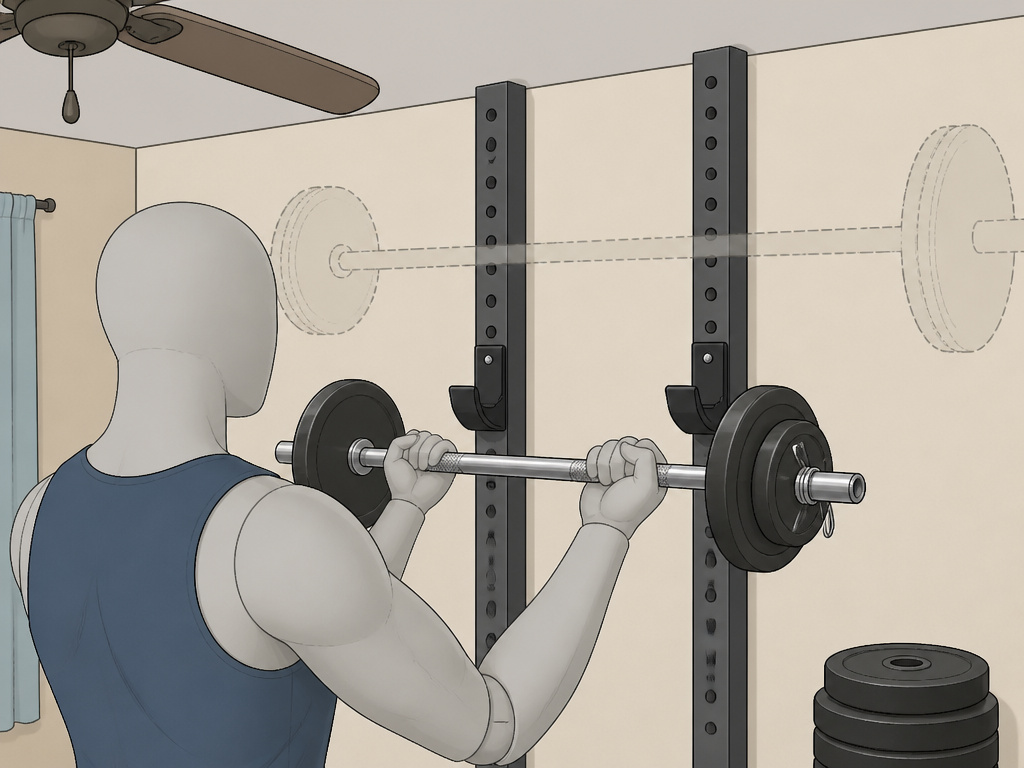
A spare bedroom, a ceiling fan at head height, and a bar you have to stand against the wall when you’re done. That’s the room where a standard bar wins.
The Manual makes the practical case: standard bars suit lighter loads, basic strength work, and small home gyms. The smaller 1 inch diameter is a different grip from an Olympic bar’s shaft. They’re shorter and lighter, which matters in a small space.
The Workout Digest lands in the same place for a first home setup.
Skip this if: you’re already pulling near the bar’s stated ceiling. A standard bar that’s been overloaded can bend permanently. By then you’ve bought plates twice.
My honest position sits closer to The Manual than to Fringe Sport. If your training is curls, rows, light presses, and you’re renting a flat with no room for a 7 foot bar, a standard bar and a barbell weight set will get you training this month. That beats a plan you can’t start.
But if you have the floor space and any intention of getting stronger for years, the Olympic bar is the cheaper purchase over time. It’s the same logic as cooking: one pan you use every week beats a drawer of gadgets you bought once. For a wider look at weight lifting barbells across both categories, the buying guides are worth a read before you spend.
Frequently Asked Questions
Is a standard barbell the same as an Olympic barbell?
No. An Olympic bar has 50 mm rotating sleeves and, in competition form, fixed IWF dimensions. That’s why published standard bar specs vary so widely between sellers.
Can I use Olympic plates on a standard bar?
Not safely as-is. Olympic plates have a 2 inch center hole and standard bars are 1 inch, so the plates slide. Adapter sleeves exist and can bridge the gap, but Fringe Sport advises keeping adapter loads light. Mixing the two plate types on one bar doesn’t work at all.
How much does an Olympic barbell weigh?
Men’s Olympic bar weighs 20 kg (44 lb). A women’s Olympic bar weighs 15 kg (33 lb). Both figures come from IWF competition standards, and both bars use a 50 mm sleeve.
Are all Olympic barbells the same length?
No. IWF men’s bars measure 2,200 mm and women’s bars measure 2,010 mm. Fringe Sport lists 6.6 feet and 7.2 feet as its length options.
Is a powerlifting bar an Olympic bar?
No, and the confusion is widespread. The Workout Digest notes powerlifting bars are regulated by the IPF, follow different standards, and use different plate color coding. Olympic bars spin on bushings or bearings, which suits the snatch and the clean and jerk.
How long will a standard barbell last?
Compound Fitness puts standard bar life at 1 to 3 years in home use, against 5 to 15 years for an Olympic bar in commercial settings. Overloading a standard bar shortens that considerably, and the failure mode is a permanent bend rather than a clean break.
The Bottom Line
One trigger decides this for most people. If the weight you’re lifting is anywhere near the ceiling the seller printed on a standard bar, stop shopping and buy the Olympic bar. You’re already at the edge, and the edge is where bars bend.
One thing to try this week: go put your hands on an empty 20 kg bar at a gym. Not a loaded one. Roll the sleeve with your palm and feel whether it turns freely. That single test tells you more about a barbell than any spec sheet, and it costs you a visit.
Here’s the concession, though. If you’re in a small flat, moving every year, or training in a room where a 2,200 mm bar doesn’t fit, the standard bar’s size advantage is real and the Olympic bar’s durability advantage is theoretical. Buy the bar that fits your life and start lifting. Keep it simple and keep showing up.
