
How to Use Dumbbells Safely at Home: The 24-Inch Rule
This post contains affiliate links. As an Amazon Associate, we earn from qualifying purchases.
To use dumbbells safely at home, test the locking mechanism before every session, keep 24 inches (0.6 m) of clear space beyond your maximum reach, and never drop, clash, or lean on a loaded dumbbell. Adjustable pairs add one more check: the weight selector must click into place at every setting, and learning how to use dumbbells safely at home starts with these habits.
That click is a detent, a notch the knob settles into so the locking pin can grab the plate you picked. Miss the notch and the pin sits between settings. The plate still lifts. It just doesn’t stay.
What follows is the order I’d run in my own garage: the lock test, the recall list, the clearance rule, the storage question, and the three things a loaded dumbbell should never do.
Key Takeaways
- Test the lock before every session, not once at setup. A knob that turns with the handle out of the base means the dumbbell is out of service.
- Keep 24 inches (0.6 m) of free space beyond your maximum reach in every direction. Both Bowflex and NÜOBELL print that number.
- More than 60 reports of plates dislodging led to the FitRx SmartBell XL recall. Stop using it and get the free repair.
- Never drop or clash loaded dumbbells. NÜOBELL excludes drop damage from its 2-year residential warranty.
Test the Lock Before You Load It
Two knobs, one base, and a hand that tries to turn what shouldn’t turn. That’s the whole test, and it catches the failure that puts a plate through a floorboard.
Bowflex builds the procedure into the SelectTech BD1090 manual. It’s worth copying even if you own a different pair, because the logic behind how to use dumbbells safely at home is the same on any dial-style adjustable dumbbell.
The locking mechanism test requires the handle seated in the base, both knobs turned to the lowest setting until each settles into a detent with an audible click. The handle is then withdrawn, and each knob is gripped and firmly turned. A correctly engaged locking pin prevents rotation. Any rotation outside the cradle means the dumbbell is out of service.
Before you start: A loaded plate that lets go lands on whatever is under it, usually a foot. Keep your feet clear of the drop zone while you change settings, and never adjust a dumbbell held overhead. If a knob turns with the handle out of the base, stop the session and call the manufacturer instead of finishing your sets.
The Bowflex Lock Test, Step by Step
- Seat the handle in the base and turn both knobs to the lowest number. Skip the detent and you’re testing a setting that was never actually selected.
- Lift the handle straight out. If a plate rides up with it, the lock has already failed and you stop here.
- With the handle out of the base, grab a knob and try to turn it. Any movement means the locking pin isn’t engaging, which is the exact failure that sends a plate to the floor.
- Set the handle back, move up one setting, and lift it about 1 inch (2.5 cm) off the base. Try the knob again. Skipping the lifted position misses a pin that only fails once the handle clears the cradle.
- Repeat at every weight setting, on both handles. Testing one setting tells you about one setting.
A dumbbell that fails any of those five is not a dumbbell you work around. Bowflex’s own instruction is blunt: if any knob rotates outside the cradle, stop using it and contact Nautilus Customer Service.
Here’s what the failure actually looks like in the room. The knob turns, but it turns with a light, gritty drag instead of the firm stop you feel on a healthy unit. No click. That’s your cue.
| Symptom | What it means | What to do |
|---|---|---|
| Knob turns with the handle off the base | Locking pin is not engaging | Stop. Contact the manufacturer. |
| No click at a weight setting | Detent not seated | Re-seat the handle and retry before lifting |
| A plate shifts or rattles mid-set | Plate not fully captured | Rack it and re-check that setting |
| Collar spins on a vertical Olympic handle | Collar slipping (the Impex OBB-20 recall condition) | Stop. The remedy is replacement collars. |
If you’re still deciding which style of weight to buy, it helps to know that adjustable dumbbells are only one of several types of dumbbells, and the lock design changes completely between them.
What Do the Recall Records Actually Show?
More than 60 reports of weight plates coming loose during use, and at least seven injuries. That’s the Consumer Product Safety Commission’s count on one product, and it’s the reason the lock test above isn’t optional.
The FitRx SmartBell XL, Model 9034, adjusts from 10 to 90 pounds in five-pound increments by turning the handle while the dumbbell sits in its tray. The recalled units carry serial number KK23289034 and were sold exclusively at Walmart.com. The reported injuries were bruises, contusions and abrasions, which tells you the plates were falling on people, not landing beside them.
The remedy is a free repair: a new dumbbell handle and storage tray from Tzumi Electronics. The full CPSC SmartBell XL dumbbell recall notice spells out the model and serial numbers.
Easy to miss: The model and serial number are printed on the side of the storage tray, not on the handle. If the tray is shoved under a bench or buried in a closet, you can’t check it in five seconds, and checking it is the one thing the recall notice asks you to do.
The second recall is a different failure entirely. The Impex OBB-20 Olympic Dumbbell Handle shipped with two black locking collars, and those collars could slip when the handle was held perpendicular to the floor. Four reports, no injuries. Read the Impex Fitness dumbbell handle recall if you own an Olympic-style handle with slip-on collars.
Notice the shape of that one. The collar didn’t fail under heavy load. It failed because of the angle the handle was held at. Orientation, not weight.
The 24-Inch Rule That Most Home Gyms Skip
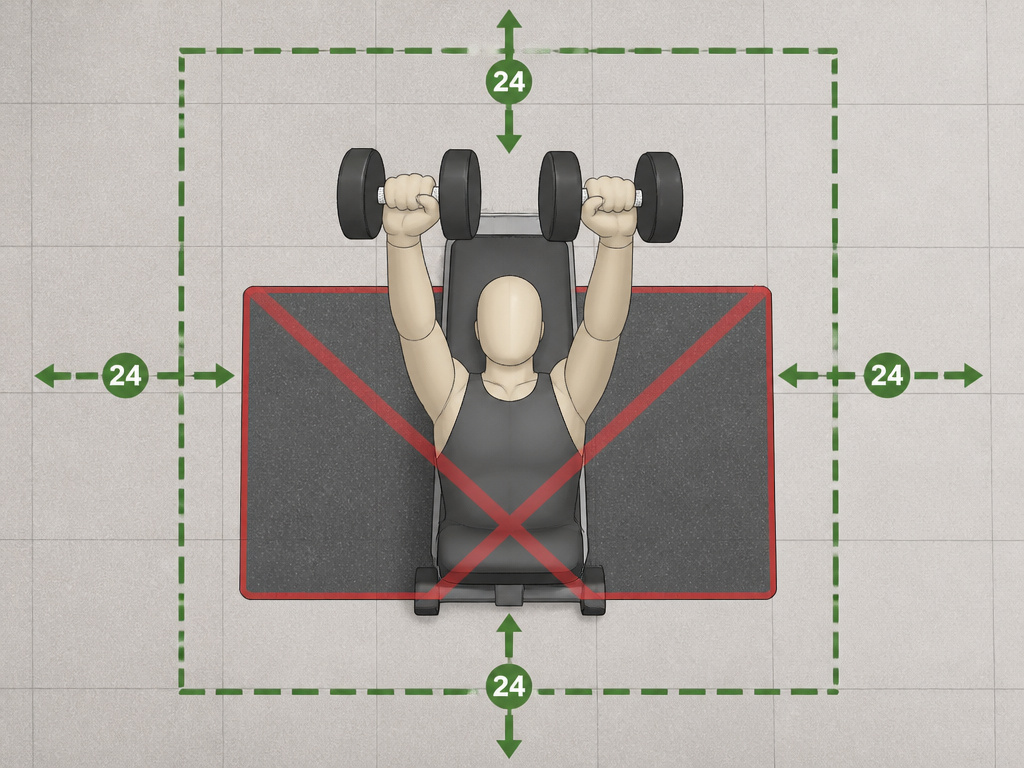
Both manuals ask for the same thing: 0.6 m (24 inches) of free space beyond the maximum reach of the exercise, in every direction.
Read that carefully. It’s not 24 inches of mat. It’s 24 inches past your fingertips at full extension, on all four sides. If you press a pair of dumbbells overhead, the number is measured from where those dumbbells end up, not from where your feet are planted.
Both Bowflex and NÜOBELL also restrict their dumbbells to indoor, dry locations. A damp garage or a covered patio counts as a wet location in practice, because condensation forms on cold steel faster than most people expect.
Common mistake: Measuring the mat instead of the reach. A six-foot mat under a bench press tells you nothing about whether a dumbbell has somewhere to go when a rep gets ugly.
The clearance rule is really a how to use dumbbells safely at home fallback plan. Space is what turns a dropped dumbbell into a noise instead of a broken toe. If your setup fails the 24-inch test, a full home gym safety checklist walk-through will usually find the two feet you’re missing.
Where Do the Dumbbells Rest Between Sets?
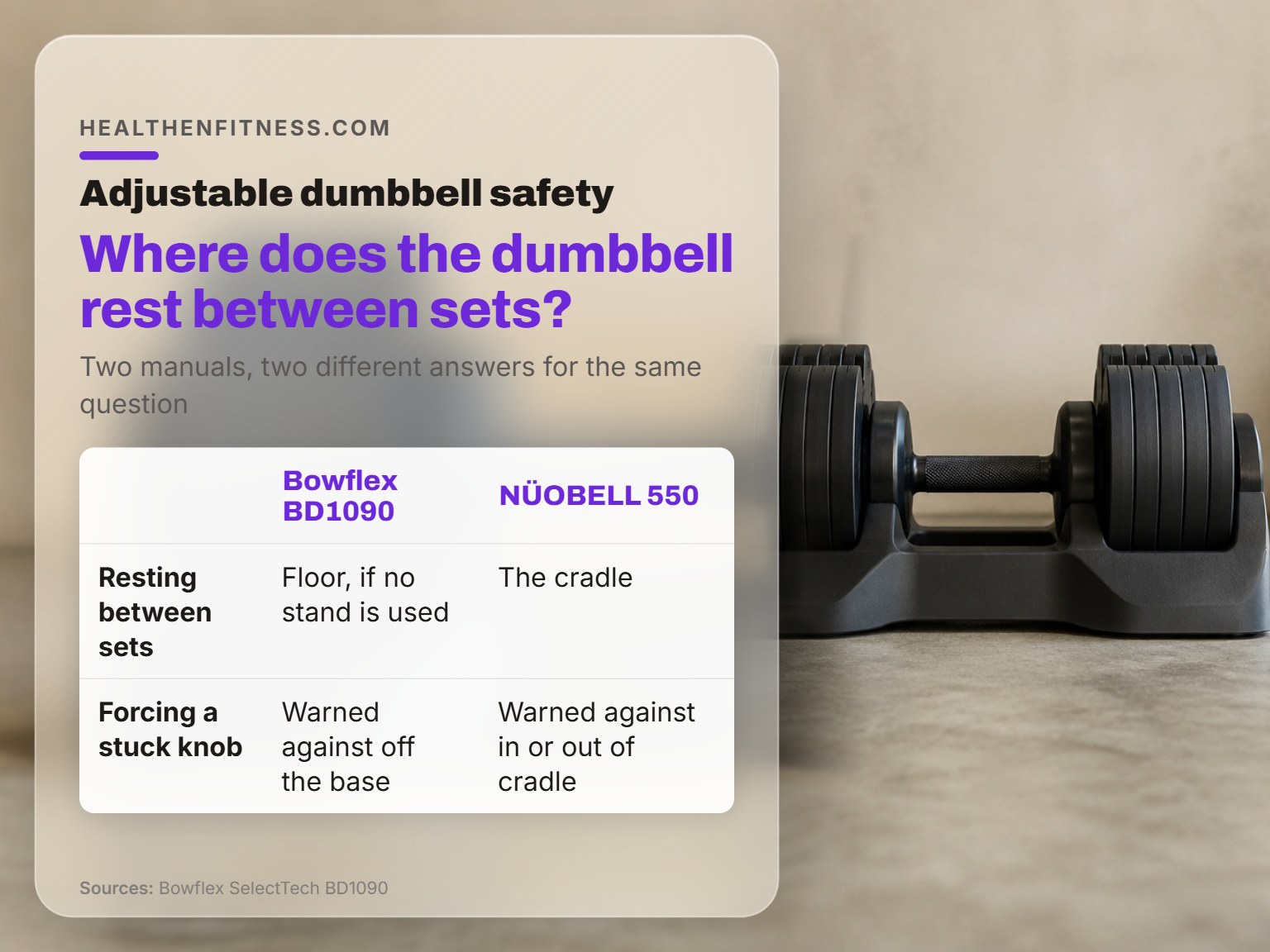
The set ends, the dumbbell is in your hands, the floor is right there, and the cradle is across the room. That’s the moment the two manuals give you opposite instructions.
Bowflex says that if you’re not using an optional dumbbell stand, put the assembly directly on the floor for best support. NÜOBELL says the cradle is the ultimate support spot when the dumbbells aren’t in use.
Same category of product, same question, two different answers. The forcing-the-knob rule splits the same way.
| Question | Bowflex SelectTech BD1090 | NÜOBELL 550 |
|---|---|---|
| Resting between sets | Floor, if no stand is used | The cradle |
| Dropping a loaded dumbbell | Damage and possible injury; no warranty carve-out stated | Dropping or slamming excluded from the 2-year warranty |
| Forcing a stuck knob | Warned against once the handle leaves the base | Warned against in or out of the cradle |
I’d take the cradle rule over the floor rule, and not because one manual outranks the other. A dumbbell left on the floor is a dumbbell somebody steps over, kicks, or grabs by the handle without checking the setting. The cradle at least keeps the plates lined up with the slots they came out of.
Neither answer is wrong. What matters is picking one and doing it every single time, because the risky version is the one you do when you’re tired and improvising.
If floor storage is your only option, a pair of dumbbell storage ideas that keeps the weights off the walking path solves most of the problem. A proper best dumbbell racks stand solves the rest.
Three Things a Loaded Dumbbell Should Never Do
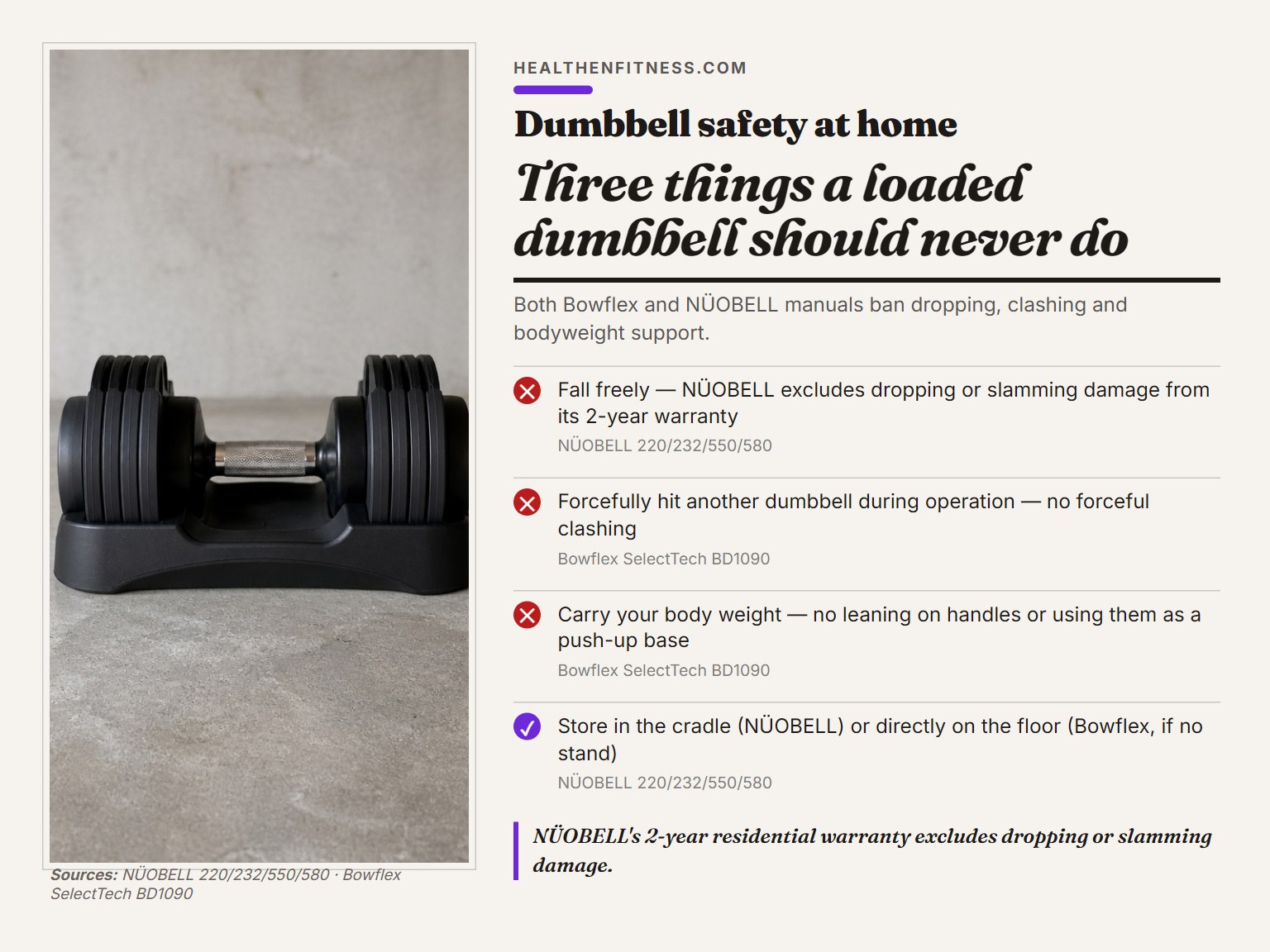
Three things a loaded dumbbell should never do: fall freely, hit another dumbbell, or hold your body weight.
- Fall freely. Bowflex ties it to product damage and possible personal injury. NÜOBELL goes further and excludes dropping or slamming damage from its 2-year residential warranty, so a dropped dumbbell there is a repair you pay for.
- Clash with its neighbor. Both manuals warn against letting the dumbbells hit forcefully during a set. The plates are held by a selector, and a hard impact is a direct test of that selector mid-rep.
- Carry you. Leaning on the handles or using them as a push-up base is banned by both. The handle is a grip point for a moving load, not a structural support for a body.
That middle one catches people during renegade rows and dumbbell push-ups. The weight isn’t the problem. The sideways load on a handle that was designed to be pulled, not stood on, is.
The warranty split is worth knowing because it changes what a mistake costs you. NÜOBELL’s 2-year residential warranty explicitly excludes dropping or slamming, plus cosmetic wear and damage from misuse or tampering. Bowflex frames the same instruction as damage and injury risk and states no warranty carve-out at all.
Neither company is telling you to be careless. They’re just pricing the same accident differently.
Racking is the other half of this. Learning to how to rack weights properly is a two-minute habit that removes most of the ways a dumbbell ends up on the floor in the first place. And when the handles get slick, how to clean and maintain dumbbells matters more than it sounds: NÜOBELL’s own guidance is warm water and mild soap, wiped dry, with no solvents or bleach anywhere near the plates.
Can a Teenager Use Adjustable Dumbbells?
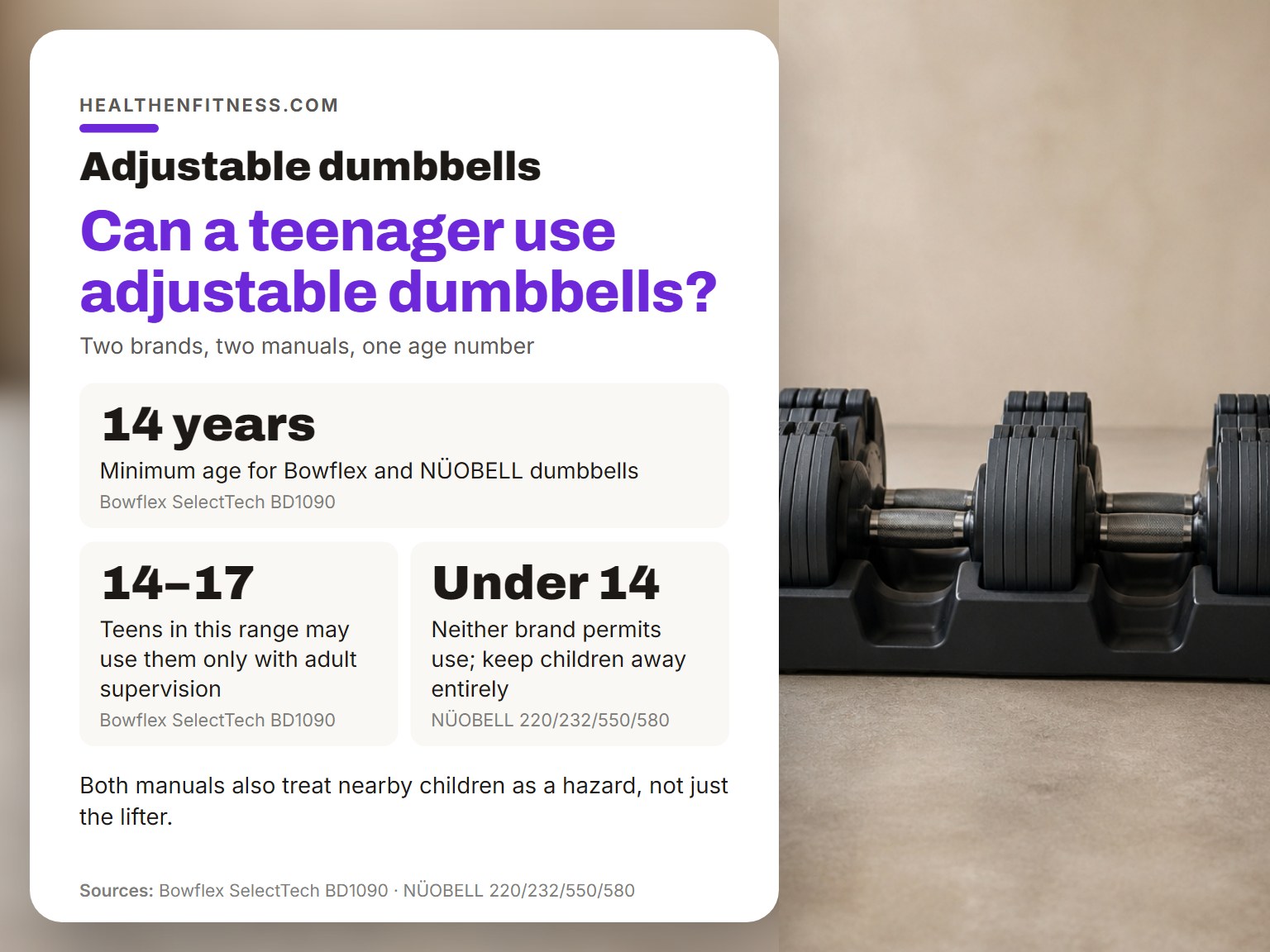
Bowflex puts the floor at 14 years old, with supervision required through 17.
NÜOBELL lands in the same place: rated for ages 14 and up, with teens supervised up to 17 and younger children kept away from the equipment entirely. Bowflex adds that children must not be let on or near the machine at all.
- Under 14: neither brand permits use. Bowflex states the dumbbells are not intended for anyone under 14.
- 14 to 17: use is allowed with supervision from an adult.
- Spectators: both manuals treat nearby children as a hazard in their own right, not just the lifter.
Two brands, two manuals, one number. That agreement is rarer than you’d think in this category, and it’s the closest thing to a consensus you’ll find on home dumbbell use.
Which Dumbbells Suit a Home Setup?
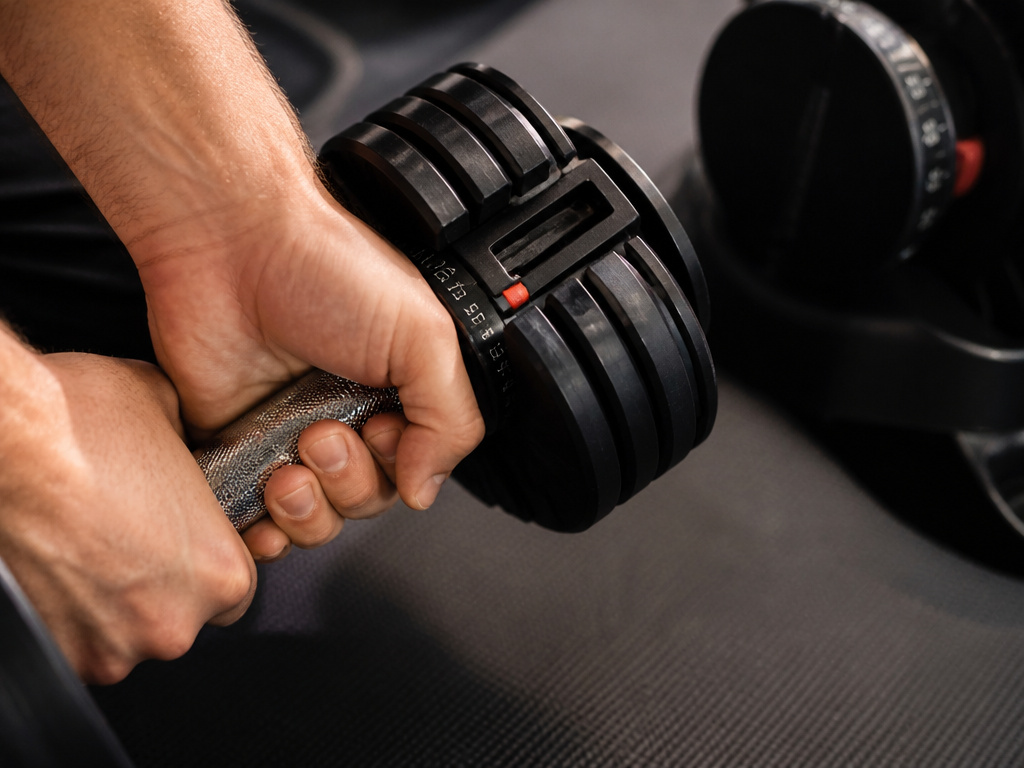
Fixed pairs are faster. That’s the whole argument: grab, lift, put down, no selector to check.
The problem is space and money, which is why most home setups end up adjustable. So the practical question is which adjustable pair, and the honest answer is the one whose lock test you’ll actually run.
For a small room, the Bowflex SelectTech BD1090 is the pair with the most documented test procedure in its manual, which matters if you’re the type who needs a checklist rather than a vibe. The NÜOBELL 550 takes the opposite approach: fewer steps, but a cradle-first storage rule and a warranty that draws a hard line at dropping. If you already own Olympic plates, an Olympic handle like the Impex OBB-20 is the cheapest route into heavy dumbbell work, provided the collars are the post-recall replacements.
A friend of mine spent her first month going heavy on low reps, and her form fell apart a little more each session. We dropped the load and pushed the reps instead. Her technique cleaned up inside two weeks, and she was lifting more total volume by the end of the month than she had been at the heavier weight. Adjustable dumbbells make that switch easy, which is the strongest argument for them.
Whatever you pick, the loading decision matters more than the hardware. If you’re unsure where to start, this guide to how to choose dumbbell weight will keep you from being the person who goes too light for three sets and too heavy for the last one. Once the weights are sorted, a set of best dumbbell workouts built around goblet squats, Romanian deadlifts, presses and rows will carry you a long way.
Frequently Asked Questions
Do I need a spotter for dumbbell work at home?
Not in the way you need one for a barbell bench press. The advantage of dumbbells is that you can dump them to the sides. That advantage only holds if the floor around you is clear, which is exactly what the 24-inch clearance rule is protecting.
How do I know if my adjustable dumbbells are recalled?
Check the model and serial number against the CPSC notice. On the FitRx SmartBell XL, both are printed on the side of the storage tray. If your model matches and the serial matches, stop using the dumbbells and contact the manufacturer for the free repair.
Can I use adjustable dumbbells in a garage gym?
Only if the garage stays dry. Both Bowflex and NÜOBELL restrict their dumbbells to indoor, dry locations and specifically prohibit wet or moist environments. A garage that sweats in humid weather is a wet location in practice, whatever the label on the door says.
What should I do if a weight plate feels loose mid-set?
End the set. Put the dumbbell back in the base or cradle, re-seat it, and run the lock test at that specific setting before you lift again. A plate that shifts or rattles is telling you the selector didn’t fully capture it.
Are fixed dumbbells safer than adjustable ones?
They remove one failure mode, the selector, and add none. Fixed pairs can’t drop a plate because the plate is welded or cast into the head. The trade-off is space and cost, plus you can’t step down five pounds when your form starts to slip.
The Bottom Line
This week, do one thing. Take both dumbbells out of the base, try to turn each knob, and put them back. If either knob moves, you’re done lifting until it’s fixed.
Everything else here is a habit you build after that first check. The clearance rule, the cradle-or-floor decision, the no-drop rule: none of them matter if the selector was already failing before you picked the weight up.
One honest limit. I’m not a clinician, and nothing here diagnoses or rehabs an injury. If something in your shoulder or lower back hurts in a way that doesn’t fade with rest, that’s a conversation for a professional, not a training article. Both manuals say the same thing in their own way: consult a physician before starting, and stop if you feel pain, tightness, shortness of breath, or faintness.
Start smaller than you think you need to. The dumbbells will still be heavy next week.
