
How to Improve Hip Mobility: The 90-Second Rule
This post contains affiliate links. As an Amazon Associate, we earn from qualifying purchases.
How to improve hip mobility: pick one stretch, hold it for 90 seconds of total time, and run it daily for 6 weeks. A randomized trial found a single 90-second hip stretch bout beat a no-treatment control, and a 6-week daily program of 5 minutes a day improved the Modified Thomas Test by 5.92 degrees.
The dose is smaller than it sounds. That trial held the stretch 30 seconds and rested 10, three times over. That’s 90 seconds of total stretch time. The control group sat on a table for 5 minutes.
What follows is the dose the research actually tested, how often to run it, the self-mobilization moves that hold up, and the two situations where hip work does more harm than good.
Key Takeaways
- 90 seconds of total stretch time beat a no-treatment control in a single session, in a trial that enrolled adults with 25 degrees or less of passive hip internal rotation.
- Daily beats heroic. Five minutes a day for 6 weeks added 5.92 degrees on the Modified Thomas Test and 12.39 cm to a single-leg broad jump.
- Stretching didn’t build glutes. Gluteal strength (p=0.23) and bridge endurance (p=0.26) didn’t budge in that same study.
- Self-mobilization is an add-on, not a replacement for a clinician, and the clinical commentary lists a history of hip fracture, recent surgery, and anticoagulation medication among contraindications.
- Avoid squats, lunges, and step-ups during a flare-up, and get a hip that pinches or catches assessed before you stretch into it.
What Hip Mobility Actually Limits in the Gym
Restricted hip mobility shows up as a compensation somewhere else. A clinical commentary on the topic links it to problems at the hip, the lumbar spine, and the lower extremity, which is a polite way of saying your back is doing a job your hip quit.
A randomized controlled trial enrolled adults aged 18 to 65 with passive hip internal rotation of 25 degrees or less on at least one side. Exclusion criteria were hip surgery or reported hip pain within the previous 12 months. Fifty-eight participants completed baseline measurement of flexion, internal rotation, external rotation, and extension.
That inclusion cutoff is worth sitting with. The trial studied people who were measurably restricted, not people who were already mobile and wanted more.
Here’s what a short hip looks like under a bar:
- A squat that stalls above parallel on one side only.
- One heel lifting at the bottom of a goblet squat, which is often an ankle telling on itself.
- A deadlift setup where the chest won’t come up without the lower back rounding.
- Low back ache after a session that had nothing to do with the low back.
- A hip that pinches at end range instead of stretching.
That last one matters. Pinch is joint. Stretch is muscle. Treating a pinch like a stretch is the fastest way to make it worse.
Flexibility is how far a joint travels with help. Mobility is how far you control on your own, and the mobility vs flexibility split explains why a partner-assisted stretch can feel great and change nothing under load.
A stiff ankle will fake a stiff hip every time. Check ankle mobility for squats before you blame the hip.
The 90-Second Stretch Protocol a Randomized Trial Tested
Ninety seconds of total stretch time is the entire dose.
The protocol is almost insultingly simple: hip flexed to 90 degrees, stretch held 30 seconds, 10 seconds of rest between reps, three reps. That’s it.
Before you start: Sharp pinching at the front of the hip is joint, not muscle, and forcing it gets worse within a session or two. Numbness or tingling down the leg means stop and get assessed. If you’ve had hip surgery in the past year or you take blood thinners, clear it with a clinician first.
- Warm up first. Cold tissue gives you a number you don’t own, so the range you measure cold won’t match the range you keep.
- Lie on your back and bring the working hip to 90 degrees of flexion. Let the knee bend freely so the knee joint isn’t taking the stretch.
- Rotate into internal rotation until you feel a stretch at the front of the hip. Stop at the pinch. Pushing past it is how people irritate the joint capsule instead of the muscle.
- Hold 30 seconds, rest 10, repeat three times. Skipping the third rep is the most common shortcut, and it’s the rep that gets you to the 90 seconds the trial actually tested.
Hold times are one place the sources split. The trial used 30 seconds. Consumer guidance from Healthline allows up to 30 seconds for a floor hip flexor stretch or a knee-to-chest. It allows up to a minute for a butterfly forward fold or a figure four. Both are defensible. Pick one and keep it consistent so you can tell whether anything changed.
If the front of the hip is your sticking point, the hip flexor stretch is the one to dose first. The 6-week lunge-and-reach study measured exactly that tissue, using the Modified Thomas Test as its yardstick.
There’s a competing finding worth knowing. A separate trial on internal rotation found the acute effect of hip stretches was minimal once a 10-minute cycle-ergometer warm-up was in the picture. The authors attributed the range gains to the warm-up and suggested clinicians could skip the figure-4 and modified-lunge stretches afterward.
Treat the warm-up as the main event and the stretch as the finisher, and that finding stops being a contradiction.
How Often Do You Need to Train Hip Mobility?
How often is often enough? The tested answer is once a day, five minutes, for six weeks.
| Goal | Dose tested | Where it comes from |
|---|---|---|
| Range before a session | 90 seconds total stretch time | Hip internal rotation trial |
| Hip flexor length over time | 5 minutes daily, 6 weeks | Lunge-and-reach cohort |
| Stiffness with arthritis | Daily, even briefly | Consumer guidance |
| Pain gating vs mobility | Mid-range vs end-range | Clinical commentary |
Gluteal strength (p=0.23) and single-leg bridge endurance (p=0.26) didn’t change, and that’s the part that keeps me honest. Stretching bought length and jump distance. It didn’t build the muscle doing the work.
Frequency advice also splits by population. Consumer guidance for people with arthritis says stretch every day, even briefly, because short daily sessions beat longer ones a few times a week. The 6-week study used daily work as well, but on healthy college-aged participants. Same schedule, weaker evidence base for the arthritis case.
Five minutes a day beats a long session once a week. The studies that show change are the boring ones: daily, timed, and repeated long enough to be unglamorous.
Frequency works like seasoning a pot of soup. A little every day, tasted as you go, beats dumping the whole shaker in on Sunday.
If you want to build a weekly schedule around this, there’s a longer answer on how often to do mobility work that covers stacking it next to lifting days.
(I ran my own mobility work without timing anything. That is a very reliable way to make no progress.)
Self-Mobilization at Home: What It Can and Can’t Do
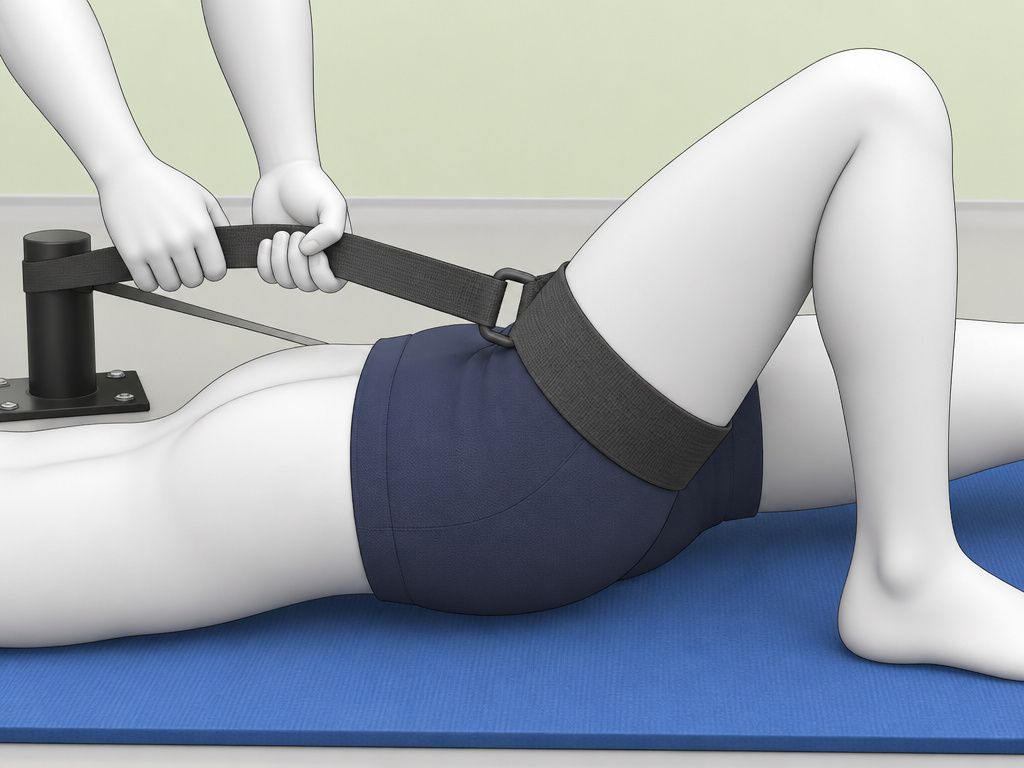
The clinical commentary on self-hip mobilization opens with an admission that’s rare in fitness writing: there’s no direct evidence that self-mobilization works on its own.
The authors still recommend the techniques, but as adjuncts. The clinical suggestions for restricted hips are explicit that they shouldn’t replace skilled clinician work. They work best after a clinician has demonstrated them in person.
I’ve watched people who sit all day arch their lower back on every overhead press. Hip and upper-back work cleaned up the press without touching the load. That’s the carryover people are actually chasing.
Supine Long-Axis Distraction With a Belt
For a hip with restricted capsular mobility across several planes, supine long-axis distraction is the go-to. At home you have three options: a weighted pulley system, heavy elastic tubing, or a belt around something solid.
The belt is the most controllable. You move your body toward your head to load it. If you want more distraction, flex the opposite hip and knee and push that foot into the floor.
The part nobody mentions: A weighted pulley gives you the lowest distraction force of the three, so it needs the most attention to how the hip responds. If you can’t feel where the pull is going, you can’t tell whether it’s helping.
Mid-Range vs End-Range Distraction
Position changes what the technique does. Mid-range hip distraction is used to gate pain and settle symptoms down. Distraction at end-range abduction or rotation is aimed at mobility instead.
That distinction is useful when you’re sore. It’s also why a generic “hip mobility routine” off the internet is a coin flip.
If you sit for a living, the mobility drills for desk workers are built around the positions you’re actually stuck in all day.
How to Improve Hip Mobility With Drills That Have a Dose
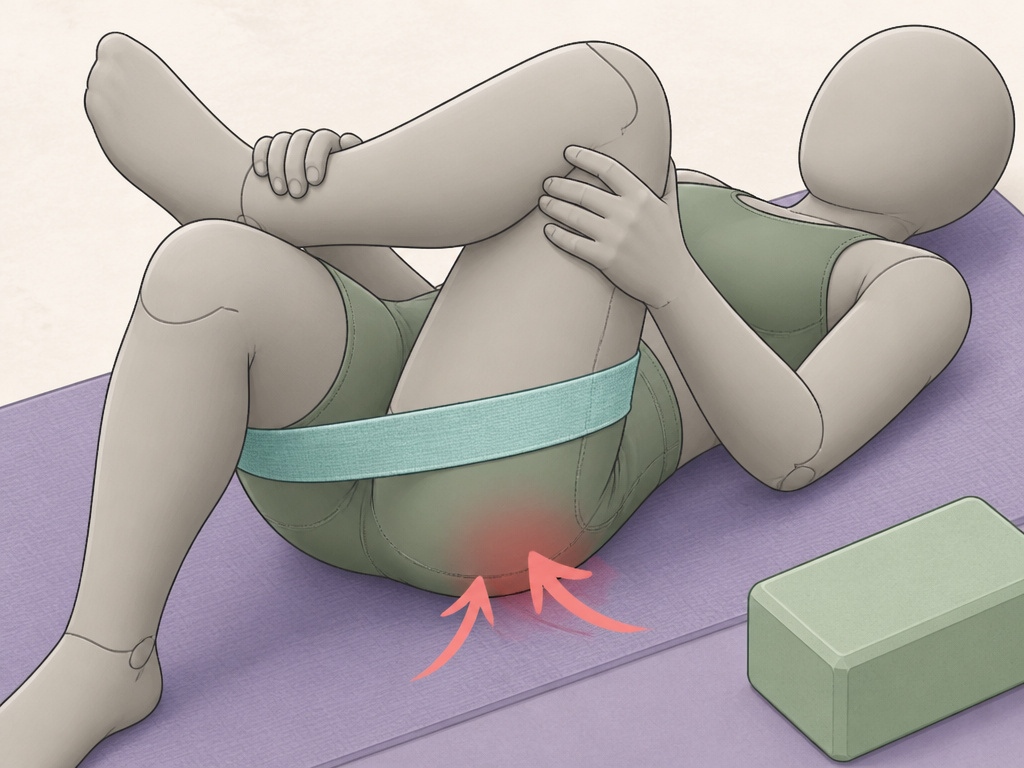
Most of the drill list you’ve seen is filler.
- Clamshell: 1 to 3 sets of 8 to 15 reps.
Notice what’s missing: anything that takes a long time.
A foam roller helps with the tissue around the hip, not the joint itself.
For bands, a light one is enough for clamshells. A yoga block under each thigh makes a butterfly hold survivable.
I’d rather see you do three of these badly on a Tuesday than plan a perfect mobility block you run twice. I’ve been the guy with the perfect plan. It didn’t last.
Adding a sixth drill to a routine you already skip is like buying another spice jar for a cabinet you never cook from.
The figure four is the one to watch for feel. The first part is quiet, then the outside of the hip starts talking, and that’s the part you’re after.
There’s a longer list of exercises for tight hips if you want more options than these five.
Where Hip Mobility Work Goes Sideways
Pushing into a stretch is the instinct, and it’s the wrong one for a joint that’s already irritated.
The self-mobilization commentary lists specific situations where hip mobilization may be inappropriate:
- History of hip fracture.
- Recent hip surgery.
- Anticoagulation medication.
- Worsening symptoms.
- Generalized or local ligamentous laxity.
- Systemic illness.
The same authors flag bony morphologic changes as another reason mobilization may not be appropriate. They also say to trial the technique and re-assess rather than commit to it.
Skip this if: You’re mid-flare-up. Consumer guidance is blunt that squats, lunges, and step-ups should come out of the program during any flare, and loading an angry hip is the fastest way to turn a two-day flare into a two-week one.
A pinching hip has a specific feel: a sharp catch at the front of the joint, right in the crease, that stops the motion dead instead of easing into it.
This is one of the places the sources genuinely disagree. Consumer guidance says avoid squats, lunges, and step-ups during a flare-up. The clinical commentary takes a different line. It holds that end-range self-mobilization may improve mobility and ease symptoms in some clients, provided tolerance is re-assessed and the technique stops at any adverse response.
Both agree on the stop rule. They disagree on whether you should be doing anything at all in the middle of a flare.
Here’s the second “when not to” that matters. If the front of the hip feels sharp rather than stretchy, that’s joint. Keep pushing and the pinch will show up earlier each week, not later.
Stretching or Strength Work: Which Improves Hip ROM Faster?
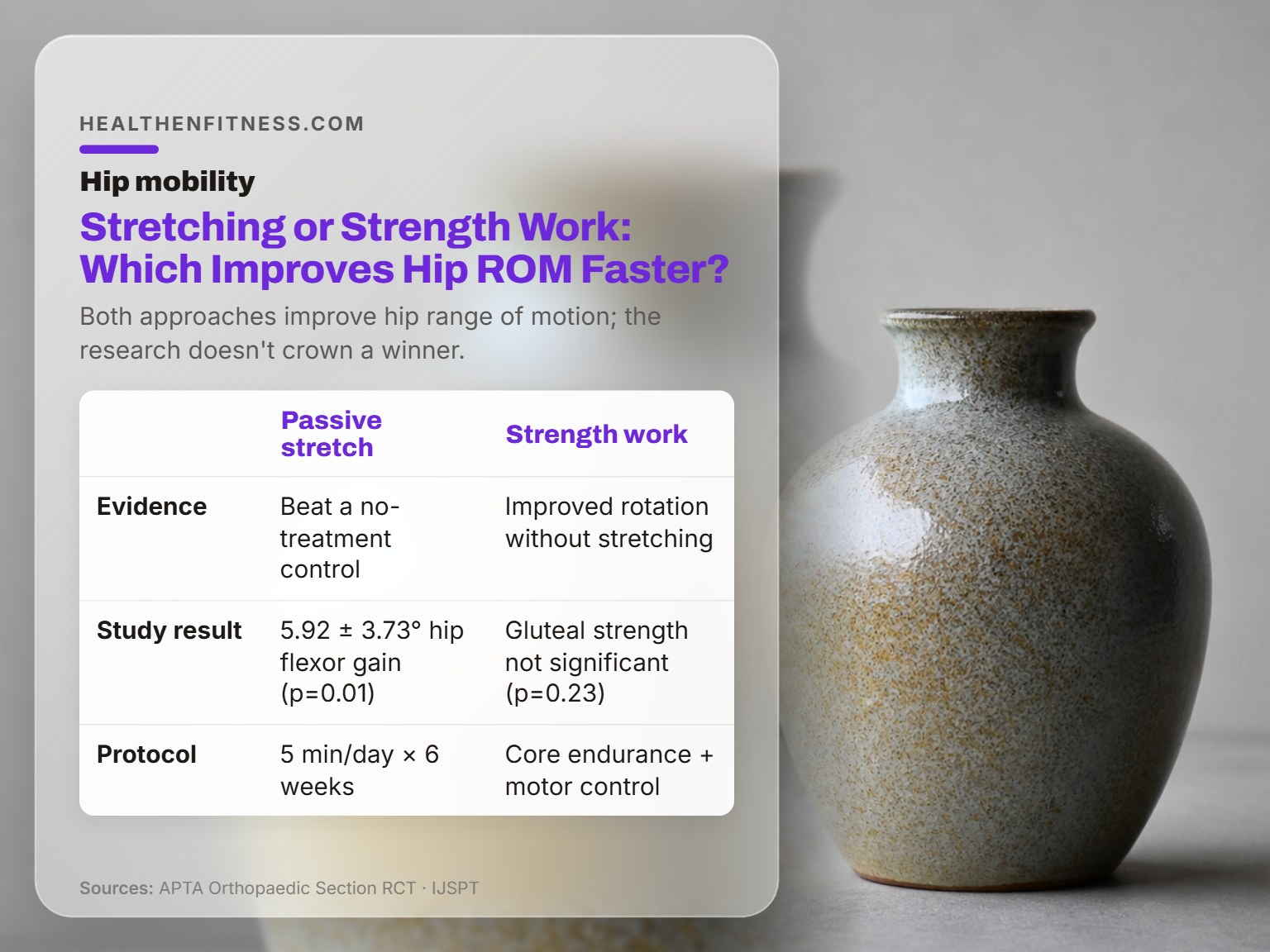
Both approaches move the needle, and the research doesn’t crown a winner.
| Approach | Best for | What the evidence shows |
|---|---|---|
| Passive stretch | Immediate range, low cost | Beat a no-treatment control |
| Mobilization with movement | Pain-limited range | Matched stretch, didn’t beat it |
| Strength and motor control | Holding range under load | Improved rotation without stretching |
| Self-mobilization at home | Topping up clinic work | Adjunct only, no direct evidence |
The hip joint range of motion improvements in a four-arm trial came from stretching alone, stretching plus motor control work, and core endurance plus motor control work. The group that never stretched still gained a moderate amount of range, though the change was significant only in rotation.
That’s a real finding and a narrow one. Rotation improved. Nothing in it said everything improved.
Where Stretching Wins
Before a session, when you need range in the next 10 minutes. A passive stretch is the cheapest tool you own, and it beat a control group in a single bout.
Where Strength Work Wins
For range you keep. The lunge-and-reach study gained hip flexor length but not gluteal strength, which tells you the stretch wasn’t doing the strength job. If you want the new range to survive a loaded squat, load it.
So the split is honest: stretch for the session, strengthen for the decade.
Frequently Asked Questions
How long does it take to improve hip mobility?
The shortest tested window is a single session, where a 90-second stretch bout beat a no-treatment control. For a change you keep, the 6-week daily protocol is the reference point. Expect weeks, not days.
Can you improve hip mobility without stretching?
Possibly. A four-arm trial found that a core endurance plus motor control program without any stretching produced a moderate range increase. That change was significant only in rotation, so it’s one narrow finding rather than a license to skip everything else.
How do you know if hip mobility work is working?
Pick a measurable output before you start: squat depth on video, or a hip internal rotation angle someone can check with you lying prone and the knee bent to 90 degrees. Re-test on the same setup every few weeks.
What should you not do with tight hips?
Don’t push into a pinch. Don’t stretch through numbness, tingling, or sharp pain. And if you’re mid-flare-up, take squats, lunges, and step-ups out of the program rather than training through it.
How many hip mobility exercises should you do?
Fewer than you think. One stretch dosed at 90 seconds, run daily, is a complete program for the front of the hip. Adding five more drills mostly adds time, not range.
The Bottom Line
If you take one thing from all of this, take the stopwatch.
Set a timer for 90 seconds of actual stretch time, run it daily for six weeks, and log the number. If your hip internal rotation hasn’t moved by week six, the stretch isn’t your problem. Get the joint looked at rather than adding more drills.
The concession is this: everything above assumes a hip that’s restricted but healthy. If you’ve had hip surgery, a fracture, or you’re on blood thinners, the self-mobilization half of this article doesn’t apply to you until a clinician says it does.
That’s the honest answer to how to improve hip mobility. Start smaller than you think. Pick one stretch, put a 90-second timer on your phone, and do it after your workout while you’re already warm. That’s the whole assignment.
