
How to Improve Wrist Mobility for Lifting: Step-by-Step
This post contains affiliate links. As an Amazon Associate, we earn from qualifying purchases.
To improve wrist mobility for lifting, load the wrist through its full range with resistance training rather than stretching alone, and keep daily wrist angles within published limits: 32.7° extension, 48.6° flexion, 21.8° radial deviation, and 14.5° ulnar deviation at the 30 mmHg carpal-tunnel pressure threshold.
Those angle limits come from a 2007 Human Factors study of 37 healthy participants. They’re the only published wrist-angle numbers tied to a measurable pressure threshold inside the carpal tunnel. The 25th-percentile cutoffs protect 75% of that sample, so roughly one in four people exceed pressure at smaller angles than the chart says. Ulnar deviation is the tightest of the four, and it’s the one a barbell grip quietly pushes past. This is why how to improve wrist mobility for lifting matters for anyone who trains with a bar.
What follows: the two training methods the research compares head to head, the wrist-angle numbers worth memorizing, and the one loading mistake that keeps lifters stuck at the same range for years.
Key Takeaways
- Resistance training improves wrist range of motion with a pooled effect size of 0.73 across 55 studies, and it is statistically equivalent to stretch training for ROM.
- Ulnar deviation caps at 14.5° at the 30 mmHg threshold, the tightest of the four wrist angles.
- Body-weight-only loading produces no significant ROM gain, so push-ups and planks won’t cut it.
- Trained lifters gain less (ES 0.43) than untrained ones (ES 1.042), so don’t expect beginner-level jumps.
- Existing CTS symptoms put you outside the healthy-participant model the angle limits are based on.
What Do the Published Wrist-Angle Limits Actually Mean?
Wrist posture limits tied to intracarpal pressure thresholds were published by Keir and colleagues in Human Factors in 2007. At the 30 mmHg threshold, the 25th-percentile protective angles are extension 32.7°, flexion 48.6°, radial deviation 21.8°, and ulnar deviation 14.5°. These are the only published numeric wrist-angle limits tied to a physiologic pressure threshold.
That blockquote is the whole reason this article exists. Most wrist-mobility content gives you vague cues like “keep a neutral wrist” without a number attached. Keir’s team gave you a number, and it’s tied to pressure inside the carpal tunnel rather than to a coach’s eyeball.
| Wrist Angle | 25 mmHg Threshold | 30 mmHg Threshold |
|---|---|---|
| Extension | 26.6° | 32.7° |
| Flexion | 37.7° | 48.6° |
| Radial deviation | 17.8° | 21.8° |
| Ulnar deviation | 12.1° | 14.5° |
The two thresholds matter for how to improve wrist mobility for lifting because they bracket a range. At 25 mmHg the protective angles are tighter. At 30 mmHg they loosen a bit. Neither one is a universal safety line. Both are 25th-percentile values, which means they protect about 75% of the healthy sample and leave the other 25% exceeding threshold at smaller angles.
The wrist approaches its protective extension limit around 32.7 degrees, and pushing past it on a loaded barbell takes you beyond the pressure threshold. That’s the physical version of the 32.7° number. If you’re pushing into that block on a loaded barbell, you’re past the pressure threshold whether or not you feel it yet.
The full CDC wrist posture carpal tunnel guidelines came out of Keir’s 2007 paper, and the numbers still hold up as the only pressure-linked wrist-angle chart in the literature.
Stretching and Resistance Training Are Statistically Equivalent for Wrist Range
A 2023 Sports Medicine meta-analysis of 55 studies found resistance training and stretch training produced statistically equivalent range-of-motion gains (ES = 0.08, p=0.79). The authors concluded that stretching before or after resistance training may not be necessary. That’s the single most useful finding for anyone trying to improve wrist mobility for lifting, and almost no wrist-mobility article cites it.
I’ve stopped recommending static wrist stretches before pressing. The research keeps landing on the same place, and the loaded work does the job without eating ten minutes of your warm-up. Form first, then add weight.
Here’s where the sources disagree, and I’d rather show you the split than pretend it doesn’t exist. The occupational therapy review frames stretching, nerve-gliding, and tendon-gliding exercise combined with splinting as the promising protocol for carpal tunnel syndrome. Alizadeh’s meta-analysis says stretching adds nothing beyond what resistance training already delivers. Both are peer-reviewed, and both are pointing at different populations. The OT review is about treating symptomatic CTS. Alizadeh is about improving range in healthy people. Read them in context.
For a healthy lifter chasing better wrist range, the range of motion resistance training meta-analysis is the more relevant evidence. It’s the one I’d hand a beginner who asks whether they need to stretch before every session.
If you want the movement patterns themselves, the wrist mobility exercises on this site cover the loaded versions that match Alizadeh’s protocol. Skip the pre-lift static holds and put the work at the end of the session instead.
The 3 Loading Methods That Actually Move the Needle
Three loading methods show up in the research-adjacent training literature, and they don’t all deliver the same thing. Here’s the ranked version.
- Dumbbell wrist curls and extensions. The entry point. Light enough to learn the pattern, heavy enough to drive adaptation once you’re past the first few weeks. Start light enough to learn the pattern and add a rep before you add load.
- Barbell or EZ-bar wrist work. Higher absolute load, more carryover to pressing and pulling. The EZ-bar version keeps your elbows in a less stressful position if straight-bar work irritates the joint.
- Grip-specific loading. Grippers and thick-grip attachments train the forearm and hand, not wrist range directly. They’re worth adding, but they don’t replace wrist-specific work.
| Method | Range Effect | Best For |
|---|---|---|
| Dumbbell wrist curls | Moderate, localized | Beginners learning the pattern |
| Barbell wrist work | Higher load, more carryover | Intermediate lifters |
| Gripper work | Grip-specific, less ROM | Grip strength, not range |
The forearm burn during wrist extensions is the muscle working, not a warning sign. If it turns sharp or shoots into the thumb side, stop the set.
The proper wrist curl technique matters more than the load. A short, controlled range beats a sloppy swing every time. If you want the broader forearm picture, the forearm and wrist workouts on this site pair the wrist work with grip and rotation.
Separately, grip strength for lifting is worth training on its own. A stronger grip lets you hold heavier loads for longer, which gives the wrist more total time under tension across a session.
How Do You Program Wrist Work Without Overdoing It?
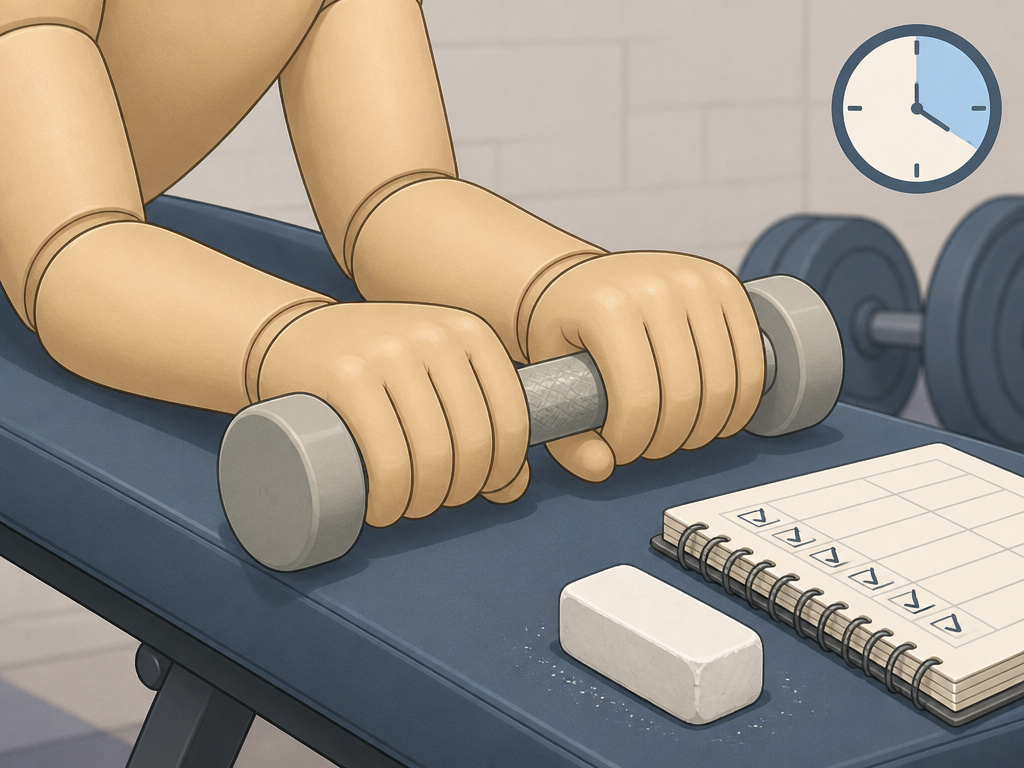
Before you start: Loaded wrist work can aggravate existing tendon irritation or carpal tunnel symptoms, so stop a set the moment you feel sharp pain rather than a muscle burn. Grip failure under a heavy bar drops the weight without warning, so chalk up and use a spotter or safeties on any pressing movement above your working weight. If numbness or tingling runs into the thumb and index finger, that’s a nerve signal, not a mobility problem, and it needs a clinician rather than a program tweak.
Programming rules that hold up:
- Two sessions a week is enough. Wrist work is small-muscle work, and it recovers fast, but it also accumulates fatigue quickly if you push it daily.
- Put it at the end of the session, not the start. Loaded wrist work before a heavy press will leave your grip flat when you need it most.
- Add reps before load. When clean reps feel easy, add reps before adding load.
- One set per direction is a starting point. Wrist flexion and extension each get a set. Radial and ulnar deviation get one each if you’re specifically chasing those angles.
The mobility warm-up routine that works for hips and shoulders also works for wrists, as long as you’re doing dynamic movement rather than long static holds. If you want the broader warm-up structure, the warm-up for heavy lifts covers sequencing.
The Ulnar Deviation Trap in Barbell Grips
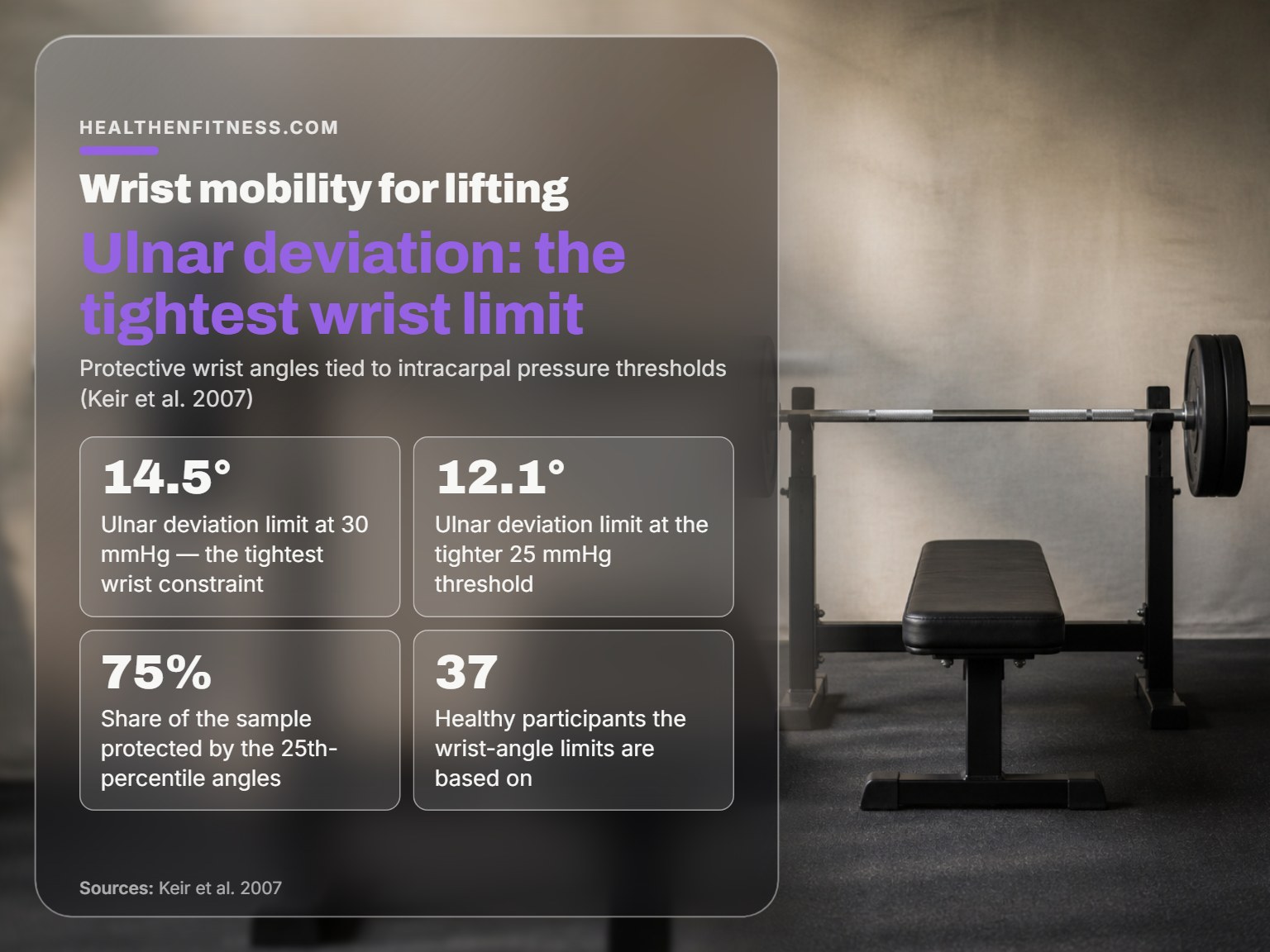
Ulnar deviation is where most lifters blow past the limit without noticing. The 30 mmHg protective angle is 14.5°, and a standard barbell bench grip puts the wrist at or past that number on every rep. The tighter 25 mmHg threshold is 12.1°, which is a smaller margin than most people realize.
A dull ache on the pinky side after pressing is the first sign you’re past the ulnar deviation limit. Not sharp pain. Just a low, persistent throb that shows up an hour after the session and fades by the next morning. That’s the feedback loop, and it’s easy to ignore until it isn’t.
If your pinky side aches after pressing, check your grip width before you blame your wrists. A bar set too wide forces ulnar deviation past 14.5° on every rep, and no amount of wrist work will out-train a bad setup.
Wrist wraps buy you support under heavy load, but they don’t fix grip width. Use them for top sets, then take them off for accessory work so your wrist gets the feedback it needs to self-correct.
The common causes of wrist pain lifting article walks through the full differential, but grip width and ulnar deviation are the two most lifters skip past. Narrow the grip and see if the ache fades before you change anything else.
When Splinting Fits (and When It Doesn’t)
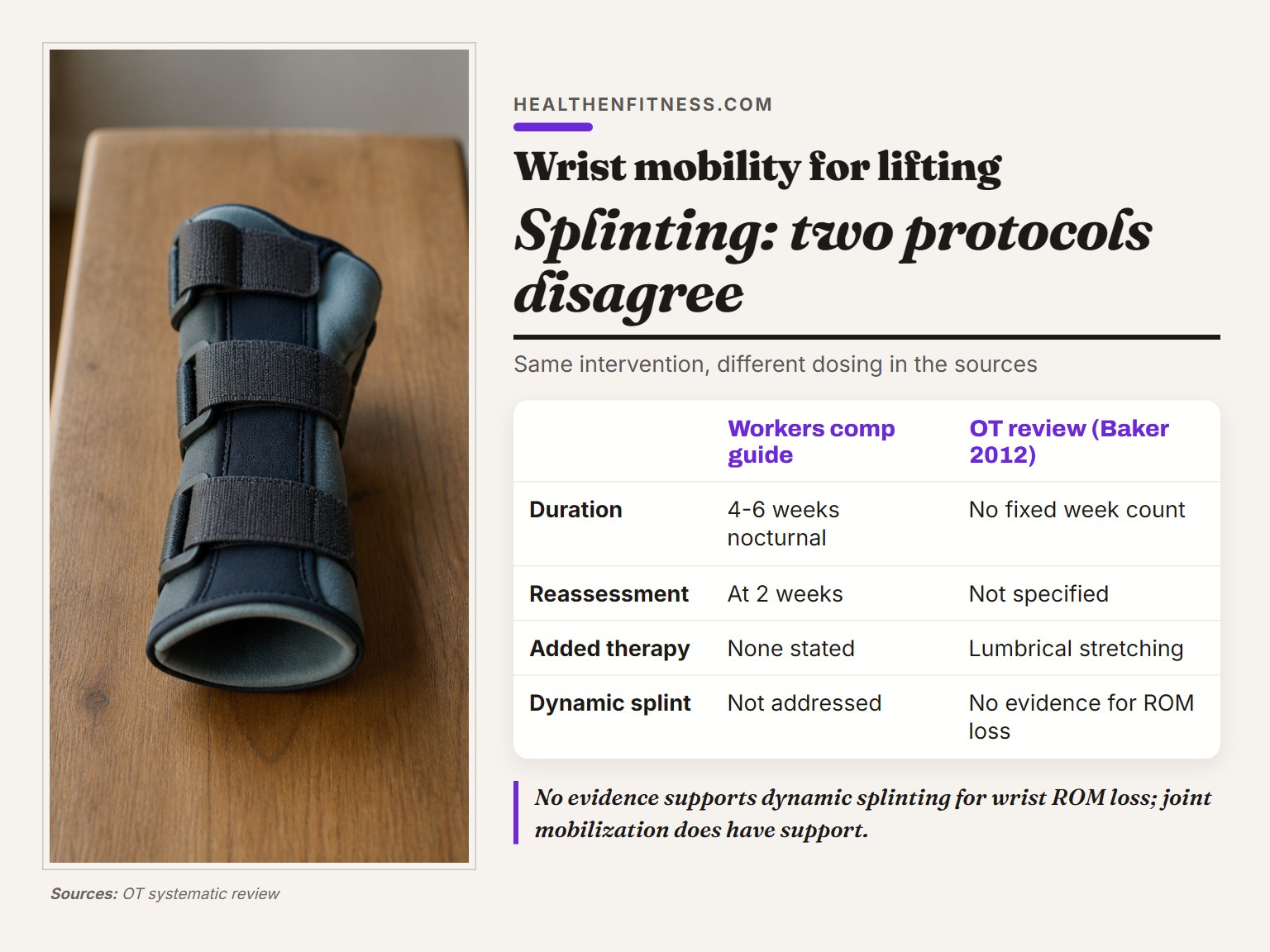
Splinting is a clinical intervention, and the sources disagree on dosing. The New York State Workers’ Compensation Board guideline calls for nocturnal splinting over 4-6 weeks with a reassessment trigger at 2 weeks. The occupational therapy review cites Baker et al. 2012 favoring general splinting plus lumbrical stretching for short- and long-term benefit, without a fixed week count. Different dosing, same intervention.
Nocturnal Splinting
The workers compensation forearm injury standards are the more specific of the two. Four to six weeks of nighttime wear, reassess at two weeks, and discontinue if there’s no improvement. That’s a clinical protocol, not a home remedy, so run it past a clinician before you self-prescribe.
Lumbrical Stretching
The wrist and hand therapy interventions review frames lumbrical stretching as part of the combined protocol. A flexbar is a common tool for the eccentric version of this work. It’s cheap, it’s portable, and it’s the closest thing to a home version of the clinical protocol.
One thing the OT review is clear on: no evidence supports dynamic splinting for wrist range-of-motion loss. Joint mobilization does have support. If a clinician offers you a dynamic splint for a stiff wrist, ask what the evidence base is.
The Body-Weight Trap
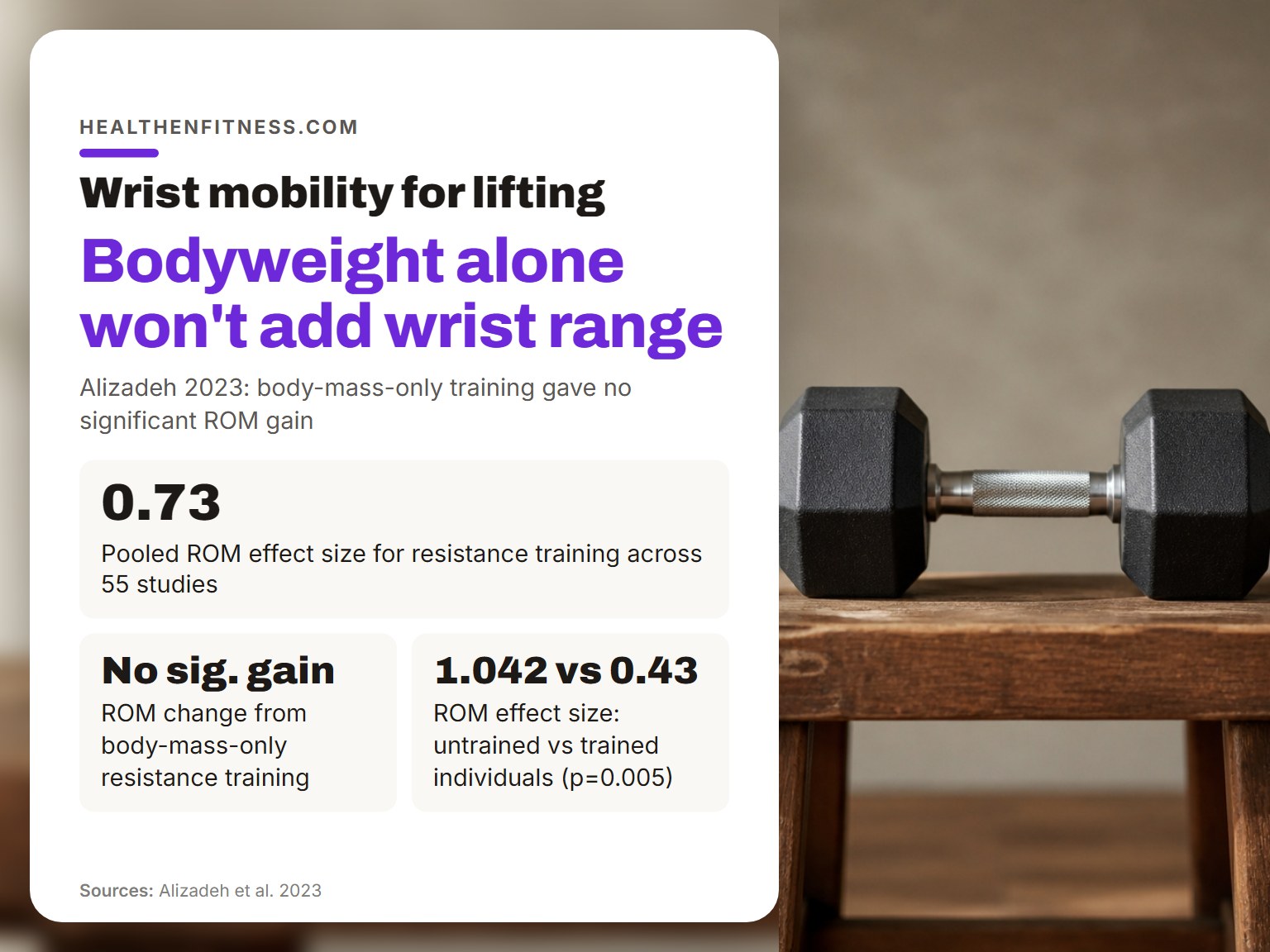
Common mistake: Loading only with bodyweight and expecting range gains. Alizadeh’s data shows no significant ROM improvement from body-mass-only resistance training, so a year of push-ups leaves your wrist range roughly where it started.
This is the single most common programming error I see in wrist-mobility advice. Bodyweight work is great for a lot of things. It is not great for driving wrist range adaptation, because the load isn’t heavy enough to force the tissue to remodel.
The fix for how to improve wrist mobility for lifting is simple: add external load. A dumbbell, a barbell, or a gripper. Anything that lets you push the wrist past the load it sees in daily life.
If you’re already doing forearm exercises with dumbbells, you’re ahead of the curve. If you’re doing push-ups and planks and calling it wrist training, you’re not.
Frequently Asked Questions
How long does it take to improve wrist mobility for lifting?
Resistance training produces measurable range-of-motion gains across the 55 studies Alizadeh reviewed, but the timeline depends on your starting point. Untrained lifters saw much larger effects (ES 1.042) than trained ones (ES 0.43), which suggests beginners notice change faster than experienced lifters. The research doesn’t pin a fixed week count, so track your own range rather than waiting for a specific date.
Is stretching or resistance training better for wrist mobility?
The two methods produced statistically equivalent range-of-motion gains in Alizadeh’s 2023 meta-analysis (ES = 0.08, p=0.79), and the authors concluded stretching before or after resistance training may not be necessary. A separate occupational therapy review still frames stretching, nerve-gliding, and tendon-gliding combined with splinting as the promising protocol for carpal tunnel syndrome. The populations differ, so read both findings in context.
Can I improve wrist mobility with bodyweight exercises only?
Not according to Alizadeh’s data. Body-mass-only resistance training produced no significant range-of-motion gain in the meta-analysis. You need external load, whether that’s a dumbbell, a barbell, or a gripper, to drive the adaptation.
What wrist angle should I stay under during lifting?
The published limits at the 30 mmHg carpal-tunnel pressure threshold are 32.7° extension, 48.6° flexion, 21.8° radial deviation, and 14.5° ulnar deviation. Ulnar deviation is the tightest, so watch your grip width on pressing movements. These are 25th-percentile protective angles, meaning they protect about 75% of the sample, not everyone.
Do wrist wraps help or hurt mobility?
Wrist wraps support the joint under heavy load, which can let you train around a sensitive wrist without pushing past the angle limits. They don’t improve mobility on their own, and wrapping too tight for too long can mask the feedback you need to correct your grip. Use them for heavy sets, then take them off for the accessory work that actually trains range.
The Bottom Line
Pick one wrist exercise and add it to the end of your next two sessions. A set of dumbbell wrist extensions and a set of wrist curls is enough to start. Don’t stretch first. The research keeps pointing at loaded work as the driver of range, and a static stretch before pressing mostly eats warm-up time.
Track what changes. If your pinky side aches after pressing, your grip is too wide for the 14.5° ulnar deviation limit, and a wrist wrap won’t fix a bar position problem. Narrow the grip and see if the ache fades.
If numbness or tingling shows up in the thumb and index finger, stop. That’s a nerve signal, not a mobility gap, and it belongs with a clinician rather than a program tweak. The angle limits here come from healthy participants, and anyone with existing carpal tunnel symptoms sits outside that model.
Progress beats perfection. Add the two sets. See what happens.
