
Common Gym Injuries and How to Prevent Them
This post contains affiliate links. As an Amazon Associate, we earn from qualifying purchases.
Common gym injuries and how to prevent them are two halves of one story: strains and sprains to the shoulder, lower back, knee, and ankle, driven mostly by load you haven’t earned yet. Prevention is unglamorous. Build gradual overload and trunk control into the program, keep the warm-up short and repeatable, and stop at the first tweak.
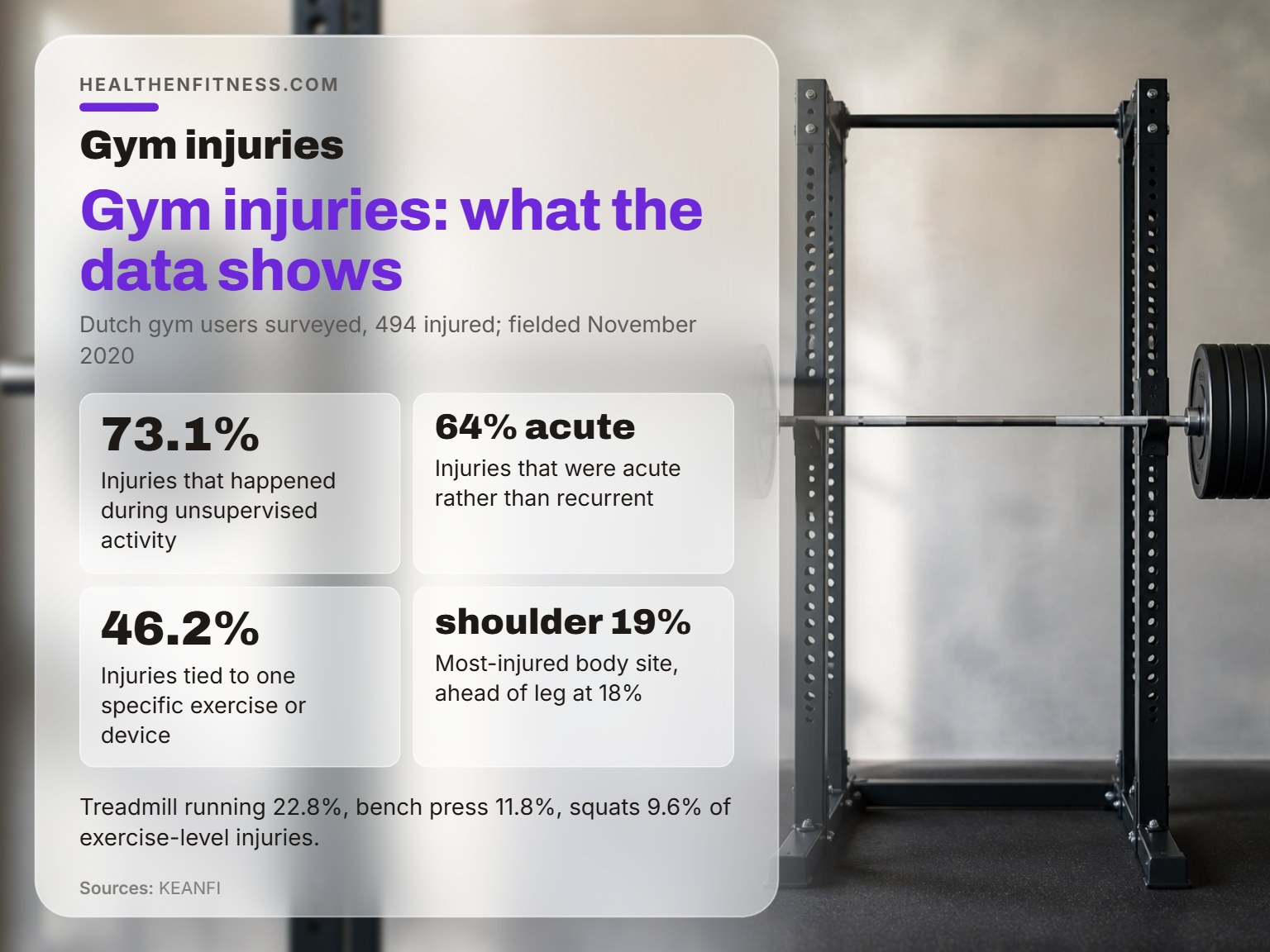
The Dutch survey below is where that idea gets specific. Of 494 injured gym users, 73.1% were hurt with no coach in sight, which means the advice worth keeping has to work when you’re alone and guessing.
What follows: the injury numbers and why four good sources rank body sites differently, the three exercises that show up most, the warm-up argument, and the group of lifters the standard advice skips.
Key Takeaways
- Injuries to the shoulder, back, knee, and ankle are the leading sites, and the shoulder leads at 19% in Dutch gym data.
- 73.1% of injuries happened unsupervised, so any plan that depends on a coach watching your form misses most of the real risk.
- Incidence and prevalence tell different stories. Powerlifting shows 1.0 to 4.4 injuries per 1000 training hours and, in one report, a 70% point prevalence.
- Warm-up is the popular answer, program design is the better-supported one, and both matter for different reasons.
- Stop at the first tweak. Cool down gently, stretch, ice, and rest from the aggravating activity.
Common Gym Injuries: What the Dutch Data Actually Shows
494 injured gym users. That’s the sample behind the most detailed breakdown of gym injuries available, a survey fielded in the Netherlands in November 2020 and published in November 2022.
The Dutch survey, fielded in November 2020 and published in November 2022, recorded 494 injured gym users. Acute injuries made up 64% of the total, recurrent injuries 34%, and 46.2% of cases were traced to one specific exercise or device rather than to a general training load built up over months.
That last figure is the useful one for the common gym injuries and how to prevent them question. Just under half the sample could point at a single movement or machine and say “that one.” The cause is usually identifiable in hindsight, which means it’s usually identifiable beforehand too.
The site breakdown runs shoulder 19%, leg 18%, knee 13%, ankle 12%, back 11% in the Netherlands fitness injury study. That’s a general gym population, not competitors.
Compare it to competitive lifters and the order changes completely. A 2024 review in BMJ Open Sport and Exercise Medicine found weightlifting injuries clustering at the knee, lower back, shoulder, and hands or fingers, while powerlifting landed on the lower back and pelvis, shoulder, and elbow.
An updated review of injuries in functional fitness puts shoulder first, then lumbar spine, then knee, across 26 studies and 10,967 participants, with a mean injury prevalence of 32.8%.
| Population | Most-injured sites | Source |
|---|---|---|
| General gym users (Netherlands) | Shoulder 19%, leg 18%, knee 13%, ankle 12%, back 11% | Kemler et al., 2022 |
| Functional fitness | Shoulder, then lumbar spine, then knee | Updated review, 26 studies |
| Olympic weightlifting | Knee, lower back, shoulder, hands and fingers | BMJ Open SEM, 2024 |
| Powerlifting | Lower back and pelvis, shoulder, elbow | BMJ Open SEM, 2024 |
| Yoga and Pilates | Back and spine (n=19, 23%) | Kemler et al., 2022 |
Why the Site Rankings Don’t Match
Four credible sources, four different rank orders. None of them is wrong, and that’s the point worth carrying into your own training.
The populations differ, the definitions differ, and the sports load the body in different ways. A powerlifter spends most of a session in a braced hinge under near-maximal load. A general gym member splits time between machines, dumbbells, and a treadmill.
Yoga and Pilates invert the pattern entirely, with back and spine as the top injury location in the Dutch data. If your week is mostly mat work, the shoulder-first ranking doesn’t describe you.
73.1% of These Injuries Happened With Nobody Coaching
Supervision changes the arithmetic when you compare a common gym injuries and how to prevent them. Nearly three in four injured Dutch gym users were hurt while training unsupervised, which puts the trainer-first advice in an awkward spot.
Hospital and institute blogs routinely tell beginners to book a session with a certified trainer to learn form. That’s decent advice. It also describes a minority of the situations where people actually get hurt.
So build the safety net into the room instead of into a person. Rack pins set just below your bottom position, collars on any loaded bar, a clear floor around the rack, and a phone within reach.
When you train alone, the setup is your spotter.
If you’re lifting without anyone else in the building, the solo gym safety basics matter more than the program. And the standard gym safety rules cover the parts nobody thinks about until a plate rolls.
The other unsupervised problem is honesty. With no coach, the only feedback loop is how the rep felt, and “felt fine” is a poor instrument when the weight is new.
Which Exercises Actually Cause the Most Injuries?
Treadmill running accounts for 22.8% of the exercise-level injury attributions in the Dutch data, more than any single lift. Bench press sits at 11.8% and squats at 9.6%.
That ordering surprises people who assume the barbell is the dangerous part. A treadmill is a repetitive impact surface, and most people use one while tired or distracted.
The three biggest contributors, in the Dutch data:
- Treadmill running at 22.8%, a repetitive-impact problem rather than a loading problem, and the one most people ignore because it feels like the safe corner of the gym.
- Bench press at 11.8%, where the shoulder sits abducted and externally rotated under a load typically much heavier than an Olympic snatch relative to bodyweight.
- Squats at 9.6%, with the caveat that ACL stress rises when the movement doesn’t support body mass, which is the double-leg and single-leg squat and lunge family.
That bench press number has a mechanism behind it. A 2024 review notes that powerlifters often use a wider grip, which parks the shoulder in a more abducted, externally rotated position, and the loads used in the bench are heavier than snatch loads relative to bodyweight. Higher force at a more extreme joint angle is a bad combination.
A review of common resistance training injuries covers the tissue-level detail if you want the mechanism rather than the count.
Warm-Up or Program Design: What Actually Prevents Injuries?
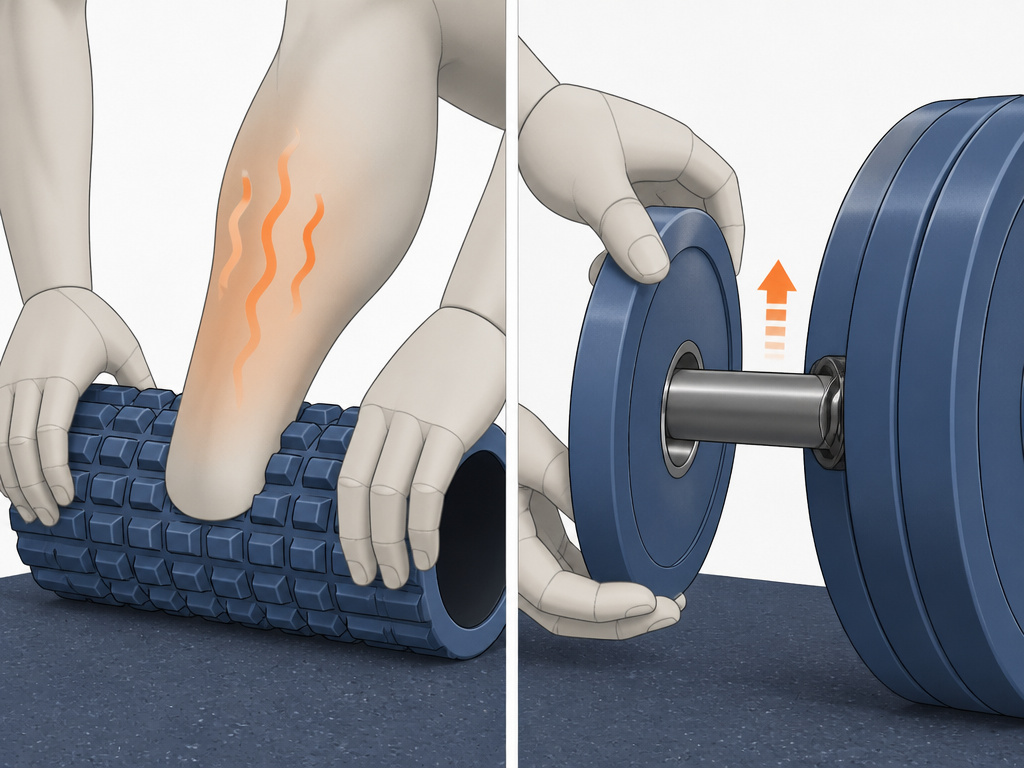
Two credible sources give two different answers about prevention, and the honest read is that both are partly right.
The Heart Research Institute states that a warm-up is “pretty much the only thing that has been proven to prevent injuries,” while an integrative review points instead at periodization, gradual overload, technique supervision, trunk stabilization, and knee, pelvis, and core strength work. An integrative review of 39 articles points instead at periodization, gradual overload, technique supervision, trunk stabilization, and knee, pelvis, and core strength work.
Here’s the disagreement laid out, because pretending it doesn’t exist doesn’t help you train.
| Question | One position | Other position |
|---|---|---|
| What prevents injury? | Warm-up is “pretty much the only thing proven” (Heart Research Institute) | Periodization, gradual overload, trunk work (integrative review) |
| Is a coach present? | Book a trainer to learn form (hospital blogs) | 73.1% of Dutch injuries were unsupervised |
| After a back tweak: rest or move? | Ice and rest the aggravating activity (Heart Research Institute) | Keep walking, avoid long lying down (same source) |
| Does scaling loads cause injury? | Coaching folklore says yes (CrossFit review) | Only limited evidence; longer participation was protective |
I still warm up every session. I just don’t believe it’s carrying the whole load.
The practical version is a short proper warm-up that raises tissue temperature and rehearses the pattern, followed by a program that adds load slowly enough for the tissue to remodel. Heavy resistance training does appear to help prevent injury through structural adaptation, including increased collagen XIV, macrophages, and tenascin-C at the myotendinous junction, provided the exercise matches the joint and muscle it’s supposed to train.
That last clause is the whole game. A movement that fights your biomechanics doesn’t protect anything.
If you want a menu rather than a principle, these injury prevention exercises cover the trunk and hip work that shows up repeatedly in the systematic review of gym injuries.
The 4 Things You Control in the First 90 Days
Before you start: Rack pins set below your bottom position catch a failed rep; pins set too high turn a miss into a neck injury. Collars stop plates sliding when the bar tips. A clear floor around the rack removes the trip that happens during the one rep you weren’t thinking about.
- Pick a load you could repeat tomorrow. If the last set leaves you guessing whether you’ll manage the same weight next week, it was too heavy. Skipping this is how one week turns into a fortnight off.
- Build trunk stability before you build the number. A program without quasistatic trunk stabilization carried a higher risk of ACL rupture in one comparison, because the ligament tension went up. Skip it and the knee takes the load the trunk should have handled.
- Add load in small steps you can describe out loud. “Five kilos on the squat this month” is a plan. “More weight when it feels easy” is a coin flip. The progressive overload rules are dull and they work.
- Write it down in a paper notebook. Sets, reps, and how the joint felt. Skipping this means you can’t tell progress from a night’s sleep, and you’ll repeat the common beginner workout mistakes without noticing.
One more data point that cuts against the usual warning: a CrossFit injury risk factors review found only limited evidence that switching between prescribed and scaled loads raises injury risk, and found that longer participation was protective. Experience appears to buy you something.
Should You Train Through the Soreness?
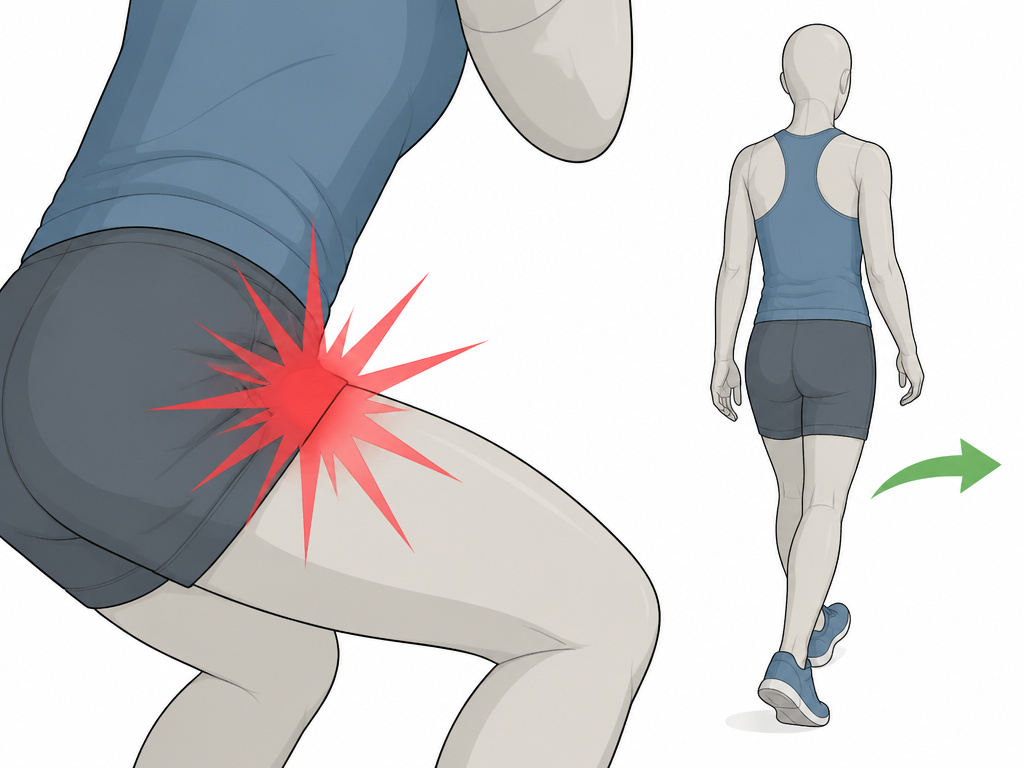
You finish a set of squats, stand up, and something at the front of the hip catches. That’s the moment the decision gets made, and it’s usually made badly.
Soreness that arrives a day or two later, spread evenly across a muscle belly, is a different animal from a sharp catch during a rep. One is adaptation. The other is a warning you should read immediately.
The First-Tweak Rule
Stop the exercise at the first tweak, cool down gently, stretch, ice, and rest from the thing that aggravated it, though for backs the same source says movement is key: keep walking and avoid lying down too long. The full extent often only becomes clear once the muscles have cooled, which is why the “it’s probably fine” call made mid-set is unreliable.
Backs are the exception worth knowing. With a back tweak, movement helps: keep walking, avoid lying down for long stretches, and don’t let the muscles seize up. If symptoms haven’t settled within 2 to 3 days, that’s the point to see a chiropractor or physiotherapist.
Knowing when a gym injury needs a doctor is a separate skill from knowing when to rest, and it’s worth reading up on before you need it. In the meantime, you can usually train around an injury rather than stopping entirely.
The Lifters the Standard Advice Skips
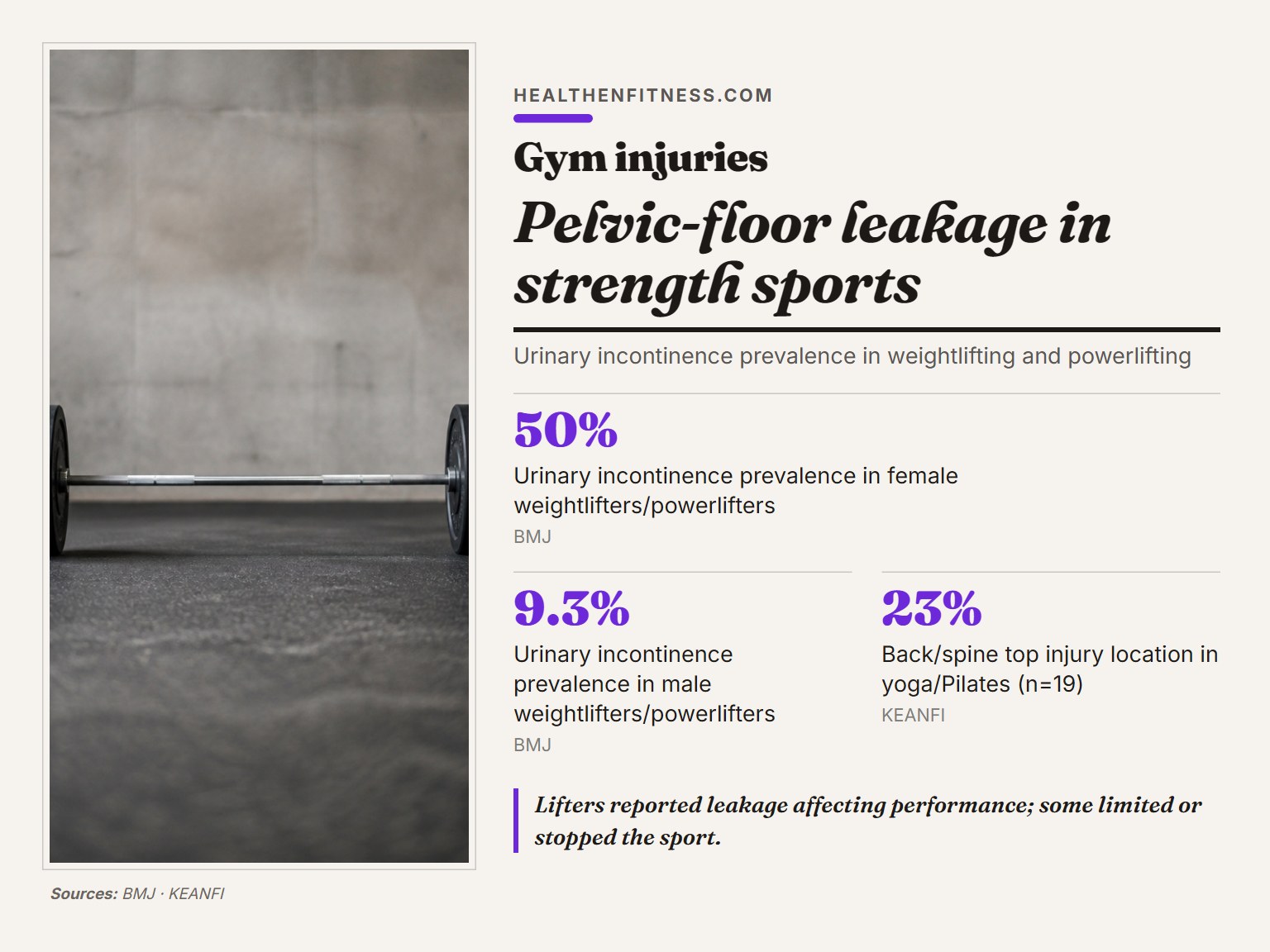
Pelvic-floor dysfunction sits outside almost every gym-injury article, and the numbers are not small. In weightlifting and powerlifting, urinary incontinence prevalence runs at 50% of females against 9.3% of males.
Lifters in that review reported leakage affecting sports performance, and for some it led to limiting or stopping the sport altogether.
The other groups the shoulder-first ranking misses:
- Yoga and Pilates practitioners, where back and spine is the top injury location rather than the shoulder.
- Female lifters in strength sports, where pelvic-floor dysfunction is common and rarely discussed.
- Returning lifters with a training history, who tend to reload at the weight they left rather than the weight they can currently own.
If you fall into any of those, the general ranking is a poor guide and the general advice is thinner than it looks.
Frequently Asked Questions
How long should a warm-up actually last before lifting?
Short, repeatable routine beats a long, elaborate one you skip on busy days. Five to ten minutes of light cardio plus a few ramp-up sets of the first main lift covers most sessions. The goal is raising tissue temperature and rehearsing the movement pattern, not fatiguing yourself before the working sets begin.
Does stretching before a workout reduce injury risk?
Static stretching held before training has weak support as a standalone prevention method. Dynamic movement that takes a joint through its full range while building heat tends to serve lifters better. Save prolonged static holds for after the session, when muscles are warm and you are not about to load them heavily.
What should I do in the first minute after feeling a sharp tweak?
Stop the set immediately rather than trying to push through the last rep or two. Note which movement triggered it and how it felt, since that detail guides what to avoid next session. If pain persists beyond a day or two, or comes with swelling or loss of range, get it assessed rather than self-diagnosing online.
Are beginners or experienced lifters more at risk?
Experience does not automatically protect you, because the load keeps climbing as technique improves. Beginners get hurt by doing too much too soon, while veterans get hurt by ego lifting or skipping recovery they used to need less. Both groups benefit from tracking weekly volume and treating any sudden jump in weight as a red flag.
Before You Go
One threshold worth carrying out of here: if a joint hurts during the rep, in a specific spot, that’s your signal to drop the load and rebuild the pattern. Not next week. That session.
The rest is smaller than it sounds. Start smaller than you think you need to, log what you did, and let the weeks stack up.
Today, just set your rack pins one notch below your bottom position and do a set with an empty bar before anything else.
