
10 Best Muscle Stimulators in 2026
This post contains affiliate links. As an Amazon Associate, we earn from qualifying purchases.
The OMRON Max Power Relief TENS Unit wins as Best Overall because it combines drug-free pain relief with pads that last up to 150 uses. That makes it a simple grab-and-go option for sore muscles and joints. For athletes wanting wireless freedom, the Compex Wireless USA 2.0 shines, while the Beurer EM59 stands out for those who want heat therapy alongside stimulation.
The real challenge with muscle stimulators is finding the right balance between features and your actual routine. Do you need something tiny for travel, a device with deep customization, or a no-fuss unit for post-workout recovery? The wrong choice means wasted money and a gadget that collects dust.
We built this guide by comparing specifications, studying manufacturer documentation, and analyzing patterns in owner feedback across dozens of models. Our goal is to help you match a device to your specific needs, whether that is pain relief, muscle recovery, or performance training, without the guesswork.
Top 10 Muscle Stimulators in the Market
Certain content that appears on this site comes from Amazon. This content is provided "as is" and is subject to change or removal at any time.
The Best Muscle Stimulators, Reviewed
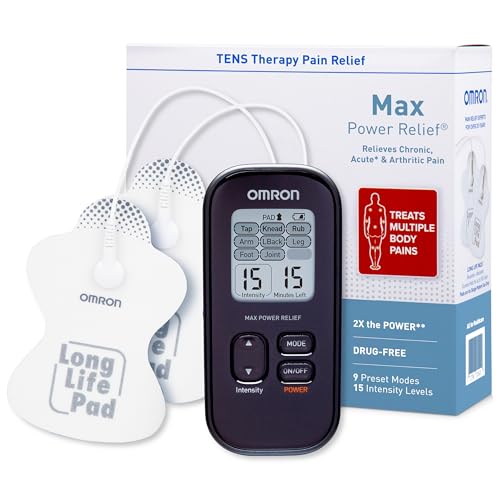
OMRON Max Power Relief TENS Unit
What We Like
- Long Life Pads last up to 150 uses
- Drug-free pain relief for muscles & joints
- Portable and easy-to-use controls
- Includes everything needed out of the box
Trade-offs
- 15-minute session requires resetting for longer use
- Uses disposable AAA batteries instead of rechargeable
- Only two pads included for treatment
A 30-minute maximum session per use (three times daily) means this unit is built for short, focused pain relief rather than all-day wear. That fits perfectly if you want to target a sore shoulder after a workout or ease lower back tension during a work break. The Long Life Pads are a practical feature: they can be washed after every 15 sessions, giving roughly 10 washes for up to 150 total uses, so you are not constantly buying replacements. Omron keeps it simple with intuitive controls and a clear display, making this a grab-and-go option for drug-free muscle and joint relief.
The Omron unit limits you to two pads and a single 15-minute session before you need to restart. So if you want to treat multiple spots at once or run longer continuous cycles, the Beurer EM59 includes two adjustable channels and heat therapy. But for straightforward, portable pain relief that works reliably out of the box, this Omron device keeps things simple without skimping on pad life or comfort. It’s the kind of thing you toss in a gym bag or keep in a desk drawer, ready when a muscle starts complaining.
AUVON 3-in-1 TENS Unit Muscle Stimulator

What We Like
- 40 intensity levels for gradual relief
- 24 pre-programmed modes for variety
- Includes 12 pads with US adhesive gel
- Type-C charging cable included
Trade-offs
- Pads rated for only 45 uses each
- No wireless operation (wired lead wires)
Forty intensity levels and 24 pre-programmed modes let you adjust the stimulation gradually, whether you are dealing with shoulder pain or post-workout leg soreness. The 3-in-1 design (TENS, EMS, and RELAX) gives you three distinct ways to use it: pain relief, muscle performance, or fatigue recovery, all in one compact aluminum-alloy body that slips into a bag. If you want options without carrying multiple devices, this unit covers a lot of ground.
The trade-off is that the included pads are rated for about 45 uses before the adhesive starts to fade, so you will eventually need to buy replacements. That is typical for TENS pads, but worth keeping in mind if you plan to use it daily. The Omron Max Power Relief TENS Unit comes with two pads, while the AUVON includes twelve right out of the box, giving you more coverage for larger areas like your lower back or thighs. Just plan to buy a spare set of pads if you are a frequent user.
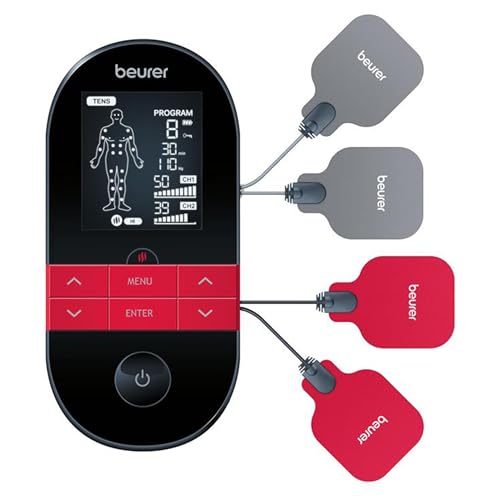
Beurer EM59 Digital 3-in-1 TENS Unit
What We Like
- Combines TENS, EMS, and heat therapy
- 64 preset programs plus 6 custom settings
- Compact with belt clip for portability
- Safety auto switch-off feature
Trade-offs
- Four electrode pads limit simultaneous coverage area
- Only four electrode pads included for two channels
Sixty-four preset programs and six customizable settings mean you can dial in exactly the kind of stimulation you want, whether that’s a gentle TENS pulse for nerve discomfort or an EMS contraction for muscle recovery. The device also includes integrated heat therapy, which can help relax tight tissue before the electrical pulses start. The timer runs from five minutes up to a hundred, so you can set it and forget it without worrying about overdoing a session.
The heat feature and rechargeable battery make the Beurer EM59 a bit chunkier than a bare-bones stimulator like the TENS 7000 Digital unit. So it’s less ideal for slipping into a gym bag pocket. You also only get four self-adhesive pads, which limits how many muscle groups you can target at once compared to units with more pads. Still, if you want the soothing combo of warmth and electrical therapy in one compact device that clips onto your waistband, this is the one to grab.
Compex Edge 3.0 Muscle Stimulator

What We Like
- Water resistant silicone sleeve
- Up to 8 hours of stimulation
- USB rechargeable battery
- Programs for before, during, or after workout
Trade-offs
- Only 4 programs limit variety
- No wireless pods like some Compex models
Four targeted programs, two for strength, one for recovery, and one for TENS pain relief, mean this stimulator is built around performance, not just relaxation. You can use it before a workout to activate muscles, during a session to push through fatigue, or after to speed recovery, all without hunting through dozens of modes you will never touch. The water resistant silicone sleeve and improved LCD with a center navigation button make it easy to adjust on the fly, even if you are sweaty or in a crowded gym. For someone who trains regularly and wants a focused tool that supports the whole workout cycle, this is a smart, no-fluff choice.
That focus on simplicity means you get only four programs, so you lose the variety that multi-mode units like the AUVON 3-in-1 offer for different pain locations or massage styles. But if your priority is clean, effective muscle performance support, strength when you need it, recovery when you are done, the Edge 3.0 delivers exactly that. It has a battery that lasts up to eight hours so you are not constantly hunting for a charger.
Product photos
Compex Wireless USA 2.0 Muscle Stimulator

What We Like
- 10 programs including strength and recovery
- Wireless PODs for full mobility
- Color display for easy navigation
- TENS program for pain management
Trade-offs
- Weighs 1.0 lb, heavier than some portable stimulators
- Wireless PODs require charging before each use.
Ten programs, four for strength, two for warmup, three for recovery, plus one TENS, give this unit a clear athletic focus that most muscle stimulators skip. The wireless PODs and rechargeable station let you move freely during a warmup or walk around while recovering, which matters when you’re trying to fit stimulation into a real gym session. It’s built for someone who wants to build explosive power and speed up recovery between workouts, not just numb a sore spot on the couch.
And at one pound, it’s noticeably heavier than the featherweight wireless options out there, so if you plan to wear it under clothes while moving, that weight adds up. For the athlete who wants targeted strength and recovery programs in a cord-free package, this makes more sense than a general-purpose stimulator that only offers pain relief.
TENS 7000 Digital TENS Unit

What We Like
- Over 3 million units sold since 2008
- Multiple TENS therapy modes included
- Comes with hard carrying case
Trade-offs
- Uses disposable 9V battery, not rechargeable
- Bulkier than compact units like OMRON Max Power Relief
Over 3 million units sold and a 15-plus-year track record among medical professionals mean this TENS unit has been a go-to for drug-free pain relief for back, neck, sciatica, and elbow issues. It comes with four reusable pads and a hard carrying case, so you get everything needed to start therapy right away. If you want a straightforward, no-app, no-wireless machine that just works out of the box, this is the one that has earned its reputation by staying in use.
The trade-off for that proven reliability is a design that feels a bit old-school. It runs on a single 9V battery rather than a built-in rechargeable pack, so you will need to keep spares handy if you use it daily. It is also larger than some wireless models, which means it takes up more space in a bag. If you prioritize compactness and rechargeability over proven track record, the Compex Wireless USA 2.0 is worth a look. But for anyone who values a unit that has been a favorite among medical professionals for over 15 years, the TENS 7000 is the straightforward choice.
Product photos
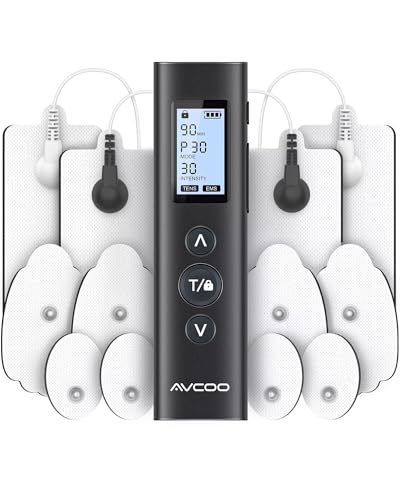
AVCOO 30 Modes TENS EMS Unit
What We Like
- Weighs only 0.09 lb for travel
- 30 modes and 30 intensity levels
- 12 medical-grade pads in 3 sizes
Trade-offs
- No wireless or app control
- Requires manual mode selection each use
At just 0.09 pounds and smaller than a phone, this AVCOO unit fits in a jacket pocket or gym bag without adding bulk. So you can use it during a commute, at the office, or between sets. The 30 modes and 30 intensity levels give you plenty of options to find what feels right for your back, neck, or shoulders. The 30 hours of usage means you won’t need to recharge as often during a trip. It suits anyone who needs pain relief on the go and wants a straightforward, no-fuss device that’s ready when they are.
This unit is fully manual with no wireless connectivity or app control, so you adjust modes and intensity directly on the device rather than from your phone. If you prefer setting programs remotely or want a more hands-off experience, the MASTOGO Wireless TENS unit offers app control for that convenience. But the AVCOO delivers a huge range of therapy options in a package that disappears into your pocket, making it an easy grab-and-go companion.
Product photos
TENS 7000 Rechargeable Tens Unit

What We Like
- Built-in rechargeable battery for extended sessions
- Up to 100mA intensity for deep relief
- Targets back, neck, shoulders, and more
- Includes 4 electrode pads for easy application
Trade-offs
- Wired electrode pads restrict movement compared to wireless models
- No timer or preset programs for quick sessions
A built-in rechargeable battery means you can work through a full recovery session without hunting for fresh batteries or stopping mid-treatment. That’s the kind of convenience that makes a TENS unit feel less like a chore and more like a regular part of your routine. With adjustable intensity up to 100mA and four included electrode pads, this machine targets common trouble spots like the lower back, neck, and shoulders. For anyone who wants dependable electrotherapy without the fuss of swapping power cells, this is a straightforward, no-surprises option.
The unit uses a wired connection to the electrode pads, which is standard for most TENS machines in this category. If you prefer to move freely during treatment, a wireless model like the MASTOGO 12 Modes Wireless TENS Unit offers that option. But the TENS 7000 focuses on delivering consistent, adjustable therapy without the complexity of wireless setup.
Product photos
MASTOGO 12 Modes Wireless TENS Unit

What We Like
- Wireless snap design stays on skin
- App control via DOMAS for iOS/Android
- 12 preset modes for pain and muscle
- Independent dual-channel control
Trade-offs
- Requires smartphone and Bluetooth for full control
- No wired remote backup if app disconnects
- Only 20 intensity levels vs. some rivals' 40
A dual-channel wireless design with independent control means you can treat two different body areas at once, each with its own intensity and mode. The DOMAS app handles all settings via Bluetooth, so there is no tangled cord or lost remote to worry about. With 12 combined TENS and EMS modes and 20 intensity levels, this unit covers both pain relief and muscle conditioning. It suits anyone who wants the convenience of phone-based control and the flexibility to move freely during a session.
The app is your only interface here, so there is no built-in screen or physical remote. A dead phone or Bluetooth hiccup leaves you without adjustments mid-session. If you prefer a straightforward button-and-screen setup, a device like the AUVON 3-in-1 may feel more reliable. But for app-savvy users who value portability and independent channels, this is a clean, modern pick.
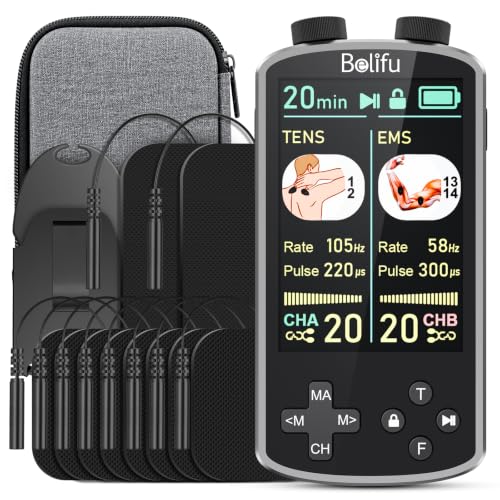
Belifu 4-in-1 TENS EMS Unit
What We Like
- 36 modes plus DIY frequency customization
- Independent dual channel for simultaneous therapy
- Ultra-clear 3.8" color display
- Rechargeable battery lasts up to 60 hours
Trade-offs
- Requires wires connecting pads to unit
- Larger than pocket-sized TENS units
A 3.8-inch full-color display makes this muscle stimulator far easier to read and adjust than the dim monochrome screens on older units, so you spend less time squinting and more time getting relief. With 36 modes plus a DIY custom frequency option, you can dial in exactly the pulse width and therapy style that works for your back pain or post-workout soreness. The independent dual channel lets you treat your neck and lower back at the same time with different settings, which is a convenience you won’t find on simpler single-channel devices. This unit suits anyone who wants personalized control over their recovery without wrestling with a tiny screen or limited programs.
This is a wired system, not a wireless one like the MASTOGO 12 Modes Wireless TENS Unit. You have two sets of pads connected by cables to the main device, which can feel a bit tethered if you like to move around during therapy. But if you prioritize customization and a clear interface over cord-free freedom, the Belifu gives you far more mode variety and a much larger display than the MASTOGO’s app-controlled approach. The rechargeable battery runs up to 60 hours between charges, so you can use it daily for weeks without hunting for an outlet.
Product photos
How We Evaluated Muscle Stimulators
Our research focused on what actually matters when you strap electrodes to your body. We examined specifications like intensity levels, program counts, pad quality, battery life, and form factor for each unit. Manufacturer claims about pad longevity and therapy modes were cross-checked against what long-term owners consistently report.
Three criteria drove our rankings. First, pad quality and longevity, replacing pads adds cost and frustration, so units with longer-lasting adhesive gel scored higher. Second, versatility in treatment modes: we looked for a meaningful range of TENS, EMS, and custom programs rather than just a high number count. Third, portability and power management, since a stimulator you cannot easily take to the gym or on a trip loses value fast.
A research-led evaluation has honest limits. What we can offer is a clear picture of what each device promises and what patterns emerge from the community of people who use them daily.
What To Look For In Muscle Stimulators
Choosing the right stimulator means understanding the differences between TENS, EMS, and combination units, and matching those to your goals. Here is what separates a useful tool from an expensive paperweight.
Focus on pad quality and replacement cost first, then check that the device has enough intensity levels and programs for your needs. Portability matters if you plan to use it at the gym or while traveling.
TENS vs. EMS vs. Combo Units
TENS (Transcutaneous Electrical Nerve Stimulation) targets pain relief by sending gentle pulses through the skin to interfere with pain signals. EMS (Electrical Muscle Stimulation) causes actual muscle contractions, making it better for recovery, strength activation, and reducing muscle soreness after workouts. Many modern electrical stimulation devices combine both, giving you one unit for pain and performance. If your primary goal is post-workout recovery, dedicated muscle recovery stimulators often include specialized programs for that purpose.
Intensity Levels and Program Variety
More intensity levels mean finer control over how strong the sensation feels. A unit with 40 levels, like the AUVON 3-in-1, lets you dial in exactly the right strength for different body areas. Program variety matters too, you want modes for pain, recovery, strength, and warm-up rather than twenty near-identical patterns. Note that some muscle stim machines offer preset programs optimized for specific body parts, which can simplify setup considerably.
Pad Quality and Coverage
Electrode pads are a consumable item, and their lifespan varies dramatically. The OMRON Max Power Relief claims pads lasting up to 150 uses, while others need replacement after 45 uses. Pad size and shape also affect how well the unit treats larger muscle groups like the back versus smaller areas like the wrist.
Units that include multiple pad sizes, like the AVCOO with 12 pads in three sizes, offer better versatility. For those seeking a completely cable-free experience, wireless stimulators eliminate the tether entirely, though they often have fewer pad placement options.
- Check how many uses the included pads are rated for before replacement.
- Verify the unit supports the number of channels you need for treating multiple areas simultaneously.
- Look for a carrying case if you plan to travel with the device.
- Confirm the power source matches your preference, rechargeable for convenience or disposable for simplicity.
A good rule of thumb: spend more on pad quality than on fancy app features you might never use.
Muscle Stimulators Compared
The table below compares the key specs of our top picks so you can see at a glance how they stack up on intensity, programs, and power.
| Product | Therapy Types | Programs/Modes | Channels |
|---|---|---|---|
| OMRON Max Power Relief TENS Unit | TENS | N/A | N/A |
| AUVON 3-in-1 TENS Unit Muscle Stimulator | TENS, EMS, RELAX | 24 pre-programmed | A/B dual channel |
| Beurer EM59 Digital 3-in-1 TENS Unit | TENS, EMS, Heat | 64 preset + 6 custom | 2 adjustable |
| Compex Edge 3.0 Muscle Stimulator | TENS | 4 | N/A |
| Compex Wireless USA 2.0 Muscle Stimulator | TENS | 10 | N/A |
| TENS 7000 Digital TENS Unit | TENS | N/A | N/A |
| AVCOO 30 Modes TENS EMS Unit | TENS, EMS | 30 | Dual |
| TENS 7000 Rechargeable Tens Unit | TENS | N/A | 2 adjustable |
| MASTOGO 12 Modes Wireless TENS Unit | TENS, EMS | 12 | Dual, independent control |
| Belifu 4-in-1 TENS EMS Unit | TENS, EMS, RELAX, DIY | 36 + DIY custom frequency | Independent dual channel |
Frequently Asked Questions
What is the difference between TENS and EMS?
TENS units focus on pain relief by sending electrical pulses that interfere with pain signals traveling to the brain. EMS units cause muscle contractions, which helps with recovery, strength building, and reducing soreness after exercise. Many combination devices offer both modes in one unit.
How often can I use a muscle stimulator?
Most manufacturers recommend using TENS units for 15 to 30 minute sessions, with a break between sessions. EMS units are typically used for 15 to 20 minutes per muscle group per day. Always follow the specific instructions for your device, and consult a doctor if you have any underlying health conditions.
Can muscle stimulators help build muscle?
EMS devices can help with muscle activation and toning, but they are not a replacement for resistance training. They work best as a supplement for recovery, reducing soreness, and waking up dormant muscle fibers after injury or time off from training. For serious muscle growth, compound lifts and progressive overload remain the standard approach.
Are wireless muscle stimulators better than wired ones?
Wireless units offer freedom of movement and are easier to use while walking or doing light activity, making them popular with athletes. Wired units typically provide more consistent power delivery, lower cost, and a wider range of pad placement options. The choice depends on whether mobility or treatment area flexibility matters more to you.
How long do electrode pads last?
Pad lifespan varies significantly by brand and how well they are cared for. Some pads are rated for 45 uses, while premium options like those on the OMRON Max Power Relief last up to 150 uses. Storing pads on the plastic liner between uses and keeping them clean extends their life considerably.
The Bottom Line
The OMRON Max Power Relief TENS Unit is the best overall choice for anyone who wants a simple, portable, and reliable device for targeted muscle and joint pain relief. Its long-lasting pads and straightforward controls make it a no-regret purchase for home or travel use.
If you are an athlete or gym regular, the Compex Edge 3.0 or Compex Wireless USA 2.0 offer performance-focused programs for before and after workouts. Budget-conscious shoppers should look at the TENS 7000 for its proven track record, while the Beurer EM59 adds heat therapy for those who want extra comfort during treatment.
The single most important factor is matching the device to your primary goal, pain relief, muscle recovery, or performance training. Pick the category that fits your routine first, then choose the unit with the best pad quality and intensity control within that category.
