
Rest Periods for Muscle Growth: What the Data Says
This post contains affiliate links. As an Amazon Associate, we earn from qualifying purchases.
Rest periods for muscle growth matter less than most gym arguments suggest. The 2024 Frontiers Bayesian meta-analysis of 9 studies and 19 measurements found longer rest (>60 s) slightly ahead of short rest (SMD 0.56 vs 0.48), while the NSCA still recommends 30-90 s. Both build muscle. The gap is small.
The mechanism behind the rest periods for muscle growth question is volume load. Cut rest to 60 seconds and the next set costs you reps; Longo et al. Recorded 9.8 reps averaged across three sets on short rest versus 16.1 on 180 seconds. Fewer reps at the same load means less mechanical tension, and tension is the signal your body reads.
What follows: the four rest bands the researchers actually tested, where the NSCA guidance and the pooled data split, and the two populations the evidence still cannot speak to.
Key Takeaways
- Longer rest edges ahead, but barely. The pooled effect was 0.56 for over 60 seconds against 0.48 for 60 seconds or less.
- The NSCA’s 30-to-90-second window is now contested: the Frontiers 2024 meta-analysis states its findings are inconsistent with NSCA recommendations and that current guidelines on rest interval prescription warrant reconsideration.
- Past 90 seconds, the hypertrophy benefit is doubtful according to the Frontiers review, though McMahon et al. And de Salles et al. Report strength benefits and rep quality keeps climbing.
- Training to failure does not change the rest equation. Thigh SMD was 0.31 with failure and 0.27 without.
- Nobody has tested torso muscles. Chest, lats, and delts have zero rest-interval data behind them.
What the 2024 Meta-Analysis Actually Measured
The Frontiers review pooled nine studies and nineteen separate measurements of muscle size, drawn from the arm, thigh, and whole body.
The 2024 Bayesian meta-analysis pooled nine randomized studies and nineteen hypertrophy measurements, splitting rest intervals into short (60 seconds or less) and longer (over 60 seconds). Non-controlled effect sizes were 0.48 for short rest and 0.56 for longer rest, with substantial heterogeneity across the included measurements drawn from the arm, thigh, and whole body.
Standardized mean differences in the rest periods for muscle growth data are not pounds of muscle. They are a yardstick for comparing studies that used different scanners, different exercises, and different populations. A gap of 0.08 on that yardstick sits closer to noise than to a program change.
The review itself flags this. Heterogeneity across those nineteen measurements was substantial, and the authors say so directly. Pooled numbers describe a trend across studies, not a prescription for your Tuesday session.
The Frontiers Bayesian meta-analysis on rest intervals was preregistered on the Open Science Framework, which is rare enough in this corner of exercise science to be worth mentioning. Included studies ran 5 to 10 weeks, and every one required at least two sessions per week for at least four weeks.
Why the NSCA Says 30 to 90 Seconds and the Newer Data Disagrees
The National Strength and Conditioning Association still recommends 30 to 90 seconds of rest for hypertrophy goals.
That number came from acute hormone research. Short rest spikes growth hormone and testosterone after a session, and for years that spike was assumed to drive growth. It was a reasonable guess built on a real observation.
The assumption did not hold. McKendry et al. Found that one minute of rest blunted the myofibrillar protein synthetic response compared with five minutes, even though the short-rest group had the larger hormone rise. The hormone went up. The muscle-building signal went down.
| Source | Rest Recommendation | What It Rests On |
|---|---|---|
| NSCA (cited in Frontiers 2024) | 30-90 seconds | Acute post-set hormone response |
| Frontiers 2024 meta-analysis | Slightly favors over 60 seconds | 9 studies, 19 measurements |
| Longo et al. (reported in Frontiers 2024) | 180 seconds beat 60 seconds | 13.1% vs 6.8% quadriceps CSA |
| Built With Science (coaching position) | 3 minutes, up to 4 for heavy work | Practitioner experience |
The review’s conclusion is blunt about the conflict. It states that its findings are inconsistent with the NSCA recommendation and that current guidelines on rest interval prescription warrant reconsideration.
Granting the NSCA its due: the 30-to-90-second window came from real data on post-set hormones. The problem is that later work showed the hormone spike does not track with growth. I stopped repeating the short-rest rule once the protein synthesis numbers came out.
A 2017 systematic review landed somewhere in the middle. Grgic et al. Concluded that short and long rest are both viable for untrained lifters, but that longer durations may be advantageous for people with training experience. That review is a short versus long rest intervals review worth reading in full if you want the pre-2024 picture.
Does Resting Longer Than 90 Seconds Build More Muscle?
So is there anything past 90 seconds worth having?
On size, the review casts doubt. Its own wording is that the evidence remains equivocal about whether resting beyond 90 seconds further enhances hypertrophic adaptations, and that the analysis casts doubt on any beneficial effect in that range.
On strength and rep quality, the answer flips. McMahon et al. Reported that five minutes was more efficacious acutely than two. De Salles et al. Found that three to five minutes produced greater absolute strength gains. Neither of those is a hypertrophy outcome, and that distinction matters more than most people realize.
Three minutes feels absurd the first time you try it. You stand there with your hands still warm from the last set, watching a wall clock, certain you are wasting the session. You are not. You are buying back reps.
If your goal is size and your calendar is tight, 90 seconds is the practical ceiling. Past that you are buying strength and better reps, not extra hypertrophy. Know which one you are shopping for before you start counting.
There is also a load-dependent wrinkle. The review notes that differences in volume load tend to level off when comparing 120 s vs 180 s rest intervals. Rest prescription cannot be load-agnostic, which is exactly why single-number rules keep failing.
Pick your rep ranges for muscle growth first, then set rest around them. Heavy triples and sets of twenty do not want the same clock.
The Four Rest Bands, Side by Side
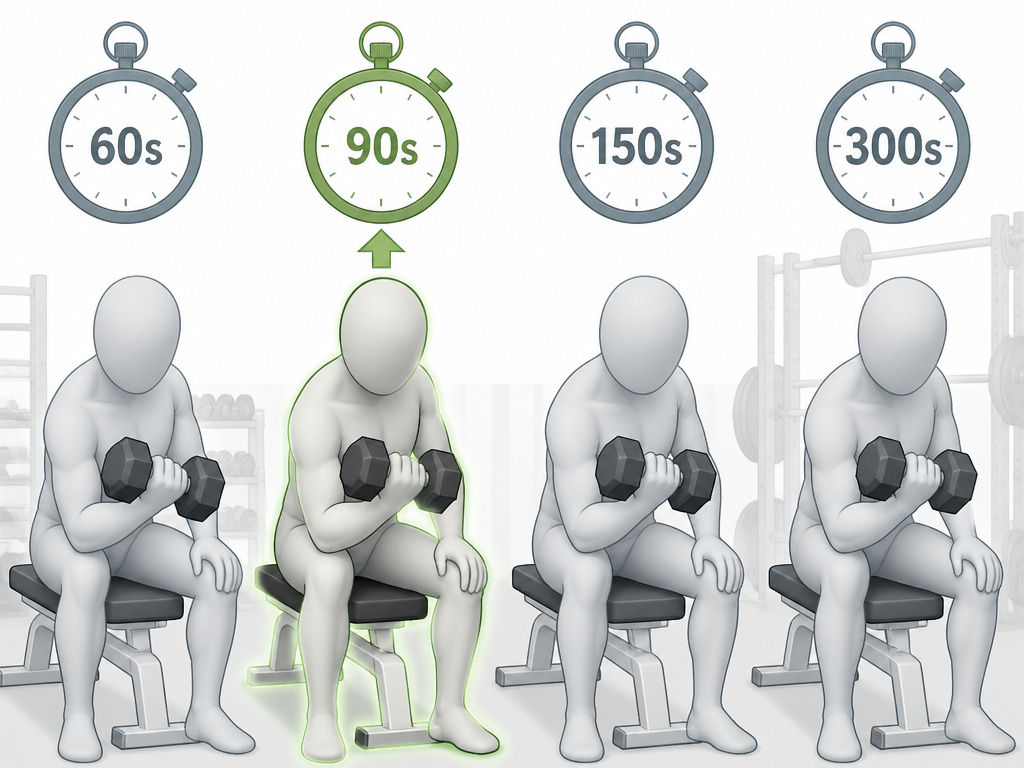
Four bands, and the middle one wins: 61 to 119 seconds posted the largest non-controlled effect size at 0.65.
| Rest Band | Non-Controlled SMD | What It Looks Like in the Gym |
|---|---|---|
| Short (60 s or less) | 0.47 | Superset pace, still breathing hard |
| Intermediate (61-119 s) | 0.65 | Two minutes, chalk back on, go |
| Long (120-179 s) | 0.55 | Three minutes, full recovery for squats |
| Very long (180 s or more) | 0.50 | Five minutes, near-max singles and doubles |
Read that table with the caveat attached. These are non-controlled effect sizes, meaning they describe how much each band improved from baseline, not how the bands compare head to head. Every band produced medium-to-large improvements. Rest interval length was not the thing standing between these subjects and growth.
What the Numbers Do Not Say
- The four-category pattern is not a smooth curve. It rises to the intermediate band and then falls, which the authors describe as a U-shape that casts doubt on the finding.
- Controlled comparisons were smaller and less flattering: arm 0.13, thigh 0.17, whole body -0.08.
- The probability that longer rest actually favored thigh growth was 88%, but the probability the effect exceeded “small” was only 54%.
- Whole-body measurements slightly favored shorter rest, though that analysis rested on three studies and indirect body-composition estimates.
How Long Should You Rest Between Sets?
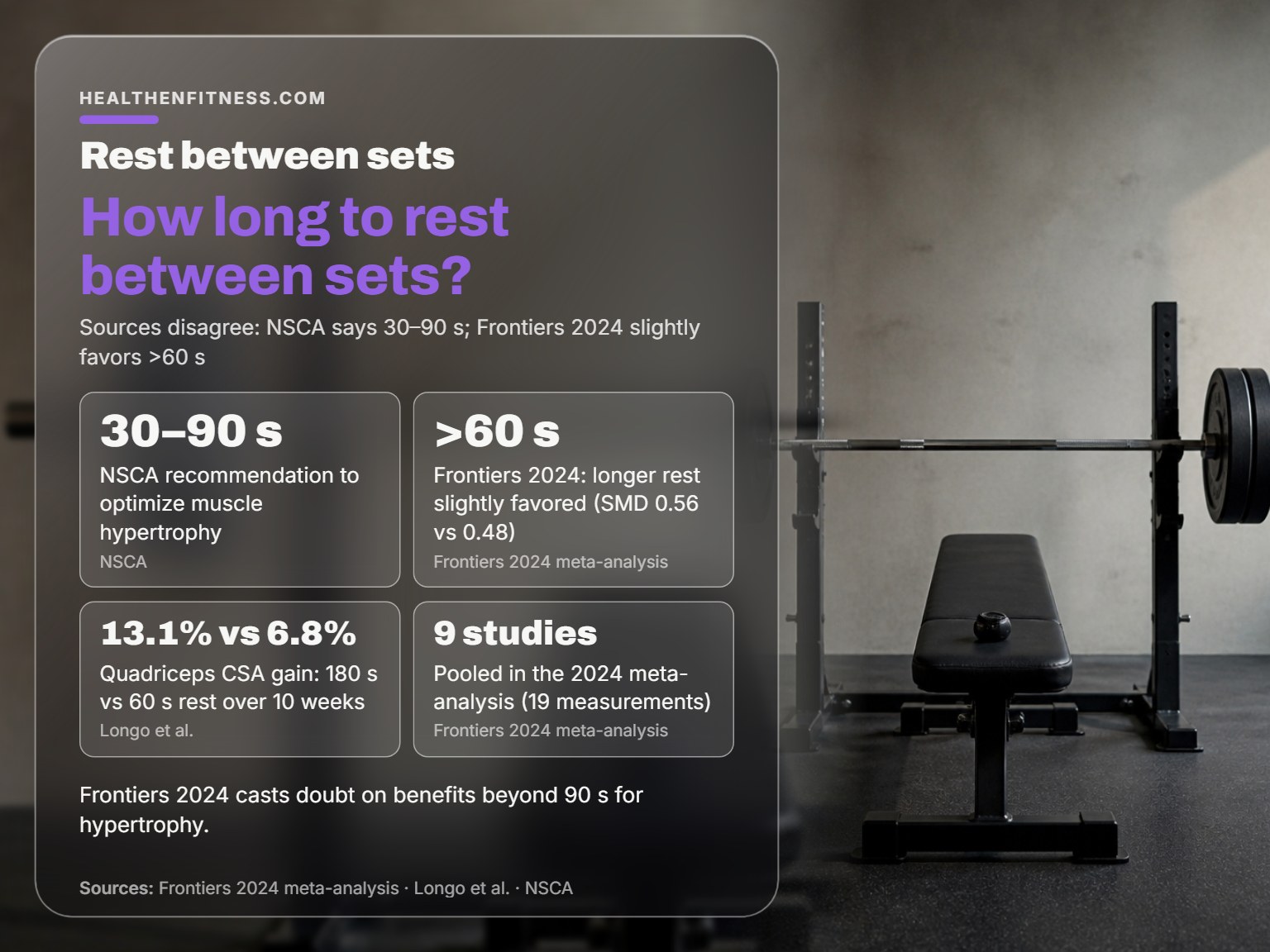
Two minutes is a reasonable default for many lifters, though the NSCA recommends 30–90 seconds, the Frontiers 2024 meta-analysis slightly favors over 60 seconds, and Built With Science advises at least 3 minutes for compound lifts.
Before you start: Holding your breath through a grinding rep spikes blood pressure hard, so breathe out on the way up. Racking a bar while you are still dizzy from a short-rest set is how plates end up on your foot, so wait until your breathing is quiet before you unload. If a joint pinches rather than a muscle burning, end the set.
- Set a timer instead of guessing. Most people under-rest without noticing. Use a rest timer between sets and log the interval next to the lift, so next month you can see whether your rest drifted.
- Use 90 seconds for isolation work as a starting point. Curls, lateral raises, and triceps work recover fast, though sources disagree: Fink et al. Found short rest (30 s) produced greater arm CSA gain, while the Frontiers 2024 meta-analysis found arm hypertrophy slightly favored longer (>60 s) rest.
- Use two to three minutes for compounds. Skipping this is why your third set of squats turns into a set of eight grindy reps at a weight you handled for twelve in week one.
- Cap it at three minutes unless you are chasing strength. Resting five minutes is defensible for heavy singles; for hypertrophy the Frontiers review casts doubt on benefits beyond 90 seconds, though McMahon et al. Found 5-min rest more efficacious acutely and de Salles et al. Found 3–5 min produced greater absolute strength gains.
- Log the rest, not just the weight. If your rest quietly drops from three minutes to 90 seconds over a month, your volume drops with it and you will blame your program.
By rep eight on short rest the bar speed drops visibly. The plates rattle a half-second slower and your last two reps grind instead of drive. That is fatigue talking, not effort.
If you like the idea of training pairs of exercises back to back, understand what it does to this math before you commit. Supersets vs straight sets is a rest-interval decision wearing a different hat.
Common mistake: Shortening rest to fit more exercises into an hour. You end up with more sets at lower quality, and the review’s volume-load data says the trade goes the wrong way.
What Rest Cannot Fix: Sleep, Volume, and Frequency
You finished the last set of squats, you have eleven minutes before you need to leave, and the rack is free. That is not a rest interval problem. That is a scheduling problem, and no stopwatch fixes it.
A barbell takes a beating, but no bar rescues a rest interval that is too short. Same for the bench. If you train at home, a bench is worth having for one plain reason: three-minute rests are a lot easier sitting down than standing over a bar.
Rest between sets is one variable in a stack. Your sets and reps determine the training stimulus. Your training frequency determines how often that stimulus repeats. Your sleep for muscle growth determines whether any of it consolidates.
The Three-Day-a-Week Version
Three full-body sessions a week is where most beginners should live for the first year, and rest intervals inside those sessions are simple. Two minutes on compounds, 90 seconds on everything else, three minutes on the last heavy set of the day.
Between sessions, the rest days question matters more than the seconds between sets. So does what to do on a rest day if you are the type who cannot sit still. Light movement on an off day beats a hard session you did not need.
The part nobody mentions: Rest intervals and total session length trade against each other. Adding a minute to every set across five exercises adds substantial time to the session. If that pushes you from four sessions a week to three, you lost more than you gained.
Where the Evidence Runs Out
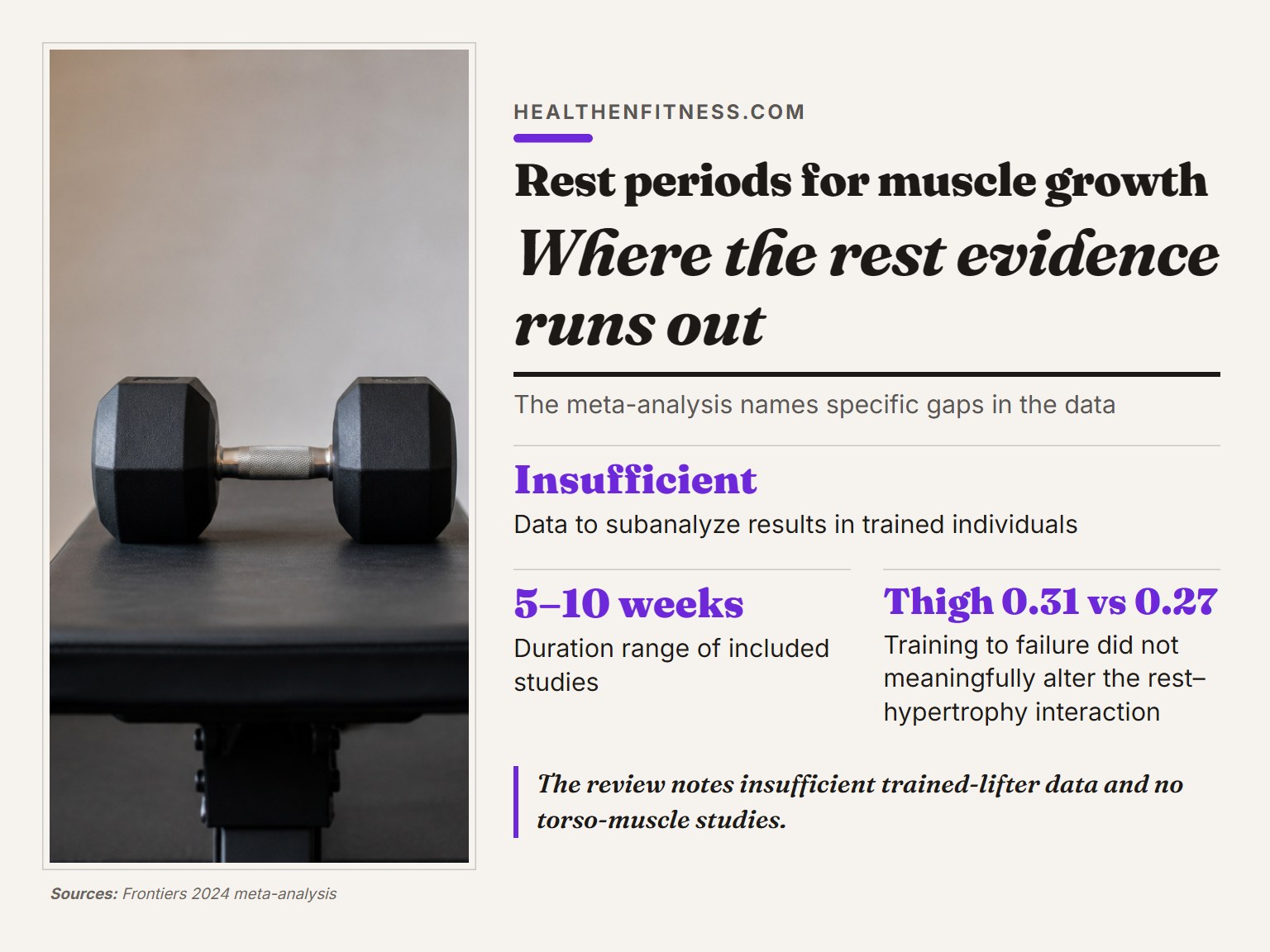
The gaps in the evidence are specific enough to name, and naming them is more useful than pretending they are not there.
Who the Data Actually Studied
The review states plainly that there was insufficient data to subanalyze results in trained individuals at all. The review states plainly that there was insufficient data to subanalyze results in trained individuals at all.
That matters because the untrained and trained findings point different directions. In untrained males, one study found no strength differences between 1 and 2.5 minutes of rest. In trained men, Schoenfeld et al. Found clear differences between 1 and 3 minutes, with longer rest producing greater anterior thigh thickness.
The untrained subanalysis in the review backs this up: longer rest gave a slight thigh benefit (SMD 0.17) but negligible arm (0.02) and whole-body (-0.05) effects.
Skip this if: You are a competitive strength athlete or a physique competitor in a peak block. The pooled data here is hypertrophy data from 5-to-10-week studies, mostly in untrained lifters. Your coach’s programming is a different conversation.
Two more holes worth knowing. No study has investigated rest interval length effects on torso muscles, meaning pectorals, lats, and deltoids are unmeasured. And the review notes that training to failure did not meaningfully alter the rest-hypertrophy interaction, which undercuts the common assumption that hard sets demand longer rest.
For the broader picture on how rest fits alongside load, volume, and frequency, this umbrella review resistance training variables is a reasonable next read. If you want the older hormonal framing that started the whole debate, the rest interval hormonal response study is where that thread begins, and the rest intervals and metabolic stress study covers the load-versus-rest angle.
Frequently Asked Questions
Is 60 seconds enough rest for hypertrophy?
It is enough to build muscle, yes. Short rest produced an effect size of 0.47 to 0.48 across the pooled studies, which is a real stimulus. It just was not the best-performing band. If you are short on time, 60 seconds works. If you are not, two minutes is a better use of the same hour.
Should I rest longer on compound lifts than isolation work?
Yes, and the data supports the split. The controlled arm estimate was 0.13 and the thigh estimate was 0.17, both slightly favoring longer rest, but the arm effect had only a 45% probability of exceeding “small.” Squats and deadlifts cost more to recover from than curls. Treat them differently.
Does rest time matter if I train to failure?
Less than you would think. Proximity to failure did not meaningfully change how rest length interacted with growth.
Why do guidelines still say 30 to 90 seconds?
Because the guideline predates the data that challenged it. The 30-to-90-second window was built on acute hormone research, and hormone spikes were assumed to drive hypertrophy. Later work found the spike does not track with muscle growth, but guidelines move slower than studies.
How do I know if my rest is too short?
Watch your rep counts across sets. Watch your rep counts across sets; if set three drops noticeably below set one at the same load, your rest may be too short for that exercise. Longo et al. Recorded 9.8 ± 2.9 reps on short rest versus 16.1 ± 5.2 on long rest across three sets, which is the size of the problem in plain numbers.
The Bottom Line
If your rest between working sets on squats, deadlifts, or rows is under 60 seconds, add a minute before you change anything else in your program. That single change costs you nothing and buys back reps you are currently leaving on the rack.
Here is the concession. Almost none of this applies cleanly to a competitive strength athlete in a meet prep block. The pooled evidence is hypertrophy data, drawn mostly from untrained lifters across 5-to-10-week studies, with no torso data and no trained-lifter subanalysis. If you are past your first few years of serious training, treat all of it as a starting point rather than an answer.
And the part I will defend even when someone disagrees: I would rather see you rest three minutes and finish six honest sets than rest 45 seconds and finish eight sloppy ones. The clock is a tool, not a virtue. Start lighter than your ego wants, log what you actually did, and let the rest interval serve the set instead of the other way around.
