
How Many Calories Should You Eat to Lose Weight?
This post contains affiliate links. As an Amazon Associate, we earn from qualifying purchases.
The calories you should eat to lose weight sit roughly 500 below your daily maintenance level. UK guidance puts average maintenance at 2,500 kcal for men and 2,000 kcal for women, so common targets land near 2,000 and 1,500. How many calories should you eat to lose weight depends on your maintenance level.
That 500-calorie gap is where WebMD and the British Heart Foundation converge on how many calories should you eat to lose weight, while the NHS simply states that weight loss requires eating and drinking fewer calories than you use. The number that actually works for you depends on your size, your activity level, and other individual factors.
What follows walks through the three numbers that decide your target: maintenance calories, the deficit you can actually live with, and the floor you shouldn’t cross. There’s also a section on why the calculator is only half the story.
Key Takeaways
- A 500-calorie daily deficit is the standard starting point; it produces roughly 1 lb of loss per week.
- UK maintenance averages are 2,500 kcal for men and 2,000 kcal for women, but age and activity shift those numbers by hundreds of calories.
- Don’t go below 1,200 kcal (women) or 1,500 kcal (men) without a doctor involved; WebMD calls lower intake potentially unhealthy.
- Protein and fibre do more for hunger than willpower does, and both let you hold a deficit without white-knuckling it.
- Walking counts. Adding daily movement can help raise your energy burn without changing your food intake.
What Does a Calorie Deficit Actually Mean?
A calorie deficit means you’re eating fewer calories than your body burns in a day. That’s the whole mechanism. Your body fills the gap by breaking down stored fat, and the scale moves down over time.
The Mifflin-St Jeor equation estimates basal metabolic rate from weight in kilograms, height in centimeters, and age in years. Men add five; women subtract 161. The Mifflin-St Jeor equation estimates basal metabolic rate, which can then be used to estimate maintenance calories, the number a deficit is subtracted from.
The deficit drives the loss, which is why the how many calories should you eat to lose weight question matters. Protein, meal timing, and cardio all matter as support systems, because they help you hold the deficit for weeks at a time.
WebMD puts it plainly: you won’t lose weight without a calorie deficit, and a 500 calorie a day deficit is about 1 lb per week.
The British Heart Foundation adds a useful caveat. Their guidance says you don’t have to count calories at all if you’d rather track weight, waist measurement, or how your clothes fit. Both approaches describe the same deficit. They differ on whether you need to measure it.
The Maintenance Numbers Most People Start From
Maintenance is the number you subtract from. Get it wrong and every deficit calculation downstream is off.
Healthline, citing the 2020-2025 Dietary Guidelines for Americans, lays out the age-banded ranges most adults fall into.
| Group | Age | Daily calories |
|---|---|---|
| Adult women | 19-30 | 1,800-2,400 |
| Adult women | 31-60 | 1,600-2,200 |
| Adult women | 61+ | 1,600-2,200 |
| Adult men | 19-30 | 2,400-3,000 |
| Adult men | 31-60 | 2,200-3,000 |
| Adult men | 61+ | 2,000-2,600 |
Notice the spread. A 25-year-old man and a 65-year-old man can differ by 800 calories a day at maintenance, which is nearly two full meals.
The Mifflin-St Jeor Formula
To get a specific number, the Mifflin-St Jeor equation is the one NASM and Healthline both use. Men: (10 x weight in kg) + (6.25 x height in cm) – (5 x age) + 5. Women: same formula, minus 161 instead of plus 5.
The Activity Multipliers
Multiply the result by an activity factor to estimate your total daily energy expenditure. If you’d rather not do the arithmetic, a TDEE calculator guide walks through the multipliers step by step.
A basic digital food scale is more accurate than eyeballing portions, and it costs less mental energy than you’d think once it lives on the counter.
How Big Should Your Deficit Be?
Sources disagree on this, and it’s worth seeing the disagreement laid out rather than picking one number and pretending it’s universal.
| Source | Recommended deficit | Expected loss |
|---|---|---|
| NASM | 500-1,000 kcal/day | Up to 2 lb/week |
| WebMD | ~500 kcal/day | About 1 lb/week |
| British Heart Foundation | 500-600 kcal/day | 1-2 lb/week |
BHF sits at the conservative end with 500-600. NASM stretches up to 1,000. None of them is wrong. A bigger deficit produces faster loss, but it’s harder to hold.
If you want a fuller picture of what’s realistic, the rate of weight loss piece on this site goes deeper.
A 1,000-calorie deficit sounds heroic on paper. In practice, it usually shows up as a headache around 3pm and a sudden interest in the office biscuit tin.
Common mistake: Chasing the biggest deficit you can tolerate on day one. The first week feels fine because water weight drops fast, then week two hits and you’re ravenous, irritable, and ready to quit. Start at 500 and only widen it if the scale stalls for three weeks.
Why the Calculator Is Only Half the Story

Self-reported calorie intake is unreliable, and that’s not a character flaw. It’s a measurement problem.
Research cited in a dietary interventions for obesity review found that self-reported intake often underestimates actual intake. People aren’t lying. They’re forgetting the oil they cooked with, the handful of nuts, and the splash of milk in three coffees.
I’ve watched people swear they eat 1,500 calories, then log a weekend honestly and find 3,000. The food wasn’t hiding. The portions were.
Calorie-tracking apps make logging easy; the hard part is remembering to log the oil. A calculator built on label data inherits that error, which is one reason two people eating “the same” 1,800 calories can get different results.
The British Heart Foundation takes a different angle entirely. Their guidance says you don’t have to count calories at all; tracking weight, waist measurement, or how your clothes fit is enough for a lot of people.
If you do want to track, the calorie tracking approach that works best is the one you’ll actually keep up.
The Daily Calorie Floor You Shouldn’t Cross
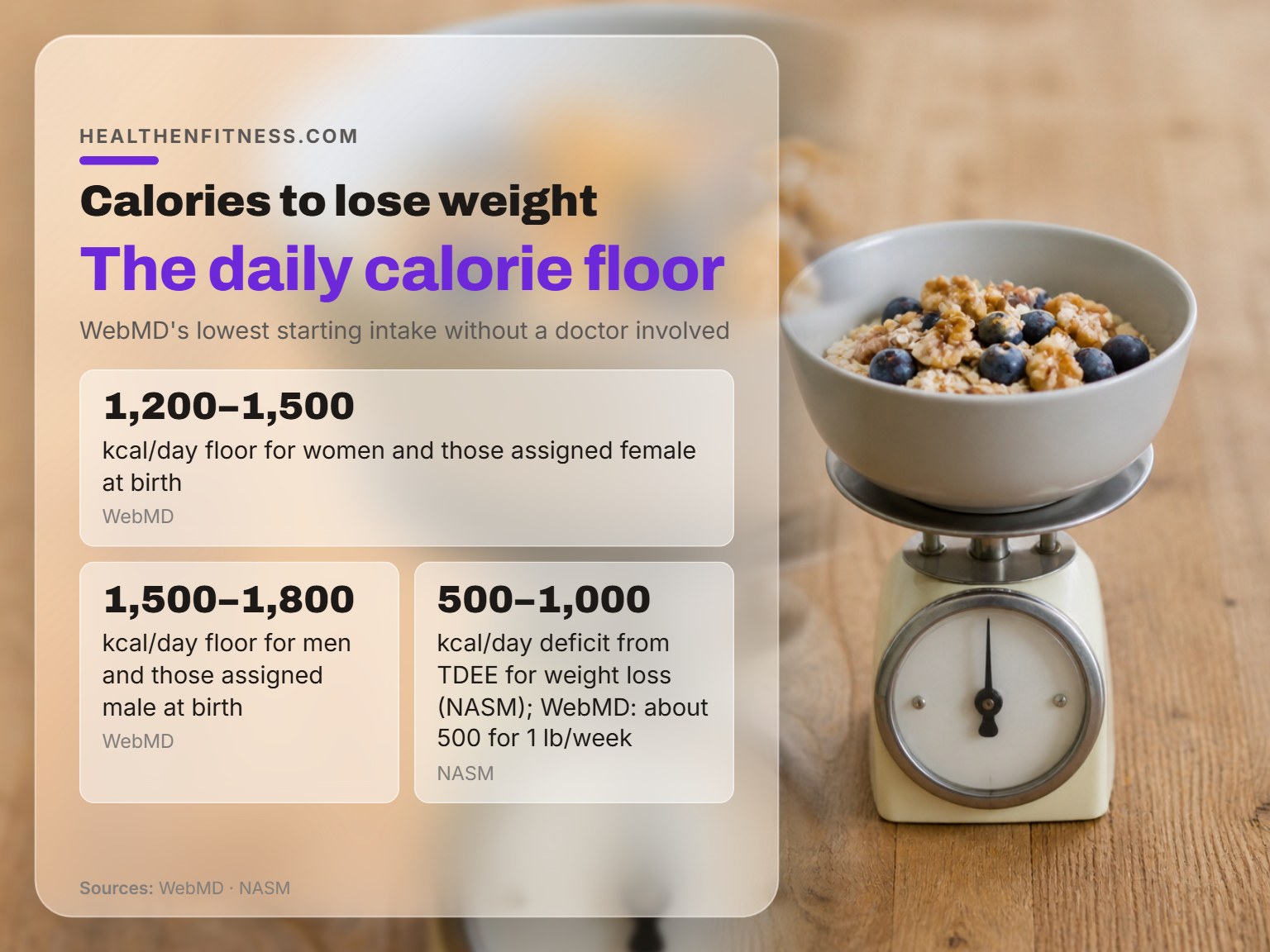
There’s a floor, and it’s lower than most people think but higher than some diets suggest.
WebMD sets the floor at 1,200-1,500 kcal for women and 1,500-1,800 for men, and warns that going below it can be unhealthy.
Where this goes sideways: Treating 1,200 as a target rather than a floor. That number is the lowest intake most adults should attempt without a doctor involved. If you’re hitting it and still hungry, the fix is a smaller deficit, not a lower floor.
The scale doesn’t move in a straight line. You can hold a 500-calorie deficit for ten days, see nothing, then drop 1.5 pounds overnight when your body finally lets go of water.
NASM warns that prolonged severe calorie restriction can lead to malnutrition, organ dysfunction, and other serious complications. The floors exist for a reason.
If you’re hungry enough to be irritable, your deficit is too big. Shrink the deficit, not the food quality.
Protein, Fat, and Carbs: The Split That Keeps You Full
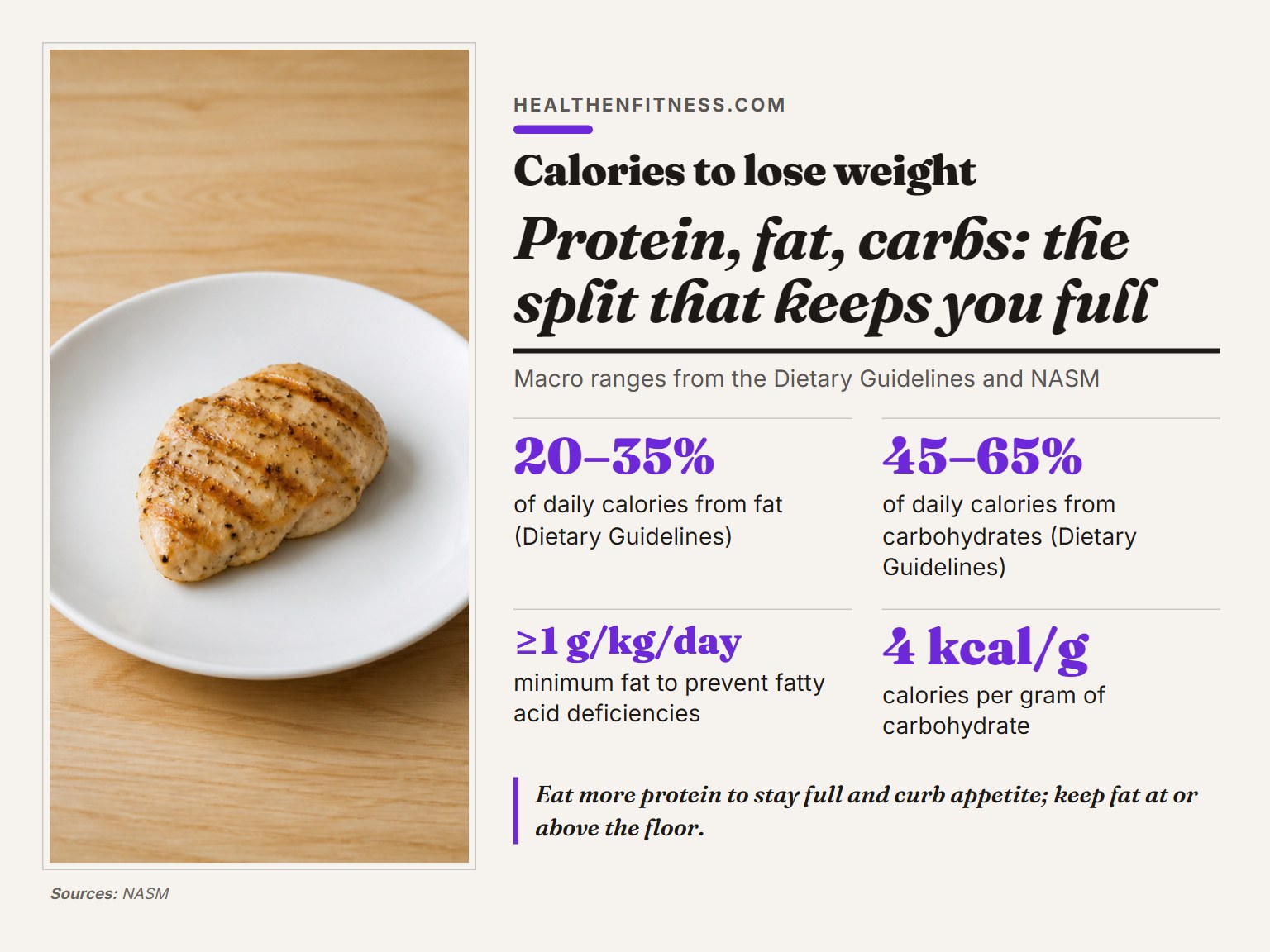
Three numbers matter here: protein grams, fat grams, and carb grams.
Protein: The Lever Most People Underuse
Healthline’s advice is blunt: eat more protein to stay full and curb appetite. A protein intake plan that puts a palm-sized portion on every plate does more for hunger than any app will. Protein also helps preserve muscle while you’re in a deficit, which is why every coach harps on it.
Fat: The Floor That Matters
NASM recommends at least 1 g per kg of body weight per day to prevent fatty acid deficiencies, and the Dietary Guidelines put fat at 20-35% of total calories. A dietary fat target below that floor is one of the few places where “eating less” genuinely backfires.
Carbs: The Flexible Macro
The Dietary Guidelines put carbohydrates at 45-65% of calories, and each gram is 4 calories. You can slide within that range based on what keeps you full and what you actually enjoy eating. Cutting carbs to zero isn’t required for fat loss, and it isn’t sustainable for most people.
Whatever split you land on, the goal during a deficit is to preserve muscle while you lose fat. Protein and resistance training are the two levers that make that possible.
Walking, NEAT, and the Calories You Don’t Notice

You finish a 45-minute gym session, drive home, sit at a desk for eight hours, and wonder why the scale hasn’t moved.
I used to think my gym session was the whole story. Then I looked at my phone’s step count on a desk-bound day and saw 2,100 steps. On a day I paced during calls and walked to the shop, it was 8,000. Same workout, same food, wildly different energy burn. When I raised my daily average from about 5,000 to 8,000 steps using a basic phone pedometer, my weekly progress picked up without me touching my food intake. I learned that one the hard way.
That’s NEAT: non-exercise activity thermogenesis, the calories you burn on your feet, fidgeting, and generally not sitting still. It’s the most variable part of your daily burn, and for a lot of people it’s the difference between a deficit and maintenance.
A daily steps target can be a reasonable way to track activity, and a basic pedometer or phone is all you need to track it.
The phone in your pocket buzzes at 8,000 steps. That little vibration is the cheapest feedback loop in fitness.
Cardio helps too, but it’s a smaller lever than most people think. A cardio for weight loss plan that adds two or three sessions a week is plenty; more than that and you’re mostly buying fatigue.
I won’t pretend walking is a workout. It isn’t. But it’s the cheapest way to add 200-300 calories of daily burn without adding hunger, and hunger is what kills most deficits.
When Counting Calories Stops Helping
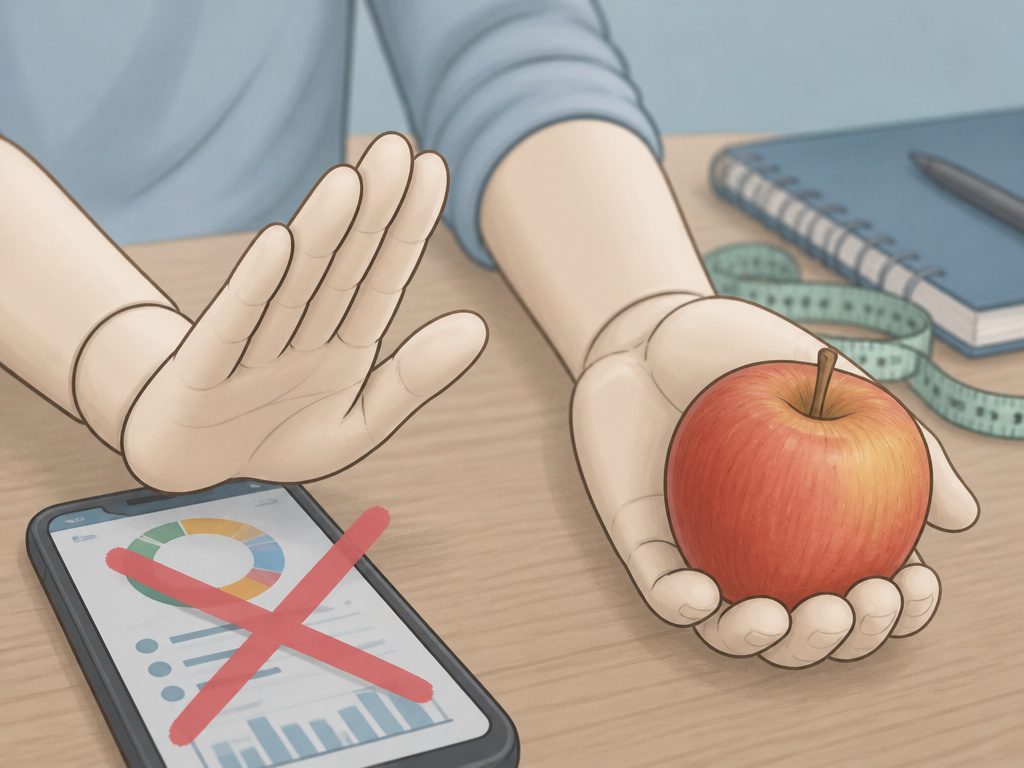
Counting works for some people and quietly wrecks others. The difference isn’t willpower.
Healthline flags the risk.
Healthline is explicit about children: cutting a child’s calorie intake may increase the risk of nutritional deficiencies, slow growth, and foster a difficult relationship with food. Their advice is to skip counting entirely and focus on a balanced diet with plenty of nutrient-dense foods.
I’ve had clients who counted every almond for six months and were miserable, and clients who tracked loosely and lost the same weight. The difference was never the app.
BHF’s position is the same in spirit. You don’t have to count calories to maintain a healthy weight; tracking weight, waist measurement, or how your clothes fit is enough for a lot of people.
If you’ve been at it for a while and the scale has stopped moving, a weight loss plateau usually has a specific cause, and it’s rarely “you need to eat less.”
Skip this if: You’ve had an eating disorder, or you find yourself weighing food at midnight and feeling guilty about an apple. The numbers are a tool, and tools get put down when they stop helping.
Frequently Asked Questions
How many calories should I eat to lose 1 lb a week?
500-calorie daily deficit produces roughly 1 lb of loss per week, per WebMD. The British Heart Foundation says a 500-600 calorie daily deficit usually leads to about 0.5-1 kg (1-2 lb) per week. If your maintenance is 2,200, your target lands around 1,700. If your maintenance is 1,800, your target lands near 1,300, which is close to the floor for most women.
Is 1,200 calories a day safe?
WebMD sets the floor at 1,200-1,500 for women and 1,500-1,800 for men, and warns that going below it can be unhealthy. For most adults, 1,200 is the lowest number to attempt without a doctor involved.
Do I need to count calories to lose weight?
The British Heart Foundation says no. Their guidance says you can track weight, waist measurement, or how your clothes fit instead. The NHS frames weight loss as eating and drinking fewer calories than you use, which is the same deficit described a different way. Both agree the deficit matters; they differ on whether you need to count it.
Why am I not losing weight on 1,500 calories a day?
The most common reason is that you’re eating more than 1,500 without realizing it. Research in a dietary interventions review found self-reported intake often underestimates actual intake. The second most common reason is that your maintenance has dropped as you’ve lost weight, so 1,500 is no longer a deficit. Recalculate periodically as your weight changes.
How many calories should a woman eat to lose weight?
Healthline’s Dietary Guidelines ranges put adult women at 1,600-2,400 kcal per day for maintenance, depending on age. Subtract a 500-calorie deficit and the low end can fall below WebMD’s 1,200 floor. For most women, a target between 1,300 and 1,800 is the practical range.
Can I lose weight without exercise?
Yes, technically. The deficit is driven by food intake, and BHF notes that changing your diet is the bigger lever. But exercise helps hold the deficit by raising your daily burn, and resistance training specifically helps preserve muscle while you lose fat. Walking counts as exercise here, and it’s the easiest place to start.
The Bottom Line
One rule worth keeping: if you’ve been at the same weight for three weeks on the same intake, you’re at maintenance, not in a deficit. That’s not failure. It’s data. Reduce your intake slightly or add some daily movement, then give it another three weeks before you change anything else.
Most diet advice sells the deficit as the hard part. The hard part is holding it for eight weeks while your life keeps happening. A smaller deficit you actually keep beats a larger deficit you abandon in ten days. Every time.
This all assumes you’re an adult without a history of disordered eating, without a medical condition that affects metabolism, and without a pregnancy in the picture. If any of those apply, the numbers above are a starting point for a conversation with your doctor, not a plan.
Today, just calculate your maintenance once, subtract 500, and eat that for two weeks without changing anything else. Write the number on a sticky note and put it on the fridge. Start smaller than you think you need to.
