
How Much Protein Do You Need to Build Muscle?
This post contains affiliate links. As an Amazon Associate, we earn from qualifying purchases.
Protein to build muscle: most published guidance lands between 1.6 and 2.2 g/kg per day, and the largest meta-analysis of the question found no extra fat-free mass gain above 1.62 g/kg per day. Your exact number depends on age, training history, and whether you’re cutting.
Those two figures sit far enough apart that two people can quote the same body of research on how much protein do you need to build muscle at each other and both come away right. The gap traces to what each group measured: lean mass added in a surplus, muscle held onto in a deficit, or strength on a fixed program.
What follows: the numbers that actually decide your target, the age and cutting exceptions where standard advice flips, and why your daily total matters more than the shake you drink after training.
Key Takeaways
- 1.62 g/kg/day is where the biggest meta-analysis stopped seeing extra fat-free mass gains from protein supplementation.
- 0.7 to 1 g/lb is the range Gold’s Gym publishes, which works out to roughly 1.6 to 2.2 g/kg, while Hartford HealthCare’s rule of thumb is 0.7 g/lb.
- Age cuts both ways. Supplementation helps older lifters less, yet older adults may need more total protein per day and per meal.
- In a deficit, protein goes up. One review puts the useful figure at about 1.6 g/kg/day during a 500 to 750 kcal daily deficit.
- Your daily total beats your timing. The post-exercise protein dose didn’t change outcomes in the meta-analysis.
What the Largest Meta-Analysis Actually Found
Morton and colleagues pooled 49 randomised controlled trials covering 1,863 participants, all involving resistance training of at least six weeks.
Protein supplementation raised fat-free mass by 0.30 kg and one-rep-max strength by 2.49 kg across the pooled trials. Muscle fibre cross-sectional area rose by 310 square micrometres. The dose-response curve flattened at a total intake of 1.62 g/kg per day, and beyond that point added protein produced no measurable further gain in fat-free mass.
Fat-free mass means everything in your body that isn’t fat. The 1.62 g/kg figure is a ceiling on what a supplement adds, and it isn’t a floor you have to clear.
Lifting alone added 1.1±1.2 kg of fat-free mass over a mean of 13±8 weeks. Protein pushed that to 0.30 kg more, a 27 percent increase.
Read the ordering again. The training did most of the work. Protein was the smaller lever, and it only pulled while total intake sat below that mark.
There’s a wrinkle worth knowing. The protein supplementation meta-analysis on hypertrophy found supplementation worked better in people who were already resistance-trained, adding 0.75 kg of fat-free mass, and worse as age climbed.
Earlier work went at this with nitrogen balance, including the protein requirements in novice bodybuilders study from 1992.
Why the Numbers Don’t Agree
Forty-nine trials, 1,863 participants, and the published daily targets still spread from about 1.54 to 2.2 g/kg.
Each group answered a slightly different how much protein do you need to build muscle question, and the answers don’t collapse into one number.
| Source | Daily target | What it’s measuring |
|---|---|---|
| Morton 2018 meta-analysis | 1.62 g/kg/day | Ceiling on supplement effect |
| Hartford HealthCare (Barrett) | 0.7 g/lb (~1.54 g/kg) | General rule for muscle gain |
| Gold’s Gym | 0.7-1 g/lb (1.6-2.2 g/kg) | Range for muscle gain |
| Phillips et al. Review | ~1.6 g/kg/day | Muscle retention in a deficit |
Morton’s team wanted the point where adding protein stopped doing anything. That’s a ceiling.
Hartford’s Chris Barrett, a registered dietitian, gives a rule of thumb for a healthy adult trying to add muscle. That’s a starting point.
Gold’s Gym publishes a range and states that eating well beyond it won’t build extra muscle. Phillips and colleagues looked at people in a calorie deficit and asked how much protein holds muscle in place.
I’ve come around on presenting it this way. One number invites an argument. Four numbers with their questions attached let you pick the one that matches your situation.
Gender gets glossed over more than it should. Gold’s Gym’s position is that the target doesn’t change by gender, and the same 0.7 to 1 g/lb applies to women. Morton’s group found no clear sex-based differences but noted far less work has been done in women. The protein needs for women picture is thinner in the data than anyone would like.
The ISSN protein and exercise position stand takes up the exercising-population case separately, and it’s worth reading in full rather than through a summary.
How Much Protein Do You Need to Build Muscle at Your Body Weight?
Scale weight does most of the work here.
- Weigh yourself on the same scale, at the same time of day. Write the number down. Skip it and you’re guessing, and a guess of ten pounds moves your daily target by several grams of protein.
- Multiply by 0.7. That’s your floor. A 154 lb lifter lands around 112 to 154 grams a day.
- Multiply by 1.0. That’s your ceiling. The same lifter’s upper end is around 154 grams.
- If you’re carrying a lot of extra fat, run the math on your goal weight. Gold’s Gym’s reasoning is that fat doesn’t need feeding the way muscle does. Skip this and your target comes out higher than it needs to be.
| Body weight | Lower end (0.7 g/lb) | Upper end (1 g/lb) |
|---|---|---|
| 132 lb (60 kg) | 96 g | 132 g |
| 154 lb (70 kg) | 112 g | 154 g |
| 175 lb | 125 g | 175 g |
| 198 lb (90 kg) | 145 g | 198 g |
The 132, 154 and 198 pound rows come from Gold’s Gym’s reference table. The 175 pound row is Hartford’s own worked example at 0.7 g/lb.
Hitting 112 grams is a food problem, not a math problem. A muscle-building foods list does more for you than a calculator.
I spent a couple of weeks weighing every gram on a food scale and got twitchy about it. Now I weigh carefully for a week or two to learn what portions look like, then eyeball it and check the two-week trend.
Does Age Change the Target?
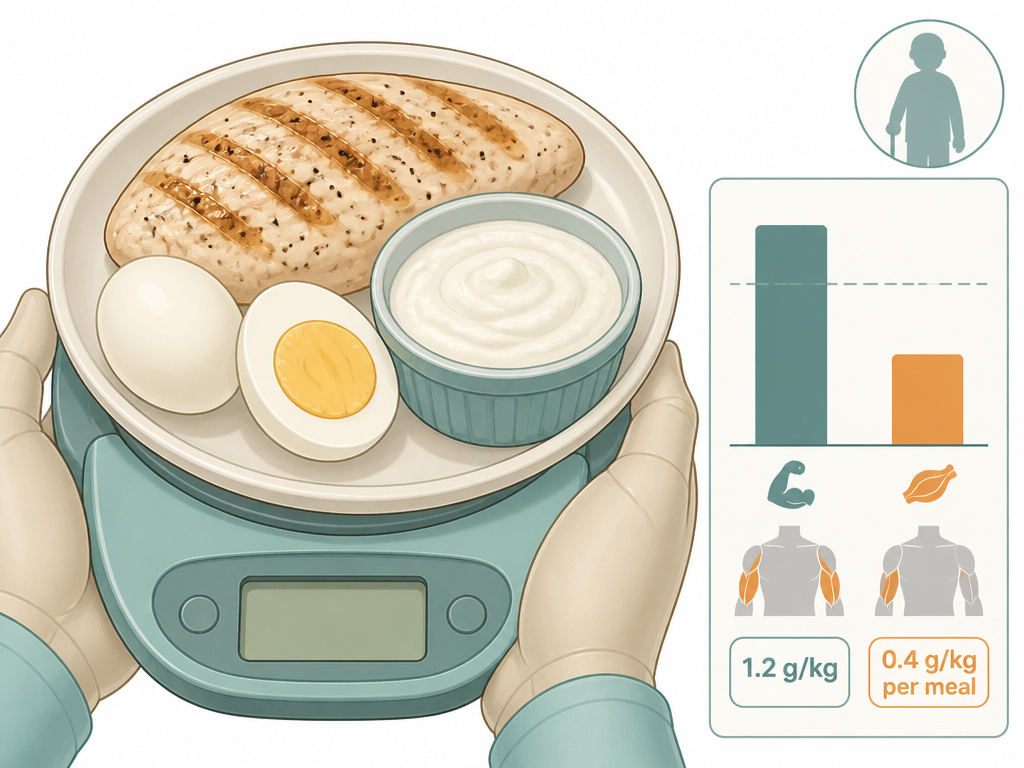
Two reviews point in opposite directions on age, and both are working from real data.
Phillips and colleagues report that protein at or above 1.2 g/kg/day is linked to less unintentional weight loss in older adults. They put 1.5 g/kg as potentially useful against sarcopenia, which is age-related muscle loss. And they flag at least 0.4 g/kg per meal (0.6 g/kg of lean body mass) as important for holding muscle and strength.
Morton’s group found the reverse on supplementation: the effect on fat-free mass gains shrank with each year of age.
Both can be true. Morton measured what a supplement adds on top of whatever someone already eats, inside a training study. Phillips measured the total intake needed to preserve muscle.
If you’re over 60 and lifting, treat 1.2 g/kg as the floor and 0.4 g/kg per meal as the number that decides whether the day counted.
The mechanism is a blunted response. Advanced age limits the muscle-building signal that normally follows a protein feed, which is why a bigger single dose may be needed to get the same effect.
The dietary protein and muscle mass review even floats 70 grams in a single meal as possibly useful for older adults, by suppressing whole-body protein breakdown.
Cutting, Bulking, and the Deficit Exception
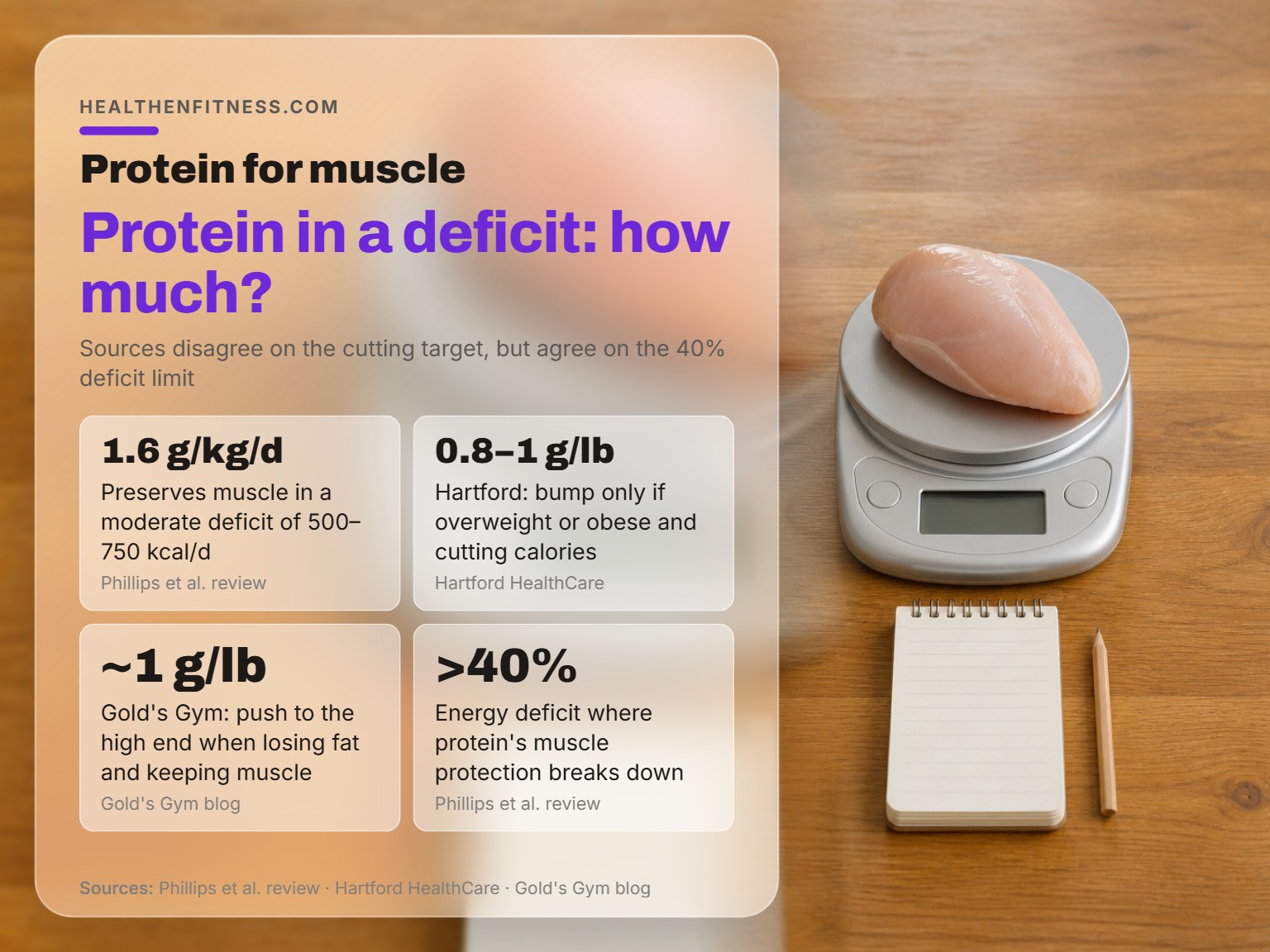
You’re three weeks into a deficit, training hard, and the scale is dropping but so is your bench.
Three sources, three positions:
- Hartford says bump to 0.8 to 1 g/lb only if you’re overweight or obese and cutting calories.
- Gold’s Gym says push to the high end, around 1 g/lb, whenever you’re losing fat and keeping muscle.
- Phillips puts the useful figure at about 1.6 g/kg/day during a moderate deficit of 500 to 750 kcal a day.
The Phillips review also names the point where the protection breaks. Once the deficit goes beyond 40 percent of daily energy needs, more of the protein you eat gets oxidized for fuel and less is available to hold muscle.
That’s the practical warning. A hard cut for weeks on end is where the higher-protein advice stops delivering.
Where this goes sideways: Chasing a steep deficit for a month or more while trusting protein to hold everything. Past that 40 percent line, strength on the bar drops before the scale tells you anything.
If you’re trying to gain muscle without fat, the deficit question decides your number more than your body weight does.
Per-Meal Dose and the Carb Question
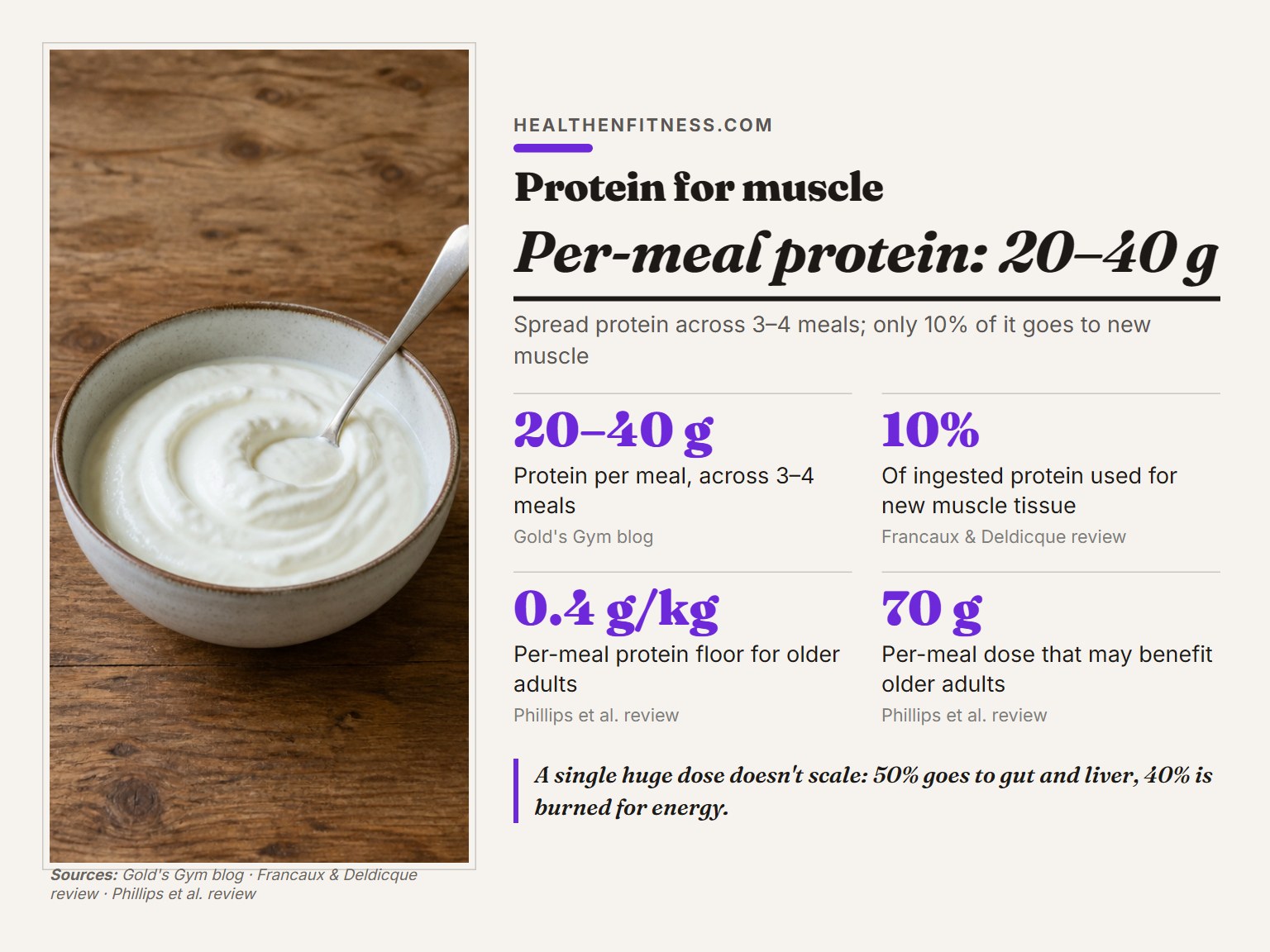
Does any of this change if you eat it all at dinner?
For me, yes. Aiming for roughly 20 to 40 grams at each meal cut my snacking more than any willpower trick I’ve tried, and Greek yogurt at breakfast was the easy win. That’s an observation from my own kitchen, not a study result.
Gold’s Gym’s guidance is 20 to 40 grams per meal across three or four meals. Phillips puts the older-adult floor at 0.4 g/kg per meal and floats 70 grams as possibly beneficial for older adults.
The mechanism behind per-meal dosing is a saturable funnel. Only about 10 percent of the protein you eat gets used for new muscle tissue, 50 percent is taken up by the gut and liver, and 40 percent is burned for energy. That’s why a single huge dose doesn’t scale.
Common mistake: Stacking most of your protein at dinner. You end up short at breakfast and lunch, and the daily total is the number the research keeps pointing at.
Should You Add Carbs to Your Post-Workout Protein?
The protein intake and muscle hypertrophy update says no, at least not for the muscle-building response. Insulin above roughly 5 IU/mL, barely above fasting, doesn’t appear to activate muscle protein synthesis. Insulin mostly works by slowing breakdown, and slowing it too much may interfere with the recycling that repairs tissue.
Gold’s Gym’s point is different and still stands: you need enough total calories and carbs to grow, and those calories are better spent on carbs than on protein past about 1 g/lb.
A badly mixed shake leaves a chalky film across your teeth and the back of your throat. That’s one reason I’d rather eat yogurt and skip the debate.
Worth separating the protein absorption limit question from the protein timing question. They get bundled together and they shouldn’t be.
What to Actually Eat, and When Powder Earns Its Place
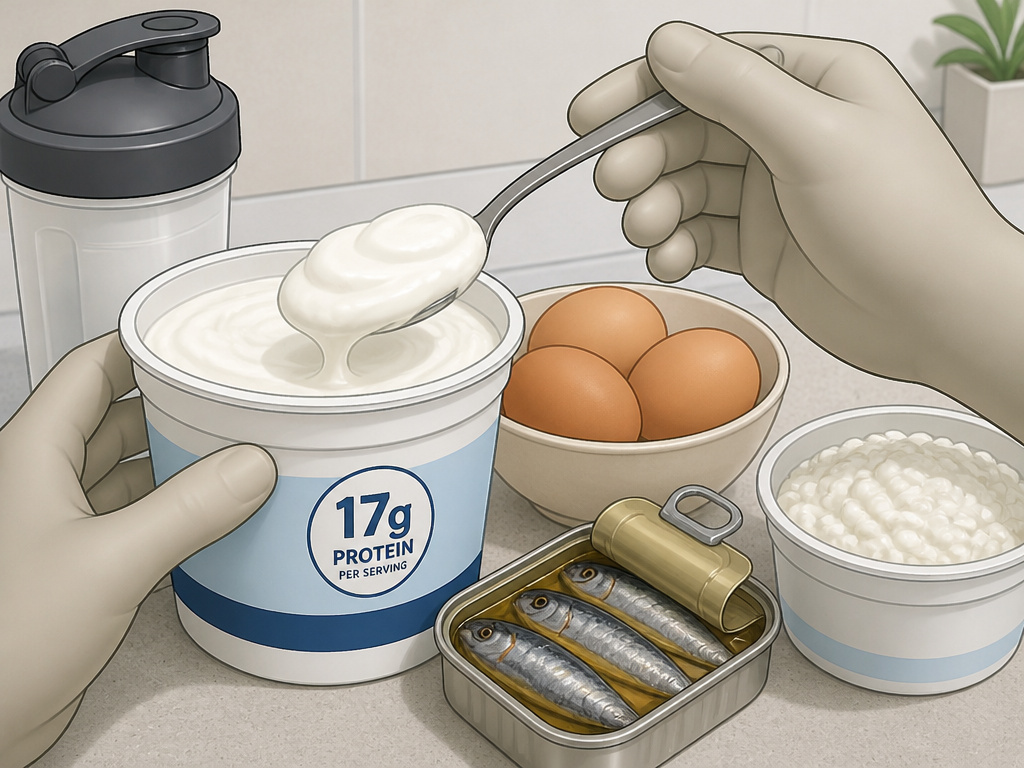
Greek yogurt does more for this than any tub of powder.
- Fage Total 0% Greek yogurt. Mostly protein by weight, no cooking, and it goes down at 7am when nothing else does.
- Eggs. Cheap, and they carry a full spread of amino acids.
- Canned sardines or tuna. Shelf-stable, and the sort of thing you’ll actually eat on a bad day.
- Cottage cheese. Slower digesting, which makes it a good last meal of the day.
- Tofu and tempeh. Plant options that fit the same slot.
A whey powder that is mostly protein and carries third-party testing is the kind I’d point at if you want one. It’s convenience, not a requirement. Hartford’s advice is to pick a product that’s mostly protein and carries third-party testing like NSF Certified for Sport.
Plant-based eaters can hit the same totals, but Hartford notes plant proteins run lower in some amino acids, so variety across the day matters more than any single source. The protein for vegetarians approach leans on legumes, whole grains, nuts, seeds and soy rather than one hero food.
Isolated, intact proteins give a bigger anabolic response than mixed meals, according to the Phillips review. That’s the argument for a plain yogurt or a piece of fish over a bar with twenty ingredients.
Skip this if: you have kidney disease or a diagnosed condition that affects protein metabolism. Every range here is for healthy adults, and your clinician’s number overrides this article.
A shaker bottle left in a gym bag overnight smells faintly of sour milk and old pennies, and no amount of rinsing fixes it. Rinse it at the gym.
If you want a straight answer on do you need protein powder, the honest one is that it solves a logistics problem and nothing else. I use a food-tracking app for the two-week check, mostly because it shows the daily total without turning it into a game. For the food side, the best protein sources list covers what to put on the plate.
Frequently Asked Questions
Is 1.6 g/kg of protein enough to build muscle?
For most healthy adults in a resistance-training program, yes. The largest meta-analysis found protein supplementation stopped adding fat-free mass beyond a total intake of 1.62 g/kg/day. Gold’s Gym’s upper bound of 2.2 g/kg sits above that, and the two figures come from different questions rather than a contradiction.
Do you need protein right after a workout?
The post-exercise dose didn’t change outcomes in the Morton meta-analysis. Hartford’s guidance is that eating protein within an hour or two of training, as part of a regular meal, can help with repair. Your daily total carries more weight than the clock.
Can you build muscle on 0.7 g/lb of protein?
That’s about 1.54 g/kg, which is Hartford’s rule of thumb for a healthy adult trying to add muscle. It sits just under the 1.62 g/kg supplementation ceiling, so it’s a reasonable target. If you’re older or in a calorie deficit, the sources push the number higher.
Does the protein target change for women?
Gold’s Gym’s position is that it doesn’t, and the same 0.7 to 1 g/lb applies. Morton’s group found no clear sex-based differences but acknowledged that far less research has been done in women than in men, so treat the confidence level as lower.
Is 2 g/lb of protein too much?
Hartford calls 2 grams per pound unnecessary, and Gold’s Gym says more than about 1 g/lb won’t build extra muscle. The calories are better spent on carbohydrates that fuel training. Nobody in these sources is arguing that 2 g/lb is dangerous for healthy adults, only that it’s wasted effort.
The Bottom Line
The concession first. None of this matters much if your training is inconsistent. Lifting alone accounted for 1.1 kg of fat-free mass in the meta-analysis, and protein added 0.30 kg on top. Fix the training before you optimize the food.
Then the trigger. If your daily total sits under 1.2 g/kg, that’s the one number to move this month, and it moves by putting protein at breakfast and lunch rather than adding a shake at night. Steady beats flashy.
One more thing worth flagging. If you’re over 60, the floor moves up to 1.2 g/kg and the per-meal dose starts to matter as much as the daily total. That’s the one group where the standard advice genuinely changes shape.
Today, just put a palm-sized serving of protein next to your coffee tomorrow morning and see what it does to your 3pm snacking.
