
How Much Protein Should You Eat When Cutting?
This post contains affiliate links. As an Amazon Associate, we earn from qualifying purchases.
How much protein should you eat when cutting depends on whether you measure against body weight or fat-free mass. Research on lean, resistance-trained athletes points to 2.3-3.1 g/kg of fat-free mass, scaled up with leanness and calorie restriction. For most people cutting, 0.7-1 g/lb of body weight is a practical floor.
The two numbers use different denominators, and that’s where most of the confusion starts. Helms measures protein against fat-free mass. Legion measures against total body weight. The body-weight math at 1 g/lb gives 200 g. Close, but not identical, and the gap widens as body fat rises.
What follows walks through the research on both sides, the practical math for your own body weight, and the one meal most people skip that quietly wrecks their daily total.
Key Takeaways
- 2.3-3.1 g/kg of fat-free mass is the Helms et al. 2014 recommendation for lean, resistance-trained athletes in a deficit, scaled up with leanness and restriction severity.
- 0.7-1 g/lb of body weight is the Legion Athletics floor for general cutting, with 1-1.2 g/lb for men under 8% body fat and women under 18%.
- The RDA of 0.8 g/kg/d is adequate when you’re not stressed, but Kim et al. 2019 found higher intakes attenuated lean mass loss during energy restriction by 0.41 kg.
- Tolerance to higher protein intakes may depend on how long the deficit runs, so watch for signs the number is too high.
- Protein at breakfast and lunch, not just dinner, is where most people leave grams on the table.
Why the Protein Numbers Disagree So Much
Two credible sources, two very different numbers. That’s the first thing to sort out before you pick a target.
I’ve had this conversation more times than I can count. Someone reads one article, sees 2.3 g/kg, and starts eating 250 g of protein a day without knowing why. Then they wonder why they’re too full to eat a potato.
Helms et al. 2014 recommends 2.3-3.1 g/kg of fat-free mass for lean, resistance-trained athletes in a deficit. Legion Athletics recommends at least 0.7-0.8 g/lb of body weight for the same general goal, up to 1 g/lb if you’re highly active, and 1-1.2 g/lb if you’re already very lean. Those aren’t the same number, and they aren’t measuring the same thing.
Protein recommendations during caloric restriction are typically expressed against one of two denominators: total body weight or fat-free mass. The choice changes the resulting gram target substantially, particularly for lifters carrying higher body fat. Fat-free mass denominators produce higher gram targets at the same relative intake, which is why recommendations that appear to conflict often describe the same physiological range.
| Source | Recommendation | Population |
|---|---|---|
| Helms et al. 2014 | 2.3-3.1 g/kg FFM | Lean, resistance-trained, cutting |
| Kim et al. 2019 | Above RDA (0.8 g/kg/d) | Adults under energy restriction |
| Legion Athletics | 0.7-1 g/lb/day | General cutting population |
| Legion Athletics (very lean) | 1-1.2 g/lb/day | Under 8% BF men, under 18% women |
The disagreement isn’t really about the science. It’s about who each recommendation is written for. Helms studied lean athletes in a meaningful deficit. Legion writes for a broader audience that includes plenty of people with more body fat and less training history.
There’s a second disagreement worth naming. Helms and Kim both conclude that protein needs rise during a cut. Legion argues the 2014 review was more hypothesis than fact, and that a moderate intake works just fine. Both positions have support. The practical takeaway is that the floor is real and the ceiling is soft.
Worth knowing before you start: The Helms review is a small evidence base. It’s a small evidence base, and the 2.3-3.1 g/kg range is a recommendation, not a proven threshold. Treat it as a well-reasoned starting point.
What the Research Actually Shows
The Helms review pulled studies meeting strict criteria: adults over 18, resistance-trained for more than six months, males at or below 23% body fat, females at or below 35%, all in a calorie deficit.
The Helms Review (2014)
Body fat dropped in every study group, between 0.5% and 6.6%. Fat-free mass dropped in nine of 13 groups, between 0.3 and 2.7 kg. Six groups gained, held, or lost a nonsignificant amount of FFM. Five of those six were among the highest in body fat, the lowest in caloric restriction, or doing novel resistance training.
The one group that wasn’t high in body fat, was in a substantial deficit, and wasn’t doing anything new training-wise ate the most protein of anyone in the review: 2.5-2.6 g/kg. That’s the origin of the 2.3-3.1 g/kg recommendation, and it’s why the number scales with leanness and restriction severity.
You can read the full systematic review of protein in lean athletes if you want the study-level detail.
The Kim Meta-Analysis (2019)
Kim et al. Pulled 19 studies yielding 23 comparisons of lean mass change. The findings split cleanly by stressor:
- With energy restriction: higher-than-RDA protein attenuated lean mass loss by 0.41 kg (95% CI 0.15, 0.67).
- Without energy restriction: no significant effect (0.23 kg, 95% CI -0.44, 0.89).
- With resistance training: higher protein increased lean mass by 0.77 kg (95% CI 0.23, 1.31).
- Without resistance training: no significant effect (0.29 kg, 95% CI -0.04, 0.62).
The authors concluded the RDA is fine for non-stressed adults, but may not be appropriate under energy restriction or resistance training. That’s a direct challenge to the flat 0.8 g/kg/d number, and it’s worth reading in full via the protein intakes above RDA lean body mass paper.
Two other trials matter here. The AJCN higher vs lower protein trial is the primary source.
The FASEB high-protein diet weight loss trial has the full protocol.
How Much Protein Should You Eat When Cutting? The Math
The most accurate method is the one you’ll actually do consistently, and that’s usually the simpler one. Start with body weight if you don’t know your body fat percentage. Start with fat-free mass if you do.
If You Know Your Body Fat Percentage
Multiply your fat-free mass in kg by 2.3 to 3.1.
If You Don’t
Multiply your body weight in lb by 0.7 to 1. If you’re already lean, push toward the top of that range or slightly above.
Here’s the same math in table form:
| Body Weight | 0.7 g/lb | 1 g/lb |
|---|---|---|
| 150 lb | 105 g | 150 g |
| 180 lb | 126 g | 180 g |
| 200 lb | 140 g | 200 g |
| 220 lb | 154 g | 220 g |
The steps I’d actually follow:
- Pick your denominator. Body weight if you don’t know your body fat. FFM if you do.
- Set a floor, not a ceiling. 0.7 g/lb or 2.3 g/kg FFM is the minimum. Going above it is fine; going below it isn’t.
- Spread it across three or four meals. A palm-sized serving of protein at each meal gets most people there without a calculator.
- Check it after two weeks. If you’re losing strength, sleeping badly, or constantly hungry, the number is probably too low. If you’re stuffed and can’t hit your carbs, it’s probably too high.
If you’re a woman who lifts, the protein intake for women piece covers the same math with a few adjustments for body composition differences.
Before you start: If you have kidney disease, a history of disordered eating, or any condition that affects protein metabolism, talk to your doctor before pushing intake above 1 g/lb. The numbers here are for healthy adults.
Does Protein Timing Matter on a Cut?
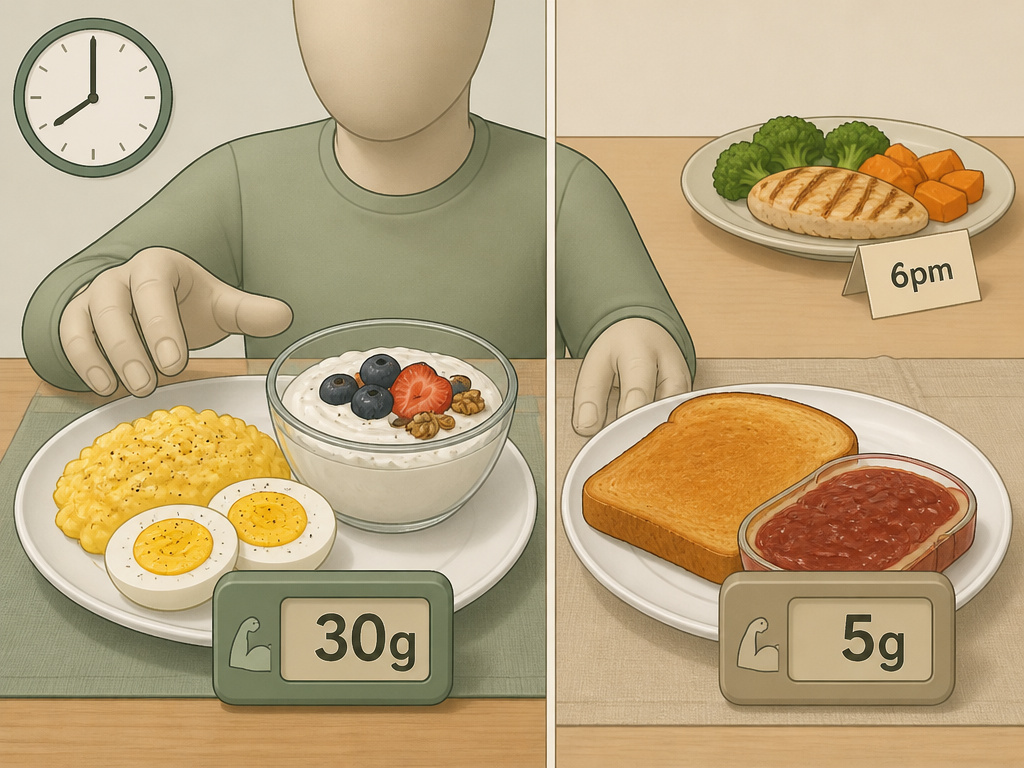
It’s 3pm. You’ve hit 80 grams since breakfast and you still have dinner to go. That’s the shape of a protein day, and it’s the opposite of how most people eat.
Total daily intake matters more than the clock, but the clock still matters at the margins. A breakfast of eggs and Greek yogurt holds you until lunch. A breakfast of toast and jam has you hunting the pantry by 10am. That’s the physical difference protein makes on a cut, and it’s the one most people feel before they ever count a gram.
The anabolic window is overrated. You don’t need a shake immediately after training. What you do need is protein at breakfast and lunch, not just dinner. Many people eat most of their daily protein after 6pm. That’s a habit problem, not a biology problem.
The anabolic window gets all the attention. Breakfast gets none. If you’re going to fix one meal, fix breakfast.
If you’re trying to lose fat while keeping muscle, the timing piece is the easiest lever to pull. Shift some of your protein from dinner to breakfast and see how the day feels.
When Eating More Protein Backfires
Higher protein intakes can be hard to sustain, so watch for signs the number is too high. That’s a real signal, and it’s worth knowing before you jump straight to the top of the range.
I’ve watched people push protein to 2.5 g/kg and then wonder why their training falls apart in week three. The protein isn’t the problem. The trade-off is.
Where this goes sideways: Pushing protein to the top of the range without adjusting carbs and fats. Legion’s own piece warns that excessive protein leaves less room for the carbs and fats that fuel workouts and regulate hormones. If your training quality drops by week two, the protein number isn’t the problem. The trade-off is.
Legion’s warning about excessive protein is a useful counterweight to the “more is always better” instinct. It doesn’t mean 2.3 g/kg is bad. It means tolerance depends on context: how long the deficit runs, how much training you’re doing, and how much room you’ve left for carbs and fats.
A few signs the number is too high:
- You’re constantly full and struggling to hit your calorie target.
- Training quality is dropping week over week.
- You’re eating so much protein that carbs and fats are getting squeezed.
If any of those show up, drop to 0.7-0.8 g/lb and see if the picture improves. If you’re running a structured cutting workout program, the training side will tell you quickly whether the nutrition side is working.
If you’re lean and cutting hard, 0.8 g/kg/d is a floor you’ll clear by lunch. If you’re carrying more body fat, the same number is a reasonable ceiling.
Do You Actually Need a Protein Shake?
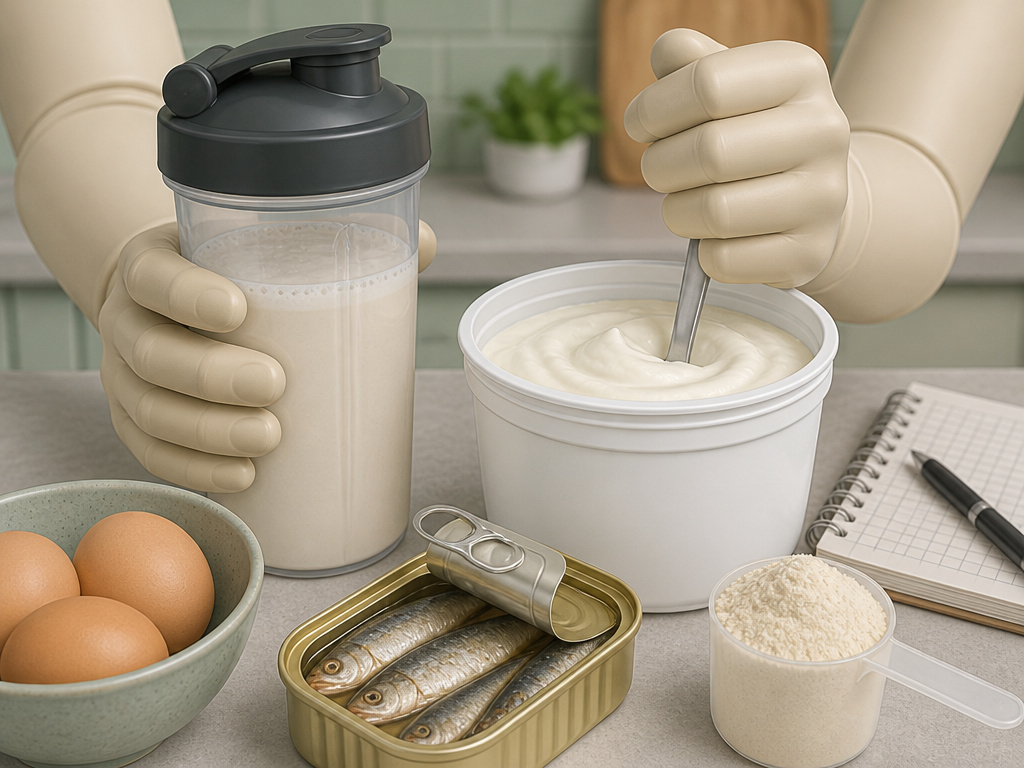
Powder is a convenience tool. Whole food does the same job if you can manage it.
Whey powder mixed with water is thin and a little chalky. Greek yogurt is thick enough to hold a spoon upright. Both hit the target; only one feels like food. If you can get your protein from whole foods, do that. If you can’t, powder fills the gap.
The foods I reach for most:
- Greek yogurt: a high-protein option that doesn’t taste like a compromise.
- Eggs: a cheap, easy protein source to scramble into a meal.
- Canned fish: sardines, tuna, salmon. Cheap, shelf-stable, and easy to keep on hand.
- Whey powder: the default when you need a quick protein hit.
If you want to build the whole plan around food, the protein without supplements piece walks through it. If you’re picking a powder, the protein sources comparison covers the main options.
A tracker helps when you want to see the actual numbers. It’s not required. A notebook works fine. Start smaller than you think you need to, and let the log tell you where the gaps are.
Frequently Asked Questions
Is 0.8 g/kg of protein enough when cutting?
For non-stressed adults, yes. Kim et al. 2019 concluded the RDA is adequate in that context. Under energy restriction, the same meta-analysis found higher intakes attenuated lean mass loss by 0.41 kg. So the RDA is a floor for sedentary adults and probably too low for anyone cutting.
How much protein should a 180 lb man eat when cutting?
At 0.7-1 g/lb, that’s 126-180 g per day. If he’s lean and training hard, push toward the top of that range or slightly above. If he’s carrying more body fat, the lower end is fine.
Can you eat too much protein on a cut?
Yes, in a practical sense. Legion Athletics warns that excessive protein leaves less room for carbs and fats, which fuel workouts and regulate hormones. Legion Athletics also warns that excessive protein leaves less room for carbs and fats. For most people, the practical ceiling is a trade-off against the other macros.
Should I drink a protein shake right after training?
No. The anabolic window is overrated. Total daily protein matters more than the post-workout window. If a shake is the easiest way to hit your number, have one. If whole food works, use that.
How do I hit my protein target without eating meat?
Greek yogurt, eggs, cottage cheese, canned fish if you eat it, tofu, tempeh, lentils, and a plant protein powder will all get you there. The math is the same. The volume of food is higher, which is the real challenge.
The Bottom Line
The short answer to how much protein should you eat when cutting is 0.7-1 g/lb of body weight for most people. That covers most situations, most of the time, and it’s the range the Legion Athletics piece lands on after reviewing the evidence.
If you’re lean, resistance-trained, and in a meaningful deficit, push higher. Helms et al. 2014 puts the range at 2.3-3.1 g/kg of fat-free mass, and the study-level data supports it. The two recommendations aren’t in conflict once you account for the denominator and the population.
Here’s the threshold I’d use: if you’re lean and running a meaningful deficit, treat 2.3 g/kg FFM as your floor, not your ceiling. If you’re above those body fat levels, 0.7-1 g/lb of body weight is plenty, and pushing higher mostly costs you carbs.
Today, just check what you ate for breakfast. If it had little protein, that’s the first thing to fix.
