
How Many Steps a Day to Lose Weight: 4 Numbers to Track
This post contains affiliate links. As an Amazon Associate, we earn from qualifying purchases.
For how many steps a day to lose weight, most adults land in the 7,000 to 10,000 range, and trials show people who lost 10% or more of their body weight averaged around 10,000 total steps. The famous 10,000 figure came from a 1965 pedometer marketing campaign, not research.
The 1965 number stuck because it’s round and easy to sell. What the last few years of research has done is break the how many steps a day to lose weight question into pieces: age groups, starting points, and whether the person is also cutting calories.
What follows: the actual research on step counts and weight loss, where the studies disagree, and a simple way to pick a target that fits your starting point.
Key Takeaways
- 7,000 steps covers most of the health benefit for most adults, per a 2025 meta-analysis of 57 studies.
- ~10,000 total steps showed up in the Step-Up trial among people who lost 10% or more of their body weight.
- 7,000 may not be enough for long-term weight loss, according to that same Step-Up analysis. The right number depends on your goal.
- Add 500 to 1,000 steps to your current average for modest loss, then reassess after 1-2 weeks.
- Steps alone rarely move the scale. Every major review pairs them with a calorie deficit.
The 10,000-Step Number Was Invented to Sell Pedometers
The idea of 10,000 steps originated in a 1965 Japanese marketing campaign to sell pedometers, per Healthline. That’s the origin story. It wasn’t a clinical finding.
A 1965 Japanese marketing campaign to sell pedometers popularized the 10,000-step target. The number was chosen for its roundness and cultural resonance, not from clinical trials. Decades of subsequent research has since tested the number against actual health outcomes, producing a range of 7,000 to 10,000 steps for most adults.
I used to chase 10,000 like it was a grade. Miss it, feel bad. Hit it, feel virtuous. Neither reaction was based on anything real.
What the research has actually done is replace one number with a range. A 2025 dose-response meta-analysis of 57 studies found most health benefits accrue by about 7,000 steps a day. That’s from the 2025 daily steps meta-analysis, and it’s the single most useful number in this whole topic.
What the Research Actually Says About Steps and Weight Loss
Two studies do most of the heavy lifting here, and they measure different things. One is about health outcomes. The other is about weight.
The 2025 Meta-Analysis
A 2025 review found that 7,000 steps daily was associated with a 47% lower risk of all-cause mortality compared with 2,000 steps. That’s a health number, not a weight number. It’s also the number most people actually want, even if they think they want weight loss.
A separate 2022 review of 15 studies found the mortality plateau varies by age: 6,000 to 8,000 steps for adults 60 and older, 8,000 to 10,000 for adults under 60. Same data, different cutoffs.
The Step-Up Trial
The Step-Up randomized trial is the one that speaks directly to weight loss. At 18 months, participants who lost 10% or more of their body weight were averaging 9,822 total steps a day, with 3,482 of those as bout-MVPA steps (walking in bouts of at least 10 minutes at a moderate pace). That’s from the Step-Up randomized trial analysis.
The same trial found that 7,000 steps a day may not be sufficient to enhance long-term weight loss within a behavioral weight-loss program. So: 7,000 for health, closer to 10,000 for weight loss. Those are different goals.
| Goal | Daily Step Target | Source |
|---|---|---|
| General health | 7,000 | 2025 meta-analysis, 57 studies |
| Mortality plateau, under 60 | 8,000-10,000 | 2022 review, 15 studies |
| Mortality plateau, 60+ | 6,000-8,000 | 2022 review, 15 studies |
| Weight loss, 10%+ | ~10,000 total; ~3,500 bout | Step-Up RCT |
| Modest loss | +500-1,000 over current | MyFitnessPal |
Why the Numbers Don’t Agree — and Which One Fits You
Three different sources give three different numbers for weight loss, and they’re all correct. They just measure different outcomes.
Baylor Scott & White says 10,000 to 12,500 steps per day can be effective for slimming down, especially with a calorie-conscious diet. The Step-Up trial says ~10,000 total with ~3,500 as bout-MVPA. MyFitnessPal says 7,000 to 10,000 is the practical range, and for greater loss, don’t use a step-only target at all.
Common mistake: Chasing 10,000 as a fixed number. The 2025 meta-analysis found most health benefits accrue by about 7,000, so the extra 3,000 buys you less than you’d think.
The disagreement isn’t a problem. It’s a signal that the right number depends on what you’re trying to do. Health? 7,000. Weight maintenance? 8,000-10,000. Weight loss? Closer to 10,000, with diet in the mix.
I’d rather see a client hit 8,000 consistently than spike to 12,000 twice a week. Consistency is the variable that actually matters.
| Current Daily Average | What It Suggests | First Move |
|---|---|---|
| Under 5,000 | Sedentary range | Add 250-500/day |
| 5,000-7,000 | Below optimal | Hold, then add 500-1,000 |
| 7,000-10,000 | Practical range | Hold, reassess every 2-4 weeks |
| 10,000+ | Active | Focus on diet and intensity |
How Many Steps Do You Need If You’re Over 60?
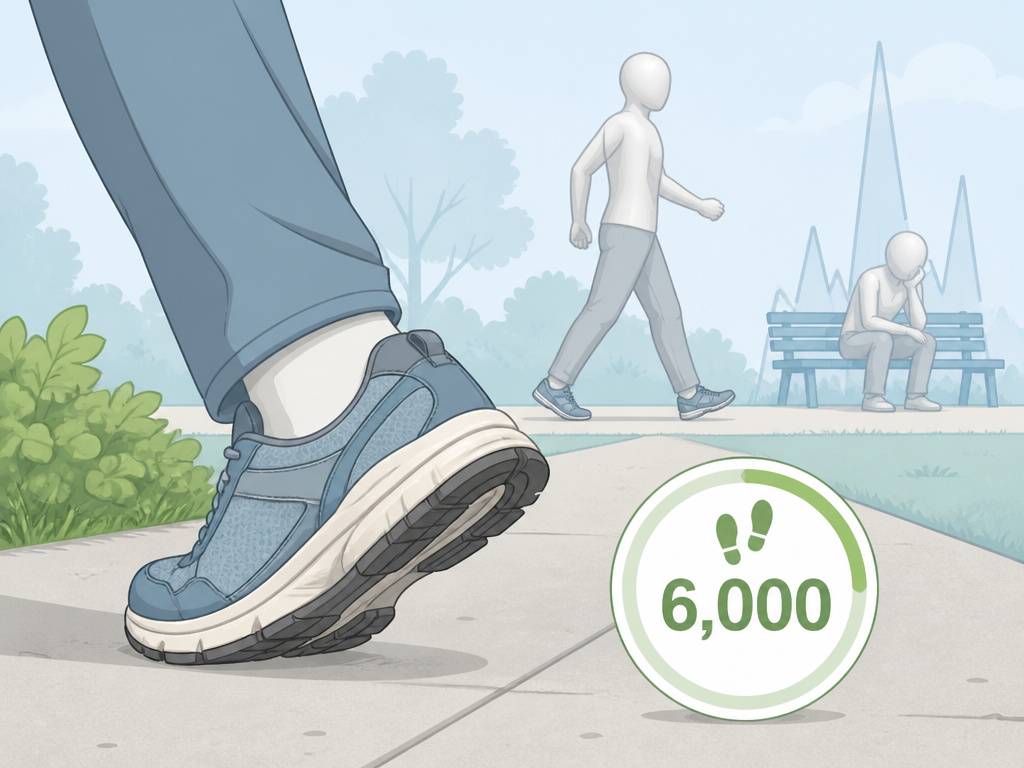
Less than you think. A 2022 review of 15 studies found the mortality plateau for adults 60 and older is 6,000 to 8,000 steps a day, lower than the under-60 range.
The American Heart Association data is even more striking. Older adults averaging about 4,500 steps a day cut their risk of serious heart problems by more than three-quarters compared with those taking under 2,000. And adding just 500 steps a day reduced cardiovascular risk by roughly 14%.
I’ve watched older clients do better at 6,000 steady than 9,000 spiky. Consistency beats volume at that age.
This is the place where the “more is better” instinct does the most damage. A 75-year-old who walks 6,000 steps every day is in better shape than one who hits 10,000 twice a week and sits the rest of the time. The research supports that.
Do Bout Steps Matter More Than Total Steps?
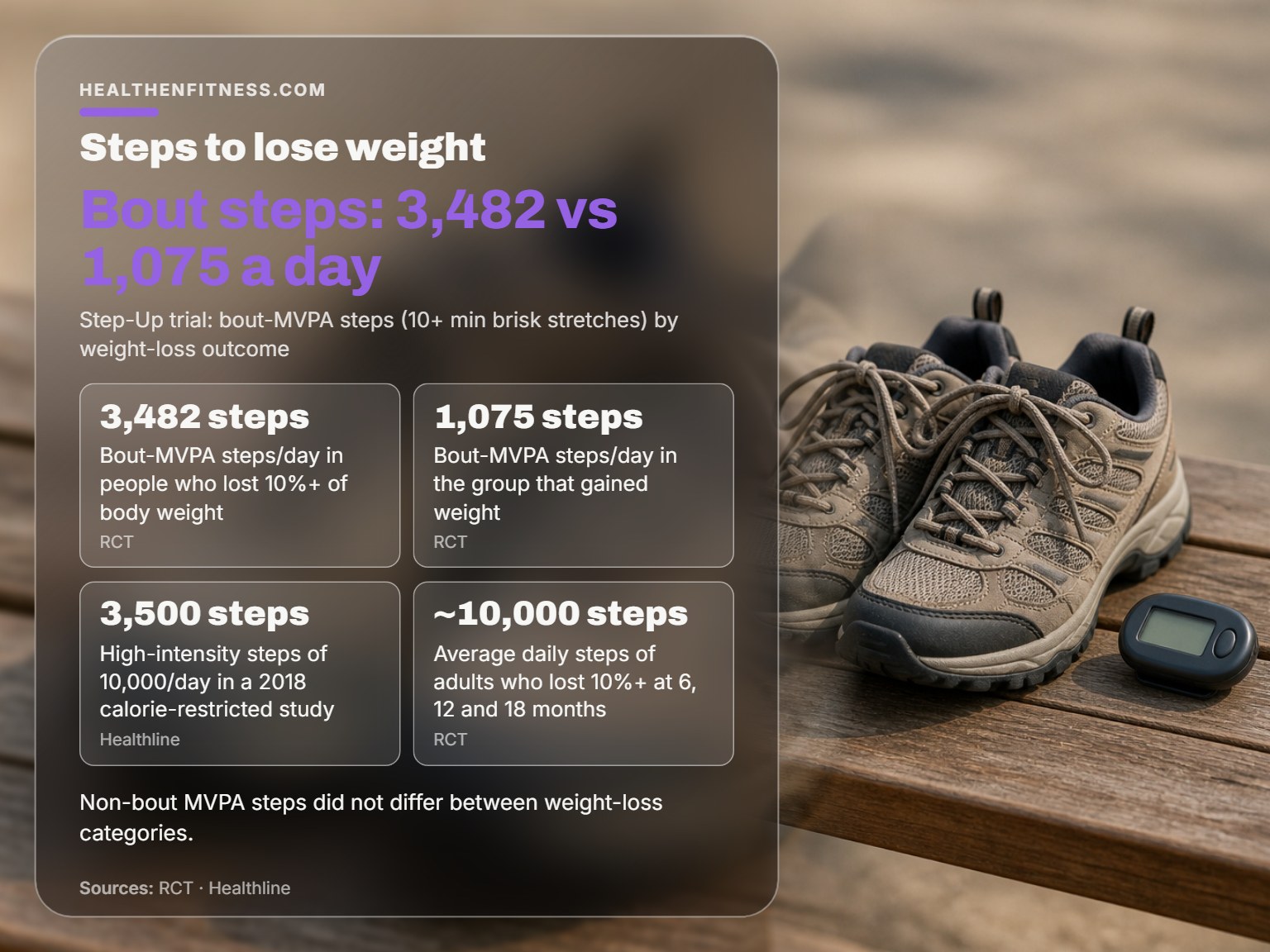
The Step-Up trial says yes, at least for weight loss. Participants who lost 10% or more of their body weight averaged 3,482 bout-MVPA steps a day, compared with 1,075 in the group that gained weight. Bout-MVPA means walking in stretches of at least 10 minutes at a moderate pace.
Non-bout MVPA steps didn’t differ between weight-loss categories. So the total count alone misleads. How you accumulate the steps matters.
A brisk 20-minute walk leaves you slightly warm under the collar, the kind where you unzip your jacket halfway through. That’s the pace the bout-MVPA threshold is asking for.
A 2018 study of participants on a calorie-restricted diet found that taking 10,000 steps daily helped support weight loss, especially when 3,500 of those steps were performed at high intensity. Same ballpark as the Step-Up number.
If you want to compare approaches, the walking vs running question comes down to time versus joint load. Running gets you to the same calorie burn faster. Walking lets you do more of it without wrecking your knees. For step-counting purposes, walking is the base layer. If you want to layer in more intensity, incline walking is the low-impact way to do it.
The Diet Variable: Steps Alone Rarely Move the Scale
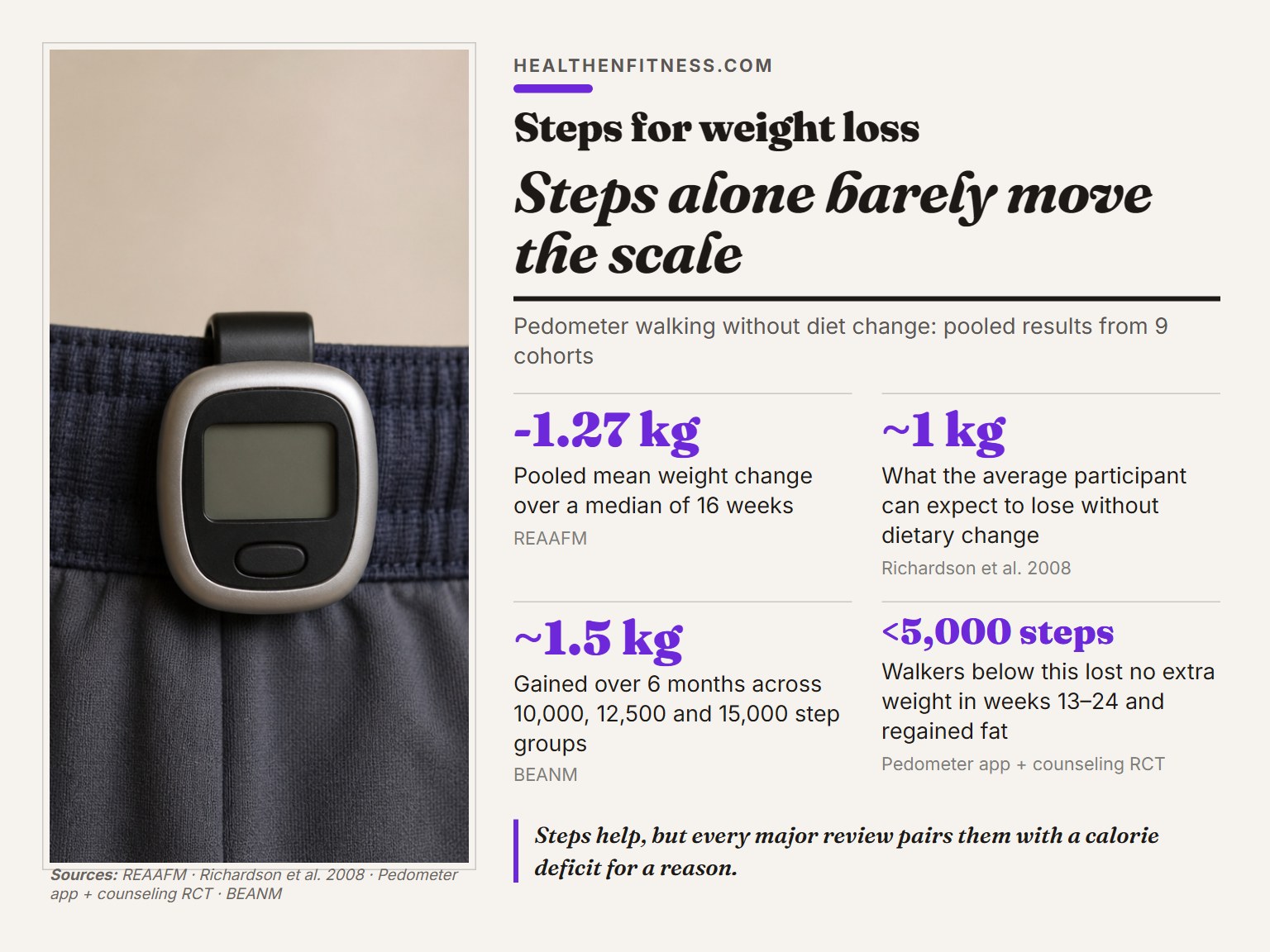
The Richardson meta-analysis of 9 pedometer-walking cohorts gives the cleanest answer here. Participants lost a pooled -1.27 kg (about 2.8 pounds) over a median of 16 weeks. That’s it. And the authors caution that the association between higher step counts and lower weight doesn’t prove that adding steps causes weight loss.
Their conclusion: the average participant in a pedometer-based walking program without dietary change can expect to lose about 1 kg. Adding a dietary component may yield more weight loss and better adherence. That’s from the pedometer walking weight loss meta-analysis.
The pedometer-app trial makes the same point. Participants followed a diet with a 500 kcal/day reduction to hit a weekly weight loss of 400 grams. Patients walking fewer than 5,000 steps a day didn’t lose additional weight in weeks 13-24 and began to regain fat lost in the first 12 weeks.
The part nobody mentions: Steps alone don’t move the scale if the food doesn’t change. Every major review pairs them with a calorie deficit for a reason.
The Bailey 2019 trial is the starkest example. Researchers prescribed 10,000, 12,500, and 15,000 steps per day to women in the study. All three groups gained about 1.5 kg over the 6 months. No significant difference between groups. There was no difference in energy intake either.
So the honest framing: steps help, but they’re one input. The calorie deficit is the other. If you want the full picture on how much cardio for weight loss actually helps, that’s a separate question with its own answer.
A few years back I bumped my daily average from around 5,000 to about 8,000, using nothing fancier than the step counter on my phone. My weekly progress improved without me changing a thing about food. Pacing during phone calls, walking to the coffee shop instead of driving. It added up. I’d been treating my 45-minute gym session as the whole story, and on the days I sat at a desk the rest of the time, I was barely moving.
That’s the quiet part. The gym is loud. The walking is quiet. The walking is doing more than you think.
The 5-Step Ramp That Won’t Wreck Your Shins
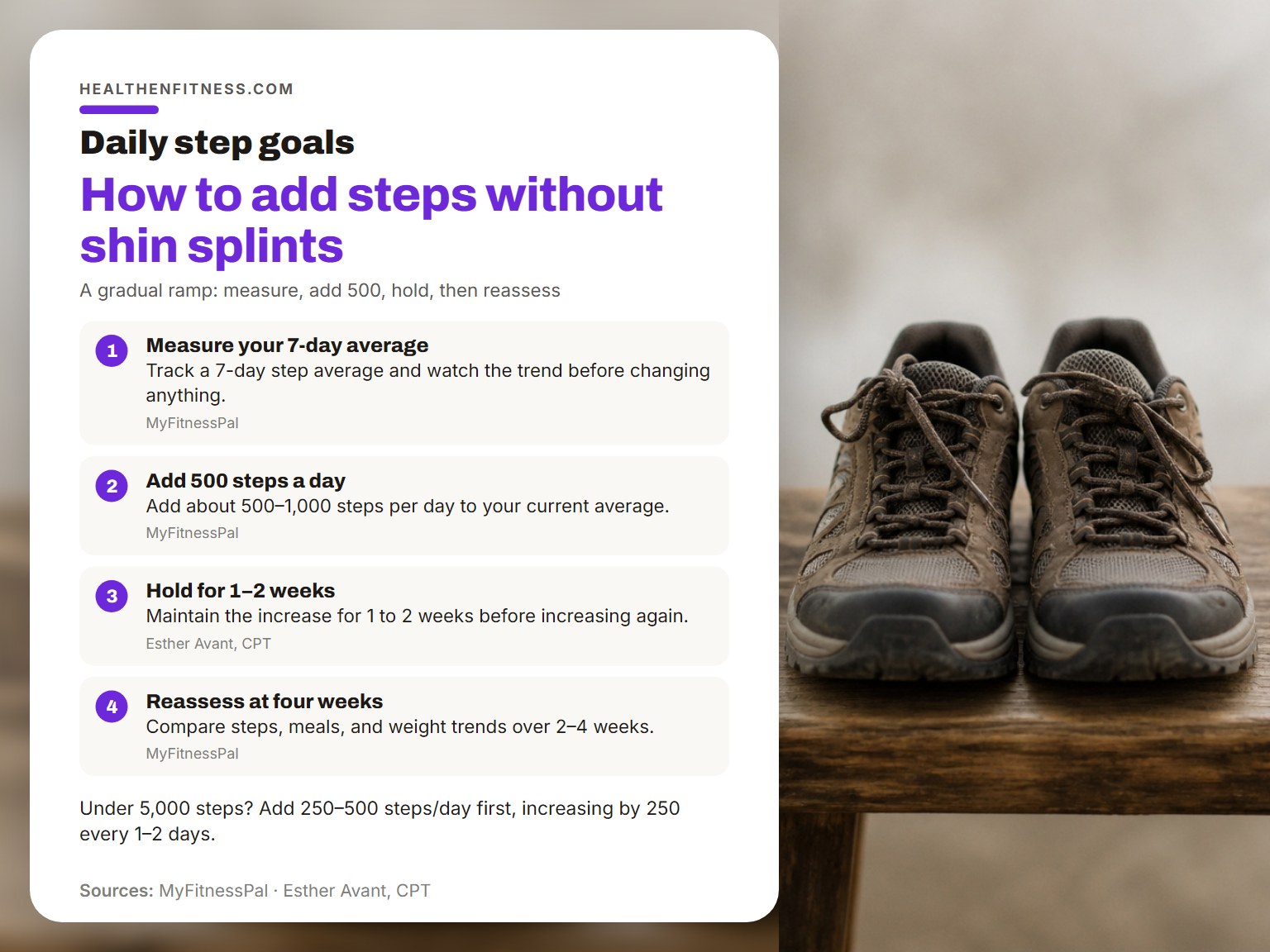
The best starting point depends on where you are now. If you’re under 5,000 steps a day, start by adding 250 to 500 steps per day. The first week, increase by 250 every 1 to 2 days, then add 500 per day until you hit your target.
If you’re already at 5,000 to 7,000, certified trainer Esther Avant suggests setting a goal of 500 to 1,000 steps above your current average and holding it for 1 to 2 weeks before increasing again.
Physical therapist Gregory Minnis recommends increasing by 10% to 20% each week until you reach your desired count. That’s the most conservative of the three, and probably the right one if you’re injury-prone or over 50.
The First Two Weeks
The first week, your shins will complain. A dull ache on the inside of the calf, the kind that shows up around day four and fades by day ten. That’s normal. Pushing through it with more volume is what turns a two-week adjustment into a six-week layoff.
The sequence I’d actually give someone:
- Measure your current average for 7 days. Don’t change anything yet. Just look.
- Add 500 steps a day for two weeks. That’s roughly a quarter-mile, or about five extra minutes of walking.
- Hold for two weeks before adding more. This is the step most people skip, and it’s why they quit.
- Add another 500 if you’re tolerating the first increase without shin, knee, or foot pain.
- Reassess at the four-week mark against your weight trend, not the daily number.
If you’re under 5,000 steps now, add 250 a day for a week before you add anything else. The first week is about proving you can show up, not about hitting a number.
Where this goes sideways: Jumping from 5,000 to 12,000 in a week. Shin splints show up around day four and sideline you for two weeks.
Small ways to add steps without a formal walk:
- Take phone calls standing up and pacing. Most people get 500-1,000 steps from a single 20-minute call.
- Park at the far end of the lot. That’s 200-400 steps each way.
- Take three 10-minute walks instead of one 30-minute walk. Same total, easier to fit.
- Walk during kids’ activities or waiting rooms instead of sitting.
- Get a dog, or borrow a neighbor’s. The accountability is worth more than the steps.
A pair of walking shoes makes the difference between “I’ll do it tomorrow” and “I did it today.” The wrong shoes make the first week hurt.
The 4 Numbers That Beat the Scale

The scale is a noisy signal. One takeout pizza night, and it reads two to three pounds heavier by morning. That’s water weight from the salt and carbs. Fat doesn’t appear overnight. Hard leg days do the same thing. I once saw a three-pound bump after heavy squats, cut my food in a panic, and felt terrible for two days. Inflammation and glycogen, not fat. Lesson learned, badly.
The 7-Day Average
One day tells you nothing. Seven days tells you the trend. MyFitnessPal’s dietitians recommend comparing steps, meals, and weight trends over 2-4 weeks. That’s the right window. Shorter than that and you’re reading noise.
So track things that don’t lie as often:
- 7-day step average. One day tells you nothing. Seven days tells you the trend.
- Waist measurement. Once a month, same spot, morning. It moves when the scale stalls.
- Monthly photos. Same light, same pose. The change you can’t see day to day shows up across 30 days.
- Weight trend over 2-4 weeks. Not the daily number. The direction.
If you hit a weight loss plateau, the first question isn’t “how do I add more steps.” It’s “has anything else changed?” Sleep, stress, food intake, and step count all move together.
For tracking, a basic phone pedometer is fine. If you want more detail, the fitness trackers for weight loss that actually help are the ones you’ll wear every day.
There’s a whole separate question about tracker accuracy that’s worth understanding. Short version: wrist-based trackers undercount arm-swing-free walking (pushing a cart, holding a rail) and overcount arm-heavy activity. Your phone in your pocket is actually pretty good.
Frequently Asked Questions
Is 10,000 steps a day enough to lose weight?
It can be, if you’re also in a calorie deficit. The Step-Up trial found people who lost 10% or more of their body weight averaged around 10,000 total steps. But the Bailey 2019 trial found no weight benefit from 12,500 or 15,000 versus 10,000 when diet didn’t change. Steps are one input.
How many steps a day to lose weight if I’m over 60?
The mortality data suggests 6,000 to 8,000 steps a day for adults 60 and older. For weight loss specifically, the research is thinner, but the same principle applies: pair steps with a modest calorie deficit and add gradually. The American Heart Association data shows real benefit starting around 4,500 steps.
Do I need to walk fast, or just walk more?
Both matter, but differently. The Step-Up trial found bout-MVPA steps (10+ minutes at moderate pace) were higher in people who lost 10% or more of their body weight. Total steps matter too. If you have to pick one, pick total steps first, then add intensity.
How long until I see weight loss from walking?
The Richardson meta-analysis found participants lost about 0.05 kg per week, or roughly 1 kg over a median of 16 weeks. That’s without dietary change. With a calorie deficit, the pedometer-app trial showed about 400 grams per week. Slower than most people expect.
What if I can’t hit 10,000 steps?
Then don’t. The 2025 meta-analysis found most health benefits accrue by about 7,000. Baylor Scott & White says 5,000 to 7,000 daily still provides major health benefits. Start where you are and add 500 a day.
The Bottom Line
The number that matters most is the one you’ll actually hit on a Tuesday in February. Charts don’t walk. For most adults, that’s somewhere between 7,000 and 10,000 steps a day, though Baylor Scott & White puts the slimming-down range at 10,000-12,500 with a calorie-conscious diet, Creasy et al. Found ~10,000 among those losing 10%+, and MyFitnessPal advises against a step-only target for greater loss.
One rule most guides skip: if you’re currently under 5,000 steps a day, the target isn’t 10,000. Start by adding 250 to 500 steps a day. Get there first, hold it for two weeks, and then decide what’s next. Jumping straight to 10,000 is how people end up with shin splints and a two-week recovery.
This all changes if you’re training for a race or working a physically demanding job. In those cases your step count is already high, and the food is the whole game.
Start smaller than you think you need to. The research on consistency is much stronger than the research on any specific step count.
Today, just walk for ten minutes after your next meal. That’s it.
