
Does Fasted Cardio Burn More Fat? What the Research Says
This post contains affiliate links. As an Amazon Associate, we earn from qualifying purchases.
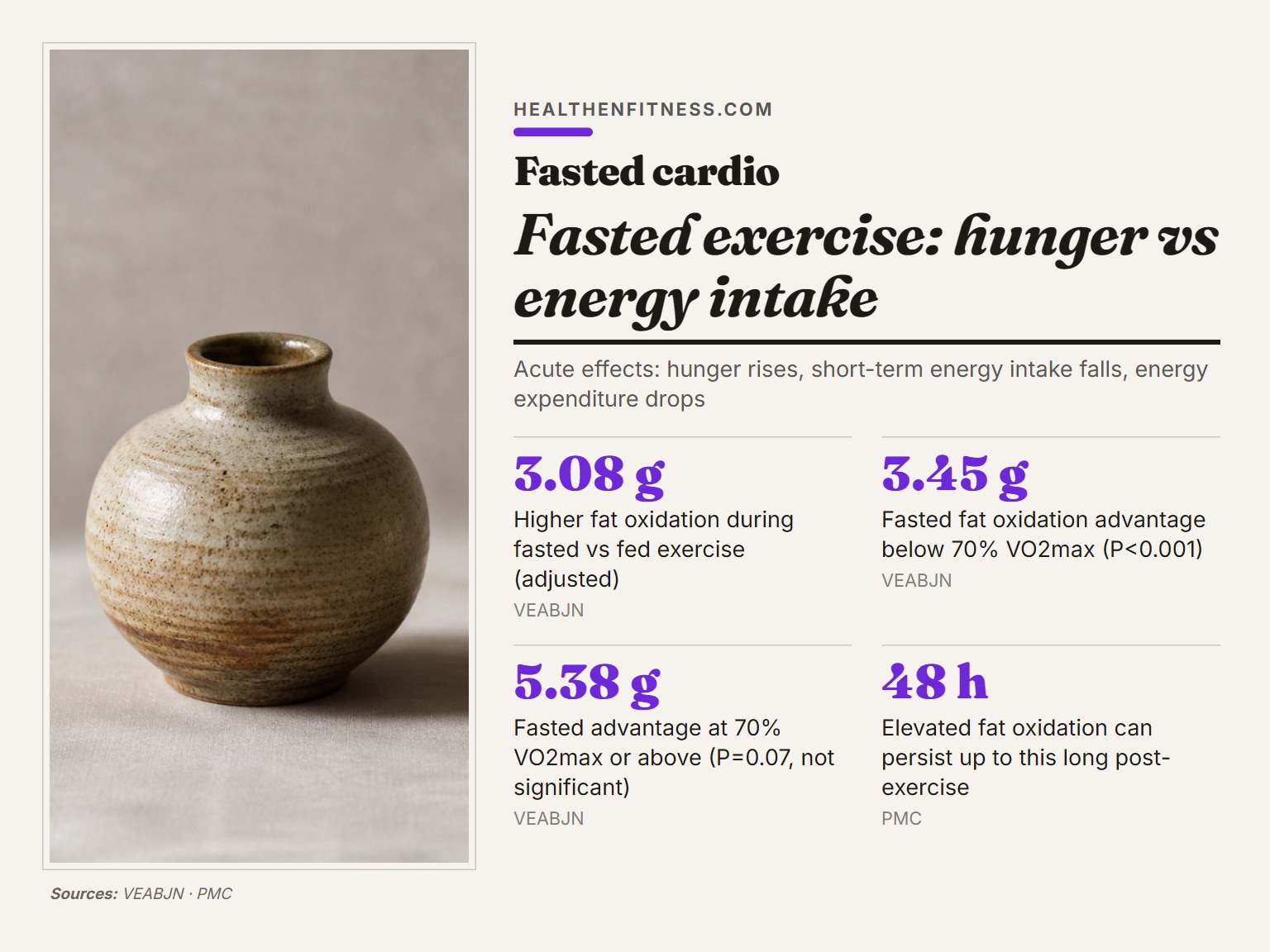
Fasted cardio burns more fat during the session itself. A 2016 British Journal of Nutrition meta-analysis of 27 studies found fasted aerobic exercise raised fat oxidation by 3.08 g versus fed exercise. Over weeks and months, that edge doesn’t translate into greater body fat loss.
The 3.08 g figure is the corrected one. Vieira and colleagues found publication bias at P=0.007 and trimmed the raw 3.53 g effect down to 3.08 g. That correction is the difference between a headline and a reliable number.
What follows walks through the during-session number, the 24-hour picture, the intensity split, and the one lever that actually moves body fat over months.
Key Takeaways
- Fasted cardio raises fat oxidation during the session by roughly 3.08 g in the pooled estimate, after correcting for publication bias.
- The advantage disappears at 70% VO2max and above, where the effect was not statistically significant (P=0.07).
- Long-term body fat loss showed no fasted-versus-fed difference in training studies, per the UNSW review team.
- Post-exercise hunger rises after fasted sessions, and the network meta-analysis found lower energy expenditure alongside lower short-term intake.
- Keep protein and total intake steady whether you train fasted or fed. That’s the lever that moves body composition.
What the Fasted Cardio Research Actually Measures
The research splits into two very different questions, and most articles mash them together when they ask does fasted cardio burn more fat. Question one is what happens to fat oxidation during a single session. Question two is what happens to body fat over weeks and months.
Vieira and colleagues pooled 27 trials with 273 adult participants after screening 10,405 articles. The unadjusted fasted-versus-fed fat oxidation difference was 3.53 g during exercise. After Duval and Tweedie trim-and-fill correction for publication bias detected at P=0.007, the adjusted effect dropped to 3.08 g. Sessions were capped at 120 minutes.
That 3.08 g number is the during-session difference. It’s real, it’s statistically significant, and it’s small enough that a handful of extra calories after the session could wipe it out.
The fat as fuel question is where this gets interesting, because the fuel mix shifts based on what you ate and when. The workout timing question is a separate one, and the answer depends on which outcome you’re chasing.
Here’s the part that trips people up. The meta-analysis measured fat oxidation with indirect calorimetry, which estimates fuel use from respiratory exchange. It doesn’t measure how much fat you lose. Those are different measurements.
Why Does the Fat Oxidation Number Look So Big?
Ever wonder why the fat oxidation number gets quoted as proof that fasted cardio works when the real question is does fasted cardio burn more fat? Because it’s real, measurable, and easy to publish. It’s also the wrong number to build a diet around.
Three grams of fat is a small number. Small. That’s the point.
The during-session difference is real. The problem is that the body compensates. Melanson’s 24-hour review found that in non-fasted individuals, moderate exercise under an hour per day has little effect on daily fat oxidation. Melanson’s review found the during-session bump doesn’t carry over to daily fat oxidation, though Vieira’s meta-analysis found a significant during-exercise increase.
That finding comes from the 24-hour fat oxidation research, which argues it’s time to put the low-intensity “fat burn” myth to rest. Melanson’s authors are blunt about it: exercise intensity doesn’t affect daily fat balance if intake is unchanged, though Vieira found the fasted during-exercise advantage is significant below 70% VO2max but not above.
Three things follow from that:
- The during-session number is a fuel-mix measurement. Fat loss is a different thing entirely.
- Your body adjusts fat oxidation across the day to compensate for what happened during the session.
- The only way to shift body fat is to change total intake or total expenditure over time.
Vieira attributes the fasted increase to substrate availability during exercise. Melanson points to insulin-induced suppression of lipolysis after eating. Those are different explanations for overlapping phenomena, and neither one settles the long-term question.
The Lancet eBioMedicine fasted exercise article is one place to see how metabolic chamber work handles this question. It’s a useful reminder that the during-session number and the 24-hour number are different measurements of different things.
The 70% VO2max Line Where the Advantage Disappears
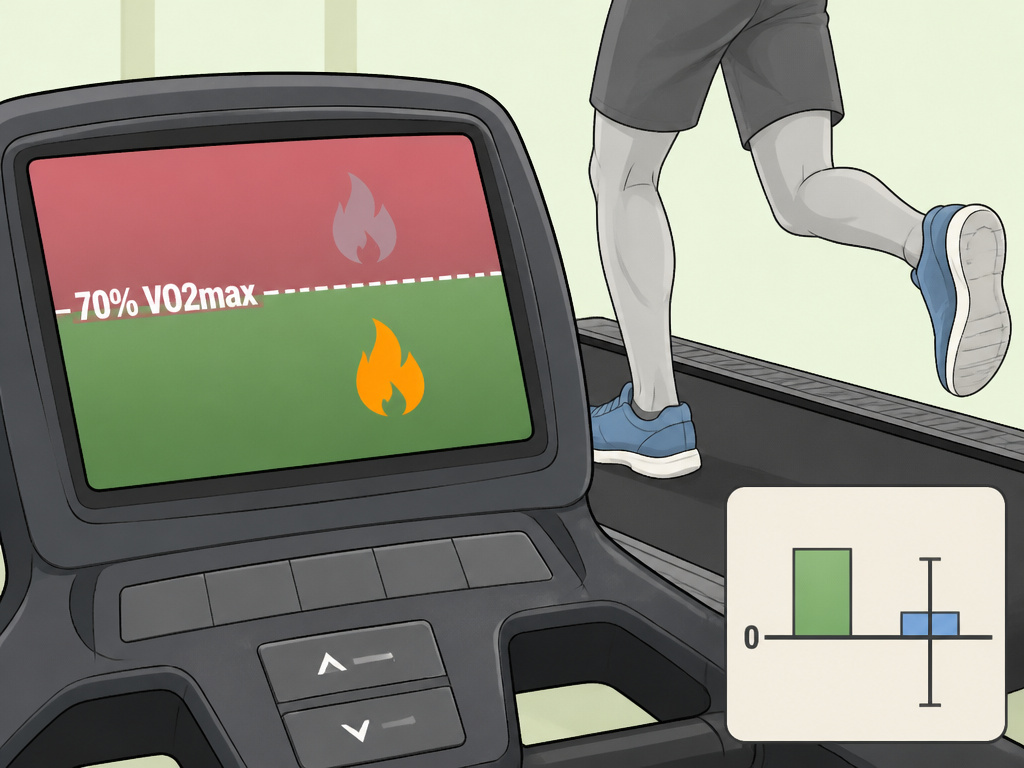
At 70% VO2max and above, the fasted advantage stops being statistically significant. That’s the finding buried in the intensity split of the British Journal of Nutrition meta-analysis, and it’s the one most articles skip.
At low-to-moderate intensity, below 70% VO2max, the fasted advantage was 3.45 g (95% CI 2.19, 4.71, P<0.001). At 70% VO2max and above, the point estimate was larger at 5.38 g, but the confidence interval crossed zero (95% CI -0.45, 11.21, P=0.07). That’s not a reliable effect.
| Training Scenario | Fasted Fat Oxidation Effect | Statistically Significant? |
|---|---|---|
| Low-to-moderate steady cardio (below 70% VO2max) | 3.45 g (95% CI 2.19, 4.71) | Yes (P<0.001) |
| Moderate-to-high intensity (70% VO2max and above) | 5.38 g (95% CI -0.45, 11.21) | No (P=0.07) |
| Sessions longer than 120 minutes | Not studied in the meta-analysis | No data |
What the Intensity Split Means for Your Week
At 70% VO2max and above, the breathing gets sharp and the legs lose that light floaty feel. The session starts to feel like work. I’ve had mornings where a fasted easy run felt fine and a fasted interval session felt awful. That matches the intensity split in the research, even if my sample size is one.
For the harder sessions, steady state cardio at a conversational pace is where the fasted advantage actually shows up. Intervals are a different animal.
Long-Term Fat Loss Doesn’t Follow From the Acute Number
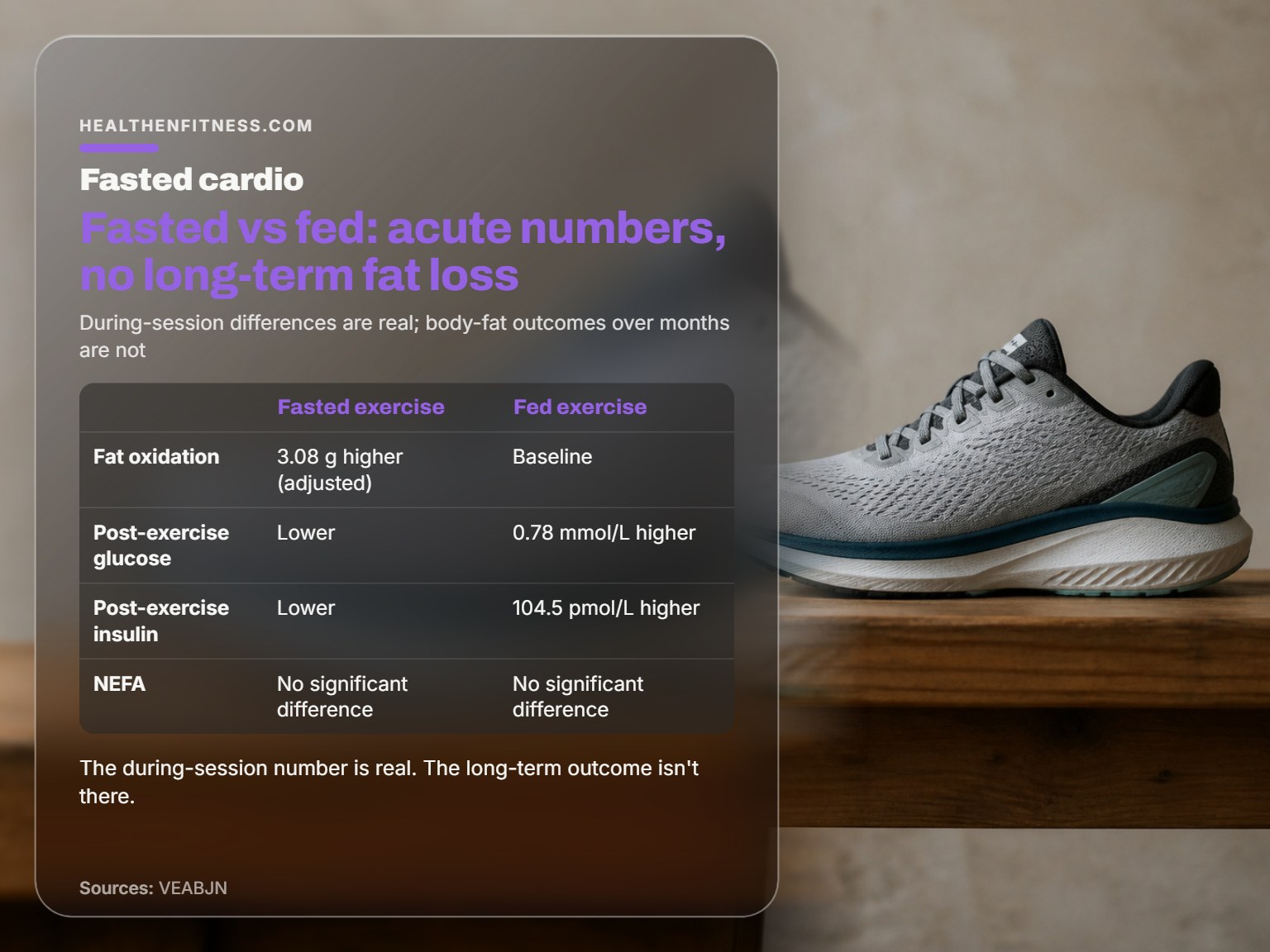
The 2017 systematic review from the UNSW team found that a fasted exercise training program doesn’t translate into long-term differences in body fat loss. The during-session number is real. The long-term outcome isn’t there.
The UNSW fasted cardio explainer puts it plainly: the evidence doesn’t support the superiority of fasted exercise for weight loss or sports performance. That’s the conclusion after decades of research, not a single study.
Here’s the comparison side by side:
| Measure | Fasted Exercise | Fed Exercise |
|---|---|---|
| Fat oxidation during session | 3.08 g higher (adjusted) | Baseline |
| Post-exercise glucose | Lower | 0.78 mmol/L higher |
| Post-exercise insulin | Lower | 104.5 pmol/L higher |
| NEFA concentrations | No significant difference | No significant difference |
| Long-term body fat change | No difference | No difference |
The glucose and insulin differences are real and measurable. They just don’t add up to a body composition difference over months.
When the Long-Term Data Actually Matters
For lifters, the strength training vs cardio balance matters more than the fasted question. Keep the lifting, keep the protein, and let the cardio timing fall where it fits your schedule.
Three groups should skip fasted cardio entirely:
- Anyone who gets headaches or nausea when training hungry
- Lifters in a heavy training block who need session quality
- People who eat back more than they saved after fasted sessions
I’ve watched clients do both, and the ones who stuck with fasted cardio were the ones who liked it, not the ones chasing a metabolic edge. Adherence beats physiology every time.
What Happens to Hunger and Energy Intake After Fasted Exercise?
You finish a fasted session, feel ravenous, and eat back more than you saved. That’s the compensation problem, and it’s where the fasted cardio story gets less flattering.
The acute effects of fasted exercise network meta-analysis found that fasted exercise without a post-exercise meal produced the greatest short-term reduction in energy intake. It also found increased subjective hunger and decreased energy expenditure relative to fed exercise. The two partially cancel.
The hunger after a fasted session has a specific quality. It’s not the slow build of a normal lunchtime appetite. It arrives fast, and it’s the kind that makes a vending machine look reasonable.
Before you start: Fasted training can cause headaches and nausea in some people, though this isn’t universal. If you get lightheaded during the session, stop and eat something small before your next attempt. Don’t push through a fasted session on a hard training day.
The intermittent fasting for lifters crowd knows this trade-off well. The eating window matters, but the total intake matters more.
The number that moves body fat over months is total intake, not the fuel mix during a single run. Pick the timing you’ll repeat and put your attention on the weekly average.
How to Fit Fasted Cardio Into a Lifting Week
A watch’s calorie-burn readout swings enough day to day that treating it as a budget is a mistake. I quit trusting my watch after a stretch where two identical Tuesday runs read very different calorie numbers. Same route, same pace, same coffee beforehand.
That’s why I now count sessions completed per week instead. It’s a number that doesn’t lie to me.
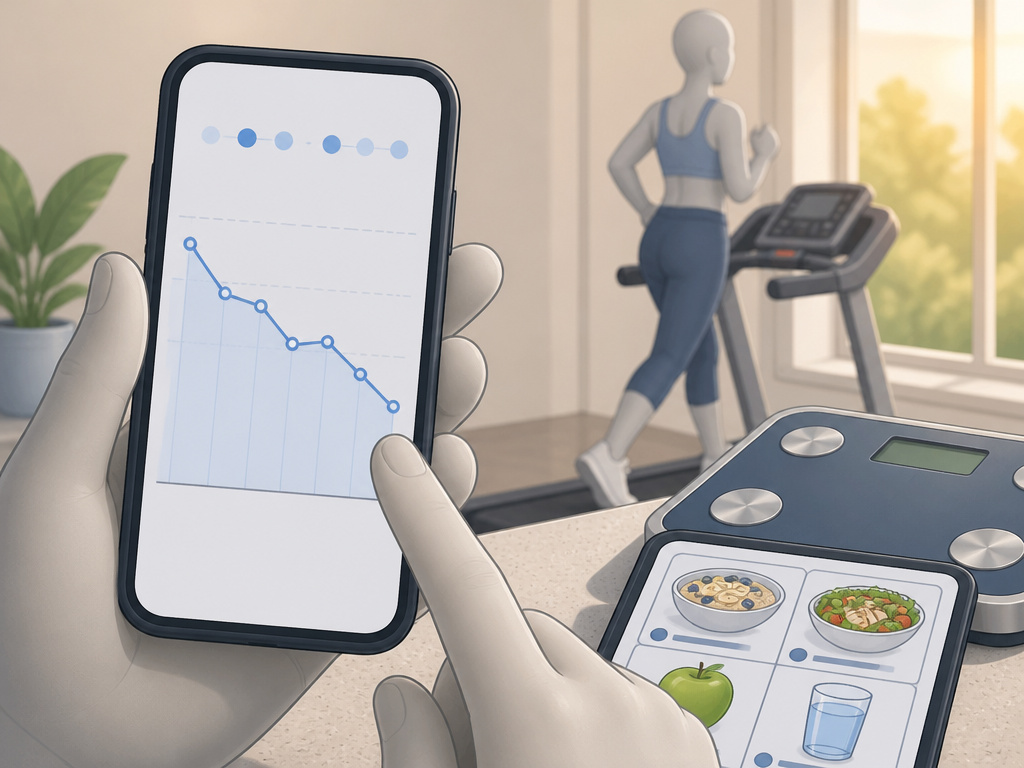
For the intake side, logging food by weight is the only way to know whether you’re actually in a deficit. A scale that gives you a weekly trend you can actually read matters more than any single morning’s number.
Testing It on Yourself
Here’s how to test fasted cardio for yourself without changing five variables at once:
- Pick one easy session per week (a walk, a slow jog, a steady bike) and do it fasted for several weeks.
- Log your food the same way you always do, using whatever app you already use.
- Weigh yourself at the same time each morning and look at the weekly average, not the daily number.
- Compare the recent trend to your previous weeks. If nothing changed, the fasted timing isn’t doing anything for you.
- If you felt terrible, hungry, or lightheaded, drop it. The during-session number doesn’t justify feeling bad.
The scale can read the same from one morning to the next. The trend shows up over weeks, not in the first few mornings.
The morning cardio slot is where fasted training fits most naturally, because you’re already in the fasted state when you wake up. That’s a scheduling convenience. The metabolic math is the same either way.
For most lifters, the honest answer is simpler. Train fasted if you like it and it fits your morning. Train fed if you don’t. The body fat outcome is the same.
Frequently Asked Questions
Does fasted cardio burn more fat than fed cardio?
During the session, yes. The 2016 meta-analysis found a 3.08 g fat oxidation advantage for fasted aerobic exercise at low-to-moderate intensity. Over weeks and months, the advantage doesn’t translate into greater body fat loss.
How long do you have to fast before cardio counts as fasted?
The network meta-analysis defined fasted exercise as at least 6 hours after the last meal. For most people, that means training in the morning before breakfast.
Does fasted cardio burn muscle?
There’s no strong evidence that fasted cardio causes muscle loss in otherwise healthy people who eat enough protein and total calories. The research on fasted versus fed resistance training is limited and low quality, so the honest answer is that we don’t know for sure.
Is fasted cardio better for weight loss?
The evidence doesn’t support the superiority of fasted exercise for weight loss. The UNSW review team found no long-term body fat difference between fasted and fed training programs.
Can I do fasted cardio if I lift weights?
Yes, if you tolerate it. Keep your protein intake steady and don’t drop strength training to make room for more cardio. That’s the mistake that costs people muscle.
Why do I feel nauseous during fasted cardio?
Some people get headaches and nausea when exercising fasted, though this isn’t universal. It’s usually a blood sugar or hydration issue. Eat a small snack before the session if it keeps happening.
The Bottom Line
If you want one rule: pick the cardio timing you’ll actually repeat, and put your attention on total intake and weekly weight trend instead of the fuel mix during a single session.
The during-session number is real. The long-term outcome isn’t there. That’s the whole story in two sentences.
One concession worth making: if you’re training for a race or a hard lifting block, the fueling question flips. Eating before prolonged efforts is the better bet for session quality, and the fasted fat oxidation edge is the wrong thing to optimize for when your goal depends on output.
Do this today: pick one easy session this week, do it fasted, and log how you feel and what you eat afterward. That’s the only data that matters for your body.
