
Walking vs Running for Fat Loss: Which Burns More?
This post contains affiliate links. As an Amazon Associate, we earn from qualifying purchases.
Walking vs running for fat loss splits on one number: minutes or miles. Running burns more calories per minute, but the two cost roughly the same per mile. For most people starting out, walking wins because it’s repeatable, and a 300 to 500 kcal daily deficit does the real work.
The minute-versus-mile split is where most of the online arguing goes wrong. Two people can both be right and still talk past each other, because one is quoting calories per minute and the other is quoting calories per mile. The MET values underneath both are published and checkable. The confusion lives in the headline.
What follows walks through the MET math, the per-mile equivalence, the injury figures that get thrown around without citations, and the weekly schedule I’d actually hand a beginner. By the end you’ll be able to pick a modality and a deficit without guessing.
Key Takeaways
- Running burns more per minute. Walking and running cost roughly the same per mile, so the winner depends on which clock you’re using.
- A 300 to 500 kcal daily deficit is the modest range that produces 0.5 to 1 kg of loss per week without wrecking your training.
- Running loads the joints at 2.5 to 3 times body weight per stride. Walking lands at 1 to 1.5 times.
- EPOC is real but small, at 6 to 15 percent of exercise energy cost. Don’t build a plan around afterburn.
- Walkers stuck with it longer in at least one six-month comparison, with similar total fat loss to runners.
What 3.5 MET vs 9.8 MET Actually Means
The Compendium of Physical Activities assigns a 3.5 MET value to walking at 3.0 mph and a 9.8 MET value to running at 6 mph. Those are the two numbers doing most of the work in every calorie comparison you’ve read.
Energy cost in the Compendium is expressed as a metabolic equivalent, or MET, where one MET equals resting metabolic rate at roughly 1 kcal per kilogram per hour. Calories burned are calculated as MET multiplied by body weight in kilograms multiplied by hours of activity. Walking at 3.0 mph carries a 3.5 MET value; running at 6 mph carries 9.8.
Run the formula on a 75 kg person and the gap shows up fast. Forty-five minutes of brisk walking at 3.5 MET comes to 196 kcal. Twenty-five minutes of running at 6 mph comes to roughly 306 kcal, about 56 percent more in less time.
Here’s the same comparison at a fixed 30 minutes for a 73 kg person:
| Activity (30 min, 73 kg) | Calories Burned | Per Minute |
|---|---|---|
| Brisk walking, 3.5 mph | 180 | 6 |
| Easy jogging, 5 mph | 270 | 9 |
| Steady running, 6.5 mph | 360 | 12 |
| Fast running, 8 mph | 450+ | 15+ |
One caution before that table gets too much weight. I’ve stopped trusting the calorie readout on my watch for anything past a rough trend. The MET formula is solid. The input it gets from your wrist is an estimate stacked on an estimate.
The MET values are the honest part of this comparison. Everything after this point is about what you do with them.
The Walking vs Running for Fat Loss Question Has Two Denominators
Body+Mind’s line that you burn the same calories over an equivalent distance is correct, and it quietly undoes a lot of the running-is-faster advice. Per mile, walking and running cost broadly similar energy, because cost scales with distance moved rather than pace.
Per minute, running wins by a wide margin because it covers more ground in the same clock time. Both statements are true. They answer different questions.
So the practical version looks like this. If you have 30 minutes and healthy joints, run. If you have an hour and don’t want the impact, walk the same distance and you’ll land in a similar place on total energy.
That’s also why how many steps a day to lose weight is a more useful question for a lot of people than picking a modality. Steps are distance-flavored, and distance is where the two activities converge.
Common mistake: Comparing a 30-minute run to a 30-minute walk and concluding running is twice as good. That comparison only holds if your walking time stays fixed. Give the walk the same distance and the gap narrows sharply.
Is Running Actually Better for Fat Loss?
Three separate claims get bundled into that question, and only one of them holds up cleanly.
The Fat-Oxidation Argument
Explogalore holds that walking may burn a higher percentage of its calories from fat than running, while the research brief holds that substrate use is irrelevant to fat loss, which is about energy balance. Explogalore makes this point, and at the substrate level it’s accurate: lower intensity leans on fat oxidation, higher intensity leans on glycogen.
Percentage of calories from fat and total fat lost are different measurements. Fat loss tracks your energy balance over weeks, not the fuel mix during one session. A 45-minute walk that burns 196 kcal mostly from fat still trails a 25-minute run burning 306 kcal from a mixed fuel pool, if the deficit is what you’re managing.
The Adherence Argument
Worldlyinfo cites a six-month comparison in which walkers had higher adherence and similar total fat loss to runners. The study isn’t named in that writeup, so treat the specific figure as soft.
The direction is still worth taking seriously. An activity you can repeat four times a week beats one that puts you on the couch by week three.
Body+Mind makes the same case from a different angle. If you have significant weight to lose, or you’re managing arthritis, fibromyalgia, or degenerative disk disease, walking may be the better tool because running is often too painful to sustain.
I’d rather see a beginner walk five days a week for three months than run three days a week for three weeks. The walking plan looks boring on paper. Boring is what survives a bad night’s sleep and a cold morning.
On time, Explogalore puts a meaningful session at 20 to 25 minutes of running versus 45 to 50 minutes of walking, while Worldlyinfo’s version is 30 minutes of running against 45 to 60 minutes of walking. Walking wins on repeatability. Which of those two constraints binds you is the actual decision.
The Injury Numbers Nobody Bothers to Cite
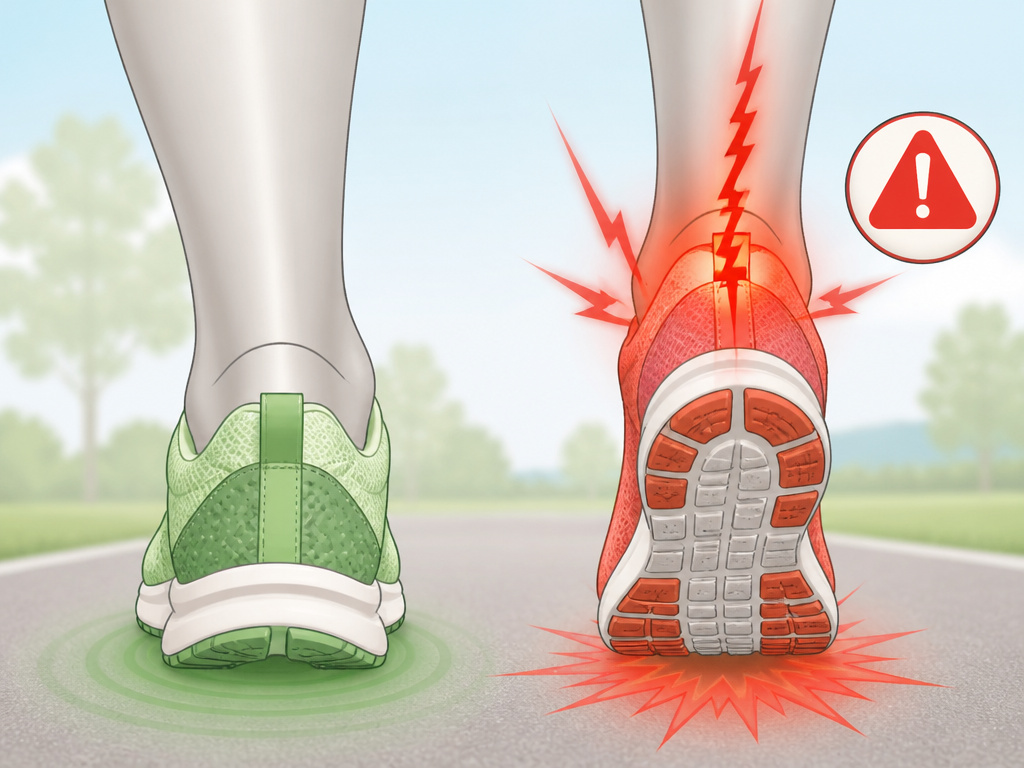
Running injury incidence sits at roughly 2.5 to 12.1 injuries per 1,000 hours of running, per van Mechelen’s 1992 review in Sports Medicine.
I learned the practical version of that number the hard way. Years ago I pushed through a sharp twinge in my knee because I’d decided it was just effort talking. A week of training disappeared, and the lesson stuck: sharp pain ends the session, a dull ache from effort can continue.
That distinction is the whole skill. It’s also the one thing no injury statistic can hand you.
The percentage figures floating around online are a mess. Body+Mind puts walkers at 1 to 5 percent injury risk and runners at 20 to 70 percent, with no citation attached. Worldlyinfo gives walking around 5 to 10 percent annually, easy running 20 to 30 percent, and fast or HIIT running 40 to 50 percent. Van Mechelen’s figure uses a different unit entirely, injuries per 1,000 hours, so it can’t be dropped into the same sentence as a lifetime percentage.
| Activity | Joint Load Per Stride | Reported Annual Injury Rate |
|---|---|---|
| Walking | 1 to 1.5x body weight | ~5 to 10% |
| Easy running | 2.5 to 3x body weight | ~20 to 30% |
| Fast or HIIT running | 3 to 4x body weight | 40 to 50% |
The honest read: the direction is consistent across all three sources, running carries more injury risk than walking, and the exact magnitude depends on which denominator the author picked.
You can feel the difference in the first ten steps. Walking rolls through the heel at roughly 1 to 1.5 times body weight. Running lands at 2.5 to 3 times, and the jolt travels up through the ankle and shin before your brain registers it.
Before you start: Sharp, pinpoint pain during a session means stop, not push. A shin or foot stress injury often starts as a dull ache that only appears when you run, and it graduates to a limp if you keep training on it. Get a clinician to look at anything that lingers.
If any of these describe you, default to walking and add impact later:
- You’re carrying significant extra weight and running makes your knees complain the next morning
- You have arthritis, fibromyalgia, or degenerative disk disease
- You’re coming back from a long layoff and want a base before adding impact
- You need a walker or crutches, in which case look for paved paths or a flat indoor space like a mall
- You want to add volume without adding recovery cost
How Many Minutes of Each Do You Actually Need?
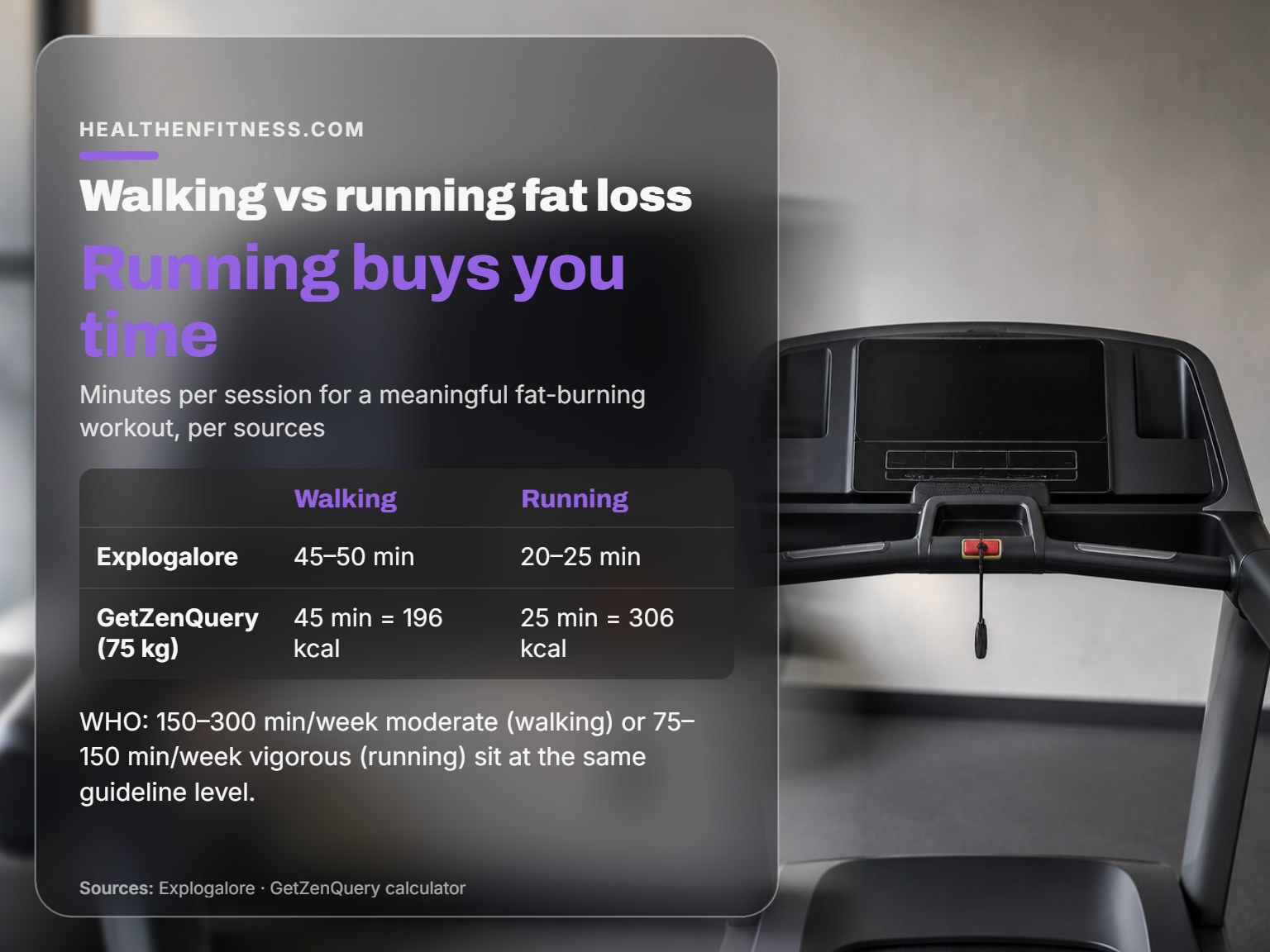
The time question has a clean answer once you accept that walking counts as moderate activity and running counts as vigorous. WHO’s 2024 guidance sets the floor at 150 to 300 minutes per week of moderate activity, or 75 to 150 minutes of vigorous activity.
Walking lands in the first bucket. Running lands in the second. That framing is more useful than the calorie tables, because it tells you the two activities aren’t competing for the same slot. A 150-minute running week and a 300-minute walking week sit at the same place on the guideline.
Explogalore puts the practical version at 20 to 25 minutes of running versus 45 to 50 minutes of walking for a meaningful fat-burning session. Worldlyinfo’s version is 30 minutes of running against 45 to 60 minutes of walking. GetZenQuery’s worked example lands in the same neighborhood: 25 minutes running for 306 kcal against 45 minutes walking for 196 kcal.
Three sources, three slightly different numbers, same shape. Running buys you time.
The 12-3-30 Shortcut
Treadmill incline is the middle path, and the 12-3-30 format is the popular version: 12 percent incline, 3 mph, 30 minutes. It raises intensity without the impact of jogging, which is why it shows up in so many beginner plans.
It’s also easy to overshoot. Quest for Fitness notes that for some people it’s a great fat-loss option and for others it’s too much, too soon. Start below the full protocol and build toward it.
If you want the full protocol broken down, incline walking is the place to start. Getting treadmill speed right matters more than people expect once the incline goes up, and the treadmill settings that actually work are less about a magic combination than a pace you can hold.
Quest for Fitness’s rule for the moderate range is simple: you’re breathing harder than normal but can still speak in short phrases. If you can’t talk at all, you’ve wandered out of the fat-loss zone.
Start boring. A 30-minute walk at a conversational pace is a real workout, and it’s the one most people skip straight past on their way to something harder.
Weekly Volume Decides More Than Modality
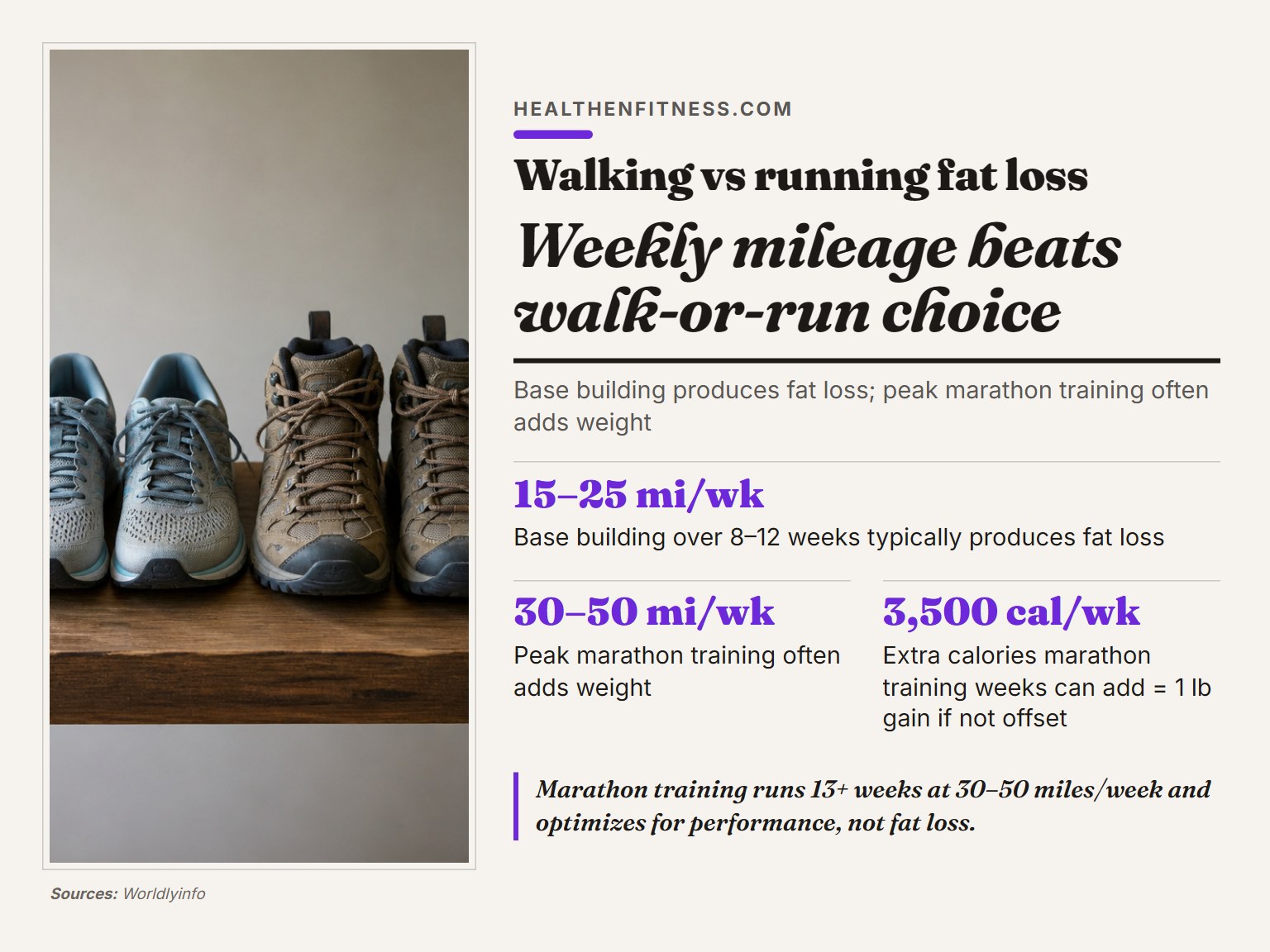
Weekly mileage moves fat loss outcomes more than the walk-or-run choice does. Worldlyinfo’s phase table is the clearest version of this. Base building at 15 to 25 miles per week over 8 to 12 weeks typically produces fat loss. Peak marathon training at 30 to 50 plus miles often adds weight.
The mechanism is appetite and compensation. High volume raises hunger, reduces spontaneous movement outside training, and pushes recovery nutrition up. Worldlyinfo estimates marathon training weeks can run 3,500 extra calories per week, which is a pound of gain if nothing else changes.
The Marathon Trap
Marathon training runs 13 or more weeks at 30 to 50 miles per week, and it optimizes for performance rather than fat loss. That’s the honest framing, and it’s also where I have to flag my own limit: I’ve never coached marathon or triathlon programming, so I’ll keep this general.
If fat loss is the goal, the base-building or maintenance phase of 15 to 30 miles per week is the better home. If you’re set on racing, the sequence Worldlyinfo suggests is instead of 50 miles/week all easy, try 30–35 miles/week with one long run, one tempo/interval session, and easy running, race, take a 4-week recovery, then enter a fat-loss phase at 20 to 30 miles per week. The recovery phase of 4 to 8 weeks at 10 to 20 miles per week is where easy weight loss tends to resume.
Here’s the blended week I’d hand someone who wants fat loss without a marathon on the calendar:
- Easy run or run-walk, 30 to 40 minutes. Skipping the easy pace turns day one into a hard day and costs you day three.
- Strength training, 30 minutes. Lower body and core, because a deficit without lifting eats muscle.
- Walk, 45 to 60 minutes at a conversational pace. This is the recovery day that makes the running days possible.
- Moderate-hard run with intervals, 30 to 40 minutes. One hard session per week is plenty at this stage.
- Strength training, 30 minutes. The second slot protects the muscle the deficit is threatening.
- Long easy run or walk, 45 to 90 minutes. Keep it genuinely easy or it stops being a long day.
- Rest or very light mobility. Cutting this one is how the whole week falls apart by week four.
That’s 4 to 5 hours a week. Notice it isn’t all running.
The two strength slots aren’t padding. strength training vs cardio for fat loss is worth reading if you’ve been told cardio is the whole answer, and Worldlyinfo puts strength work at 2 to 3 sessions a week for lower body and core during a deficit, mainly to hold onto muscle.
Which brings up best type of workout to lose weight. The answer that holds up is usually the one you can schedule.
The pattern I see most often is someone cutting calories hard and dropping strength training at the same time, which is how you lose muscle alongside the fat.
Where this goes sideways: Cutting calories hard and dropping lifting at the same time. You’ll lose weight on the scale and a chunk of it will be muscle, which is the opposite of what you wanted.
A 20-minute easy run takes 35 by the time you’ve warmed up, run, and cooled down. That math is why the walking plan wins some weeks.
Skip the Afterburn Math

Sources disagree on afterburn: Worldlyinfo gives walking a 1 to 2 hour afterburn at 10 to 15 percent above baseline and easy running 6 to 12 hours at 20 to 30 percent, while LaForgia’s 2006 review puts EPOC at only 6 to 15 percent of total exercise energy cost. Worldlyinfo gives walking a 1 to 2 hour afterburn at 10 to 15 percent above baseline, easy running 6 to 12 hours at 20 to 30 percent, and HIIT 24 to 48 hours at 30 to 50 percent. Those numbers look dramatic.
LaForgia’s 2006 review in the Journal of Applied Physiology puts EPOC at 6 to 15 percent of total exercise energy cost. Six to 15 percent of a 300 kcal run is 18 to 45 kcal. That’s real, and it’s not a plan.
Explogalore goes further and calls walking’s EPOC minimal by comparison, particularly at a leisurely pace. That’s a fair reading of the same literature. The disagreement is about how much weight to put on a small effect.
Where the sources split on which modality wins, the split is honest. Worldlyinfo argues running is faster for fat loss and recommends an 80 percent easy-run-or-walk base with occasional harder running. Body+Mind argues running doesn’t automatically win and that the right choice depends on personality, time, and preference. Quest for Fitness lands closest to my own view: the better choice is the one you can recover from and repeat.
Here’s the part that gets buried. No peer-reviewed head-to-head trial comparing walking and running for fat loss at matched energy expenditure turned up in the research behind this piece. The confident-sounding claims on both sides are extrapolations from MET tables and injury data, not from a clean experiment.
That absence is worth sitting with.
What to track instead of afterburn:
- Weekly body weight trend, same scale, same time of day. A scale that logs automatically makes this painless.
- A few weeks of honest intake tracking. An intake-tracking app is what I’d point you to for that.
- Sessions completed per week, which matters more than session quality for the first month
- How your joints feel the morning after, which is the earliest warning you’ll get
Trackers are useful for trend lines and useless for precision. I’d trust a weekly average from a scale over any single calorie-burn readout.
Frequently Asked Questions
Does walking or running burn more calories per mile?
Per mile, Body+Mind and the general physiology research brief hold that the two are broadly similar because energy cost scales with distance moved rather than pace, while Worldlyinfo and GetZenQuery emphasize that running burns 2–3× more calories per minute. Both statements come from the same MET data, just different denominators.
How long does it take to see fat loss from walking?
Daily deficit of 300 to 500 kcal is the modest range that produces 0.5 to 1 kg of loss per week when it’s held consistently. Most people see the trend line move within a few weeks, though water and sodium can mask it for several days at a time.
Can I mix walking and running in the same week?
Yes, and it’s probably the better plan. Worldlyinfo’s blended schedule runs 4 to 5 hours a week across easy runs, walks, intervals, and two strength sessions. The mix keeps impact down while keeping volume up.
Is walking enough for fat loss without changing my diet?
Walking alone can produce fat loss if it moves you into a deficit. Quest for Fitness’s example is blunt: burn 250 kcal in a session and eat 500 extra, and fat loss stalls. Diet is doing most of the work in either modality.
Which is better after 50, walking or running?
Explogalore recommends a quick medical check-in before starting either one after 50, and notes that walking intervals are one of the more underrated tools for that group. Walking also keeps the joint load at 1 to 1.5 times body weight instead of 2.5 to 3.
The Bottom Line
The walking vs running for fat loss question gets easier once you stop looking for a winner. A daily deficit in the modest 300 to 500 kcal range, or the 500 to 1000 kcal range, held for weeks, is what moves the scale. Either modality is just the vehicle that gets you there.
None of this applies cleanly if you’re marathon training. Worldlyinfo’s guidance is a 300 to 500 kcal deficit max during high volume, and even that assumes you’re eating enough protein and lifting twice a week. Cut harder and you’ll lose the training along with the fat.
If you’re starting from zero, walk first. Add running when the walking stops feeling like a chore, which usually takes longer than the internet suggests.
Do this today: one 30-minute walk and one weigh-in, logged somewhere you’ll see it next week.
