
Is Breakfast Necessary for Gym Goers? What Studies Say
This post contains affiliate links. As an Amazon Associate, we earn from qualifying purchases.
Breakfast for gym goers is necessary in one specific case: habitual morning eaters who train before eating lose reps, and 16 resistance-trained men dropped from 68 to 58 back squat reps without it. A 2025 review limits that damage to the first two sets.
Ten reps out of 68 is a real chunk of a four-set block, and rep volume is the thing that drives adaptation. Is breakfast necessary for gym goers? Lose them every morning session and your weekly total quietly falls even though you never missed a workout.
What follows is the trial data on morning lifting, the session-length line where breakfast stops being optional, the calorie argument both camps get wrong, and a short test you can run on yourself this week.
Key Takeaways
- Morning lifters who normally eat breakfast lose reps without it: 68 to 58 on squats in the 2019 trial.
- The damage lands in sets 1 and 2, not the whole session, according to a 2025 review.
- Endurance work past 60 minutes is where breakfast earns its keep. Under 60, the review found no or minimal effect.
- Skipping breakfast can produce a negative 24-hour energy balance of around 400 kcal, but the review says body-composition changes come from reduced kilocalorie intake, not from breakfast itself.
- If you’re gaining mass or struggling to eat enough, don’t skip it.
Does Skipping Breakfast Really Cost You Reps?
Sixteen resistance-trained men, four sets to failure, and a two-hour gap between breakfast and the first set.
The 2019 trial fed 16 resistance-trained men either a 1.5 g carbohydrate per kilogram breakfast or water, then tested four sets to failure two hours later. Total back squat repetitions fell from 68 to 58 and bench press from 40 to 38, with effect sizes near 1.0.
Both differences were significant at p<0.001. The effect sizes were 0.98 for squats and 1.06 for bench press, which is large for a single meal. The full protocol sits in the breakfast omission resistance exercise performance study, and the details matter: 1.5 g of carbohydrate per kilogram of body weight, eaten two hours out.
| Measure | Breakfast eaten | Breakfast omitted |
|---|---|---|
| Total back squat reps | 68 | 58 |
| Total bench press reps | 40 | 38 |
| Effect size | 0.98 squat, 1.06 bench | — |
| Statistical significance | p<0.001 | p<0.001 |
The men averaged 77.56 kg and all were habitual breakfast eaters at three or more days a week. That last detail is the one most write-ups skip.
The bar doesn’t stop dead when you’re underfuelled. It slows, and you feel the slowdown in your forearms before your legs agree with it, which is why is breakfast necessary for gym goers is worth asking.
I’ve had lifters tell me they train better fasted, then watched them grind out rep six where they used to get ten. Feeling and rep count don’t always match.
Easy to miss: The impairment finding is explicitly limited to habitual breakfast consumers. If you normally skip breakfast, this trial doesn’t describe you, and its numbers don’t transfer.
Two Credible Sources, Opposite Headlines
Both are describing the same data.
The 2019 trial counted total repetitions across four sets and found a clear drop, whereas the 2025 breakfast impact on training adaptations review describes morning resistance training as showing reduced early-set performance, specifically sets 1 and 2 of four, but not later-set performance, and elsewhere characterizes it as no or minimal impact. Elsewhere the same review characterizes morning resistance training as having no or minimal impact from breakfast omission.
Those two statements look like a fight. They aren’t. If your first two sets sag and your last two hold, your total still falls. One source counted the whole session, the other counted it set by set.
My read: the trial and the review aren’t fighting. One counted total reps, the other counted reps by set. If your first two sets sag, your total sags, and you’ll feel it as a session that never gets going.
The review also flags a limit on all of this. Few studies directly compare habitual breakfast eaters with habitual skippers. Most used cohorts of people eating breakfast five or more days a week, or people skipping it on two or fewer days. That makes a clean head-to-head hard to find.
So the honest answer is narrower than either headline. If you eat breakfast most mornings and train in the morning, skipping it costs you early sets. If you never eat breakfast, nobody has shown that it costs you anything.
The 60-Minute Line That Decides Endurance Work
Above 60 minutes, the 2025 review says a benefit from breakfast is suggested. Below 60 minutes, it reports no or minimal effect.
That’s the cleanest dividing line in the whole literature, and it’s a dividing line you can apply to your own training calendar today when you compare a is breakfast necessary for gym goers. A 45-minute easy run sits on one side. A 75-minute ride sits on the other.
The same review found that evening time-trial performance is consistently inhibited after breakfast omission, even when the person eats at midday. Skipping at 8 a.m. Can still show up at 5 p.m.
Why Evening Sessions Still Suffer
A Proceedings of the Nutrition Society review put a number on it. In one study, breakfast was provided or omitted at 08:00, an ad libitum lunch was eaten at 12:30, and a 60-minute exercise bout ran at 17:00. Performance dropped 4.5% after breakfast omission.
That’s nine hours after the missed meal and four and a half hours after lunch. The review’s authors noted the result sits right on the boundary of their own 60-minute threshold, which is a fair caveat.
Under an hour, eat if it makes you feel better and skip the guilt if it doesn’t. Past an hour, treat breakfast as part of the session rather than an optional extra.
The meal timing around workouts question gets messier once your sessions run long, because you’re no longer managing hunger. You’re managing fuel.
Does Skipping Breakfast Shrink Your Daily Calories?
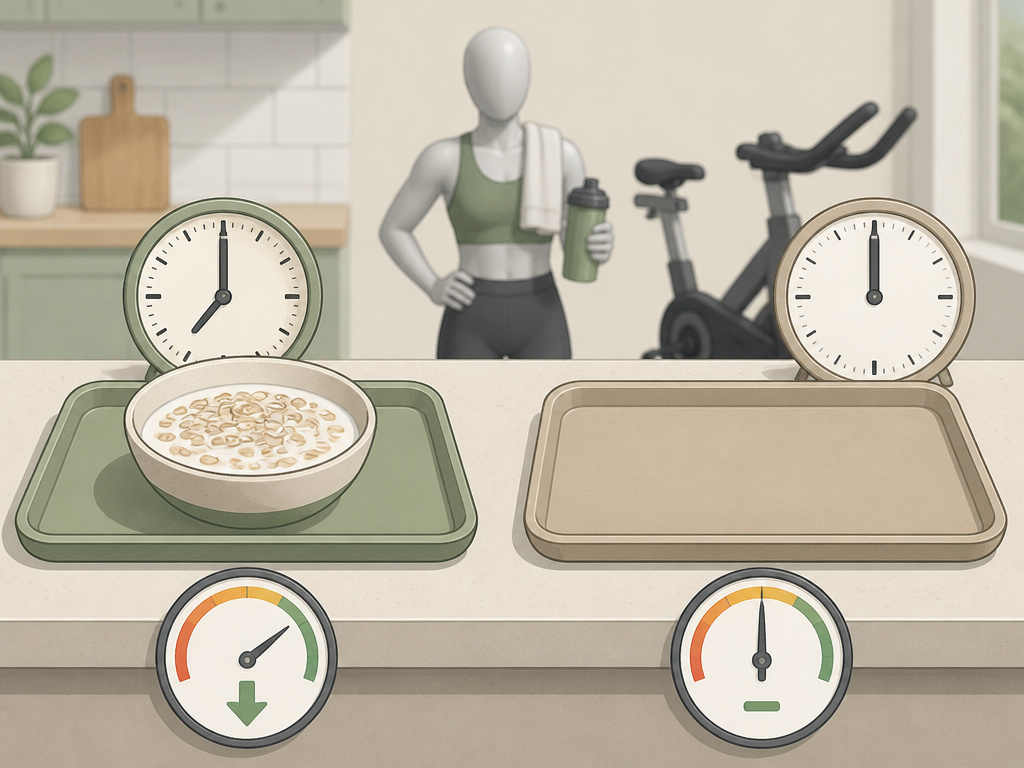
Daily energy intake is where breakfast skipping actually pays off, if it pays off at all.
One crossover trial of 12 physically active men measured 24-hour energy balance after four conditions. The breakfast was oats and milk at 431 kcal, with 65 g carbohydrate, 11 g fat and 19 g protein. Exercise was 60 minutes of cycling at 50% of peak power output.
- Fasted exercise: minus 400 kcal over 24 hours (95% CI minus 230 to minus 571).
- Breakfast plus exercise: plus 7 kcal (95% CI minus 153 to 177).
- Breakfast plus rest: plus 492 kcal (95% CI 332 to 652).
You can read the design in the skipping breakfast 24-hour energy balance trial. The interesting part is the compensation data: plasma glucose utilization correlated with how much people ate back at lunch, at r=0.62 and P=0.03.
A breakfast effects on appetite and performance review found the same pattern. An ad libitum lunch offset appetite to the same extent whether or not breakfast was eaten, which preserved the deficit. A six-week intervention where people ate at least 2930 kJ before 11:00, or abstained until 12:00, produced roughly 2300 kJ/d lower intake when breakfast was skipped.
The deficit survives lunch. Appetite doesn’t come roaring back at noon in these studies, so the hole dug at 7 a.m. Doesn’t automatically get filled.
Where this goes sideways: Dropping breakfast to cut calories without lifting your protein and fiber intake. The 2025 review warns that dietary quality tends to fall whenever meal frequency drops, and the deficit you created gets eaten back in snacks.
Here’s where the sources genuinely split. The 2025 review states that favorable body-composition changes with breakfast omission were primarily driven by the concomitant reduced kilocalorie intake, not a breakfast-specific mechanism. It advises putting primary emphasis on total nutrient intake regardless of breakfast.
Cleveland Clinic dietitian Beth Czerwony, RD, takes a different angle. She cites an observational study linking breakfast skipping four to five days a week to as much as a 55% increased risk of Type 2 diabetes, and recommends food within two hours of getting up. She also says plainly that much of the advice about breakfast’s importance rests on observational studies rather than randomized trials.
Both are honest about what they have. If you’re chasing intermittent fasting for lifters, the weight-loss trials are the ones that matter, and they’re less dramatic than the internet suggests. A 12-week energy-restricted diet found no difference in weight loss between two-meal and three-meal groups. Dhurandhar and colleagues found no significant weight change over 16 weeks whether breakfast was eaten or skipped.
What Breakfast Does to Blood Sugar and Cortisol
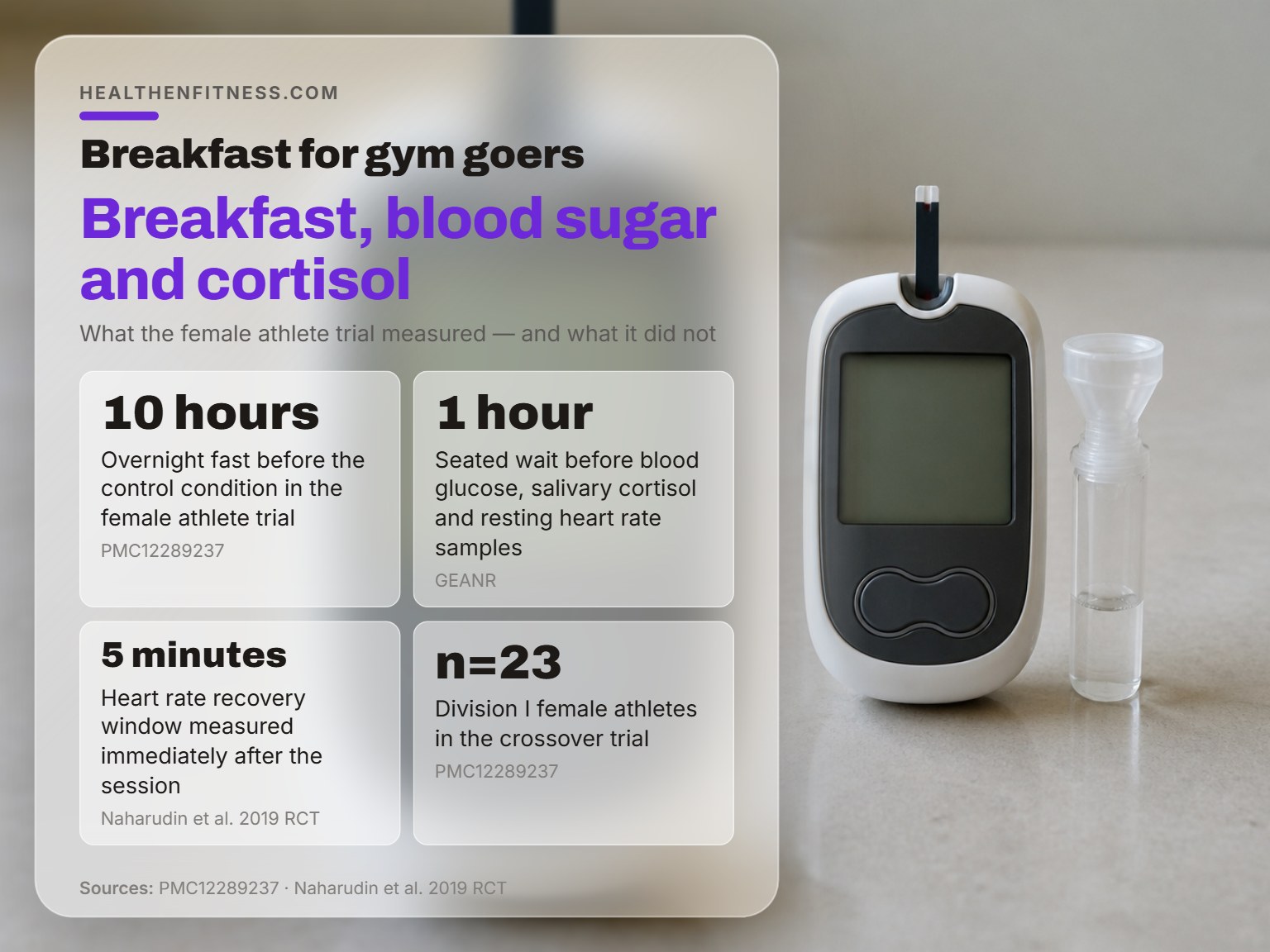
The female collegiate athlete trial measured blood glucose, salivary cortisol, resting heart rate, heart rate recovery and perceived exertion. It did not measure reps.
That’s the whole point of mentioning it. Twenty-three Division I female athletes did a crossover protocol with a 10-hour overnight fast before the control condition, a one-hour seated wait before samples were taken, and a five-minute heart rate recovery window after the session. The trial notes that breakfast consumption can mitigate the blood glucose changes resistance training causes.
It also notes that people who habitually eat breakfast tend to have lower cortisol values on waking than people who don’t. That’s a real difference, and it’s about habit rather than about any single morning.
The part nobody mentions: The female strength data is largely absent. That trial measured glucose, cortisol and heart rate, not repetition performance, so nobody can tell you whether women lose reps without breakfast the way the 16 men did.
I’d rather say that out loud than pretend the evidence is symmetrical. It isn’t.
The best time of day to workout question matters here, because the morning data and the afternoon data aren’t interchangeable. The review points out that the time-restricted eating studies showing strength gains all ran their training in the afternoon, fed. They tell you nothing about a 6 a.m. Fasted session.
Who Should Not Skip Breakfast
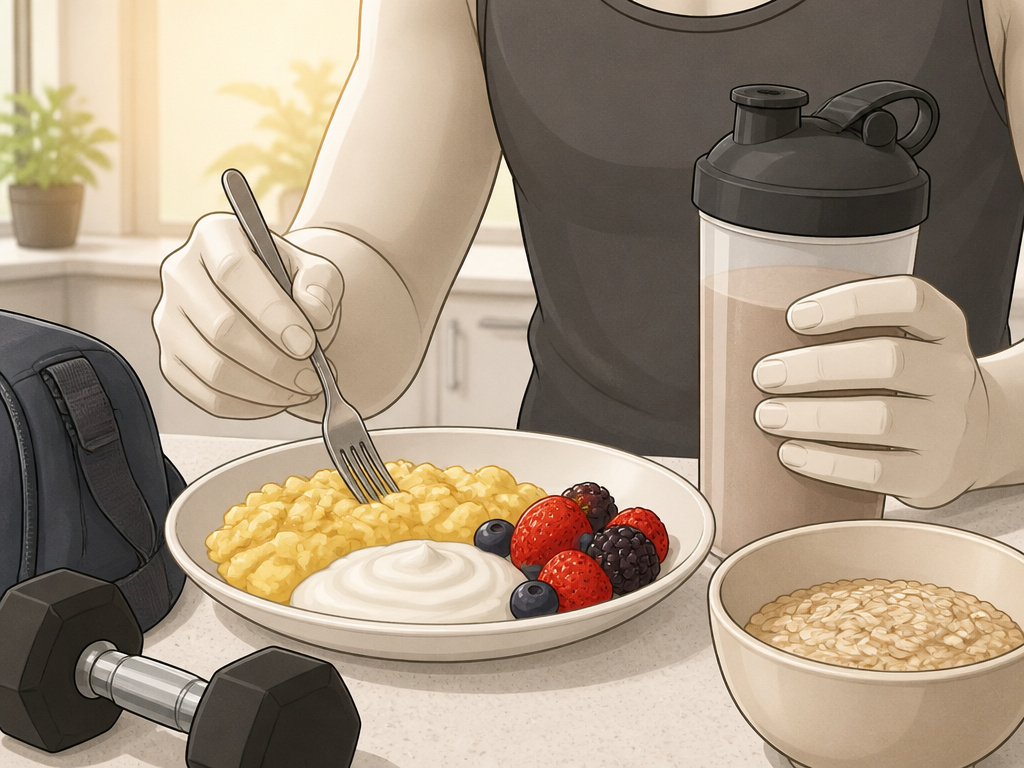
Eat first if you’re trying to gain.
The 2025 review is direct about this: skipping breakfast would not be recommended in athletes, or in people who need to increase body mass, or in anyone who has a hard time maintaining their necessary kilocalorie intake, while Cleveland Clinic advises that if you don’t wake up hungry, delaying the first meal may be better and what you eat over the whole day matters more than breakfast timing. That’s a recommendation from the review’s authors, not a manufacturer claim.
The other group is people whose morning is a scheduling problem rather than a nutrition one. Cleveland Clinic notes that 25% of Americans skip breakfast, many citing exactly that.
If You’re Trying to Add Mass
Hitting a calorie surplus on two meals is harder than on three, and the review’s warning about dietary quality applies most sharply here. A high-protein breakfast is the simplest fix, because protein and fiber are the two things that make a smaller number of meals feel like enough.
If Your Morning Is Chaos
Cleveland Clinic suggests a beverage when solid food doesn’t appeal: a cup of milk with fruit on the side, or a low-sugar meal replacement shake. That’s a lower bar than cooking, and a lower bar is the one you’ll actually clear.
Four groups where the evidence points toward eating:
- You’re trying to add body mass and hitting your daily calories is already a grind.
- Your sessions regularly run past an hour, especially in the evening.
- You have diabetes or take medication that affects blood sugar, which makes this a conversation with your clinician rather than a blog post.
- You just feel terrible training empty. That counts as a reason.
If none of those describe you, the what to eat before training question may not be worth much of your attention.
What to Eat If You Train in the Morning

It’s 6:40 a.m., you have twenty minutes, and the gym bag is already by the door.
The trial protocol isn’t built for that morning. It used 1.5 g of carbohydrate per kilogram of body weight two hours before training, which for most people means a genuinely large breakfast and a very early alarm. Cleveland Clinic’s practical version is looser: food within two hours of waking, built around protein and fiber, aiming for 25 g or more of dietary fiber across the day.
Before you start: Hard fasted training isn’t a neutral experiment if you manage blood sugar, take medication that affects glucose, or have a history of feeling faint under load. Eat something small first and keep water within reach, because a 90% set is a bad place to discover you’re lightheaded.
Two Realistic Morning Setups
For a session under an hour, keep it small and boring. A bowl of oats with a scoop of Greek yogurt lands protein and carbohydrate without weighing you down, and both are things you can assemble half asleep. If you want the liquid version, a whey protein shake mixed in milk is faster to get down than anything you have to chew.
For a session over an hour, or a morning lift where you’ve been losing reps, eat the real breakfast two hours out. The best pre-workout breakfast for that job is carbohydrate-led with protein alongside it, not a token snack.
Then test it instead of guessing. Three steps:
- Eat your normal breakfast two hours before a morning session and log total reps for every set. Skip the log and you’ll be comparing feelings, which lie.
- Repeat the same session fasted, same load, same rest periods. Change the load and you’ve tested something else entirely.
- Compare sets 1 and 2 separately, then the total. A total-only comparison hides the exact pattern the 2025 review describes.
A cheap paper notebook works fine here. A reusable notebook that wipes clean works too, but any notebook you’ll actually open beats an app with badges.
Here’s the timing picture the research actually supports:
| Situation | What the evidence shows | Source |
|---|---|---|
| Morning lift, habitual breakfast eater | Total reps fall, early sets worst | Naharudin 2019 |
| Morning lift, habitual skipper | Not directly tested in that trial | Naharudin 2019 |
| Endurance under 60 minutes | No or minimal effect | Hägele 2025 |
| Endurance over 60 minutes | Benefit suggested | Hägele 2025 |
| Evening session after skipped breakfast | Performance inhibited despite lunch | Hägele 2025 |
One more data point worth knowing: a lean-adults trial found resting metabolic rate stayed stable within 11 kcal/d between breakfast and fasting conditions. Breakfast doesn’t “boost” your metabolism in any meaningful way. What it did change was physical activity thermogenesis, which was markedly higher with breakfast than with fasting.
Start smaller than you think. A glass of milk and a banana is a real answer if the alternative is nothing.
Frequently Asked Questions
Is it bad to work out without breakfast?
Not automatically. The 2019 trial found reduced squat and bench press reps after breakfast omission, but that finding was limited to habitual breakfast eaters, and a 2025 review describes the effect as hitting sets 1 and 2 rather than the whole session. If you normally skip breakfast and feel fine, the evidence doesn’t require you to change.
How long before a morning workout should I eat?
The trial protocol used two hours. Cleveland Clinic’s general guidance is to eat within two hours of waking. If two hours before training isn’t realistic, a smaller portion closer to the session is the practical compromise, though it hasn’t been tested the same way.
Does skipping breakfast make you gain weight?
The trials don’t support that. A 12-week energy-restricted diet found no difference in weight loss between two-meal and three-meal groups, and Dhurandhar and colleagues found no significant weight change over 16 weeks. The 2025 review attributes body-composition changes to total kilocalorie intake rather than to breakfast itself.
Do fasted workouts burn more fat?
One crossover trial of 12 men found fasted exercise produced a 24-hour energy balance of minus 400 kcal, versus plus 7 kcal with breakfast plus exercise. That’s a real acute deficit. Whether it translates into more fat loss over months is a different question, and the longer trials point at total intake.
Should I eat breakfast if I train in the evening?
The evidence leans yes. A Proceedings of the Nutrition Society review reported a 4.5% performance decrement in a 60-minute bout at 17:00 after breakfast was omitted at 08:00, despite an ad libitum lunch at 12:30. The 2025 review found evening time-trial performance consistently inhibited after omission.
The Bottom Line
Here’s the threshold I’d actually use. If your session runs past 60 minutes, or you’re trying to gain weight, or you’re a habitual breakfast eater who lifts in the morning, eat first. Those three conditions are where the evidence is strongest. If you’re a habitual skipper doing 45-minute sessions, nobody has shown that forcing breakfast down does anything for you.
The concession worth stating plainly: the female strength data is thin. The female-only trial measured glucose, cortisol and heart rate, not reps, so the rep numbers here come from 16 men. That’s a real gap, not a rounding error.
And ignore the metabolism angle entirely. Resting metabolic rate held steady within 11 kcal/d between fed and fasted conditions in a lean-adults trial. Breakfast isn’t a furnace switch.
Today, just eat your normal breakfast two hours before your next morning session and count your squat reps set by set. That single comparison will tell you more about your own body than any of these studies can.
