
10 Best Exercise Bik in 2026
This post contains affiliate links. As an Amazon Associate, we earn from qualifying purchases.
The CURSOR FITNESS Exercise Bike is the best overall exercise bike because it combines a whisper-quiet belt drive, tool-free assembly, and a reinforced frame that fits riders from 4’8″ to 6’2″. For app-based training, the Schwinn Fitness IC4 offers 100 micro-adjustable resistance levels, and the Peloton Exercise Bike delivers a full interactive touchscreen experience.
Finding the right exercise bike for your home means balancing noise, stability, adjustability, and the kind of training you actually enjoy. A bike that is too loud, too small, or too complicated will collect dust.
We evaluated these bikes by studying manufacturer specifications, expert round-ups, and patterns in owner feedback. This guide breaks down the key differences so you can match a bike to your space, budget, and fitness goals.
Top 10 Exercise Bikes in the Market
Certain content that appears on this site comes from Amazon. This content is provided "as is" and is subject to change or removal at any time.
The Best Exercise Bikes, Reviewed
CURSOR FITNESS Exercise Bike
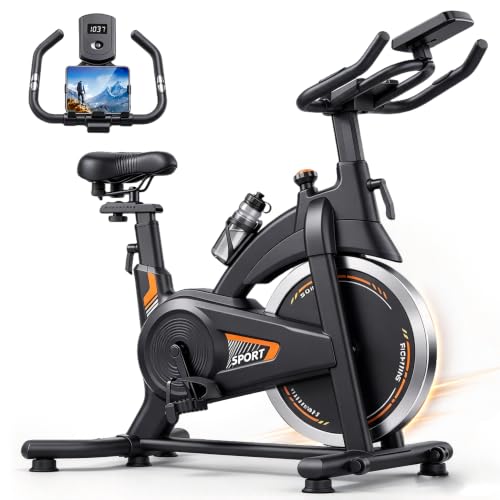
What We Like
- Quiet belt drive under 25 dB
- Fits riders 4'8" to 6'2"
- Tool-free assembly in 30 minutes
- 300 lb reinforced steel frame
Trade-offs
- At 39.7 lb, less stable for heavy sprinting
- No included screen or display
- Infinite resistance but no preset levels
At 39.7 pounds, this bike is lighter than some studio models like the Schwinn Fitness IC4 (112 pounds), which may feel more stable during very aggressive standing efforts. If you plan to do intense sprint work where extra weight helps keep the bike planted, the lighter frame might not feel as secure. For steady rides, recovery sessions, and moderate interval training, the quiet belt drive and adjustable fit make it a practical choice for home use.
Product photos
Schwinn Fitness IC4 Indoor Cycling Bike
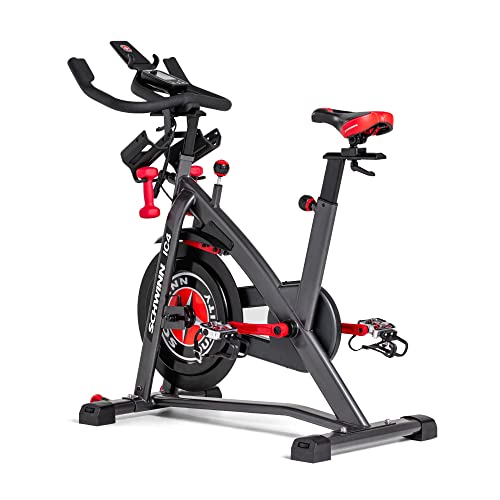
What We Like
- 100 micro-adjustable magnetic resistance levels
- Dual-sided pedals with SPD clips and toe cages
- Full color backlit LCD with heart rate monitor
- Works with Peloton, Zwift, and other apps
Trade-offs
- 112-pound weight makes it hard to move
- Requires separate subscriptions for popular cycling apps
The Schwinn IC4’s 100 micro-adjustable resistance levels let you fine-tune tension smoothly, which is useful for matching the pace of app-based classes from Peloton, Zwift, or JRNY. The dual-sided pedals (SPD on one side, toe cages on the other) let you ride in cycling shoes or sneakers, so you don’t have to commit to a cleat system right away. The full color backlit LCD shows heart rate, speed, time, distance, calories, and RPMs, so you can track your workout without a phone or tablet.
The bike weighs 112 pounds, so it stays planted during intense rides but is a challenge to move between rooms. If you plan to keep it in one spot, that stability works in your favor. By comparison, the CURSOR FITNESS bike weighs 39.7 pounds and is much easier to relocate. You will need separate subscriptions for Peloton or Zwift if you want those apps, adding to ongoing costs. For buyers who value precise resistance control and app compatibility over portability, this bike meets those needs.
Peloton Exercise Bike
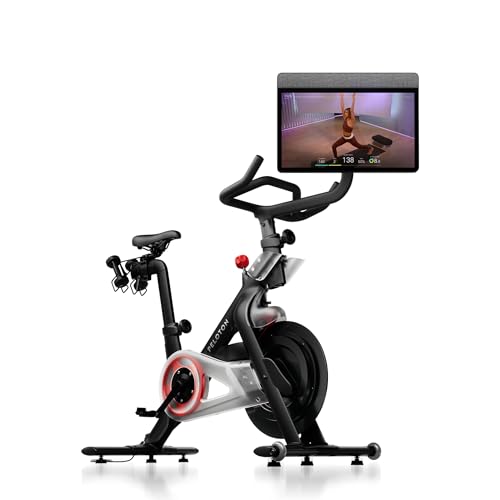
What We Like
- 21.5" HD swivel touchscreen for 15+ workout types
- Personalized weekly fitness plans and recommendations
- Adjustable seat, handlebars, and tilting screen
- Bluetooth 5.2 and USB-C charging included
Trade-offs
- At 178 lb, moving it requires lifting aids and care
- Requires 24" clearance and 8' ceiling height for setup
- WiFi required; membership sold separately /month
A 21.5-inch HD touchscreen that swivels 360 degrees means you can go from a cycling class to a yoga flow or strength session without moving to another room. That flexibility, paired with tailored weekly workout plans and personalized class recommendations based on your recent rides, makes this bike feel less like a single-purpose machine and more like a full home studio. It suits someone who wants guided variety, cardio, strength, Pilates, barre, all from one sturdy frame that supports riders up to 297 pounds and heights from 4’11” to 6’5″.
At 178 pounds, this isn’t a bike you casually reposition. The manufacturer recommends lifting aids and proper technique during assembly. You’ll need at least 24 inches of clearance on all sides plus an 8-foot ceiling. That’s a heavier commitment than the CURSOR FITNESS bike (39.7 lb), which you can easily tuck into a corner. But if your space is dedicated and you want an interactive screen that adapts to how you feel each day, the Peloton’s swivel display and personalized programming make it a compelling centerpiece for a varied home routine.
Product photos
MERACH Exercise Bike with Screen
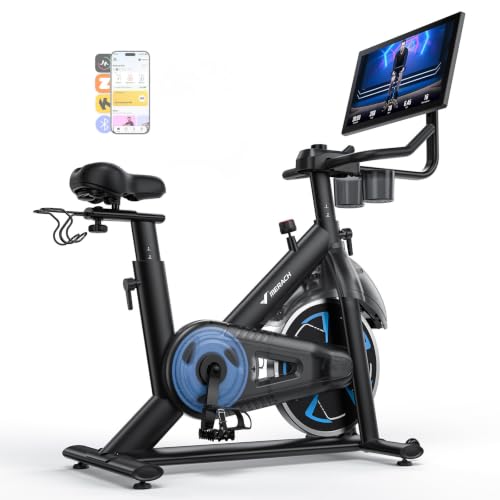
What We Like
- 21.5" rotatable HD anti-glare display
- 330 lb weight capacity reinforced frame
- Whisper-quiet under 25 dB operation
- Auto-adjusting magnetic resistance syncs with courses
Trade-offs
- Display not compatible with Google phones
- At 66 lb, moving it requires effort
A 21.5-inch rotatable HD display that swivels and tilts 180° means you can follow a cycling class, stream a show, or mirror your phone without craning your neck. Pair it with the Merach app for real-time stats like distance and calories, and the magnetic resistance automatically adjusts to match the expert courses, so you don’t have to fiddle with a knob mid-sprint.
The display currently isn’t compatible with Google phones, so if you use one, you won’t be able to mirror content. At 66 pounds, it’s heavier than the CURSOR FITNESS model (39.7 lb), so repositioning it in a shared space takes a bit more muscle. The nearly silent operation (under 25 dB) makes it a strong pick for apartments or early-morning sessions where noise is a concern. If you value a large integrated screen and don’t mind the extra heft, this is a straightforward option that offers app-guided workouts.
Product photos
SLUNSE FITNESS Exercise Bike
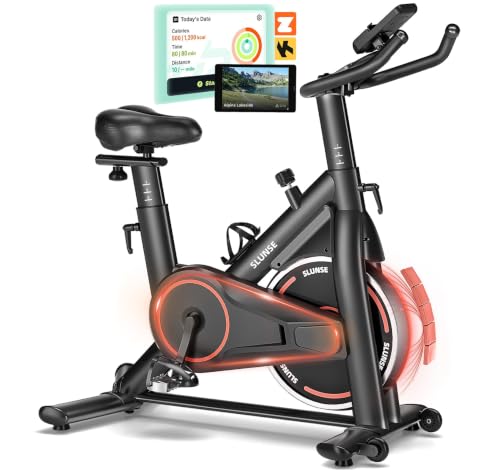
What We Like
- 350 lb weight capacity
- 100-level micro-adjustment resistance
- Thickened aluminum steel frame
- 5 adjustable non-slip feet pads
Trade-offs
- Height range tops at 6'1", not for taller riders
- No built-in screen for app workouts
A 350-pound weight capacity and a 35-pound flywheel wrapped in thickened aluminum steel tell you this bike is built for riders who want zero wobble. The curved rear base and five adjustable non-slip feet pads lock it down on any floor, so you can push hard out of the saddle without feeling that side-to-side shimmy that ruins a workout. It’s the kind of stable platform that suits heavier users, taller beginners up to 6’1″, or anyone who values safety over flash. The 100-level micro-adjustment resistance lets you fine-tune tension for different training needs, all while the belt drive keeps things quiet enough for an apartment.
This bike is not trying to be a Peloton or a Schwinn IC4. There is no built-in screen, so you will need your own tablet or phone to use the app compatibility. The 59.5-pound frame is still manageable thanks to the transport wheels for moving between rooms. If you want a polished all-in-one smart bike with a big display, the MERACH with its 21.5″ HD screen offers that, but it also carries a lower weight limit. The SLUNSE FITNESS gives you the rugged stability and precise resistance control without the premium price tag, making it a straightforward, no-nonsense choice for someone who just wants a rock-solid bike that stays put and lets them ride hard.
Product photos
Sunny Health & Fitness Premium Smart Exercise Bike

What We Like
- 44 lb flywheel for smooth momentum
- Magnetic resistance keeps rides quiet
- 4-way adjustable seat and handlebars
- Free SunnyFit app with 1,000+ workouts
Trade-offs
- At 124.8 lb, moving it is a chore
- No included screen or display
- Requires a mobile device for app use
A 44-pound flywheel is the heart of this bike, giving you that heavy, momentum-driven spin that feels stable and satisfying on every pedal stroke. The magnetic resistance keeps rides quiet, so it works well in shared living spaces. The 4-way adjustable seat and handlebars help you dial in your fit, and the free SunnyFit app opens up over a thousand trainer-led rides and scenic tours right from your phone or tablet.
At 124.8 pounds, this bike is heavy enough that you won’t want to move it between rooms. It lacks a built-in screen, so you’ll need to place your own phone or tablet on the included holder to follow the app workouts. Compared to the Schwinn IC4, which weighs 112.0 pounds and also relies on your own device, the Sunny model’s 44-pound flywheel gives it a smooth, stable ride that riders who value momentum will appreciate.
NordicTrack T Series 9 Exercise Bike

What We Like
- 16 digital resistance levels for customized intensity
- SmartAdjust auto-adapts resistance to your fitness
- Dual-sided pedals with SPD and toe cages
- Front-mounted transport wheels for easy moving
Trade-offs
- At 94.3 lb, it is heavy to reposition without wheels
- Full iFIT features require paid membership after first month
- No built-in screen, relies on your own tablet or phone
The 16 digital resistance levels mean you can dial in exactly the effort you want, from a gentle recovery spin to a lung-busting climb. That precision is the heart of why this bike shines for anyone who wants guided, adaptive training. If you are the kind of person who likes a trainer to tell you what to do next, and you already own a tablet or phone, the iFIT integration here is the real draw. SmartAdjust automatically adapts your bike’s resistance in real time based on your workout history and performance. The more you train, the more your workouts evolve. It is a bike designed around a coaching membership, not just a standalone piece of equipment.
You are committing to that ecosystem. After the included first month, the iFIT membership costs extra, and without it you lose the auto-adjust, AI coaching, and app syncing that make this bike special. The LCD display shows live stats, but there is no built-in screen, so you will need your own device on the shelf to follow workouts. At 94.3 pounds, it is not light, but the front-mounted transport wheels make it easier to roll out of the way after a session. This bike offers a connected training experience for someone who wants a coach, just be ready for the subscription.
Product photos
NordicTrack X24 Bike
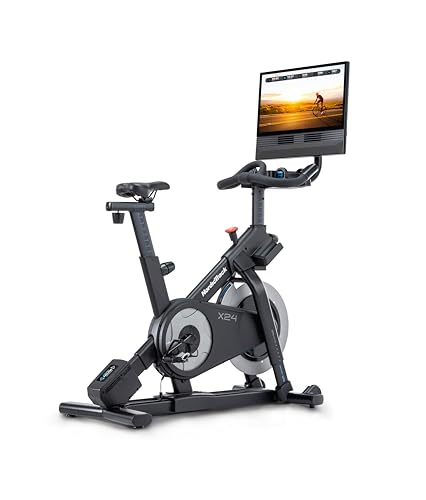
What We Like
- 24" pivoting touchscreen for on/off-bike classes
- -10% to 20% auto incline simulates real terrain
- 24 digital resistance levels for any intensity
Trade-offs
- At 179.2 lb, moving it is a two-person job
- iFIT Pro Membership required for core features
A -10% decline to 20% incline range means this bike can mimic everything from a steep Alpine descent to a grinding hill climb without you touching a knob. That auto-adjusting terrain, paired with 24 digital resistance levels and SmartAdjust that learns your performance, makes it feel like you’re actually riding outside. It suits anyone who wants immersive trail-like training at home and doesn’t mind leaning into a subscription ecosystem to get it.
Size and commitment are the trade-offs here. At 179.2 pounds and nearly five feet long, this is a permanent piece of furniture, not something you stash in a closet. Compared to the Schwinn IC4 at 112 pounds, the NordicTrack demands a dedicated spot and a friend to help move it. You also need the iFIT Pro Membership to unlock the auto-terrain and streaming features that make this bike special. If you want a simple spin without subscriptions or a massive frame, the Schwinn is lighter and more straightforward.
MERACH Friction Stationary Bike
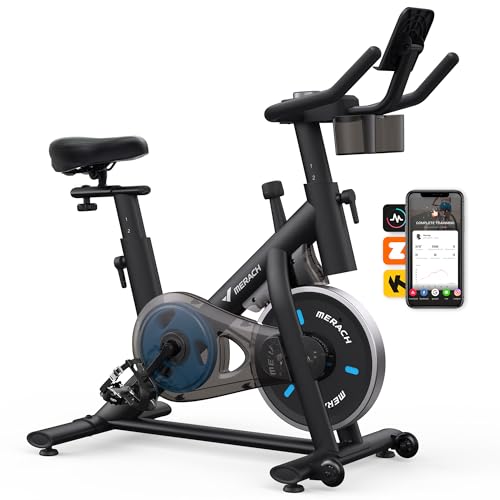
What We Like
- Adjustable seat and handlebars for 4'8"–6'2" riders
- Bluetooth app tracks metrics, works with Zwift
- Triangular steel frame supports 300 lb
Trade-offs
- Heavier than some compact bikes at 59.5 lb
- No built-in screen for guided classes
The multi-slot silent belt drive keeps noise below 25 decibels, so you can pedal through a 6 AM workout without waking anyone else. For someone who wants a stable, quiet indoor bike that tracks real-time metrics via Bluetooth and fits riders from 4’8″ to 6’2″, this is a smart way to start without overcommitting.
The friction resistance system uses a brake pad, which is a simpler design than magnetic systems found on some other bikes. Compared to the CURSOR FITNESS bike, the MERACH is heavier at 59.5 pounds versus 39.7 pounds, which adds stability but makes it less portable. It lacks a built-in touchscreen, so guided classes require a separate tablet or phone. If you want a stable, app-connected bike that fits a wide range of rider heights and don’t mind the friction pad design, this model delivers a quiet ride at a reasonable weight.
Product photos
YOSUDA Exercise Bike
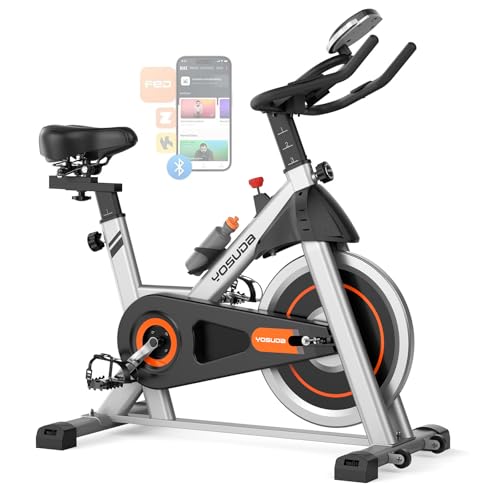
What We Like
- Belt drive for quiet, smooth rides
- 25 lb flywheel adds steady momentum
- 300 lb weight capacity for stability
- Adjustable seat and handlebars for fit
Trade-offs
- At 59.5 lbs, it's heavy to move
- Heavier than some comparable models at 59.5 pounds
A 25-pound flywheel and belt-driven system mean this bike delivers the kind of smooth, quiet ride that lets you pedal through a workout without waking anyone else in the house. The heavy-duty steel frame and 300-pound weight capacity keep it planted during high-intensity efforts, so you can push hard without worrying about wobble. That combination makes it a natural fit for anyone who wants a steady, low-distraction indoor cycling experience at home, especially if you live in an apartment or share walls with neighbors.
How We Evaluated Exercise Bikes
We built this guide by analyzing specifications from each manufacturer, studying expert round-ups across the fitness industry, and identifying common praise and complaints in owner feedback. The goal was to find the best exercise bikes for realistic home use, not just spec-sheet winners.
Three criteria mattered most. First, noise and maintenance, belt drives and magnetic resistance are quieter and lower-maintenance than friction pads. Second, rider fit range, a bike that doesn’t adjust enough for your height or inseam is unusable. Third, stability under load, a wobbly bike ruins the ride and can be dangerous during sprints.
A research-led evaluation like this cannot replace personal test rides, but it does surface the trade-offs that matter. We prioritized bikes with clear, verifiable specs and consistent owner feedback patterns over marketing claims.
What To Look For In Exercise Bikes
Choosing an exercise bike comes down to matching your body, your space, and how you like to ride. Here are the key factors to consider before buying.
Look for a bike with a resistance system that matches your noise tolerance, a weight capacity that exceeds your body weight by at least 50 lb, and a height range that fits your inseam. Magnetic resistance is quieter; belt drives are smoother.
Resistance Type: Magnetic vs. Friction vs. Belt
Magnetic resistance is the quietest and most durable option, using magnets to create drag without physical contact. Friction resistance uses a pad against the flywheel, it is louder and wears over time but is common on budget bikes. Belt-drive bikes use a belt instead of a chain, which reduces noise and maintenance compared to chain-driven models.
The number of resistance levels matters for progressive training. Bikes with micro-adjustment (like the Schwinn IC4’s 100 levels) let you dial in precise tension, while simpler bikes may have 8-16 levels that jump between effort zones.
Rider Fit and Adjustability
A bike that does not fit your body is a waste of money. Look for four-way adjustable seats (up/down and forward/back) and handlebars that move vertically. The height range should include your inseam measurement; most bikes accommodate riders from roughly 4’8″ to 6’5″, but some top out at 6’1″ or 6’4″.
The flywheel weight affects how the ride feels. Heavier flywheels (40+ lb) provide smoother momentum and a more road-like feel, while lighter flywheels (20-30 lb) are easier to accelerate but may feel less stable at high cadence.
Connectivity and Display Options
Bikes range from no screen at all (use your own tablet or phone) to built-in touchscreens with app integration. If you want app-based classes, check compatibility, some bikes work with Peloton, Zwift, and iFIT, while others lock you into one ecosystem with a paid membership.
- Measure your ceiling height (at least 8 feet for most bikes) and floor space (roughly 2′ x 4′ minimum).
- Check the bike’s assembled weight, heavier bikes are more stable but harder to move.
- Verify the weight capacity against your needs; 300 lb is standard, but some frames support 330-350 lb.
- Look at pedal type, dual-sided pedals with SPD clips and toe cages offer the most flexibility.
A heavier flywheel and wider base usually mean a more stable ride, but they also mean a heavier bike to move.
Exercise Bikes Compared
The table below compares the 10 exercise bikes side-by-side by weight capacity, flywheel weight, resistance type, and key features so you can see which model fits your needs.
| Product | Weight Capacity | Resistance Type | Dimensions (L x W x H) |
|---|---|---|---|
| CURSOR FITNESS Exercise Bike | 300 lb | Infinite resistance | 31.5 x 21.2 x 43.3 inches |
| Schwinn Fitness IC4 Indoor Cycling Bike | N/A | 100 micro-adjustable levels | 48.7 x 21.2 x 51.8 inches |
| Peloton Exercise Bike | Up to 297 lbs | N/A | 54 x 23 x 61 inches |
| MERACH Exercise Bike with Screen | 330 lbs | Magnetic, auto/manual | 55.1 x 19.3 x 58.2 inches |
| SLUNSE FITNESS Exercise Bike | 350 lbs | 100-level micro-adjustment | 39.4 x 22.8 x 47.2 inches |
| Sunny Health & Fitness Premium Smart Exercise Bike | 300 lb | Magnetic, quiet | 50.8 x 23.4 x 47.6 inches |
| NordicTrack T Series 9 Exercise Bike | N/A | 16 digital | 46.8 x 22.6 x 49.4 inches |
| NordicTrack X24 Bike | N/A | 24 digital | 56.4 x 21.8 x 65.1 inches |
| MERACH Friction Stationary Bike | 300 lb | Friction (infinite adjustment) | 40.0 x 22.0 x 45.0 inches |
| YOSUDA Exercise Bike | 300 lb | N/A | 29.9 x 7.5 x 38.6 inches |
Frequently Asked Questions
What type of exercise bike is best for home use?
For most home setups, a magnetic resistance bike with a belt drive offers the best balance of quiet operation, low maintenance, and smooth riding. The home exercise bikes we recommend range from app-compatible models to simple manual bikes, so the “best” type depends on whether you want interactive coaching or a straightforward ride.
How much space do I need for an exercise bike?
Most exercise bikes require a footprint of about 2 feet wide by 4 feet long, plus additional clearance for mounting and dismounting. You also need at least 8 feet of ceiling height for bikes with high seat positions. Compact exercise bikes are available if floor space is tight.
Is a heavier flywheel better on an exercise bike?
A heavier flywheel (40 lb or more) provides smoother momentum and a more road-like feel, making it easier to maintain a steady cadence. Lighter flywheels require more effort to keep spinning but are easier to accelerate. The trade-off is weight, bikes with heavy flywheels are harder to move.
Do I need a smart exercise bike with a screen?
Not necessarily. Many riders prefer to use their own tablet or phone with a bike that has a device holder. Smart exercise bikes with built-in screens offer convenience and integrated coaching. But they cost more and often require a paid membership for full features.
Can I lose weight using an exercise bike?
Yes, cycling burns calories and builds cardiovascular fitness. That supports weight loss when combined with a balanced diet and consistent routine. Exercise bikes for weight loss typically feature adjustable resistance levels so you can increase intensity over time.
The Bottom Line
The CURSOR FITNESS Exercise Bike is the best overall choice for anyone who wants a quiet, adjustable bike that goes together fast and fits a wide range of riders. Its trade-offs, no built-in display and a lighter frame, are minor compared to the value of a tool-free setup and a near-silent ride.
If you want app-based classes with precise resistance control, the Schwinn Fitness IC4 delivers 100 levels of magnetic resistance and works with Peloton and Zwift. For a fully interactive touchscreen experience with strength and yoga classes, the Peloton Exercise Bike is the premium pick.
The single most important factor is fit, a bike that does not adjust to your body will not get used. Measure your inseam, check the height range, and choose a bike that lets you ride comfortably from day one.
