
10 Best Yoga Gear For Beginners in 2026
This post contains affiliate links. As an Amazon Associate, we earn from qualifying purchases.
For a new yogi, the Gaiam Premium Yoga Mat earns our best overall spot with its 5mm cushion for joint protection and textured non-slip surface that helps you hold poses without sliding. We also recommend the Manduka Begin Yoga Mat for lightweight portability and the GRAND BASICS Instructional Mat for anyone who wants pose guidance printed right on the surface.
Starting yoga means sorting through mats, blocks, straps, and clothes, and it is easy to buy gear that looks good but does not work for your body or your practice space. The wrong mat can leave your knees sore or have you slipping in downward dog, while the right setup makes every session more comfortable and more fun.
We built this guide by studying manufacturer specifications, expert round-ups, and patterns in what beginners consistently say works and what does not. You will find ten picks that cover different budgets, body types, and practice styles, each with honest trade-offs so you can choose with confidence.
Top 10 Yoga Gear For Beginners in the Market
Certain content that appears on this site comes from Amazon. This content is provided "as is" and is subject to change or removal at any time.
The Best Yoga Gear For Beginners, Reviewed
Gaiam Premium Yoga Mat

What We Like
- 5mm cushion protects joints
- Textured non-slip surface for grip
- Lightweight and portable with strap
- Free downloadable yoga class included
Trade-offs
- PVC material needs 2-3 days to air out
- Standard 24" width limits sprawling poses
A 5mm cushion sits right in the sweet spot for beginners, enough padding to save your knees and wrists in kneeling poses, but not so thick that you wobble in standing balances. The textured non-slip surface gives you traction even when your palms get sweaty, so downward dog feels stable from day one. It’s also lightweight at 2.6 pounds and comes with a cinch strap, meaning you can toss it over your shoulder and walk to the park or studio without feeling like you’re hauling gear. That combination of joint comfort, grip, and portability is why this mat makes starting a yoga practice feel straightforward instead of intimidating.
The trade-off is that the 68-inch length and 24-inch width are standard, not generous. If you’re over six feet tall or like to spread your limbs wide in shavasana, you might find yourself creeping off the edges. Compared to the YOGATI mat with alignment lines, which stretches to 72 inches, the Gaiam is a bit more compact. But for the vast majority of beginners, that size is plenty, and the non-toxic 6P-free PVC means you’re not unrolling a chemical cloud into your living room (just give it two or three days to air out first). It’s a practical, no-nonsense mat that gets out of your way so you can focus on learning the poses.
Gaiam Reversible Yoga Mat

What We Like
- Two-sided print for mood and motivation
- 6mm cushioning for joint comfort
- Non-slip textured sticky surface
- Free downloadable yoga class included
Trade-offs
- 24-inch width limits arm space for broader builds
- PVC material not preferred by eco-focused beginners
The 6mm thickness provides extra cushioning for your knees and wrists during floor poses, which is helpful if you’re new to yoga or have sensitive joints. The two-sided reversible print lets you switch designs to keep your practice space feeling fresh, and the mat comes with a free downloadable yoga class so you don’t have to search for a starter routine. This mat works well for anyone who values comfort and visual variety over ultra-portability or eco-materials.
The PVC construction can have a noticeable smell right out of the package; Gaiam recommends unrolling it for two to three days to let that fade. Compared to the Manduka Begin Yoga Mat (5mm thick), this Gaiam gives you more cushioning and a reversible look but lacks alignment guides that some beginners find helpful for foot placement. The 24-inch width is typical for mats in this guide, but if you have broader shoulders or like a wider stance, you might feel a bit cramped during wide-legged poses. For a beginner focused on comfort and a cheerful practice space, this mat delivers where it counts.
YOGATI Yoga Mat with Alignment Lines

What We Like
- Laser-etched alignment lines guide hand and foot placement
- Textured closed-cell surface resists slipping during sweat
- 6mm dense foam cushions joints without sacrificing stability
- Lightweight at 1.9 lb with included carrying strap
Trade-offs
- Narrower than some extra-wide mats at 24 inches
- Closed-cell surface can feel sticky in dry climates
The laser-etched center markings show where your palms and heels belong, which helps beginners learn correct form while experienced yogis fine-tune symmetry. At 6mm thick, the dense TPE foam softens knees and elbows against a hard floor but stays firm enough that you won’t wobble in tree pose. The mat is reversible with a warm sand side and a caramel side, so you can flip it for a fresh look. For a beginner who wants to build good habits from day one, those alignment guides turn every practice into a mini lesson without needing an instructor staring over your shoulder.
The trade-off for that lightweight portability is a narrower 24-inch width. If you tend to sprawl your feet wide in happy baby or take big side steps in warrior sequences, you might find yourself grazing the edge. For someone practicing mostly indoors a few times a week, the alignment lines alone make this a smart starting point.
Product photos
Manduka Begin Yoga Mat

What We Like
- Lightweight at 2.1 pounds
- Reversible dual-color design
- Center alignment stripe for form
- Eco-friendly TPE foam cushioning
Trade-offs
- 5mm thickness offers less joint cushioning than thicker mats
- Narrower than many competing yoga mats at 24 inches
At just 2.1 pounds, this mat makes your first few classes feel like less of a logistical puzzle. You can toss it in a tote, carry it to the park, or stash it by the couch without wrestling a heavy roll. The 5mm TPE foam provides cushioning that supports your joints, while the center alignment stripe helps guide your poses for proper form. It is reversible with a dual-color design, giving you two looks in one mat.
At just 2.1 pounds, this mat is light enough to toss into a tote or backpack without adding noticeable weight. That makes it a practical choice for beginners who want to practice at home, in class, or on the go. It measures 68 inches long and 24 inches wide with 5mm of cushioning, which is enough support for most basic poses while still being easy to roll out and carry. The reversible dual-color design and center alignment stripe help guide your form, so you can build confidence in your practice without needing extra gear.
GRAND BASICS Instructional Yoga Mat

What We Like
- 75 illustrated poses printed on mat
- Extra 1/4-inch cushion for knees
- Includes carrying strap for travel
- Non-slip, non-toxic PVC construction
Trade-offs
- Heavier than many beginner mats at 3.7 lbs
- Narrower than some extra-wide options
The 75 illustrated poses printed on the mat give you a visual guide during practice, so you don’t need to look away from your mat to check a screen or instructor. The quarter-inch thickness provides extra cushion for your knees and tailbone compared to thinner mats, which can make holding poses more comfortable. The included carrying strap lets you take it to class or home easily.
At 3.7 pounds, this mat is heavier than the Manduka Begin (2.1 pounds) or the Gaiam Premium (2.6 pounds), so carrying it to class requires a bit more effort. Any odor from the PVC material fresh out of the packaging will quickly dissipate. For someone who wants extra cushioning and printed guidance, the weight is a reasonable trade-off.
Amazon Basics Extra Thick Yoga Mat

What We Like
- Half-inch cushioning for comfortable support
- Lightweight at only 2.2 pounds
- Textured surface for extra traction
- Includes elastic carrying strap
Trade-offs
- NBR foam absorbs moisture more than PVC
- At 24 inches wide, less roomy than wider mats
A full half inch of cushioning means this mat absorbs shock from knees, elbows, and hips during floor poses or ab work, so beginners can focus on form rather than discomfort. The NBR foam construction stretches and springs back, keeping its shape over time, and the textured surface helps your hands and feet stay planted during downward dog or balance poses. At just 2.2 pounds with a carrying strap, it is easy to take to a class or park, making it a practical starting point for anyone wanting a forgiving surface without a heavy investment.
The NBR foam construction is lightweight and durable, but the care instructions specify hand wash only, which means you will need to wipe it down after each session to keep it clean. It measures 24 inches wide, which is standard for yoga mats but narrower than extra-wide options like the KEEP Non-Slip Large Yoga Mat at 32 inches. Taller or broader beginners may find their hands and feet occasionally slide off the sides during wide stances. For most newcomers, though, the generous cushioning and portability make this a smart, budget-friendly way to start a home practice.
Product photos
Retrospec Solana Thick Yoga Mat

What We Like
- Half-inch thickness cushions joints and knees
- Non-slip surface helps maintain balance
- Includes carrying strap for portability
- Easy to clean with soap and water
Trade-offs
- At 72 inches, shorter than some alternatives
- 24-inch width limits side-to-side space
A full half-inch of cushion means your knees, hips, and wrists get serious relief during floor poses and kneeling stretches. That extra padding makes this mat a natural fit for beginners who are still building comfort on hard surfaces, or anyone nursing sensitive joints. The non-slip surface helps you hold poses without sliding around, and the included strap makes it easy to roll up and carry to class or the living room. It’s a straightforward, no-fuss design that prioritizes comfort and stability over frills.
The initial odor is also worth noting. Retrospec recommends airing it out for a day or two before your first session. But if joint comfort is your top priority and you’re under about six feet tall, this mat delivers real value without breaking your budget.
KEEP Non-Slip Large Yoga Mat
What We Like
- 32-inch width for extra room
- 7mm thick cushioning for joint protection
- Double-sided non-slip grip
- Eco-friendly TPE material
Trade-offs
- TPE material less durable than PVC over time
- Requires airing out before first use to dissipate odor
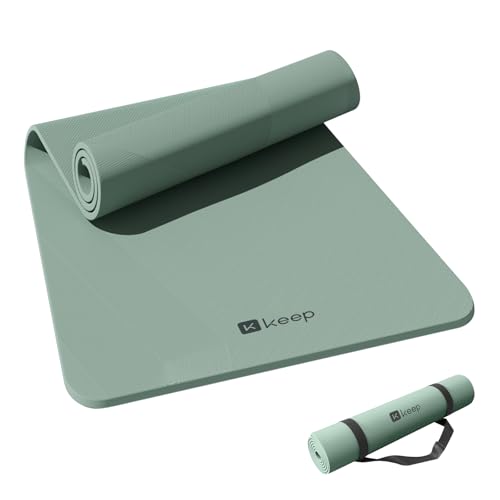
At 32 inches wide, this mat gives you a noticeably larger surface than standard 24-inch mats. You can spread out for wide-legged poses or dynamic flows without worrying about your hands or feet slipping off the edge. The 7mm padding offers generous cushioning for your knees and elbows during floor work, making it a comfortable choice if you’re just starting out and still figuring out where your joints like to land. The double-sided non-slip texture helps keep you steady on dry or wet surfaces, and the TPE material is free from plasticizers and formamide, so it’s a gentler option for both your body and the planet.
The KEEP Non-Slip Large Yoga Mat is 72 inches long and 32 inches wide. That gives you noticeably more room than standard 24-inch-wide mats like the Gaiam Premium Yoga Mat, so you can spread out during dynamic flows or wide-legged stretches without worrying about your hand or foot slipping off the edge. At 7mm thick, the padding cushions knees and elbows during floor work, which is a real plus if you’re sensitive on hard surfaces. The double-sided non-slip texture, a fingerprint-like pattern on top and a full anti-slip pattern on the bottom, keeps the mat planted on both dry and wet floors, so you can focus on your pose rather than sliding around. Reviewers note the TPE material is free of plasticizers and formamide, making it a safer choice for those concerned about chemical exposure during practice.
Product photos
FARINOK Yoga Set for Beginners

What We Like
- 8mm thick cushion for joints
- Double-sided non-slip for stability
- Includes carrying bag for portability
Trade-offs
- At 5.7 lb, heavier than most basic mats
- Accessories are basic, not studio-grade
The 8mm thickness gives your knees, hips, and elbows noticeable cushion on hard floors, which is a real help if you’re new to yoga and find standard mats too thin. The set bundles a strap, two blocks, resistance bands, a door anchor, booty bands, and a carrying bag, so you have everything you need to start without buying extras. For a beginner who wants one purchase that covers the essentials, this delivers convenience and comfort right out of the box.
Weight is the main drawback here. At 5.7 pounds, it’s heavier than the Gaiam Premium (2.6 lb), so if you’re walking to class or stashing it in a tight locker, you’ll feel the difference. The 24-inch width is standard, and the included accessories are functional for starting out. For someone who wants a complete starter bundle with extra cushion, this set is a practical, no-fuss way to begin.
Product photos
STAASH Premium Yoga Set
What We Like
- Complete 4-in-1 starter set
- Non-slip PU surface for hot yoga
- Eco-friendly natural rubber and PU
- Knee pad adds joint cushioning
Trade-offs
- At 6.6 lb, heavier than most mats
- 0.2 in thickness offers less cushioning
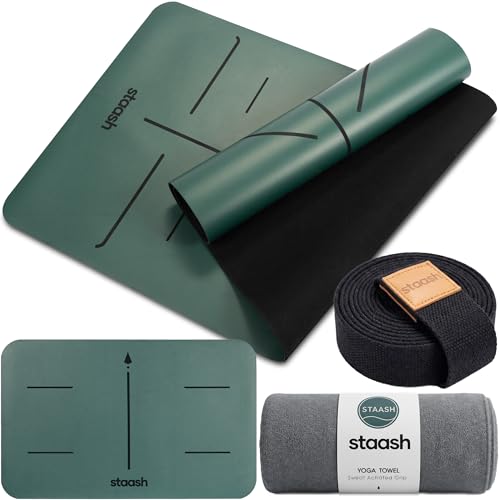
A complete 4-in-1 set means you get a 72-inch mat, towel, strap, and knee pad in one box. A beginner can walk into their first class with everything but a water bottle, no scrambling for extras. The PU surface is designed for non-slip grip during hot yoga, and the natural rubber construction is eco-friendly. For someone who just wants to show up and practice without overthinking gear, this kit removes the guesswork.
Weight and thickness are the main compromises. At 6.6 pounds, it’s heavier than many alternatives, so carrying it to a studio adds some heft. And at 0.2 inches, it offers less cushioning than thicker mats, though the included knee pad helps protect joints on hard floors. If you want a single lightweight mat and nothing else, a simpler option like the Gaiam Premium is available. But if you value having all the starter accessories in one box, this set delivers.
Product photos
How We Evaluated Yoga Gear For Beginners
The evaluation focused on three areas: manufacturer documentation detailing materials, thicknesses, and dimensions; expert round-ups from yoga instructors who work with beginners daily; and owner feedback patterns—what real beginners say after a month of using the gear.
The criteria that mattered most were cushioning and joint protection, grip and stability, and portability. A mat that is too thin hurts your knees. You cannot learn a pose if you are sliding. A heavy mat kills motivation to go to class. For kits and sets, we also looked at whether the included accessories actually help a beginner or just add weight.
A research-led evaluation has limits. Owner feedback can be subjective, and a mat that works for one body type may not work for another. We flag these trade-offs honestly so you can match a product to your specific needs rather than chasing a generic best.
What To Look For In Yoga Gear For Beginners
Think of your first yoga setup as a tool that removes friction. The right mat keeps you stable, the right clothes let you move, and the right accessories fill gaps your mat cannot. Here is what matters most.
A good beginner mat cushions your joints, grips the floor, and weighs less than your desire to skip class. The rest, blocks, straps, clothes, fills in where your body needs extra help.
Thickness and Cushioning
Mat thickness directly affects your comfort in kneeling poses, seated postures, and any time your bones press into the floor. A standard 5mm mat works for most people, while 6mm to 8mm mats give extra padding for sensitive knees and wrists. Thicker mats (half inch and up) feel like a soft landing but can make balancing poses harder because your feet sink in. If you practice on hardwood or tile, lean toward 6mm or more.
Material and Grip
The material of your mat determines how well you stick to it, and how well it sticks to the floor. PVC mats offer reliable grip and durability but need a few days to air out the initial smell. TPE mats are lighter and more eco-friendly but wear faster. Natural rubber grips well when dry but can get slippery with sweat. For beginners, a textured PVC or TPE mat provides the best balance of grip and forgiveness as you learn proper alignment.
Portability and Storage
A mat that is heavy or awkward to carry becomes an excuse to stay home. Look for mats under 3 pounds if you plan to walk to class or carry your gear on public transit. A carrying strap or bag makes a big difference, even a 5-pound mat feels manageable with a good strap over your shoulder. If you practice at home, consider where you will store the mat; thicker mats take up more space in a closet or corner.
- Check the mat’s length against your height, add at least 6 inches above and below your body
- Look for a non-slip surface on both sides of the mat, not just the top
- Confirm the carrying strap or bag is included or sold separately
- Read a few owner comments about the mat’s initial smell and how long it takes to fade
- If you have allergies, check whether the mat uses latex or other common irritants
A mat that is too short or too narrow will frustrate you every session. Measure your height and typical stance width before buying.
Yoga Gear For Beginners Compared
The table below compares the ten beginner yoga equipment picks side by side, covering thickness, weight, material, and key features so you can see which one fits your needs at a glance.
| Product | Thickness | Dimensions | Weight | Material |
|---|---|---|---|---|
| Gaiam Premium Yoga Mat | 5mm | 68" x 24" | 2.6 lbs | 6P-free PVC |
| Gaiam Reversible Yoga Mat | 6mm | 68" x 24" | 3.1 lbs | PVC (7P-free) |
| YOGATI Yoga Mat with Alignment Lines | 6mm | 72 x 24 in | 1.9 lb | Dual Layer TPE |
| Manduka Begin Yoga Mat | 5mm | 68 x 24 inches | 2.1 pounds | TPE foam |
| GRAND BASICS Instructional Yoga Mat | 1/4 inch | 68 x 24 inches | 3.7 pounds | SGS Certified PVC |
| Amazon Basics Extra Thick Yoga Mat | 0.5 inches | 74" x 24" | 2.2 pounds | NBR foam |
| Retrospec Solana Thick Yoga Mat | 1/2 inch | 72 x 24 inches | 2.7 pounds | BPA-free, no phthalates or latex |
| KEEP Non-Slip Large Yoga Mat | 7mm | 72"L x 32"W | 2.8 pounds | TPE |
| FARINOK Yoga Set for Beginners | 0.35 in (8 mm) | 72 x 24 in | 5.7 lb | High Density |
| STAASH Premium Yoga Set | 0.2 in | 72 x 26.8 x 0.2 in | 6.6 lb | PU + natural rubber |
Frequently Asked Questions
What thickness yoga mat is best for a beginner?
A 5mm to 6mm mat gives the best balance of cushioning and stability for most new yogis. Thinner mats (3mm or less) can leave your knees sore during floor poses, while thicker mats (half inch or more) feel soft but may make balancing harder. If you have sensitive joints or practice on hard floors, lean toward 6mm.
Do I need yoga blocks and straps as a beginner?
Blocks and straps help you modify poses when your flexibility or strength is still developing. A block brings the floor closer to your hand in standing poses, and a strap extends your reach in seated stretches. Many starter sets include these, but you can begin with just a good mat and add props as you need them.
How do I clean a yoga mat?
Most PVC and TPE mats can be wiped down with a mild soap and water solution after each use. Avoid soaking the mat or using harsh chemicals, which can break down the surface and reduce grip. A spray bottle with a few drops of dish soap works well. Let the mat air dry completely before rolling it up.
What should I wear for my first yoga class?
Wear clothes that let you move freely without being baggy, fitted leggings or shorts and a top that stays in place during forward folds and inversions. Avoid loose cotton that bunches up when you sweat. Grippy socks can help if you feel unsteady on the mat, but most beginners go barefoot.
Can I do yoga on a regular exercise mat?
You can, but most general exercise mats are thinner and less grippy than dedicated yoga mats. A standard gym mat may not provide enough cushion for kneeling poses or enough traction for standing balances. A purpose-built yoga mat makes the experience noticeably more comfortable and safer.
The Bottom Line
The Gaiam Premium Yoga Mat is our top pick for most beginners because it combines 5mm cushioning, a textured non-slip surface, and a lightweight build that makes it easy to carry to class. It is a straightforward, reliable mat that removes the common beginner frustrations of sore joints and sliding hands.
If you want printed pose guidance on your mat, the GRAND BASICS Instructional Mat puts 75 illustrated poses right under you. For a lightweight mat with alignment guidance, the Manduka Begin Yoga Mat is a strong choice at just 2.1 pounds. Budget-conscious beginners will find the Amazon Basics Extra Thick Yoga Mat offers thick half-inch cushioning at an affordable price point.
The single most important buying factor is thickness: match your mat’s cushioning to your body weight, joint sensitivity, and floor type. Everything else, material, width, accessories, comes second to a mat that keeps you comfortable enough to keep coming back.
