
How to Do Lateral Raises Correctly: Grip and Height
This post contains affiliate links. As an Amazon Associate, we earn from qualifying purchases.
To do lateral raises correctly, start with a neutral grip (thumbs forward, palms facing your body), keep a slight bend in the elbow, and raise until your arms are roughly parallel to the floor.
That grip number is the part of how to do lateral raises correctly worth sitting with. Rotating your thumbs up feels safer, and plenty of gyms teach it that way, but the same study found that version handed the work to the front delt and dropped middle-delt activation. Thumbs forward keeps the middle head as the prime mover.
What follows walks the setup, the height question four credible sources answer four different ways, and the equipment choice that matters less than the internet claims.
Key Takeaways
- Thumbs forward beat thumbs up for middle-delt activation in a 2020 EMG study of ten competitive bodybuilders, though ACE Fitness and Stoppani still recommend external rotation for shoulder safety.
- Sources disagree on the top: ACE Fitness and PureGym raise to shoulder height (PureGym notes going higher can work the traps if mobility allows), Stoppani stops just short of parallel, and Rogue progresses to a Y raise and overhead.
Which Grip Builds the Most Middle Delt?
Ten competitive bodybuilders, four lateral raise variations, and one clear winner for the middle deltoid.
A 2020 study in the International Journal of Environmental Research and Public Health measured surface EMG across six muscles in ten competitive bodybuilders. All variations stopped at 90 degrees of humeral abduction with the elbow almost fully extended and the wrist in line with the forearm.
That study is the closest thing this exercise has to a controlled comparison. Coratella and colleagues normalized the signal across six muscles, so the numbers are directly comparable between variations rather than just “this one lit up more.”
| Grip | Hand position | What the study found |
|---|---|---|
| Thumbs forward (neutral) | Palms facing your body | Highest middle-delt activation of the three |
| Thumbs up (external) | Palms facing forward | Middle delt lower than neutral (ES 1.47) |
| Thumbs down (internal) | Palms facing back | Highest rear-delt and upper-trap activation |
Neutral beat external rotation by an effect size of 1.47, with a 95 percent confidence interval of 0.43 to 2.38. That’s a real gap but not a chasm. Those are the enormous ones.
I did these thumbs-up for about a year because a video told me to. The pump landed at the front of my shoulder and I never once asked why.
Here’s where the sources split, and it’s worth knowing before you pick a side. Jim Stoppani, PhD, recommends keeping the arms externally rotated as a safety measure, and he’s upfront about the cost: external rotation puts the front deltoid on top as the primary mover and takes the middle delt off as prime mover. His fix is to change body position rather than rotation. ACE Fitness takes a middle road, starting neutral and rotating slightly upward only past the 60 to 70 degree mark.
Three credible sources, three different hand positions. The rotation question is genuinely unsettled, and if you have a shoulder that talks to you, that’s a conversation for someone who can actually look at it.
The physical tell is where the burn lands. Thumbs up puts it near the collarbone. Thumbs forward puts it on the outside edge of the shoulder, right where a t-shirt sleeve seam sits.
How High Should You Raise the Dumbbells?
Four credible sources give four different answers about where the rep ends. None of them is obviously wrong.
ACE Fitness says continue until the arms are level with the shoulders and approximately parallel with the floor. Stoppani says stop just short of parallel to stay on the safe side. Rogue says raise until roughly parallel, then offers a Y raise and eventually overhead as range-of-motion progressions. PureGym says parallel is enough, and going higher can be a way to work the traps if your mobility allows.
So the research baseline and the safety-first coaching advice are close to the same place.
The reason the top end matters so much comes down to which muscle is doing the lifting. Stoppani’s explanation is that the first half of the range of motion is mainly the supraspinatus, which is far weaker than the deltoid. Past parallel, the upper traps start contributing, and the study confirmed it: trap activation was greatest in the internally rotated (thumbs-down) variation.
Stop where the middle delt stops being the mover. For most lifters that’s somewhere between just under parallel and true shoulder height, and the signal is simple: the work moves up toward your neck.
How to Do Lateral Raises Correctly From the First Rep
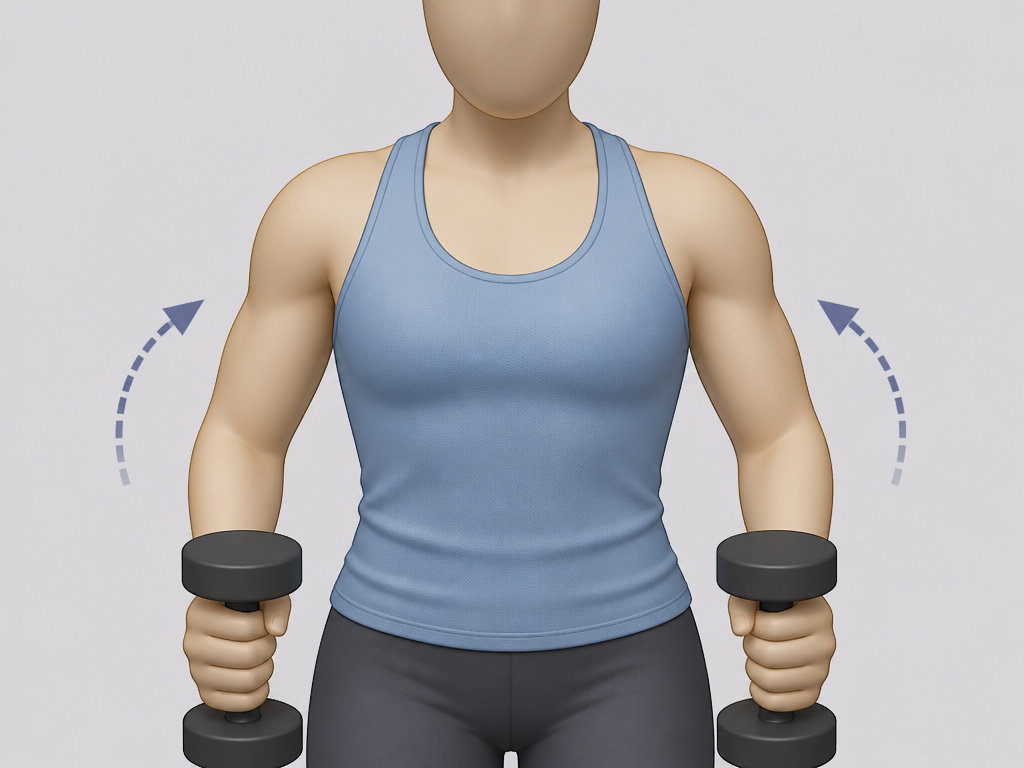
You’re standing at the rack with a pair of tens, and the first rep goes up crooked because your shoulders are still shrugged from the set before.
That’s a setup problem, and it costs you the whole set.
Before you start: A lateral raise puts load on the supraspinatus and the subacromial space at the bottom of every rep. If you feel a sharp pinch at the front of the shoulder rather than a burn on the side, stop the set. Any shoulder with a history of dislocation, impingement diagnosis, or recent surgery needs a clinician’s sign-off before loaded abduction work, not a gym-floor opinion.
- Set the grip first. Neutral, thumbs around the handles, palms facing your body, dumbbells alongside the thighs. Getting this wrong means the whole set biases the wrong head, and you won’t feel it until you’re sore in the wrong place.
- Brace and set the shoulder blades. Contract the abs and pull the shoulders down and back, per the ACE lateral raise form reference. Skip it and the traps take over from rep one.
- Lead with the elbows. The upper arms should rise slightly ahead of the forearms and dumbbells. If the hands beat the elbows, you’re curling the weight up rather than abducting the arm.
- Keep the torso still. No low-back arch, no hip drive. A big arch flares the ribs and shortens the path the shoulder needs.
- Control the way down. Lower gently, keeping the slight elbow bend and the neutral grip. Dropping the weight wastes the eccentric half of the rep.
Wrists stay neutral throughout. Bending them back under load is a small thing that shows up as a nagging ache two days later.
Dumbbells vs Cables vs Bands: Does the Tool Matter?
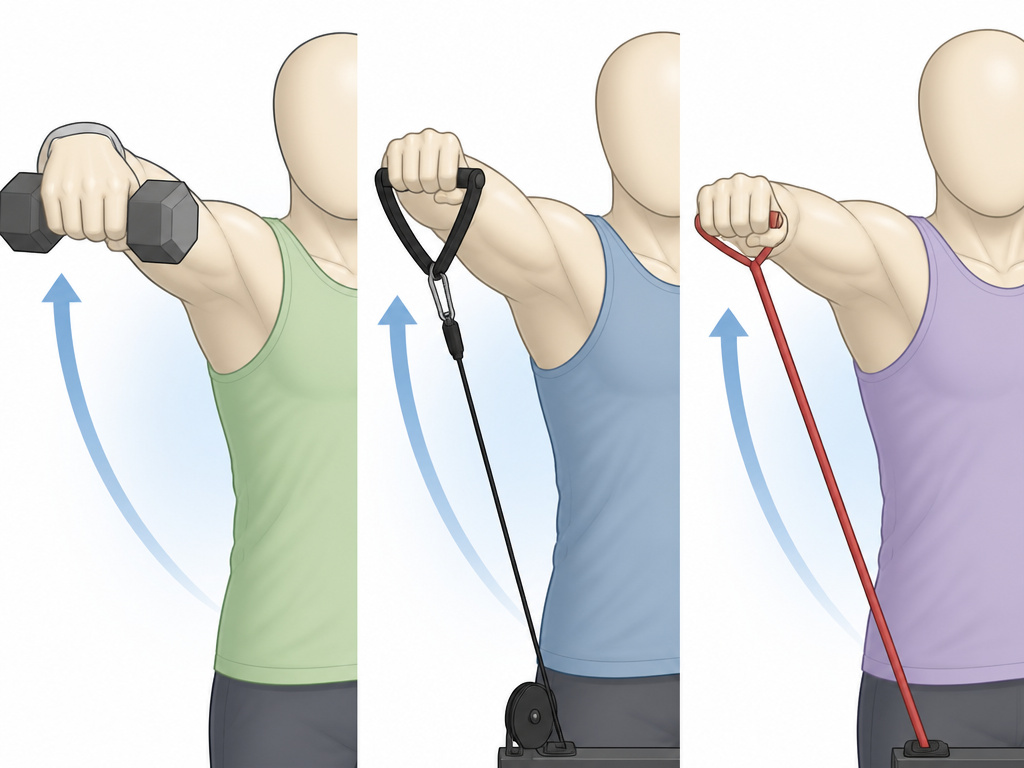
Three tools, one honest answer: all three build delts, and the differences are about where in the range the resistance sits.
Stoppani’s position is that dumbbells, cables, and elastic bands are equally effective for lateral raises. Rogue makes the counterpoint that cable lateral raises provide constant tension through the full range of motion. Both are right about different parts of the rep.
Dumbbells
The default, and the one most people should learn on. The catch is the bottom third, where the supraspinatus carries the load and the dumbbell offers almost no resistance. A pair of dumbbell delt exercises from a fixed-weight set covers the vast majority of home setups. Adjustable dumbbell pairs work if space is tight.
Cables
Rogue’s point about constant tension is the whole argument. A cable lateral raise keeps load on the middle delt at the bottom, where the dumbbell goes quiet. Stoppani’s setup cue: put the pulley on the floor one or two feet away from you so the line of pull stays perpendicular to the middle delt. With an overhand grip, start with the handle in front of the thigh and palm facing back, then rotate so the thumb finishes higher than the pinky. For more options, this list of cable shoulder exercises covers the rest of the joint.
Bands
Bands are the sleeper here, and Stoppani makes the mechanical case better than anyone: the band provides the least resistance in the weakest first part of the movement and more resistance as the middle delts kick in. That matches the strength curve instead of fighting it. A resistance band anchored low covers this for very little outlay. Use an underhand grip in front of the thighs, lift up and out, and contract hard at the top.
- Dumbbells: best for learning the path and for home training.
- Cables: best for constant tension and for the bottom third.
- Bands: best for matching the strength curve, and the cheapest entry point.
That’s the point.
What a Commercial Lateral Raise Machine Gets Right
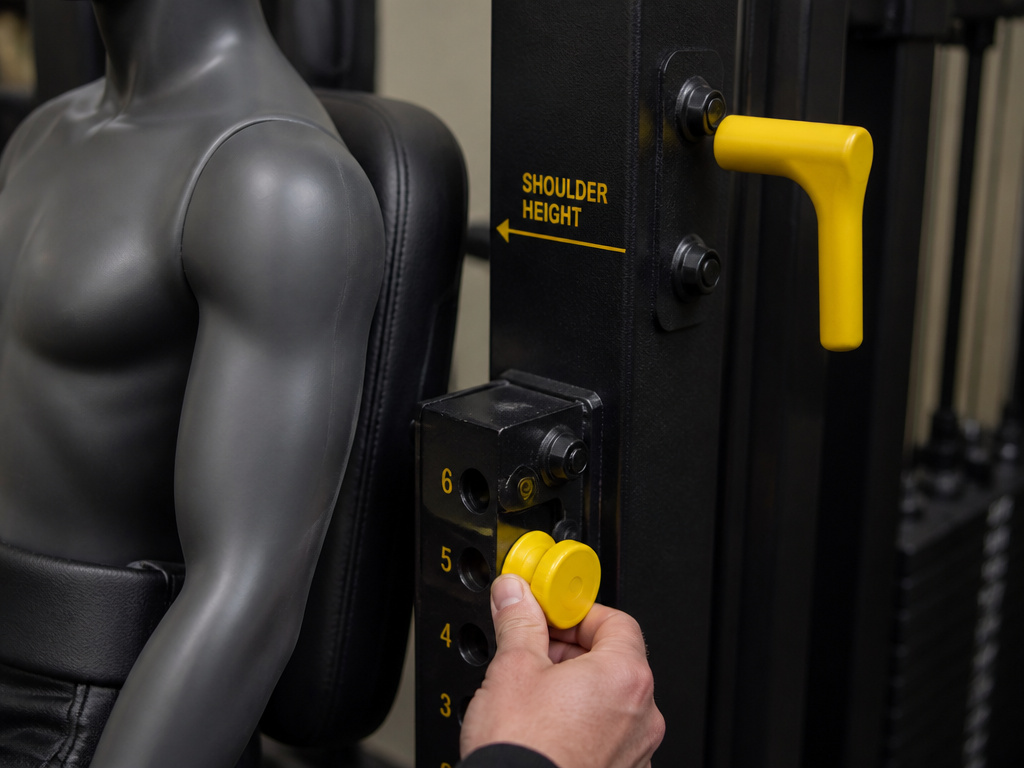
The Cybex Prestige Lateral Raise is a commercial lateral raise machine, and its owner’s manual is a proxy for what a well-designed lateral raise station should do.
The muscle listed for the unit is the deltoid. The setup cue is one line: adjust seat height so your shoulders align with the Shoulder Height decal. Every adjustment point is a yellow handle or knob, which sounds trivial until you’ve hunted for a black pin on a black frame at 6am.
| Spec | Rating |
|---|---|
| Operating humidity | 30 to 75 percent relative |
| Operating temperature | 50 to 104 F (10 to 40 C) |
| Storage temperature | 32 to 140 F (0 to 60 C) |
| Maximum user weight | 300 lbs (135 kg) |
| Maximum training weight | 205 lbs (93 kg) |
| Unit weight, standard stack | 485 lbs (220 kg) |
Two things in that manual are worth stealing for your own setup. The first is the environmental range: 30 to 75 percent relative humidity. Cybex explicitly forbids installing or storing the unit near steam rooms, saunas, indoor pools, or outdoors, because water vapor, chlorine, and bromine attack the frame. A home gym in a damp basement has the same problem in slower motion.
Machine-only failure mode, but a reminder that gym equipment has opinions about its environment.
Where this goes sideways: Loading the machine heavy and letting the pads do the steering. The fixed path means your shoulder follows the machine’s arc whether or not that arc suits your joint, and a shoulder that doesn’t like it will let you know within two or three sessions.
The ADA numbers are the other useful detail. At least one of each equipment type needs clear floor space of 30 by 48 inches on an accessible route, and 36 by 48 inches if the space is enclosed on three sides. Minimum clearance for access and emergency dismount is 23.6 inches. If your home setup has less room than that around a rack or machine, you’ve built a hazard.
How Often Should You Train Lateral Raises?
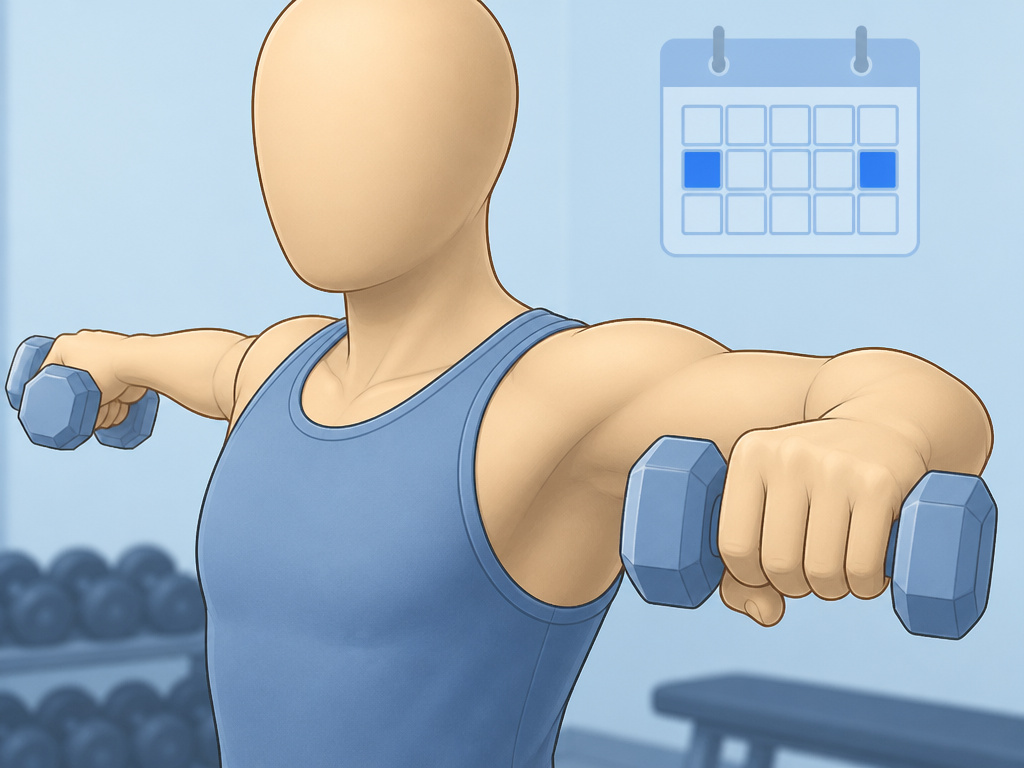
PureGym’s guidance is the most concrete available: wait at least a day between working the same muscle group twice, and if bigger shoulders are the goal, train them at least twice a week with a variety of shoulder exercises.
Twice a week is a floor, not a target. Lateral raises are a small-muscle isolation movement, so they slot in easily at the end of an upper-body day without wrecking recovery. Two sessions a week covers the frequency requirement with room to spare.
I’d rather see twelve clean reps with light dumbbells than eight sloppy ones with heavy ones. The tension has to land on the middle delt, and momentum takes it off.
What I won’t do is give you a precise weekly set number. The frequency research on small muscle groups is thin, and anyone quoting an exact figure for lateral raises specifically is extrapolating from somewhere else. Twice a week, controlled reps, and a gradual load increase is defensible. Anything more specific is guesswork dressed as programming.
If you want the wider menu, this collection of side delt exercises covers variations that hit the same head from different angles.
The Three Mistakes That Cost You the Most
Swinging is the one that shows up in every gym at every hour, and it’s the easiest to fix.
- Hip drive to start the rep. The weight gets moving from the legs, so the middle delt never gets the first third of the range. That first third is where the supraspinatus is working hardest, and skipping it just means the traps finish the job.
- Shrugging as the arms rise. Shoulders creep toward the ears and the upper traps take over. The study found trap activation was highest in the internally rotated variation, which is exactly the shape a shrug produces.
- Letting the dumbbells free-fall. The descent is where a large share of the stimulus lives. Dropping it wastes half the set and trains nothing.
- Adding weight every week because the log says so. A lateral raise is a small-muscle movement with a long lever. Progress shows up as cleaner reps at the same weight for weeks before it shows up as more weight.
Common mistake: Chasing a Y raise or an overhead press-out before the shoulder has earned it. If your traps are sore the next morning and your delts aren’t, the range is too long for your current control.
One more: pressing with a big arch in the lower back so the ribs flare. That’s a different exercise, but it’s the same fault pattern, and it shows up in the upright row just as often as it does overhead.
Frequently Asked Questions
Should lateral raises go above shoulder height?
Past parallel, the upper traps start contributing more and the middle delt stops being the primary mover. PureGym notes that going higher can work the traps if your mobility allows, and Rogue lists a Y raise as a range-of-motion progression. If middle-delt growth is the goal, stopping around shoulder height keeps the work where you want it.
Is it better to do lateral raises with thumbs up or thumbs down?
Neither, for middle-delt work. The Coratella study found neutral, thumbs forward, produced the greatest medial deltoid activation of the three grips tested. Thumbs down produced the most rear-delt and upper-trap activation, which makes it a different exercise rather than a better one.
How heavy should lateral raises be?
Light enough that you can move the weight in a controlled, smooth motion without momentum, per PureGym. Most lifters can handle far more than that, which is exactly why the exercise goes wrong. Start with a weight you can move in a controlled, smooth motion without momentum, per PureGym.
Can I do lateral raises every day?
PureGym advises at least a day between sessions for the same muscle group. PureGym advises at least a day between sessions for the same muscle group, so daily lateral raises don’t allow the recovery time the micro-tears from training need.
Do lateral raises actually widen your shoulders?
They build the middle deltoid, which is the head that creates width from the front. Lateral raises alone won’t do it, so pair them with a press for the front delt and something for the rear delt. Pair them with a press for the front delt and something for the rear delt, and eat enough to support the growth.
The Bottom Line
The short answer to how to do lateral raises correctly hasn’t changed much: neutral grip, slight elbow bend, raise to about shoulder height, control the way down. What the research adds is a reason to stop rotating your thumbs up out of habit.
One threshold worth remembering. If your traps are sore the day after lateral raises and your middle delts aren’t, your range is too long or your weight is too heavy. Drop one of them before you drop the exercise.
This all assumes a shoulder that isn’t already angry. If you’re coming back from a labrum repair or a rotator cuff issue, the grip and height questions are academic until a clinician clears loaded abduction. I don’t have the background to advise on that, and neither does a fitness article.
Do this today: grab the lightest pair of dumbbells on the rack, do one set of twelve with your thumbs forward, and pay attention to where the burn lands.
