
How to Do a Bicep Curl With Proper Form: Step-by-Step
This post contains affiliate links. As an Amazon Associate, we earn from qualifying purchases.
To do a bicep curl with proper form, grip the bar, pin your elbows at your sides, curl without swinging your torso, and lower under control. Mayo Clinic says one set of 12 to 15 reps is enough for most people, and NASM puts the grip slightly wider than shoulder-width.
NASM’s 6 to 8 inches beyond the shoulders and Mayo Clinic’s “comfortably apart” are two answers to one question, and the gap between them is where most of the confusion lives. Both organizations agree on the part that does the real work: the elbows stay pinned at your sides. Everything else is a detail you tune to your own proportions.
What follows: the setup, the grip argument, the rep itself, and the rep-range question that three certifying bodies answer three different ways. By the end you’ll be able to watch any curl and name the exact thing costing the lifter tension.
Key Takeaways
- Pin your elbows to your ribs and leave them there. Elbow drift is the fastest way to turn a curl into a bad row.
- Grip width is a range, not a rule. Mayo Clinic says about shoulder-width; NASM says 6 to 8 inches beyond the shoulders.
- End the set when your torso starts helping. A rounded lower back is your stop signal, not your finish line.
- Lower slower than you lift. Nike Training’s eccentric protocol doubles the lowering time on purpose.
The Setup That Decides the Whole Rep
The stance and the wrist do more for a curl than the weight does. Get those two right and a light bar feels productive. Get them wrong and a heavy bar just gives your lower back a workout, no matter how much you’ve read about how to do a bicep curl with proper form.
The biceps curl is an elbow-flexion movement performed with a supinated grip, meaning the palms face forward. The upper arms remain vertical and stationary while the forearms travel through an arc. Torso position stays fixed throughout; any extension of the spine transfers load from the biceps to the lumbar erectors and reduces the demand on the target muscle.
Start with your feet about hip-width and your knees soft. Mayo Clinic suggests stepping back with one foot if that feels more stable, which is a setup tweak almost nobody mentions and almost everybody benefits from. Tighten your abs and set your shoulders back and down before the first rep, per NASM.
The wrist cue splits along the same lines as everything else. Mayo Clinic says keep your wrists straight and rigid. ACE says maintain a neutral wrist with the wrists aligned to the forearms. Those describe the same position from two angles, and both are telling you not to let the bar bend your hands backward at the top.
I spent my early training letting my wrists flop back on every rep because it made the bar feel lighter. My forearms paid for it afterward, and the bar weighed exactly the same, which is the part the how to do a bicep curl with proper form question never quite prepares you for.
How Wide Should Your Grip Be on a Bicep Curl?
NASM specifies 6 to 8 inches beyond the shoulders. Mayo Clinic says hands comfortably apart, usually about shoulder-width. Nike Training gives no number at all.
| Source | Grip Width | Stated Reason |
|---|---|---|
| NASM | 6-8 inches beyond shoulders | Optimal biceps engagement and safety |
| Mayo Clinic | Comfortably apart, about shoulder-width | Comfort and control |
| Nike Training | No width specified | Focus is on tempo and load |
The gap matters because width changes which muscle does the work. NASM notes that very narrow grips shift emphasis to the brachialis and the forearms, which is why a close-grip curl burns the lower arm more than a wide one. If the biceps are the target, NASM suggests a slightly wider grip, while Mayo Clinic advises hands comfortably apart, usually about shoulder-width.
The NASM barbell bicep curl guide puts a number on it at 6 to 8 inches beyond the shoulders, while Mayo Clinic advises hands comfortably apart, usually about shoulder-width.
Picking a Width for Your Own Arms
Arm length, shoulder mobility, and wrist comfort all push the number around. A lifter with long forearms will feel cramped at shoulder-width and natural a little wider. A lifter with a cranky wrist does better slightly narrower, or on a bar with angled grips.
If your wrists complain at shoulder-width on a straight bar, settle the EZ curl bar vs straight bar question before you add weight. The angled grips let you hold a semi-supinated position that’s easier on the joint.
Whichever width you land on, write it down. Grip width drifts until you’re doing a completely different exercise and wondering why it got easier.
The Curl and Lower: Where Most Reps Fall Apart
I rounded my lower back on the last rep of a set once, and I felt it before I saw it in the mirror. The weight was light. I was just tired and wanted the set to be over. That’s the rep that taught me the rule I now use on every curl: when the form breaks, the set ends.
Before you start: A swinging curl loads your lower back, and ACE notes that swinging the torso backward places unnecessary stress on the low back. Set your abs before the first rep, not after. If you feel a pinch above the waistband on the way up, rack the weight.
- Set your grip and stance. Palms face away from your body, per Mayo Clinic. Step back with one foot if it helps stability.
- Lock the elbows in. NASM wants them at your sides with no forward or outward drift. If your elbows move, the shoulder takes over and the biceps lose tension.
- Curl up under control and exhale. ACE cues an exhale on the way up. Curl until your elbows can’t flex further, then pause for a beat.
- Lower to hip height, slowly. NASM says lower with control back to hip height. NASM says stop just short of full extension, while ACE says extend the arms but don’t lock the elbows.
- Reset your abs before the next rep. If your torso has to help, you’re done with the set.
A clean rep has a sound and a feel to it. The bar tracks a quiet arc close to your body, and your elbows stay glued to your ribs like they’re hinged there. When the rep is going wrong, you feel the bar pull forward, away from your torso, on the way up. That forward drift is your elbows traveling with it.
The Mayo Clinic barbell biceps curl video walks through the tempo if you want to see it before you try it.
How Many Sets and Reps Should You Actually Do?
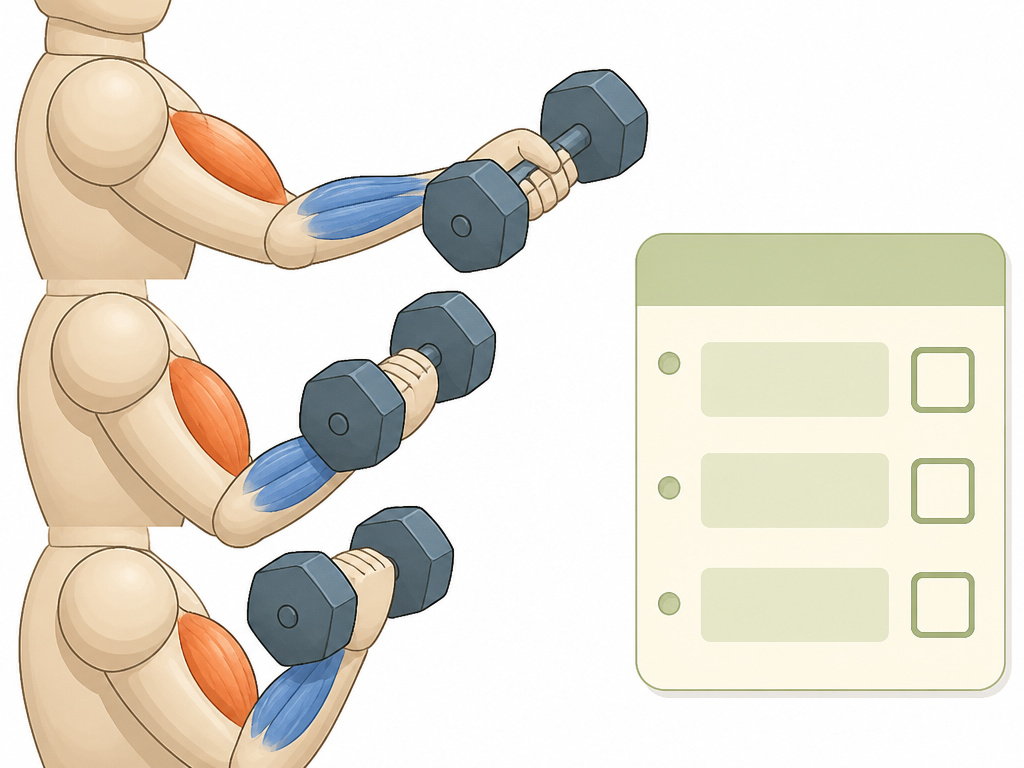
Three sets of 8 to 12 reps is NASM’s prescription for hypertrophy and strength. Mayo Clinic says one set of 12 to 15 is enough for most people. Nike Training says 2 to 4 sets of 8 to 15 at the end of a workout. All three are defensible.
| Goal | Sets and Reps | Source |
|---|---|---|
| General fitness | 1 set of 12-15 | Mayo Clinic |
| Hypertrophy and strength | 3 sets of 8-12 | NASM |
| Muscular endurance | 3 sets of 12-15 | NASM |
| End-of-workout burnout | 2-4 sets of 8-15 | Nike Training |
The three prescriptions answer three different questions. Mayo Clinic is covering the general-population minimum. NASM is programming for someone whose biceps are the goal. Nike is describing a finisher bolted onto the end of an upper-body session.
Pick the one that matches your actual situation. Two full-body sessions a week with curls at the end of each? Mayo’s single set is plenty. Arms are the priority? NASM’s 3 sets of 8 to 12 is the better fit.
I ran three sets of ten because ten is a round number and round numbers are comforting. When I finally matched the rep range to the goal, the same weekly workload built noticeably different arms.
Where you place curls in the week matters more than the exact set count. Bias the long head of biceps with shoulder-extended positions like incline curls, and the short head of biceps with a wider, more supinated grip. That’s a refinement. Get the basic rep right first.
If the last two reps of a set are getting ugly, Nike’s easier option is to drop the reps or the weight, or switch to a concentration curl with your elbow braced against your inner thigh.
Full Lockout or Stop Short? The Bottom-of-Rep Split
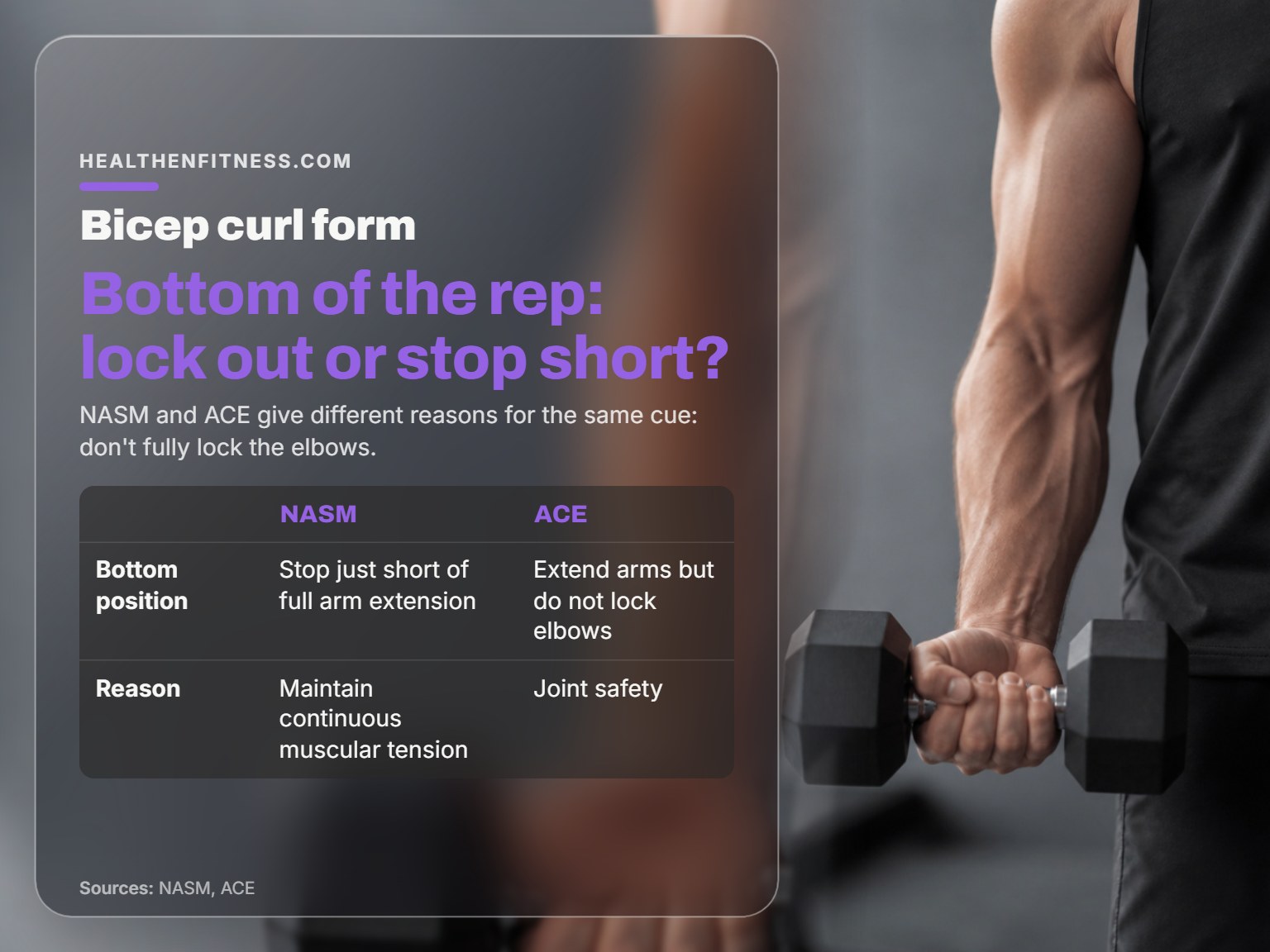
The bottom of the rep is where the two biggest certifying bodies part ways, and the split is small enough to matter.
Why NASM Stops Short
NASM’s cue is to stop just short of full arm extension to maintain continuous muscular tension. At full extension the biceps sits at resting length and the tension between reps drops toward zero. Stopping short keeps a slice of load on the muscle through the turnaround.
Why ACE Avoids the Lockout
ACE says to extend the elbows in a slow, controlled manner, stopping when the arms are extended but not locked. The stated concern there is joint safety rather than tension. Two organizations, two different reasons, one shared instruction.
Come down until the elbow feels loaded, not until it feels empty. The rep starts before the arm is straight.
For most lifters the practical answer is similar, though NASM stops just short of full extension to keep tension while ACE extends the arms without locking the elbows for joint safety. If you’re chasing size, NASM’s tension argument is the stronger one. If your elbows have a history, follow ACE’s joint-safety framing.
The ACE seated biceps curl guide is the clearest description of the machine version, where the pad does the stability work and you can feel the bottom position without your torso interfering.
Try the machine once even if you never touch it again. The incline pad removes the swing variable, so you can feel what a controlled bottom actually feels like. Take that feeling back to the free-weight rack.
Barbell, Dumbbell, or Machine: Which One You’ll Actually Repeat
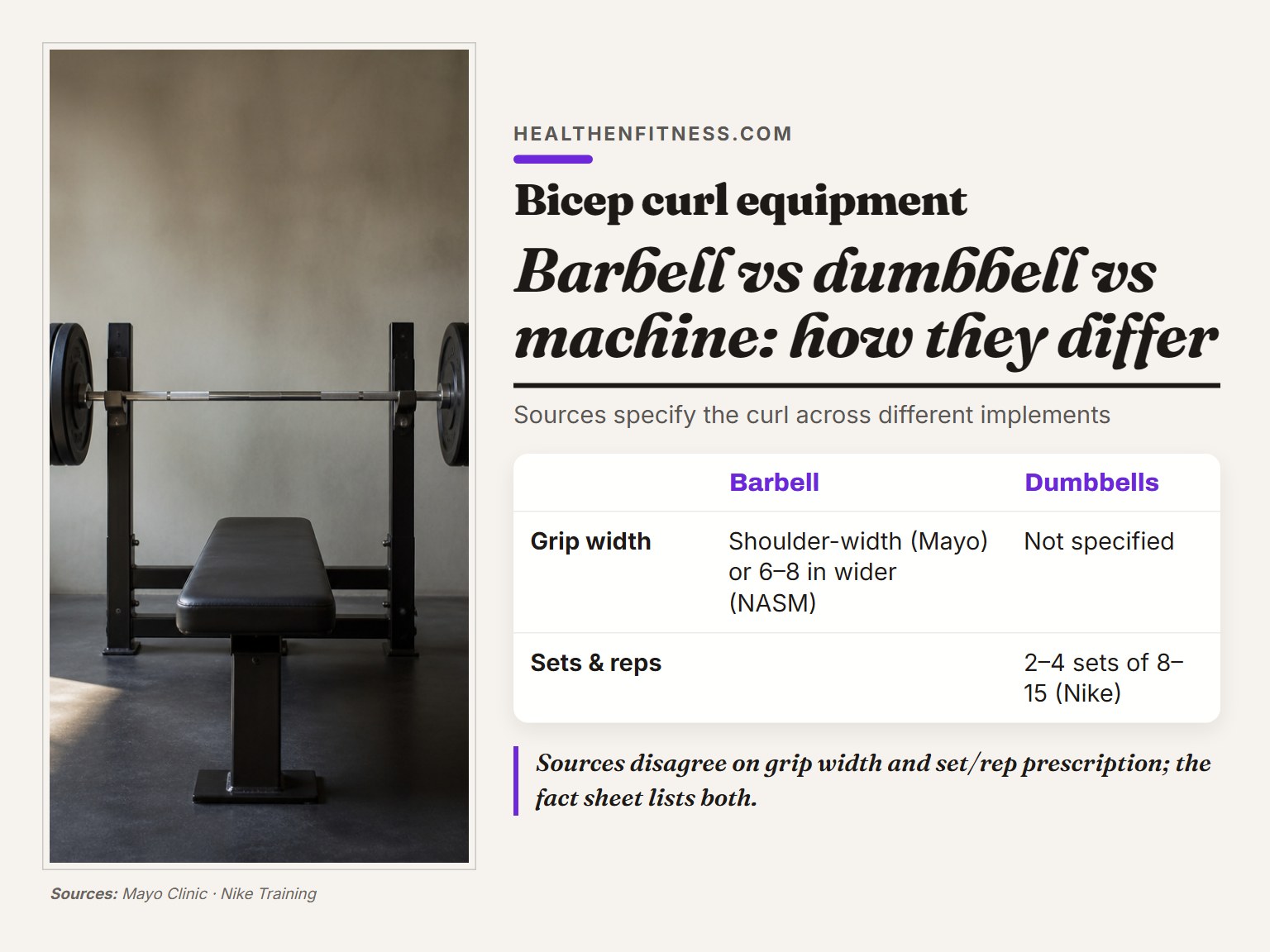
Mayo Clinic and NASM both write the curl around a barbell. Nike Training uses dumbbells. ACE uses a selectorized machine with an incline pad and a moving lever. The “same” exercise is specified across four different implements with different mechanics.
The Barbell Case
The barbell loads both arms at once and fixes your grip width for you, which removes a variable while you’re learning. If you’re weighing barbell vs dumbbell curls, the bar is easier to progress, since adding weight is a plate change rather than a jump to the next dumbbell.
The Dumbbell Case
Dumbbells let each arm work independently, which exposes a strength gap you didn’t know you had. They also let you rotate into a fully supinated position at the top, which a fixed bar won’t allow. Dumbbell bicep workouts expose a side-to-side gap.
The Machine Case
ACE’s seated version locks your torso in place, which makes it the easiest of the three to feel the biceps on and the hardest to cheat. Set the seat so the middle of your elbows lines up with the lever’s axis of rotation. Get that wrong and the resistance curve fights you through every rep.
Quick way to choose:
- Barbell if you’re training for load and want the simplest progression.
- Dumbbells if you suspect one arm is carrying the other.
- Machine if your lower back has opinions.
I’d skip the preacher curl in year one. The pad takes the swing out of the equation, which sounds like a feature until you realize you haven’t learned to control the swing yet.
I’d rather see a beginner do three clean sets with an empty bar than one sloppy set with plates on it. The bar doesn’t know you’re in a hurry.
Four Ways a Curl Goes Wrong (and the One That Hurts Your Back)
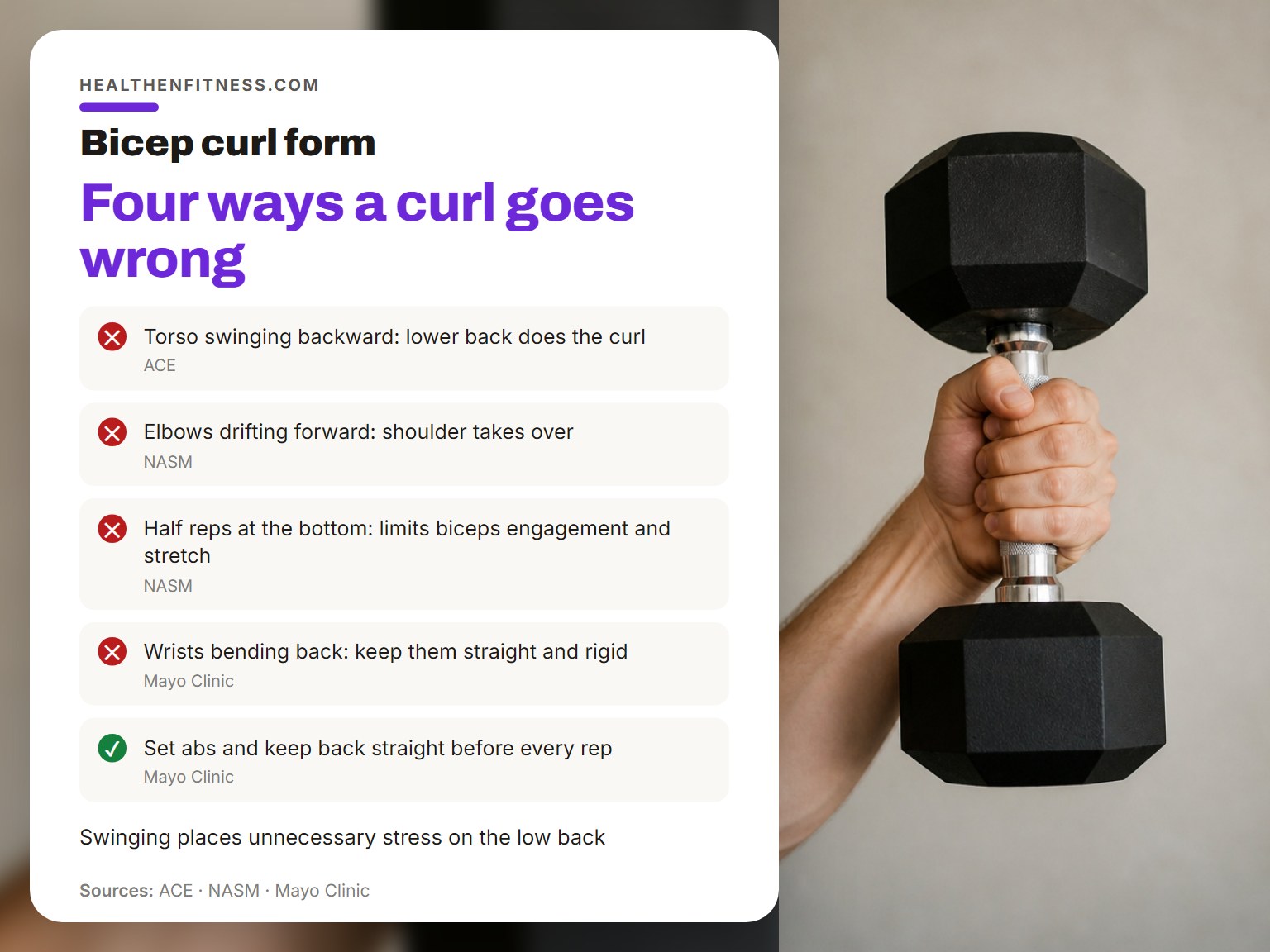
Bad curls come in four flavors, and three of them fix themselves the moment you drop the weight.
- Torso swinging backward. Your lower back is doing the curl. Cut the weight by a plate and set your abs before every rep.
- Elbows drifting forward. The shoulder is taking over. Think about keeping your elbows in your back pockets.
- Half reps at the bottom. NASM flags this directly: not achieving full range of motion limits biceps engagement and stretch. Come down further, not faster.
- Wrists bending back. Straight and rigid, per Mayo Clinic. If grip is the limiter, straps fix it faster than a lighter bar.
A swinging rep announces itself before you see it. There’s a quick pinch above the waistband on the way up, and by the last few reps it’s a dull ache that follows you out to the car.
Where this goes sideways: Adding weight before the rep is clean. The swing shows up first as a small backward lean, then as a rounded lower back, and by then you’ve spent the set on your lumbar spine instead of your arms.
If you want a wider menu than the curl, the best biceps exercises covers the pulling movements that do most of the work anyway.
Frequently Asked Questions
How heavy should I go on a bicep curl?
Pick a weight you can barely finish the final two reps of with good form, per Nike Training. If you can’t control the lowering phase, the weight is too heavy no matter what the rep count says.
Is one set of curls really enough?
Mayo Clinic says one set of 12 to 15 reps is adequate for most people. That’s the general-population floor. If your biceps are the training goal rather than a side effect of pulling movements, NASM’s 3 sets of 8 to 12 is the better prescription.
Should my elbows stay completely still?
NASM wants them at your sides with no forward or outward drift. A little movement happens naturally as the load gets heavy, but if your elbows travel forward, your shoulder is doing the work and the biceps lose tension.
Do I need to lock out at the bottom?
Neither NASM nor ACE recommends a hard lockout. NASM stops just short of full extension to keep tension on the muscle. ACE extends the arms without locking the elbows, for joint safety. Come down until the elbow feels loaded and reverse there.
What’s the difference between a barbell and dumbbell curl?
Mayo Clinic and NASM describe the barbell version; Nike Training uses dumbbells. The barbell fixes your grip width and makes loading simple. Dumbbells let each arm work independently and let you supinate fully at the top.
The Bottom Line
The threshold I’d give anyone starting out: if your torso moves backward at all during a curl, the set is over. Not the workout. The set. Drop a plate, reset your abs, and finish the remaining reps with your back against something vertical if you have to.
The rep-range argument will keep going, and it matters less than people think. Mayo Clinic’s single set and NASM’s three sets both work when the reps are clean. Three sets of swinging never works.
One caveat worth stating plainly. If you have a history of low back trouble, the standing barbell curl is not the version to learn on. Use the seated machine ACE describes, or a seated dumbbell curl with your back supported, until you can hold a neutral spine without thinking about it. (And if a twinge sticks around past a week, get it looked at.)
The short version of how to do a bicep curl with proper form fits in one line: elbows in, torso still, lower slower than you lift.
Today: do one set of 12 to 15 curls with good form. Count the tempo out loud on the way down.
