
10 Best Stationary Exercise Bikes in 2026
This post contains affiliate links. As an Amazon Associate, we earn from qualifying purchases.
The Peloton Exercise Bike takes our Best Overall spot because its 21.5-inch HD swivel touchscreen lets you shift from cycling to strength to yoga without leaving the bike. For budget-conscious riders, the YPOO Exercise Bike Magnetic delivers near-silent resistance at a lower cost, while the Schwinn Fitness IC4 is our Best App-Compatible pick for those who want platform flexibility. Whether you want live classes, quiet operation, or a heavy-duty frame, this guide covers ten top stationary bikes for home use.
Choosing a stationary bike for your home gym means balancing resistance type, frame weight, screen features, and subscription costs. A bike that feels great in the store can disappoint after a month if the seat doesn’t adjust to your height or the resistance tops out too soon. We focused on durability, adjustability, and real-world riding comfort to help you avoid that mistake.
We built this guide by analyzing manufacturer specifications, reading patterns in owner feedback, and consulting expert round-ups on what makes a bike worth the investment. You’ll find clear breakdowns of resistance systems, weight capacities, and connectivity options so you can match a bike to your space, budget, and fitness goals.
Top 10 Stationary Exercise Bikes in the Market
Certain content that appears on this site comes from Amazon. This content is provided "as is" and is subject to change or removal at any time.
The Best Stationary Exercise Bikes, Reviewed
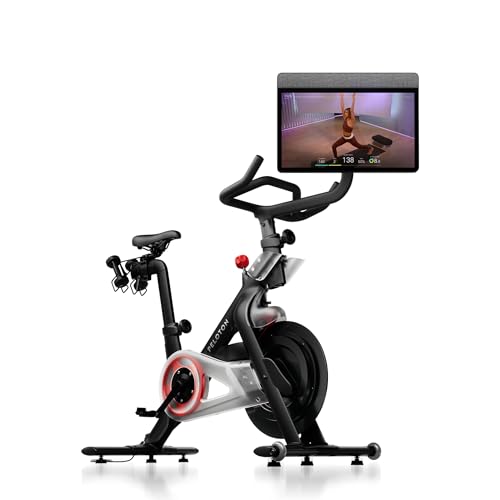
Peloton Exercise Bike
What We Like
- 21.5" HD swivel touchscreen for multi-workout types
- Personalized weekly workout plans and recommendations
Trade-offs
- Requires/month All-Access Membership for full content
- Heavy 178-pound frame requires careful setup planning.
A 21.5-inch full HD touchscreen that swivels 360 degrees means you can follow a cycling class, then pivot to a yoga or strength session without ever leaving the bike. That flexibility, paired with personalized weekly workout plans and recommendations tailored to your recent rides and goals, makes the Peloton feel less like a piece of gym equipment and more like a coach who actually remembers what you did last Tuesday. If your goal is a guided, varied home fitness routine that keeps you accountable, this bike delivers the structure and motivation to stick with it.
The full experience depends on a premium monthly membership, and the bike itself weighs 178 pounds, so you will want to set it up in a permanent spot with at least 24 inches of clearance on all sides and an 8-foot ceiling. Compared to the Schwinn IC4, which is lighter and costs less upfront, the Peloton demands a bigger commitment in both space and subscription. But if you value a polished, all-in-one platform with live and on-demand classes across 15 workout types, and you have the room and budget for it, this is the most complete package in the guide.
Product photos
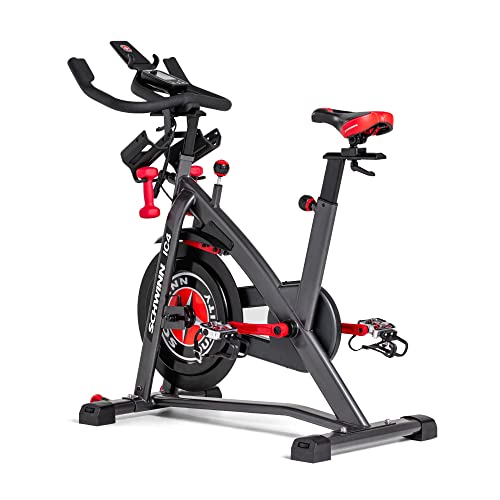
Schwinn Fitness IC4 Indoor Cycling Bike
What We Like
- 100 micro-adjustable magnetic resistance levels
- Dual-sided pedals for cleats or cages
- Works with Peloton and Zwift apps
- Full color backlit LCD console
Trade-offs
- At 112 pounds, moving it is a two-person job
- Separate app subscriptions required for full features
The Schwinn IC4 pairs 100 micro-adjustable resistance levels with broad app compatibility, so you can follow a Peloton class, tackle a Zwift climb, or explore JRNY virtual courses without buying a branded bike. The magnetic resistance offers 100 levels of adjustment, which gives you fine control over your workout intensity. The dual-sided pedals let you clip in with SPD cleats or use the included toe cages if you are still figuring out your cycling shoes. A full color backlit LCD console displays heart rate, speed, time, distance, calories, and RPMs, so you can track your metrics at a glance.
Weight is a factor: at 112 pounds this bike stays planted during hard efforts, but you will want help moving it to vacuum underneath. The YPOO model weighs 44 pounds, making it much easier to relocate, while the IC4 is clearly heavier and less portable. Also, while the bike works with Peloton and Zwift, those apps require their own subscriptions, so factor that into your budget. If you want a connected ride that works with multiple training platforms, this bike offers flexibility without locking you into one ecosystem.
YPOO Exercise Bike Magnetic

What We Like
- Near-silent magnetic belt drive
- Supports riders up to 300 lbs
- Fits heights 4'8" to 6'1"
Trade-offs
- No built-in screen for app courses
- Weighs 44 lbs, lighter than some competitors
A 300-pound weight capacity and near-silent magnetic belt drive make this bike feel far more capable than its budget price suggests. The 4-way adjustable seat and height-adjustable handlebars fit riders from 4’8″ to 6’1″, and the whole thing arrives 80 percent pre-assembled for a quick 30-minute setup.
There’s no built-in screen, so you’ll need a tablet or phone to follow the app courses. At 44 pounds, it’s lighter than the Schwinn IC4, which means it may shift slightly during aggressive hill climbs if you don’t lock the level knobs. If you want a connected ride with a display and heavier frame, the Schwinn IC4 is worth the extra cost.
Product photos
Superun Exercise Bike

What We Like
- 32 magnetic resistance levels for fine-tuning
- Heavy-duty steel frame supports up to 300 lbs
- 4-way adjustable seat fits riders 4.6'–6.1'
- Built-in transport wheels for easy moving
Trade-offs
- No included tablet holder or screen
- At 43.1 lbs, lighter than some studio bikes
A heavy-duty steel frame provides the foundation for a stable ride, supporting riders up to 300 pounds without wobbling during sprints or climbs. The 32-level magnetic resistance system allows precise tension adjustments through a twist knob, from light recovery spins to steep climb simulations. Unlike friction-based resistance, this magnetic design operates quietly, so you can focus on your workout without distracting noise. The clear LCD monitor tracks time, speed, distance, calories, and RPM to keep your sessions data-driven.
The trade-off for that lighter, apartment-friendly build is that the Superun doesn’t have the heft of a dedicated studio bike like the Schwinn Fitness IC4, which weighs 112 pounds. That extra mass can feel more reassuring during all-out sprints, but it also makes the Schwinn harder to move. If your priority is a bike that fits into a small space, assembles quickly, and still delivers precise resistance control without breaking your budget, the Superun hits that sweet spot. It skips the bells and whistles, no built-in screen, no app connectivity, but for someone who just wants a quiet, adjustable ride that doesn’t dominate the room, that simplicity is part of the charm.
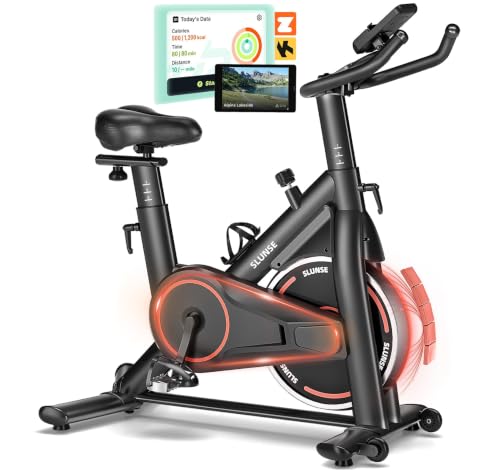
SLUNSE FITNESS Exercise Bike
What We Like
- 350 lb weight capacity for larger riders
- Thickened aluminum steel frame with curved base
- 100-level micro-adjustment resistance for fine tuning
- Silent belt drive for quiet home use
Trade-offs
- At 59.5 lb, moving it still requires effort
- No built-in screen or touch display
- Height range tops out at 6'1"
A 350-pound weight capacity and a 35-pound flywheel wrapped in thickened aluminum steel tell you this bike is built to last. The curved rear base and five adjustable non-slip feet keep it planted on any floor, so you can push hard without wobble. That heavy-duty construction makes it a smart choice for anyone who wants a stable, quiet ride at home without spending on a premium brand name.
This bike stays analog where others go digital. You get a basic LCD monitor for time and calories, but no built-in screen like the MERACH with its 21.5-inch display. If you want streaming classes without mounting a tablet, that model might suit you better. For straightforward, sturdy cycling that won’t shake or creak, the SLUNSE delivers where it counts.
Product photos
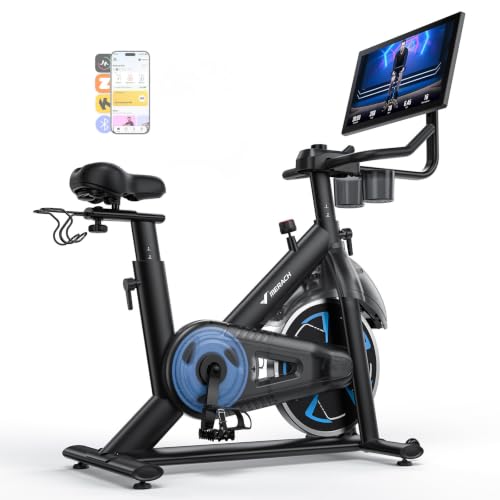
MERACH Exercise Bike with Screen
What We Like
- Large 21.5" rotatable HD display
- Whisper-quiet under 25 dB
- 330 lb weight capacity for stability
- Auto-adjusting magnetic resistance
Trade-offs
- Not compatible with Google phones
- Heavy at 66 lbs for moving
- App sync limited to Merach, Google Fit, Apple Health
A 21.5-inch HD display that swivels and tilts means you can follow along with classes or mirror your own content without craning your neck. The magnetic resistance adjusts automatically during guided workouts, so your effort stays in sync with the program. It’s built for riders up to 330 pounds, and the dual-triangle frame keeps things steady even when you push hard. If you want a bike with a built-in screen and auto-resistance, this setup delivers those features at a more accessible price point than some competitors.
The screen integration doesn’t work with Google phones, so if you own one, you’ll need to check compatibility first. At 66 pounds, it’s not something you’ll want to move between rooms regularly, but that heft is exactly what gives it that rock-solid feel during sprints. For anyone who values a built-in screen and quiet operation under 25 dB, this is a smart pick that keeps the focus on the ride.
Product photos
Sunny Health & Fitness Premium Smart Exercise Bike

What We Like
- 44 lb flywheel for smooth momentum
- Magnetic resistance for near-silent rides
- Free SunnyFit app with 1,000+ workouts
- 300 lb user capacity
Trade-offs
- 124.8 lb bike is heavy to move
- No built-in screen or display
- Requires mobile device for app features
A 44-pound flywheel makes this bike feel like a studio machine that keeps its momentum steady through every pedal stroke, so you can push harder without the jerky stops lighter bikes cause. That heavy wheel, paired with magnetic resistance and a 300-pound capacity, suits riders who want a rock-solid, quiet ride that stays planted even during high-intensity intervals. It’s a great fit for anyone who values that gym-bike heft and doesn’t need a touchscreen to stay motivated.
The 44-pound flywheel delivers smooth momentum that keeps the pedals turning through each stroke, so you get a steady, natural ride without the jerky feel of lighter wheels. At 124.8 pounds, the bike stays planted on the floor during hard sprints, but moving it to another room takes serious effort. You supply your own phone or tablet to run the free SunnyFit app, there’s no built-in screen, which keeps the price lower than all-in-one models like the Peloton.
NordicTrack T Series 9 Exercise Bike

What We Like
- 16 digital resistance levels for custom intensity
- Dual-sided pedals with SPD and toe clips
- Front-mounted transport wheels for easy moving
Trade-offs
- iFIT membership required for smart features
- At 94.3 lbs, it's heavy to reposition without wheels
- LCD display is basic without iFIT tablet
With 16 digital resistance levels, this bike gives you precise control over your workout intensity, from gentle recovery spins to challenging climbs. The digital magnetic resistance adjusts smoothly, so you can focus on your ride rather than fumbling with a knob. The included month of iFIT lets you test smart coaching and auto-adjusting resistance.
The built-in LCD is fairly basic, so you’ll want to prop up your own tablet or phone to get the most out of iFIT’s workout library. At 94.3 pounds, it’s not the lightest bike in this guide, but the front-mounted transport wheels make it manageable to roll out of the way when you’re done. Compared to the Peloton, which weighs 178 pounds, this NordicTrack offers a similar connected experience at a much more accessible weight. The dual-sided pedals with SPD clips are a nice bonus for cyclists who already own cleated shoes.
Product photos
NordicTrack X24 Bike
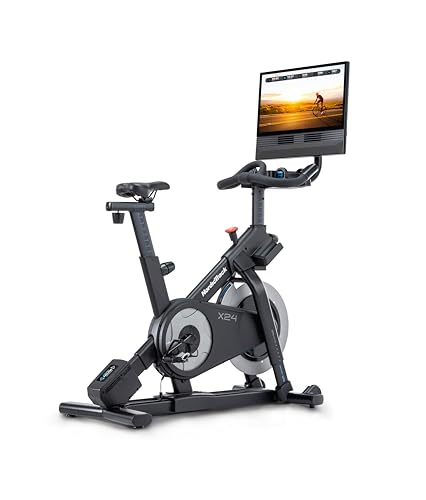
What We Like
- Pivoting 24" touchscreen for off-bike classes
- -10% decline to 20% incline range
- SmartAdjust auto-adapts resistance and incline
- Dual-sided pedals with SPD and toe clips
Trade-offs
- Requires iFIT Pro Membership for key features
- At 179.2 lb, moving it is a two-person job
A -10% decline to 20% incline range means this bike can simulate everything from a steep descent to a grinding climb, which is rare for an indoor cycle. That range, combined with 24 digital resistance levels and SmartAdjust that automatically tweaks both as you ride, makes it a strong fit for anyone training for outdoor cycling events or just wanting terrain variety without leaving the house. The pivoting 24-inch HD touchscreen also lets you follow off-bike classes like yoga or strength.
The iFIT Pro Membership is required to unlock most of what makes this bike special, streaming shows, auto-adjust terrain, and syncing with apps like Strava. At 179.2 pounds, it’s also a beast to relocate, so plan where it lives carefully.
MERACH Friction Stationary Bike
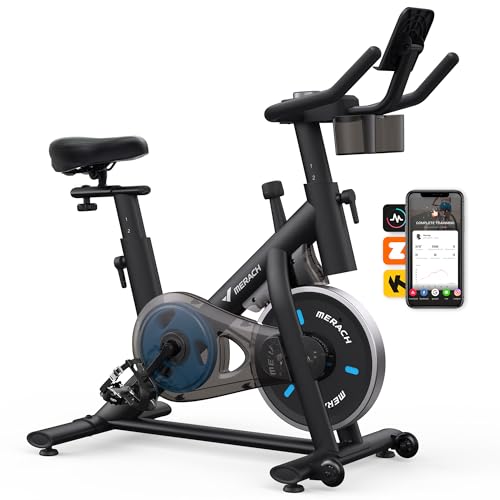
What We Like
- Ultra-quiet belt drive under 25 dB
- Infinite resistance adjustment for any pace
- Bluetooth app tracks metrics in real time
- Sturdy 300 lb capacity with anti-tip frame
Trade-offs
- No included screen or built-in classes
- Heavier than some compact models at 59.5 lbs
At under 25 decibels, this bike is quiet enough to use during a conference call or while the rest of the house sleeps, which is why reviewers say it works well in apartments or shared spaces. The infinite friction resistance lets you fine-tune effort from a light spin to a steep climb, and the Bluetooth app connects to Kinomap and Zwift for guided rides. It fits riders from 4’8″ to 6’2″, so several family members can share one machine without constant readjustment.
The LED monitor tracks your stats, but there is no built-in screen or preloaded classes, so you will need to bring your own tablet or phone for guided workouts. At 59.5 pounds, it is heavier than some compact options like the YPOO (44 lbs) or Superun (43.1 lbs), but still manageable with the transport wheels. If you want a near-silent, straightforward bike that does not demand a subscription and works with your favorite apps, this is a strong, budget-friendly pick.
Product photos
How We Evaluated Stationary Exercise Bikes
Our evaluation started with the core mechanics that determine ride quality and longevity. We compared resistance systems, magnetic versus felt-pad friction, because magnetic units run quieter and require less maintenance over time. We also looked at flywheel weight, frame construction, and maximum user weight ratings to separate bikes built for casual pedaling from those meant for serious training.
Connectivity and content mattered next. A bike that pairs with popular apps like Peloton, Zwift, or Apple Health opens up far more workout variety than one locked into a single ecosystem. We weighed whether a bike included a built-in screen, offered Bluetooth for your own device, or required a subscription to unlock its full potential. The exercise bikes that earned top marks balanced hardware quality with smart features that actually enhance your ride.
Finally, we considered the practical realities of home ownership: assembly difficulty, floor space needed, and portability. A 178-pound bike with a small footprint can still be a headache if you live upstairs. We noted which models include transport wheels, which require two people to move, and which bikes for home use fit riders at the tall and short ends of the spectrum. No research-based guide replaces a test ride, but these criteria get you close to the right choice.
What To Look For In Stationary Exercise Bikes
Before you buy, understand the three factors that separate a bike you’ll use from one that collects dust: resistance type, adjustability range, and connectivity.
Focus on magnetic resistance for quiet, low-maintenance rides. Check that the seat and handlebars adjust to your height. Decide whether you need a built-in screen or can use your own tablet. These ten choices determine your daily experience more than brand name or color.
Resistance Type and Noise Level
Magnetic resistance is the gold standard for home use. It creates friction without physical contact between parts, so it stays quiet and requires no pad replacements. The MERACH Exercise Bike with Screen operates under 25 decibels, quieter than a whisper, while the YPOO Exercise Bike Magnetic uses a belt drive that makes it suitable for apartment living. Friction resistance, found on older or cheaper models, works fine but gets louder over time and needs periodic pad swaps. If you plan to ride while others sleep or watch TV, prioritize magnetic.
Frame Stability and Weight Capacity
A wobbly bike ruins every ride. Look for a steel frame and a weight capacity that exceeds your body weight by at least 50 pounds for a safety margin. The SLUNSE FITNESS Exercise Bike supports 350 pounds with a thickened aluminum steel frame and curved base, making it one of the most stable options for larger riders.
Heavier bikes generally feel more solid, the Peloton weighs 178 pounds and barely shifts during out-of-saddle sprints, but they are harder to move. If you need to relocate your bike often, look for front-mounted transport wheels and a frame under 60 pounds.
Adjustability and Fit
A bike that doesn’t fit your body leads to knee pain and early abandonment. Check four adjustment points: seat height, seat fore-aft position, handlebar height, and handlebar reach. The Superun Exercise Bike fits riders from 4’6″ to 6’1″ with a 4-way adjustable seat, while the YPOO Exercise Bike Magnetic accommodates heights from 4’8″ to 6’1″.
If you share a bike with a partner, quick-adjust levers rather than bolts make switching between riders fast. Pedal type matters too, dual-sided pedals with SPD clips on one side and toe cages on the other let you ride in cycling shoes or sneakers.
- Measure your inseam and compare it to the bike’s minimum and maximum seat height.
- Confirm the handlebars adjust forward and backward, not just up and down.
- Check the pedal type: dual-sided SPD/toe-cage pedals offer the most flexibility.
- Look for a water bottle cage mount, it sounds trivial, but you will want it.
- Verify the bike’s footprint fits your space with room to mount and dismount safely.
A bike that fits well on day one will feel even better after month three. Prioritize adjustability over flashy features.
Stationary Exercise Bikes Compared
The table below compares the ten stationary exercise bikes across key specs so you can see at a glance how resistance type, weight capacity, screen features, and price tier stack up against each other.
| Product | Resistance | Bike Weight | Dimensions |
|---|---|---|---|
| Peloton Exercise Bike | Magnetic | 178 pounds | 54 x 23 x 61 inches |
| Schwinn Fitness IC4 Indoor Cycling Bike | 100 micro-adjustable levels | 112.0 pounds | 48.7 x 21.2 x 51.8 inches |
| YPOO Exercise Bike Magnetic | Magnetic, infinite levels | 44.0 pounds | 32.9 x 19.3 x 44.5 inches |
| Superun Exercise Bike | 32-level magnetic | 43.1 lbs | 40.5 x 19.3 x 44.1 inches |
| SLUNSE FITNESS Exercise Bike | 100-level micro-adjustment | 59.5 lbs | 39.4 x 22.8 x 47.2 inches |
| MERACH Exercise Bike with Screen | Magnetic, auto/manual | 66.0 pounds | 55.1 x 19.3 x 58.2 inches |
| Sunny Health & Fitness Premium Smart Exercise Bike | Magnetic | 124.8 lb | 50.8 x 23.4 x 47.6 inches |
| NordicTrack T Series 9 Exercise Bike | 16 digital levels | 94.3 lbs | 46.8 x 22.6 x 49.4 in |
| NordicTrack X24 Bike | 24 digital levels | 179.2 lb | 56.4 x 21.8 x 65.1 inches |
| MERACH Friction Stationary Bike | Friction (infinite adjustment) | 59.5 lbs | 42.6 x 19.3 x 48.6 inches |
Frequently Asked Questions
What type of stationary bike is best for home use?
Magnetic resistance bikes are best for most home users because they run near-silent, require almost no maintenance, and offer smooth resistance changes. For guided workouts, choose a model with a built-in screen like the Peloton or MERACH. If you prefer to use your own tablet, a bike with a sturdy device holder and Bluetooth connectivity gives you the same flexibility at a lower cost. The best stationary bikes for home gyms combine quiet operation with enough adjustability to fit multiple users.
How much should I spend on a stationary exercise bike?
Budget models around the YPOO Exercise Bike Magnetic price point deliver solid magnetic resistance and app compatibility without a built-in screen. Mid-range bikes like the Schwinn IC4 add more resistance levels and better console displays. Premium bikes with large touchscreens and subscription content cost more upfront but include the full workout experience. The right budget depends on whether you value a built-in screen, live classes, or prefer to supply your own device and content.
Do I need a subscription for a stationary bike?
Not all bikes require a subscription. The YPOO and Superun models work fine with free apps or no connectivity at all. Bikes like the Peloton and NordicTrack X24 unlock their best features, live classes, auto-resistance, personalized plans, through monthly memberships. If you want subscription content, factor that cost into your total. If you prefer to ride without ongoing fees, choose a bike that stores basic metrics on its console and pairs with free apps.
What is the difference between an upright bike and a recumbent bike?
Upright bikes mimic the position of a road bike, your hips are above the pedals and you lean forward to the handlebars. They engage your core and allow standing climbs. Recumbent bikes place you in a reclined seat with pedals in front, which reduces lower back strain and is gentler on the joints. For general fitness and higher intensity work, upright bikes are more popular. For rehabilitation or comfort-focused riding, recumbent exercise bikes are the better choice.
Can I lose weight using a stationary bike?
Yes, stationary cycling burns calories effectively when done consistently at moderate to high intensity. A bike with adjustable resistance lets you increase the workload as your fitness improves. Pairing cycling with a calorie-controlled diet creates the deficit needed for weight loss. The best bikes for weight loss offer enough resistance range to challenge both beginners and experienced riders, keeping workouts productive as you progress.
The Bottom Line
The Peloton Exercise Bike earns our Best Overall recommendation because its swivel touchscreen and personalized weekly plans make it a true cross-training hub, not just a bike. It serves riders who want guided classes across cycling, strength, and yoga without switching equipment. If the subscription model or price gives you pause, the Schwinn IC4 delivers similar app compatibility and 100 resistance levels at a lower upfront cost.
Budget-focused shoppers should look at the YPOO Exercise Bike Magnetic, which pairs near-silent magnetic resistance with a 300-pound weight capacity and a wide height range. For heavy-duty stability, the SLUNSE FITNESS Exercise Bike supports 350 pounds with a reinforced frame that won’t wobble during hard efforts. Each of these picks addresses a specific need without demanding features you won’t use.
The single most important factor in choosing a stationary bike is resistance type paired with adjustability. A quiet magnetic system and a frame that fits your body will keep you riding long after the novelty wears off. Check your inseam, measure your floor space, and decide whether you want a screen or prefer to bring your own device. Those three decisions point you to the right bike every time.
