
9 Best Fitness Trackers For Athletes in 2026
This post contains affiliate links. As an Amazon Associate, we earn from qualifying purchases.
For athletes who demand precision, durability, and sport-specific metrics, the COROS PACE 4 Pro GPS Sport Watch leads the field with its ultralight titanium build, 60-hour GPS battery, and dual-frequency tracking. The Garmin Forerunner 165 is best for runners, while the Google Fitbit Charge 6 offers the best value with Google app integration.
The challenge isn’t finding a fitness tracker; it’s finding your fitness tracker. An ultramarathoner needs battery life measured in days, not hours. A CrossFit athlete needs rep counting, not a golf app. A swimmer needs a dive rating. The wrong device becomes an expensive step counter.
This guide is research-based, drawing from manufacturer specifications, expert round-ups, and patterns in owner feedback across nine top models. We break down what matters most for different training styles, from screenless recovery wearables to full-featured GPS watches.
Top 9 Fitness Trackers For Athletes in the Market

Certain content that appears on this site comes from Amazon. This content is provided "as is" and is subject to change or removal at any time.
The Best Fitness Trackers For Athletes, Reviewed
COROS PACE 4 Pro GPS Sport Watch

What We Like
- Titanium build with sapphire glass
- 43 g weight disappears on wrist
- 60-hour GPS battery for long events
- Dual-frequency GPS for accurate tracking
Trade-offs
- No built-in flashlight for early morning runs
- No dive rating for underwater exploration.
A 43-gram titanium body with sapphire glass and a 3,500-nit AMOLED screen means this watch is built to survive hard workouts and bright sunlight without weighing you down. It targets athletes who want pro-level navigation and training tools in a package that feels like it isn’t there. That helps you focus on your run, ride, or climb instead of fiddling with your wrist. The dual-frequency GPS locks onto your path even in tricky urban canyons or dense tree cover, and the 60-hour GPS battery keeps it alive through multi-day races or long training weeks without hunting for a charger.
At just 43 grams and 11.8 mm thin, the COROS PACE 4 Pro is built to disappear on your wrist so you can focus on performance. Reviewers note that its ultralight titanium build and slim profile make it easy to forget you are wearing it, even during long runs. Dual-frequency GPS and fast global mapping deliver precise positioning across cities, trails, and remote terrain, while up to 60 hours of GPS battery life keeps you training and racing for days without stopping to recharge.
Garmin Forerunner 165 Running Smartwatch

What We Like
- Personalized daily suggested workouts adapt to recovery
- Built-in GPS tracks pace, distance, and speed
- AMOLED display with button controls
- Morning report includes sleep, HRV, and training outlook
Trade-offs
- No onboard maps for navigation
- GPS battery life limited to 19 hours
A built-in GPS that tracks pace, distance, and speed with wrist-based heart rate means you can leave your phone behind and still get accurate run data. The 11-day battery in smartwatch mode and 19 hours in GPS mode cover everything from daily wear to long training sessions. This watch is built for runners who want structure without complexity: personalized daily suggested workouts adjust based on your performance and recovery, and Garmin Coach offers race-specific plans. The AMOLED touchscreen is bright and responsive, but traditional button controls give you a reliable backup when sweaty fingers or rain make touch tricky. It’s a focused tool for someone who wants to train smarter, not harder.
The biggest drawback for trail runners is the lack of onboard maps for navigation, so if you’re heading into unfamiliar backcountry you’d want the Garmin fēnix 8 Pro with its built-in mapping and dive-rated durability. The 43mm case is lightweight and comfortable for all-day wear. For the runner who prioritizes recovery insights, training effect labels, and a morning report that shows sleep, HRV, and training outlook, this watch delivers exactly what you need without extra bulk or cost.
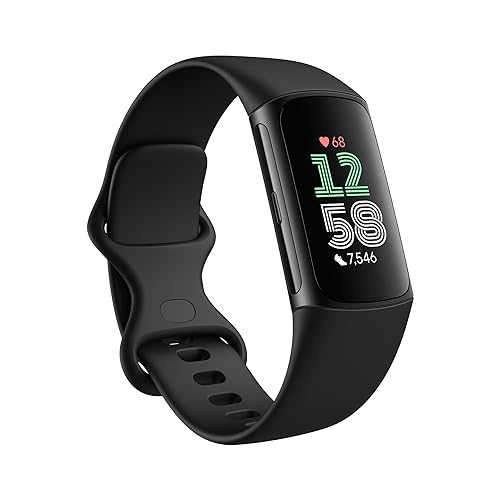
Google Fitbit Charge 6 Fitness Tracker
What We Like
- 40+ exercise modes with auto tracking
- Real-time heart rate on compatible gym machines
- Google Maps turn-by-turn directions for runs
- 3-month Google Health Premium trial included
Trade-offs
- No dive rating or advanced outdoor mapping
- No dive rating for underwater use
A built-in GPS and 40-plus exercise modes mean you can track runs, rides, and gym sessions without needing your phone nearby. Linking your Charge 6 to compatible treadmills or ellipticals lets you see your heart rate in real time on the machine. It suits athletes who want Google Maps directions during outdoor routes and the convenience of tap-to-pay with Google Wallet. The included three-month Health Premium trial gives access to personalized coaching that adapts to your life, helping you stay on track.
If you need a fitness tracker that can handle deep-water adventures, the Fitbit Charge 6 isn’t built for that. The Garmin Fenix 8 Pro is dive-rated for off-trail explorers. For most daily workouts and gym sessions, though, the Charge 6 keeps your metrics and Google tools close at hand, linking your heart rate to compatible treadmills and ellipticals so you see real-time data on the machine. It’s a practical companion for anyone who wants Google Maps directions on their wrist and tap-to-pay with Google Wallet, without the bulk of an expedition watch.
COROS PACE 4 Ultralight Sport GPS Watch

What We Like
- Weighs just 32g with nylon band
- 41 hours of continuous GPS tracking
- Voice recording and voice control
- 1.2" AMOLED with auto brightness
Trade-offs
- No dual-frequency GPS for dense urban or canyon environments
At 32 grams with the nylon band, this watch weighs less than a typical energy gel, so you genuinely forget it’s on your wrist during a hard interval or a long trail run. That ultralight build, paired with 41 hours of GPS battery, means you can push through multi-day adventures without worrying about charging or lugging extra weight. It’s built for the athlete who prioritizes speed and comfort over bulk, and the vibrant AMOLED screen stays readable with auto-adjusting brightness in varied lighting conditions.
Product photos
SUUNTO Run GPS Sport Running Watch

What We Like
- Dual-frequency GPS for precise location
- Lightweight 36g design
- 12-day battery with fast charging
- 4GB offline music storage
Trade-offs
- 20-hour GPS battery limits long ultramarathon use
- No built-in music streaming service support
A 36-gram body with a 1.32″ AMOLED touchscreen means you barely notice this watch on your wrist, even during long runs. The dual-frequency GNSS locks onto your route quickly in city canyons or open countryside, so you can focus on your stride rather than staring at a map. With 12 days of daily battery and a full recharge in one hour, it keeps up with your training week without demanding constant charging. Offline music storage for 4GB of tracks lets you leave your phone behind, which is a real perk for runners who want to travel light.
At just 36 grams with the textile velcro strap, this watch is light enough to forget you’re wearing it, so it won’t bounce or chafe during a hard run. The trade-off for that featherlight build is a 20-hour GPS battery, which is enough for daily training, tempo runs, and weekend half-marathons, but not for multi-day adventures without a charge. Still, for the runner who values precision and comfort over marathon battery life, the SUUNTO Run delivers accurate navigation and recovery insights without weighing you down.
Product photos
Amazfit Bip Max Smart Watch
What We Like
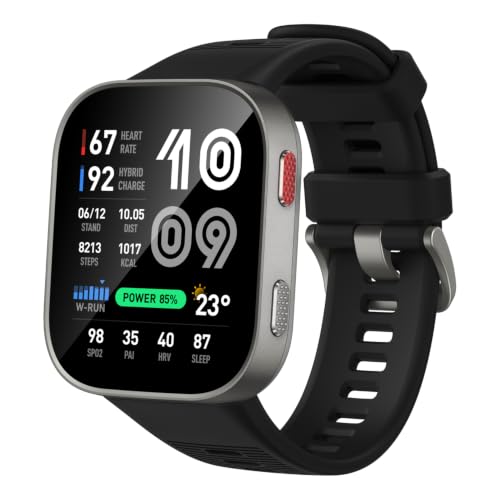
- Massive 2.07-inch AMOLED display
- 20-day battery for long training blocks
- 4GB storage for offline maps and media
- 150+ sports modes including HYROX
Trade-offs
- No dual-frequency GPS like some competitors
- Five-satellite GPS, not dual-frequency
A 2.07-inch AMOLED display is the biggest screen in this guide, so you get crystal-clear route maps and workout data without squinting mid-stride. That size pairs with a lightweight aluminum body and a 20-day battery, meaning you can wear it daily and still track multi-day adventures without hunting for a charger. It suits athletes who want a bright, spacious readout for navigation and training feedback, especially if you rely on offline maps and prefer leaving your phone behind.
The five-satellite GPS system provides fast and accurate route tracking for most environments. For athletes who prioritize the largest display for easy map reading and long battery life, the Bip Max delivers where it counts.
Product photos
WHOOP 5.0 Screenless Fitness Wearable
What We Like
- AI Coach turns 140+ metrics into actions
- 14+ day battery charges on wrist
- Healthspan tracks WHOOP Age vs. chronological age
Trade-offs
- No screen: requires phone for data
- 12-month membership required to use device
- No built-in GPS for outdoor route tracking
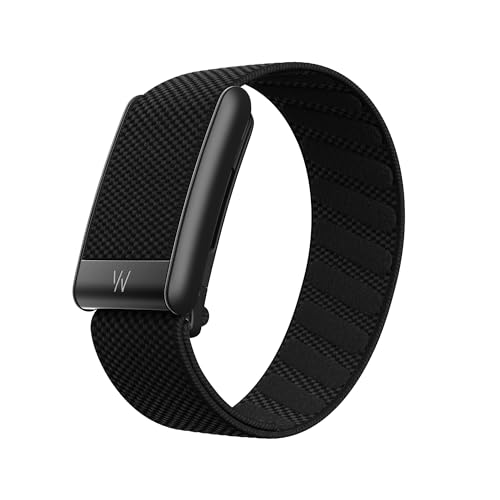
For athletes who obsess over sleep quality, strain balance, and readiness to train, the WHOOP 5.0’s AI Coach turns 140+ daily metrics into personalized next-step recommendations. This is the pick for anyone who wants a recovery-first wearable that prioritizes insight over glances.
The trade-off is obvious: no screen means you’ll pull out your phone for every stat. Compared to the Garmin Fenix 8 Pro, which gives you maps and notifications on your wrist, the WHOOP 5.0 asks you to commit to the app ecosystem. It also lacks built-in GPS, so outdoor runners or cyclists who want pace and distance without a phone will find the Fenix or COROS PACE 4 Pro more practical. But if your focus is recovery, sleep, and long-term health trends, the WHOOP’s AI coaching and continuous monitoring deliver depth that screen-first trackers can’t match.
Polar Pacer Ultra-Light GPS Runner Watch

What We Like
- Ultra-light at 0.1 pounds
- 35-hour battery in GPS training mode
- Always-on MIP color display
- Clear time, pace, distance tracking
Trade-offs
- No AMOLED display for high contrast
- No advanced training metrics beyond basics
- Limited to running-focused tracking only
The Polar Pacer Ultra-Light GPS Runner Watch offers up to 35 hours of battery life in training mode and up to 100 hours in power save mode, so you can go for long runs or multi-day events without frequent charging. It weighs just 0.1 pounds and has an always-on MIP color display that shows time, pace, distance, and laps clearly. For runners who want a lightweight, simple watch that focuses on essential tracking, this model delivers exactly that.
The Polar Pacer Ultra-Light GPS Runner Watch sticks to essential running data like time, pace, distance, and laps on a clear always-on MIP color display, so you get the basics without extra frills. By contrast, the COROS PACE 4 Pro offers a vivid AMOLED screen, and the Garmin Fenix 8 Pro adds a larger case and dive rating. But this Polar keeps things simple for runners who prioritize battery life and lightweight build. At 0.1 pounds and just half an inch thick, it’s easy to wear all day without noticing it, and the GPS tracks every step and turn reliably.
Product photos
Amazfit Helio Strap Screenless Activity Tracker
What We Like
- No subscription fees for full features
- 10-day battery between charges
- Tracks reps, sets, and rest periods
- HYROX Race mode for race prep
Trade-offs
- Screenless design means no glanceable stats during workout
- Relies entirely on phone app for data review
- No built-in GPS for outdoor route tracking
The Amazfit Helio Strap offers 27 sports modes and up to 10 days of battery life with no subscription fees, so you get training data without recurring costs. It tracks heart rate, blood-oxygen, stress, and sleep around the clock, and the strength training mode helps you track reps, sets, and rest periods. For athletes who want recovery insights and HYROX-specific support while keeping costs predictable, this strap fits between capability and simplicity.
The biggest trade-off is the screenless design: you won’t see your pace or heart rate mid-stride unless you pull out your phone, and there’s no built-in GPS for mapping outdoor runs. Compared to the Garmin Forerunner 165, which shows real-time stats on its wrist display, the Helio Strap asks you to trust the post-workout analysis instead. That makes it a better fit for gym-focused athletes who care more about recovery metrics and rep tracking than live route navigation.
Product photos
How We Evaluated Fitness Trackers For Athletes
We started with the raw specs: GPS accuracy (dual-frequency vs. Single-band), battery life in full GPS mode, display type, weight, and build materials. For each device, we cross-referenced these numbers against the demands of specific sports, trail running, triathlon, weightlifting, cycling, to see where a watch’s strengths truly shine.
The four criteria that mattered most were battery life, GPS accuracy, sport-specific metrics, and ecosystem. An athlete can’t stop mid-race to charge. Wrong distance ruins a training block. Recovery data for a runner or rep counting for a lifter matters. And the watch needs to work with your phone, your gym equipment, and your preferred apps.
This is a research-led evaluation, not a lab test. We analyzed manufacturer data, aggregated patterns from thousands of owner reviews, and consulted expert round-ups from coaching communities. The honest limit: personal comfort and wrist size can’t be measured on a spec sheet, so we flag fit and feel where the data suggests a potential issue.
What To Look For In Fitness Trackers For Athletes
Choosing a tracker means matching the device’s core strengths to your primary training environment and goals.
Key criteria: GPS accuracy (dual-frequency for urban canyons, single-band for open trails), battery life (hours vs. Days), display type (AMOLED for clarity, MIP for always-on), weight, sport-specific metrics, and subscription requirements.
GPS Accuracy and Battery Life
For runners, cyclists, and triathletes, GPS is non-negotiable. Dual-frequency GPS (like the COROS PACE 4 Pro and SUUNTO Run) locks onto satellites in two bands, giving accurate pace and distance even under dense tree cover or between tall buildings. Single-frequency GPS works well in open terrain but drifts in challenging environments.
Battery life is the other half of this equation. A watch that dies during a marathon is useless. Look for at least 20 hours of continuous GPS tracking for marathoners, and 35+ hours for ultramarathoners. The Polar Pacer and COROS PACE 4 Pro both exceed this threshold.
Sport-Specific Metrics and Recovery
A general fitness tracker counts steps. An athlete’s tracker measures training load, recovery time, HRV (heart rate variability), and sleep quality. The WHOOP 5.0 dedicates itself entirely to recovery analytics, while the Garmin Forerunner 165 offers a morning report that combines sleep, HRV, and a training outlook into one glance.
If you lift weights, look for rep counting and rest timers. The Amazfit Helio Strap tracks sets and rest periods without a subscription. If you cycle, you’ll want a device that pairs with power meters and speed sensors. Our best for cyclists guide covers those specific requirements.
Display, Weight, and Build
A watch you don’t want to wear is a watch that doesn’t help you train. Weight matters: the COROS PACE 4 Ultralight weighs just 32 grams with a nylon band, making it nearly imperceptible during a swim or a long run. The Amazfit Bip Max has a massive 2.07-inch AMOLED display for easy map reading, but that screen size may feel bulky on small wrists.
Build materials affect durability. Sapphire glass and titanium (found on the COROS PACE 4 Pro) resist scratches better than mineral glass and plastic. If you train in wet conditions or plan to swim, check the water resistance rating, some trackers lack a dive rating entirely.
- Check GPS battery life in hours, not standby days.
- Confirm the device supports your primary sport (running, cycling, swimming, lifting).
- Verify whether advanced features require a subscription (WHOOP 5.0 requires a 12-month membership).
- Test the display readability in direct sunlight before committing.
- Ensure the watch band fits your wrist size and is replaceable.
A good rule of thumb: pick the lightest device that still covers your longest training session without needing a recharge.
Fitness Trackers For Athletes Compared
The table below compares all nine trackers across the specs that matter most for athletic training: GPS accuracy, battery life, weight, display, and key sport-specific features.
| Product | Display | Battery (GPS) | GPS Type |
|---|---|---|---|
| COROS PACE 4 Pro GPS Sport Watch | 1.47" AMOLED | 60 hours | Dual-frequency |
| Garmin Forerunner 165 Running Smartwatch | AMOLED touchscreen | Up to 19 hours | Built-in GPS |
| Google Fitbit Charge 6 Fitness Tracker | N/A | N/A | Built-in |
| COROS PACE 4 Ultralight Sport GPS Watch | 1.2" AMOLED touchscreen | 41 hours | Accurate GPS |
| SUUNTO Run GPS Sport Running Watch | 1.32" AMOLED touchscreen | 20h GPS | Dual-frequency GNSS |
| Amazfit Bip Max Smart Watch | 2.07" AMOLED | N/A | 5 satellite systems |
| WHOOP 5.0 Screenless Fitness Wearable | Screenless | N/A | N/A |
| Polar Pacer Ultra-Light GPS Runner Watch | Always-on MIP color | 35 hours | Tracks every step and turn |
| Amazfit Helio Strap Screenless Activity Tracker | Screenless | N/A | N/A |
Frequently Asked Questions
What is the best fitness tracker for marathon training?
The COROS PACE 4 Pro is the strongest option for marathoners due to its 60-hour GPS battery and dual-frequency accuracy. Runners who want daily adaptive training plans should also consider the Garmin Forerunner 165, which provides personalized workouts based on recovery status.
Do I need dual-frequency GPS for running?
Dual-frequency GPS is most valuable if you run in cities with tall buildings, dense forests, or near cliffs where satellite signals bounce. For open-road or trail running in flat terrain, a single-frequency GPS like the one in the COROS PACE 4 Ultralight is sufficient and saves battery.
What is the difference between a fitness tracker and a smartwatch for the gym?
Fitness trackers prioritize sport metrics, battery life, and lightweight design, while smartwatches offer apps, notifications, and larger screens. Our tracker vs smartwatch comparison explains which is better for different gym activities, from weightlifting to cardio classes.
Can a fitness tracker help with weightlifting and rep counting?
Yes, but not all trackers do it well. The Amazfit Helio Strap is specifically designed for strength training, tracking reps, sets, and rest periods without a subscription. For a broader look at options, see our guide on best strength training trackers.
How do fitness trackers measure recovery and readiness?
Most advanced trackers use heart rate variability (HRV), resting heart rate, and sleep data to calculate a daily recovery score. The WHOOP 5.0 is the most focused on this, using an AI Coach to turn over 140 metrics into actionable training advice. The Garmin Forerunner 165 also provides a morning readiness report.
The Bottom Line
The COROS PACE 4 Pro is the best overall fitness tracker for athletes who need a lightweight, durable watch with exceptional battery life and accurate GPS. It suits runners, triathletes, and anyone who prioritizes long training sessions without worrying about battery anxiety.
If your budget is tighter or you prefer Google’s ecosystem, the Google Fitbit Charge 6 delivers gym machine connectivity and turn-by-turn directions at a more accessible price point. Runners who want adaptive daily coaching should lean toward the Garmin Forerunner 165.
The single most important buying factor is battery life in full GPS mode. No amount of premium features matters if the watch dies before you cross the finish line. Match the battery to your longest training session, then let weight and display quality decide the rest.
