
10 Best Functional Trainers For Home Gym in 2026
This post contains affiliate links. As an Amazon Associate, we earn from qualifying purchases.
For a home gym that handles everything from cable crossovers to lat pulldowns, the XMark Functional Trainer Cable Machine is the best overall choice. It has dual 200 lb weight stacks and 19 adjustable pulley heights. The Body-Solid Powerline PFT100 Cable Crossover offers the best dual-stack value, while the Centr 1 Home Gym Functional Trainer keeps things compact for smaller spaces.
Building a home gym around a functional trainer means balancing resistance, footprint, and versatility. Too many machines promise full-body training but skimp on pulley positions or weight capacity, leaving you with limited exercises. The real challenge is finding a unit that matches your strength level without dominating your floor plan.
We evaluated these picks by comparing specifications, manufacturer documentation, expert round-ups, and patterns in owner feedback. This guide breaks down what each machine does best so you can match one to your space, budget, and training goals.
Top 10 Functional Trainers For Home Gym in the Market
Certain content that appears on this site comes from Amazon. This content is provided "as is" and is subject to change or removal at any time.
The Best Functional Trainers For Home Gym, Reviewed
XMark Functional Trainer Cable Machine

What We Like
- Dual 200 lb weight stacks work independently
- 19 adjustable pulley heights for full-body training
- Complete attachment kit included for immediate use
- Built-in pull-up bar with angled and straight grips
Trade-offs
- 800 lb weight makes relocation very difficult
- Requires freight delivery scheduling with phone number
- Weight bench sold separately for press exercises
Two independent 200 lb weight stacks give you 400 lb of total resistance on a 2:1 pulley ratio, so you can train one arm or leg at a time while keeping the motion smooth through every rep. That dual-stack design, paired with 19 adjustable pulley heights from 12 to 75 inches, means you can hit presses, rows, flys, curls, and leg work without swapping machines. This trainer suits someone who wants commercial-grade cable work at home and does not mind dedicating serious floor space to get it.
The trade-off is size and weight: at 800 lb and 65.5 inches long, this is a permanent fixture, not something you shuffle around a garage. It also arrives via freight carrier, so you need to schedule a delivery appointment by phone. Compare that to the Centr 1 Home Gym Functional Trainer, which weighs 350 lb and fits a tighter footprint, but its single 160 lb weight stack tops out sooner for stronger lifters. If you plan to grow into heavier cable work and have a dedicated spot, the XMark delivers the capacity and versatility to match.
Body-Solid Powerline PFT100 Cable Crossover

What We Like
- Dual 160 lb weight stacks for isolateral training
- Extra-wide mainframe for stability
- 10-year frame warranty
- Versatile high and low pulley exercises
Trade-offs
- 476 lb unit needs dedicated floor space
- Weight ratio 1:2 means half the felt resistance
- Wider footprint than some compact trainers
A dual 160-pound weight stack gives you independent resistance on each side, so you can work one arm at a time or do cable crossovers without fighting a single stack. That extra-wide mainframe keeps things steady even when you’re pulling hard, and the 10-year frame warranty tells you Body-Solid expects this to last. This is the pick for anyone building a home gym on a budget who wants real dual-stack functionality without jumping to premium price territory. The variety of exercises, from pec flys to glute kickbacks, means you’re not stuck doing the same three moves forever.
The trade-off is that the 1:2 weight ratio means each stack provides half the felt resistance of its listed weight, so if you’re used to loading heavy on a commercial machine, you’ll outgrow this sooner. For most home lifters starting out or maintaining strength, the PFT100’s value is hard to beat, just know you’re trading raw weight capacity for that budget-friendly entry point.
Centr 1 Home Gym Functional Trainer

What We Like
- 165 exercise options for full-body training
- Compact footprint at 51 in wide
- Industrial-grade steel with powder coat finish
Trade-offs
- 160 lb weight stack limits very heavy lifters
- 312 lb unit is heavy to move once assembled
The single 160-pound weight stack won’t satisfy someone chasing heavy cable rows or lat pulldowns. If that’s you, the Inspire Fitness FTX with its two 165-pound stacks might be a better fit. At 312 pounds, the Centr 1 is not something you’ll casually rearrange, so plan your setup spot carefully before assembly. Owners report it delivers a wide range of workout options for the footprint it occupies.
Inspire Fitness FTX Functional Trainer

What We Like
- Smallest footprint among full functional trainers
- Two 165 lb weight stacks for independent arms
- Built-in phone/tablet holder and accessory storage
- Includes pull-up bar and 4 accessories
Trade-offs
- At 544 lb, moving it once assembled is difficult
- Weight stacks lighter than some competitors' 200 lb stacks
A 40-inch width and 54-inch depth mean this machine squeezes into corners where most functional trainers simply won’t fit. That compact footprint is the whole point. You get two independent 165 lb weight stacks, a pull-up bar, sliding pulleys, and a full accessory kit in a frame that doesn’t dominate your garage or spare room. The built-in tablet holder and storage rack keep your workout organized without extra shelving. For anyone trying to add serious cable work to a home gym without losing floor space for other equipment, this is the rare setup that actually delivers on that promise.
The small footprint means a lighter total weight stack than the XMark’s dual 200 lb stacks, so if you’re already repping heavy rows or lat pulldowns near the 165 lb range, you might max out the FTX sooner than you’d like. At 544 pounds, it’s no weekend project to reposition once assembled, so measure your space carefully before committing. Still, for the home lifter who values a tidy, versatile cable station over raw poundage, the Inspire FTX earns its spot as the space-saving specialist in this guide.
Goimu WM1 Wall Mount Cable Station
What We Like
- 17 adjustable pulley positions for versatile angles
- Dual pulley system with 1:1 and 2:1 ratios
- Compact 3.12 sq. ft footprint saves space
- Rock-solid stability with reinforced steel brackets
Trade-offs
- Requires concrete or masonry wall for installation
- At 81.3 lb, mounting effort is heavier than freestanding models
- Wall-mounted design limits portability and repositioning
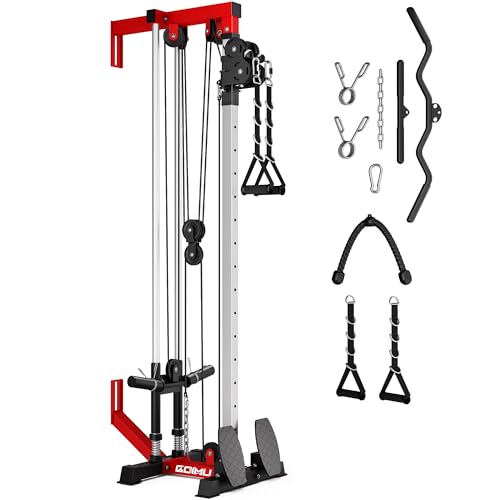
If your home gym is fighting for every square inch, the Goimu WM1’s 3.12-square-foot footprint means you can tuck a full cable station against a wall without sacrificing your workout space. Seventeen height settings let you dial in everything from chest flys at 70 inches to low rows. The SmartT Dual Pulley Technology lets you switch between a heavy 1:1 ratio and a lighter 2:1 ratio for drop sets or endurance work, all without changing plates. This is the setup for anyone who wants professional-level cable variety in a garage or apartment where floor space is precious.
You need a concrete or masonry wall to mount it securely, and at 81.3 pounds, installation isn’t a quick weekend project. Compared to the Body-Solid Powerline PFT100, which sits on its own frame but takes up 62.6 inches of width, the Goimu WM1 saves serious floor real estate. You lose the ability to move it around, but if your walls are solid and your space is tight, that stability pays off in wobble-free lifts every rep.
Mikolo Wall Mount Cable Machine

What We Like
- 118 lb selectorized weight stack for quick changes
- 1:1 pull ratio with included 2-1 cable adapter
- 19 adjustable pulley positions for full-body moves
- Compact wall-mounted design saves floor space
Trade-offs
- 118 lb stack lighter than dual-stack functional trainers
- Wall mounting requires sturdy wall and installation effort
- Single weight stack limits independent arm work
A 118 lb selectorized weight stack means you can dial in resistance with a simple pin drop, no fumbling with plates mid-set. That makes this Mikolo wall mount a smart fit for anyone building a home gym on a budget who still wants real cable functionality, lat pulldowns, rows, crossovers, curls, without dedicating a huge footprint. The included 2-1 cable adapter lets you switch from the standard 2:1 ratio to a true 1:1 pull, so that 118 lbs feels like 118 lbs in your hands for heavy pulls. Nineteen adjustable pulley heights cover everything from high chest flys to low bicep curls, and the 14-gauge steel frame with reinforced brackets keeps things steady once mounted.
The trade-off is straightforward: at 118 lbs per stack, you’re working with less total resistance than dual-stack machines like the Inspire Fitness FTX, which offers two 165 lb stacks. That means heavier lifters may outgrow this cable station for exercises like lat pulldowns or seated rows, where you’d want more than 118 lbs. You also lose the ability to perform independent arm movements (think unilateral cable flys or single-arm curls) since there’s only one weight stack. For the price-conscious home gym builder who prioritizes space savings and core cable moves over max load or dual-arm independence, this is a capable starter that won’t crowd your room.
Product photos
Goimu WM3-V4 Folding Squat Rack

What We Like
- Folds to 4.3 sq ft for storage
- 15 adjustable pulley heights for variety
- 5 configurable modes for different workouts
- Dual independent pulleys for partner training
Trade-offs
- Requires wall mounting for stability
- No weight stack included, needs separate plates
The Goimu WM3-V4 folds down to 4.3 square feet when stored, so it can sit against a wall in a garage or apartment corner and still leave room for other gear. That folding design, paired with five setup modes from a half rack for squats to a cable crossover station, makes it a space-conscious choice for anyone who wants both barbell lifts and cable work without dedicating a whole room to gym equipment. The dual independent pulley system uses a 1:1 ratio, and with 15 adjustable pulley heights you can target a wide range of movements.
Because this is a wall-mounted unit, you will need to bolt it into studs and have your own weight plates on hand. There is no built-in weight stack like the Inspire Fitness FTX. That keeps the Goimu’s design simpler and its footprint smaller, but it also means buying plates separately and following the included manual for installation. If you already own a set of plates and want a system that folds away when not in use, this is a practical fit. For someone who prefers a machine with a built-in weight stack, the Inspire is the alternative.
Product photos
Major Fitness F22 Power Rack

What We Like
- Replaces cage, rack, and cable crossover
- Dual-triangle base for stable no-bolt setup
- Independent dual pulleys for two users
- Includes dip bars, landmine, and lat pulldown
Trade-offs
- 243 lb weight needs two people to assemble
- No weight stack included, uses plate loading
A 1600 lb static capacity and a 2×3 in 14-gauge steel frame mean this rack handles heavy squats and deadlifts without flexing or wobbling, even without bolting it to the floor. That dual-triangle base design spreads the load so you can do aggressive cable crossovers or weighted pull-ups without that annoying sway. It replaces a squat cage, a cable crossover, and a lat pulldown machine in one footprint. That makes it a smart fit for a home gym where floor space is tight and you want one station that does compound lifts and isolation work.
At 243 pounds, the F22 is heavy enough that you will want a second person to help with assembly, but that weight also helps keep the rack planted during heavy lifts. The dual pulleys use your own plates instead of a built-in weight stack, which keeps the price down but means swapping plates between exercises. Owners report that the frame stays stable under a loaded barbell, avoiding the wobble that plagues many all-in-one designs.
Product photos
JELENS CC01 Cable Crossover Machine
What We Like
- Triangular frame uses only 12.1 sq ft
- 15 pulley height adjustment levels
- Includes pull-down bar, rowing bar, handles
- Detachable pull-up bar holds 500 lb
Trade-offs
- At 146 lb, moving it alone is tough
- Requires separate weight plates (not included)
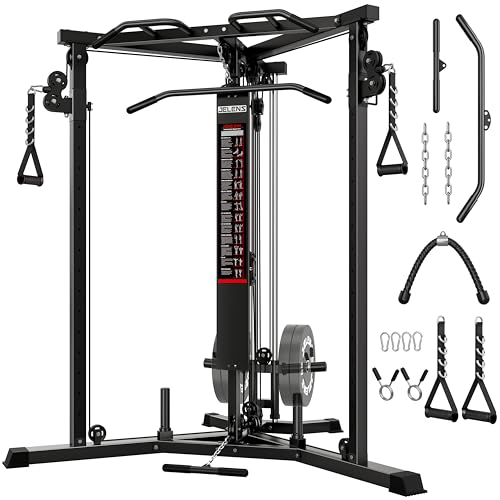
The triangular frame of this JELENS cable crossover occupies 12.1 square feet of floor space, which means it fits into tighter spots than many home gym machines. The 15 height adjustment levels on the pulley system let you switch between exercises like seated rows, lat pulldowns, and cable chest flyes without much hassle. The detachable pull-up bar holds up to 500 lb, and the main frame weighs 146 lb, so once it is assembled, you will not want to move it often.
Product photos
JELENS C21 Power Cage

What We Like
- Independent dual pulleys for two users
- 2,000-lb capacity for heavy lifting
- Includes lat bar, cable bar, dip bars, more
- 20-step numbered uprights for quick adjustments
Trade-offs
- Half-rack design limits some full-cage exercises
- No weight stacks included, uses plate loading
A 2,000-lb weight capacity on a half-rack frame that fits in just 17.27 square feet means you can squat and bench heavy without needing a dedicated gym space. The independent dual pulley system with a true 1:1 ratio lets two people train at once, so you and a partner can run supersets or drop sets side by side with zero waiting. It ships with a lat pulldown bar, cable bar, dip bars, and more, so you start full-body work on day one. This is the setup for anyone who wants a power rack and a functional trainer in one compact footprint, especially if you share the gym with a roommate or family member.
The half-rack design occupies only 17.27 square feet, so it fits neatly into a garage or spare room without dominating the space. Because it lacks full front posts, some lifters might prefer a fully enclosed cage for certain exercises, but the trade-off is a more compact footprint. If you want heavy barbell training plus cable work for two people in a tight area, this rack delivers a combination that many dedicated cable machines can’t match.
Product photos
How We Evaluated Functional Trainers For Home Gym
Our evaluation focused on three areas: resistance quality, pulley versatility, and real-world footprint. We compared weight stack sizes, pulley height ranges, and the number of included attachments for each machine. We also looked at frame construction, warranty terms, and assembly requirements from manufacturer documentation.
The criteria that mattered most were effective resistance (both stack weight and pulley ratio), adjustability (number of pulley positions and smoothness of adjustment), and space efficiency (footprint and whether the unit requires wall mounting). Owner feedback patterns helped us understand which machines hold up over time and which trade-offs matter most in daily use.
A research-led evaluation has limits, we haven’t tested these machines ourselves, and personal preference for feel and ergonomics plays a big role. What we can offer is a clear picture of what each functional trainer delivers on paper and what real owners tend to report, so you can narrow your shortlist with confidence.
What To Look For In Functional Trainers For Home Gym
Choosing a functional trainer starts with understanding how weight stacks, pulley systems, and footprint interact. The right machine for you depends on your strength level, available space, and whether you want a freestanding unit or something that mounts to the wall.
A functional trainer’s job is to give you smooth cable resistance through a wide range of motion. The best ones balance stack weight, pulley height options, and floor space in a way that fits your training without dominating your room.
Weight Stack and Pulley Ratio
The weight stack determines how much resistance you can use, but the pulley ratio changes how that weight feels. A 1:1 ratio means the stack weight equals the felt resistance. A 2:1 ratio halves the felt resistance, so a 160 lb stack feels like 80 lb. Dual-stack machines let each arm work independently, which is essential for unilateral exercises like single-arm cable rows. For serious strength work, look for stacks of 200 lb or more per side with a 1:1 ratio.
Pulley Adjustment and Range
More pulley positions mean more exercise variety. A good functional trainer offers at least 15 adjustable heights, letting you set the cable at shoulder height for chest flyes, mid-thigh for rows, or near the floor for cable pull-throughs. The smoothness of the adjustment mechanism matters too, detent pins or pop-pins should engage cleanly without sticking. Some machines use a guide-rod system that lets you slide the pulley continuously rather than locking into preset holes.
Footprint and Installation Type
Freestanding functional trainers typically need several feet of width and about 2 feet of depth, plus space for you to stand and move. Wall-mounted units cut the footprint dramatically but require a concrete or masonry wall for secure installation. Folding models add flexibility for multipurpose rooms. Before buying, measure your space and account for the cable’s range of motion, you need room to stand in front of and beside the machine.
- Measure your ceiling height, some machines need enough height for full pulley travel.
- Check the floor space when cables are fully extended, not just the base footprint.
- Confirm wall type if choosing a wall-mounted model, drywall alone won’t support the load.
- Count the included attachments versus what you’ll need to buy separately.
A functional trainer should feel solid under load. If the frame wobbles during a lat pulldown, the weight stack and pulley ratio won’t matter much.
Functional Trainers For Home Gym Compared
The table below compares all ten functional trainers side by side, so you can see how weight stacks, pulley positions, and footprints stack up at a glance.
| Product | Weight Stacks | Dimensions | Pull Ratio |
|---|---|---|---|
| XMark Functional Trainer Cable Machine | Dual 200 lb (400 lb total) | 65.5" L x 43.5" W x 83.5" H | 2:1 |
| Body-Solid Powerline PFT100 Cable Crossover | 2 x 160 lb (1:2 ratio) | 42.3"L x 62.6"W x 83"H | 1:2 |
| Centr 1 Home Gym Functional Trainer | 160 lb | 81.5" H x 51" W x 62" L | N/A |
| Inspire Fitness FTX Functional Trainer | Two 165 lb stacks | L 40.0 × W 54.0 × H 85.0 in | N/A |
| Goimu WM1 Wall Mount Cable Station | N/A | 28.1 x 24.8 x 78.7 inches | 1:1 and 2:1 via cable adaptor |
| Mikolo Wall Mount Cable Machine | 118 lbs built-in | N/A | 2:1 standard, 1:1 with included adapter |
| Goimu WM3-V4 Folding Squat Rack | N/A | L 53.0 x W 33.5 x H 85.0 in | 1:1 |
| Major Fitness F22 Power Rack | N/A | 55.5 x 68.9 x 82.5 in | 2:1 |
| JELENS CC01 Cable Crossover Machine | N/A | 64.2 x 53.9 x 81.9 in | N/A |
| JELENS C21 Power Cage | N/A | 53.5 x 46.5 x 84.7 inches | 1:1 |
Frequently Asked Questions
What is a functional trainer and how is it different from a cable machine?
A functional trainer is a type of cable machine with two independent weight stacks and adjustable pulleys that move vertically. Unlike a simple lat pulldown station or a cable crossover with fixed pulleys, a functional trainer lets you set each cable at a different height for exercises like split squats, woodchops, and standing cable flyes. This versatility makes it better suited for full-body training in a home gym.
How much weight do I need in a functional trainer?
For most home gym users, 200 lb per side provides enough resistance for upper and lower body exercises. Beginners can start with less, but heavier stacks give room to progress. Pay attention to the pulley ratio, a 2:1 ratio halves the felt resistance, so a 160 lb stack feels like 80 lb. If you are an advanced lifter, look for a 1:1 ratio and stacks of 200 lb or more.
Can I do pull-ups on a functional trainer?
Some functional trainers include a built-in pull-up bar, like the XMark Functional Trainer Cable Machine and the Inspire Fitness FTX Functional Trainer. Others, like the JELENS CC01 Cable Crossover Machine, include a detachable pull-up bar. If pull-ups are a priority, check the product specifications for a bar rated to your body weight before buying.
What is the difference between a wall-mounted and a freestanding functional trainer?
A wall-mounted functional trainer bolts to a concrete or masonry wall and takes up very little floor space, often under 4 square feet. A freestanding unit sits on its own base and can be placed anywhere with enough room, but it takes up more space and is heavier. Wall-mounted models like the Goimu WM1 are ideal for small home gyms, while freestanding units offer more flexibility for rearrangement.
How much space do I need for a functional trainer at home?
Freestanding functional trainers typically need several feet of width, 2 to 3 feet of depth, and enough ceiling height. Add a few feet in front of the machine for cable range of motion. Compact models like the Centr 1 Home Gym Functional Trainer fit in tighter spaces, while wall-mounted units can squeeze into corners. Always measure your room and the machine’s full cable travel before committing.
The Bottom Line
The XMark Functional Trainer Cable Machine earns the best overall spot because it combines dual 200 lb weight stacks with 19 adjustable pulley heights and a complete attachment kit, all in a commercial-grade frame. It is the right choice for home gym owners who want serious strength training without compromising on exercise variety.
If your budget is tighter or your space is smaller, the Body-Solid Powerline PFT100 Cable Crossover delivers true dual-stack training at a more accessible price point. The Centr 1 Home Gym Functional Trainer and Inspire Fitness FTX Functional Trainer offer compact footprints for tight floor plans. Wall-mounted options like the Goimu WM1 and Mikolo Wall Mount Cable Machine are excellent for those who can drill into a solid wall.
The single most important factor in choosing a functional trainer is matching the weight stack and pulley ratio to your strength level and training goals. Everything else, footprint, attachments, assembly, can be worked around. Start with the resistance you need, then find the machine that fits your room.
