
10 Best Home Gym Pull Up Bars in 2026
This post contains affiliate links. As an Amazon Associate, we earn from qualifying purchases.
The Ally Peaks Heavy Duty Doorway Pull Up Bar is our best overall pick because it combines a 440 lb capacity with multi-grip versatility and tool-free installation that protects your door frame. For a no-fuss budget option, the MOMODA Doorway Pull Up Bar delivers similar strength at a lower price point. If you have floor space to dedicate, the Sportsroyals Power Tower Pull Up Bar offers a complete freestanding station with adjustable settings for users from 5’1″ to 6’5″.
The real challenge with home gym pull up bars isn’t finding one, it’s finding one that fits your actual space and your workout style. Doorway depth, trim height, wall construction, and ceiling joist spacing all determine which bar will work safely in your home. A bar that doesn’t fit right either damages your home or sits unused.
This guide is research-based, drawing on manufacturer specifications, expert round-ups, and patterns in owner feedback to help you match the right bar to your home and your goals. We cover ten distinct picks across doorway, wall-mounted, freestanding, and ceiling-mounted designs so you can choose with confidence.
Top 10 Home Gym Pull Up Bars in the Market
Certain content that appears on this site comes from Amazon. This content is provided "as is" and is subject to change or removal at any time.
The Best Home Gym Pull Up Bars, Reviewed
Ally Peaks Heavy Duty Doorway Pull Up Bar

What We Like
- 440 lb capacity with thickened steel
- Double silicone door frame protection
- Multi-grip for pull-ups, dips, crunches
- No-screw leverage installation
Trade-offs
- Requires doorway depth up to 8.27 inches
- Trim height limit of 3.75 inches
The trade-off is that your doorway needs to meet those depth and trim height specs, if you have shallow molding or an extra-wide opening, you will need to measure first. Compared to a wall-mounted bar like the HWOOUSA 48-inch model, this one is portable and leaves no damage, but it does not require permanent installation. For anyone who wants a solid home gym setup without drilling holes, the Ally Peaks is a reliable option.
Product photos
MOMODA Doorway Pull Up Bar
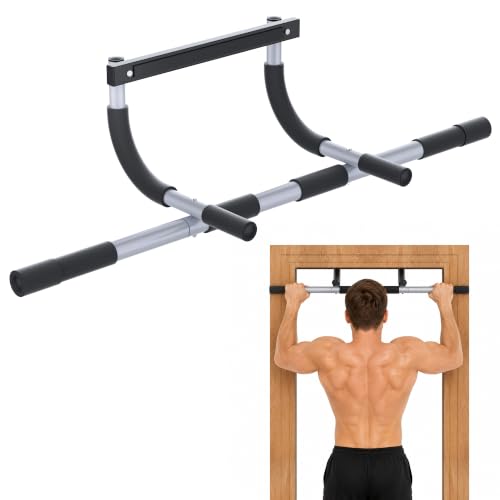
What We Like
- 440 lb capacity in a lightweight bar
- Three grip positions for varied exercises
- No-screw installation protects door frame
- Foam-padded grips for comfortable hold
Trade-offs
- Only fits doorways 19-39 inches wide
- No wall or ceiling mounting option
A 440-pound weight capacity in a bar that weighs 5.3 pounds means it can handle heavy use without adding storage burden. The bar uses leverage to clamp into a door frame, so no screws or drilling are required. Three grip positions, narrow, wide, and neutral, let you vary pull-up and chin-up angles to work different upper-body muscles. For someone who wants a setup that installs in seconds and leaves no marks, this is a practical choice.
The bar only works on door frames between 19 and 39 inches wide, so very wide or oddly shaped doorways are out. It also relies on a clamping mechanism rather than being bolted into studs like a wall-mounted option, say, the HWOOUSA Wall Mount Pull Up Bar. If you prefer a permanently fixed bar, a mounted option might suit you better. For straightforward pull-ups and chin-ups, this is a practical way to turn a standard doorway into a home gym.
Product photos
Sportsroyals Power Tower Pull Up Bar
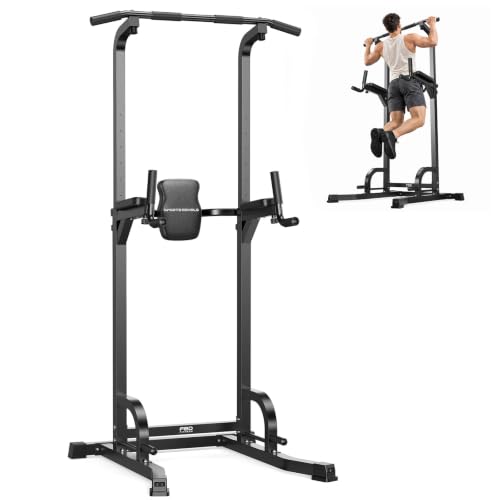
What We Like
- Wider U-shaped base with adjustable foot pads
- Eight height settings fit 5'1" to 6'5"
- Three grip-distance positions for arm length
- Padded armrests and wide back pad
Trade-offs
- At 47.2 lb, moving it between rooms is a chore
- Base footprint 9.8 sq ft needs dedicated floor space
- No wall or doorway mount, free standing only
The trade-off is space and portability. At 47.2 pounds and a 9.8-square-foot footprint, it is not something you tuck into a closet or carry from room to room. Doorway-mounted pull-up bars, such as the Ally Peaks model, are lighter and mount without a permanent floor footprint, but this Sportsroyals unit requires a dedicated corner. If you have the room and want a freestanding station that handles pull-ups, dips, inverted rows, knee raises, and push-ups without needing wall or door mounting, the extra floor space is the cost of that convenience.
Jusgym Wall Mounted Pull Up Bar

What We Like
- 500 lb capacity supports heavy users
- Adjustable depth for muscle-ups or compact space
- Includes rings for bands, boxing, gymnastics
- Powder-coated steel resists rust
Trade-offs
- Requires drilling into wall or studs
- Heavier than doorway bars at 21.6 lbs
A 500-pound weight capacity means this bar handles everything from beginner pull-ups to advanced weighted training without wobbling or flexing. The reinforced steel frame mounts to concrete or wooden walls, giving you a stable anchor for pull-ups, chin-ups, and core exercises. Two depth settings let you choose a compact 19-inch position for tight spaces or a 27-inch extension for muscle-ups and kipping pull-ups, which adds versatility beyond a standard fixed bar. If you want a permanent station that won’t quit when you push hard, this is the one to bolt in.
Installation isn’t instant; you need a drill, a stud finder, and a bit of patience to mount it securely. That’s the price of that unshakable stability. Compared to the LIONSCOOL Wall Mounted Pull Up Bar with Pulley, the Jusgym skips the pulley system but keeps the design focused on direct strength training. At 21.6 pounds, it’s a substantial unit that stays firmly in place once mounted. Ideal for anyone ready to commit to a permanent home gym setup.
Product photos
LIONSCOOL Wall Mounted Pull Up Bar with Pulley

What We Like
- Integrated pulley system for cable exercises
- Multiple grip positions target different muscles
- Includes tricep rope and cable handles
Trade-offs
- Requires solid wall mounting, not doorway-friendly
- Heavy 30 lb unit needs sturdy installation
- 48-inch span limits narrow wall spaces
The LIONSCOOL Wall Mounted Pull Up Bar with Pulley brings a built-in cable system right to your home wall, letting you do lat pulldowns, tricep pushdowns, and cable flys alongside standard pull-ups. With a 450 lb weight capacity and diamond knurling for a secure grip even when sweaty, it suits anyone who wants a full upper-body gym without a bulky machine. The included tricep rope, straight bar, and two cable handles mean you can switch exercises quickly, making it ideal for progressive strength training.
This bar must be mounted on a solid cement or brick wall for safe use. At 30 pounds with a 48-inch width, it is not a quick-install option for renters or small spaces. The Jusgym Wall Mounted Pull Up Bar supports 500 pounds but lacks a pulley system, while the LIONSCOOL offers more exercise variety with its built-in pulley setup, though its weight capacity is up to 450 pounds. If you have a dedicated wall space and want one piece of equipment that handles both pulling and cable work, this is a smart pick.
Product photos
HWOOUSA Wall Mount Pull Up Bar
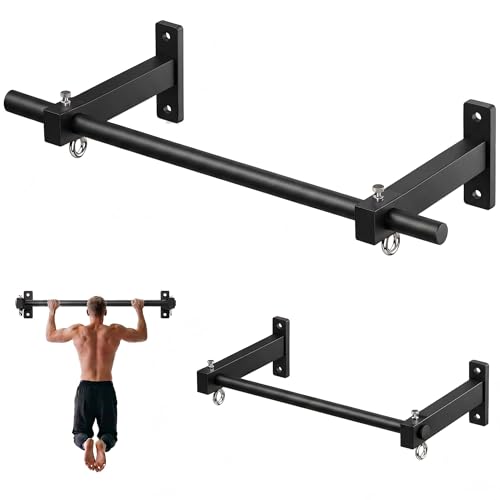
What We Like
- Adjustable mounting fits 16", 24", 32" studs
- 500 lb capacity for heavy-duty use
- Two O-rings for bands or straps
- Compact design saves floor space
Trade-offs
- Fixed grip positions limit variety
- Requires solid wall type for safe installation
With a 500-pound load capacity and adjustable mounting that adapts to 16-, 24-, or 32-inch stud spacing, this wall-mounted bar is built for people who want a stable, permanent pull-up station without guessing whether the brackets will line up. The heavy-duty steel frame and powder coating resist rust and sweat, so it holds up in a garage or basement over years of regular use. It suits anyone who has a solid concrete, cement, brick, or wood wall and wants a no-nonsense bar that stays put during wide or narrow grip work. The two included O-rings let you attach resistance bands or a yoga strap, turning a simple pull-up bar into a small training station without extra gear.
Compared to the Jusgym Wall Mounted Pull Up Bar, which offers a longer 51-inch bar for wider grip variations, this HWOOUSA model is more compact and focuses on adjustable stud fit rather than grip span. If your walls are solid and you want a straightforward, affordable upgrade from a doorway bar, this one delivers reliable performance without wobble. Just make sure your wall can handle the screws before you start drilling.
Product photos
Kipika Ceiling Mounted Pull Up Bar

What We Like
- Five grip styles for varied workouts
- Height adjustable in five positions
- Rust-resistant powder coating for durability
- Includes screws for wood and concrete mounting
Trade-offs
- Requires ceiling studs 12 or 24 inches apart
- Mounting holes fixed at 48 inches apart limits flexibility
The Kipika Ceiling Mounted Pull Up Bar offers five distinct grip styles, wide, narrow, neutral, chin-up, and hammer, so you can target different muscle groups without switching equipment. Its adjustable height range, from 18 to 26 inches from the mounting surface, lets you customize the bar to your ceiling height and preferred reach. That makes it a strong fit for anyone with a dedicated home gym space who wants a permanent, versatile pull-up station that won’t wobble or take up floor area.
That means you’ll need to check your ceiling framing before buying. The Jusgym Wall Mounted Pull Up Bar weighs 21.6 pounds and mounts to wall studs, so it’s a different setup. But once the Kipika is installed, the height adjustability and grip variety give you a versatile training station that doesn’t take up floor space.
Product photos
MOMODA No Screw Doorway Pull Up Bar
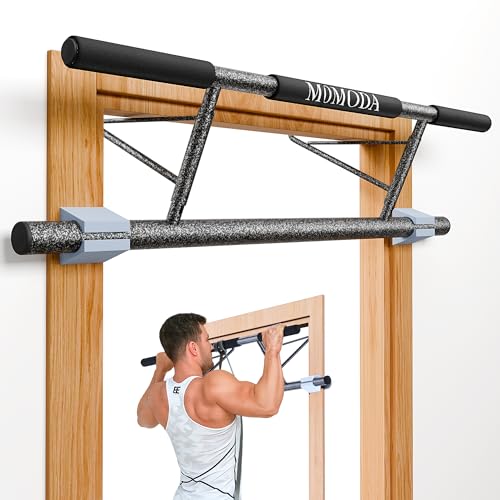
What We Like
- 440 lb capacity for heavy-duty use
- No-drill install protects door frames
- Foldable design saves storage space
- Padded foam grips for comfort
Trade-offs
- Fits only door depths of 7.8 in
- Trim height limit of 3.54 in
- Avoid shaking during exercise per manual
A 440-pound weight capacity in a no-screw doorway bar means this can handle everything from bodyweight pull-ups to weighted training without needing to drill into your frame. The high-density foam pads are designed to avoid damage to the wall, and the foldable design lets you stash it in a closet or under a bed when not in use. It suits beginners and advanced athletes who want a quick-install bar that doesn’t compromise on strength, especially for apartments or dorms where drilling isn’t an option.
The real trade-off is the fit limitations: this bar requires a door depth of exactly 7.8 inches and a trim height up to 3.54 inches. So it won’t work on thicker or heavily moulded door frames. If your door frame meets the specs, this is a practical, space-saving choice; if not, you might need to look at a wall-mounted option like the Jusgym Wall Mounted Pull Up Bar.
Product photos
PROIRON Door Pull Up Bar
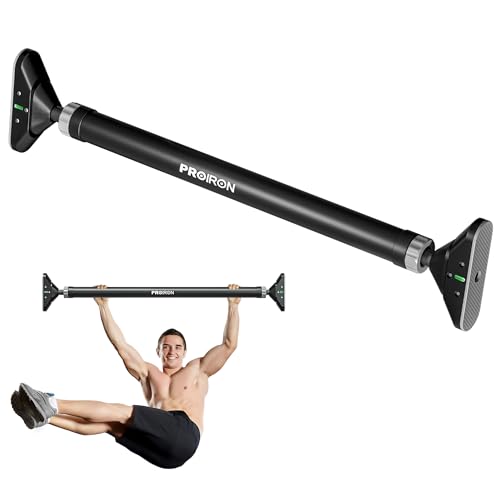
What We Like
- Double gear lock prevents rotation
- 440 lb max load capacity
- EVA foam grip reduces calluses
- No-drill installation with spirit levels
Trade-offs
- Door frame width range is limited to 28.3-38.2 inches
- Not suitable for hollow or glass doors
A 440-pound max load and a double gear lock that stops rotation make this doorway bar feel planted even during explosive movements. The two spirit levels built into the installation mean you don’t need a screwdriver or a steady eye, just slide it in, check the bubbles, and start your set. It suits anyone who wants a secure, temporary setup they can take down in seconds without leaving marks on the frame.
The biggest limitation is that this bar only fits door frames between 28.3 and 38.2 inches wide. So if your doors are narrower or wider, you’ll need a different model like the Ally Peaks bar with its broader adjustable range. For most standard residential frames, though, the PROIRON bar locks in place without drilling, giving you a secure setup that feels solid from the first rep.
Product photos
HWOOUSA 48" Wall Mounted Pull Up Bar
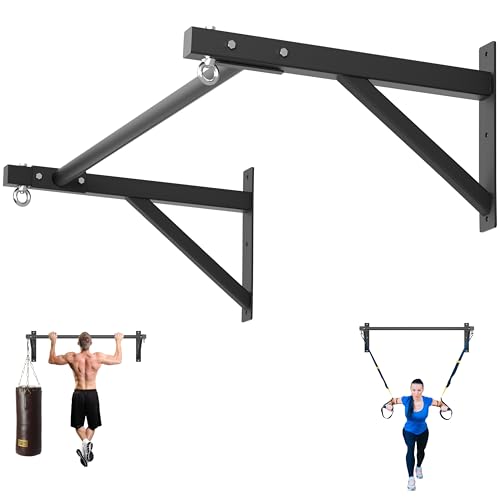
What We Like
- 650 lb capacity for heavy-duty use
- Multi-grip options: wide, standard, reverse
- Two anchor bolts for TRX, bands, bags
- Rustproof powder-coated finish
Trade-offs
- Requires 48" wall space for mounting
- Only fits 16" or 24" stud spacing
- At 17.6 lb, needs solid wall installation
A 650-pound weight capacity means this bar can handle not just you but added weight from a vest or belt without a creak. The 48-inch mounting width gives you room for wide-grip pulls, while the multi-grip bar lets you switch to standard or reverse grip. Two built-in anchor bolts let you hang resistance bands, TRX straps, or a punching bag, turning a simple pull-up bar into a small training station. If you have a garage or basement wall with 16 or 24-inch stud spacing and want a setup that won’t wobble under serious load, this is the one.
You need a solid 48-inch stretch of wall and a stud pattern that matches, no mounting on 32-inch centers or odd layouts. Compared to the Jusgym wall-mounted bar, which holds 500 pounds and weighs 21.6 pounds, this HWOOUSA model gives you a higher capacity and the accessory anchors. If your wall space is tight or you plan to move the bar often, a doorway model might be more convenient, but for a permanent heavy-duty station, this bar earns its place for raw strength work.
How We Evaluated Home Gym Pull Up Bars
We started by reviewing the technical specs that determine whether a pull-up bar actually works in a given home: weight capacity, mounting method, and dimensional limits like doorway width, depth, and trim height. Each product’s manufacturer documentation provided the core data on materials, assembly requirements, and installation constraints.
Three criteria mattered most. First, mounting compatibility, a bar that requires a specific doorway depth, stud spacing, or ceiling joist layout will only work for homes that match those dimensions. Second, weight capacity and build quality, steel thickness, frame stability, and load limits tell you whether the bar will feel solid during intense use. Third, versatility, multi-grip options, accessory attachments, and adjustable settings determine how many exercises you can do on one piece of equipment.
A research-led evaluation has limits: we haven’t installed every bar in a real home, and owner feedback can vary based on individual door frames and wall types. What we can offer is a clear, criteria-based comparison so you know exactly what to measure in your own space before you buy.
What To Look For In Home Gym Pull Up Bars
The right pull-up bar starts with your home’s architecture, not your workout goals. Measure first, buy second.
Measure your doorway depth, trim height, and width before shopping. Check your wall stud spacing (16 or 24 inches) for wall-mounted bars, and ceiling joist spacing for ceiling-mounted options. Weight capacity should match or exceed your body weight plus any added load from bands or weight belts.
Mounting Style and Space Requirements
Doorway bars are the most popular choice because they install without tools and leave no permanent marks, ideal for renters. But they require specific doorway dimensions: most need a depth of at least 4.7 inches and trim height under 3.75 inches. Wall-mounted and ceiling-mounted bars offer higher weight capacities and more grip variety but require drilling into studs or joists, making them permanent installations.
Freestanding power towers need dedicated floor space; the Sportsroyals model requires about 9.8 square feet, but lets you do pull-ups, dips, and core work in one spot.
Weight Capacity and Build Quality
Look for steel construction with a capacity rating that gives you a safety margin. The heaviest-rated models on our list, like the HWOOUSA 48″ Wall Mounted Pull Up Bar, support up to 650 lb, while most doorway bars carry a 440 lb limit. Thicker steel and powder-coated finishes resist rust and wobble over time. For wall-mounted options, the mounting hardware and anchor bolts are just as important as the bar itself, a 500 lb bar is only as strong as the screws holding it to your wall.
Grip Options and Exercise Versatility
Multi-grip bars let you target different muscle groups: wide grip for lat development, close grip for biceps and lower lats, and neutral grip for shoulder-friendly pulling. Some bars add dip stations, push-up handles, or pulley systems for cable exercises. The LIONSCOOL Wall Mounted Pull Up Bar with Pulley, for example, includes a tricep rope and cable handles that turn a simple pull-up bar into a full upper-body station.
- Measure your doorway depth and trim height before considering any doorway bar.
- Check your wall or ceiling stud spacing against the bar’s mounting requirements.
- Confirm the weight capacity exceeds your body weight by at least 50 lb for safe use.
- Decide whether you need a permanent installation or a removable one before choosing a mounting style.
A pull-up bar that doesn’t fit your home is just a piece of metal you can’t use. Measure your space before you shop.
Home Gym Pull Up Bars Compared
The table below compares all ten picks across key specs so you can quickly see which bar fits your space and your workout style.
| Product | Type | Weight Capacity | Mounting | Dimensions |
|---|---|---|---|---|
| Ally Peaks Heavy Duty Doorway Pull Up Bar | Doorway | 440 pounds | Doorway | L 37.0 in, W 37.0 in, H 20.2 in |
| MOMODA Doorway Pull Up Bar | Doorway | 440 lbs | Doorway | L 20.0 in, W 20.0 in, H 8.0 in |
| Sportsroyals Power Tower Pull Up Bar | Power Tower | 360 lb | Floor | 44 × 38 × 83 in |
| Jusgym Wall Mounted Pull Up Bar | Wall Mounted | 500 lbs | Wall | N/A |
| LIONSCOOL Wall Mounted Pull Up Bar with Pulley | Wall Mounted | 450 lb | Wall | L 48.0 in, W 48.0 in, H 20.0 in |
| HWOOUSA Wall Mount Pull Up Bar | Wall Mount | 500 lbs | Wall | L 32.0 in, W 32.0 in, H 4.7 in |
| Kipika Ceiling Mounted Pull Up Bar | Ceiling Mounted | N/A | Ceiling | L 4.5 in, W 4.5 in, H 11.0 in |
| MOMODA No Screw Doorway Pull Up Bar | Doorway | 440 lbs | Doorway | L 39.5 in, W 39.5 in, H 20.2 in |
| PROIRON Door Pull Up Bar | Doorway | 440 LB | Doorway | L 7.4 in, W 30.3 in, H 2.4 in |
| HWOOUSA 48" Wall Mounted Pull Up Bar | Wall Mounted | 650 lbs | Wall | L 50.0 in, W 50.0 in, H 14.2 in |
Frequently Asked Questions
What is the best type of pull-up bar for a home gym?
The best type depends entirely on your living situation and available space. Doorway bars work well for renters and small spaces because they install without drilling. Wall-mounted bars offer higher weight capacities and more grip options but require permanent installation into studs. Freestanding power towers need dedicated floor space but provide the most exercise variety without any wall or door mounting.
How much weight should a pull-up bar support?
A pull-up bar should support at least your body weight plus a safety margin of fifty to one hundred pounds. Most doorway bars carry a 440 lb capacity, which covers nearly all users. Heavier users or anyone adding weight plates or bands should look for wall-mounted options rated at 500 lb or more. The Jusgym Wall Mounted Pull Up Bar or the HWOOUSA Wall Mount Pull Up Bar are examples.
Can I install a pull-up bar without damaging my door frame?
Yes, tension-mounted doorway bars press against the door frame using leverage rather than screws, so they leave no permanent marks. Models like the MOMODA No Screw Doorway Pull Up Bar and the PROIRON Door Pull Up Bar use padded brackets or foam grips to protect the frame. Just ensure your doorway dimensions match the bar’s requirements to avoid pressure damage.
What is the difference between doorway and wall-mounted pull-up bars?
Doorway bars fit into an existing door frame and require no tools or drilling, making them removable and renter-friendly. Wall-mounted bars bolt directly into wall studs, offering higher weight capacities, more grip positions, and the option to add accessories like rings or pulley systems. Wall-mounted bars are permanent and require a solid wall with accessible studs at the correct spacing.
How do I know if my ceiling can support a ceiling-mounted pull-up bar?
Ceiling-mounted bars require ceiling joists spaced 12 or 24 inches apart, and you must be able to drill into solid wood or concrete. The Kipika Ceiling Mounted Pull Up Bar, for example, includes screws for both wood and concrete mounting but needs mounting holes fixed 48 inches apart. If you have drywall alone or joists that don’t match the bar’s spacing, a ceiling mount is not a safe option.
The Bottom Line
The Ally Peaks Heavy Duty Doorway Pull Up Bar is the best overall choice for most home exercisers because it delivers a 440 lb capacity, multi-grip versatility, and tool-free installation all in one package. It’s ideal if you want a sturdy bar that works with your door frame and doesn’t require drilling or permanent changes to your home.
If your budget is tighter, the MOMODA Doorway Pull Up Bar gives you the same 440 lb capacity with foam-padded grips and three grip positions at a more accessible price point. For those with a dedicated workout corner, the Sportsroyals Power Tower Pull Up Bar offers a complete station with adjustable settings for users of different heights.
The single most important factor is measuring your space first. A pull-up bar is only useful if it actually fits your doorway, wall, or ceiling, so grab a tape measure before you buy.
