
10 Best Home Gym Racks in 2026
This post contains affiliate links. As an Amazon Associate, we earn from qualifying purchases.
The best home gym rack for most lifters is the YOLEO Squat Rack with Pull-Up Bar, thanks to its 1000 lb capacity, adjustable pull-up bar, and built-in plate storage that cuts clutter. For a complete all-in-one setup, the Goimu C1-V4 Power Cage comes with over 30 attachments, while the Titan Fitness T-3 Folding Power Rack saves floor space by folding flat against the wall.
Choosing a rack means balancing capacity, footprint, and features like cable systems or weight stacks. A rack that fits your ceiling height and training style makes the difference between a gym you use and one you ignore.
We evaluated ten racks based on manufacturer specs, owner feedback patterns, and expert round-ups to find the right fit for different spaces and budgets. This guide covers everything from budget cages to premium all-in-one stations.
Top 10 Home Gym Racks in the Market
Certain content that appears on this site comes from Amazon. This content is provided "as is" and is subject to change or removal at any time.
The Best Home Gym Racks, Reviewed
YOLEO Squat Rack with Pull-Up Bar

What We Like
- 1000 lb capacity for serious training
- Adjustable pull-up bar fits different heights
- 16.5" safety arms for solo lifting
- Built-in plate storage reduces clutter
Trade-offs
- No cable or pulley system included
- Fixed 83-inch frame won't fit under 7-foot ceilings.
With a maximum load capacity of up to 1000 pounds, this rack provides a solid foundation for heavy squats and bench presses, letting you train with confidence. The pull-up bar adjusts from 71.5 to 80.5 inches, so you can set it to a height that works for your body. The 16.5-inch safety arms catch the bar if you need to bail out of a rep, which makes solo training safer. Built-in plate storage keeps weight plates organized and off the floor, reducing clutter in your home gym.
The trade-off is that this is a dedicated squat stand, not an all-in-one cage. You won’t find a cable crossover or lat pulldown like the Goimu C1-V4 offers, so if you want those movements built in, you’ll need to look elsewhere. But if your priority is a squat rack that handles squats, bench press, pull-ups, and dips, and stores your plates out of the way, this YOLEO delivers those core functions without extra attachments.
Product photos
Goimu C1-V4 Power Cage

What We Like
- 2000 lb safe weight capacity
- 30+ included attachments for variety
- 1:1 pulley ratio for direct resistance
- Full cage with 43.35 in depth
Trade-offs
- 44.7 in width limits very wide stance squats
- 2×2 in steel lighter than some 3×3 in racks
With a 2000-pound safe load rating and a 1:1 pulley system that makes every pound of weight feel exactly like it should, the Goimu C1-V4 is built for lifters who want one station that handles almost everything. The full cage gives you a 43.35-inch interior depth, so you can bench and squat without feeling cramped. The 30-plus attachments mean you can switch from lat pulldowns to landmine rows without buying extra gear. It occupies about 17.88 square feet of floor space, which makes it a practical fit for a garage or spare room where you want real gym versatility without dedicating the whole space to one machine.
The 2×2-inch alloy steel frame, while plenty strong for most home lifters, is a step down in heft from the 3×3-inch uprights on something like the MAJOR FITNESS Drone1 Power Cage. That heavier frame matters if you plan to drop heavy weights aggressively or want the most rigid possible feel during max-effort squats. But for someone building a home gym on a budget who wants a full cable system, safety rods, and storage posts all in one package, the Goimu gives you a lot of function without the premium price tag. Just measure your ceiling height first, because 83.5 inches is not a short rack.
MAJOR FITNESS Drone1 Power Cage

What We Like
- All-in-one with weight stack
- 1,500 lb capacity for heavy lifts
- Lifetime support from manufacturer
Trade-offs
- 100 lb weight stack limits heavy cable work
- 63" × 66" footprint needs dedicated floor space
- 14-gauge steel lighter than some rivals' 11-gauge
A 100 lb weight stack built into a power cage means you get quick resistance changes without loading plates, so lat pulldowns, rows, and cable flyes flow smoothly between sets. This Drone1 suits someone who wants a complete strength station that handles squats, bench press, pull-ups, and cable moves in one compact unit, especially if you value convenience over max cable weight. The 1,500 lb frame capacity and reinforced J-hooks give you confidence for heavy barbell work, while the 85-inch height fits most home gym ceilings.
The 100 lb weight stack feels light for serious rowers or pulldown enthusiasts who need progressive overload beyond that range. Compared to the Titan Fitness T-3 Folding Power Rack, which saves wall space but offers no integrated cables, the Drone1 trades a smaller footprint for full cable functionality. If a single machine that covers both free weights and cable exercises without swapping equipment is your priority, this is a practical fit, just know you may outgrow the stack sooner than the frame.
Titan Fitness T-3 Folding Power Rack

What We Like
- Folds flat to save floor space
- 1,000 lb weight capacity for heavy lifts
- Westside spacing for bench and squat zones
- Adjustable pull-up bar with quick pin system
Trade-offs
- Requires wall mounting (hardware not included)
- Two-person setup recommended
A 1,000 lb weight capacity in a rack that folds flat to just 21 inches deep means you get serious strength training without sacrificing your garage or spare room. This is for anyone who wants a full power rack experience but has to share their space with a car, storage bins, or life in general. The 2×3 11-gauge steel uprights with Westside spacing let you dial in your bench and squat positions exactly, and the adjustable pull-up bar adds versatility without taking up extra floor area. It’s a practical solution for home gyms where every square foot counts.
The Titan T-3 Folding Power Rack is designed to be mounted to a wall, but the included assembly hardware is not for wall mounting. You will need to source your own wall anchors and be comfortable with drilling into studs, or plan to hire a hand. Two people are recommended for assembly, which is common for wall-mounted racks but worth noting if you usually build gear solo. Compared to the FLYBIRD SR1 Squat Rack, which is listed at 68 pounds, the Titan T-3 offers a 1,000 lb weight capacity and folds flat when not in use, but it requires wall mounting. If you rent or cannot drill into walls, the FLYBIRD might be a better fit.
Goimu DP01 Power Cage
What We Like
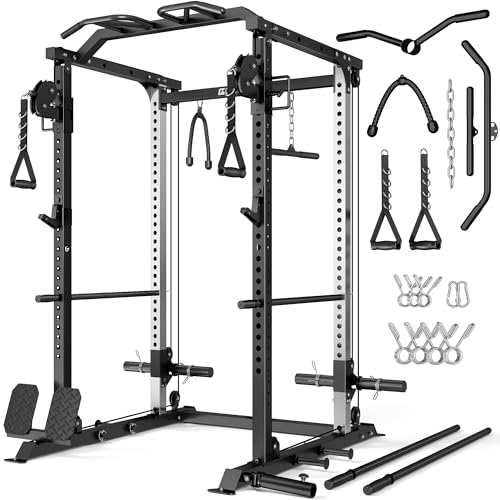
- Dual independent pulley system for unilateral training
- 31 cable height options for precise adjustments
- Compact 17.88 sq ft footprint
- 2000 lb heavy-duty steel construction
Trade-offs
- 84.2-inch height requires a tall ceiling clearance
- 2×2-inch steel is less rigid than 3×3-inch uprights on some rivals
With a 2000-pound weight capacity packed into just 17.88 square feet, this cage proves you don’t need a warehouse to train like one. The dual independent pulley system lets you work each arm separately, handy for fixing muscle imbalances or rehabbing an old shoulder injury without having to skip your partner’s workout. Thirty-one cable height choices and 29 J-hook positions (spaced an inch apart) mean you can dial in everything from lat pulldowns to bench presses without fighting a clunky adjustment. It’s the kind of setup that makes you wonder why more compact racks don’t offer this much versatility.
The small footprint shows up in the interior space: 47.64 inches is enough for most pressing movements, but if you’re over six feet tall or like a wide grip on bench, you might feel a little boxed in. For someone squeezing a full gym into an apartment corner or garage nook, this rack’s cable crossover capability and rock-solid frame make it a smart, space-conscious pick.
FLYBIRD SR1 Squat Rack
What We Like
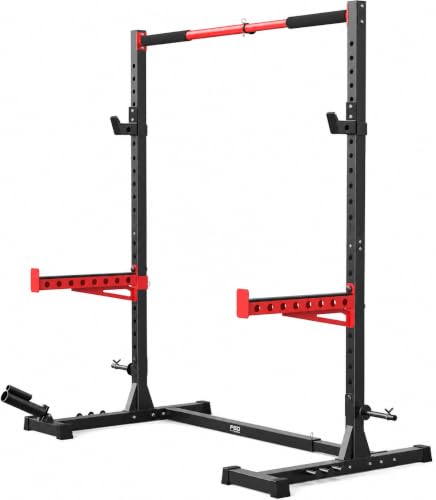
- 22 precision height settings for versatile lifts
- Adjustable width fits 6 and 7 ft barbells
- Includes landmine attachment and band pegs
- Extended 16.7" safety arms for solo training
Trade-offs
- 950 lb capacity is lower than many full cages
- No pulley system for cable exercises
- Compact footprint limits attachment space
With 22 precision height adjustments and 1-inch hole spacing, you can dial in the perfect J-hook and safety arm position for squats, bench presses, or shoulder presses without guesswork. That kind of fine-tuning matters when you’re training alone and need the safeties to catch the bar exactly where you want it. The adjustable width design also means this half rack works with both 6-foot and 7-foot barbells, so you aren’t locked into one bar size. It’s a smart fit for anyone building a home gym in a garage or basement who wants a stable, space-conscious rack that doesn’t sacrifice adjustability.
The 950-pound capacity, while plenty for most home lifters, falls short of the 2000-pound ratings you’ll see on full cages like the Goimu C1-V4. You also won’t get a built-in pulley system for cable rows or lat pulldowns, so if those are core to your routine, you might feel limited. But if a compact, adjustable half rack that includes a landmine attachment, band pegs, and a foam-padded pull-up bar out of the box is what you need, the FLYBIRD SR1 delivers a lot of versatility in a small footprint without overcomplicating assembly.
JELENS S11 Power Cage

What We Like
- 2000 lb capacity from 50mm steel tubing
- Smooth pulley system with precision steel shaft
- 13 laser-marked height adjustments for quick setup
- Compact 12.5 sq ft footprint
Trade-offs
- 44.5 inch width limits very wide stances
- Pulley system adds assembly complexity
A 2000-pound safe weight capacity from 50mm heavy-duty steel tubing means this cage can handle heavy squat and bench loads as you get stronger. The smooth pulley system with precision steel shaft supports lat pulldowns and cable work. The included attachments, lat pull-down bar, cable bar, T-bar, landmine, J-hooks, and safety rods, cover a range of upper and lower body exercises. It also fits into 12.5 square feet, which helps if your workout space is limited.
The JELENS S11 Power Cage covers just 12.5 square feet, so it fits comfortably in a spare bedroom or corner of a garage without dominating the space. Its 44.5-inch width is narrower than the MAJOR FITNESS Drone1’s 63.4-inch frame, which means you trade some open-floor room for a compact layout. The 82.6-inch height works in most standard rooms, but owners with low rafters should check their clearance before buying. For someone who wants a full set of training options in a small footprint, this rack delivers a lot of function without hogging the floor.
Product photos
Mikolo K6 Power Cage

What We Like
- 8-in-1 design with cable crossover included
- 230 lb rubber weight set and bench bundled
- In-cage safety for squats and bench press
- Upgraded pulley system with roller sleeves
Trade-offs
- 67.5-inch length needs generous floor space
- 230 lb unit is heavy to move after assembly
An 8-in-1 home gym package combines a power rack, cable crossover machine, lat pulldown station, low row station with footplate attachment, chin-up station, dip station, core trainer, and resistance station into one unit. This setup allows unlimited exercises within a limited floor area. The true cage design provides an interior measuring 41 by 60 inches, deep enough to accommodate almost any weight bench. Working inside the frame offers better safety for beginners compared to free weights, with the cage catching a failed rep instead of your body.
The trade-off for all that versatility is floor space. At 67.5 inches long and 56.5 inches wide, this cage requires a dedicated area. The unit weighs 230 pounds, so moving it after assembly is not easy. But if you have the space and want one machine that covers free weights, cables, and bodyweight moves without buying add-ons later, the K6 delivers a complete setup that simpler racks cannot match.
Product photos
MAJOR FITNESS F22 Power Rack

What We Like
- Dual pulley system for two users
- Compact footprint replaces three machines
- 1600 lb static weight capacity
- No bolting needed for stability
Trade-offs
- 243 lb weight makes assembly a two-person job
- 14-gauge steel lighter than some 11-gauge racks
- 2:1 pulley ratio feels lighter than 1:1
With a 1600-pound static weight capacity, this rack is built to handle heavy squats and deadlifts without the frame warping or flexing under max loads, according to the manufacturer. The 14-gauge steel frame uses a dual-triangle base design that keeps the rack planted on the floor without bolting it down. You can set it up in a garage or basement without drilling holes. The independent dual-pulley system with a 2:1 ratio allows two people to train at once without cable interference, making it a space-saving solution for home gyms that want a squat rack, cable crossover, and lat pulldown station in one compact footprint.
At 243 pounds, this rack is heavy enough that you will want a second person to help with assembly and moving it into place. The 14-gauge steel is solid for most home lifters, though some may prefer thicker steel for extreme heavy lifting. The manufacturer states the frame won’t warp or flex under max-load squats, deadlifts, or heavy rack pulls. For anyone who wants a complete cable-crossover setup in a rack that fits a standard home gym space, this is a practical, well-engineered choice.
Product photos
SPORTSROYALS Power Cage with LAT Pulldown
What We Like
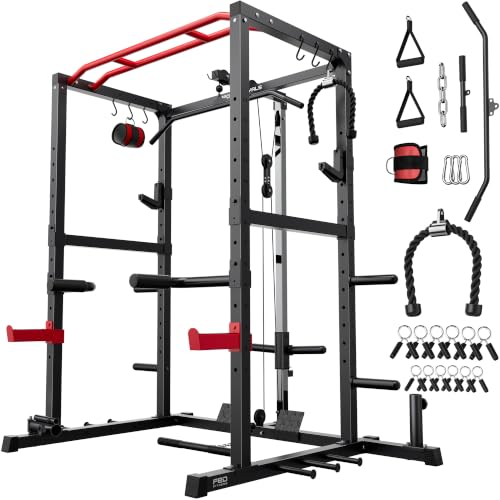
- 1200 lb frame capacity for heavy lifting
- Includes lat pulldown and cable row system
- Reinforcing tabs improve stability during use
Trade-offs
- Requires 2-3 people for assembly
- 150-pound unit is heavy to move alone.
A 1200-pound frame capacity in a cage that also packs a lat pulldown and cable row system means you can squat, bench, and do pull-downs without buying separate machines or worrying about the rack wobbling under heavy loads. The included attachments, dip bars, landmine, tricep rope, ankle strap, and more, cover a wide range of exercises right out of the box. This cage is designed for someone setting up a garage or spare-room gym who wants serious versatility from a single machine.
This cage is heavy enough to stay put on rubber mats but light enough (150 pounds) that on carpet or smooth concrete, you might want to bolt it down for total peace of mind during heavy squats. If you have the room and want one machine that does squats, rows, and lat work without swapping gear, this is a practical way to get there.
Product photos
How We Evaluated Home Gym Racks
Our evaluation started with manufacturer specifications for weight capacity, frame dimensions, and steel gauge. We then cross-referenced these numbers against patterns in owner feedback to understand how each rack performs in real home gyms. Expert round-ups from strength training communities helped us identify which features matter most for different training styles.
The four criteria that mattered most were weight capacity, footprint and ceiling clearance, included attachments and cable systems, and frame construction quality. A rack with a 1000 lb capacity but thin 14-gauge steel might not last as long as a 2000 lb rack with 11-gauge steel, even if your lifts never approach either limit.
A research-led evaluation has limits: we cannot replicate years of daily use in a single review cycle. Owner feedback patterns over months and years give the best picture of long-term durability and real-world assembly headaches.
What To Look For In Home Gym Racks
Choosing a home gym rack comes down to matching three things: your ceiling height, your heaviest lift, and the floor space you can spare. Start with those numbers, then look at features.
Match your rack to your ceiling height, heaviest lift, and available floor space before comparing attachments or cable systems.
Weight Capacity and Steel Gauge
The rack’s stated weight capacity tells you its safety margin for squats, bench press, and pull-ups. A rack that can hold one thousand pounds handles most home lifters, but the steel gauge matters just as much. Thicker 11-gauge steel resists wobble better than 14-gauge, especially during explosive lifts or when reracking unevenly. The uprights’ steel tube dimensions (2×2 inch vs 3×3 inch) also affect stability.
Ceiling Clearance and Footprint
Measure your ceiling height before buying any rack. An 83-inch rack needs enough clearance for the pull-up bar, while some folding racks require less overhead space. Floor footprint matters for both daily use and storage. Compact cages fit in spare bedrooms, while all-in-one stations with weight stacks need more space. Folding power racks solve space problems by mounting to the wall and folding flat.
Cable Systems and Attachments
A rack with a built-in cable pulley system replaces several standalone machines. The pulley ratio matters: a 1:1 ratio gives direct resistance matching the weight stack, while a 2:1 ratio halves the feel of each plate. Racks with cables let you do lat pulldowns, cable rows, and tricep pushdowns without leaving the cage. For lifters who want maximum attachment options, power rack attachments like dip handles, landmine posts, and band pegs expand your exercise library significantly.
- Measure ceiling height and floor space before shopping
- Compare steel gauge (11-gauge is thicker than 14-gauge)
- Check pulley ratio for cable systems (1:1 feels heavier than 2:1)
- Look at included attachments versus buying separately
- Read assembly instructions for two-person requirements
A rack with 1,000 lb capacity and 11-gauge steel serves most home lifters for years without needing an upgrade.
Home Gym Racks Compared
The table below compares each rack’s capacity, dimensions, and key features to help you narrow your choice.
| Product | Max Load | Frame Height | Footprint (L x W) | Steel Specs |
|---|---|---|---|---|
| YOLEO Squat Rack with Pull-Up Bar | 1000 lbs | 83 inches | 83.0 x 67.0 inches | N/A |
| Goimu C1-V4 Power Cage | 2000 lbs | 83.5 inches | 57.6 x 44.7 inches | 2×2 in alloy steel |
| MAJOR FITNESS Drone1 Power Cage | 1500 lbs | 85 inches | 65.9 x 63.4 inches | 2" × 2" 14-gauge |
| Titan Fitness T-3 Folding Power Rack | 1000 lb | 82 inches | N/A | 11-gauge 2×3 |
| Goimu DP01 Power Cage | 2000 lbs | 84.2 inches | 57.9 x 46.5 inches | 2"x2" steel tubing |
| FLYBIRD SR1 Squat Rack | 950 lbs | 83 inches | 42.0 x 51.0 inches | 2" x 2" commercial-grade |
| JELENS S11 Power Cage | 2000 lbs | 82.6 inches | 57.5 x 44.5 inches | 50mm x 50mm |
| Mikolo K6 Power Cage | N/A | 86.4 inches | 67.5 x 56.5 inches | N/A |
| MAJOR FITNESS F22 Power Rack | 1600 lb static | 82.5 inches | 68.9 x 55.5 inches | 14-gauge (0.08 in thick) |
| SPORTSROYALS Power Cage with LAT Pulldown | 1200 lb | 82.6 inches | 56.0 x 82.6 inches | 50×50mm steel, 1.5mm thick |
Frequently Asked Questions
What is the difference between a power rack and a squat rack?
A power rack (or power cage) has four uprights with safety bars that catch the barbell during failed lifts, plus a pull-up bar on top. A squat rack typically has two uprights and no safety arms, requiring a spotter or bail-out technique. Power rack vs squat rack comparisons show that power cages are safer for solo lifting.
How much weight capacity do I need for a home gym rack?
Most home lifters need enough capacity for squats and bench press combined. A rack that can hold one thousand pounds provides a comfortable safety margin for intermediate lifters, while racks that can hold two thousand pounds suit advanced powerlifters. Your body weight plus the heaviest barbell weight you plan to lift determines the minimum.
Can I install a power rack in a room with low ceilings?
Yes, but you need to measure carefully. Standard racks are 83 to 84 inches tall, requiring enough clearance for pull-ups. Folding power racks and half racks often have lower profiles that fit rooms with 7-foot ceilings. Always check the assembled height before purchasing.
What attachments should I get for my home gym rack?
Essential attachments include a dip bar attachment, landmine post, and band pegs for resistance bands. A cable pulley system adds lat pulldowns and cable rows. Best attachments for power racks include J-hooks with urethane coating, safety straps instead of solid pins, and multi-grip pull-up bars.
Do I need to bolt a power rack to the floor?
Not always. Heavier racks with wide bases often stay stable without bolting, especially when weight plates are stored on the rack’s built-in storage. Lighter or folding power racks require wall mounting for safety. If you plan to do explosive lifts or kipping pull-ups, bolting to the floor or a platform adds stability.
The Bottom Line
The YOLEO Squat Rack with Pull-Up Bar is the best overall choice for home lifters who want a stable, high-capacity rack for heavy squats and pull-ups without needing cable attachments. Its 1000 lb capacity and built-in plate storage make it a straightforward upgrade from a basic squat stand.
If you need an all-in-one solution with cables, the Goimu C1-V4 Power Cage offers over 30 attachments and a 1:1 pulley ratio for direct resistance. Budget-conscious buyers should consider the JELENS S11 Power Cage, which delivers a 2000 lb capacity and pulley system at an affordable price point.
The single most important factor when buying a home gym rack is ceiling height, measure it before comparing any other feature. A rack that fits your room safely will serve you for years; one that doesn’t will sit unused.
