
10 Best Medicine Balls for Every Budget in 2026
This post contains affiliate links. As an Amazon Associate, we earn from qualifying purchases.
The best medicine ball is the Amazon Basics Heavy-Duty Slam Medicine Ball. It combines a sand-filled, no-bounce core with a textured, non-slip grip that handles everything from HIIT slams to controlled core work. For athletes who prioritize grip security, the ProsourceFit Slam Medicine Ball is a top alternative, while the REP Weighted Slam Ball offers the widest weight range for progressive training.
Finding the right medicine ball means balancing durability, weight options, and surface feel. A ball that bounces unpredictably can disrupt a workout, while one that is too heavy or too light limits your exercise variety. The sweet spot is a ball that absorbs impact, stays comfortable in your hands, and matches your current strength level.
This guide is based on specifications, manufacturer documentation, expert round-ups, and patterns in owner feedback to identify the ten best medicine balls. We focused on construction quality, weight availability, grip texture, and intended use to help you choose confidently.
Top 10 Medicine Balls in the Market
Certain content that appears on this site comes from Amazon. This content is provided "as is" and is subject to change or removal at any time.
The Best Medicine Balls, Research-Based Review
Amazon Basics Heavy-Duty Slam Medicine Ball

What We Like
- Heavy-duty PVC absorbs powerful impacts
- Sand-filled core prevents unwanted bouncing
- Textured non-slip grip stays secure when sweaty
- Balanced weight suits controlled and dynamic moves
Trade-offs
- PVC surface can feel firm on bare floors
- Fixed 15-pound weight limits progression for heavier slammers
A 15-pound dead-weight design with a sand-filled core means this ball thuds on impact instead of bouncing back at your shins. That controlled landing makes it a natural pick for slam drills, core rotations, and explosive throws where you want the ball to stay put after the hit. The textured PVC grip gives you confidence even when your palms get slick, so you can focus on power output rather than readjusting your hold. It suits anyone building a home gym on a sensible budget, especially if CrossFit-style conditioning or HIIT circuits are on the menu. The balanced weight distribution also keeps the ball predictable during overhead passes and wall-ball-style work, which is a nice bonus for a slam-focused tool.
At 15 pounds, this ball is a fixed weight, so if you’re already slamming heavier loads at the gym, it won’t match your current training. The ProsourceFit Slam Medicine Ball also comes in 15 pounds with a treaded grip, putting both in the same weight class. For someone starting or returning to ball work, fifteen pounds is a common entry point that works for a range of exercises. Just know that if progressive overload is your goal with a single ball, you may need to step up to a heavier option later.
Product photos
ProsourceFit Slam Medicine Ball

What We Like
- Non-slip tire tread grip
- Durable PVC rubber shell
- Sand-filled design minimizes bounce
Trade-offs
- At 9 inches diameter, feels compact for throws
- Sand fill shifts, requiring constant muscle engagement
A 15-pound sand-filled ball with a tire-tread textured surface gives you a secure hold when your hands get slick during slams or presses. The deadweight design minimizes bouncing or rolling, which lets you do explosive movements without chasing the ball across the floor. That shifting sand inside forces your core and stabilizers to work harder on every catch and lift. Reviewers note the textured grip feels especially reassuring during overhead throws and wall-ball drills, where a slippery ball could lead to a missed catch or strained wrist. For anyone new to slam-ball training, starting around 10 to 15 pounds helps build proper mechanics before moving up.
The trade-off is that the sand fill shifts as you move, forcing your core and stabilizers to work harder to keep the ball steady. That’s great for building control but less ideal if you want a predictable, uniform weight for catch-and-throw drills. Compared to the Amazon Basics Heavy-Duty Slam Medicine Ball, which has a longer, narrower shape, the ProsourceFit’s compact 9-inch diameter offers a different feel for overhead slams and catching.
Product photos
REP Weighted Slam Ball

What We Like
- Multiple weight options from 5 to 30 lb
- Soft textured surface for secure grip
- No-bounce sand-filled core for safety
- Built for high-impact slam exercises
Trade-offs
- No weight option above 30 lb for advanced users
The REP Weighted Slam Ball comes in weights from 5 to 30 lb, so you can pick the load that matches your current training level. Its sand-filled core is designed to minimize bounce and roll after each slam, which keeps the ball in place for safer workouts in tight spaces. The soft, textured rubber shell provides a grippy surface for control during high-speed movements. This ball is built for explosive full-body exercises like slams, tosses, and throws, making it suitable for strength training, CrossFit, and conditioning programs.
If you need a ball heavier than 30 lb for advanced plyometric work, this model does not offer that option. Compared to the Titan Fitness 25 lb Rubber Slam Ball, the REP provides multiple lighter weight choices for gradual progression, while the Titan is a single heavy weight. For home gym users who want flexibility across different exercises and fitness levels, the range of sizes makes this a versatile option.
Product photos
Retrospec Core Medicine Ball

What We Like
- Textured vegan leather prevents slipping
- Cushioned feel protects hands
- Maintains shape through repeated impact
Trade-offs
- Not intended for slam exercises
The 6-pound ball’s textured vegan leather surface gives you a slip-resistant grip that protects your hands during use. It’s designed for strength training, balance work, and recovery moves where you want a secure hold. That makes it a practical choice for controlled full-body routines.
This ball is not intended for slamming, so if your workouts rely on explosive floor drops, you will want a dedicated slam ball like the ProsourceFit Slam Medicine Ball instead. But for exercises like core passes and wall throws, the Retrospec’s textured vegan leather and shape-retaining fill deliver consistent performance without the rough feel of rubber. It is a comfortable option for controlled movement, not for high-impact slamming.
Mikolo Medicine Ball Set
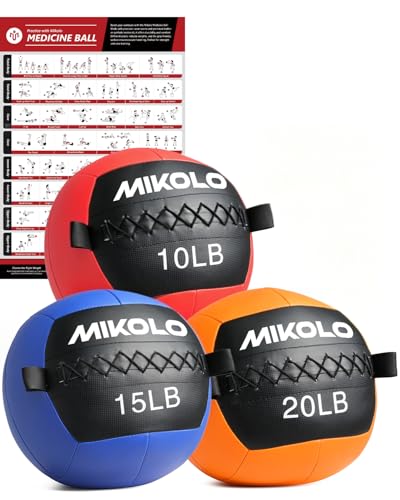
What We Like
- Wide nylon finger loops for secure grip
- Double-layer leak-proof exterior resists sweat
- Zero shifting from double-layer Oxford cloth seals
- Includes wall-mountable workout chart
Trade-offs
- Set includes only three fixed weight options
- No single ball under 10 pounds for lighter training
The 36mm-wide finger loops with an 80cm circumference give you a grip that feels more like a handle than a strap, which makes dynamic lifts, tosses, and slams noticeably more stable. That design choice sets this Mikolo set apart for anyone who wants to move fast without losing control mid-motion. It suits beginners and athletes alike because the dual-layer PVC and mesh fabric exterior keeps sweat from turning the ball slippery, and the wall-mountable workout chart takes the guesswork out of planning your session.
Three fixed weights come in this kit instead of a single ball you can load up incrementally. If you prefer to micro-load or need just one heavy ball, a standalone option like the REP Weighted Slam Ball might fit better. For most home gym setups, though, the loop design and included variety make this a practical, ready-to-use kit.
Product photos
RitFit Weighted Medicine Ball

What We Like
- Ten weight options from 2 to 20 lbs
- Non-slip rubber shell with textured grip
- Improves coordination and balance
- Eco-friendly rubber construction
Trade-offs
- No slam or dead-bounce design for high-impact throws
- Not designed for slam or high-impact throws
With ten weight options from 2 to 20 lbs, this ball lets you start light and build up gradually as your balance and core control improve. The basketball-like textured surface gives you a confident grip during moves like medicine ball burpees or overhead swings. If you are working on coordination and want a ball that grows with your progress rather than forcing you to buy a new one every few weeks, this design makes steady sense.
This ball is not built for slamming. The RitFit’s sturdy rubber shell is better suited for controlled exercises like squats, lunges, and core twists. That makes it a focused tool rather than a do-everything ball, but for someone prioritizing balance work over explosive slams, the trade-off is worth it.
ZELUS Medicine Ball with Dual Grip

What We Like
- Eco-friendly rubber, harmless to health
- Dual anti-skid grips for secure hold
- Leak-proof air valve extends ball life
- Heavy-duty shell resists wear and tear
Trade-offs
- Only two weight options limit progression
- No textured surface for slam exercises
The ZELUS Medicine Ball uses eco-friendly, odorless rubber that is 100% harmless to you and your family. Its dual anti-skid grips let you hold on firmly during core work or dynamic movements, and the heavy-duty shell stands up to tough workouts without falling apart. This ball is ideal for anyone who wants a safe, sustainable option for home gyms or outdoor training, especially if you value materials that won’t off-gas or irritate sensitive noses.
You get two weight choices, 10 lb and 20 lb, so if you need a middle ground or plan to progress in smaller steps, you might outgrow it quickly. The REP Weighted Slam Ball offers a 10 lb option with a soft textured surface, but the ZELUS uses a rubber shell that resists wear and tear. For lifters who prioritize grip security and durability, this ball delivers a reliable workout without the chemical smell.
Product photos
YOTTOY Medicine Ball
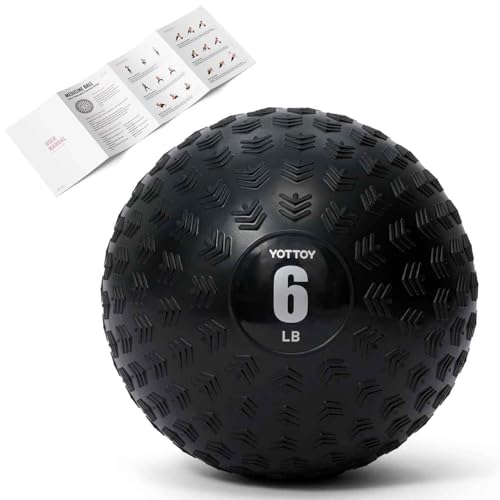
What We Like
- Non-bouncing sand fill for controlled slams
- Raised anti-slip texture for sweaty hands
- 7-inch diameter suits smaller hands
- Durable PVC shell handles repeated impacts
Trade-offs
- Only available up to 15 lb for heavier training
- No color options besides black
A 7-inch diameter and sand fill make this ball easy to grip and control, even when your hands get sweaty. That raised anti-slip texture means you can concentrate on the movement, overhead lunges, Russian twists, ball slams, without worrying about it slipping out of your hands. The non-bouncing design makes it suitable for outdoor use since you won’t need to worry about it bouncing unpredictably on uneven surfaces. The PVC shell is built to take repeated slams, so you can use it indoors or out without babying it.
The weight range tops out at 15 lb, which may not suit those who need heavier resistance for advanced training. For comparison, the Titan Fitness 25 lb Rubber Slam Ball offers a heavier option. But for someone working with the available weights, the YOTTOY’s manageable size and non-bouncing sand core keep things controlled. It’s a straightforward way to add full-body conditioning to your routine.
CAP Barbell Rubber Medicine Ball

What We Like
- Tacky rubber surface for non-slip grip
- Lightest 2-pound option for absolute beginners
- Multiple weight choices up to 12 pounds
- Works for rehab, balance, and coordination drills
Trade-offs
- At 2 pounds, too light for slams or power work
- No bounce absorption for high-impact slam exercises
A 2-pound medicine ball is the lightest option in CAP Barbell’s rubber medicine ball line, which runs from 2 up to 12 pounds. The tacky rubber surface provides a non-slip grip, which helps you do controlled movements without worrying about the ball slipping. Because it’s only 2 pounds, it’s suited for low-impact exercises like balance and coordination drills, not for explosive slams or power work. Reviewers find it a practical starting point for building familiarity with medicine ball training before moving to heavier weights.
At 2 pounds, this ball is designed for controlled, low-impact movement rather than slam-and-bounce intensity. The 7.5-inch length and 7-inch width make it compact for single-hand use, but it may feel small for two-hand catches during partner passes. That’s not a flaw, it’s a design for rehabilitation therapy and balance exercises. If your goal is to ease into medicine ball training with a lightweight option, this ball offers a safe entry point.
Product photos
Titan Fitness Rubber Slam Ball
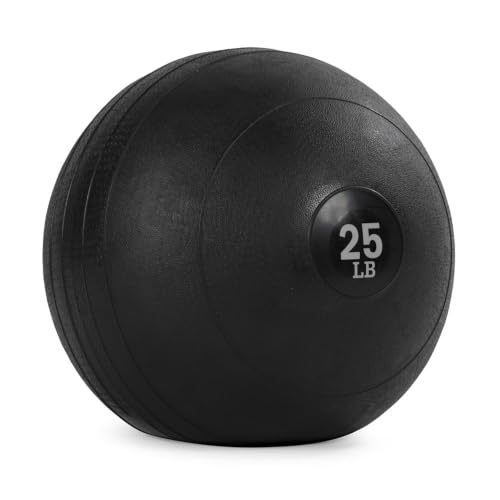
What We Like
- Textured grip for sweaty hands
- Minimal bounce absorbs impact
- Full-body movement versatility
- Available from 10 to 60 lb
Trade-offs
- Dead weight design lacks dynamic rebound
- 12-inch diameter feels large for small hands
A 25-pound dead weight ball with a textured rubberized shell means you can slam it into the ground without worrying about wild bounces or losing your grip mid-rep. That makes this Titan Fitness ball a natural fit for explosive power work like ball slams, squat throws, and overhead lunges where control matters more than rebound. It targets the full chain, forearms, glutes, quads, shoulders, hamstrings, abs, so you get a metabolic conditioning punch alongside strength building. If your routine leans toward CrossFit, HIIT, or any session where you want to move heavy and fast, this ball is built to take that abuse.
The Titan Fitness 25 LB Rubber Slam Ball uses a dead weight design that won’t bounce back to you during dynamic drills, so catch-and-throw rhythms feel different than with a softer medicine ball. The ProsourceFit Slam Medicine Ball weighs 15 pounds and has a treaded texture, while this Titan model is 25 pounds with a 12-inch diameter, making it a heavier option for strength-focused workouts. Reviewers note the textured rubberized shell keeps a steady grip even when hands sweat, which helps during intense sets.
How We Evaluated Medicine Balls
We began by reviewing the specifications and build materials of dozens of medicine balls, focusing on the construction that determines durability and bounce behavior. Sand-filled cores and heavy-duty PVC or rubber shells consistently rated higher in owner feedback for impact absorption and longevity. We also examined weight ranges to ensure options for both beginners and advanced athletes.
Our criteria centered on four factors. First, construction and bounce control: a sand-filled or dead-weight design prevents dangerous rebounds during slams. Second, grip and surface texture: textured rubber or leather surfaces reduce slippage when hands get sweaty. Third, weight availability: a wider range of options allows for progressive overload. Fourth, intended use compatibility: not every ball is designed for slams, and matching the ball to your workout style prevents premature wear.
A research-led evaluation has limits. We have synthesized patterns from verified owner reports and expert round-ups to give you a reliable starting point. For a broader look at options, you can explore our comprehensive medicine ball guide.
What To Look For In Medicine Balls
Choosing a medicine ball means understanding how its core, shell, and weight options align with your training goals. The right ball absorbs impact, stays grippy, and lets you progress without buying a new one every few months.
A medicine ball should have a sand-filled or dead-weight core to minimize bounce, a textured non-slip surface, and a weight that challenges you without compromising form. Match the ball to your primary exercises, slams, throws, or core work, to get the most from your purchase.
Core Type and Bounce Control
The core determines how a ball behaves on impact. Sand-filled cores are standard for slam exercises because they absorb energy and prevent the ball from bouncing back toward your face or shins. Some balls use a rubber or foam-filled core that still bounces, which is useful for wall-ball drills but dangerous for slams. If your workouts include overhead or floor slams, prioritize a dead-weight or sand-filled design.
Grip and Surface Material
Grip is critical when your hands get sweaty. Textured PVC, rubber with raised patterns, or vegan leather all offer better traction than smooth surfaces. The ProsourceFit Slam Medicine Ball uses a tire-tread pattern that many owners find especially secure. For exercises like rotational throws or Russian twists, a surface that resists slipping lets you focus on the movement rather than holding on.
Weight Range and Progression
A good medicine ball should offer enough weight options to let you progress without replacing the ball too soon. Beginners often start around six to ten pounds, while intermediate users may need fifteen to twenty pounds. The REP Weighted Slam Ball covers five to thirty pounds, making it a strong choice for those who plan to increase intensity. If you need heavier loads for power training, the Titan Fitness Rubber Slam Ball goes up to sixty pounds.
- Check the ball’s diameter: smaller diameters (7 to 9 inches) suit smaller hands or throws, while larger ones (12 to 14 inches) require more grip strength.
- Look for a leak-proof air valve on rubber balls to maintain shape over time.
- Confirm the ball is designed for your primary exercise: slam balls are not always ideal for wall-ball throws, and vice versa.
- Consider the floor surface: a PVC ball on hardwood may scuff, while rubber is gentler.
A good rule of thumb: buy a ball that is 5 to 10 percent of your body weight for slams and throws, and 10 to 15 percent for core work.
Medicine Balls Compared
The table below compares the key specs of our top ten medicine balls, helping you see at a glance which one fits your training style.
| Product | Weight | Material | Surface/Grip |
|---|---|---|---|
| Amazon Basics Heavy-Duty Slam Medicine Ball | 15 lb | Heavy-duty PVC, sand-filled core | Textured non-slip |
| ProsourceFit Slam Medicine Ball | 15 lb | PVC rubber shell | Tire tread textured |
| REP Weighted Slam Ball | 10 lb | Sand-filled | Soft, textured rubber |
| Retrospec Core Medicine Ball | 6 lb | Vegan leather | Textured, slip-resistant |
| Mikolo Medicine Ball Set | 10/15/20LB | PVC + mesh fabric | Finger loops |
| RitFit Weighted Medicine Ball | 4 lb | Eco-friendly rubber | Basketball-like grip |
| ZELUS Medicine Ball with Dual Grip | 10 lb | Eco-friendly odorless rubber | Dual anti-skid grips |
| YOTTOY Medicine Ball | 6 lb | PVC | Raised anti-slip grip |
| CAP Barbell Rubber Medicine Ball | 2 lb | Rubber | Tacky surface |
| Titan Fitness Rubber Slam Ball | 25 lb | Textured rubberized shell | Textured |
Frequently Asked Questions
What is the best medicine ball for slams?
The Amazon Basics Heavy-Duty Slam Medicine Ball is the best choice for slams. Its sand-filled core absorbs impact with minimal bounce, and the textured PVC grip stays secure during high-intensity moves. For more options designed specifically for slams, see our guide to medicine balls for slams.
How much should a medicine ball weigh?
Choose a weight that allows you to maintain good form through the full range of motion. For slams and throws, a ball that is 5 to 10 percent of your body weight is a common starting point. For core exercises and rotational work, 10 to 15 percent works well. Beginners should start lighter and focus on control.
Can I use a medicine ball for wall-ball exercises?
Only if the ball is designed to bounce. Sand-filled slam balls absorb impact and will not rebound off a wall, making them unsuitable for wall-ball drills. Look for a ball with a rubber or foam core if you plan to do wall-ball shots. Our guide to bouncing medicine balls covers these options.
What is the difference between a slam ball and a medicine ball?
A slam ball is typically sand-filled with a durable PVC shell designed to absorb high-impact slams without bouncing. A traditional medicine ball often has a rubber or leather surface and may bounce, making it better for throws, core work, and catching drills. Some balls cross over, but most manufacturers specify the intended use.
How do I care for a medicine ball?
Store your medicine ball in a cool, dry place away from direct sunlight to prevent the shell from cracking. Wipe it down after sweaty workouts with a damp cloth. Avoid dropping it on rough concrete or sharp edges. Check the air valve periodically on inflatable models to ensure the ball maintains its shape.
The Bottom Line
The Amazon Basics Heavy-Duty Slam Medicine Ball is the best overall pick for most home gym owners. It delivers a no-bounce, impact-absorbing design that suits HIIT, CrossFit-style workouts, and controlled core training. The textured grip holds up when things get sweaty, and the fixed 15-pound weight is a solid starting point for intermediate users.
If you need a wider weight range, the REP Weighted Slam Ball offers options from 5 to 30 pounds, making it ideal for progressive training. Budget-conscious shoppers should consider the YOTTOY Medicine Ball, which provides a compact, non-bouncing slam ball at an affordable price. Athletes focused on grip security will appreciate the ProsourceFit Slam Medicine Ball and its tire-tread surface.
The single most important factor when buying a medicine ball is matching the core type to your workout. A sand-filled, dead-weight ball keeps you safe during slams, while a bouncing ball is necessary for wall-ball drills. Choose based on your primary exercises, and you will get years of reliable use.
