
10 Best Pulley Systems For Home Gym in 2026
This post contains affiliate links. As an Amazon Associate, we earn from qualifying purchases.
The Goimu WM1 Wall Mount Cable Station is our Best Overall pick because it packs 17 adjustable pulley heights and switchable resistance ratios into a tiny 3.12 sq ft footprint. For those who want a weight stack instead of plates, the Goimu WM2-V4 Cable Station with Weight Stack is our Best With Weight Stack pick. And if floor space is your biggest concern, the Mikolo Wall Mount Cable Crossover Machine takes the Best Space-Saving Design award.
A pulley system for home gym use solves a real problem: how to get cable crossover, lat pulldown, and row movements without dedicating half your garage to a commercial machine. The key questions are whether you have a concrete wall to mount to, whether you already own weight plates, and how much resistance you realistically need.
This guide is research-based, pulling from manufacturer specifications, expert round-ups, and patterns in owner feedback across dozens of home gym pulley systems. We break down what to look for, compare ten top options, and help you match a system to your space, budget, and training style.
Top 10 Pulley Systems For Home Gym in the Market
Certain content that appears on this site comes from Amazon. This content is provided "as is" and is subject to change or removal at any time.
The Best Pulley Systems For Home Gym, Reviewed
Goimu WM1 Wall Mount Cable Station

What We Like
- 17 adjustable pulley heights
- Switchable 1:1 and 2:1 resistance ratios
- Compact 3.12 sq ft footprint
Trade-offs
- Requires concrete or masonry wall mounting
- No included weight plates or weight stack
- Only 17 positions vs. 19 on some competitors
With a footprint of just 3.12 square feet, this wall-mounted station fits into a garage corner or against an apartment wall without hogging floor space. Yet its 17 pulley height settings let you do everything from overhead lat pulldowns to low rows. The dual-pulley design includes a cable adaptor that switches between a 1:1 ratio for heavy compound lifts and a 2:1 ratio for lighter endurance sets or drop supersets. For someone building a home gym on a budget who wants a full cable setup without the footprint of a freestanding cage, this is a versatile space-saver among the options in this guide.
You will need to mount it into concrete or masonry (no drywall-friendly install), and unlike the Mikolo wall mount with 19 positions, you get 17 here. That is still plenty for most exercises, but it is a slight reach compromise for very tall users doing flyes at extreme angles. Also, since it’s plate-loaded, you’ll need to buy your own weight plates separately, which adds an upfront cost that the Goimu WM2-V4 with its built-in weight stack avoids. If you already own plates and don’t mind a weekend drill job, this is the smartest way to get a pro-style cable station without the pro price tag.
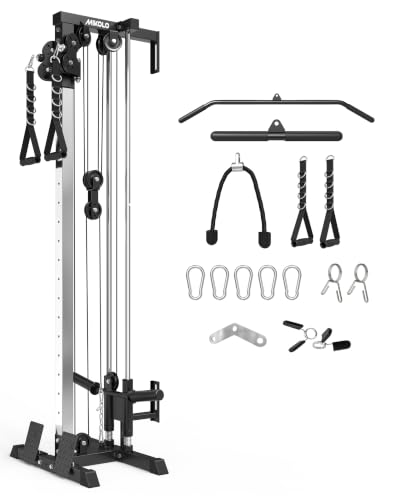
Mikolo Wall Mount Cable Crossover Machine
What We Like
- Compact corner-mount design saves floor space
- 19 adjustable pulley positions for varied exercises
- Includes lat bar, cable bar, and tricep rope
Trade-offs
- Requires wall mounting, not freestanding
- Plate-loaded only; no built-in weight stack
You need a sturdy wall and at least 82 inches of ceiling height for installation. Because it is plate-loaded rather than having a built-in weight stack, you must supply your own plates. Compared to the Goimu WM2-V4, which has 33 adjustable positions and a 155-pound weight stack, the Mikolo has fewer adjustment points and requires manual plate changes. However, if you already own plates and don’t mind a short pause between exercises, this unit delivers the core cable-crossover functions in a more compact package.
Product photos
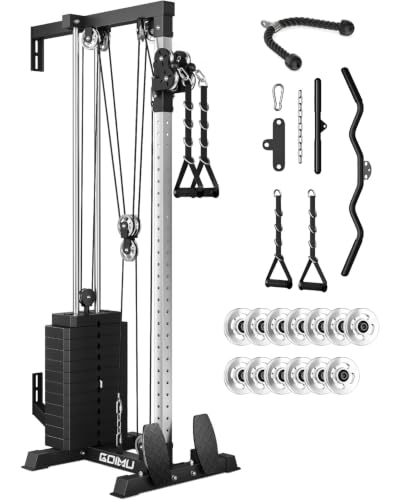
Goimu WM2-V4 Cable Station with Weight Stack
What We Like
- Selectorized weight stack eliminates plate changes
- 33 adjustable positions for versatile angles
- Aluminum pulleys for smooth, durable glide
- Wall-mounted design saves floor space
Trade-offs
- Wall mounting required, not freestanding
- Wall anchor must support over 155 lbs.
A 155-pound selectorized weight stack means you can switch resistance between sets with a pin pull instead of fumbling with plates, which keeps rest short and focus sharp. That alone makes this machine a standout for anyone who values flow over fiddling. Combined with 33 adjustable pulley positions and aluminum pulleys that glide like a commercial gym’s, it delivers the kind of smooth, varied cable work that typically demands twice the footprint. This is for the home gym owner who wants real weight stack convenience without dedicating a whole room to a functional trainer.
One catch is that 155 pounds, even with the plate-loading pin that accepts 1-inch and 2-inch plates, might feel light for advanced lifters on big compound pulls. The included 2:1 cable adapter lets you switch to a 1:1 ratio for heavier work, giving you more resistance when needed. If steady progression and convenience matter more than maxing out, this is your pick.
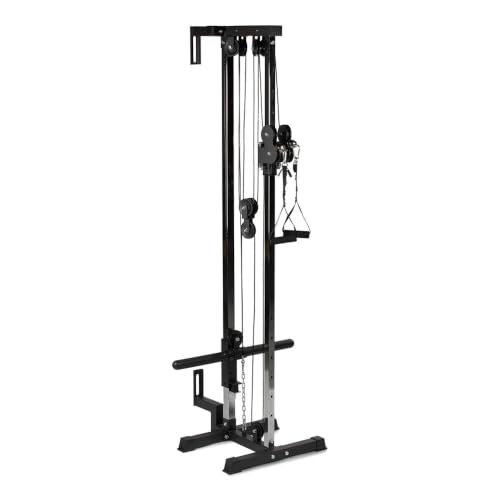
Titan Fitness Wall Mounted Pulley Tower
What We Like
- 350 lb capacity for serious loading
- 18 adjustable trolley positions for angles
- Dual D-handles with 2:1 and 1:1 ratios
- Includes Olympic adapter sleeves
Trade-offs
- Mounting hardware not included
- Requires wall or rack installation
- 70 lb unit needs sturdy mounting surface
With a 350-pound plate capacity, this tower lets you load enough weight for a wide range of exercises, and the 18 trolley positions let you hit muscles from different angles. The dual D-handles give a 2:1 ratio when used separately for high-rep work or a 1:1 ratio when connected for heavier pulls. That makes it a good fit for someone who already owns plates and wants a versatile cable station that can adapt to different training needs, not a fixed-weight machine that limits options.
You’ll need to supply your own mounting hardware and find a solid wall or compatible TITAN rack to bolt it into. At 70 pounds, it’s not something you’ll move around, so plan your space carefully. If you have the wall space and plates already, this is a straightforward, capable setup.
Product photos
Mikolo LAT and Lift Pulley System

What We Like
- Two cable lengths for varied setups
- Detachable handles for attachment swaps
- Max load of 280 lb
Trade-offs
- Requires a separate anchor point like a pull-up bar
- No included weight plates
The dual cable lengths, 70 and 90 inches, mean you can set this up on everything from a low pull-up bar to a tall power cage without the rope dragging or coming up short. That flexibility, paired with a 280-pound max load, makes it a smart pick for anyone who wants to do both lat pulldowns and biceps curls from the same compact kit. It suits home gym owners who already have a rack or beam and want to add cable work without bolting a big machine to the wall.
This is a portable add-on, not a standalone station. You’ll need a sturdy anchor point, like a power cage or heavy pull-up bar, and your own weight plates to make it work. Compared to the Titan wall-mounted pulley tower, which comes with its own frame and a 350-pound capacity, the Mikolo is lighter and far easier to pack up or move between rooms. If you have the anchor point and want cable variety without a permanent install, this system gives you that freedom.
Product photos
FitBeast Pulley System Gym

What We Like
- 330 lb max load capacity
- Two cable lengths for varied setups
- 360-degree rotating pulley reduces twisting
- Anti-collision sponge protects floor
Trade-offs
- Requires a sturdy mounting point like a power rack
- Plate-loaded, not a standalone unit
- Heavier than some portable pulley kits at 10.4 lbs
With a 330-pound max load, this kit handles serious weight without flinching. The six-strand steel cable and thickened protection ball add a layer of safety that matters when you’re loading up for lat pulldowns or rows. It comes with three different handles and two cable lengths, so you can target everything from biceps to lats right out of the box. If you already have a power rack or a sturdy beam to attach it to, this is a straightforward way to add cable work to your home setup without buying a massive machine.
It’s not a plug-and-play standalone system. You need a solid mounting point, which means it works best if you already have a power rack or a similar structure. Compared to the Mikolo LAT and Lift Pulley System, which weighs just over six pounds and is designed for lighter portable use, the FitBeast is heavier and built for higher loads. That extra capacity and rugged construction make it a better fit for someone who wants to push weight safely rather than pack it away between sessions.
MAJOR FITNESS F22 Power Rack

What We Like
- Dual pulley system allows two users at once
- 1600 lb static capacity for heavy lifts
- All-in-one rack, cage, and cable crossover
- No bolting needed with dual-triangle base
Trade-offs
- At 243 lb, moving it alone is tough
- Large 68.9" width needs generous floor space
- Plate-loaded only, no built-in weight stack
The 1600-pound static capacity means this rack can handle squats, deadlifts, and heavy rack pulls without the frame flexing or wobbling, even when you’re loading up serious iron. With a dual-triangle base that keeps it planted without bolting to the floor, and a 2:1 pulley ratio for smoother cable movement, two people can train at the same time without cables tangling. That makes it a smart pick for home gyms where partners share space or you want to superset quickly between exercises. The all-in-one design replaces a squat rack, cable crossover, and weight cage in a single footprint, so you’re not cluttering your garage with three separate machines.
At 243 pounds and 68.9 inches wide, this rack is a substantial piece of equipment that demands a dedicated space and a second pair of hands for assembly. That weight gives it a planted feel during heavy lifts, unlike wall-mounted options such as the Titan wall-mounted pulley tower, which is only 14 inches deep and takes up far less floor area. If you have the room, the payoff is a single station that handles pull-ups, cable crossovers, and more without swapping machines.
SELEWARE Wall Mount Pull Up Bar with Pulley

What We Like
- 600 lb capacity with heavy duty alloy steel
- Multi-grip bar for wide, narrow, and neutral pulls
- Doubles as a heavy bag hanger
- Includes pulley system for lat pulldowns and curls
Trade-offs
- At 45 lb, wall mounting requires solid studs
- Pulley system is single-station only
- No adjustable pulley height for varied angles
The SELEWARE Wall Mount Pull Up Bar with Pulley is rated to hold up to 600 pounds, so it can accommodate heavy use in a home gym. It combines a multi-grip chin-up bar with a cable pulley system, allowing you to perform lat pulldowns, biceps curls, and triceps extensions from the same wall bracket. This setup saves floor space while giving you both pulling strength and cable work in one unit. The powder coated finish and smooth welds are part of its construction.
The pulley station is not adjustable in height, unlike some dedicated cable machines such as the Goimu WM1, which offers multiple positions. At 45 pounds, the unit is substantial but requires proper wall mounting. If your goal is a straightforward, space-saving combo that covers pull-ups and basic cable exercises, this bar delivers. It also includes a swivel bearing hook for hanging a heavy bag, adding variety to your training.
Product photos
SERTT Weight Pulley System Gym

What We Like
- 330 lb capacity for heavy training
- Includes multiple exercise attachments
- Attaches to racks, bars, beams
- Suitable for beginners and experts
Trade-offs
- Requires existing rack or bar to mount
- No weight plates included
- Portable but not wall-mounted
With a 330-pound capacity, this pulley system handles heavy lat pulldowns and rows without breaking a sweat. The included attachments let you switch between biceps curls, triceps pushdowns, and flyes, so you’re not stuck doing just one move. It’s a great fit if you already have a squat rack or pull-up bar and want to add cable-style exercises without buying a bulky machine. Beginners will appreciate the straightforward setup, while experienced lifters can load it up and push their back and arm work.
This kit is a strap-on system, so you need a solid anchor point like a power rack or beam, and you must supply your own weight plates. Compared to the Titan wall-mounted pulley tower, which is a wall-mounted unit with a dedicated trolley, the SERTT is lighter at 11.3 pounds and more portable. It may not feel as stable for heavy single-arm work. If you don’t have a rack and want a permanent setup, a wall-mounted station might be better. For versatility and easy storage, this kit is a practical option.
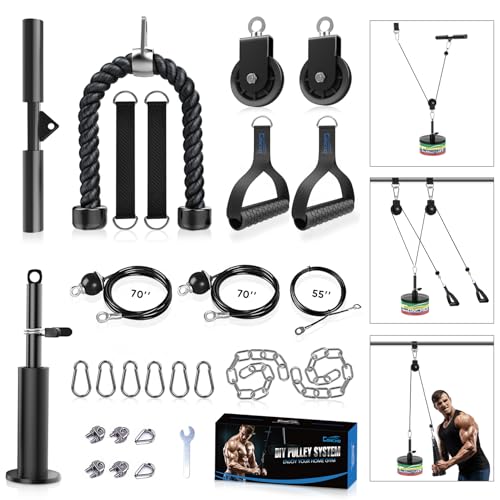
Concho Weight Pulley System
What We Like
- Three detachable handles for full-body work
- 350 lb max capacity with 12" loading pin
- Adjustable cable lengths via extension chains
- Lightweight and portable at 8.8 lbs
Trade-offs
- Requires a sturdy anchor point like a rack or beam
- No built-in weight stack, uses your own plates
- Cable lengths max out at 70" plus 40" chain
A 350-pound max capacity in an 8.8-pound kit means this pulley system packs serious strength into a truly portable package. You get three detachable handles, straight bar, tricep rope, and soft cable handles, so you can switch from lat pulldowns to bicep curls to cable rows without stopping to swap hardware. The two 70-inch cables plus a 55-inch cable and extension chains let you dial in the exact length for wide pulls or tight isolation moves. That flexibility means you aren’t locked into one setup, and you can take it from your squat rack to a door frame to a beam outside.
You supply your own plates and need a solid mounting point, a rack, pull-up bar, or ceiling hook, to hang it from. The Concho system supports up to 350 lbs with its 12-inch loading pin, so if you already own a rack and plates, that weight capacity gives you room to grow. Compared to the Mikolo LAT and Lift Pulley System, the Concho includes three detachable handles (straight bar, tricep rope, soft cable handles) for varied exercises. It does require you to provide both the mounting point and the plates.
Product photos
How We Evaluated Pulley Systems For Home Gym
We built this guide by digging into manufacturer specs, studying expert round-ups from strength training publications, and identifying common praise and complaints from real owners. Every system here earned its spot based on verified dimensions, weight capacities, mounting requirements, and included accessories.
The criteria that mattered most were mounting flexibility, resistance range, pulley adjustability, and value for the investment. A system that needs a concrete wall is great for a permanent home gym but useless for a renter. A 350 lb capacity means nothing if the pulley height doesn’t change. We prioritized systems that give you real movement variety without demanding a contractor.
A research-led evaluation has limits: we haven’t bolted each unit to a wall ourselves, and owner experiences vary with installation quality and plate brands. What we can tell you is exactly what each system includes, what it requires, and what kind of lifter it suits best.
What To Look For In Pulley Systems For Home Gym
Before you buy, understand the three big decisions: wall-mount vs. Portable, plate-loaded vs. Weight stack, and how many pulley positions you actually need.
Look for a pulley system that matches your mounting surface, your existing plate collection, and the exercises you do most. A 17-position wall unit is overkill if you only want lat pulldowns.
Mounting and Installation
Wall-mounted systems like the Goimu WM1 and Mikolo Wall Mount Crossover demand a concrete or masonry wall with proper anchors. Some, like the Titan Fitness Wall Mounted Pulley Tower, can also bolt into a power rack. Portable kits like the FitBeast and SERTT systems attach to a pull-up bar or rack crossmember, no drilling required, but you need a sturdy anchor point. Check your wall construction before buying anything that requires bolts.
Resistance Type: Plate-Loaded vs. Weight Stack
Plate-loaded systems use your own Olympic or standard plates, which keeps the cost lower but means you change plates between sets. The Goimu WM2-V4 includes a selectorized weight stack, so you just slide the pin, much faster for drop sets and circuit work. Plate-loaded towers like the Titan Fitness handle up to 350 lb, while weight stack units typically top out around 155 lb. If you lift heavy, plate-loaded is the practical choice.
Pulley Positions and Cable Angles
More pulley heights mean more exercise variety. The Mikolo Wall Mount Crossover offers 19 positions, the Goimu WM1 has 17, and the Titan Fitness tower has 18. Fewer positions, like the single-station SELEWARE pull-up bar combo, still work for basic lat pulldowns and curls but limit flyes, crossovers, and low-row angles. A good minimum is a dozen positions for full-body versatility.
Resistance Ratio (1:1 vs. 2:1)
Some systems let you switch between 1:1 (the weight you load is the weight you feel) and 2:1 (the weight you feel is half of what you load, but the cable moves twice as far). The 2:1 ratio is smoother for high-rep work and lets you use lighter plates while still getting cable tension. The Goimu WM1 and Titan Fitness tower both offer this switch. If you’re buying a single-station system without this feature, you’re stuck with whatever ratio it ships with.
- Measure your mounting area and confirm you have a solid wall, rack, or beam to anchor to.
- Count the pulley positions, more is better for exercise variety, but a dozen is enough for most lifters.
- Check whether the system includes handles, bars, and ropes, or if you need to buy attachments separately.
- Decide between plate-loaded and weight stack based on how often you change weights and your max resistance needs.
A good rule: if you already own plates, buy plate-loaded. If you want commercial convenience, pay for a weight stack.
Pulley Systems For Home Gym Compared
The table below compares all ten pulley systems across the specs that matter most: mounting type, pulley positions, resistance capacity, and included accessories.
| Product | Type | Max Load | Frame Material |
|---|---|---|---|
| Goimu WM1 Wall Mount Cable Station | Wall-mounted cable station | N/A | 14-gauge industrial steel |
| Mikolo Wall Mount Cable Crossover Machine | Wall-mounted cable station | 400 lb | 14-gauge powder-coated steel |
| Goimu WM2-V4 Cable Station with Weight Stack | Wall-mounted cable station with weight stack | N/A | 14-gauge commercial steel |
| Titan Fitness Wall Mounted Pulley Tower | Wall-mounted pulley tower | 350 lbs | Powder-coated 2" x 2" steel tubing |
| Mikolo LAT and Lift Pulley System | Portable pulley system | 280 lb | N/A |
| FitBeast Pulley System Gym | Portable pulley system | 330 lbs | N/A |
| MAJOR FITNESS F22 Power Rack | Power rack with cable crossover | N/A | 14-gauge steel |
| SELEWARE Wall Mount Pull Up Bar with Pulley | Wall-mounted pull up bar with pulley | 600 lbs | Heavy duty alloy steel |
| SERTT Weight Pulley System Gym | Portable pulley system | 330 lbs | N/A |
| Concho Weight Pulley System | Portable pulley system | 350 lbs | N/A |
Frequently Asked Questions
What is the best pulley system for a home gym with limited space?
The Goimu WM1 Wall Mount Cable Station is the best choice for tight spaces because it takes up just 3.12 sq ft of floor area while offering 17 adjustable pulley heights. The Mikolo Wall Mount Cable Crossover also saves space with a corner-mount design that keeps the footprint small.
Do I need a concrete wall to install a wall-mounted pulley system?
Most wall-mounted cable stations require mounting into concrete or masonry for safety. The Goimu WM1 and Mikolo Wall Mount Crossover both specify concrete walls in their installation instructions. If you have drywall over wood studs, look for a portable pulley system that attaches to a power rack or pull-up bar instead.
What is the difference between 1:1 and 2:1 resistance ratios?
A 1:1 ratio means the resistance you feel equals the weight you load on the cable. A 2:1 ratio means the resistance you feel is half of what you load, but the cable moves twice the distance. The 2:1 setting is smoother for high-rep exercises and lets you use lighter plates while maintaining cable tension.
Can I use a pulley system without owning weight plates?
Only if you buy a system with a built-in weight stack, like the Goimu WM2-V4 Cable Station with Weight Stack. Plate-loaded systems require you to supply your own Olympic or standard plates. Some portable kits include a loading pin but no plates, so factor the cost of plates into your budget.
How many pulley positions do I really need for a full-body workout?
Twelve to fifteen pulley positions cover most exercises including lat pulldowns, rows, flyes, tricep pushdowns, and cable crossovers. Systems with 17 to 19 positions, like the Goimu WM1 and Mikolo Wall Mount Crossover, offer slightly more angle variety for advanced movements but aren’t necessary for a solid full-body routine.
The Bottom Line
The Goimu WM1 Wall Mount Cable Station is our Best Overall pick for home gym owners who have a concrete wall and want maximum versatility in a tiny footprint. Its 17 adjustable heights and switchable 1:1 and 2:1 ratios cover everything from lat pulldowns to cable flyes without taking over the room.
If you prefer the convenience of a weight stack, the Goimu WM2-V4 eliminates plate changes and offers 33 positions. For lifters who already own plates and want serious capacity, the Titan Fitness Wall Mounted Pulley Tower handles 350 lb with an 18-position trolley. And if you can’t drill into walls, portable kits like the FitBeast and SERTT systems attach to your existing rack or bar.
The single most important buying factor is your mounting situation. Measure your wall, confirm what it’s made of, and choose a system that matches, everything else follows from there.
