
10 Best Smart Treadmills For Home in 2026
This post contains affiliate links. As an Amazon Associate, we earn from qualifying purchases.
For most home exercisers, the NordicTrack T Series 5 Starter Treadmill is the best smart treadmill for home. It auto-adjusts speed and incline with iFIT, packs into a compact 130-lb frame, and cushions each stride with KeyFlex technology. If you prefer a larger touchscreen that swivels for floor workouts, the NordicTrack Commercial 1750 Treadmill is a strong choice. For runners who want real-time form feedback, the Peloton Tread Vision stands out.
The challenge with home treadmills is balancing smart features, like auto-adjusting resistance, streaming classes, and form tracking, with a footprint that fits your actual living space. A machine loaded with tech is useless if it dominates your room or requires a subscription you won’t use.
This guide is research-based: we compared specifications, manufacturer documentation, expert round-ups, and patterns in owner feedback across ten models. We focused on what matters most for home use: smart interactivity, footprint, cushioning, and long-term value.
Top 10 Smart Treadmills For Home in the Market
Certain content that appears on this site comes from Amazon. This content is provided "as is" and is subject to change or removal at any time.
The Best Smart Treadmills For Home, Reviewed
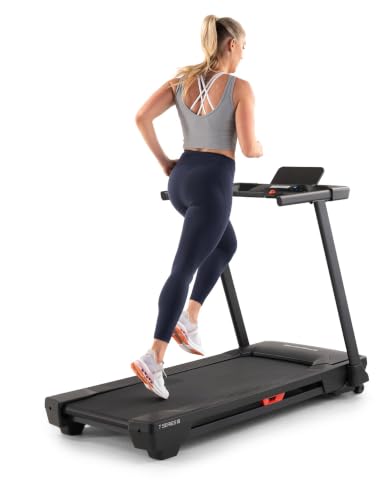
NordicTrack T Series 5 Starter Treadmill
What We Like
- Auto-adjusts speed and incline with iFIT
- KeyFlex Cushioning reduces joint impact
- Compact 130-lb frame fits small spaces
- ActivePulse adjusts to your heart rate
Trade-offs
- iFIT membership required for smart features
- 10 MPH max speed limits faster runners
- Heart rate monitor sold separately
A 10 MPH top speed and 0-10% incline give you plenty of room to walk, jog, or build endurance without overwhelming a home gym. What makes this treadmill stand out is how iFIT’s SmartAdjust takes the guesswork out of pacing. It automatically tweaks speed and incline based on your past workouts and real-time performance, so you’re never stuck wondering if you’re pushing hard enough. The KeyFlex Cushioning also softens each footstrike, which is a real relief if your knees or hips tend to complain after a long run. For someone who wants guided training without a massive footprint, this is a thoughtful, space-friendly setup.
The trade-off is that the smart features, auto-adjustment, ActivePulse heart rate control, and AI coaching, all require an iFIT membership, so the upfront cost isn’t the whole story. If you’re happy to run manually, you can skip the subscription, but then you lose the very automation that sets this model apart. Compared to the Peloton Tread, which weighs 275 pounds and demands a dedicated room, the NordicTrack T Series 5 is lighter and easier to slide into a corner or spare bedroom. It’s not built for sprinters (10 MPH is the ceiling), but for steady progress and daily consistency, it hits a sweet spot between capability and convenience.
NordicTrack Commercial 1750 Treadmill

What We Like
- Pivoting 16" touchscreen for off-treadmill workouts
- -3% decline to 12% incline range
- RunFlex cushioning reduces impact
- Folding design with assisted lowering
Trade-offs
- iFIT Pro membership required for auto-adjust and streaming
- Bluetooth HR monitor sold separately for ActivePulse
- At 265.7 lbs, it's heavy to move regularly
A 16-inch pivoting touchscreen that lets you view off-treadmill classes like yoga or strength makes this treadmill more than just a running machine. The -3% decline to 12% incline range lets you simulate downhill recovery and steep climbs, while RunFlex cushioning softens each footstrike so your joints don’t pay for the miles. This setup suits someone who wants one piece of equipment that handles both cardio sessions and guided strength or yoga classes without needing a second screen.
The catch is that most of the interactive magic, auto-adjusting speed and incline, streaming shows, heart-rate-controlled workouts, requires a premium iFIT Pro Membership. If you skip the subscription, the treadmill still works manually, but you lose the feature that makes its screen special. Compared to the Peloton Treadmill, the NordicTrack 1750 offers a wider incline range and a folding frame, but its ongoing cost can add up for those who don’t plan to commit to iFIT long-term.
Peloton Treadmill

What We Like
- 360° swivel screen for floor workouts
- 59-inch running belt for taller strides
- Bluetooth 5.2 and USB-C charging
- Auto-incline follows instructor cues
Trade-offs
- At 275 lb, very heavy to move or assemble
- Needs 78.7" clearance behind and 8' ceiling
A 24-inch HD screen that swivels a full 360 degrees means you can step off the belt and immediately follow a yoga or strength class without squinting at a tiny phone or twisting your neck. That versatility, 15+ workout types from one machine, is the core reason this treadmill fits homes where one person runs and another prefers Pilates. The 59-inch running surface also supports users up to 6’4″, so longer strides feel natural, not cramped. It’s built for the household that wants a single piece of gear to serve multiple training moods, not just a straight-ahead run.
The Peloton Treadmill weighs 275 pounds, so this is not a machine you casually shift to vacuum under; you’ll need lifting aids and a dedicated spot. It also demands a minimum 8-foot ceiling and 78.7 inches of clearance behind the tread, which rules out low basements or tight apartments. Compared to the lighter Sunny Health & Fitness Wi-Fi Treadmill (174.2 lb), the Peloton is far less portable. But it offers a much larger, more interactive screen and a richer class library, if you’re willing to pay the monthly membership fee for full access.
Product photos
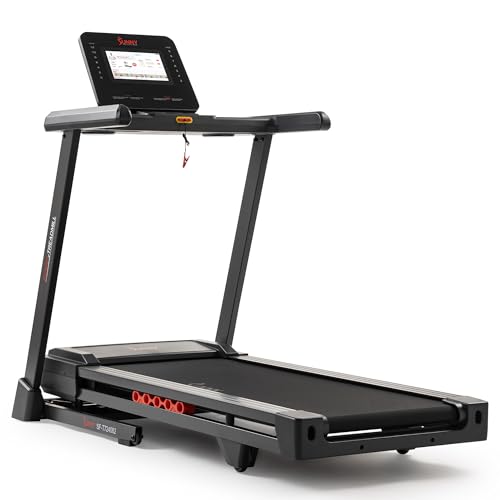
Sunny Health & Fitness Wi-Fi Treadmill
What We Like
- Built-in Wi-Fi streaming on 10" touchscreen
- 12% auto incline for varied intensity
- Quiet 3 HP motor up to 12 MPH
- Folds vertically with soft-drop system
Trade-offs
- Running deck is shorter than some options
- 174.2-pound weight makes relocation difficult
A 10-inch touchscreen that streams shows and music directly without a tablet or phone nearby is the headline here. That built-in Wi-Fi and the SunnyFit app unlock thousands of trainer-led classes and scenic routes, all displayed on the console itself. For someone who wants entertainment and guided workouts baked into the machine rather than rigging up their own device, this makes the treadmill feel like a complete package. The 3 HP motor stays quiet enough for a home setting, and the 12% auto incline adds challenge without manual fuss.
The running surface is 53 inches long, which is shorter than the 60-inch deck found on some competitors like the NordicTrack Commercial 1750. So taller runners or those with a long stride may feel cramped at higher speeds. The treadmill weighs 174.2 pounds, making it heavy to move, but the front transport wheels and vertical fold help once it is in place. If streaming is your priority and you don’t need the longest stride length, this delivers that feature without forcing you into a premium price bracket.
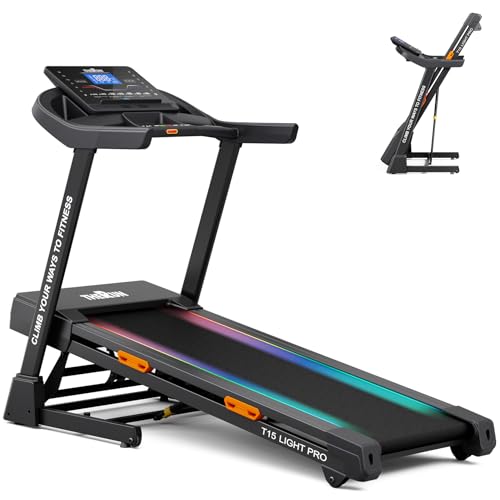
THERUN 20% Auto Incline Treadmill
What We Like
- 20% auto incline for steep hills
- 55" x 20" belt fits tall runners
- Color-changing LED pace indicator
- Zwift, FitShow, Kinomap app sync
Trade-offs
- At 157.6 lb, it's heavy to move
- No built-in touchscreen for apps
A 20% auto incline, steeper than most home treadmills, lets you simulate serious hill climbs without leaving your living room. The 55-by-20-inch belt gives tall runners up to 6’3″ room for a natural stride, and the 3.5 HP motor keeps the belt steady even at 12 MPH sprints.
The console is straightforward: you sync your own device via Zwift, FitShow, or Kinomap for guided workouts, and the built-in fan and Bluetooth speakers add comfort, but there’s no touchscreen built in. At 157.6 pounds, it’s not the lightest machine to reposition, though the folding design helps reclaim floor space between sessions. If you want app-connected hill training without paying for a giant screen you might rarely use, this delivers a 20% incline at a weight that’s easier to manage than some larger models.
ProForm Pro 9000 Treadmill

What We Like
- Folds away with SpaceSaver Design
- 22" tilting touchscreen for easy viewing
- Rebound Pro Cushioning for comfort
- Quick speed and incline controls
Trade-offs
- At 251 lb, moving it is a two-person job
- iFIT Pro subscription needed for ActivePulse
A 22-inch tilting touchscreen that adjusts to your view means you can follow a trainer or watch a show without craning your neck. And the SpaceSaver fold lets you tuck the whole thing away when the living room needs to be a living room again. That combination of a generous screen and a foldable frame makes this a strong fit for anyone who wants a full-featured running deck but doesn’t have a dedicated gym room. The Rebound Pro Cushioning also helps take some sting out of each stride, which matters if your knees remind you that pavement is not your friend.
The 251-pound weight means this machine is not something you casually move around, so decide on its final location before assembly. Compared to the lighter Sunny Health & Fitness Wi-Fi Treadmill at 174.2 lb, the Pro 9000 is better suited to a permanent home. The -3% decline adds downhill simulation. And the ActivePulse feature, which adjusts intensity to keep you in your target heart rate zone, requires a Pro iFIT subscription, so include that cost if you want that coaching.
Peloton Tread Vision

What We Like
- Real-time form feedback via movement-tracking camera
- Peloton IQ efficiency score with detailed tips
- Cushioned belt reduces joint impact
- Compact 6×3 ft footprint
Trade-offs
- At 299 lb, very heavy to move or reposition
- Requires compatible heart rate monitor separately
A movement-tracking camera watches your vertical oscillation and cadence, then gives you a single efficiency score and specific tips to run smoother. That’s the core of the Peloton Tread Vision, it turns your run into data you can actually use, not just a number on a screen. If you care about improving your form and avoiding bad habits that lead to injury, this treadmill offers something the others don’t: real-time feedback for both running and strength training. It also includes personalized plans built around your goals. The cushioned belt helps protect your joints during those longer miles, and the 23.8-inch swivel screen means you can follow yoga or strength classes without twisting awkwardly.
The Tread Vision weighs 299 pounds, so this is a heavy machine; you won’t be moving it around the room on a whim, so you need a dedicated spot. Compared to the lighter NordicTrack T Series 5 Starter Treadmill at 130 pounds, the Tread Vision is a commitment to one location. For someone who values form analysis over incline variety and wants a coach-like eye on their movement, this is a focused, smart choice.
Product photos
BowFlex T16 Treadmill

What We Like
- Extra-wide 22" x 60" running deck
- FlexZone XL cushioning reduces joint impact
- Folding SoftDrop frame for storage
- Lifetime frame and motor warranty
Trade-offs
- At 295 lbs, it's very heavy to move
- Large footprint: 77.2" long requires space
- No decline feature for downhill training
A running deck that’s 22 inches wide and 60 inches long gives you room to stride naturally without worrying about stepping off the belt. This is especially helpful during fast intervals or when you’re tired and your form starts to slip. The FlexZone XL cushioning provides support and stability while helping reduce joint impact, which makes a real difference for longer runs or if your knees tend to complain after a few miles. This treadmill suits runners who want a stable, spacious platform that feels closer to an outdoor track than a cramped hotel gym machine. And the 375-pound user capacity means it can handle a wide range of body types without wobbling.
The trade-off for that generous deck is size and weight: at 295 pounds, this is not a machine you’ll casually roll into a closet after your workout, even with the folding frame. Compared to the NordicTrack T Series 5 Starter Treadmill, which weighs 130 pounds, the BowFlex T16 demands a dedicated home gym corner or a room with enough clearance. If you have the floor space and don’t need to stash it away daily, the extra running room and cushioning make it worth the footprint.
Product photos
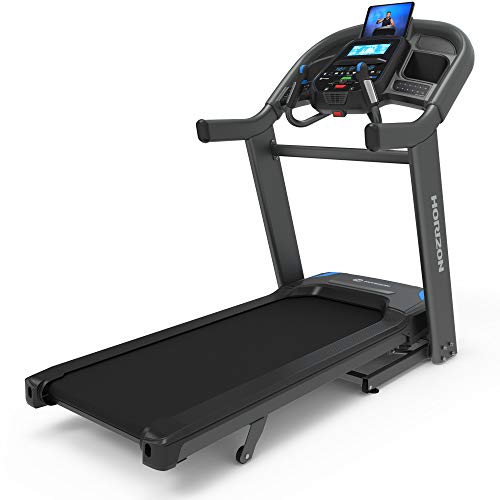
Horizon Fitness 7.4 AT Studio Treadmill
What We Like
- 350 lb max user weight
- 22 x 60 inch running surface
- 3.5 CHP motor for interval training
- FeatherLight hydraulic folding system
Trade-offs
- At 318 lbs, very heavy to move
- No included subscription or touchscreen
- Requires 76 x 37 inch floor space when open
With a 350-pound max user weight, this treadmill supports heavier runners and anyone who wants a truly sturdy platform without worrying about wobble or premature wear. The 22 by 60 inch running surface gives you room to stretch out your stride, and the 3.5 CHP motor delivers fast speed and incline changes that make interval workouts feel snappy. It folds up between sessions using a FeatherLight hydraulic system, and you don’t need a subscription to use the basic controls.
This treadmill weighs 318 pounds, so you’ll need a dedicated spot and a helper to move it. The folding design helps store it upright between workouts, but the size means it’s not something you’ll shift around casually. If you’re a heavier runner, it supports up to 350 pounds, that solid build gives you a stable platform for hard efforts.
Product photos
Sole Fitness F65 Foldable Treadmill

What We Like
- 20×60 inch cushioned running deck
- Kick release folding with hydraulic cylinder
- 0-15% power incline for varied training
- Dual Bluetooth speakers and USB-C charging
Trade-offs
- No built-in touchscreen or streaming display
- Ships via freight with curbside service only
The 3.25 HP motor handles speeds from a gentle 0.5 MPH recovery walk up to 12 MPH sprints, and the 0-15 percent power incline lets you climb hills or add intensity without pounding the belt. Bluetooth speakers and USB-C charging keep your phone and music handy, and the kick release fold tucks the whole thing away in seconds when floor space is tight.
The F65 doesn’t include a built-in touchscreen or streaming apps, so you’ll use your own tablet or phone for classes and entertainment. That keeps the price lower than some competitors, like the Peloton Treadmill, which has a large swivel screen and integrated content. If you prefer to bring your own device, the F65’s cushioned deck and solid motor deliver where it counts.
Product photos
How We Evaluated Smart Treadmills For Home
We started by cataloging the smart features that separate a connected treadmill from a basic one: auto-adjusting incline and speed, built-in or swiveling touchscreens, heart rate integration, and app compatibility. We then cross-referenced those features against the physical constraints of home use, folded footprint, assembled weight, and ceiling clearance requirements.
Three criteria carried the most weight. First, smart interactivity: how well the treadmill delivers coach-led workouts, auto-adjusts to your effort, and streams content without requiring a separate tablet. Second, footprint and storage: we prioritized machines that fold, have assisted lowering, or fit under 6 feet in length when open. Third, cushioning and build quality: a treadmill you’ll use daily needs a forgiving deck and a motor that won’t bog down during intervals.
A research-based evaluation has limits. This guide relies on manufacturer specifications and patterns in owner feedback. Factors like long-term motor reliability and touchscreen responsiveness after a year of use are best gathered from verified owner communities rather than spec sheets.
What To Look For In Smart Treadmills For Home
Choosing a smart treadmill means matching its connected features to your workout style and your floor plan. Here is what to prioritize.
Focus on three things: the quality of the smart platform (auto-adjust, streaming, app sync), the treadmill’s footprint when open and folded, and the cushioning system that protects your joints during repeated use.
Smart Platform and Subscription Model
The “smart” in a smart treadmill comes from software that adjusts your workout in real time. Look for auto-adjust features that match instructor cues or your heart rate, this is what separates a connected treadmill from one with a basic screen. Most premium platforms (iFIT, Peloton) require a monthly membership for full interactivity, so factor that into your budget. If you prefer no subscription, check that the treadmill supports free apps via Bluetooth or USB-C, like the Horizon Fitness 7.4 AT.
Footprint, Folding, and Floor Protection
A home treadmill must fit your space when open and when stored. Measure your room’s length, width, and ceiling height before buying. Many folding treadmills use hydraulic or soft-drop systems to lower the deck safely. The ProForm Pro 9000‘s SpaceSaver Design is one example. If your room is tight, look for compact treadmills that are shorter than average when open. Also check the assembled weight; machines over two hundred fifty pounds, like the BowFlex T16, are hard to reposition alone.
Cushioning and Deck Size
Cushioning reduces impact on your joints, especially during longer runs. Each brand has its own system: NordicTrack’s KeyFlex and RunFlex, Sole’s cushioned deck, and BowFlex’s FlexZone XL. Deck dimensions matter too. A 20-by-60-inch belt suits most runners; taller or heavier runners benefit from the extra width of the BowFlex T16 (22 inches) or the length of the Horizon Fitness 7.4 AT. If you share the treadmill, a wider deck accommodates different stride lengths.
- Measure your room’s length, width, and ceiling height before buying.
- Confirm the treadmill folds and whether it uses assisted lowering.
- Check the max user weight, 350 pounds on the Horizon 7.4 AT is the highest here.
- Decide on a subscription budget before choosing a smart platform.
A good rule: the treadmill’s smart features should make you want to run more, not frustrate you with a platform you never use.
Smart Treadmills For Home Compared
The table below compares the ten smart treadmills across the criteria that matter most for home use: smart features, running deck size, folded footprint, and cushioning type.
| Product | Incline Range | Weight | Dimensions |
|---|---|---|---|
| NordicTrack T Series 5 Starter Treadmill | 0-10% | 130.0 lbs | 68.3 x 30.5 x 48.7 in |
| NordicTrack Commercial 1750 Treadmill | -3% to 12% | 265.7 lbs | 80.0 x 36.0 x 65.0 in |
| Peloton Treadmill | N/A | 275 lbs | 68 x 33 x 65 in |
| Sunny Health & Fitness Wi-Fi Treadmill | 12% Auto | 174.2 lbs | 67.7 x 32.9 x 55.1 in |
| THERUN 20% Auto Incline Treadmill | 20% auto | 157.6 lbs | 69.3 x 32.1 x 52.4 in |
| ProForm Pro 9000 Treadmill | -3% to 12% | 251.0 lb | 77.3 x 35.5 x 59.6 in |
| Peloton Tread Vision | N/A | 299 lb | 68 x 33 x 66 in |
| BowFlex T16 Treadmill | Up to 15% | 295.0 lbs | 77.2 x 37.0 x 67.6 in |
| Horizon Fitness 7.4 AT Studio Treadmill | 0-15% | 318.0 pounds | 76.0 x 36.6 x 63.0 in |
| Sole Fitness F65 Foldable Treadmill | 0-15% power incline | N/A | 77.0 x 36.0 x 55.0 in |
Frequently Asked Questions
What is the best smart treadmill for a small home?
The NordicTrack T Series 5 Starter Treadmill is the best choice for small homes. It weighs only 130 pounds, making it one of the lightest smart treadmills available, and its compact frame fits easily in tight spaces. The iFIT platform auto-adjusts speed and incline without you touching a button.
Do I need a subscription for a smart treadmill?
Most smart treadmills require a monthly membership for full interactivity, auto-adjust features, streaming classes, and heart rate integration. The NordicTrack and ProForm models use iFIT, while Peloton has its own membership. The Horizon Fitness 7.4 AT and Sole F65 have no built-in subscription, so you use free apps or your own device.
How much space do I need for a home treadmill?
Measure your room’s length, width, and ceiling height. Most treadmills need at least 6 feet of length when open, plus 3 feet of clearance behind for safety. Ceiling height should be at least 8 feet for comfortable running. For tight spaces, look for treadmills that fold vertically.
Which treadmill has the best cushioning for joints?
The Sole Fitness F65 Foldable Treadmill has a 20-by-60-inch cushioned deck designed for joint-friendly running. The BowFlex T16 uses FlexZone XL cushioning and has the widest deck at 22 inches. Both reduce impact without feeling too soft or unstable.
What is the difference between a smart treadmill and a regular treadmill?
A smart treadmill connects to apps or a subscription platform to auto-adjust your workout based on instructor cues, heart rate, or pre-set programs. Regular treadmills require you to manually change speed and incline. Smart models typically have touchscreens, Bluetooth, and form-tracking features like the Peloton Tread Vision‘s movement camera.
The Bottom Line
The NordicTrack T Series 5 Starter Treadmill is the best overall smart treadmill for most home exercisers. It combines automated iFIT coaching with a compact, lightweight frame that fits small spaces, and its KeyFlex cushioning makes daily runs easier on your joints. It is ideal if you want coach-led workouts without a massive machine dominating your room.
If your budget allows for a larger touchscreen that swivels for floor workouts, the NordicTrack Commercial 1750 Treadmill is a strong upgrade. Runners focused on form should consider the Peloton Tread Vision, while those with limited floor space will appreciate the ProForm Pro 9000‘s SpaceSaver folding design.
The single most important factor: choose a smart treadmill whose platform you will actually use. A subscription you never activate or a touchscreen you ignore turns a smart treadmill into an expensive basic one. Match the software to your workout habits first, then the hardware to your space.
