
10 Best Soccer Rebound Nets in 2026
This post contains affiliate links. As an Amazon Associate, we earn from qualifying purchases.
For solo soccer training, the Franklin Sports Adjustable Rebounder takes the Best Overall spot because its tool-free push-pin assembly lets you switch between multiple rebound angles quickly, suiting everything from ground passes to volleys. The SKLZ Quickster Soccer Trainer earns Best Dual-Sided Training for its separate large and small rebound surfaces, while the FASTOSS 12-Angle Rebounder wins Best Angle Versatility with a dozen quick-switch settings.
The real challenge with rebound nets is finding one that matches your space, skill level, and the specific drills you want to run. A net that works for a small backyard may not hold up to powerful shots from an advanced player on a club field. You also need to consider portability, stability, and whether the rebound angles actually help you improve your first touch.
This guide evaluates ten leading models by comparing their build materials, adjustability, stability features, and what patterns in owner feedback reveal about real-world use. We break down what each net does best so you can match a rebounder to your training goals.
Top 10 Soccer Rebound Nets in the Market
Certain content that appears on this site comes from Amazon. This content is provided "as is" and is subject to change or removal at any time.
The Best Soccer Rebound Nets, Reviewed
Franklin Sports Adjustable Rebounder

What We Like
- Adjustable angles for varied skill practice
- Durable powder-coated steel frame
- All-weather net for outdoor use
- Tool-free push-pin assembly
Trade-offs
- At 72 inches long, needs ample space
- 24-inch width limits side-to-side drills
- No built-in carry handle or bag for portability
A 6-foot-wide adjustable frame with locking pins lets you tilt this rebounder from ground passes to chest-high volleys without the frame wobbling. That versatility makes it a natural fit for anyone who wants to practice receiving different ball heights in one session. The powder-coated steel frame is built for outdoor use, and the all-weather net is designed for rugged dependability. Assembly uses push pins that snap into place, with extra fasteners for improved performance.
At 72 inches long and 48 inches tall, this rebounder demands a decent patch of flat ground, ruling out cramped garages or small patios. Assembly is quick with push pins, but there is no built-in carry handle or bag, so moving it between locations requires two hands. For players who have the room and want a stable, adjustable rebounder, this is a practical option.
Product photos
SKLZ Quickster Soccer Trainer
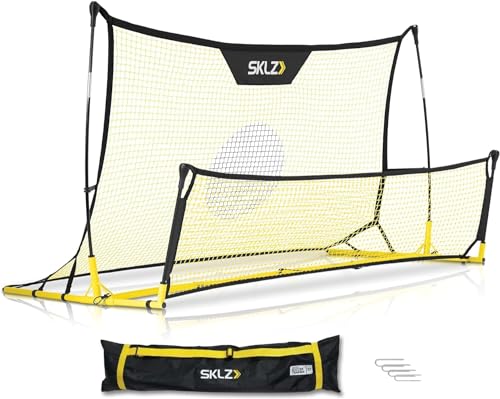
What We Like
- Dual-sided for ground passes and aerial work
- Bottom-bar-free large side for true roll
- Adjustable poles lock for consistent rebounds
- Weather-resistant netting for all-weather use
Trade-offs
- Small side is only 20 inches tall
- Needs stakes for stability on grass
The large 6×4-foot side has no bottom bar, which the manufacturer says allows an uninterrupted, true-roll experience for trapping with chest, thighs, or feet. The dual-sided design includes a 6-foot-by-20-inch small side on the other frame for ground-level passing and receiving drills. It’s built for solo practice, letting you work on ball control without needing a partner.
The small side is 20 inches tall, so it’s best for low ground passes rather than high or volleyed balls. At 13.2 pounds, it’s portable, but it’s designed for individual skill work, not as a full-size goal for team play.
FASTOSS 12-Angle Soccer Rebounder
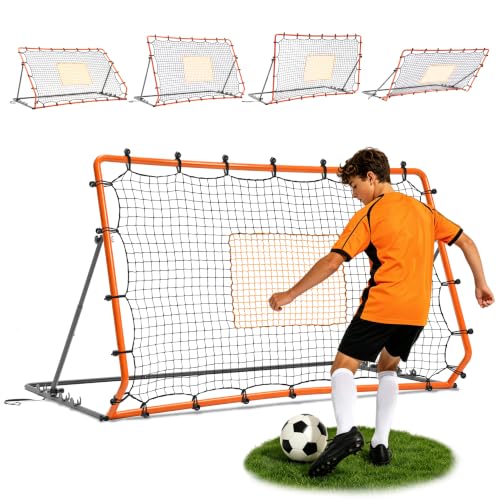
What We Like
- 12 quick-switch rebound angles
- Flat-fold design for easy storage
- Integrated target zones for accuracy
- Lifetime warranty included
Trade-offs
- At 6×4 ft, smaller than full-size goals
- Requires sandbags and stakes for stability
- No dual-sided use for multi-player drills
The ability to switch between 12 rebound angles means you can work on first-touch volleys, ground passes, chest traps, and headers in a single session. That is ideal for solo players training without a coach or partner. The built-in target zones sharpen passing, striking, and receiving accuracy without needing extra straps or accessories, so you can focus on repetition. If you train alone and want a rebounder that adapts to different skills, this design offers that versatility.
At 6×4 feet, this rebounder is compact enough for a backyard or driveway but smaller than a regulation goal, so shooting practice on the move may feel limited. The included sandbags and ground stakes deliver extra stability, and the flat-fold structure stores neatly in garages or closets. The lifetime warranty adds peace of mind for regular use, and the design focuses on solo skill development without unnecessary complexity.
Product photos
Winthai 5x4FT Rebounder Net
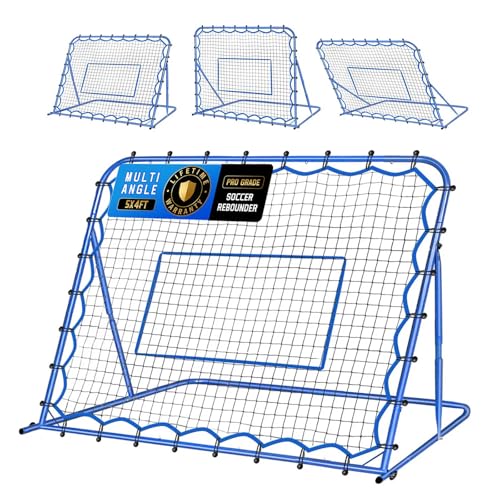
What We Like
- Quick-switch lever for 3 angles
- Built-in bullseye target for accuracy
- Sets up in 15 minutes without tools
- Includes 3 sandbags for stability
Trade-offs
- 5×4 ft surface is smaller than 6×4 ft alternatives
- No double-sided training surface
A 5×4-foot rebound surface and three quick-switch angles, 60°, 90°, and 120°, let you work on curved passes, overhead volleys, and ground passes without stopping to re-pin the frame.
The trade-off is size and heft. At 16.5 pounds and 57.6 inches wide, the Winthai is narrower than the Franklin Sports Adjustable Rebounder (6×4 feet). It also lacks a double-sided training surface, meaning you get one rebound zone instead of two. But if you want a portable, tool-free setup that sets up in 15 minutes without tools, this is a straightforward pick.
QuickPlay Replay Station Rebounder Board

What We Like
- Dual surface for predictable or random returns
- 4 adjustable rebound angles
- Natural ball return builds match-ready technique
- Stable on grass, turf, or indoor carpet
Trade-offs
- Smaller surface (14 x 47 in) limits high-speed volley drills
- No net for catching or collecting balls
The QuickPlay Replay Station uses a rigid dual-surface board instead of a net, so the ball comes back with natural speed and spin rather than exaggerated pace. That means you have to strike firmly and move your feet to handle the rebound, which builds passing accuracy and first touch that actually transfers to a game. With four adjustable angles and a flat or ribbed wave face, you can train controlled ground passes one moment and random reaction rebounds the next, all in a compact 14 x 47-inch footprint that fits in a bedroom or on the sideline before a match.
The small board area limits high-arcing volley drills where a net would catch wayward balls, and there is no collection pocket, so you will chase stray shots more than with a larger rebounder net. Compared to the SKLZ Quickster, which is a net-based trainer with a smaller surface area, the Replay Station trades catch-and-collect convenience for a more realistic, technique-focused rebound that forces you to stay sharp on your feet. It is a smart pick if your priority is building match habits rather than just getting a workout.
Product photos
QuickPlay GS Trainer 3-in-1 Goal

What We Like
- Three training modes in one frame
- Tool-free mode changes with spring pins
- Caged goal keeps ball in play
- Heavy-duty steel frame for durability
Trade-offs
- At 37.4 lb, less portable for frequent moves
- 15-inch depth limits storage in tight spaces
A single frame that switches between a 7×5-foot goal, a rebounder for volleys, and a passing wall means you can chain shooting, first-touch, and aerial drills without stopping to swap gear. That’s the core idea behind the QuickPlay GS Trainer 3-in-1 Goal, and it’s what makes it a strong pick if you want realistic solo sessions in your backyard. The galvanized steel frame and caged net design keep the ball contained, so you spend more time on reps and less time chasing misses. For a player who wants to build match rhythm at home, this system cuts out the hassle of owning separate pieces.
The QuickPlay GS Trainer 3-in-1 Goal weighs 37.4 pounds, so it’s heavier than most rebounders and best kept in a permanent training spot rather than moved around. It offers three modes, goal, rebounder, and passing wall, letting you switch between shooting, passing, and control drills without stopping to reset. That fixed weight and multi-mode design mean you trade portability for a single setup that covers a lot of training ground.
Open Goaaal All-in-One System
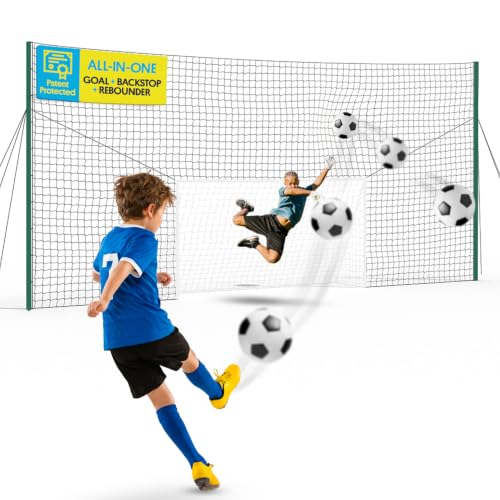
What We Like
- All-in-one goal, rebounder, and backstop
- Keeps every shot in play
- Weather-resistant for year-round outdoor use
- Width adjustable to fit your yard
Trade-offs
- Only works on natural grass, not turf or concrete
- At 10 ft tall, needs a larger backyard space
- Requires guy ropes for anchoring stability
A 21-foot-wide backstop that catches every stray shot and sends it right back into play, that’s the core promise of the Open Goaaal All-in-One System. It combines a full-sized training goal, a rebound net, and a containment net into one setup, so you spend time practicing instead of chasing balls over the fence. The 9×5-foot inner goal is sized for youth training, but the surrounding net gives older players room to work on power without worrying about broken windows. This is the system for anyone with a grassy backyard who wants a dedicated, permanent training station that the whole family can use.
This is a big, permanent installation. It needs a yard space at least 17 feet 6 inches wide and 6 feet 6 inches deep, and it only anchors into natural grass, no concrete or turf. Setup requires spiking poles into the ground and securing guy ropes, so it’s not something you’ll move around casually. Compared to a portable rebounder like the Franklin Sports Adjustable Rebounder, the Open Goaaal offers far more coverage and a real goal structure, but it demands a committed spot in your yard. If you have the space and want a system that stays put through rain and wind, this is the one.
Product photos
PodiuMax 4-in-1 Soccer Goal Rebounder
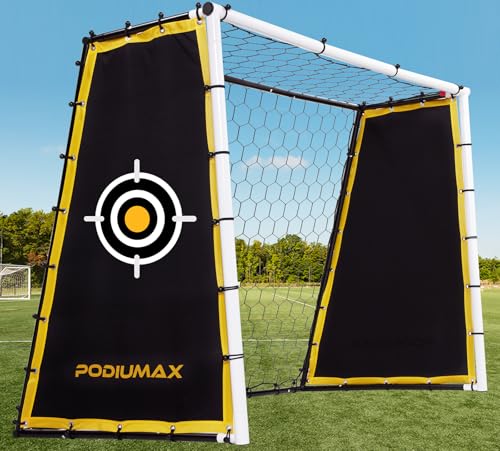
What We Like
- Four distinct training modes in one frame
- Sloped back net for controlled rebound trajectory
- Triangular support stays stable in wind
- Tear-resistant mesh handles hard shots
Trade-offs
- No adjustable rebound angle for varied drills
- Fixed rebound angle limits drill variety
The 7×5 ft front net gives you a full-size goal for shooting practice, while the sloped back net returns kicks with controlled trajectory and force, so you can work on passing and ball control without chasing balls. Four modes, goal, rebounder, ground pass net, and shooting target, let one frame cover shooting accuracy, low passing drills, and solo training. That makes it a versatile setup for anyone practicing multiple skills without buying separate gear.
Triangular supports paired with 32mm metal pipes anchor the frame firmly, so even gusty backyard conditions won’t tip it during a session. The sloped back net returns kicks with a fixed trajectory and controlled force, which saves time chasing balls and lets a solo player focus on passing rhythm or ball control. Because the rebound angle is not adjustable, the trajectory stays consistent every time, ideal for drilling the same pass or volley until the movement becomes automatic. Reviewers mention that the elastic rope adds snap to the rebound, making repetitive practice feel more dynamic without requiring constant resetting.
XUEMONT 6x4ft Rebounder Net
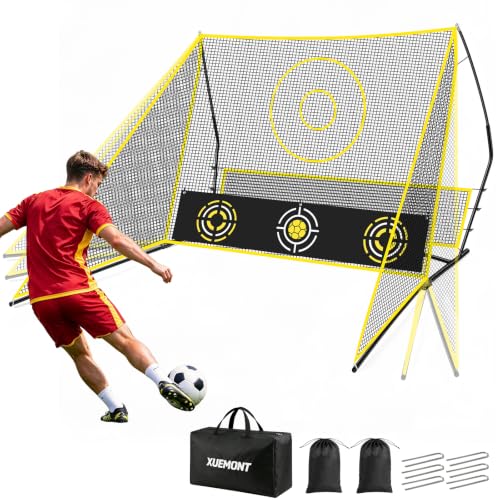
What We Like
- Dual net for aerial and ground drills
- Fluorescent target for shooting accuracy
- Side nets block stray balls
Trade-offs
- 3 angles limit trajectory variety
- Side nets add bulk for storage
The XUEMONT 6x4ft Rebounder Net comes with dual nets, a large upper panel for volleys and heading, plus a narrow lower one for ground passing, so you can work on both aerial and footwork drills without switching gear. The stability kit includes six ground stakes, two sandbags, and two positioning straps, which help keep the frame secure on hard flat ground where stakes alone won’t work. That makes it a practical pick for driveways, patios, or any flat ground where you want reliable bounce-back without the frame sliding away after a few hard shots.
Product photos
JOLORLY 5.5x4ft Rebounder Net
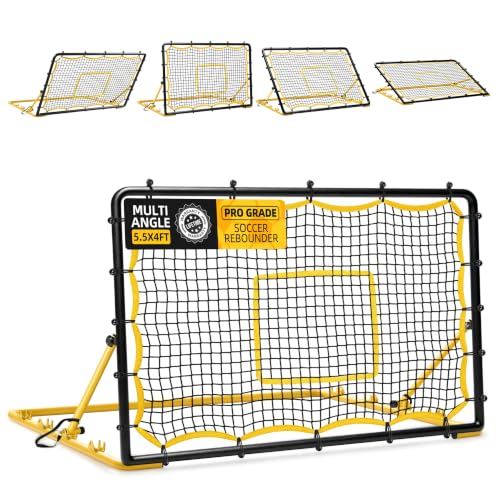
What We Like
- Four quick-switch angles for varied drills
- Flat-fold design stores in small spaces
- Tool-free assembly in 5 minutes
- Lifetime warranty on heavy-duty net and frame
Trade-offs
- At 65.8 inches wide, it's narrower than some 6×4 options
- Sandbags and stakes included, but need filling or hammering
- No dual-sided rebound surface for multi-player drills
The 5.5×4-foot size means this rebounder slips into a garage corner or car trunk without a second thought, yet still offers four distinct angles, 30, 60, 90, and 120 degrees. That lets you practice volleys, headers, or ground passes without needing a partner. Its flat-fold design and five-minute tool-free setup make it the go-to for sneaking in a quick session on the patio or at the park, then packing it away before dinner. It’s built with a powder-coated steel frame and a heavy-duty 48-ply PE net backed by a lifetime warranty, so it can handle daily abuse from youth players or weekend warriors alike.
The 5.5×4-foot hitting area is a bit smaller than the Franklin Sports model’s 6-foot width, but that model is only 2 feet deep, so the JOLORLY gives you more depth for catching errant shots. Three fillable sandbags and four ground stakes keep it stable on grass or concrete, though you’ll need to fill the bags and set the stakes yourself. For solo practice where space is tight and setup speed matters, this rebounder delivers focused training without the bulk of a full-size goal system.
Product photos
How We Evaluated Soccer Rebound Nets
Our evaluation focused on manufacturer specifications, build quality claims, and patterns in owner feedback across multiple models. We looked at frame materials, net durability, and the range of rebound angles each net offers. For stability, we checked anchoring methods like stakes, sandbags, and guy ropes, and noted the weight and footprint of each unit.
The four criteria that mattered most were rebound angle adjustability, frame rigidity, ease of setup and takedown, and portability. Adjustable angles let you vary drill difficulty, while a rigid frame keeps the rebound consistent. Fast assembly and light weight matter if you plan to move the net between the garage and the field. We also considered whether the net included extras like target zones or dual-sided surfaces.
An evaluation like this cannot replace testing ball rebound speed or long-term weather resistance. We rely on reported specs and the collective experience of many owners to identify which models tend to hold up and which fall short. For a deeper dive into specific categories, check our dedicated review of soccer rebounder nets for more detail on the top contenders.
What To Look For In Soccer Rebound Nets
Choosing the right rebounder means matching its size, adjustability, and stability to your training space and skill level. Here is what matters most.
Look for a net with at least three rebound angles, a powder-coated steel frame for outdoor durability, and a stable anchoring system that matches your surface (grass, turf, or concrete). Consider weight and folded size if you plan to move it between locations.
Rebound Angle Adjustability
The number of rebound angles directly affects the variety of drills you can run. Entry-level nets offer three angles for basic ground passes and volleys, while premium models like the FASTOSS 12-Angle Rebounder provide a dozen settings for everything from short chips to driven balls. More angles let you incrementally increase difficulty as your first touch improves.
Adjustability mechanisms vary. Tool-free push pins or quick-switch levers are far more convenient than bolts and wrenches. Some nets, like the Franklin Sports Adjustable Rebounder, use a simple push-pin system that changes angles in seconds without tools. If you train with a partner or coach, look for a net that locks securely at each angle so the rebound stays consistent.
Build Quality and Frame Stability
The frame must absorb repeated ball impacts without wobbling or bending. Powder-coated steel is the standard for outdoor durability, resisting rust and holding up to weather exposure. Look for a gauge that feels substantial, lighter frames may flex under hard shots, especially on uneven ground. The QuickPlay GS Trainer 3-in-1 Goal uses a heavy-duty steel frame that stays planted during powerful strikes.
Stability also depends on the anchoring system. On grass, stakes work well for most nets, but larger systems like the Open Goaaal All-in-One require guy ropes for wind resistance. For hard surfaces like driveways, sandbags or weighted bases are essential. The Winthai 5x4FT Rebounder Net includes three sandbags, which helps it stay put on concrete. If you train on turf, check that the net’s stakes are compatible with the surface without damaging it.
Portability and Setup Time
If you plan to move the net between your backyard, a park, or a training field, weight and folded size matter. A compact model like the JOLORLY 5.5x4ft Rebounder Net folds flat for trunk storage and assembles in about five minutes without tools. Heavier units like the QuickPlay GS Trainer weigh over thirty-seven pounds and are better suited for a permanent backyard spot.
Setup time varies widely. Some nets require 15 minutes of assembly, while others pop open in under five. Tool-free assembly is a major plus for anyone who wants to start training quickly. A built-in carry handle or bag makes transport easier, but many budget nets lack this feature. For a closer look at the differences between net-based and board-based training tools, see our guide on soccer rebounder boards.
Surface Size and Training Area
The rebound surface determines the types of drills you can perform effectively. Larger surfaces, like the 6×4 foot models, give you a bigger target for passing and shooting drills and can handle powerful shots without the ball flying past the frame. Smaller surfaces, like the QuickPlay Replay Station‘s 14×47 inch board, are better for close-range first-touch work and volley practice.
Consider your available space. A 72-inch-long net like the Franklin Sports Adjustable Rebounder needs a generous backyard or field area. If you train in a driveway or small patio, a more compact option around 5×4 feet will fit better while still providing enough surface for meaningful practice. The XUEMONT 6x4ft Rebounder Net includes side nets that block stray balls, making it a good fit for hard surfaces where balls tend to roll away.
- Measure your training space before buying, including clearance behind the net for ball rebound.
- Check the folded dimensions against your car’s trunk or back seat for transport.
- Look for a net that includes stakes or sandbags for your primary training surface.
- Consider a lifetime warranty if you plan to use the net year-round outdoors.
- Read owner feedback about assembly difficulty and long-term frame durability.
A net with a lifetime warranty and tool-free angle adjustment is usually worth paying more for over a bare-bones model that may need replacement within a season.
Soccer Rebound Nets Compared
The table below compares the ten rebound nets across key specs including rebound angles, surface size, frame material, and included stability features.
| Product | Frame Material | Net Type | Dimensions |
|---|---|---|---|
| Franklin Sports Adjustable Rebounder | Powder-coated steel | All-weather | 72 x 24 x 48 inches |
| SKLZ Quickster Soccer Trainer | Adjustable poles with Quick-Connect C-Clips | UV and weather-resistant netting | 15 x 20 x 6 inches |
| FASTOSS 12-Angle Soccer Rebounder | Powder-coated steel | 48 ply PE | 43.2 x 72.0 x 48.0 inches |
| Winthai 5x4FT Rebounder Net | N/A | High-elasticity net | 57.6 x 44.4 inches |
| QuickPlay Replay Station Rebounder Board | Powder-coated steel | N/A | 14 x 47 x 11 in |
| QuickPlay GS Trainer 3-in-1 Goal | Galvanized steel | N/A | 92.9 x 38.5 x 15 in |
| Open Goaaal All-in-One System | N/A | N/A | 10 ft high x 21 ft wide |
| PodiuMax 4-in-1 Soccer Goal Rebounder | 32mm metal pipes | 10-ply reinforced mesh | 41.3 x 84.3 x 60.6 inches |
| XUEMONT 6x4ft Rebounder Net | 12.7mm fiberglass poles | Premium PE mesh | 6×4 ft |
| JOLORLY 5.5x4ft Rebounder Net | Powder-coated steel | 48 ply PE | 65.8 x 42.9 x 42.9 inches |
Frequently Asked Questions
What size soccer rebound net should I buy for a backyard?
For a typical backyard, a 5×4 foot or 6×4 foot surface works well. The 5×4 size fits smaller yards and still allows passing and shooting drills, while a 6×4 net gives a larger target for powerful shots. Measure your yard’s width and depth, leaving at least 10 feet behind the net for the ball to rebound.
How do I keep a rebound net stable on grass or concrete?
On grass, use the included ground stakes to anchor the frame legs. On concrete or asphalt, fill sandbags or weight bags and place them on the base legs. Some nets also include guy ropes for extra wind resistance. For hard surfaces, models like the XUEMONT 6x4ft Rebounder Net are designed with stability in mind.
Can a rebound net help improve my first touch?
Yes. Consistent ball returns from a rebounder let you practice receiving passes, trapping, and controlling the ball at different speeds and heights. Adjustable-angle nets let you start with soft ground passes and progress to driven volleys. For more on training tools, see our guide on solo soccer trainers.
Are rebound nets weather-resistant for year-round outdoor use?
Many rebound nets use all-weather netting and powder-coated steel frames that resist rust and UV damage. The Franklin Sports Adjustable Rebounder and the Open Goaaal All-in-One System are designed for year-round outdoor use. However, extreme weather like heavy snow or high winds can damage any net, so storing it indoors during storms extends its life.
What is the difference between a rebounder net and a rebounder board?
A rebounder net uses tensioned netting to absorb and return the ball, which is gentler on the ball and quieter. A rebounder board, like the QuickPlay Replay Station, uses a rigid surface for a more predictable, realistic ball return that mimics a wall pass. Boards are better for sharpening first touch, while nets are better for catching and collecting balls during high-volume drills. Compare both in our rebounder walls guide.
The Bottom Line
The Franklin Sports Adjustable Rebounder is the best overall pick for players who have a backyard or club field and want a stable, adjustable net that handles multiple pass heights. Its tool-free push-pin angle changes and all-weather netting make it a versatile long-term training partner. If you need a dual-sided surface for both ground and aerial work, the SKLZ Quickster Soccer Trainer offers separate large and small rebound zones in one portable kit.
For budget-conscious buyers, the Winthai 5x4FT Rebounder Net delivers three quick-switch angles and a built-in bullseye target at an affordable price point. Solo players who want maximum angle variety should consider the FASTOSS 12-Angle Rebounder, which lets you fine-tune your drills without moving the frame. Families with a large grassy yard will appreciate the Open Goaaal All-in-One System, which combines a goal, rebounder, and backstop to stop ball chasing.
The single most important factor in choosing a rebound net is matching its size and adjustability to your training space and skill level. A net that fits your yard and offers enough angle variety to challenge you will get used far more often than a one-size-fits-all model that is too big or too limited. Whether you are a beginner working on first touch or an advanced player sharpening driven volleys, the right rebounder makes solo practice productive and fun.
