
10 Best Treadmills For Running in 2026
This post contains affiliate links. As an Amazon Associate, we earn from qualifying purchases.
For runners who want a reliable home machine, the SOLE F80 Folding Treadmill is the best overall thanks to its spacious 20″ x 60″ cushioned deck and built-in 10.1″ touchscreen. The Horizon Fitness 7.0AT Treadmill earns our Best Heavy Duty Build award for its stable 257-lb frame, while the ProForm Carbon TLX Treadmill takes Best Value Cushioning with its joint-friendly ProShox system.
The problem with buying a treadmill for running is that most home machines skimp on deck length and cushioning, leaving you with a cramped stride and harsh landings. A proper running treadmill needs a belt long enough for your natural gait, impact absorption that protects your joints, and a motor that handles sustained paces without overheating.
This guide is research-based, drawing on manufacturer specifications, expert round-ups, and patterns in owner feedback to identify the ten best treadmills for running. We focused on the features that matter most to runners: deck dimensions, cushioning systems, motor durability, and overall build quality.
Top 10 Treadmills For Running in the Market
Certain content that appears on this site comes from Amazon. This content is provided "as is" and is subject to change or removal at any time.
The Best Treadmills For Running, Reviewed
SOLE F80 Folding Treadmill

What We Like
- 20" x 60" cushioned deck reduces joint impact
- 10.1" touchscreen with built-in training programs
- Folds away with kick-release hydraulic assist
- WiFi, Bluetooth, and USB-C charging included
Trade-offs
- 77" length requires a dedicated floor space
- Ships via freight with curbside delivery only
This is the treadmill that suits someone who wants a serious running tool but doesn’t have space for a commercial unit, and who values cushioning and a spacious deck over flashy extras.
The trade-off is that the 77-inch length means you’ll need a dedicated spot in your home, and the freight-only curbside delivery requires you to bring the box inside and handle assembly. Compared to the Horizon Fitness 7.0AT, the SOLE F80 offers a touchscreen and a wider, longer deck, but the Horizon’s lighter weight might be easier for someone in an upstairs apartment. For the runner who prioritizes joint-friendly comfort and a fold-away design that doesn’t sacrifice running surface, this machine delivers where it counts.
Horizon Fitness 7.0AT Treadmill

What We Like
- Heavy 257-lb build for stability
- 20" x 60" cushioned running deck
- QuickDial speed and incline controls
- Connects to Peloton, Strava, Zwift
Trade-offs
- At 257 lb, moving it is a project
- No folding mechanism for storage
- No built-in screen for streaming
At 257 pounds, this treadmill is built with a heavy-duty frame that stays put during use. The 20-inch by 60-inch running area with 3-Zone Variable Response Cushioning provides a wide, padded surface for running. QuickDial speed and incline controls allow you to adjust settings quickly. It also syncs with fitness apps like Peloton, Strava, and Zwift, so you can follow structured workouts using your own device.
The trade-off for that heavy-duty build is that moving it is a project. At 257 pounds, it’s a permanent fixture once you set it down. Compare that to the ProForm Carbon TLX, which weighs about 36 pounds less, and you can see the difference in priorities. The Horizon also requires you to use your own tablet or phone for guided classes, since it does not include a built-in screen. That’s fine if you already have a device you like, but it’s worth knowing before you buy.
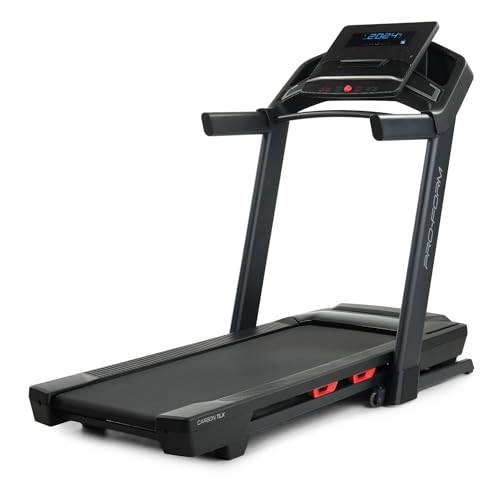
ProForm Carbon TLX Treadmill
What We Like
- 0-12% incline for varied terrain
- Folding frame saves floor space
- ProShox cushioning soaks up impact
Trade-offs
- iFIT membership required for auto-adjust features
- Heart rate monitor sold separately
The catch is that the smart features, like automatic speed and incline adjustments during iFIT workouts, require a paid membership, and the heart rate monitor that lets ActivePulse fine-tune your effort is sold separately. Compared to the SOLE F80, which has a 20″ x 60″ running deck, the ProForm Carbon TLX offers a different approach with its iFIT ecosystem. If you are happy to follow along with iFIT and value cushioning over simplicity, this is a comfortable, space-friendly way to log your miles.
Product photos
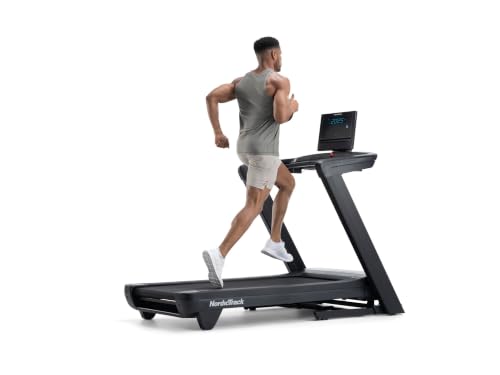
NordicTrack Commercial LE Treadmill
What We Like
- -3% decline targets new muscle groups
- RunFlex cushioning reduces joint impact
- Folds compact with assisted lowering
- SmartAdjust auto-adapts to your fitness
Trade-offs
- No integrated screen; requires your own device
- iFIT membership needed for auto-adjust features
- At 258 lb, moving it takes some effort
A -3% decline to 12% incline range gives this treadmill a capability you rarely find on home models, letting you simulate downhill running to vary your stride. The RunFlex cushioning absorbs shock during those descents, and the folding frame with assisted lowering makes storage manageable if you have room to move a 258-pound machine. Reviewers note the decline setting is a standout feature for runners who want to train on terrain that mimics real-world conditions.
There is no integrated screen, so you place your own tablet or phone on the device shelf to follow iFIT workouts. That setup keeps the price lower, but features like SmartAdjust and ActivePulse require an iFIT membership to function. Compared to the SOLE F80, which has a built-in display, this NordicTrack offers a wider incline range but depends on a subscription for its adaptive coaching. Best for runners who want decline training and don’t mind using their own device for guided workouts. Not ideal for anyone who prefers a built-in touchscreen without ongoing subscription costs.
Product photos
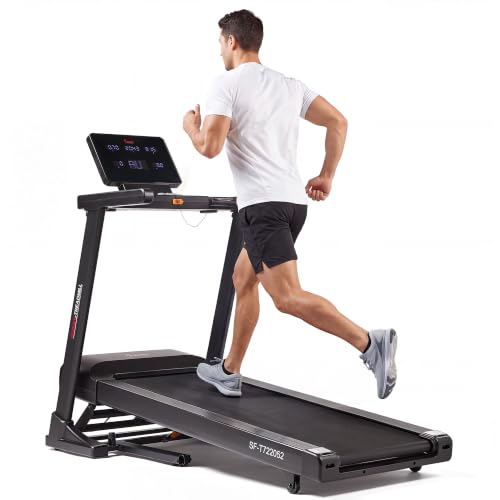
Sunny Health & Fitness Treadmill
What We Like
- 55 x 20-inch running surface for comfort
- 15 auto incline levels for varied intensity
- 24 personalized workout programs store routines
- Free SunnyFit app with 1,000+ trainer-led videos
Trade-offs
- At 167.6 lb, moving it takes effort
- No folding design for compact storage
- Pulse sensors, not chest strap accuracy
The real trade-off here is weight and portability. At 167.6 pounds, this is not a machine you will casually fold up and tuck away after each run, unlike the lighter NordicTrack T Series 5. That extra heft does give it a stable feel underfoot, so you are not bouncing around when you push the pace. If you have a dedicated corner for your cardio and want a treadmill with a spacious deck, incline variety, and app-connected workouts, this one delivers where it counts.
Product photos
BowFlex T16 Treadmill

What We Like
- Large 16-inch HD touchscreen for streaming
- Spacious 22×60 cushioned running deck
- Folding SoftDrop frame saves space
- Lifetime frame and motor warranty
Trade-offs
- At 295 lbs, it is heavy to move
- Requires JRNY subscription for full features
- No integrated heart rate chest strap included
At 295 pounds, this is a heavy machine that will need a dedicated spot or some effort to move, even with the folding design. For comparison, the Horizon Fitness 7.0AT weighs 257 pounds, so the BowFlex T16 is noticeably heavier. You’ll need a JRNY subscription to access adaptive workouts and connected features, and the treadmill relies on watch syncing or built-in sensors for heart rate tracking since no chest strap is included.
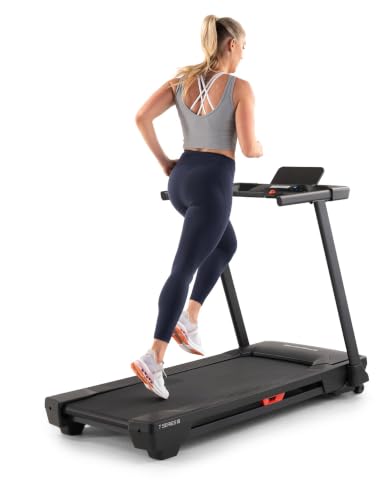
NordicTrack T Series 5 Treadmill
What We Like
- Lightweight at 130 lbs for easy placement
- KeyFlex Cushioning reduces joint impact
- 0-10% incline targets more muscle groups
- iFIT auto-adjusts speed and incline
Trade-offs
- 10 MPH top speed limits serious sprinters
- Requires iFIT membership for auto-adjust features
At just 130 pounds and with a length of 68.3 inches, this treadmill fits where bigger machines won’t, think apartment corners, spare rooms, or a spot near the window. The KeyFlex Cushioning softens each footstrike, so your knees and hips get a gentler ride during daily jogs or incline walks. It’s built for the runner who values space and joint comfort over raw speed, with iFIT’s SmartAdjust automatically tweaking the 0-10% incline to keep workouts challenging without you fiddling with buttons.
The trade-off shows up when you push past 10 MPH: interval sprinters and competitive runners will hit the ceiling early. Compared to the Horizon Fitness 7.0AT, which weighs nearly twice as much and offers a wider deck, the NordicTrack T Series 5 trades stability and top-end speed for easy portability and a smaller footprint. If your runs hover around a comfortable pace and floor space is precious, this compact design delivers exactly what it promises, a no-fuss treadmill that respects your joints and your square footage.
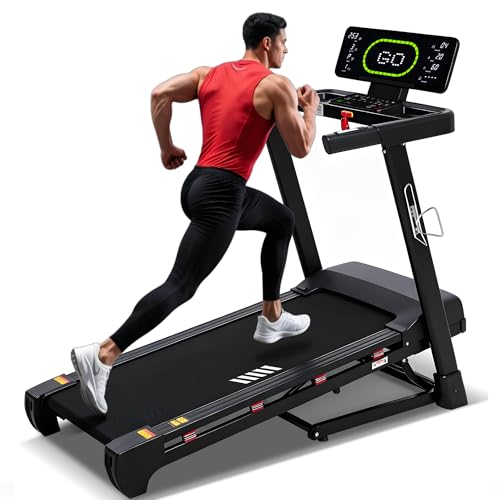
ECHANFIT Heavy Duty Treadmill
What We Like
- 500 lb weight capacity
- 20" wide running belt
- 20-level auto incline
- 8+6 shock absorption system
Trade-offs
- 128 lb weight makes moving it harder
- No integrated touchscreen for guided workouts
A 500-pound weight capacity and a 4.5 HP brushless motor set this treadmill apart for heavier runners or anyone who wants commercial-grade stability at home. The 20-inch wide belt gives you room to stride naturally, while the 20-level auto incline and 8+6 shock absorption system make hill workouts and joint-friendly running feel genuinely supported.
At 128 pounds, this machine is heavy enough that you’ll rely on the transport wheels and hydraulic fold to store it. The 50-inch deck length is shorter than the SOLE F80 or Horizon 7.0AT, which have longer decks. Still, for the price of entry into this weight class, the ECHANFIT delivers a stable, cushioned ride that heavier runners and incline fans will appreciate.
Product photos
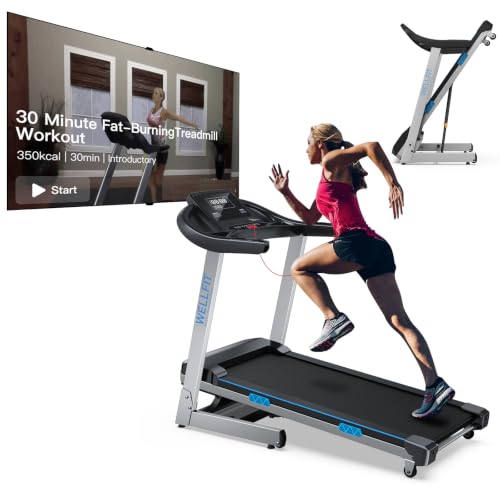
WELLFIT Home Treadmill
What We Like
- 400 lb weight capacity for stability
- Folds compact with soft-drop hydraulic system
- Noise under 45dB for quiet operation
Trade-offs
- 8.8 MPH max speed limits fast runners
- 18 x 43 in belt shorter than premium models
- Requires grounded outlet for safe operation
For apartment dwellers or home-office runners, the noise level is often the deciding factor. This model uses noise-reduction technology to keep operation under 45dB, which is quieter than a typical conversation. Owners report being able to run at any hour without disturbing family members or neighbors in adjacent units. The 4.0HP brushless motor also helps minimize sound while delivering steady power from 0.6 to 8.8 MPH, so you can walk, jog, or sprint without the whine or vibration common in lower-end machines. That combination of quiet operation and reliable speed makes it practical for shared living spaces where a loud treadmill would be a problem.
The trade-off is the 8.8 MPH top speed, if you’re chasing sub-6-minute miles, you’ll max out before you hit your stride. But for steady-state runs, incline work, and quiet operation at a weight that stays put, the WELLFIT delivers where it counts most.
ProForm Carbon Pro 9000 Treadmill

What We Like
- Pivoting 16" touchscreen for on- and off-treadmill workouts
- ProShox cushioning reduces joint impact
- Folding frame with wheels saves space
- Speed and incline shortcuts for quick adjustments
Trade-offs
- iFIT Pro Membership required for full screen features
- Bluetooth heart rate monitor sold separately for ActivePulse
The 16-inch pivoting touchscreen adjusts angle so you can see it during a run or while doing off-treadmill workouts like yoga or strength training. That flexibility makes this treadmill feel less like a single-purpose machine and more like a home gym hub. With speeds up to 12 MPH and a 0-12% incline, you have room to sprint, climb, and everything in between. The ProShox cushioning helps absorb impact, which can be easier on your joints. This one suits runners who want entertainment and variety built right into the deck, not just a belt and a display.
Here’s the honest trade-off: most of the smart features, streaming shows, automatic heart-rate adjustments, off-treadmill classes, require a paid iFIT Pro membership. If you are fine subscribing, the experience is rich and interactive. If you would rather avoid another monthly bill, the screen still shows your stats, but you lose the guided workouts and pivoting content. It is a great fit if you love guided training; less so if you just want to set your speed and run.
Product photos
How We Evaluated Treadmills For Running
We built this guide by studying manufacturer data sheets, reading expert round-ups from fitness publications, and analyzing patterns in thousands of owner reviews. Our goal was to separate machines designed for casual walkers from those built to handle the demands of regular running.
The four criteria that mattered most were deck size, cushioning technology, motor quality, and build stability. A 60-inch length is the minimum for a natural running stride, and good cushioning reduces joint impact over miles. Continuous-duty horsepower keeps speeds sustained, and a heavy frame doesn’t wobble at pace. For runners who need to save space, we also prioritized folding mechanisms that actually work.
A research-led evaluation has limits, we haven’t spent weeks on each machine ourselves. For a deeper look at our process, see our full treadmill reviews for runners.
What To Look For In Treadmills For Running
Choosing a treadmill for running means prioritizing the features that support your stride and protect your joints over the long haul. Here is what matters most.
Look for a continuous-duty motor of at least a certain horsepower, a 60-inch running deck, responsive cushioning, and a stable frame that stays solid at your top speed. Folding capability is a bonus if floor space is tight.
Deck Length and Width
A running deck that is too short forces you to shorten your stride, which throws off your form and increases injury risk. For most runners, a deck length of 60 inches is the minimum for a natural gait, while taller runners or those with longer strides benefit from 65 inches or more.
Width matters too, 20 inches gives you room to land without feeling confined, especially during longer runs when form starts to break down. The SOLE F80 and Horizon 7.0AT both offer the standard 20″ x 60″ size that serious runners need.
Cushioning and Impact Absorption
Every mile on a treadmill sends impact forces through your legs, and the right cushioning system can make the difference between a comfortable run and a painful one. Look for technologies like ProShox (found on the ProForm Carbon TLX) or RunFlex (on the NordicTrack Commercial LE) that absorb shock without making the surface feel mushy or unstable. Some machines offer adjustable cushioning, but a well-designed fixed system works fine for most runners. Pair your treadmill with proper running shoes for even better impact management.
Motor Power and Continuous Duty Rating
The motor is the heart of any running treadmill, and its continuous-duty horsepower (CHP) rating tells you how well it sustains speed over time. A motor with a CHP rating at a certain level is the baseline for regular running, while a higher CHP supports faster paces and heavier runners without overheating. Avoid peak horsepower ratings, they only measure short bursts. Machines like the BowFlex T16 and Horizon 7.0AT use motors that handle sustained running without strain.
Frame Stability and Weight Capacity
A treadmill that wobbles or shakes at speed is not just annoying, it is unsafe. Look for a frame weight of at least a certain amount for a non-folding model, and check the user weight capacity. Most running treadmills support 300 to 350 pounds, but the ECHANFIT Heavy Duty model goes up to 500 pounds for heavier runners.
If you are considering a folding machine, pay attention to the hinge mechanism and locked position, some designs feel less stable than a solid frame.
A good rule of thumb: if the treadmill feels light enough for one person to tip, it is probably not stable enough for serious running.
Treadmills For Running Compared
The table below compares the ten best treadmills for running side by side, highlighting deck size, key features, and what each model does best.
| Product | Speed Range | Incline Range | Running Surface |
|---|---|---|---|
| SOLE F80 Folding Treadmill | 12 MPH | 15 levels | 20" x 60" |
| Horizon Fitness 7.0AT Treadmill | 0.5-12 MPH | N/A | 20" W x 60" L |
| ProForm Carbon TLX Treadmill | 0-12 MPH | 0-12% | N/A |
| NordicTrack Commercial LE Treadmill | 0-12 MPH | 12% incline to -3% decline | N/A |
| Sunny Health & Fitness Treadmill | 0.6-12 mph | 15 auto incline levels | 55 x 20 inches |
| BowFlex T16 Treadmill | 0.5-12 MPH | 15% | 22" x 60" |
| NordicTrack T Series 5 Treadmill | 0-10 MPH | 0-10% | N/A |
| ECHANFIT Heavy Duty Treadmill | 0.6-12 MPH | 20 levels, auto | 50" x 20" |
| WELLFIT Home Treadmill | 0.6 to 8.8 MPH | 15% auto, 15 levels | 18 x 43 in |
| ProForm Carbon Pro 9000 Treadmill | 0-12 MPH | 0-12% | N/A |
Frequently Asked Questions
What size treadmill deck do I need for running?
A deck at least 60 inches long and 20 inches wide is the standard for comfortable running. Taller runners or those with long strides should look for 65 inches or more to avoid clipping the belt at the back.
Is a folding treadmill as stable as a non-folding one?
Non-folding treadmills are generally more stable because the frame is a single solid piece. However, quality folding models with secure locking mechanisms, like the SOLE F80, can feel very stable for most runners. The trade-off is weight and portability.
How much horsepower do I need for regular running?
A continuous-duty motor with a certain CHP rating is the baseline for regular running. For faster paces or heavier runners, a higher CHP provides better durability and less strain on the motor over time.
What is the difference between cushioning and shock absorption?
Cushioning refers to the surface feel, how soft or firm the belt is underfoot. Shock absorption describes how well the deck reduces impact forces traveling through your joints. A good running treadmill balances both: enough cushion to protect your knees, but not so much that it feels like running on sand.
Can I use my own running shoes on a treadmill?
Yes, but dedicated shoes for treadmill use are ideal because they have outsoles designed for the consistent, low-abrasion surface of a belt. Road running shoes work fine, but avoid worn-out trainers with uneven tread that can affect your stability.
The Bottom Line
For most runners, the SOLE F80 Folding Treadmill is the best choice because it combines a full-size cushioned deck, a built-in training screen, and a foldable design without crossing into commercial pricing. It works for distance runners, interval trainers, and anyone who wants a machine that feels spacious and stable mile after mile.
If your budget is tighter, the Sunny Health & Fitness Treadmill (our Best Budget Pick) gives you a 55-inch deck and 15 incline levels at a much lower price point. For runners who want heavy-duty stability and app connectivity without a screen, the Horizon Fitness 7.0AT is a rock-solid alternative that connects to Peloton and Zwift.
The single most important factor when buying a treadmill for running is deck length. A belt that is too short will compromise your stride and increase injury risk no matter how many fancy features the machine has. Start with the right size, then layer in cushioning, motor power, and extras.
