
10 Best Treadmills For Trail Runners in 2026
This post contains affiliate links. As an Amazon Associate, we earn from qualifying purchases.
For trail runners, the treadmill is a training partner, not a punishment. The NordicTrack Commercial 2450 Treadmill wins as best overall because its -3% decline to 12% incline range and iFIT SmartAdjust tech let you simulate rolling terrain without constantly tapping buttons. The Renestar Treadmill with Auto Incline is our pick for steep climbs, and the BowFlex T16 offers the widest deck for a stable stride.
The problem with most home treadmills is they were designed for flat roads. Trail runners need incline variety, responsive cushioning that mimics soft dirt, and a deck long enough for a natural stride. Too many machines max out at a 12% grade or lack any decline, leaving you underprepared for race day.
This guide is built from manufacturer specs, owner feedback patterns, and expert round-ups of what makes a treadmill trail-worthy. We focused on incline range, deck dimensions, cushioning, and connectivity for app-based training. These ten picks cover everything from budget-friendly foldables to premium terrain simulators.
Top 10 Treadmills For Trail Runners in the Market
Certain content that appears on this site comes from Amazon. This content is provided "as is" and is subject to change or removal at any time.
The Best Treadmills For Trail Runners, Reviewed
NordicTrack Commercial 2450 Treadmill

What We Like
- iFIT SmartAdjust auto-tunes speed and incline
- RunFlex cushioning reduces joint impact
- -3% decline to 12% incline range
Trade-offs
- At 268.2 lb, tough to move upstairs alone
- Auto-adjust features require iFIT Pro Membership
A 12% incline and a -3% decline range let you tackle both uphill and downhill gradients during a single workout. That range, combined with RunFlex cushioning that provides shock absorption and joint support, makes this treadmill well suited for runners who want varied terrain training at home. The 24-inch tilting touchscreen can be adjusted for running or for off-treadmill classes like yoga and strength, so you can switch workout types easily. If you want a machine that offers a wide incline range and joint-friendly cushioning, this model delivers those features.
At 268.2 pounds, this treadmill is a substantial piece of equipment that most people will want help moving up or down stairs. The folding frame and integrated wheels make it easier to reposition within the same floor. The folding design allows the deck to lift and lock, reducing the footprint when not in use, and the foot bar provides controlled, assisted lowering for safe setup. This weight also contributes to stability during high-speed runs or steep inclines, so the machine stays planted on the floor rather than shifting or wobbling during intense intervals.
Product photos
Renestar Treadmill with Auto Incline

What We Like
- 25% auto incline for steep climbs
- Extra-wide 17.7" belt for stride room
- 6 shock absorbers reduce joint impact
- Quiet 3.5 HP brushless motor
Trade-offs
- Short 47.3" belt length limits long strides
- 112 lb weight makes it less portable
- No built-in subscription training platform
A 25% auto incline is the standout here, steeper than most home treadmills, which matters if you want to simulate serious mountain grades without leaving your living room. The 3.5 HP brushless motor stays quiet enough for early morning runs, and the 17.7-inch-wide belt gives you room to adjust your footing on those steep pushes. Six shock absorbers soften each landing, so your knees won’t punish you the next day.
BowFlex T16 Treadmill

What We Like
- 22" x 60" extra-wide cushioned deck
- 375 lb user capacity for stability
- 15% motorized incline for hill training
- Lifetime frame and motor warranty
Trade-offs
- At 295 lb, very heavy to move
- Folding design still takes substantial floor space
The trade-off is that this treadmill weighs 295 pounds, so moving it around the house is a two-person job. Compared to the NordicTrack Commercial 2450, which weighs 268.2 pounds, the BowFlex T16 is heavier, which can make it more stable during intense runs but less convenient if you plan to shift it between rooms. The folding SoftDrop frame helps reclaim some floor space when not in use, but the footprint is still substantial. If you have a dedicated home gym space and want a wide, stable deck for varied pace and incline training, this treadmill delivers.
SOLE F63 Folding Treadmill

What We Like
- Generous 20×60 cushioned deck
- Quiet brushless motor with 15 incline levels
- Folds compactly with hydraulic assist
- Bluetooth connectivity and USB-C charging
Trade-offs
- No built-in touchscreen for trail simulation
- Curbside delivery only; assembly not included
A 20 by 60 inch cushioned deck gives you room to stride comfortably, with 18mm of padding that reduces impact on your joints. The brushless motor runs quietly up to 12 mph, so you can push the pace without disturbing others. Fifteen incline levels let you add challenge for walking or running, all controlled through simple dials on the hand grips.
The trade-off is that there is no built-in screen for virtual workouts, so you will rely on your own tablet propped on the included holder or the SOLE+ app for entertainment. Curbside delivery means you will need to get it inside and assembled yourself, but the kick-release folding mechanism and transport wheels make storage manageable once it is set up. For runners who prioritize deck size and incline range over interactive features, this is a practical, no-nonsense pick.
Horizon Fitness 7.0AT Treadmill

What We Like
- Connects to Apple Watch and iPhone iOS 27
- Works with Peloton, Strava, and Zwift
- QuickDial speed and incline controls
- 3-Zone Variable Response Cushioning
Trade-offs
- At 257 lbs, moving it is a two-person job
- No built-in touchscreen for standalone streaming
A 20-by-60-inch cushioned deck with 3-Zone Variable Response Cushioning gives you a forgiving surface that mimics the give of soft trail underfoot. That means your joints don’t take the full hit of road-like pounding. This treadmill suits trail runners who want to keep their fitness apps in the loop: it syncs securely with an Apple Watch or iPhone iOS 27 and connects to Peloton, Strava, and Zwift, turning indoor miles into data your outdoor training can actually use. The QuickDial controls let you nudge speed or incline mid-stride without fumbling, which matters when you’re trying to match a virtual climb.
The Horizon Fitness 7.0AT connects to your own devices for classes or trail simulations, so you don’t pay for a built-in touchscreen you may not need. At 257 pounds, it’s heavy enough to stay planted during a hard run, but you’ll want a friend to help move it into place. Runners who already use an app like Peloton or Zwift will find the setup straightforward and screen-free.
NordicTrack T Series 10 Treadmill

What We Like
- Adjustable SelectFlex cushioning for joint comfort
- 10" tilting touchscreen for optimal viewing
- Folding frame with assisted lowering saves space
- ActivePulse auto-adjusts speed and incline with HR
Trade-offs
- 245 lb weight makes relocation a two-person job
- 12% max incline is lower than trail-grade hills
- iFIT Pro membership needed for auto-adjust features
A 10-inch tilting touchscreen and adjustable SelectFlex cushioning let you dial in comfort whether you are walking, jogging, or running. The cushioning range helps protect joints on recovery days while still offering a firm deck for faster work. The folding frame with assisted lowering and wheels makes it easy to store in a small space, which is practical for anyone short on floor area. This treadmill suits runners who need a compact, versatile machine that adapts to different training moods without dominating the room.
The 12 percent incline is fine for gentle grades, but those training for very steep hills may find the range limiting. The 245-pound weight means you will want a second person to help move it into place. Compare that with the NordicTrack Commercial 2450, which offers a 15 percent incline, but at the cost of a bigger footprint and a heavier frame. For the runner who values foldability and adjustable cushioning over extreme grades, this model hits a smart balance.
MERACH Treadmill with Incline
What We Like
- Hydraulic folding system stores in 30 seconds
- 12 shock absorbers cushion each stride
- Ultra-thick steel frame for stability
- Syncs with MERACH app for coach plans
Trade-offs
- 6% max incline is mild for steep trail simulation
- 7.5 MPH top speed limits fast trail intervals
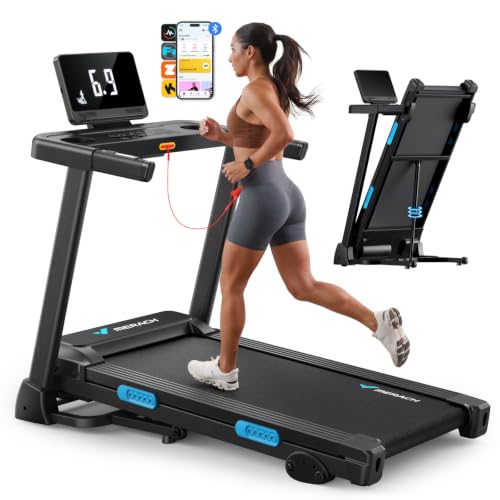
A 2.5 HP brushless motor paired with a 42.5-inch belt and 12 shock absorbers means this machine is built to handle steady hill repeats without rattling your knees or your apartment floor. The three preset incline modes. Steady-State Climb, Power Hiking, and Hill Sprints, are listed in the product features, though the max grade tops out at 6 percent. That makes it a smart fit for runners who want a compact, easy-to-store trainer for base-building and moderate incline work, especially if floor space is tight. The hydraulic folding system gets it upright in half a minute, so you can reclaim your living room between sessions.
A 7.5 MPH top speed and 6 percent manual incline cap the intensity for runners who need steep grades or faster paces. The three adjustable incline levels and three professional modes. Steady-State Climb, Power Hiking, and Hill Sprints, simulate outdoor terrain for lower-body strength and cardio. This design suits walkers, joggers, and those new to incline training, but it won’t replace a machine with a 15 percent auto incline or 12 MPH capability for advanced interval work.
Product photos
Sunny Health & Fitness Auto Incline Treadmill
What We Like
- Fully assembled out of the box
- 20-inch wide running surface
- 15 auto incline levels
- Quiet brushless motor
Trade-offs
- 53-inch deck is short for long strides
- No built-in fan or touchscreen
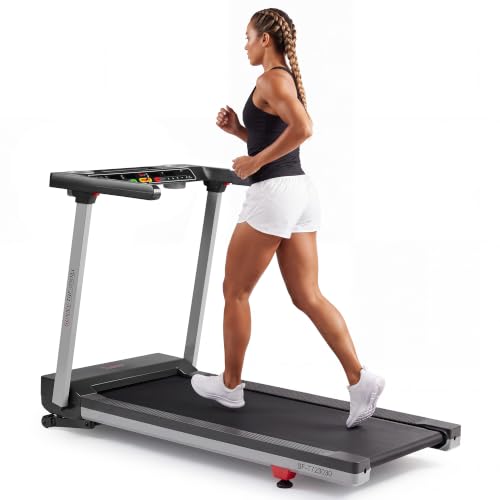
A 20-inch wide running surface is a rare find at this size, giving you room to open your stride without feeling cramped. That width, combined with 15 auto incline levels that go up to 15%, means you can simulate rolling trail terrain right in your living room. The fully assembled design is the real standout here, just raise the handlebar and you are ready to run. No wrestling with screws, no confusing instructions, no hour-long setup sessions. For someone who wants to spend their energy on the workout, not the assembly, this is a refreshing change of pace.
The trade-off comes with the 53-inch running deck. At that length, taller runners or anyone with a long gait will find their footfalls creeping close to the rear edge during faster paces. Still, if you value instant setup and a wide belt that lets you focus on incline work, this treadmill delivers exactly that.
Product photos
THERUN Treadmill Folding Incline

What We Like
- 400 lb weight capacity for larger runners
- 16% auto incline mimics steep trails
- Wide 17" belt for elbow room
- Hydraulic folding with transport wheels
Trade-offs
- Short 47.2" deck limits long strides
- 10 MPH top speed slower than trail sprints
- 145 lb unit still heavy to move upstairs
The THERUN treadmill supports up to 400 lbs, making it a sturdy option for heavier runners or anyone who wants a solid platform. Its 4.0 HP motor and 16% auto incline allow you to tackle steep grades without losing momentum, and the 17-inch wide belt gives elbows and feet room to move naturally. If you need a machine that can handle heavy use without feeling flimsy, this model delivers the key specs for serious incline work.
The trade-off is a 47.2-inch running deck, which is shorter than the 60-inch decks on the BowFlex T16 or SOLE F63. Runners with a long stride may find themselves creeping toward the back at higher speeds.
Product photos
WELLFIT Home Treadmill with Auto Incline
What We Like
- 15 auto incline levels mimic terrain
- 400 lb capacity with reinforced frame
Trade-offs
- 8.7 MPH max speed limits fast trail reps
- 43" belt length short for long strides
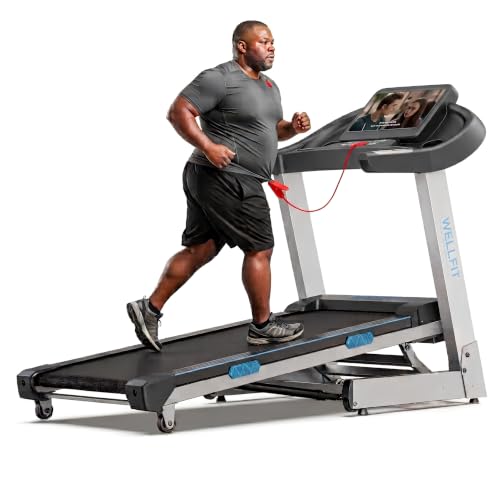
A brushless motor that stays under 45dB means you can run early morning or late evening without waking the household. The 15-level auto incline and voice control let you adjust slope intensity hands-free, while the 400-pound capacity and 8-layer cushioning keep the deck stable and forgiving on joints. For runners who value discretion and joint protection over raw speed, this treadmill fits neatly into shared living spaces.
The incline range is generous for hill work, but the belt length means you’ll adjust your gait on quicker intervals. If you prioritize noise-free, space-saving training with real incline variety, the WELLFIT delivers; if you need a full-length stride at higher speeds, the NordicTrack suits better.
Product photos
How We Evaluated Treadmills For Trail Runners
We started with the specs that matter most to trail runners: incline and decline range, belt length and width, cushioning systems, and motor quality. Each product was checked against manufacturer documentation for its maximum grade, deck dimensions, and weight capacity. We then cross-referenced those numbers with patterns in owner feedback to separate marketing claims from real-world performance.
The four criteria that carried the most weight were incline range, belt length, cushioning tech, and smart features. Incline needed to reach at least 12% for meaningful hills, with decline a major bonus. Belt length of 60 inches was preferred for full strides. Cushioning tech had to provide shock absorption that protects joints on high-impact landings. Smart features like auto-adjust speed and incline allow hands-free terrain simulation. Trail runners also needed machines that could handle varied paces, from steep power hikes to flat recovery jogs.
This is a research-led evaluation, not a hands-on test. We relied on published specifications, expert consensus on trail training needs, and aggregated owner experiences. The goal was to identify which treadmills give trail runners the best chance to replicate outdoor conditions indoors.
What To Look For In Treadmills For Trail Runners
When choosing a treadmill for trail running, prioritize terrain features over gym-style flat running. The right machine will let you train for elevation gain, technical descents, and varied pacing without leaving home.
Look for at least 12% max incline, a 60-inch belt, responsive cushioning, and smart connectivity for app-based training. Decline capability is a major bonus for downhill practice.
Incline and Decline Range
Trail running is defined by elevation change. A treadmill with a 12% max incline is the minimum for meaningful hill work, but 15% or more is better for steep trail grades. Decline capability, even just -3%, lets you practice controlled descents, which saves your quads on race day. The NordicTrack 2450’s -3% to 12% range is the widest in this group, while the Renestar hits 25% for serious climbing.
Belt Length and Width
A short deck forces you to shorten your stride, which changes your running mechanics. Trail runners need at least a 60-inch belt length for natural strides at speed. Width matters too: a 20-inch or wider deck gives you room to shift your foot placement, mimicking the uneven terrain of trails. The BowFlex T16’s 22 x 60-inch deck is the most generous here, while compact models like the WELLFIT sacrifice length for portability.
Cushioning and Shock Absorption
Trail running pounds your joints on descents and uneven ground. A good cushioning system absorbs impact without feeling mushy or unstable. Look for adjustable cushioning (like NordicTrack’s SelectFlex or Horizon’s 3-Zone system) that lets you dial in a firmer or softer feel. The MERACH’s 12 shock absorbers and the Renestar’s 6 shock absorbers show that more cushioning points can mean better joint protection.
- Check the belt length: 60 inches is ideal for a full stride.
- Confirm the max incline: at least 12%, with decline a bonus.
- Look for adjustable or multi-zone cushioning.
- Verify the motor is quiet enough for home use.
- Check weight capacity against your body weight plus gear.
A trail runner’s treadmill should feel like a dirt path, not a highway.
Treadmills For Trail Runners Compared
The table below compares our ten picks across the specs that matter most for trail training: incline range, belt size, cushioning, and connectivity.
| Product | Motor Speed | Incline Range | Running Deck |
|---|---|---|---|
| NordicTrack Commercial 2450 Treadmill | 0-14 MPH | -3% to 12% | N/A |
| Renestar Treadmill with Auto Incline | N/A | 0-25% Auto | 47.3" x 17.7" |
| BowFlex T16 Treadmill | 0–12 MPH | 0-15% | 22" x 60" |
| SOLE F63 Folding Treadmill | up to 12 mph | 15 levels | 20 x 60 in |
| Horizon Fitness 7.0AT Treadmill | 0.5 – 12 MPH | N/A | 20" x 60" |
| NordicTrack T Series 10 Treadmill | 0-12 MPH | 0-12% | N/A |
| MERACH Treadmill with Incline | 0.5-7.5 MPH | 0-6% Manual (3 levels) | 42.5" x 16.5" |
| Sunny Health & Fitness Auto Incline Treadmill | 10 MPH | 15% | 20" x 53" |
| THERUN Treadmill Folding Incline | 0.6 MPH to 10 MPH | 0% to 16% | 47.2" x 17" |
| WELLFIT Home Treadmill with Auto Incline | 1.0-8.7 MPH | 15 levels | 18" * 43" |
Frequently Asked Questions
What incline should a treadmill have for trail running?
At least 12% to simulate moderate hills, with 15% or more preferred for steep trail grades. Decline capability, even -3%, is a major advantage for downhill practice.
Can I use a regular treadmill for trail training?
A regular treadmill works for flat base miles, but you will miss the incline and decline variety that builds trail-specific strength. A machine with at least 12% incline and responsive cushioning is better.
How long should the treadmill deck be for trail running?
A 60-inch belt is ideal for natural strides at varied paces. Shorter decks force you to shorten your stride, which can throw off your trail running form.
Do I need a subscription for trail simulation features?
Some treadmills, like the NordicTrack 2450, require a paid iFIT membership for auto-adjust incline and speed features. Others, like the Horizon 7.0AT, let you connect free apps like Zwift or Strava without a subscription.
What is the best cushioning for a trail running treadmill?
Adjustable cushioning systems, like NordicTrack’s SelectFlex or Horizon’s 3-Zone Variable Response, let you switch between a firm feel for speed work and a softer feel for recovery runs. More shock absorbers generally mean better joint protection.
The Bottom Line
The NordicTrack Commercial 2450 Treadmill is the best overall pick for trail runners who want the widest terrain range and hands-free incline and decline adjustments. It is ideal for runners who plan to use the iFIT platform for guided trail simulations and do not mind the subscription cost.
If your budget is tighter, the SOLE F63 Folding Treadmill delivers a spacious 20 x 60-inch cushioned deck and reliable incline without a touchscreen. For steep climbing focus, the Renestar’s 25% auto incline is unmatched in this group. Apartment dwellers should look at the NordicTrack T Series 10 for its compact fold and SelectFlex cushioning.
The single most important factor for a trail runner is incline range. A machine that tops out at 10% will not prepare you for real hills. Prioritize at least 12% incline, a 60-inch belt, and cushioning that protects your joints on high-impact descents. Your knees will thank you on race day.
