
Beta Alanine Tingling Explained: Why It Happens
This post contains affiliate links. As an Amazon Associate, we earn from qualifying purchases.
Beta alanine tingling explained: the supplement activates MrgprD receptors on skin nerve endings, so a single dose above roughly 800 mg produces a harmless prickling that peaks within minutes and clears in 60 to 90 minutes. It isn’t an allergic reaction, and antihistamines won’t touch it.
MrgprD sits on a small set of nerve fibers that only innervate skin, which is why the sensation stays put rather than spreading through your whole body. Those fibers don’t respond to histamine at all, so the itch and the prickling run on a completely separate circuit from a mosquito bite.
What follows covers the two dose thresholds the experts can’t agree on, why a 3.2 g scoop is usually the real culprit, what sustained-release actually buys you, and the group that should skip beta-alanine entirely.
Key Takeaways
- The tingle is a nerve signal, not an allergy. Beta-alanine activates MrgprD receptors directly, and no antihistamine will blunt it.
- Two bodies draw the single-dose line in different places. The ISSN says above 800 mg; the Norwegian VKM report says 10 mg/kg of body weight, roughly 700 mg at 70 kg.
- Splitting the dose is the cheapest fix. The ISSN points to divided lower doses of 1.6 g, and VKM found intakes of 5 mg/kg or less spaced more than two hours apart didn’t trigger it.
- Slow release reduces the tingle but doesn’t erase it. Nine of ten subjects in a 2023 trial still reported paresthesia on a sustained-release formula.
- No long-term safety data exists past one year. That’s the position stand’s own wording, not a scare line.
Beta Alanine Tingling Explained: What Your Skin Is Actually Doing
MrgprD is a receptor that sits on a small population of nerve fibers, and those fibers only innervate skin.
Beta-alanine binds and activates MrgprD, a G-protein-coupled receptor on a subpopulation of small-diameter sensory neurons that innervate the skin. In human testing, intradermal beta-alanine produced itch without a wheal or flare, which points to a histamine-independent pathway rather than a classic allergic response. L-alanine, which cannot activate the receptor, produced weak, transient itch in only five of eleven subjects.
That last detail is the one that settles the argument. If this were an allergy, you’d see a raised welt and a red flare around the injection site. The work on mechanisms of itch evoked by beta-alanine found neither, in any subject, at any dose.
So what does it actually look like? Nothing. You can stare at your forearm while it prickles and see perfectly normal skin.
That’s why the “beta-alanine flush” comparison to niacin falls apart. Niacin causes visible widening of blood vessels. This causes no visible change at all, because the signal is traveling along a nerve, not through your circulation.
A pre-workout ingredient guide is worth ten minutes before you buy anything, because beta-alanine is rarely the only active in the tub and the tingling is rarely the only thing you’ll notice.
The Dose Threshold the Experts Do Not Agree On
One number, 800 mg, gets repeated everywhere, but the Norwegian committee that reviewed the same data landed at 10 mg/kg of body weight, roughly 700 mg at 70 kg.
Where the 800 mg Figure Comes From
The ISSN beta-alanine position stand states that single non-sustained-release doses above 800 mg trigger paresthesia, and that the symptoms resolve within 60 to 90 minutes.
Where the 10 mg/kg Figure Comes From
VKM, the Norwegian Scientific Committee for Food Safety, published its own risk assessment in 2017. Their line sits at 10 mg/kg of body weight, which works out to roughly 700 mg in a 70 kg adult.
Same phenomenon, different units, slightly different cutoff. Neither body merged the two, and neither should you.
| Source | Single-dose threshold | What it means for your scoop |
|---|---|---|
| ISSN position stand (2015) | Above 800 mg, non-sustained-release | Split it or buy sustained-release |
| VKM report (2017) | 10 mg/kg body weight or more | Roughly 700 mg at 70 kg |
| Advances in Nutrition review | Many products pack 3.2 g per scoop | Well past both thresholds |
That third row is where most people actually live. A systematic risk assessment and meta-analysis in Advances in Nutrition noted that plenty of pre-workout products bundle 3.2 g or more into a single scoop, which clears the ISSN line four times over and blows past the VKM per-intake ceiling as well.
Common mistake: Judging a pre-workout by the total beta-alanine in the tub instead of the amount in one scoop. A 3.2 g serve is four times the ISSN single-dose threshold, and you’ll feel it in your ears before your first working set.
If you want the tingle without the guesswork, a pre-workout with beta-alanine at least tells you what you’re getting into.
How Do You Load Beta-Alanine Without the Prickling?
Three numbers matter here: 4 to 6 g a day, 2 g or less per dose, and a two-week minimum.
Before you start: Beta-alanine isn’t a stimulant, but it isn’t nothing either. Keep single doses at 2 g or less as the ISSN recommends for loading, and if you’re under 18, the VKM review only covers 1000 to 2000 mg a day under a 5 mg/kg-per-two-hours rule. If you take any prescription medication or manage a chronic condition, run this past a clinician before you start loading.
The ISSN stand is specific about the shape of a loading phase. It calls for 4 to 6 g daily in divided doses of 2 g or less, held for at least two weeks, which produces a 20 to 30 percent increase in muscle carnosine. Push to four weeks and the increase lands at 40 to 60 percent.
- Split the daily total into doses of 2 g or less. The position stand sets that ceiling, and a 6 g day split into four 1.5 g hits keeps you comfortably under it. One big bolus gives you a spike instead of a load.
- Take each dose with a meal. The ISSN notes that combining beta-alanine with food during loading further augments muscle carnosine levels. Skip the meal and you leave part of the response on the table.
- Hold the schedule for two weeks minimum. Two weeks gets you the 20 to 30 percent rise. Four weeks gets you 40 to 60 percent. Quit at day ten and you’ve paid the tingling tax for nothing.
- Keep doses more than two hours apart. That’s the VKM rule, and it’s stricter than the ISSN’s. Repeated intakes of 5 mg/kg or less, spaced more than two hours apart, did not induce paresthesia in their review.
- Plan the washout before you need it. Carnosine takes 6 to 15 weeks to return to baseline after you stop. If you’re timing a loading block around a competition, work backwards from the date.
On the safety side, VKM found a ceiling of 6.4 g a day for up to seven weeks in 80 kg adults produced no adverse clinical effects, and hematology and chemistry stayed normal at 2.8 g and 3.2 g a day over four weeks.
A pre-workout dosing guide helps if you’re stacking this with caffeine and everything else in a scoop.
Does Sustained-Release Beta-Alanine Actually Reduce the Tingle?
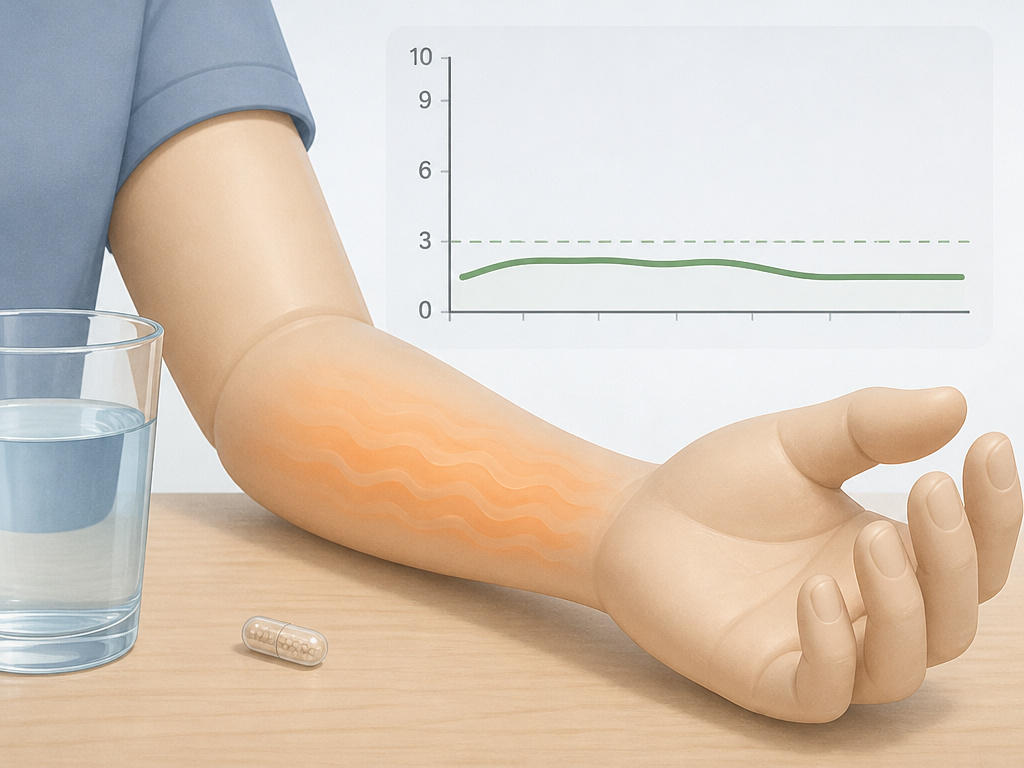
Nine of ten subjects in the 2023 sustained-release trial still reported paresthesia.
What the 2023 Trial Actually Measured
The sustained-release beta-alanine paresthesia trial ran 15 g a day split into three 5 g intakes over 30 days. Nine of the ten experimental subjects reported paresthesia, but only one of nine exceeded 3 out of 10 on the visual analogue scale, and that one scored 5.9.
Eight people called it tickling. One called it a needle prick.
That’s the useful part. The sensation arrived, but it stayed mild for almost everyone, and the worst of it was over before the session got going.
The ISSN stand says paresthesia can be attenuated with a sustained-release formula, while the 2023 trial reports that a sustained-release formulation substantially reduces paresthesia versus an equivalent immediate-release dose. The disagreement is about how much, and the trial’s own numbers show it doesn’t eliminate the sensation, it just flattens it.
The work on slow-release beta-alanine absorption kinetics looks at the same question from the absorption side rather than the symptom side.
Where this goes sideways: The 2023 trial also recorded statistically significant within-group rises in serum triglycerides, LDL-cholesterol and urea nitrogen in the beta-alanine arm, with no between-group difference. The position stand doesn’t carry that caution. It’s a reason to get bloodwork done if you’re running long loading blocks, not a reason to panic.
If you’d rather sidestep the whole question, avoiding beta-alanine tingling by choosing a different tub is a legitimate move.
When Beta-Alanine Is the Wrong Tool
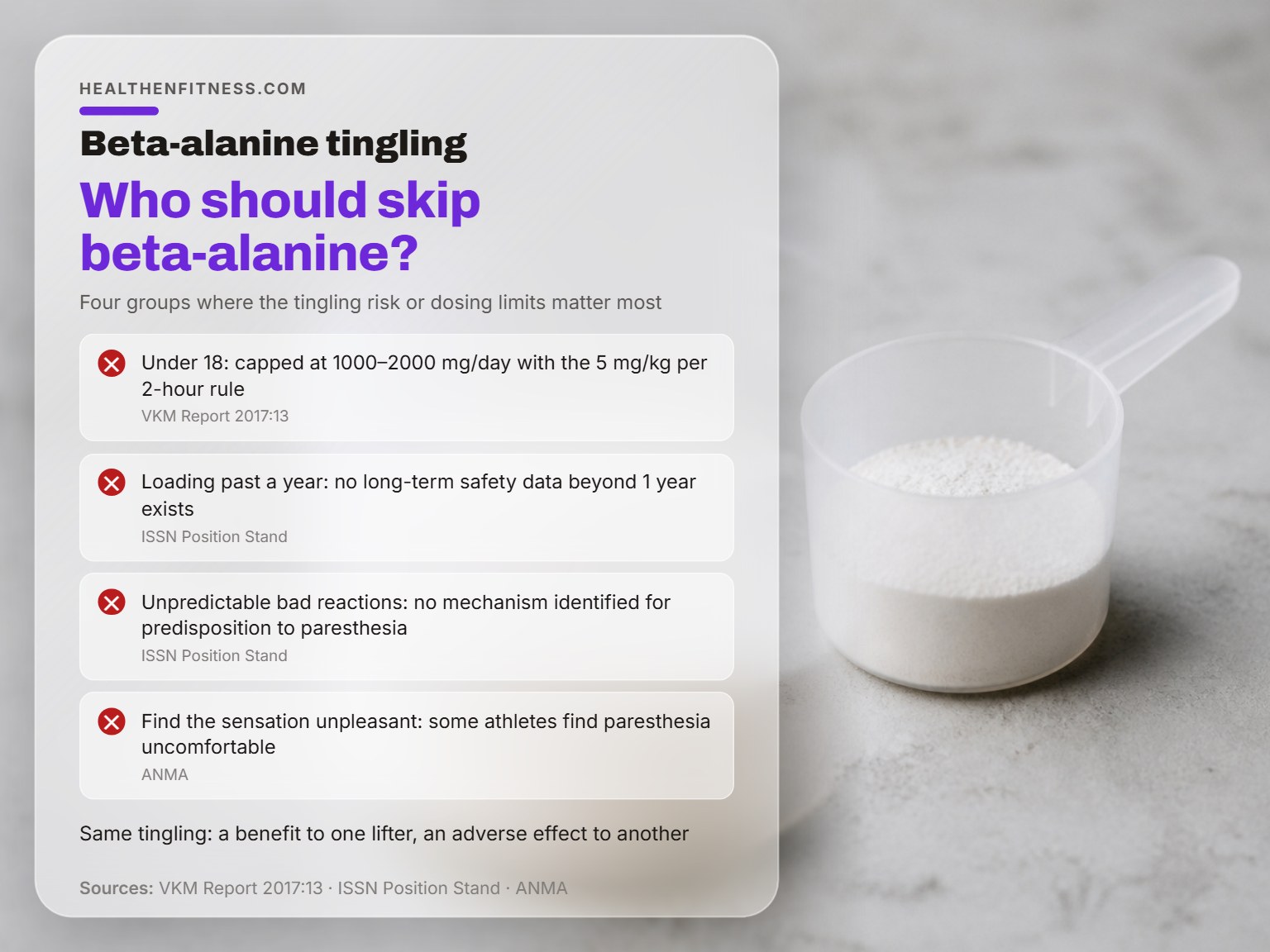
Some people should skip this entirely.
The VKM review is the clearest on age. Children under 10 fall outside its scope completely, and ages 10 to under 18 are only covered at 1000 to 2000 mg a day under the 5 mg/kg-per-two-hours rule. If you’re a teenager reading this, that’s your ceiling, and it’s lower than the adult loading range.
- Under 18: capped at 1000 to 2000 mg a day in the VKM framework, with the same spacing rule.
- Anyone planning a loading block past a year: the position stand states plainly that no long-term safety data beyond one year exists.
- People who react badly and can’t predict it: the ISSN notes that no mechanism has been identified for individual predisposition to paresthesia. You find out by trying it.
- Anyone who finds the sensation unpleasant: some athletes report that paresthesia improves their affective response to exercise, while others find it uncomfortable. Both reactions are documented.
That last bullet matters more than it sounds. The same sensation gets filed as a benefit by one lifter and an adverse effect by another, and no product label captures that split.
The beta-alanine safety narrative review is a reasonable next read if you want the wider picture.
Skip this if: You’re in your first six months of training. Nothing about beta-alanine fixes inconsistent sessions, and the tingling is one more variable to worry about while you’re still learning what effort feels like.
What to Do If the Tingle Bothers You
I once took a sample scoop of pre-workout on an empty stomach before a Saturday session and spent the first ten minutes of the warm-up rubbing my ears like a man trying to remember a phone number. Nothing was wrong. It just felt like my skin had opinions.
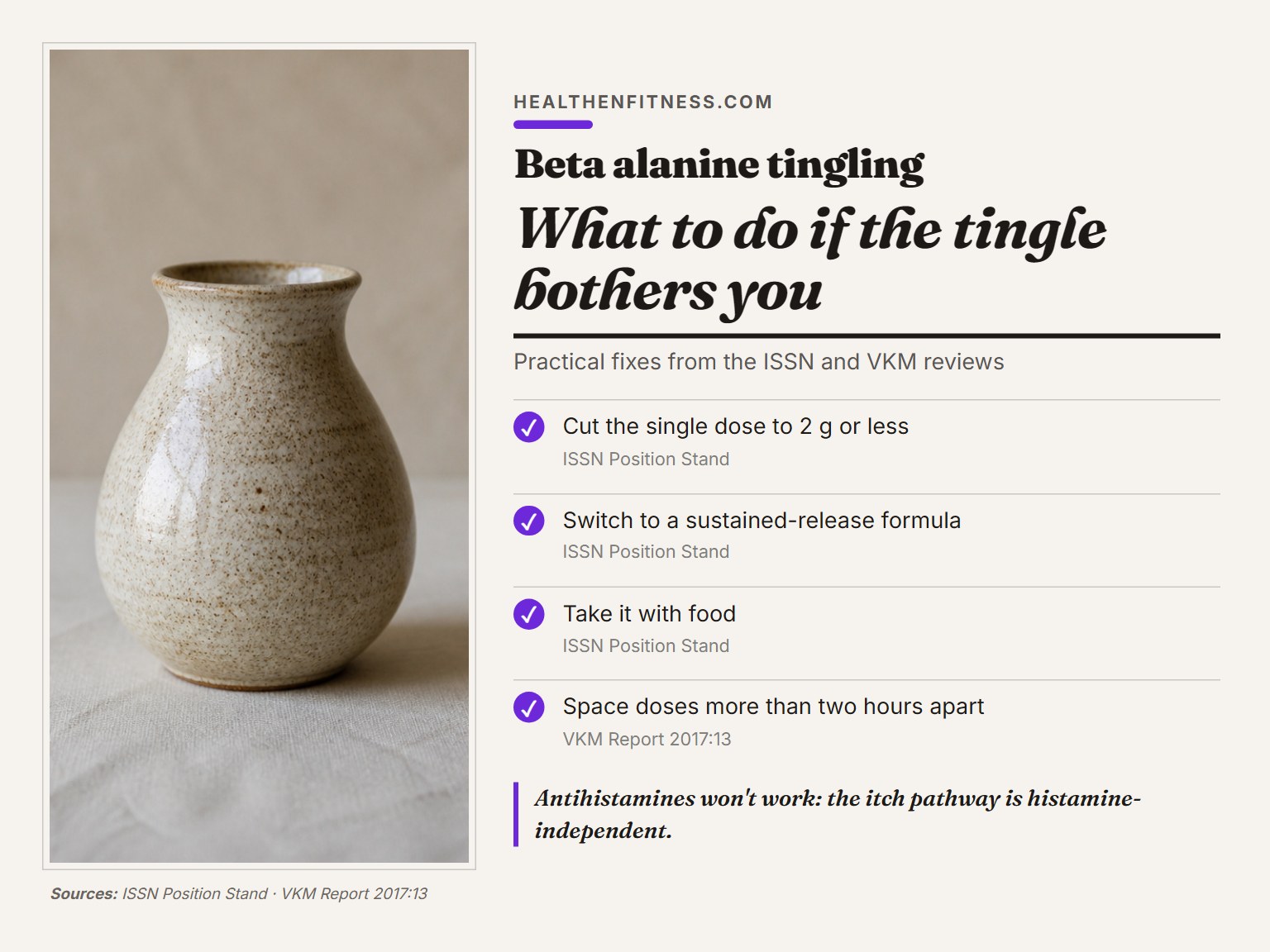
Here’s what actually helps, in order of how much difference it makes.
- Cut the single dose to 2 g or less. This is the big one, and it’s free.
- Switch to a sustained-release formula. It flattens the peak rather than removing it.
- Take it with food. The ISSN found this augments carnosine anyway, so you’re not sacrificing anything.
- Space doses more than two hours apart. The VKM rule, and it held up in their review.
- Stop taking antihistamines for it. They won’t work, and you’ll just be drowsy.
| What you notice | Likely cause | What to do |
|---|---|---|
| Prickling minutes after a scoop | 3.2 g or more in one hit | Split into 2 g or less |
| You want to scratch the itch | MrgprD pathway, no histamine | Skip the antihistamine |
| Nothing happens at all | Dose under your personal threshold | Nothing needs fixing |
| Still tingling at 90 minutes | Top of the normal window | Wait it out |
A pre-workout without jitters is worth considering if the caffeine half of the tub is the part you actually wanted.
Frequently Asked Questions
How long does beta alanine tingling last?
The ISSN position stand puts resolution at 60 to 90 minutes. Sensations peak within the first few minutes and then decline slowly, so the sharpest part is usually over well before the hour mark.
Is beta alanine tingling dangerous?
The position stand calls paresthesia the only reported side effect and describes supplementation as safe in healthy populations at recommended doses. VKM found no adverse clinical effects at 6.4 g a day for up to seven weeks in 80 kg adults. The 2023 sustained-release trial did flag within-group lipid and urea nitrogen changes as worth further study.
Will an antihistamine stop the tingle?
No. The pathway is histamine-independent, and human testing produced itch with no wheal or flare. An antihistamine targets a mechanism that isn’t involved here.
Does splitting the dose stop the tingling?
It reduces it substantially. The ISSN points to divided doses of 1.6 g, and VKM found that repeated intakes of 5 mg/kg or less, spaced more than two hours apart, didn’t induce paresthesia at all.
Does slow-release beta alanine eliminate the tingling?
It reduces it, and the 2023 trial shows it doesn’t remove it. Nine of ten subjects on a sustained-release formula still reported paresthesia, though only one of nine scored above 3 out of 10.
How long does beta alanine stay in your system?
Muscle carnosine takes 6 to 15 weeks to return to baseline after you stop supplementing, according to the position stand. The tingling itself clears in 60 to 90 minutes.
The Bottom Line
If a single dose in your tub tops 800 mg, the ISSN says you’re going to feel it, while VKM puts the threshold at 10 mg/kg of body weight, roughly 700 mg at 70 kg. No amount of water, food or antihistamine changes that, because the fix is arithmetic rather than willpower.
None of this matters much if you’re under 18 or you’ve never trained consistently. The VKM review only covers ages 10 to under 18 at 1000 to 2000 mg a day, and the position stand is explicit that there’s no long-term safety data past one year.
So here’s my honest take, and it’s an opinion rather than a finding: I’d rather see a beginner spend six months on sleep, food and three full-body sessions a week than on any tub. If you’re past that point and you want one supplement to spend money on, creatine is the one I’d pick first.
That’s beta alanine tingling explained as short as I can make it: a nerve signal, a dose threshold, and a clock. Today, just read the beta-alanine line on whatever tub is in your cupboard and divide it by the number of scoops you actually take.
