Bootcamp Class for Beginners: How to Start Right
This post contains affiliate links. As an Amazon Associate, we earn from qualifying purchases.
A bootcamp class for beginners works best when you pick an all-levels session, start at two days a week, and scale every movement to a version you can repeat. Expect a circuit of bodyweight strength, cardio intervals, and core work, with rest built into the plan.
The bootcamp class for beginners scaling part is where beginners get hurt. A circuit written for a mixed room assumes you’ll swap the burpee for a step-back, the jump squat for a plain squat, and the full push-up for an incline version. Make those swaps and the same class trains you instead of wrecking you.
What follows covers what actually happens in the room, how to read a schedule before you book, how many days to start with, and how to fit bootcamp around the lifting you’re already doing.
Key Takeaways
- Two days a week is the right starting dose. Add a third only after a month of finishing sessions without lingering soreness.
- Pick the instructor, not the format. Two classes with the same name on the schedule can be completely different workouts.
- All-levels is not a downgrade. It’s the label that means the coach expects to hand you a scaled option.
- Ignore the calorie-burn pitch. A number on a screen tells you nothing about whether you’ll come back next week.
- Scale the movement, not the effort. Swap the jump for a step-back and keep working at the same pace.
What Happens in a Beginner Bootcamp Class?
Ever walked past a studio door and heard what sounded like a small stampede?
That’s a circuit in progress. The format borrows from military PT: stations, short work intervals, and a coach moving through the room fixing positions.
A beginner bootcamp class mixes three things in one session: bodyweight or light-dumbbell strength, short cardio intervals, and a core or mobility finish. Movements rotate through stations rather than repeating in straight sets. Instructors demonstrate a scaled version of each station, and the room works at different levels at the same time.
The room smells like rubber mat and disinfectant. The sound is the giveaway: dumbbells settling on the floor, a coach counting over the music, and someone’s jump rope slapping a half beat behind everyone else.
A typical session rotates through four blocks:
- A warm-up that looks easy and isn’t, usually lunges, arm circles, and some kind of moving squat
- A strength station with dumbbells or a barbell, high reps, short rest
- A cardio interval where the coach calls the pace and you decide how hard to chase it
- A core and mobility finish that most people rush and shouldn’t
The last block is the one I’d protect. It’s also the one beginners skip when they’re running late for work.
If you’ve never been in a group class at all, it helps to know what to expect at your first class before you walk in. The first five minutes are the most disorienting part of the whole hour.
The Class Name on the Schedule Tells You Almost Nothing
Two classes can share a name and share nothing else.
I’ve taken a boxing fitness class where the coach stopped the room every few minutes to fix jab and guard positions. Same name, different studio, and it was 40 minutes of bag punching with loud music and no correction at all. Both were listed as “boxing fitness.” Only one taught me anything I could use on my own.
I won’t judge a class by the first ten minutes. Every coach can run a hard warm-up. What I watch is whether they correct anyone’s position once the room is tired, because that’s when the teaching either shows up or doesn’t.
The 20-Minute Instructor Test
Does the instructor say your name, or fix something about your position, within the first 20 minutes?
If yes, you’re in a class worth repeating. If no, you’re paying for a playlist.
That test matters more than the format label, the studio’s branding, or how hard the session felt. A coach who corrects you gives you something to practice between sessions. A coach who doesn’t gives you a sweat and a sore week.
Here’s how the common labels actually differ:
| Class label | What it usually means | Best for |
|---|---|---|
| Bootcamp / circuit | Stations, mixed equipment, short intervals | Beginners who want variety |
| HIIT | Timed all-out efforts, minimal equipment | People with a base already |
| Strength class | Dumbbell or barbell sets, longer rests | Anyone also lifting on other days |
| Mobility / gentle strength | Slow positions, breathing, light load | First month, or rest days |
Whether outdoor bootcamp versus gym training suits you better is a separate question. That one comes down to weather and equipment more than to the workout itself.
How Many Days a Week Should a Beginner Do Bootcamp?
For a bootcamp class for beginners, two days a week is the number to start with.
A bootcamp circuit packs a lot of total work into an hour. Beginners recover slower than they expect, and the soreness from session one usually peaks two days later. Two sessions with a gap between them gives you a chance to notice how your body responded before you add more.
Finish every session feeling like you could have done one more round. If you couldn’t have, the class was too hard for week one, and next week you scale it down rather than push through.
Building to a Third Day
The progression is boring on purpose. Start smaller than you think you need to.
- Weeks one and two: two classes, non-consecutive days. Stacking them back to back means the second session lands on tissue that hasn’t repaired, and the soreness compounds into week three.
- Weeks three and four: keep two classes and add one easy walk or mobility session. Adding a third hard session here is where beginners stall, because the fatigue arrives before the fitness does.
- Week five onward: add a third class only if you finished all eight sessions without lingering soreness. If you didn’t, repeat the last two weeks instead of pushing forward.
The common beginner workout mistakes that show up in week one are almost always pacing errors rather than technique errors. People go too hard too early and then blame the class.
The WHO physical activity guidance sets the weekly activity target most people are aiming at. A bootcamp class counts toward it, but it isn’t the whole picture.
The Day-One Mistake That Costs You Three Weeks
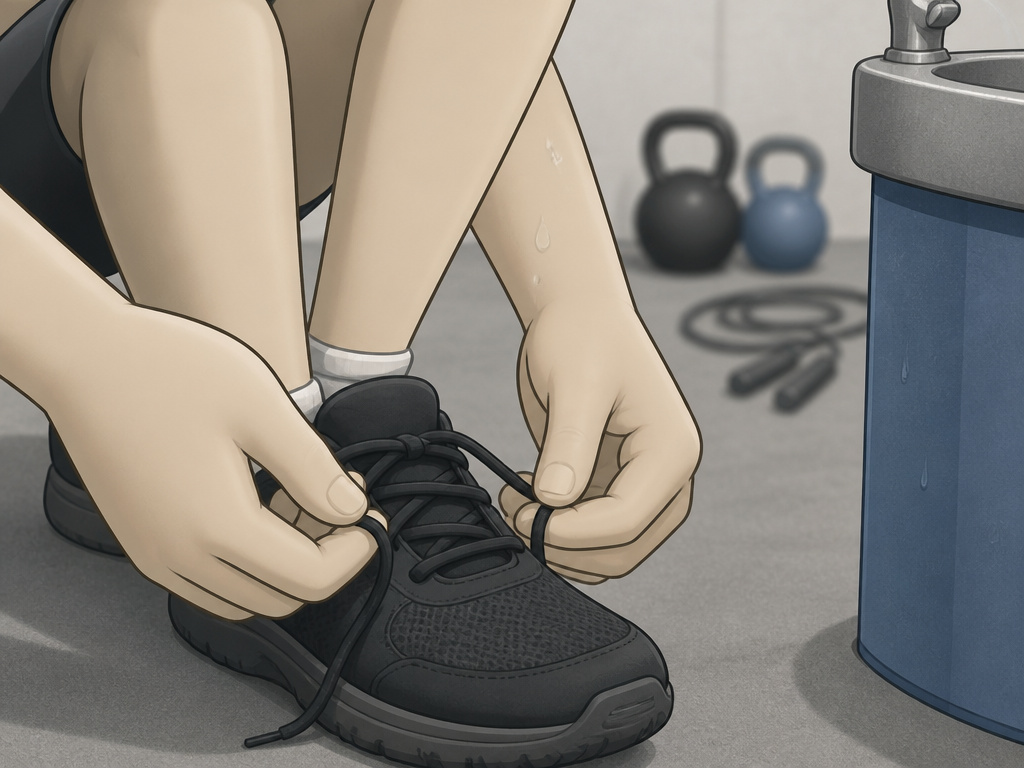
Fifteen minutes into my first bootcamp, I was crouched by the water fountain retying a lace that was already tight.
I’d signed up for the advanced session in my first week because I wanted to look committed. The first circuit broke me in about a quarter of an hour. I spent the rest of the class pretending to adjust my shoes, then skipped the next three sessions out of pure embarrassment.
The beginner or all-levels label isn’t an insult. Starting there and moving up after about four weeks beats quitting an advanced class after one rough session, and it beats it by a wide margin.
Common mistake: Booking the advanced slot because the beginner session sits at an awkward time. The first circuit sets the tone for the whole hour, and a session you can’t finish is a session you don’t come back to.
Here’s where I’d draw a hard line. If a movement produces a sharp, specific pain rather than a working burn, stop that movement and tell the coach. Sharp pain that you push through in week one tends to still be there in week six, and by then you’ve built a habit around protecting it.
Simple starter workouts between classes will do more for your bootcamp performance than adding a fourth session ever will.
What to Bring and What to Leave at Home
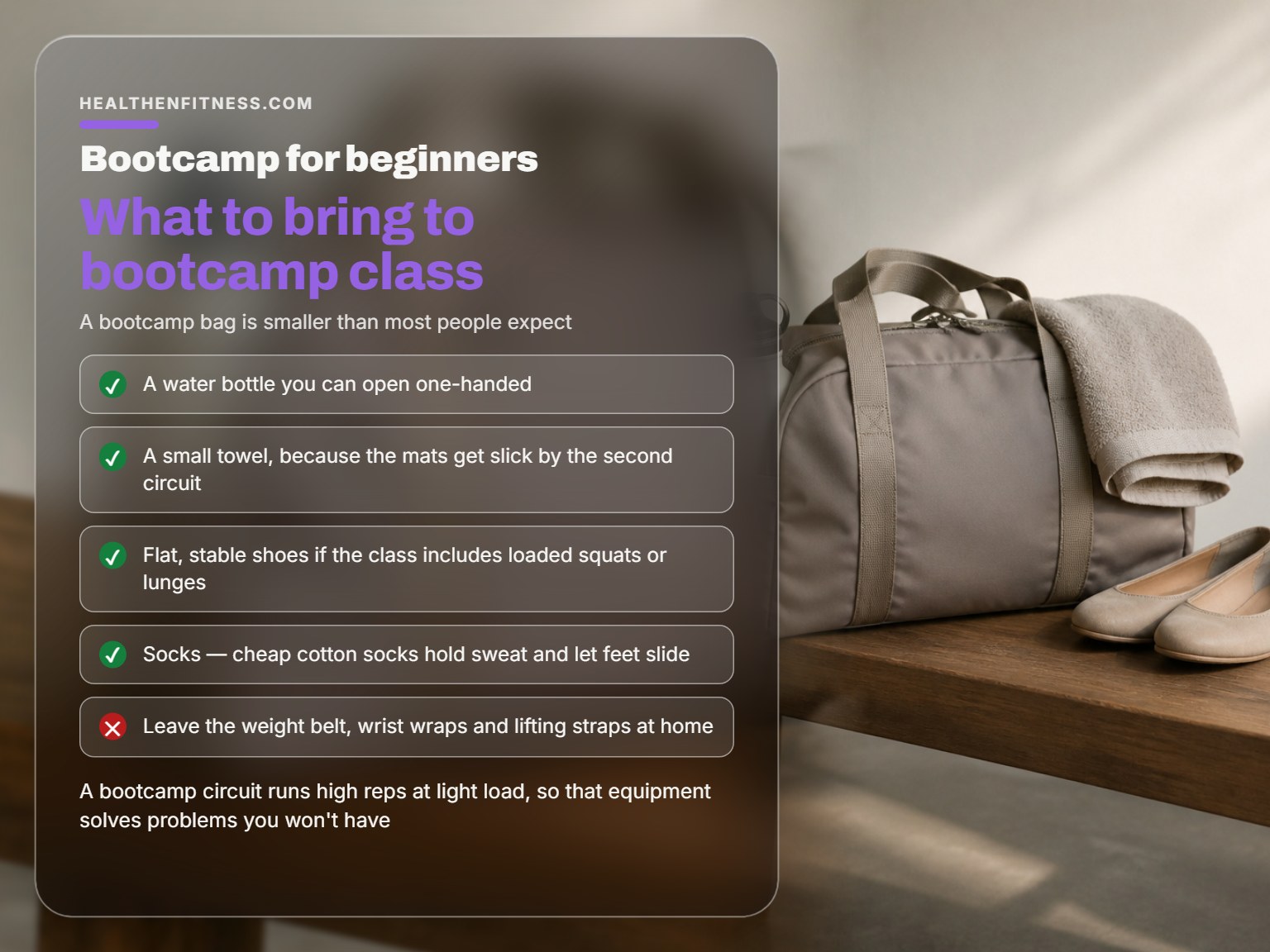
A bootcamp bag is smaller than most people expect.
You need water, a towel, and shoes with enough cushion for jumping. Everything else is optional.
- A water bottle you can open one-handed. You’ll be holding a dumbbell in the other hand more often than you think.
- A small towel, because the mats get slick by the second circuit and a wet grip on a dumbbell is how people drop things.
- Flat, stable shoes if the class includes any loaded squats or lunges. Running shoes with a tall soft heel make those positions harder to hold.
- Socks.
Cheap cotton socks are the thing people forget. They hold sweat, and by the third station you can feel your foot sliding inside the shoe on every landing.
What to Leave at Home
Leave the weight belt, the wrist wraps, and the lifting straps. A bootcamp circuit runs high reps at light load, and that equipment solves problems you won’t have in the room.
A gym bag essentials for beginners checklist covers the rest, but the four items above handle every session you’ll do in your first month.
How to Tell the Class Is Too Much for You Right Now
Soreness is a poor scorecard. It tells you the class was unfamiliar, not that it worked.
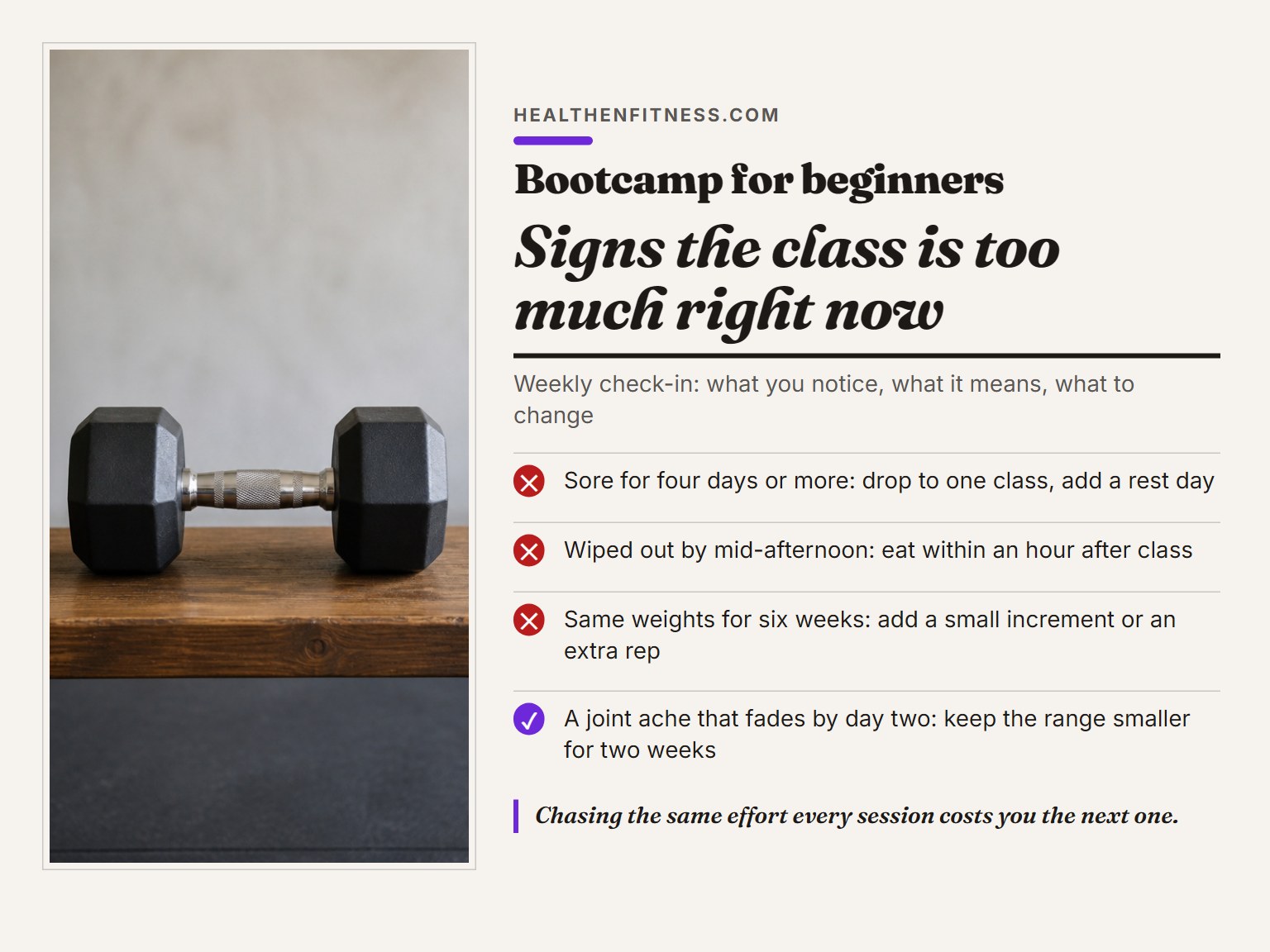
The signals that actually matter show up in how you function between sessions. Use this as a check-in at the end of each week:
| What you notice | What it usually means | What to change |
|---|---|---|
| Sore for four days or more | Volume jumped too fast | Drop to one class, add a rest day |
| Wiped out by mid-afternoon | Under-fuelled or under-slept | Eat within an hour after class |
| Same weights for six weeks | Load isn’t progressing | Add a small increment or an extra rep |
| A joint ache that fades by day two | Unfamiliar movement pattern | Keep the range smaller for two weeks |
Where this goes sideways: Chasing the same effort level every session. A class that leaves you wrecked on Tuesday will cost you Thursday, and two skipped Thursdays in a row is how a six-week experiment turns into a three-week one.
I’ve watched people treat a bootcamp class like a scoreboard, going harder each week to prove the money was worth it. The ones still training a year later are the ones who looked bored on paper.
Bootcamp vs Lifting: How to Run Both Without Burning Out
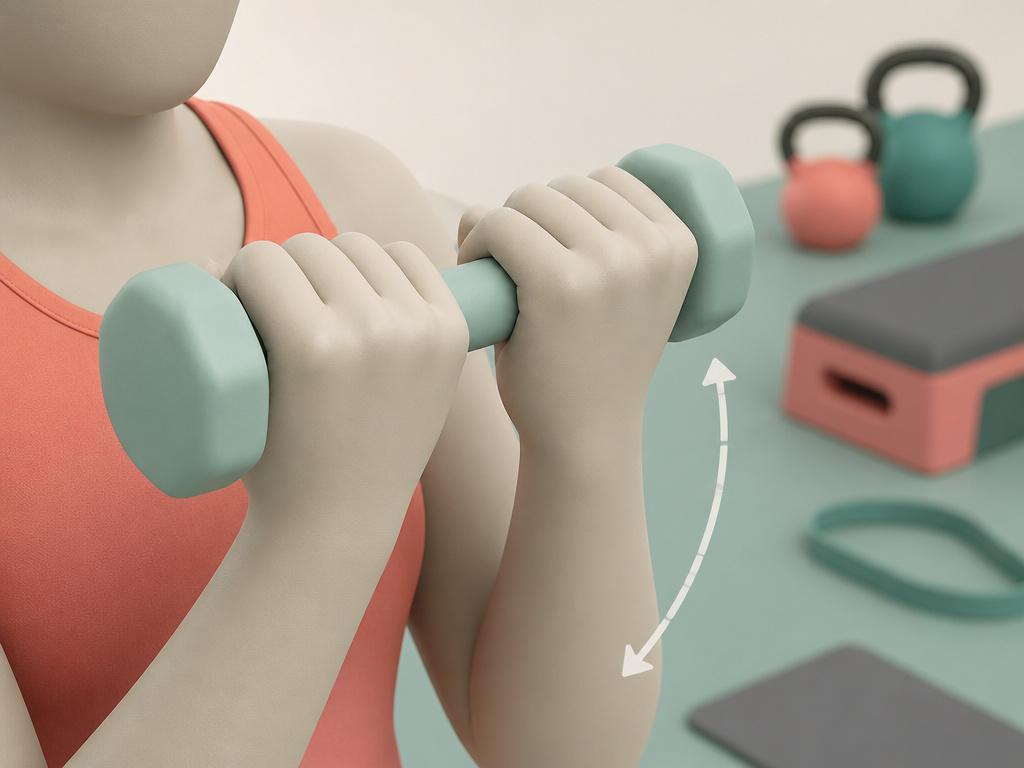
Progressive overload is the thing that builds strength, and a bootcamp circuit delivers it in small, frequent doses.
The catch is that a class also delivers a lot of fatigue. If you’re lifting three days a week and adding two bootcamp sessions on top, you’ve built a five-day program with no easy days in it.
One fix I keep coming back to: lighter sets of 10 to 12 reps on your lifting days while you’re new to the class. That range lets you practice the movement pattern before the load gets heavy, and it leaves enough energy for the circuit later in the week. It’s the same logic as seasoning a soup a pinch at a time. Dump the whole shaker in and you can’t take it back out.
If you’re building the lifting side from scratch, best workouts for beginners covers the base you need before adding classes.
If you want to rehearse the format before committing to a studio schedule, the Peloton app runs bootcamp-style classes you can do at home with a pair of dumbbells. For a barbell-based group class, Les Mills BodyPump is the one I’d point a beginner toward, because the loads stay light and the rep ranges stay high, so you learn the pattern before the weight gets heavy. A YogaWorks beginner series moves slowly enough to actually learn the positions.
Where I’d hold back: if your lifting numbers have been flat for a month, adding bootcamp won’t fix it. Drop a class, not a lifting day.
Frequently Asked Questions
Is a bootcamp class suitable for someone who has never exercised?
Yes, provided you pick an all-levels session and scale the movements. Most circuits offer a regression for every station, and a coach who corrects positions will hand you one without being asked. If you have a diagnosed heart condition, joint injury, or you’re returning after surgery, get cleared by a clinician first.
What should I do the day before my first class?
Treat it as a normal day. Eat a regular meal a couple of hours before, sleep normally, and skip the urge to “pre-train” so you’re ready. Arriving slightly fresh beats arriving sore from a workout you squeezed in to feel prepared.
How long before bootcamp feels easier?
Expect the first two or three sessions to feel chaotic and the fourth to feel familiar. The movements repeat across classes, so the coordination catches up faster than the fitness does. If session six still feels like session one, the class is probably too hard for where you are.
Can I do bootcamp and lift weights in the same week?
Yes, with spacing. Two bootcamp sessions and two or three lifting days works for most beginners if you keep at least one full rest day and don’t stack a heavy leg day directly before a class with a lot of squatting and jumping.
What if I’m the least fit person in the room?
You probably won’t be, and it won’t matter. Group classes run on stations, which means everyone is doing something different at any given moment. Nobody is watching your station closely enough to rank you.
Before You Go
One threshold worth memorizing: if you can’t hold a conversation during the warm-up, the class is above your current level. That’s the earliest signal you’ll get, and it arrives before the soreness does.
The concession is real, though. If you’re coming back from an injury, or you’ve been completely inactive for years, a general bootcamp class may be the wrong first step no matter how well you scale it. A few weeks of walking and basic strength work first will make the class land better.
And if you’re choosing between two sessions at the same time on different days, pick the day you’ll actually keep. The best class is the one that fits your week.
Do this today: book one all-levels session for next week, put it in your calendar, and plan the rest of the week around it rather than on top of it.
