
Calisthenics for Beginners Guide: Start With Three Moves
This post contains affiliate links. As an Amazon Associate, we earn from qualifying purchases.
Calisthenics for beginners guide: start with one set each of push-ups, angled rows and squats, five weekdays a week, and progress by making each rep slower before you make it harder. That is the structure a 2020 randomized trial protocol used with 40 to 60 untrained adults, and it is a sane place to begin.
Five weekdays is the part that gets argued about. The Superhuman Strength 8-week beginner plan prescribes three non-consecutive days, while the trial sequences habit formation first and effort later. Those are two different theories of how a calisthenics for beginners guide helps a beginner stick with anything.
What follows: the three moves worth starting with, both published frequency camps laid side by side, the injury data that never makes it onto a beginner page, and the progression ladder for anyone who cannot yet do a clean floor push-up.
Key Takeaways
- One set each of push-ups, angled rows and squats is the entire Minute Calisthenics prescription, run every weekday across 12 to 24 weeks.
- Frequency is genuinely contested: the trial says five weekdays, the Superhuman Strength beginner plan says three non-consecutive days.
- A survey of calisthenics participants found that 74.3% of injuries needed training modification or treatment.
- Beginners are not the highest-risk group in that dataset; risk climbed with years of participation and state-team competition.
- Progress by making the rep slower and cleaner before you make it harder.
The Three Moves a Beginner Should Start With
Push-ups, angled rows and bodyweight squats. That is the full prescription from the Minute Calisthenics protocol, and between them they cover a horizontal press, a horizontal pull and a knee-dominant squat.
The Minute Calisthenics protocol prescribes one set each of push-ups, angled rows and bodyweight squats, performed every weekday rather than daily, across a 12 to 24 week window. The primary outcome is change in composite repetitions across the three exercises at 12 weeks, measured against a waitlist control group of untrained adults.
That trio is doing more work than it looks like. A push-up loads the chest, triceps and front of the shoulder through a closed-chain press. An angled row, done with the hands on a table or a bar at hip height, pulls the shoulder blades back against gravity. A bodyweight squat trains the pattern you use every time you stand up from a chair.
- Push-up: the horizontal press. Raise the hands to make it easier.
- Angled row: the horizontal pull, and the one most beginners quietly skip.
- Bodyweight squat: knee-dominant pattern; control the descent and the depth takes care of itself.
Adding a fourth and fifth movement in week one of a calisthenics for beginners guide mostly adds fatigue. The trial leans on a small, repeatable dose, and the reason is practical: the early gains come from learning to coordinate the movement. Patterns consolidate faster with frequent low-effort rehearsal than with occasional hard sessions.
By the last two reps of an honest set, the shake starts in the triceps and the hips want to sag. That shake is your cue to end the set. Pushing through it is how the hips start doing the work the arms were supposed to do.
Three patterns. That is the whole first month.
If you want more variety later, there are calisthenics workouts that add volume without changing the three base patterns.
How Often Should a Beginner Train Calisthenics?
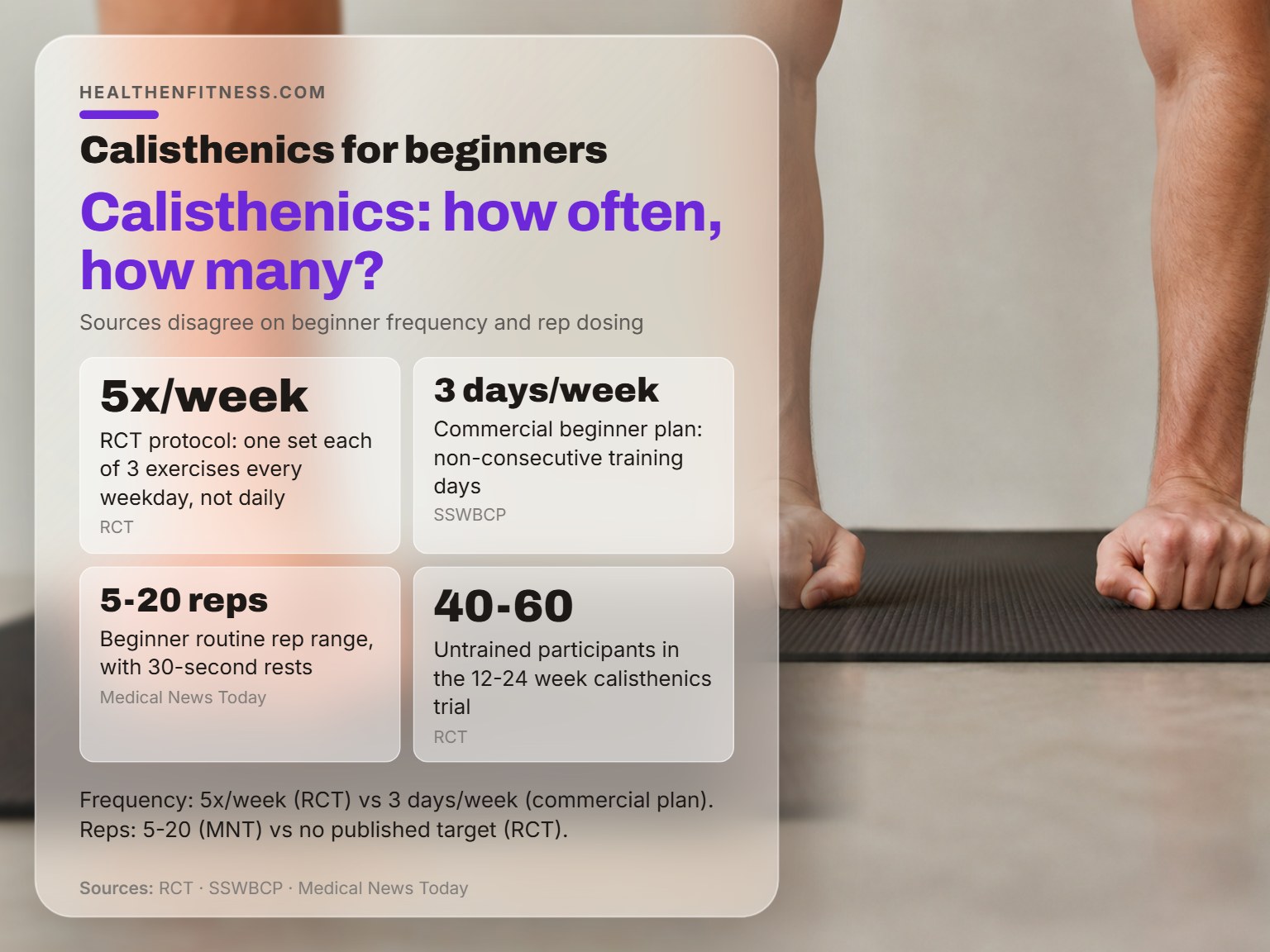
Five weekdays is the frequency the Minute Calisthenics randomized trial protocol specifies, and it sits directly against the three-days-a-week advice in the Superhuman Strength 8-week beginner plan.
| Beginner prescription | What it says | Where it comes from |
|---|---|---|
| Minute Calisthenics protocol | One set each of three moves, every weekday | 2020 randomized trial, 40 to 60 untrained adults |
| Superhuman Strength 8-week plan | Three days a week, non-consecutive | Commercial beginner plan PDF |
| Medical News Today routine | 5 to 20 reps, 30-second rests | Consumer health publisher |
The disagreement is real and neither side hides it. The trial runs 12 to 24 weeks with 40 to 60 untrained osteopathic medical students and office-based university employees, and its behavioral component is the Tiny Habits Method plus digital coaching. Frequency is doing double duty there: it is a training variable and a habit-formation device at the same time.
Five short sessions beat three long ones for the first month, because what you are building is the habit of showing up. Add difficulty once the showing up is automatic.
What is not defensible is reading the five-day protocol as five hard days. The protocol is one set each, which is a fraction of what most beginners picture when they hear “five days a week.” A beginner bodyweight plan built on three non-consecutive days will still get you there, and it will get you there without a Monday spent too sore to move.
That is the whole argument.
How Many Reps and Sets Belong in Week One?
The first beginner I coached got told, by me, to train heavy for low reps. It went about how you would expect: the movement got uglier as the load went up, and the load went up because I mistook struggling for progress. What actually worked was dropping to sets of 5 to 20 reps so the pattern could be practiced before weight got added.
The published dosing splits along the same fault line. Medical News Today’s beginner routine specifies 5 to 20 reps with 30-second rests. The Minute Calisthenics protocol publishes no rep target at all in its abstract, only a single set to a standardized protocol. One gives you a number; the other gives you a ceiling of one set.
- Pick the version you can do cleanly for 5 to 20 reps. If the last rep sags at the hips, raise your hands onto a bench. Skipping this step is how the front of the shoulder starts complaining three weeks in.
- Do one set, then stop. The protocol is one set per movement, and the discipline is in the stopping, not the starting.
- Rest 30 seconds between exercises if you run all three back to back. Shorter than that and the third movement turns into a balance drill.
- Repeat on the next weekday. Missing a day is not a reset; missing a week is, and you start again at step one.
Common mistake: Chasing a rep count before the shape is right. High-rep push-ups with sagging hips and flared elbows load the shoulder at an angle it does not tolerate well, and the ache shows up two days later, not during the set.
One set. That is it.
The Injury Numbers Behind “It’s Just Bodyweight”
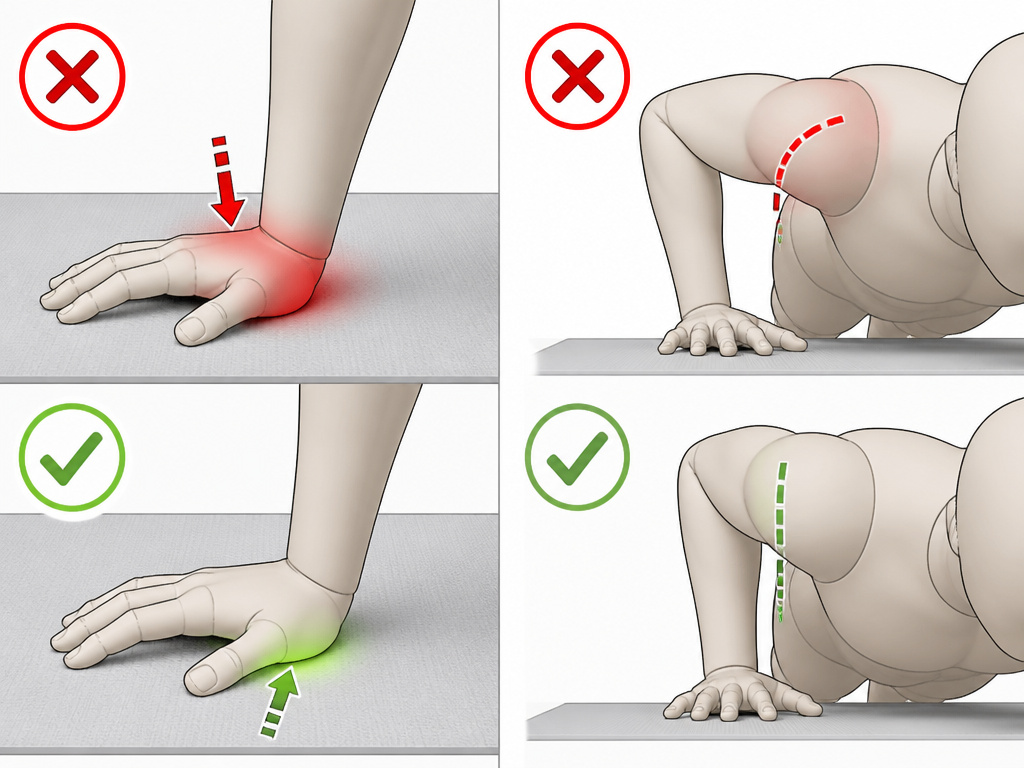
820 reported injuries in one survey, or 74.3%, needed training modification or treatment. That figure comes from the calisthenics injury epidemiology study, which surveyed 543 participants and is described by its authors as the second examination of calisthenics injuries and the first to include all competition levels.
Mean time lost to injury was 3.4 weeks. Sprains and strains made up 56.3% of the total. Those are not numbers that fit the “it’s only bodyweight” framing, and they are worth reading before you decide that a movement without a barbell cannot hurt you.
The mechanism breakdown is the useful part. Elevated work accounted for 27.6% of injuries, overuse 38.0%, and specific calisthenics skills 38.9%. Among the skill-related injuries, 40.6% were lumbar spine and 40.3% lower limb, and both were tied to extension-based movements.
A 2023 national sports-secretariat manual from Uruguay frames calisthenics as low-risk because it involves no jumps, rebounds or impacts, and states that it presents no contraindications. The injury survey points the other way, reporting that 74.3% of injuries required training modification or treatment. Both can be true at once if you read carefully: the risk in the data concentrates in advanced extension skills, not in a set of incline push-ups.
Who gets hurt is the part that gets flipped. Risk rose with years of participation, increased training hours regardless of training type, left leg dominance, and state-team participation, all significant at p<0.05. Beginners are not the top of that list. Week one is not automatically the safe window either, because the movements that hurt experienced athletes are the same ones beginners get sold tutorials for.
| What you notice | Likely cause | What to change |
|---|---|---|
| Pinch at the front of the shoulder | Elbows flared out wide | Tuck the elbows toward the ribs |
| Low-back ache during squats | Hips tucking under at the bottom | Stop at the depth you can hold |
| Wrist pain in a plank | Weight dumped into the heel of the hand | Push through the base of the index finger |
| Elbow soreness after rows | Gripping narrow and shrugging | Widen the grip, pull the blades down first |
A shoulder heading for trouble usually announces itself as a pinched feeling at the front of the joint, at the bottom of the push-up, weeks before it hurts at rest.
Where this goes sideways: Adding a harder variation while an elbow or shoulder is still sore from the last session. That is how a two-week niggle becomes the 3.4-week average layoff the survey reports.
The beginner workout mistakes that show up most often are not exotic. They are ordinary movements done with the load in the wrong place.
Easier Versions First: The Progression Ladder
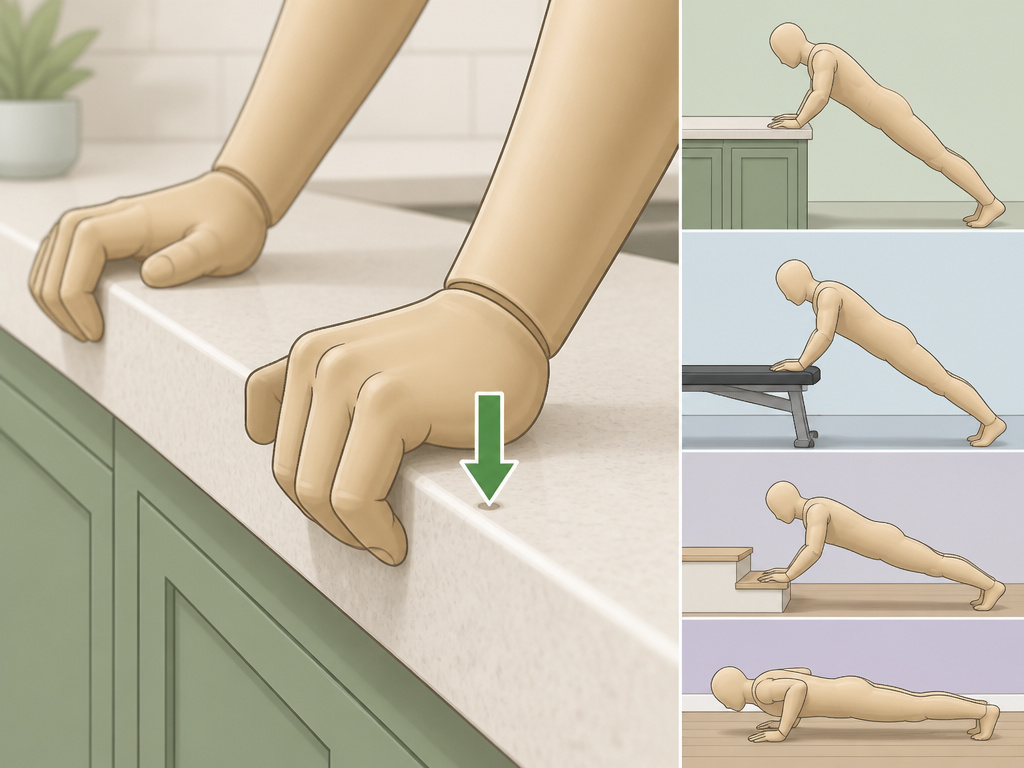
Easier versions are the method itself. Every harder movement in calisthenics is a lever change on something you can already do, which means the easy version is not a consolation prize.
Before you start: Wrist pain in a plank usually means the weight is dumped into the heel of the hand, so push through the base of the index finger instead. A pinch at the front of the shoulder at the bottom of a push-up means the elbows are flared too wide. And a joint that hurts at rest the next morning is a stop signal, not a warm-up problem.
Incline Push-Ups Before Floor Push-Ups
Raise the hands and the push-up gets easier without changing the pattern. A kitchen counter, a bench, a stair. Move down one level when the last rep of a set looks like the first, and stay there for another week when it doesn’t.
Band-Assisted Pull-Ups and Rows
A band takes weight off the bottom of the pull-up, which is exactly where a beginner runs out of steam. Loop it under the knee or the foot and work the full range. A pull-up progression for beginners that starts with band assistance and slow negatives beats one that starts with hanging and hoping.
Tempo Squats and Slow Eccentrics
Slow eccentric reps are the most underrated tool in this whole article, and they cost nothing. Lower for a slow count, pause, stand up at normal speed. The tendon spends longer under tension, which is what builds the tolerance that keeps joints quiet.
A tempo squat at a slow count produces a deep, spreading burn through the quads and a wobble at the bottom that no rep speed hides. That wobble is information.
Calisthenics vs Weight Training: Which Fits a Beginner?
A push-up and a bench press load the same joint through the same arc. The variable that separates them for a beginner is adjustability.
A barbell moves in fixed increments. A push-up moves in whatever increments your floor, a bench and a staircase provide. For the first few months that is an advantage, because you can find a version you can do cleanly today.
Legs are the exception. A bodyweight squat stops being a strength stimulus long before a barbell squat does, and loading the lower body with bodyweight alone takes creativity most beginners do not have. Where calisthenics wins is pulling: a row you can do at home beats a lat pulldown you cannot.
I would start nearly everyone on bodyweight first, then add external load to the squat pattern specifically. The upper body has room to progress for a long time. The legs run out of runway early.
The fuller comparison lives in calisthenics vs weight training, and the short version is that they are not competing teams. They are two ways to adjust difficulty.
What Gear Is Actually Worth Buying?
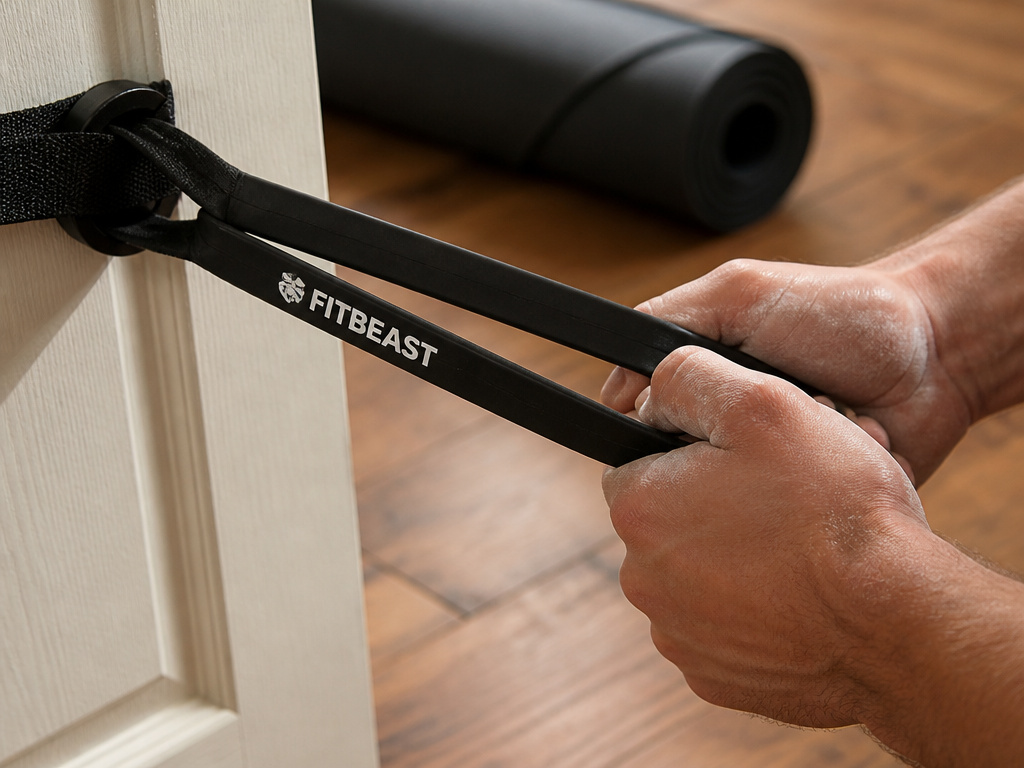
Almost none of it. A floor, a doorway and one band covers the first several months, and I say that as someone with a garage full of conveniences.
- TRX Suspension Trainer: the single most useful purchase if you travel or train in a room with no furniture worth hanging from.
- Rogue Monster Bands: the band does the work in band-assisted pull-ups, and a set covers both the easy and the hard end of the progression.
- Gymnova rings: worth it once you can hold a plank and a row position without shaking, and not before.
- Parallettes: a pair of parallettes for calisthenics takes the wrist out of the equation on pressing and dips, which matters if your wrists complain on the floor.
Buy the band first.
Frequently Asked Questions
Do I have to train every weekday to get results?
Published beginner advice genuinely disagrees on this. The Minute Calisthenics protocol runs every weekday, while the Superhuman Strength 8-week plan uses three non-consecutive days. Pick the one you will actually repeat for three months, because the one you abandon does nothing.
Can you build muscle with calisthenics alone?
The trial measured mid-thigh muscle thickness as one of its secondary outcomes, which tells you the researchers expected a bodyweight protocol to move that needle. Whether it does is what the trial was built to find out. Progressive difficulty is the variable that matters either way.
How long until I can do a pull-up?
Depends entirely on where you start, and anyone who gives you a fixed number is guessing. Work band-assisted versions and slow negatives, and measure progress in control rather than in repetitions.
Is it bad to do push-ups every day?
One set a day is a different animal from five hard sets a day. The protocol that runs every weekday prescribes a single set of each movement, which is closer to rehearsal than to training. Volume is the variable that turns a daily habit into an overuse problem.
What if I can’t do a single push-up?
Raise your hands. A push-up with the hands on a kitchen counter is still a push-up, and it is the version that lets you practice the pattern without the shoulder paying for it. Move down a level only when the last rep looks like the first.
The Bottom Line
One trigger worth memorising: when the last rep of a set looks the same as the first, you are ready for a harder version. When it does not, stay where you are for another week. That single rule handles most of the progression decisions you will face in your first year.
None of this settles the frequency argument, and I would be lying if I said it did. The trial says five weekdays, the commercial plan says three, and the injury data was collected from competitive athletes rather than untrained office workers. If you are the sort of person who burns out on streaks, take the three-day version and ignore the rest of this.
The other honest caveat: I have never coached rehabilitation after a serious injury or surgery, and generic calisthenics advice is a poor fit for a complicated medical history. That is a conversation for a clinician who can see you move.
Do this today: one set of push-ups, one set of rows with your hands on a table, one set of squats. Stop while the last rep still looks like the first.
