
CrossFit Box vs Regular Gym: Which Should You Choose?
This post contains affiliate links. As an Amazon Associate, we earn from qualifying purchases.
In the CrossFit box vs regular gym decision, a box sells coached group classes on a set schedule, while a regular gym sells open access you program yourself. If you want someone to hand you the day’s work, pick the box. If you already follow a plan, pick the gym.
Those two products fail in opposite ways.
What follows: what each membership actually buys, the injury data and its limits, the points where the sources contradict each other, and the commute test that predicts attendance better than any feature list.
Key Takeaways
- A box sells programming; a gym sells access. One hands you the day’s work and a coach, the other hands you a door code.
- The peer-reviewed injury figure sits at 2.4 to 3.1 per 1,000 training hours, with shoulder and spine the most affected sites.
- No head-to-head trial exists. Nothing in the peer-reviewed literature directly compares outcomes between the two facility types.
- Commute beats equipment. In Bangkok, a gym more than a five-minute walk from a BTS or MRT station is the one you quit.
- Ask about the On-Ramp before you sign anything. A box without a foundations program is telling you something.
What a CrossFit Box Actually Sells You
A CrossFit box sells a coached, scheduled, programmed hour. Everything else about the membership follows from that one fact.
CrossFit’s published definition of fitness lists ten general physical skills: cardiovascular and respiratory endurance, stamina, strength, flexibility, power, speed, coordination, agility, balance, and accuracy. An affiliated box delivers those through a daily workout drawn at random from a hopper, and the Games rulebook codifies the same idea as the Unknown and Unknowable principle.
The class runs about an hour, warm-up through cool-down, and the programming is already written when you walk in. Eathealthy365.com describes the format that way, and it matches what the affiliate model requires.
CrossFit Inc. Also requires every affiliate to employ at least one CrossFit Level 1 or higher certificate holder. That staffing rule is the reason a coach is standing on the floor at all.
What the Daily Workout Is Built From
The Hopper model is CrossFit’s own name for randomized task selection. You don’t know what the workout is until you show up.
The CrossFit Games Rulebook puts real numbers on the equipment side: a 20 kg barbell standard for men, 15 kg for women, and standard box-jump heights of 20, 24, and 30 inches. Those are competition specs rather than what your local box owns, but they tell you what the sport treats as normal.
Here’s what the monthly fee buys at a typical box:
- Scheduled class times, roughly an hour each
- A coach on the floor for every session
- The day’s programming, written for you
- Barbells, bumper plates, kettlebells, rings, rowers, and pull-up rigs
- An On-Ramp or Foundations block before you join regular classes
Roamfit.net notes that most Bangkok boxes rely on industrial ceiling fans rather than central air.
Is CrossFit Actually Scalable for Beginners?
CrossFit’s Level 1 Training Guide calls the box infinitely scalable for all levels. Members and affiliate owners on r/CrossFit describe something narrower, where scaling in practice means a beginner doing high-rep Olympic lifts against a clock.
Before you start: Exertional rhabdomyolysis is documented in peer-reviewed case reports after high-volume CrossFit-style workouts in untrained participants, and it is a hospital-level event rather than a sore-muscle story. The shoulder and lower back are the most commonly injured sites in the published data. Start with a coach who scales load and volume for you, and stop the session if your urine turns dark.
What Scaling Looks Like in Practice
Community reports on r/CrossFit and affiliate owner forums describe scaling as high-rep Olympic lifts under time pressure, which is a different thing from a lighter version of the same lift done well.
- Does the box run a mandatory On-Ramp or Foundations program?
- Who is coaching, and what certificate do they hold?
- What happens when a member fails a rep mid-metcon?
- Can you watch a full class before you join one?
The Injury Numbers, and What They Do Not Prove
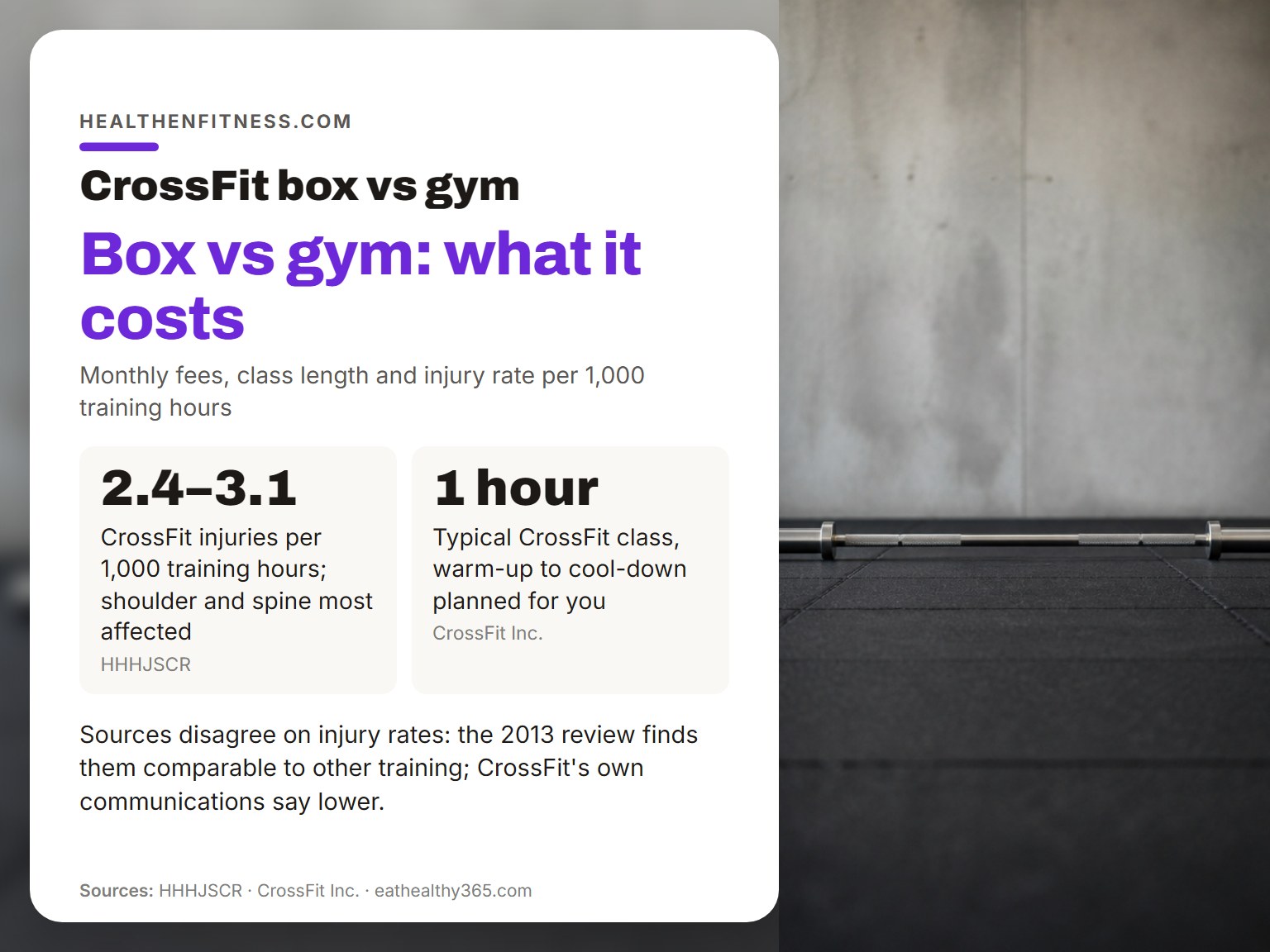
The most-cited peer-reviewed figure comes from Hak, Hodzovic and Hickey (2013) in the Journal of Strength and Conditioning Research: injury incidence across the included studies ranges roughly 2.4 to 3.1 per 1,000 training hours, with the shoulder and spine most affected.
Meyer, Morrison and Zuniga (2017) reviewed the same territory in Sports Health and found injury rates comparable to other high-intensity training, while flagging rhabdomyolysis case reports in novices.
| Source | What it reports | What it leaves open |
|---|---|---|
| Hak, Hodzovic & Hickey (2013), JSCR | 2.4 to 3.1 injuries per 1,000 training hours | No gym-member comparison group |
| Meyer, Morrison & Zuniga (2017), Sports Health | Rates comparable to other high-intensity training | Flags rhabdo cases in novices |
| Case reports (J Emerg Med, Mil Med) | Rhabdomyolysis in untrained participants | Individual cases, not population rates |
| Peer-reviewed literature overall | No head-to-head trial exists | Box vs gym outcomes stay unmeasured |
CrossFit’s own communications and some affiliate sources claim injury rates lower than general gym training. The peer-reviewed figure is the one you can actually check, and it says comparable, not lower.
No regulator has issued a recall or safety alert covering CrossFit boxes or commercial gyms as categories. CPSC, FDA, and HSE have all stayed out of it. Equipment-level recalls exist, but they belong to individual products rather than to the facility type.
What a Regular Gym Actually Sells You
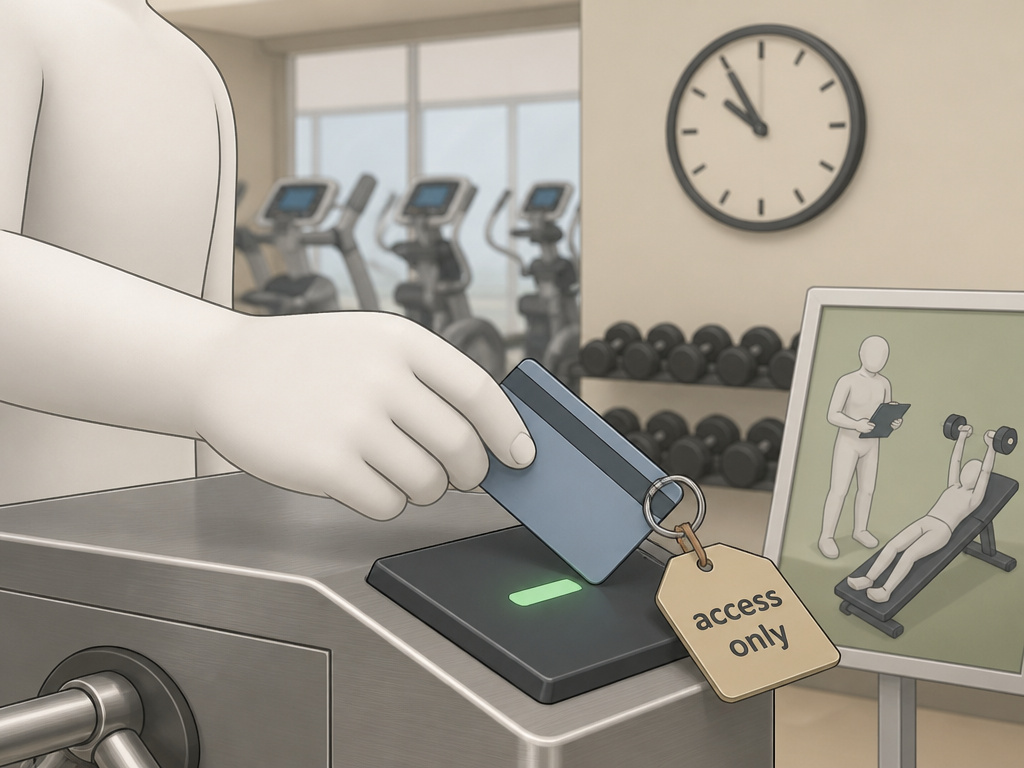
A regular gym sells access and nothing else, which is either the best deal in fitness or the exact reason you stop going.
You get a building, equipment, and hours. Eathealthy365.com notes that regular gyms stay open long hours, sometimes around the clock. Direct coaching is not included; it’s a personal training purchase on top of the membership.
That’s the trade. Programming for freedom, coaching for cost.
For experienced lifters, that trade works. NSCA and ACSM position stands support self-directed training as safe and effective for people who already know how to program. Supervision matters most for novices and less as experience accumulates.
If you’re new, eathealthy365.com recommends three to five sessions with a personal trainer to build a plan you can then run yourself. That’s a sensible middle path between the two models.
Walk into an air-conditioned chain during an April heatwave and the temperature drop is the first thing you notice.
The Standards That Apply to Both
Commercial gym equipment gets tested against ASTM F2276 in the US and EN 957 in Europe. Facility-level certification runs through NSF/ANSI 341, which covers equipment, staffing, and emergency response.
None of those standards care whether the sign outside says CrossFit. They apply to the equipment and the building, so a well-run box and a well-run gym can both clear them.
Here’s what a gym membership covers:
- Open access during staffed or badge-in hours
- Cardio machines, resistance machines, and a free-weight area
- A changing room, plus a towel and toiletries at premium clubs
- Personal training as a separate purchase
- A plan you supply yourself
Where CrossFit’s Own Claims and Outside Sources Disagree
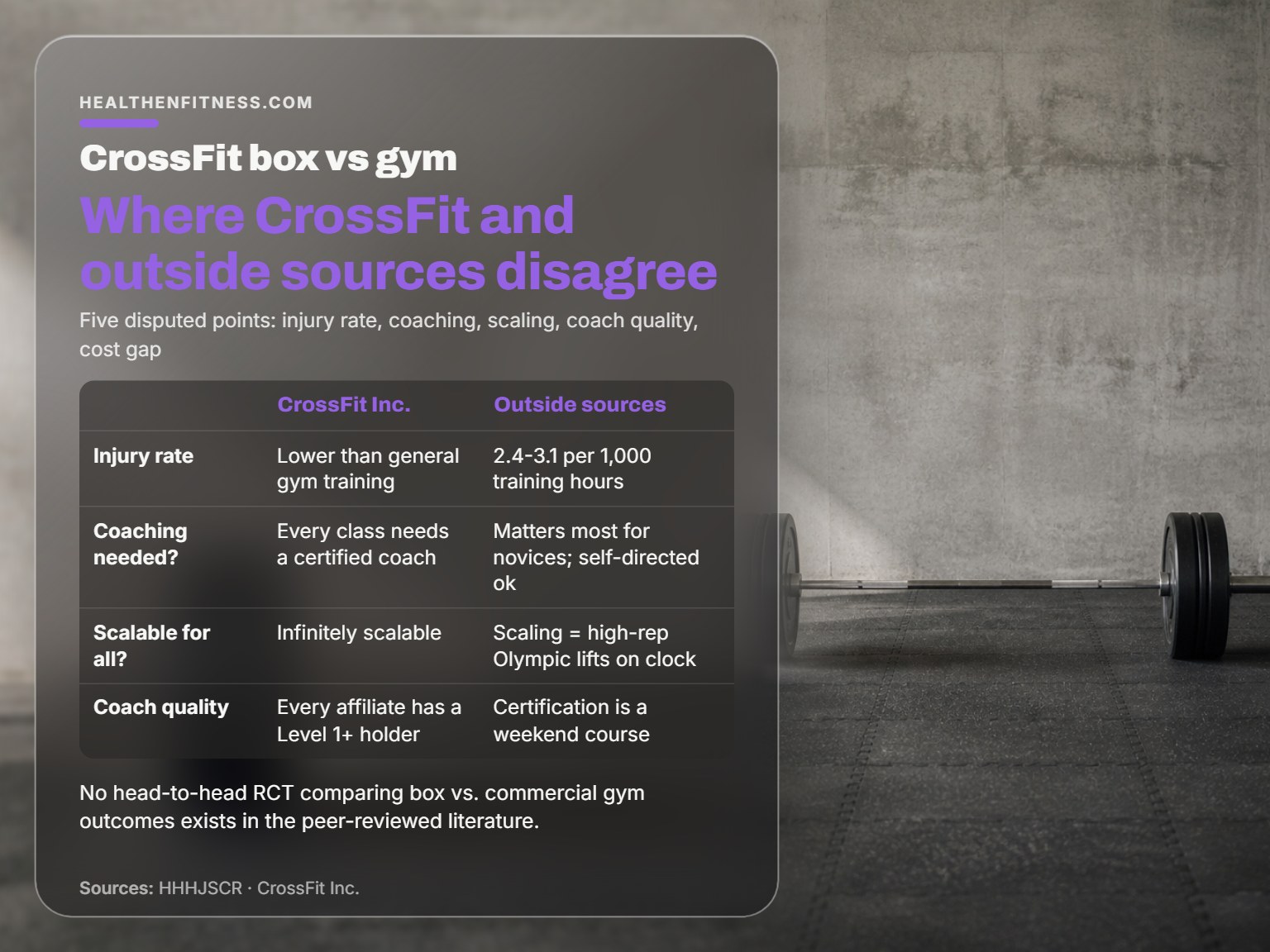
CrossFit Inc. And the independent sources do not agree on five points, and the gap matters more than any feature comparison you’ll find on a blog.
| Question | CrossFit Inc.’s position | Outside position |
|---|---|---|
| Injury rate | Lower than general gym training | 2.4 to 3.1 per 1,000 hours, comparable to other training |
| Is coaching necessary? | Every class needs a certified coach | Supervision matters most for novices; self-directed works for experienced lifters |
| Is the box scalable for all? | Infinitely scalable | Forums: scaling means high-rep Olympic lifts under a clock |
| Is coach quality uniform? | Every affiliate employs a Level 1+ holder | Forums: certification is a weekend course, not a licensure |
| How big is the cost gap? | Premium pricing reflects coached classes | Sources agree on direction, disagree on magnitude by city |
The coaching row is the one I’d sit with longest. CrossFit’s requirement guarantees a certificate holder on staff. It does not guarantee that person can teach a squat to someone who has never done one.
The Cost Gap, and Why the Numbers Don’t Line Up
Two sources, two different pictures, and neither one is wrong.
Eathealthy365.com frames it as a tier difference: the box fee sits in the premium monthly band and covers unlimited classes plus coaching, while the gym fee sits in the budget band and buys access only.
Roamfit.net, writing about Bangkok, agrees on direction and says a gym chain membership can be had for a fraction of a box membership. That source also notes that chains like Jetts 24 Hour Fitness and Virgin Active cut the monthly rate on a 12-month agreement, and that boxes sometimes discount three- and six-month upfront payments.
So both sources agree the box costs more. They don’t agree on how much more, which is why any single figure you see quoted is local to that city.
The Commute Test That Beats Every Comparison Table
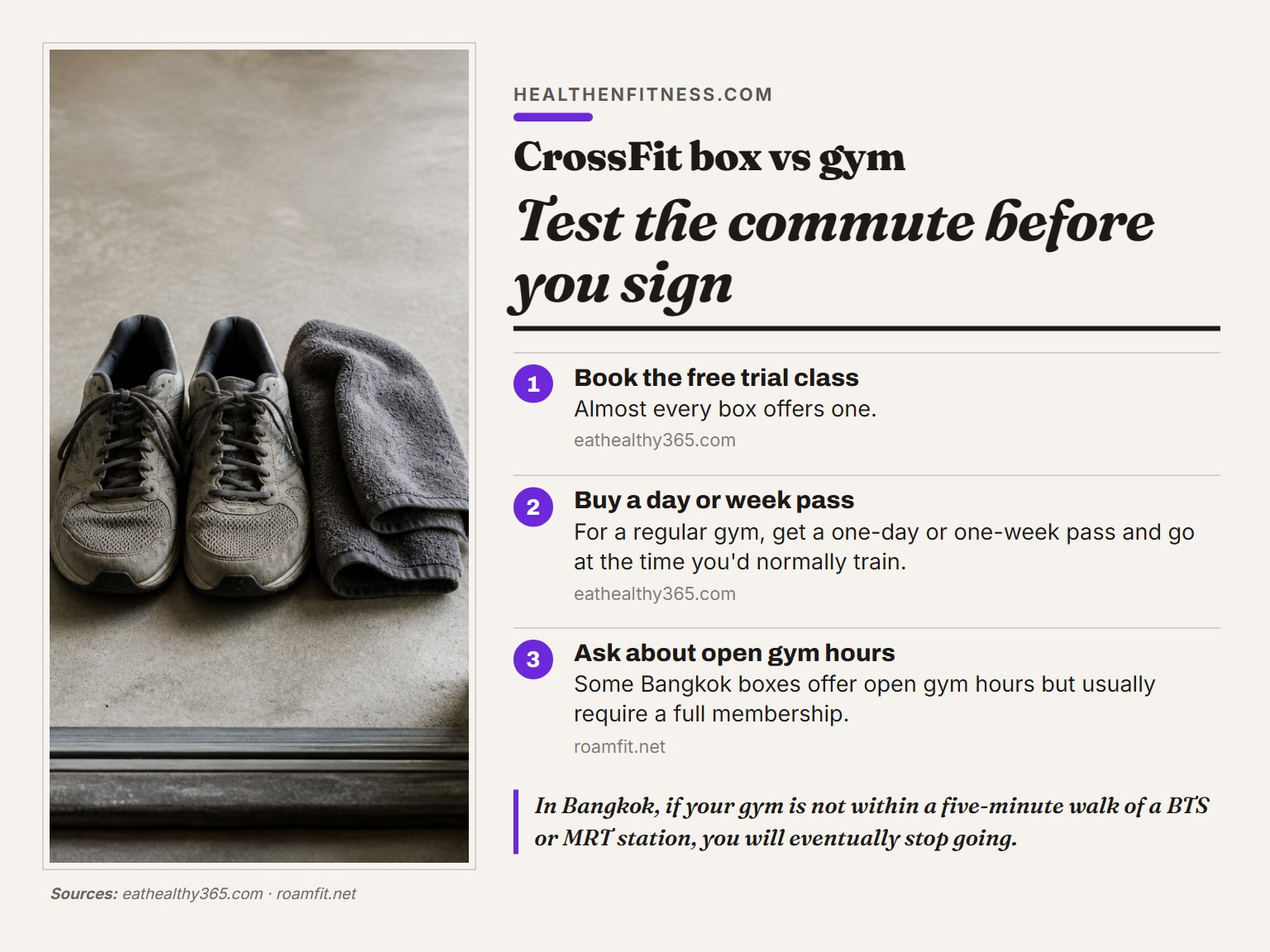
Location decides attendance. Everything else is a distant second.
Roamfit.net puts it bluntly for Bangkok: if your gym isn’t within a five-minute walk of a BTS or MRT station, you will eventually stop going.
I’d add one thing the source doesn’t say. Test the commute at the hour you’d actually train, not on a Sunday afternoon when the roads are clear.
Here’s the sequence:
- Book the free trial class. Eathealthy365.com notes that almost every box offers one, so use it and watch the coaching rather than your own performance.
- Buy a one-day or one-week pass at the gym and go at your normal training time, which is the only way to see the real crowd.
- Run the commute at that same hour, door to door, before you sign anything longer than a month.
- Ask whether open gym hours require a full membership. Roamfit.net reports that at most boxes they do.
In Bangkok, if the gym is more than a five-minute walk from a BTS or MRT station, you’ll quit. Not dramatically. You’ll just start finding reasons.
CrossFit Box vs Regular Gym: Which One Should You Join?
Pick the box if you want to be told what to do and you’ll show up to a scheduled class. Pick the gym if you already follow a program and you’d resent the schedule.
That’s the short version. The longer version splits by who you are.
If You Have Never Trained Before
A box with a real On-Ramp program is the safer start, because someone else decides the load and watches your positions. The mandatory foundations block is the first thing to ask about.
If no box near you runs one, take the gym plus three to five personal training sessions instead.
Red flags worth walking away from:
- No On-Ramp or Foundations program at all
- A coach who can’t name the certificate they hold
- A trial class that’s just a workout with no instruction
- A contract longer than a month before you’ve taken one class
If You Already Follow a Program
Take the gym. NSCA and ACSM guidance supports self-directed training for experienced lifters, and a box’s randomized daily workout fights a periodized plan rather than supporting it.
Community forums make the same complaint from the other direction, arguing that the unknown-and-unknowable model conflicts with strength goals that need weeks of consistent progression. Randomization and periodization pull against each other, and no amount of enthusiasm fixes that.
If You Want One Named Default
For most people in a city with a budget chain nearby, the answer is a plain commercial gym plus a written plan.
Jetts 24 Hour Fitness is the model to beat in Bangkok if you want air conditioning, long hours, and a location next to transit. Muscle Factory suits lifters who want racks and free weights without a class schedule.
Frequently Asked Questions
Can I do my own workout inside a CrossFit box?
Most boxes reserve floor space for scheduled classes only, so open training windows are limited or nonexistent. Some affiliates offer separate open-gym hours, but these are usually a perk for existing members rather than the core product. If self-directed training is your priority, a regular gym fits that habit far better.
Do regular gyms offer any coaching at all?
Many include a free orientation session or a single personal training trial when you join. Beyond that, instruction is an add-on you pay for separately, often at hourly rates. The base membership itself comes with no programming and no one checking your form.
Is a CrossFit membership more expensive than a gym membership?
Yes, typically by a wide margin, because you are paying for a coach’s time and a capped class size. A regular gym spreads its cost across far more members who need no supervision. The gap narrows only if you would otherwise buy personal training sessions at a gym.
What if I travel often or work irregular hours?
Class schedules are fixed, so shift work and frequent trips disrupt a box membership more than a gym one. Many boxes let you drop in at affiliates elsewhere, though policies vary and some charge a fee. A gym with long or 24-hour access absorbs an unpredictable schedule with less friction.
The Bottom Line
Here’s the trigger that should settle the CrossFit box vs regular gym question for you. If you’ve held a membership for a month and barely gone, look at the commute and the plan before you blame the facility. Both of those are fixable this week.
Pick one action. Book the free trial class at the box closest to your commute, or buy a single day pass at the gym you’re considering and go at your normal training time.
One thing this doesn’t settle: coach quality. Certification is a weekend course rather than a licensure, and it varies by affiliate.
Start smaller than you think you need to. One class, one day pass, one month. You’ll know by then.
