
Gym Dress Code Explained: What Gyms Actually Enforce
This post contains affiliate links. As an Amazon Associate, we earn from qualifying purchases.
Gym dress code explained in one line: athletic clothing that covers the torso and glutes, plus closed-toe, closed-heel athletic shoes with non-marking soles. Jeans, plastic sweat suits, and open-toed shoes are banned in nearly every written policy. Boots, sports bras worn alone, and minimalist shoes split facilities down the middle.
That split is the part worth knowing before you drive over, and it’s the gym dress code explained in practice. Two facilities can post rules that sound identical and enforce opposite ones, because a base policy memo and a service instruction treat the same treadmill differently.
What follows is the map: who bans what, why the rules exist in the first place, and the one question to ask at the front desk before you change clothes.
Key Takeaways
- Closed toe, closed heel is the footwear baseline across every policy in this set that addresses footwear.
- Boots are the loudest disagreement. DAFI 34-114 forbids them on treadmills and hardwood floors; JBLM Policy Memorandum #7 authorizes them on cardiovascular equipment.
- Jeans fail for different reasons. Rider University and Akron cite rivets and zippers tearing vinyl upholstery, while DAFI 34-114 classes jeans as non-exercise attire and JBLM bans them outright.
- Plastic and rubber sweat suits are banned outright, including on outdoor running tracks and fields, on dehydration and heat-illness grounds.
- Staff discretion covers gaps in the written list at Wright-Patterson, George Mason, and Fort Hays State.
Gym Dress Code Explained: The Four Zones on Every Sign
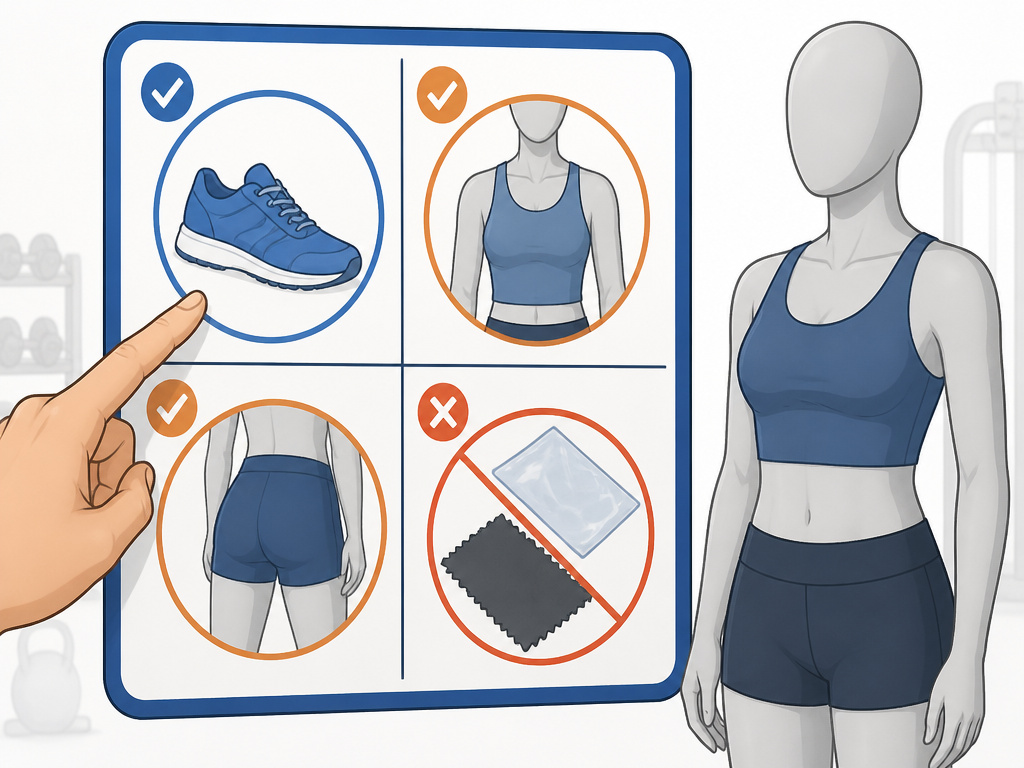
Shoes, tops, bottoms, fabric. Every posted code in this set regulates at least one of those four, and most regulate all four.
Posted facility codes regulate four zones: footwear, torso coverage, lower-body coverage, and fabric type. Footwear standards generally require closed toe and closed heel, with some policies also requiring non-marking soles. Coverage standards require tops meeting the waistband while standing and bottoms covering the glutes through a full range of motion. Fabric rules exclude plastic, rubber, and nylon garments built to raise perspiration.
Fort Hays State’s Tiger Fitness policy states the reasoning without dressing it up. The code exists to reduce bacterial disease transmission and prolong the life of exercise equipment. Rider University’s recreation center gives the same two reasons. George Mason adds a third, that the rules have to be uniformly enforceable.
That hygiene framing explains why the rules read the way they do. A bench pad with a split in the vinyl is a place where sweat pools and stays, which is why gym hygiene rules and dress codes get written by the same people.
DAFI 34-114 also requires every fitness and sports center to post the policy governing workout attire. If you can’t find the sign, that’s on the facility.
The Footwear Rules Are Where Facilities Disagree Most
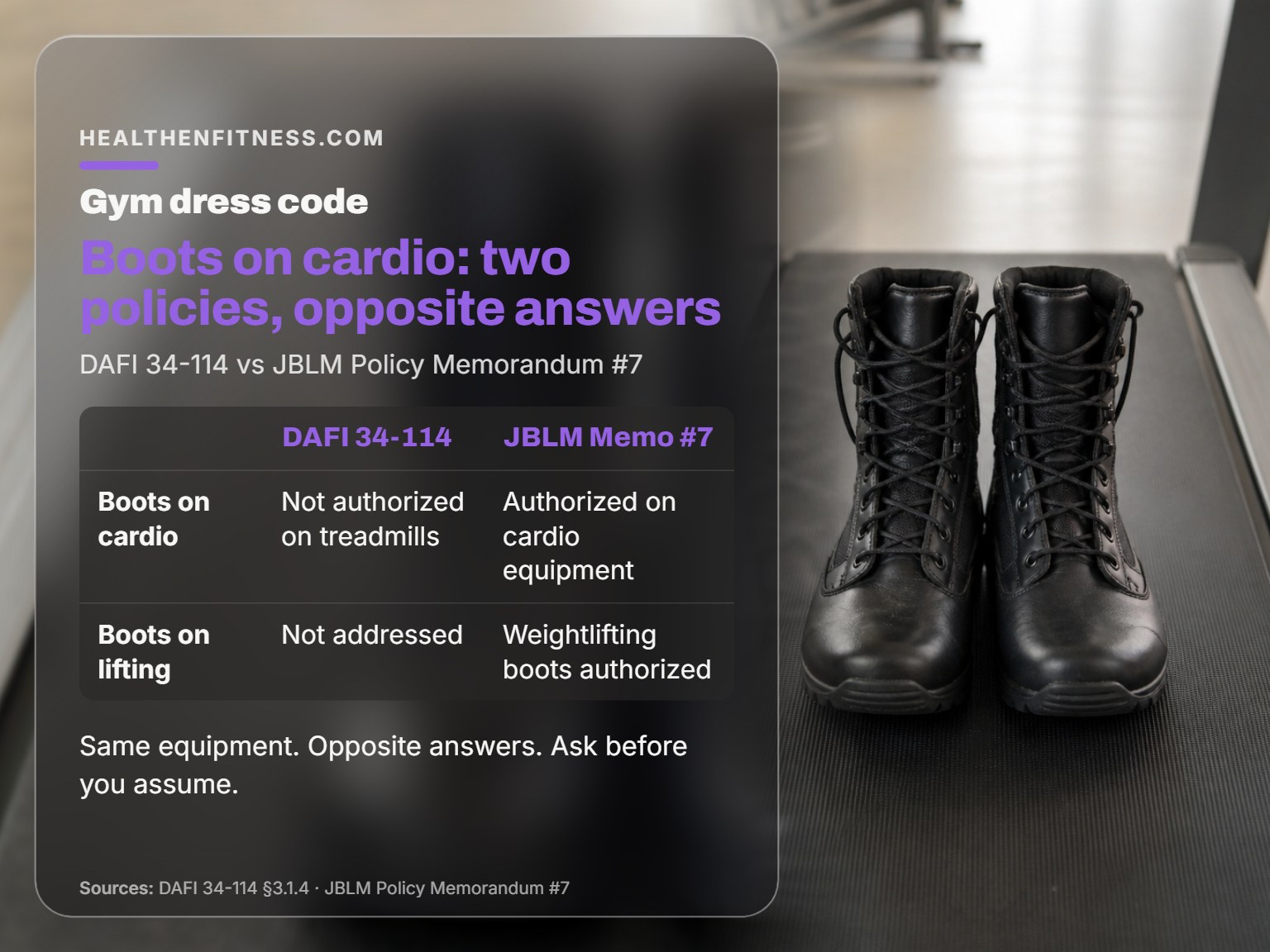
Footwear starts more front-desk conversations than any other line on the sign. “Athletic shoe” means something different to a runner, a lifter, and a soldier in boots.
| Policy | Boots on Cardio Equipment | Boots on Lifting Equipment |
|---|---|---|
| DAFI 34-114 (Wright-Patterson) | Not authorized on treadmills or hardwood floors | Not addressed |
| JBLM Policy Memorandum #7 | Authorized | Weightlifting boots authorized |
| University of Akron SRWS | Not allowed on equipment | Not allowed on equipment |
| JCC Fitness Center (2024) | Not authorized as footwear | Not authorized as footwear |
Boots: Two Official Policies, Opposite Answers
DAFI 34-114, cited verbatim by Wright-Patterson’s fitness center, says boots are not authorized on treadmills or hardwood floors, and only court shoes with non-marking soles go on hardwood. JBLM Policy Memorandum #7, dated 05 AUG 20, says the reverse for cardio: boots are authorized on cardiovascular equipment, and weightlifting boots are authorized outright.
Same equipment. Opposite answers.
What the Conflict Means for You
Ask before you assume. At an Air Force facility, boots come off before the treadmill. At JBLM, they stay on. At the University of Akron SRWS, boots come off the equipment entirely.
Most of the gym attire advice that holds up starts at the shoe and works upward.
Which Shoes Get You Turned Away at the Door?
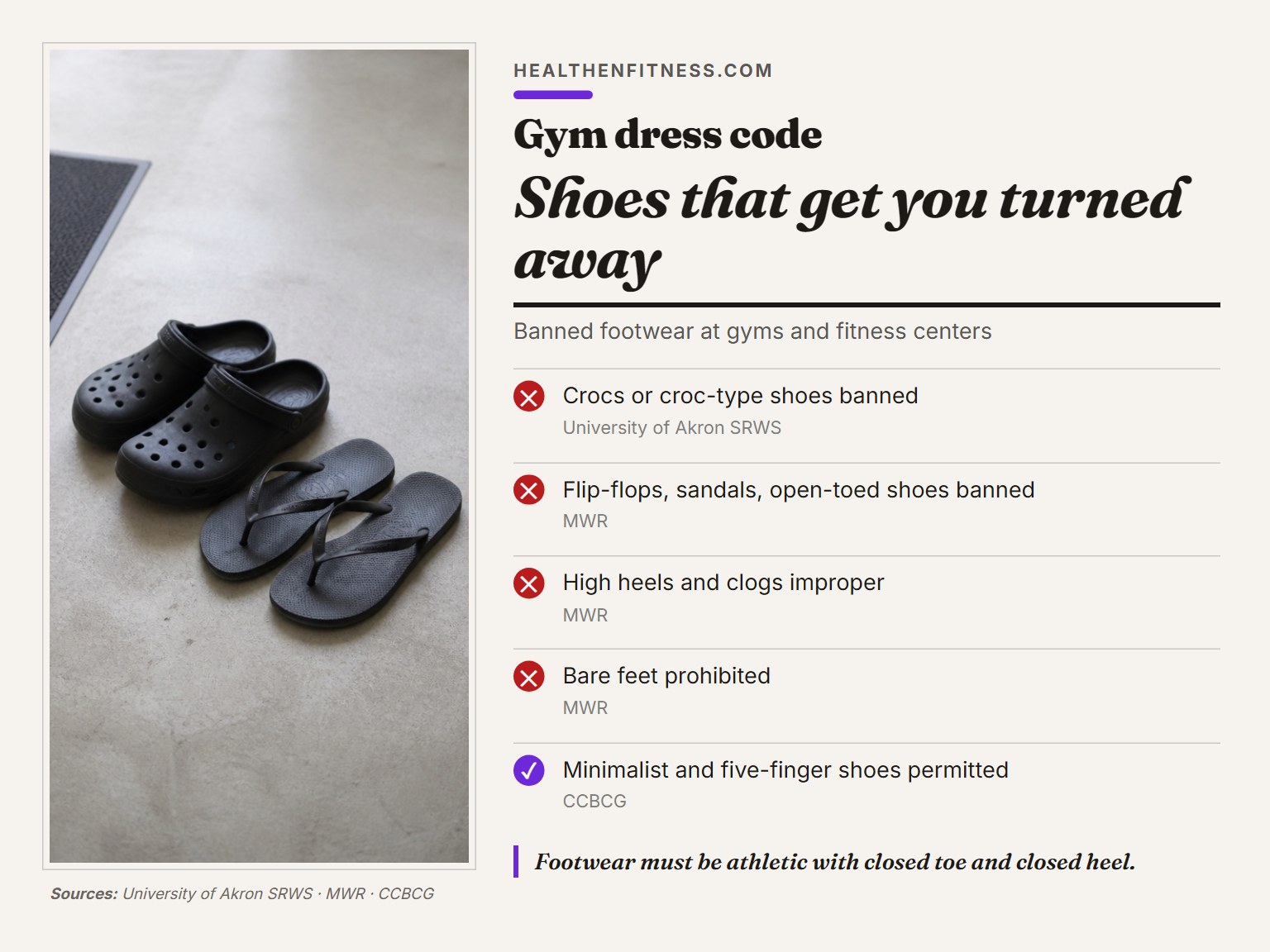
Ever watched somebody get sent back to their car over footwear? It happens most with the shoes people wear everywhere else.
The banned list is shorter than the sign suggests, and it’s remarkably consistent:
- Crocs and croc-type shoes. Akron, George Mason, and the JCC ban Crocs or croc-type shoes; Fort Campbell and the 379th EFSS list clogs as improper. George Mason names Yeezy foam-runners in the same breath.
- Flip-flops, sandals, and open-toed shoes. Banned at Akron, Fort Campbell, the 379th EFSS, and the JCC.
- High heels and clogs. Fort Campbell and the 379th EFSS both list them as improper.
- Bare feet. Fort Campbell, the 379th, and the JCC all prohibit them.
- Boots. Split, as covered above.
The interesting exception runs the other way. Conwy council’s gyms permit minimalist and five-finger shoes, Fort Campbell lists minimalist footwear as appropriate athletic shoes, and the JCC authorizes minimalist and five-finger shoes by name. George Mason’s foam-runner ban sits in a separate category, so don’t read it as a minimalist ban.
Rule of thumb: No closed heel or no closed toe, and you may not get past the desk at facilities that require both.
Tops, Bottoms, and the Coverage Standards That Vary
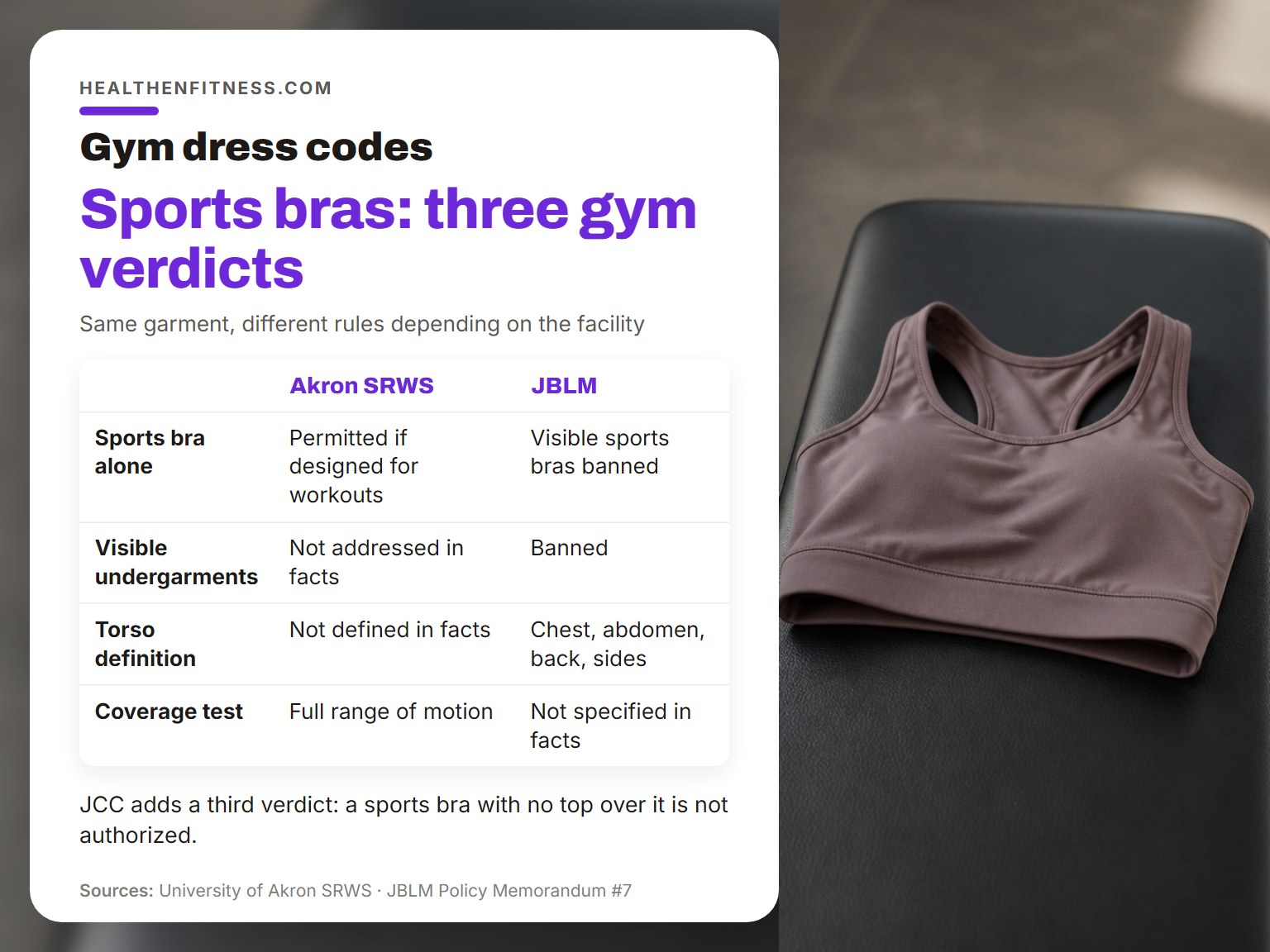
Some signs say “appropriate attire” without defining it. The ones that do define it use language you can measure, and the measurements don’t match.
Wright-Patterson’s flyer is the plainest version. Tops must meet the top of the bottoms when standing and cover the chest. Bottoms must cover the entire buttocks. Akron adds motion to the test, requiring bottoms to cover the gluteal fold through the entire range of motion.
Fort Hays asks for shirts that cover the stomach, chest, ribcage, and back. The Fort Hays State fitness dress code spells out those coverage zones.
JBLM goes further and defines the torso itself as the chest, abdomen, back, and sides. That definition exists so nobody has to argue about where the back ends.
Sports Bras and the Visible-Undergarment Split
This is the sharpest contradiction in the whole set. Akron permits sport and athletic bras designed to be worn while working out. The JCC says a sports bra with no top over it is not authorized. JBLM bans visible undergarments and sports bras outright.
Same garment. Three verdicts, depending on the building.
Expert tip: I’d carry a light t-shirt in the bag for a first session at any new gym. It gives you an option if the facility restricts sports bras worn alone.
Once you know the coverage bar, picking tops gets simple. what to wear to the gym for the first time walks through it without the guesswork, and gym outfits for women shows the cuts that hold coverage when you actually move.
Jeans, Cargo Pants, and the Vinyl Bench Problem
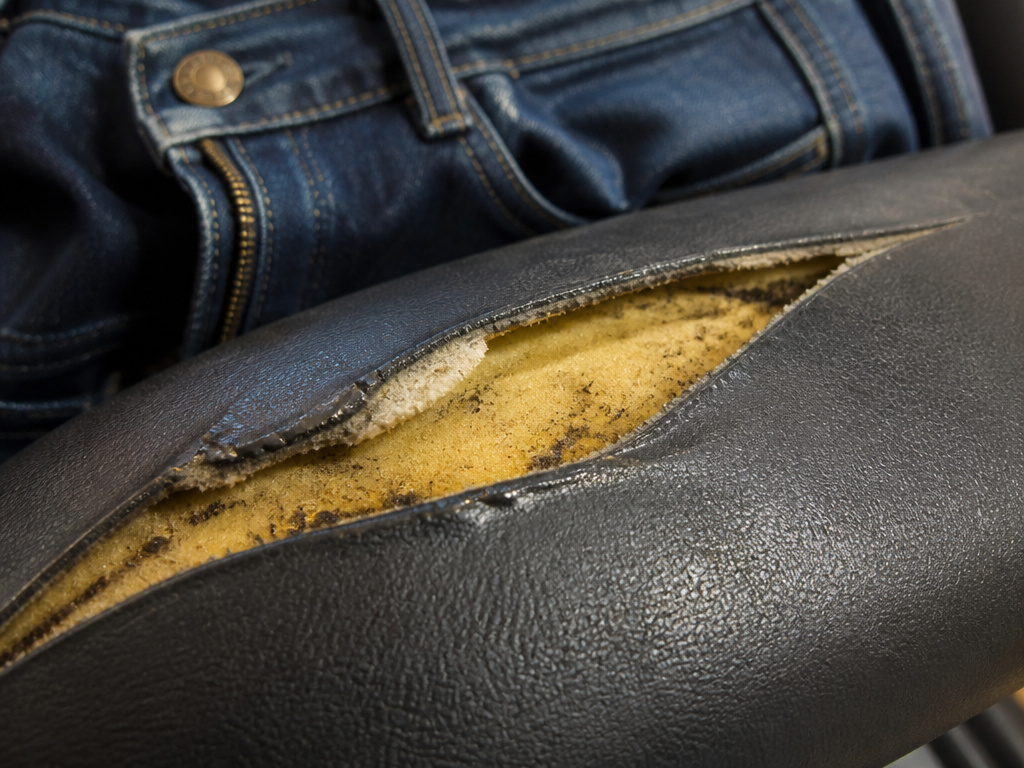
Rivets and zippers are the reason jeans show up in so many written policies. The rule is about what metal does to upholstery.
| Item | Why It’s Banned | Swap For |
|---|---|---|
| Jeans and cargo pants | Abrasive; rivets tear vinyl | Leggings or sweatpants |
| Plastic or rubber sweat suits | Dehydration and heat-illness risk | Normal breathable layers |
| Crocs and clogs | Banned at several facilities | Court or cross-training shoes |
| Ripped or baggy apparel | Gets caught in machinery | Fitted athletic wear |
| Sheer or see-through clothing | Fails the coverage standard | Opaque athletic tops |
Akron bans jeans and cargo pants because they’re abrasive on upholstery. Rider University states the mechanism plainly: rivets and zippers tear the vinyl, and once the vinyl is torn, germs and bacteria can grow inside the padding. That’s a hygiene rule wearing a dress-code costume.
Torn vinyl is also the one thing a Lysol wipe can’t fix.
DAFI 34-114 takes a quieter route and classifies casual slacks, shorts, and jeans as non-exercise attire. JBLM just bans slacks, jeans, and jean-cutoffs outright.
The part nobody mentions: A torn bench pad is the real problem, and it stays torn for months. You can’t see the bacteria, but you can feel the grit through a towel.
What to Wear Instead
Leggings, sweatpants, and athletic pants clear the bar almost everywhere. The JCC authorizes full-coverage shorts, leggings, and sweatpants or athletic pants by name.
Length matters if you wear compression shorts. Fort Hays bans spandex and biker shorts that aren’t at least mid-thigh. If you’re buying, how to choose gym shorts covers length and liner without turning it into a project.
Sweat Suits, Perfume, and the Rules Nobody Reads
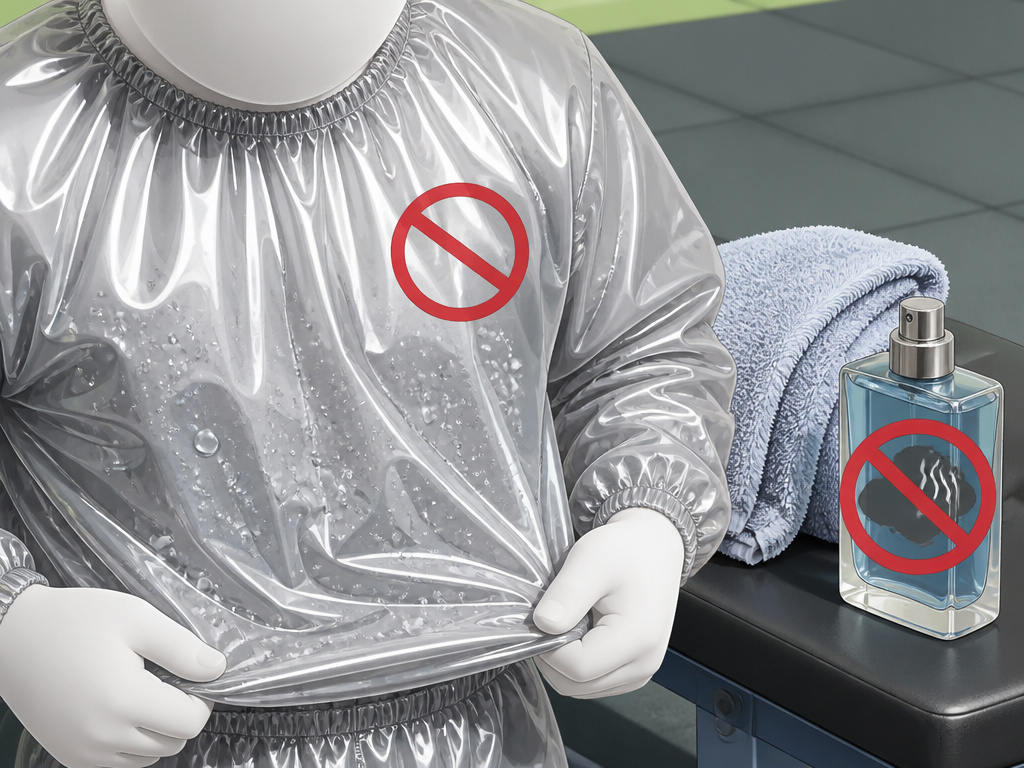
The cardio floor can have a smell to it. Sometimes that smell is a plastic sweat suit doing exactly what it was sold to do.
DAFI 34-114 bans garments made of plastic, rubber, or nylon designed to increase perspiration, in any fitness facility, including outdoor running tracks and fields. The stated reason is dehydration and heat-illness risk. That rule explicitly follows you outside the building, covering outdoor running tracks and fields.
Conwy council’s gyms go after the opposite problem. The Conwy council gym dress code requires limited use of perfume or cologne and bans heavy scent and body odour outright. It also bans clothing with rivets, work clothing, school uniforms, dresses, and offensive language.
Fabric choice solves most of this before you leave the house. gym clothing materials is worth a look if you’re still lifting in cotton.
Common mistake: Treating a plastic sweat suit as a training tool. Facilities ban them on dehydration and heat-illness grounds, and the ban covers outdoor tracks and fields too.
Staff Discretion: The Rule at the Door Isn’t the Posted Rule
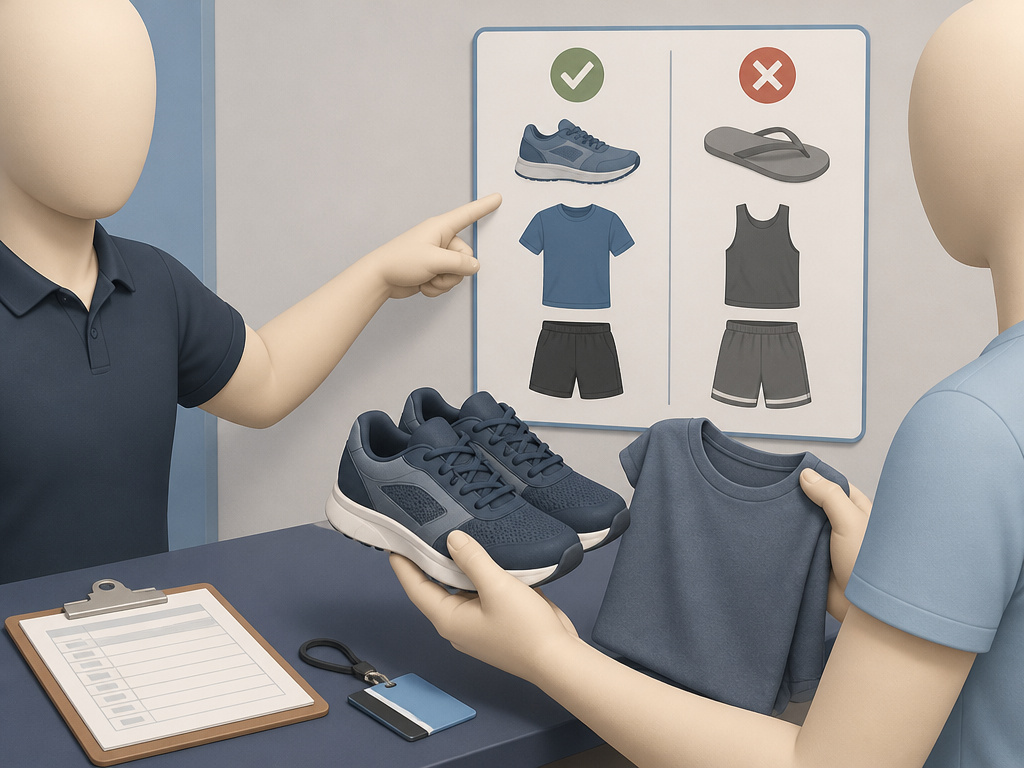
Three things can happen when staff decide your outfit doesn’t meet code: you’re asked to change, you’re asked to leave, or you’re waved through with a warning.
Wright-Patterson’s flyer says anything not covered by the code rules is at the discretion of Fitness and Sports staff, for health, safety, and equipment lifespan. The George Mason recreation dress code policy gives staff discretion particularly when participant safety is compromised. Fort Hays puts final determination with supervising staff.
Rider University says staff will ask members to change or leave the facility. Akron goes further, noting that failure to meet the standard may result in disciplinary action up to and including removal.
Which is why the useful move is a question, not a guess:
- Call the front desk before your first visit and ask what they require for shoes.
- Ask specifically about boots if you lift in them, because that’s the rule most likely to differ from the sign.
- Pack a spare t-shirt if your top is cropped or sleeveless.
- Read the posted sign at the door even if you checked online, since facilities update these.
Fair warning: the person at the desk may have final discretion. The same courtesy that gets you a shared rack gets you a straight answer about shoes.
One outfit that clears the posted code beats a drawer full of maybes, and best gym clothing narrows that down fast.
Frequently Asked Questions
Can you wear jeans to the gym?
At every facility in this set, no. DAFI 34-114 classes casual slacks, shorts, and jeans as non-exercise attire, JBLM bans slacks and jeans outright, and Akron and the JCC both prohibit them. Akron and Rider University give the reason: the rivets and zippers tear vinyl upholstery, and torn padding holds bacteria.
Are Crocs allowed in a gym?
No at the facilities that name them. Akron, George Mason, Fort Campbell, the 379th EFSS fitness center, and the JCC all ban Crocs or croc-type shoes. George Mason extends the ban to Yeezy foam-runners. The common thread is an open design that fails a closed-heel requirement.
Do you need special shoes for the weight room?
Closed-toe, closed-heel athletic shoes cover most facilities. Beyond that it depends where you train. JBLM authorizes weightlifting boots, while Akron bans boots on equipment and the JCC bans boots as footwear entirely. If you lift in boots, ask first.
Can you wear a sports bra without a shirt over it?
It depends on the building, and the three answers are genuinely different. Akron permits sport and athletic bras designed to be worn while working out. The JCC says a sports bra alone is not authorized. JBLM bans visible undergarments and sports bras outright.
What happens if you break a gym dress code?
The first response is usually a request to change. Rider University says staff will ask members to change or leave the facility. Akron notes that failure to meet the standard may result in disciplinary action up to and including removal. Wright-Patterson, George Mason, and Fort Hays all give staff final discretion.
The Bottom Line
Here’s the threshold that actually matters: if the shoe has an open heel or an open toe, don’t wear it to a gym you haven’t been to before. That single test clears the rule at every facility in this set.
The second test is coverage. Tops meet the waistband when you stand, bottoms cover the glutes through a full range of motion. Those two lines are close to universal, even where the wording differs.
One concession worth stating plainly. None of this applies if you train somewhere that publishes a numbered policy memo, because at that point you should read the memo and ignore the sign. The memo is the enforceable document, and it’s usually one page.
One thing to try this week: before your next session, photograph the posted dress code at your gym and keep it in your phone. Ten seconds of work, and you’ll never stand at the front desk guessing again.
