
How to Build a Home Workout Routine: Step-by-Step
This post contains affiliate links. As an Amazon Associate, we earn from qualifying purchases.
To build a home workout routine, cover four parts: aerobic exercise, stretching, strength training, and balance work. If you are wondering how to build a home workout routine, strength days fit best at 2-3 per week with at least 48 hours between sessions, starting with 2-5 lb hand weights or your own bodyweight.
Forty-eight hours is the number most how to build a home workout routine guides ignore. That gap is when muscle repair happens, and skipping it can turn a simple dumbbell routine into a nagging shoulder.
What follows: the four parts of a complete routine, how to pick your weekly frequency, the starting-weight rule most people skip, the reps-and-rest question the sources can’t agree on, and the equipment that earns its space in a corner of your apartment.
Key Takeaways
- Four parts, no shortcuts — aerobic, stretching, strength, balance. A routine missing any one leaves a gap.
- 2-3 strength days a week, with at least 48 hours between sessions; up to 3 non-consecutive days is safe for most people.
- Start with 2-5 lb hand weights, or bodyweight and resistance bands if you have nothing.
- One round first, building to 2-3 as you get stronger.
- Clear it with a provider if you’ve been inactive or have a health condition before starting.
The Four Parts of a Home Workout Routine
The MedlinePlus indoor fitness routine guide lists four parts for a complete routine: aerobic exercise, stretching, strength training, and balance work. Skip one and you’re leaving a gap the others can’t fill.
A complete home routine covers four categories: aerobic exercise that raises heart rate, stretching for flexibility and range of motion, strength training for muscle and bone, and balance exercises to prevent falls. Each category addresses a different system, and a routine missing one leaves that system underdeveloped.
Here’s what each part actually means in practice.
- Aerobic exercise gets your heart rate up and uses large muscle groups. Walking in place counts.
- Stretching keeps joints moving through their full range. It’s the part most home routines drop first.
- Strength training builds muscle and bone. This is where dumbbells, bands, or bodyweight come in.
- Balance work prevents falls. A single-leg stand or a heel-to-toe walk covers it.
Balance work is the part people skip because it doesn’t feel like exercise. MedlinePlus notes it prevents falls, which matters more as you age.
If you want a deeper walkthrough of sequencing these four parts into a weekly plan, the how to build a workout routine guide covers the order and the transitions.
Two Strength Days or Three? What the Sources Actually Say
Penn Medicine’s home strength training program calls for 2-3 sessions a week with at least 48 hours between them. ACE puts the ceiling at three non-consecutive days. Iversen et al. Argue the weekly volume matters more than the frequency.
That’s three different answers to the same how to build a home workout routine question. Here’s what each one actually means for a beginner.
Penn’s 48-hour rule is about recovery. Strength training creates small tears in muscle tissue, and the repair process takes roughly two days. Train the same muscle before it’s rebuilt and you accumulate fatigue instead of strength.
ACE’s guidance adds a practical ceiling: up to three non-consecutive days is safe for a full-body routine. Two days works. Three works better if you can recover.
Iversen et al.’s time-efficient training program design study reframes the question entirely. Their finding: weekly training volume is more important than training frequency. Four sets per muscle group per week beats two sessions if the two sessions only add up to three sets.
For a beginner, the practical translation is simple. Pick two or three days you can repeat every week, and make sure each muscle group gets at least four working sets across those days.
No notes, no numbers, just sweaty and confused. Then I switched to a three-day template with a notebook: squats, push-ups, rows, hinge.
The boring plan beat the variety every time.
If you’re building the weekly structure from scratch, the beginner workout schedule walkthrough covers how to slot three days around a real job.
The 2-5 lb Starting Weight Rule (and What to Use If You Have Nothing)
2 to 5 lb is the starting range MedlinePlus gives for hand weights, and it’s lower than most people expect. That’s the point.
The Virginia Cooperative Extension home fitness guide puts it another way: start with less weight and more reps to build healthy movement patterns before adding load. The pattern comes first. The weight comes second.
What to Use If You Have Nothing
MedlinePlus and Penn Medicine both list substitutes that cost nothing.
| You Have | Use Instead | Load |
|---|---|---|
| No dumbbells | Milk jug filled with water | 1 quart ≈ 2 lb |
| No dumbbells | Soup cans or a filled water bottle | Light, varies |
| Nothing at all | Bodyweight (squats, pushups) | Bodyweight |
| Bands only | Resistance band | Adjust tension |
The milk jug math is worth knowing. One quart of water weighs about 2 lb, which lands right in MedlinePlus’s starting range. Fill a gallon jug and you’ve got roughly four times that for lower-body work.
How Fast to Progress
Penn’s rule is to adjust band tension so you can complete one set of 10 reps with effort, then increase tension every few weeks. MedlinePlus says add more weight as you get stronger. Neither source gives a specific timeline, which is honest — progression depends on how consistently you train.
Bands handle pulling and hip work; the dumbbells cover the rest. A chair and a wall finish the kit.
If you’re starting from zero equipment, the home gym on a budget breakdown covers what to buy first and what to skip.
Reps, Sets, and the Rest Question Nobody Agrees On
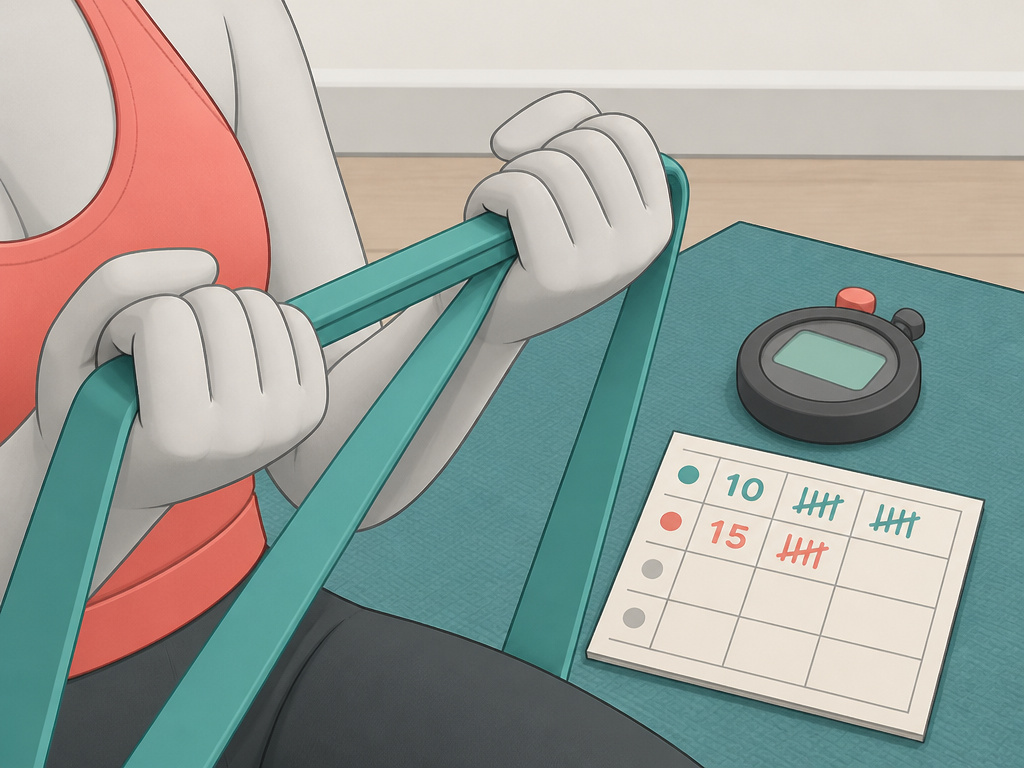
Every source disagrees on rest. Virginia Cooperative Extension says 30-60 seconds. ACE says 2-3 minutes. MedlinePlus says no breaks at all during a circuit.
That’s not a contradiction — it’s three different training styles wearing the same label.
Here’s how the rep and set prescriptions stack up.
| Source | Reps per Set | Sets |
|---|---|---|
| MedlinePlus | 15 (12-15 pushups) | 1, building to 2-3 |
| Penn Medicine | 10 | 1-3 |
| ACE | 8-15 | 1-4 |
| Iversen et al. | 6-15 RM (up to 40 to failure) | 4+ weekly per muscle group |
Reps: 10, 15, or Somewhere In Between
MedlinePlus’s sample circuit uses 15 reps per movement. Penn’s program uses 10. ACE’s range is 8-15. Iversen et al. Frame it as 6-15 RM, with 15-40 reps allowed if you’re training to volitional failure.
Sources disagree on reps: Penn’s program uses 10, MedlinePlus’s circuit uses 15 (12-15 for pushups), ACE recommends 8-15, and Iversen et al. That range builds strength and movement pattern at the same time, and it’s forgiving enough that a slightly-too-light weight still does something useful.
Rest: 30 Seconds, 2 Minutes, or None
Circuit training builds rest into the format: you move to the next muscle group instead of sitting down. Virginia Cooperative Extension suggests 30-60 seconds between sets for most beginners, while ACE recommends about 2-3 minutes of rest between sets.
Circuit training builds rest into the format: you move to the next muscle group instead of sitting down. Straight sets need 30-60 seconds for most beginners. The 2-3 minute figure is for heavier loads than a home routine uses.
A band at the right tension gives a smooth pull through the whole range. If it snaps back on the release, it’s too tight.
Sweaty and tired every time, but I couldn’t name a single number I’d improved. I also gave up ending every workout with a high-rep burnout finisher because my form fell apart on the last reps. Controlled sets at a manageable weight leave me fresher and safer.
If your schedule is tight, the 20-minute home workout format covers how to compress a circuit without losing the strength work.
The Equipment That Actually Earns Its Space
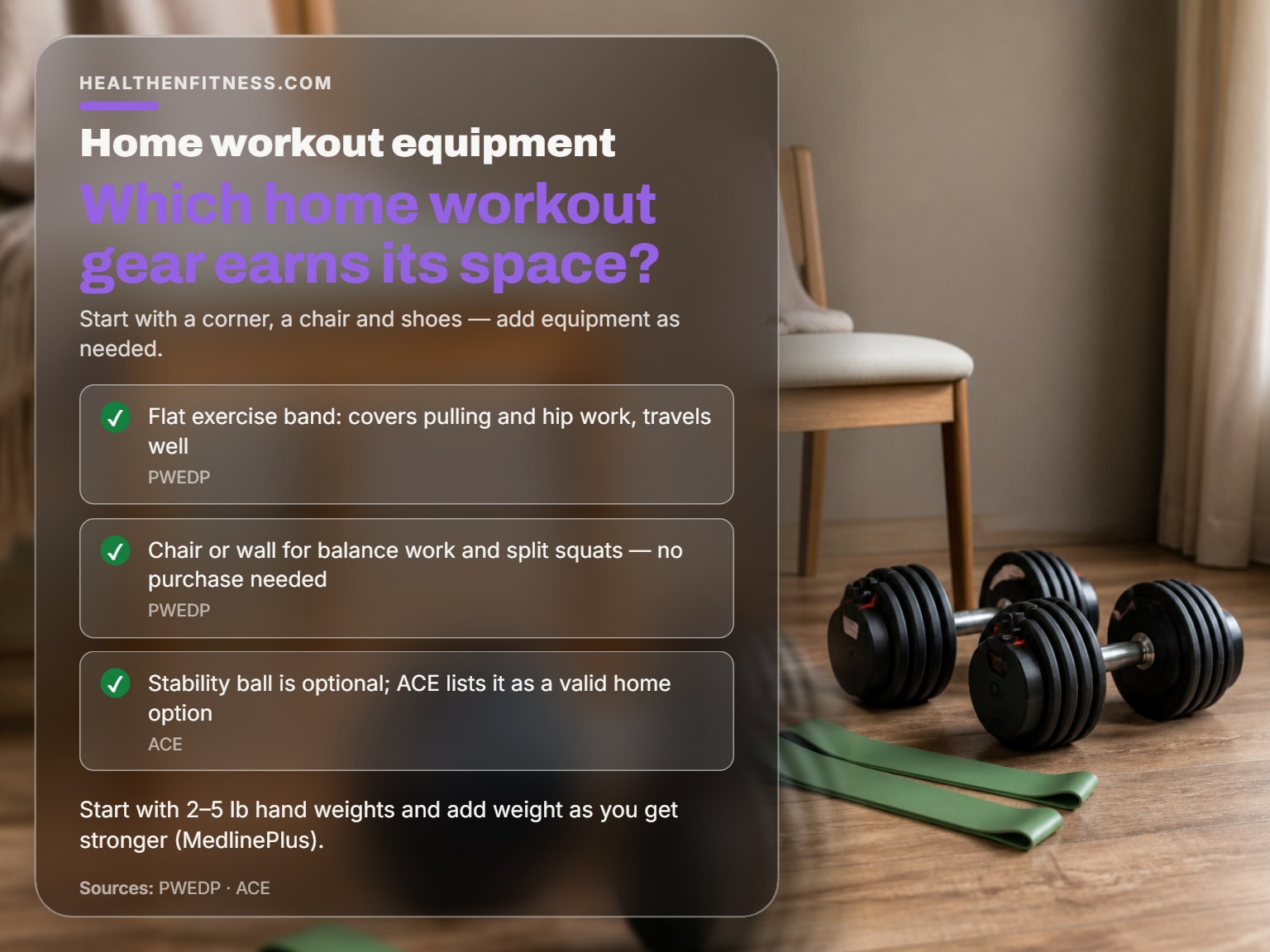
You’ve got a corner, a chair, and a pair of shoes. That’s enough to start. The equipment question is about what to add next, not what to buy first.
Here’s what earns its space, in order.
- A flat exercise band covers pulling and hip work and travels well.
- A pair of adjustable dumbbells replaces a whole rack.
- A sturdy chair or a wall handles balance work and split squats. No purchase needed.
- A stability ball is optional, but ACE lists it as a valid home option for core and balance.
If you have space for one piece of furniture, a flat bench covers seated presses, step-ups, and split squats. It’s the closest thing to a gym upgrade that still fits in a closet.
Skip the elaborate app subscription and the challenge program. The best home workout routines are the ones you can repeat without opening an app.
Common mistake: Buying a full home gym before you’ve trained for a month. The equipment sits unused, and the space it takes up makes the routine feel like a chore.
Bodyweight vs dumbbells: bodyweight wins on convenience and travel, dumbbells win on loading the hips and back. MedlinePlus suggests starting with 2-5 lb hand weights and adding weight as you get stronger, while Virginia Cooperative Extension suggests starting with less weight and more reps before adding load. The bodyweight workouts guide covers the full progression.
Where Home Routines Fall Apart (and How to Fix It)
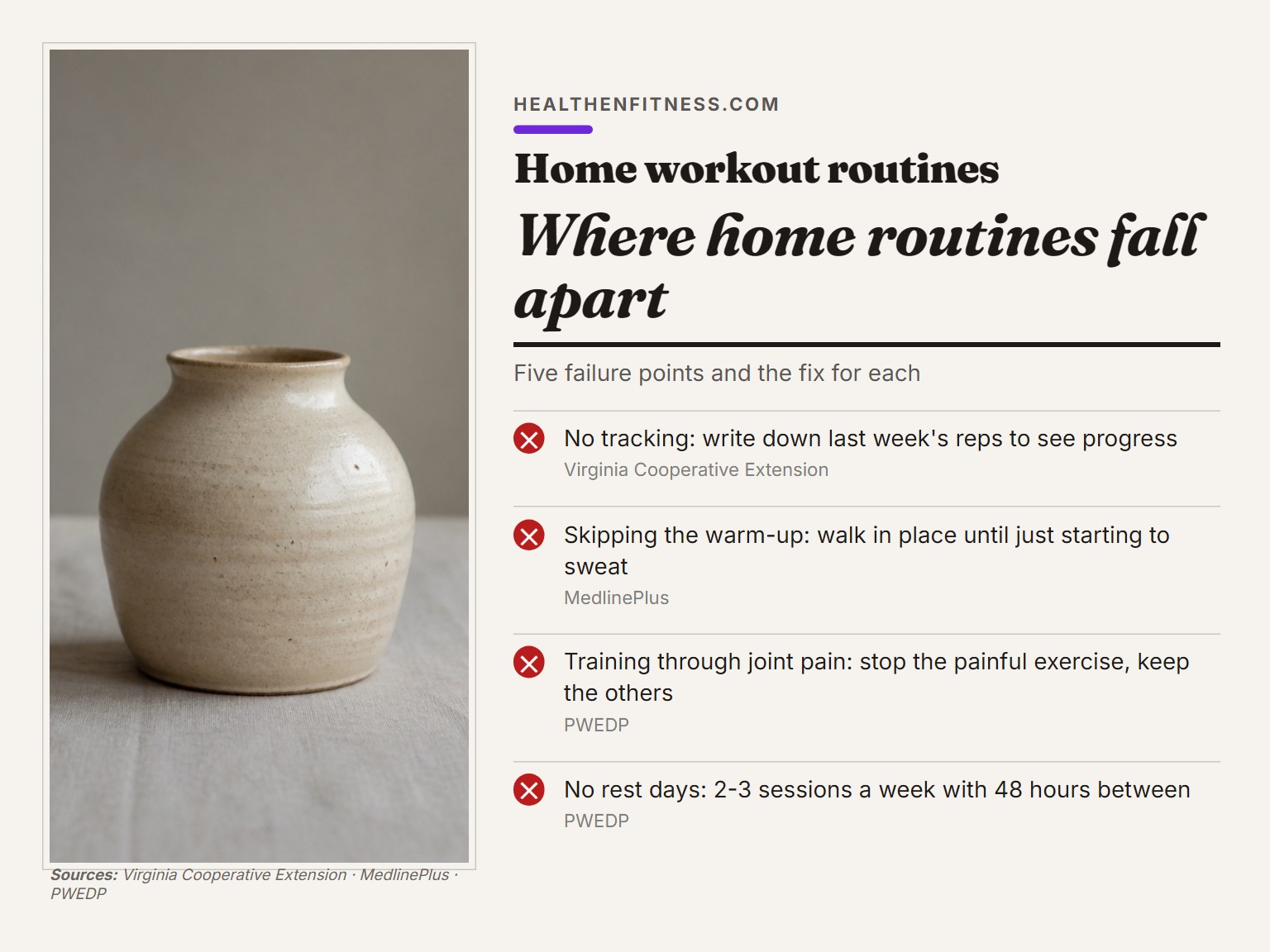
Everyone tells you to add more exercises. The opposite works better. A five-lift plan you repeat beats a fifteen-move circuit you can’t track.
Here are the five failure points I see most often, and the fix for each.
- No tracking. If you can’t see last week’s reps, you can’t tell if you’re progressing. Write it down.
- Too many exercises. Five or six lifts, 2-3 sets each, covers the major muscle groups.
- Skipping the warm-up. MedlinePlus says walk in place until you’re just starting to sweat. Penn says 5-10 minutes of aerobic work. Iversen et al. Say keep it exercise-specific. The sources differ on warm-up: MedlinePlus says walk in place until just starting to sweat, Penn says 5-10 minutes of aerobic work, and Iversen et al.
- Training through joint pain. Penn’s rule is stop the painful exercise, keep the others.
- No rest days. Penn Medicine recommends two to three sessions a week with 48 hours between, ACE says up to three non-consecutive days is safe, and Iversen et al. Argue weekly volume matters more than frequency.
Before you start: Two things to check. If you’ve been inactive or have a health condition, clear it with a provider first (MedlinePlus). If an exercise hurts a joint, stop that movement and keep the others (Penn Medicine).
Where this goes sideways: Training on a slippery floor or in socks. Bare feet on hardwood plus a fast circuit equals a slip you don’t see coming.
The tracking point matters more than it sounds. The Virginia Cooperative Extension home fitness guide recommends tracking workouts to measure progress, and it’s the single habit that separates a routine that sticks from one that fades by week four.
Do you actually know what your last session looked like on paper? If not, that’s the first fix.
If you want a ready-made weekly structure, the workout plans library has options for two, three, and four days. And if fat loss is the goal, the workout plan for weight loss walkthrough covers how to pair strength work with aerobic volume.
Frequently Asked Questions
How many days a week should a beginner train at home?
Two to three strength sessions a week, with at least 48 hours between them. Penn Medicine recommends 2-3 sessions; ACE sets the ceiling at three non-consecutive days. Start with two if you’re new to strength training and add a third once recovery feels easy.
What if I don’t have any equipment?
Bodyweight and household objects cover everything. MedlinePlus suggests bodyweight squats and pushups, or resistance bands. Penn Medicine lists stairs, soup cans, and milk jugs filled with water as substitutes. A quart of water weighs about 2 lb, which is right in the starting range.
How long should a home workout take?
It depends on sets and rest.
Can I build muscle with bodyweight only?
Yes, within limits. Bodyweight training builds strength and muscle, especially for beginners. The ceiling comes when the movement gets too easy — at that point, adding a band or a pair of dumbbells is how you keep progressing. ACE lists bodyweight, bands, and light dumbbells as valid home options.
Should I stretch before or after?
MedlinePlus includes stretching as one of the four parts of a complete routine and recommends a dynamic warm-up before strength work. Iversen et al. Argue stretching only matters if flexibility is your goal. MedlinePlus includes stretching as one of the four parts of a complete routine and recommends a dynamic warm-up, while Iversen et al.
Before You Go
The four-part structure here works for most people, but it changes if you’re training for a specific event or coming back from an injury. In those cases, a generic home routine is the wrong starting point — talk to a clinician or a coach who can see you move.
One rule most guides skip: if you’ve been inactive or have a health condition, see a provider before your first session. MedlinePlus lists this as step one, and it’s the gate most home routines walk right past.
If you want one answer and you have a small space: a pair of adjustable dumbbells, a resistance band, and a sturdy chair. That covers the large majority of home routines.
Do this today: pick a corner, put a chair there, and write down three exercises you can do without equipment. That’s day one.
