
How to Do Ring Dips: Step-by-Step (Without Sagging)
This post contains affiliate links. As an Amazon Associate, we earn from qualifying purchases.
To do ring dips, set the rings at hip height, press up to a locked support hold, lower under control until your upper arms reach parallel, then press back up. The rings move, so your shoulders and core work harder than they do on bars. If you want to know how to do ring dips, start with the setup above.
That movement is the whole story. A fixed bar holds still while you push. Rings tilt, drift apart, and force your stabilizers to chase the handles through every inch of the rep. Which is why a guy who can bang out fifteen bar dips often drops to five shaky ring reps the first time he looks up how to do ring dips.
What follows is the setup, the first rep, the fixes for the two things that go wrong most, and a progression ladder for anyone who cannot hold a steady support yet. No twelve-week program. Just the movement, done properly.
Key Takeaways
- Set rings at hip height for dips; higher rings turn the exercise into a shrug-fest at the top.
- Lock the elbows and depress the shoulders before you lower a single inch, or the bottom position lands on soft joint.
- Stop at parallel until you own the range; deeper is not better if your shoulders roll forward.
- Slow the lowering to three seconds and ring dips get honest fast, even at five reps.
- Skip ring dips entirely if you cannot hold a still support for twenty seconds.
What Makes Ring Dips Harder Than Bar Dips
The instability is not a gimmick. On parallel bars, your hands are locked in a fixed plane, so the pressing muscles do almost all the work. On rings, the straps let each hand wander, and your rotator cuff and core spend the whole rep correcting that drift.
Ring dips require the lifter to stabilize two independent moving handles while pressing bodyweight. Because the rings allow lateral and rotational travel, the shoulder stabilizers and trunk work continuously rather than isometrically, and the pressing muscles receive a less predictable load through the full range of motion.
Here is the practical difference in a table you can actually use.
| Factor | Bar Dips | Ring Dips |
|---|---|---|
| Hand position | Fixed, locked plane | Free to drift and rotate |
| Stabilizer demand | Low to moderate | High, constant |
| Typical rep drop | Baseline | Roughly a third fewer |
| Shoulder forgiveness | More forgiving | Demands clean position |
| Best for | Loading heavy | Building control |
That last row matters more than people expect. If your goal is to pile on weight, bars let you load harder. If your goal is shoulder control and pressing strength that carries over to everything else, rings win. The dips for chest breakdown covers the bar version in detail if you want to run both.
Try this week: do one set of ring support holds and time it. That number tells you where you actually stand.
How Do You Set the Rings for Dips?
Ring height and width decide whether the rep feels strong or sketchy, and most people never adjust either. Set the rings so the handles sit at roughly hip height when you stand between them. Too high and you cannot get a full range without your feet fighting the floor. Too low and the bottom of the rep buries your shoulders, which is the first thing to check when you compare a how to do ring dips guide against your own setup.
Width is the other half. Shoulder-width apart is the default. Wider rings increase the stabilizer demand and the strain on the front of the shoulder; narrower rings crowd your torso at the bottom. Start at shoulder width and only widen once the rep is clean.
A quick check before every session:
- Strap buckles facing out, so the metal never digs into your forearm at lockout.
- Both rings at the same height, measured from the floor, not eyeballed.
- Straps hanging straight, with no twist that lets the ring rotate mid-rep.
- Wood rings wiped down if your hands are sweaty, because a slick ring changes your grip and your shoulder position along with it.
If you are still shopping, the best gymnastic rings comparison covers wood versus plastic and strap quality, and the exercise rings for beginners guide is the place to start if you have never hung a pair. I use Rogue Fitness rings at home and a set of Rings by Rep at the gym, and both hold their shape under load.
Honestly, the strap quality matters more than the ring material. A cheap strap that slips a quarter inch mid-set will wreck your confidence faster than any wood-versus-plastic debate.
The Setup and First Rep, Step by Step
Before you start: Ring dips load the front of the shoulder hard, and a torn labrum takes months to settle. Warm up with band pull-aparts and two easy sets of push-ups first. Keep the rings over a clear floor, because a failed rep drops you straight down with no bar to catch.
- Grab the rings and press to a support hold. Arms locked, shoulders pushed down away from your ears. If you cannot hold this for twenty seconds without shaking, stop here and build that first.
- Set your feet. Crossed behind you and off the floor for a strict rep, or lightly touching for assistance. Skipping this leaves you swinging, and a swinging ring dip is a shoulder injury waiting on a calendar date.
- Brace your ribs down and squeeze your glutes. A soft trunk lets the rings drift apart at the bottom, which is exactly where your shoulder is most exposed.
- Lower for a three count. Elbows track back, not flared out wide. Rushing the descent is how people arrive at the bottom with no control and no way back up.
- Stop when your upper arms reach parallel. Going deeper before you own the range puts the shoulder in internal rotation under load, and that is the position that complains for weeks.
- Press back up and re-lock. Finish with the shoulders down, not shrugged up around your ears.
That is the whole movement. Six steps, and step five is the one people ignore.
Why Does Your Shoulder Roll Forward on Ring Dips?
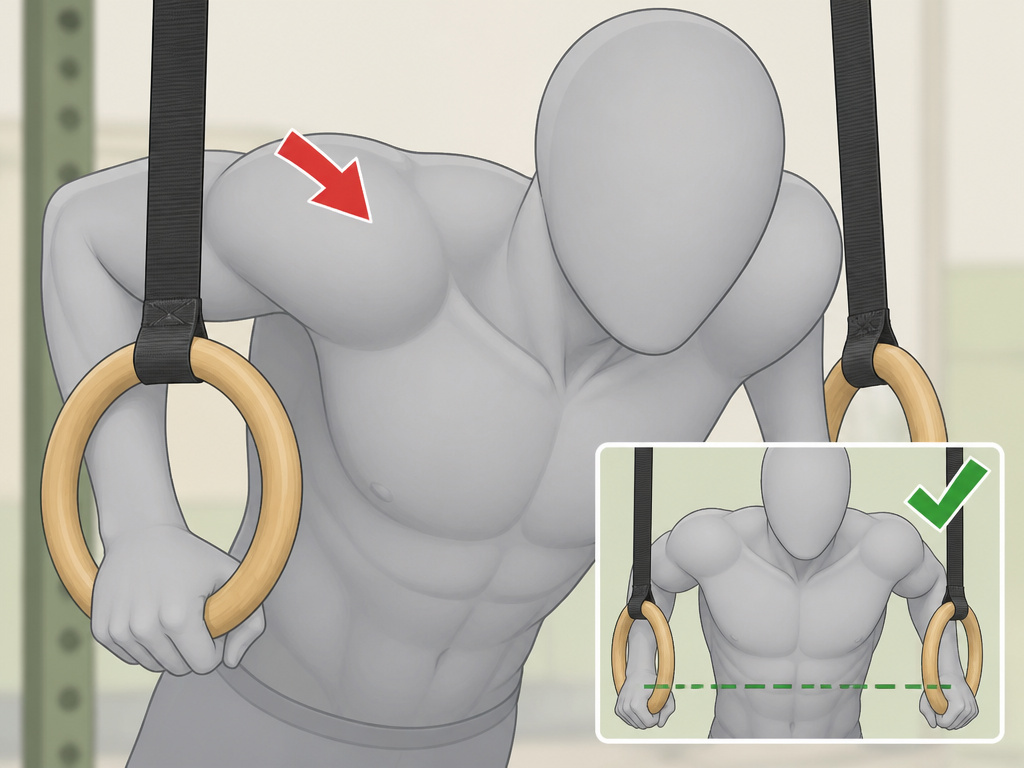
Forward shoulder roll at the bottom almost always traces to one of three causes, and none of them are “you need more mobility.” Here is the diagnostic table I use.
| Symptom | Likely Cause | Fix |
|---|---|---|
| Shoulder rolls forward at bottom | Depth beyond current control | Stop at parallel, add pauses |
| Rings drift apart mid-rep | Soft trunk, no glute squeeze | Brace ribs down, cross feet |
| Elbows flare wide | Weak lockout position | Support holds, band-assisted reps |
| Pain at the front of the shoulder | Ring width too wide | Narrow to shoulder width |
Start with the depth fix, because it solves more cases than anything else. Most people who roll forward are simply going lower than their shoulder can control, and the joint pays for the extra inch.
The other thing worth saying: ring dips and dips vs bench dips are not the same conversation. Bench dips let you dump the shoulder forward with almost no consequence because your feet carry most of the load. Rings do not offer that mercy. If your bench dip form is sloppy, fix it before you hang a pair of rings.
Progressions From Support Hold to Full Ring Dip
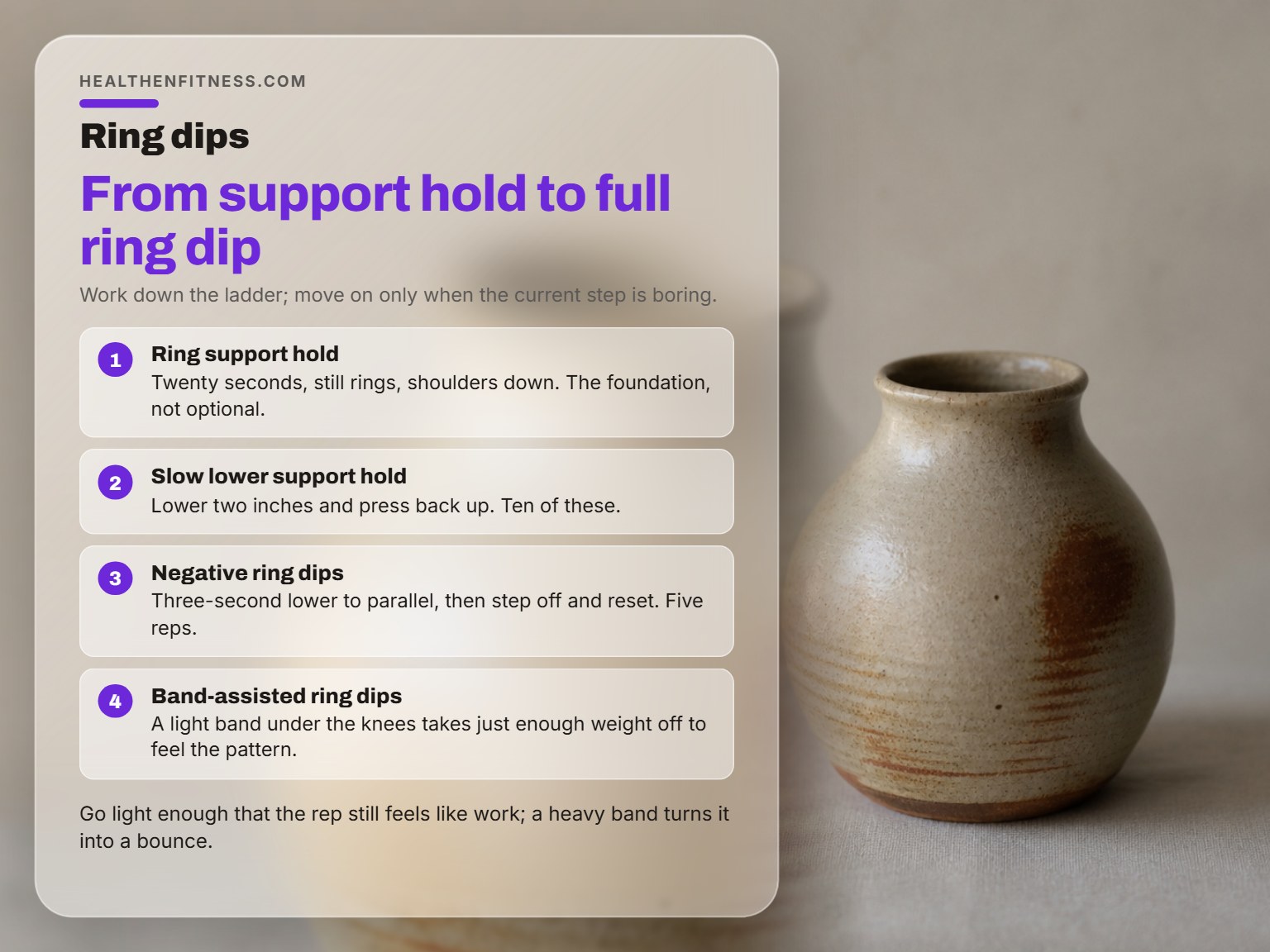
Nobody starts at a full ring dip, and pretending otherwise is how people quit in week two. Work down this ladder and only move on when the current step is boring.
- Ring support hold. Twenty seconds, still rings, shoulders down. This is the foundation and it is not optional.
- Ring support hold with a slow lower. Lower yourself two inches and press back up. Ten of these.
- Negative ring dips. Three-second lower to parallel, then step off and reset. Five reps.
- Band-assisted ring dips. A light band under the knees takes just enough weight off to let you feel the pattern.
- Full ring dips. Three clean reps before you chase five.
The band step is where most people cheat. A heavy band turns the movement into a bounce, and you learn nothing. Go light enough that the rep still feels like work.
Once you own five clean ring dips, the muscle up progression becomes a realistic next project, and ring rows build the pulling side that keeps your shoulders balanced.
I won’t put anyone on full ring dips until they can hold a still support for twenty seconds and do five controlled negatives. Skipping that step is how you get a shoulder that clicks for a month. I learned that one the slow way.
Tempo and Pauses Beat More Reps
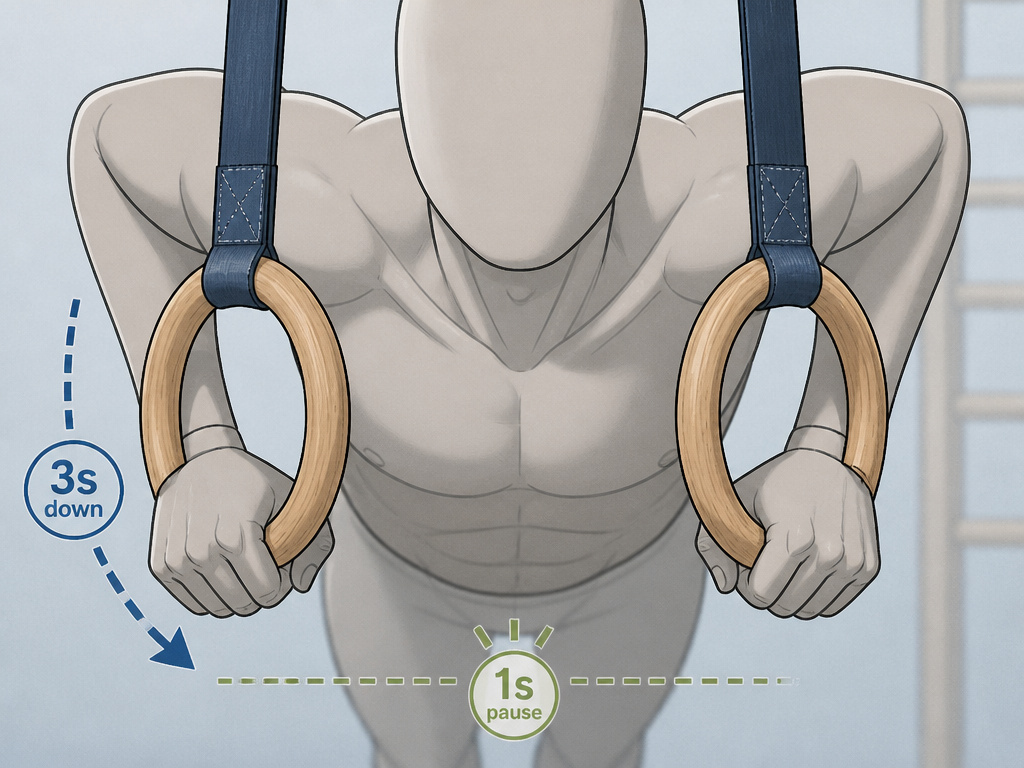
Chasing rep count on rings is a trap. Ten fast, sloppy reps build less than five slow ones, and the sloppy version trains your shoulder to accept a bad position under load.
Here is the tempo I hand to most people: three seconds down, one second pause at parallel, press up at normal speed, brief lockout. That pause is the whole trick. It kills momentum, forces your stabilizers to hold, and makes five reps feel like a real set.
You will shake. That is fine. The shake is your shoulder learning to control a moving handle, and it settles within a few weeks of consistent work.
If you can do ten ring dips but they all look the same as rep one through ten, slow down. Add the pause and watch the count drop to five. That drop is the honest number.
The same logic applies to your push-up work. Slow tempo and pauses make a basic push-up far harder than twenty rushed reps, and that carries straight over to the rings.
When to Skip Ring Dips
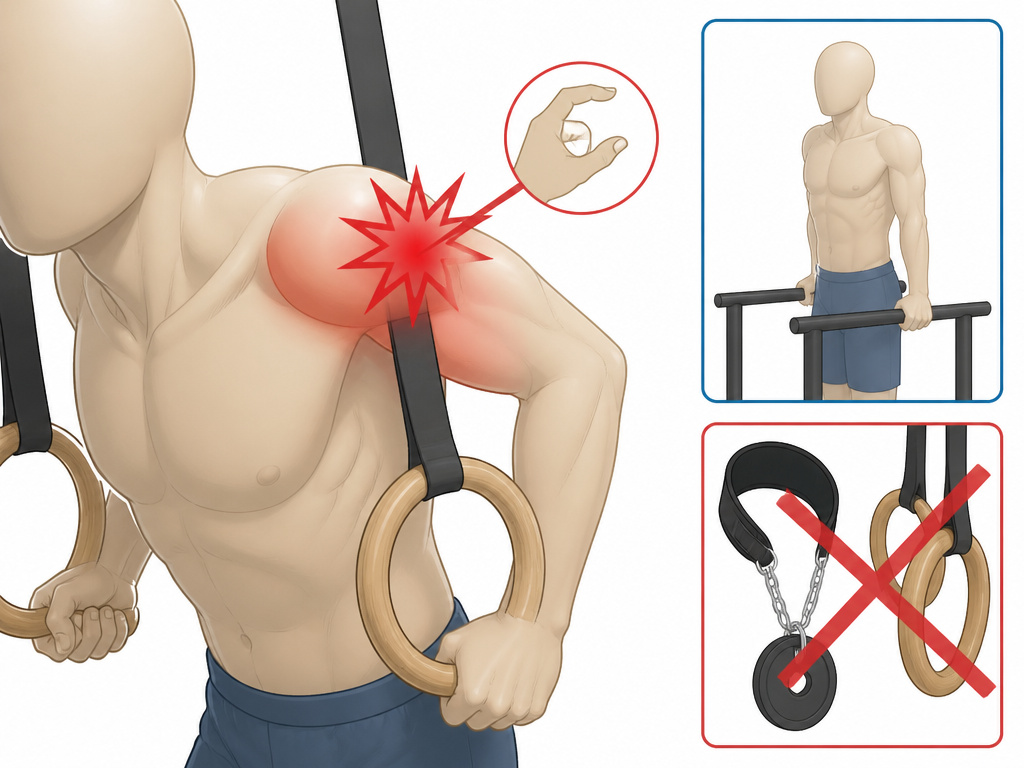
Ring dips are not the right choice for everyone, and a few situations should send you to a different exercise entirely.
Skip this if: you feel a sharp pinch at the front of the shoulder at the bottom of the rep. That pinch is not a cue to push through. Back off to support holds for two weeks, and if it returns, get it looked at by someone who can actually assess the joint.
The other case is anyone who cannot yet do a clean parallel bar dip. Rings add instability on top of a movement you have not learned. Build the bar dip first, then move over.
And if you are chasing heavy loaded work, a dip belt for weighted dips on bars is the better tool. Rings and heavy plates do not mix well, because the instability multiplies the load on the joint in ways a belt cannot control.
Frequently Asked Questions
How many ring dips should a beginner do?
Start with three sets of three clean reps, or negatives if you cannot manage full reps yet. Add one rep per week only when the last set still looks like the first. Quality beats volume here.
Are ring dips harder than regular dips?
Yes, for most people. The rings move independently, so your shoulders and trunk work continuously to stabilize. Expect to do noticeably fewer ring reps than bar reps at first.
Can ring dips hurt your shoulders?
They can, if you go deeper than you control or let the shoulders roll forward at the bottom. Stop at parallel, keep the rings at shoulder width, and build a solid support hold before adding reps.
What muscles do ring dips work?
They hit the chest, triceps, and front delts like a bar dip, with far more demand on the rotator cuff and core because the rings never hold still.
Do I need a spotter for ring dips?
Not usually, if you keep your feet available to touch down. Set the rings over a clear floor and keep a light foot contact until you trust the rep.
The Bottom Line
One rule covers most of this: if you cannot hold a still support for twenty seconds, you are not ready to do ring dips yet, and that is a two-week detour, not a setback.
Start there this week. Hang the rings, set them at hip height, and just hold. Time it. When twenty seconds feels easy, add a three-second negative and build from there.
The rest follows on its own. Keep it simple and keep showing up.
