
How to Lose Fat at the Gym: What Actually Works
This post contains affiliate links. As an Amazon Associate, we earn from qualifying purchases.
To lose fat at the gym, pair a modest calorie deficit with both aerobic and resistance training. In a 36-trial meta-analysis of programs lasting at least 10 weeks, aerobic training beat resistance training on fat mass by 1.06 kg, while resistance training held onto 0.88 kg more fat-free mass.
That 10-week line is where the how to lose fat at the gym argument gets settled, because it marks the point where a program stops being a novelty and starts being a workload your body has to adapt to. Below it, the trials can’t tell the modes apart on any measure. So the cardio-versus-weights debate in week three is noise.
What follows is what six primary sources actually measured, where they contradict each other, and the weekly structure I’d hand a friend who wants the scale to move without giving up the muscle they built.
Key Takeaways
- Cardio wins on absolute fat mass in programs of 10 weeks or longer: 1.06 kg more fat lost than resistance training alone across 36 randomized trials.
- Weights protect lean tissue. Resistance training kept 0.88 kg more fat-free mass in that same comparison, and EASO gives moderate-to-high intensity resistance work a Grade A for lean mass preservation.
- Match the workload and the modes converge. When energy expenditure is equal, body mass, fat mass, body-fat percentage, and fat-free mass all change similarly.
- Exercise alone averages 2 to 3 kg of weight loss, per EASO. The deficit does the rest of the work.
- Under 10 weeks, pick what you’ll actually repeat. No mode separated on any body composition measure in shorter trials.
Why the First 10 Weeks Decide Which Exercise Wins
Ten weeks is the line where the exercise modes stop looking identical. A PROSPERO-registered meta-analysis of 36 randomized trials and 1,564 participants found the split appears once programs run that long, and disappears when they don’t.
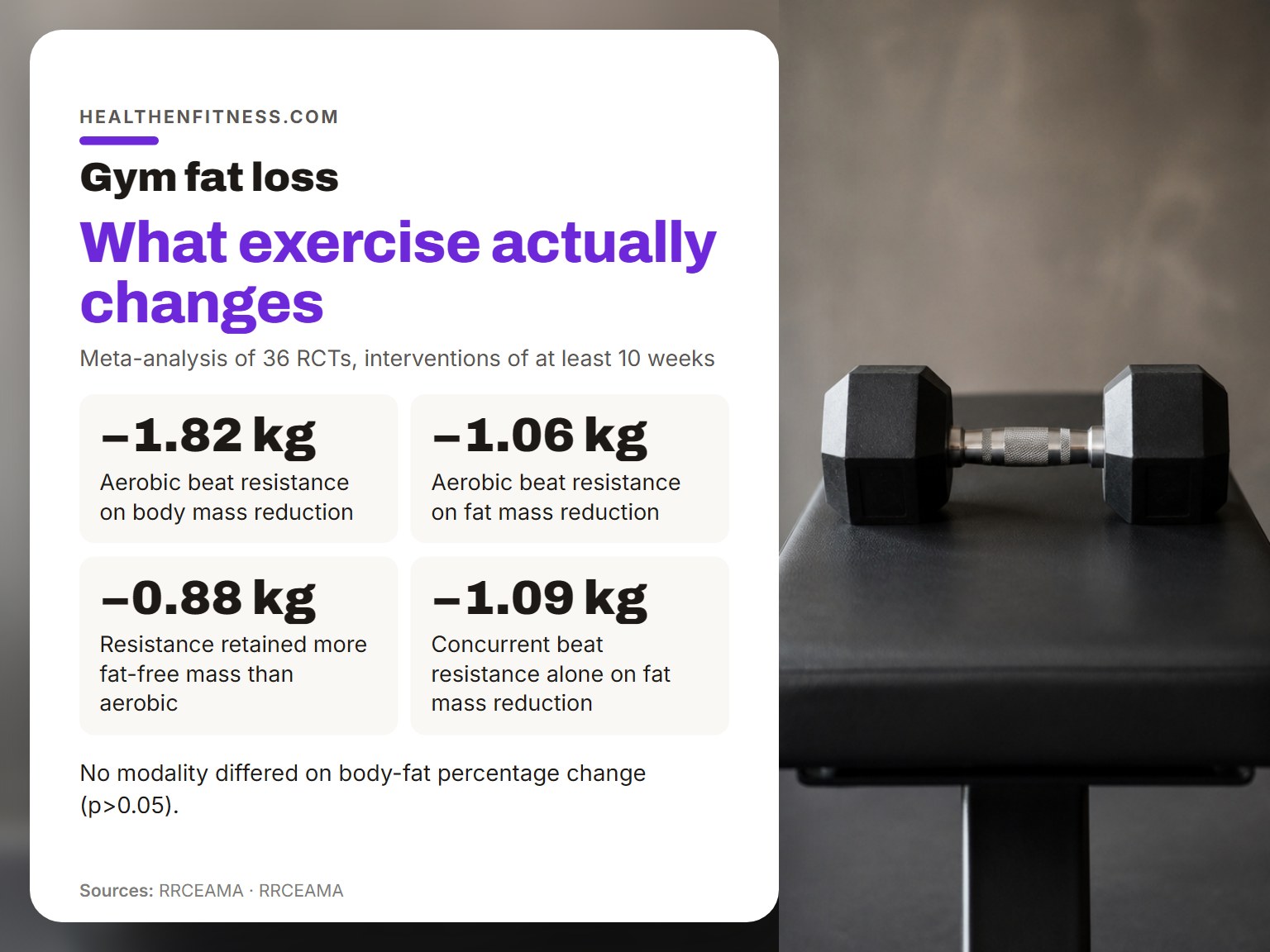
Interventions lasting at least 10 weeks separate the exercise modes. Aerobic training produced a 1.82 kg greater reduction in body mass and a 1.06 kg greater reduction in fat mass than resistance training, while resistance training preserved 0.88 kg more fat-free mass. Under 10 weeks, no mode outperformed another. These figures come from a 36-trial meta-analysis.
Read those numbers as a comparison of what each mode does on its own, with diet held constant across groups. The aerobic groups lost more absolute fat. The resistance groups came out holding more lean tissue.
| Comparison | Measure | Mean difference | Favors |
|---|---|---|---|
| Aerobic vs resistance | Body mass | −1.82 kg | Aerobic |
| Aerobic vs resistance | Fat mass | −1.06 kg | Aerobic |
| Aerobic vs resistance | Fat-free mass | −0.88 kg | Resistance |
| Concurrent vs resistance | Fat mass | −1.09 kg | Concurrent |
| All modes, workload matched | Fat, body mass, lean mass | No difference (p>0.05) | Neither |
Notice what’s missing from that table: body-fat percentage. No mode differed on it (p>0.05), which happens to be the number people quote when they insist one style “works better.” The absolute kilograms moved. The percentage didn’t.
My own first year in a gym, I ran almost nothing but steady cardio and wondered why I looked smaller but felt softer. The data here explains that. I was losing weight in the aerobic column and ignoring the lean-mass column entirely.
Which Burns More Fat at the Gym: Cardio or Weights?
On absolute fat mass over 10 weeks or more, Ramírez-Campillo et al. Found cardio beat resistance training, while a review of 65 trials framed resistance training as reliably effective on its own. The European Association for the Study of Obesity goes further and gives moderate-intensity aerobic exercise a Grade A for losing body weight, total fat, visceral fat, and intra-hepatic fat, plus improving blood pressure.
Weights aren’t dead weight in that comparison, though. A review of 65 trials in overweight and obese adults found resistance training produced a 1.6 kg reduction in fat mass and a 0.8 kg gain in lean mass, and that result held regardless of training duration, volume, or intensity.
So you have two reviews pointing in slightly different directions: Ramírez-Campillo et al. Frame resistance training as the weaker modality for absolute fat loss, while the review of 65 trials frames it as reliably effective on its own. Both are peer-reviewed, and both used different comparison structures.
Common mistake: Reading “cardio beats weights for fat loss” as a reason to skip lifting entirely. The 1.06 kg fat-mass edge for aerobic work comes attached to a 0.88 kg lean-mass edge for resistance work, and the concurrent-training arm beat resistance alone by 1.09 kg of fat.
Here’s the practical version. A treadmill session at a conversational pace leaves you able to talk in full sentences. A session of hard intervals leaves you tasting metal and gripping the rails. Both burn energy, and neither is magic.
If you want the full breakdown of how to sequence the two, strength training vs cardio covers the ordering question in more depth than I can here. And if you’d rather start from a menu of sessions, these fat-burning workouts are built around the same principle: get the energy cost up without wrecking your recovery for the next lifting day.
One more wrinkle worth knowing. EASO grades HIIT only a B and asks for a thorough cardiovascular-risk assessment plus supervision, while a separate overview of 149 studies found no difference between aerobic training and HIIT when energy expenditure was equal.
What Changes When You Match the Workload
Set the energy cost equal and the how to lose fat at the gym hierarchy flattens. That’s the finding that gets buried under the headline numbers.
When workload is matched, fat mass, body mass, body-fat percentage, and fat-free mass changes come out similar across resistance, aerobic, and concurrent training (p>0.05). The mode stops mattering and the total work starts mattering.
- The concurrent-training arm beat resistance alone on fat mass by 1.09 kg, but resistance training neither improved nor impeded fat loss once it was added to the mix.
- Same-day versus different-day ordering made no difference to body mass or body-fat percentage. The one fat-mass difference between them showed up in a single study, which is too thin to build a rule on.
- Short programs under 10 weeks showed no mode differences at all, on any measure.
That last point is the one I’d tape to the mirror. If you’re a few weeks into a program and wondering whether you picked the wrong style, the research can’t answer that question yet. Which is fine.
The meta-analysis authors themselves land on workload and duration as the levers to pull when programming for fat loss. Not the machine label. Not the class name.
I spent a genuinely embarrassing amount of my second year switching programs constantly, convinced the next split was the missing piece. It wasn’t. The only thing that changed across those months was how much total work I did, and that’s the variable I should have been tracking.
If you want sessions already built around that idea, these workouts to lose body fat keep the weekly energy cost consistent instead of spiking it on random days.
How Long Before the Scale Agrees With You?
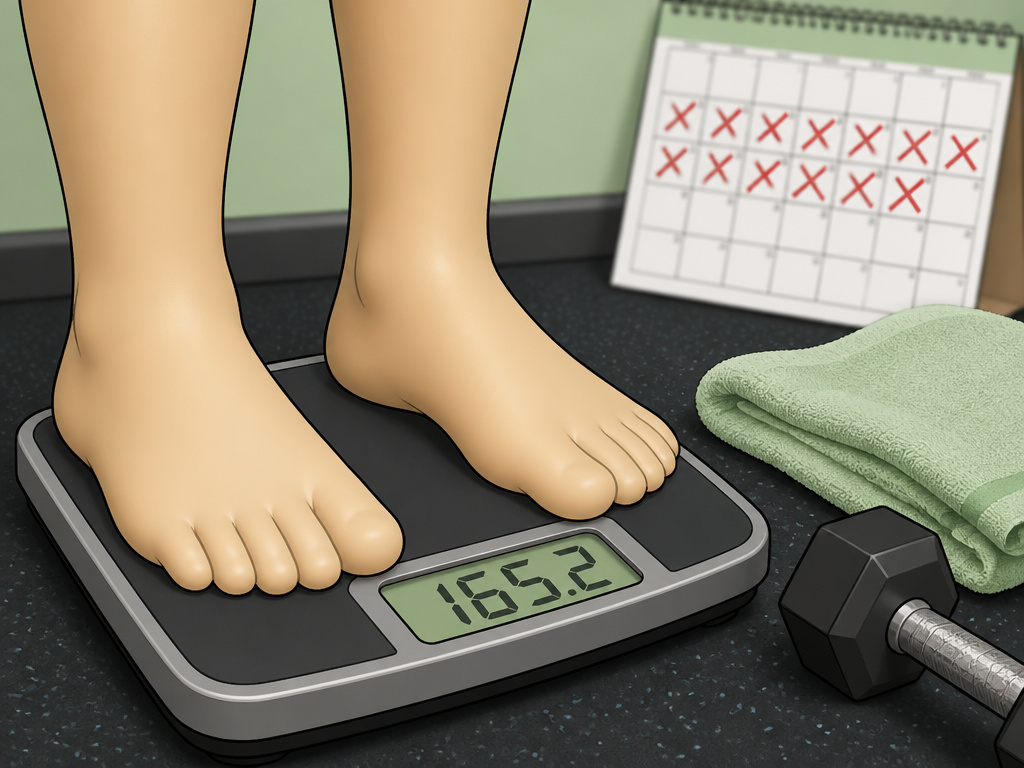
Trials shorter than 10 weeks found no significant differences in body mass, body-fat percentage, fat mass, or fat-free mass between any of the three modes. Duration is the variable that makes the comparison possible.
The METPOWeR trial ran 12 months and compared three volumes of aerobic exercise: 150, 225, and 300 minutes per week. Across all groups, 88% of participants maintained a 5% weight loss at 12 months. Mean weight regain ranged from 1.1 kg in the low-volume group to 2.8 kg in the high-volume group.
Read that again. The highest-volume group regained the most, not the least, and the authors suggest a minimal volume may favor successful maintenance, though the trial wasn’t designed to prove equivalence; retrospective analyses, by contrast, linked ≥250 min/week to less weight regain.
| Timeframe | What the evidence shows | What it means for your program |
|---|---|---|
| Under 10 weeks | No mode differences on any body composition measure | Pick what you’ll actually attend |
| 10 weeks and beyond | Aerobic edges resistance on fat mass; resistance edges aerobic on lean mass | Run both, or run concurrent training |
| 12 months of maintenance | 88% held a 5% loss; regain 1.1 to 2.8 kg across volumes | Volume isn’t the lever you think it is |
That sits awkwardly against the retrospective analyses, which consistently linked larger exercise volumes (250 minutes per week or more) to less weight regain. And it sits awkwardly against one systematic review that found no significant effect of exercise on weight maintenance at all.
Three positions, three different study designs: the METPOWeR trial found no significant difference in weight regain across 150, 225, and 300 min/week groups, retrospective analyses linked ≥250 min/week to less regain, and one systematic review found no significant effect of exercise on weight maintenance at all.
Worth knowing before you start: Weight regain after a diet is the norm across every source here, and no exercise protocol in these reviews eliminated it. Plan for the regain phase before you start the deficit phase.
If you want equipment that makes the cardio side easy to repeat, the gym equipment for fat loss roundup sticks to machines and tools that don’t require a learning curve. The gym machines for fat loss list covers the cardio side specifically.
Why Lifting Still Earns Its Place
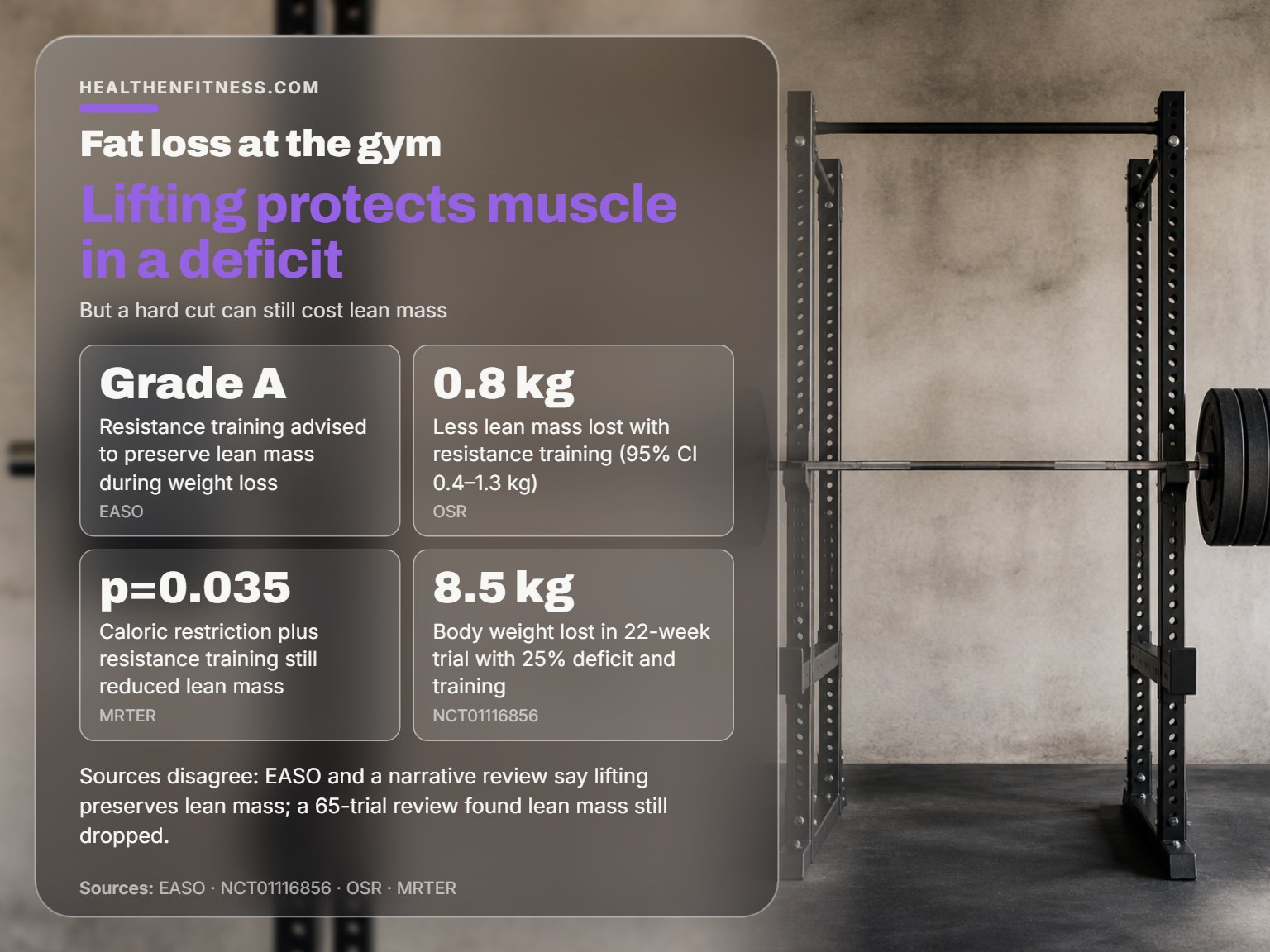
Lifting is how you keep the muscle you already paid for. EASO gives resistance training at moderate-to-high intensity a Grade A for preserving lean mass during weight loss, and a separate overview reported that resistance training reduced lean mass loss by 0.8 kg (95% CI 0.4 to 1.3 kg).
A narrative review on fat-loss phases in resistance-trained athletes puts it plainly: resistance exercise prevents the loss of fat-free mass during periods of caloric restriction.
Then the data gets messier.
The Catch With Caloric Restriction
A review of 65 trials found that caloric restriction combined with resistance training significantly reduced lean mass (p=0.035). That’s the opposite direction from the Grade A recommendation, and it isn’t a small detail.
The sources disagree here: EASO and a narrative review hold that resistance training preserves lean mass during weight loss, while a review of 65 trials found caloric restriction combined with resistance training significantly reduced lean mass (p=0.035). Big deficit plus lifting still costs you some lean tissue.
Where this goes sideways: Cutting hard and adding cardio on top of your lifting days. The 22-week strength-plus-endurance trial paired its training with a 25% deficit and still lost 8.5 kg of body weight in the training group, which tells you the deficit was doing heavy lifting of its own.
On the bar, this shows up as a grind. The same load that left the rack fast early on comes off the pins slow later. The weight on the bar hasn’t changed. Your recovery has.
There’s more on holding muscle through a cut in preserve muscle while cutting, including how to read a strength drop that’s normal versus one that means you’ve cut too far. The resistance training in overweight adults meta-analysis is where the 1.6 kg fat and 0.8 kg lean figures come from if you want to read the original.
Two more findings from that review worth filing away. Males lost more fat than females with resistance training (p<0.001), and younger age predicted greater lean-mass gains (p=0.009). Neither is a reason to skip training. Both are reasons to compare your progress to your own baseline instead of someone else’s.
The Deficit Math That Survives a Real Week
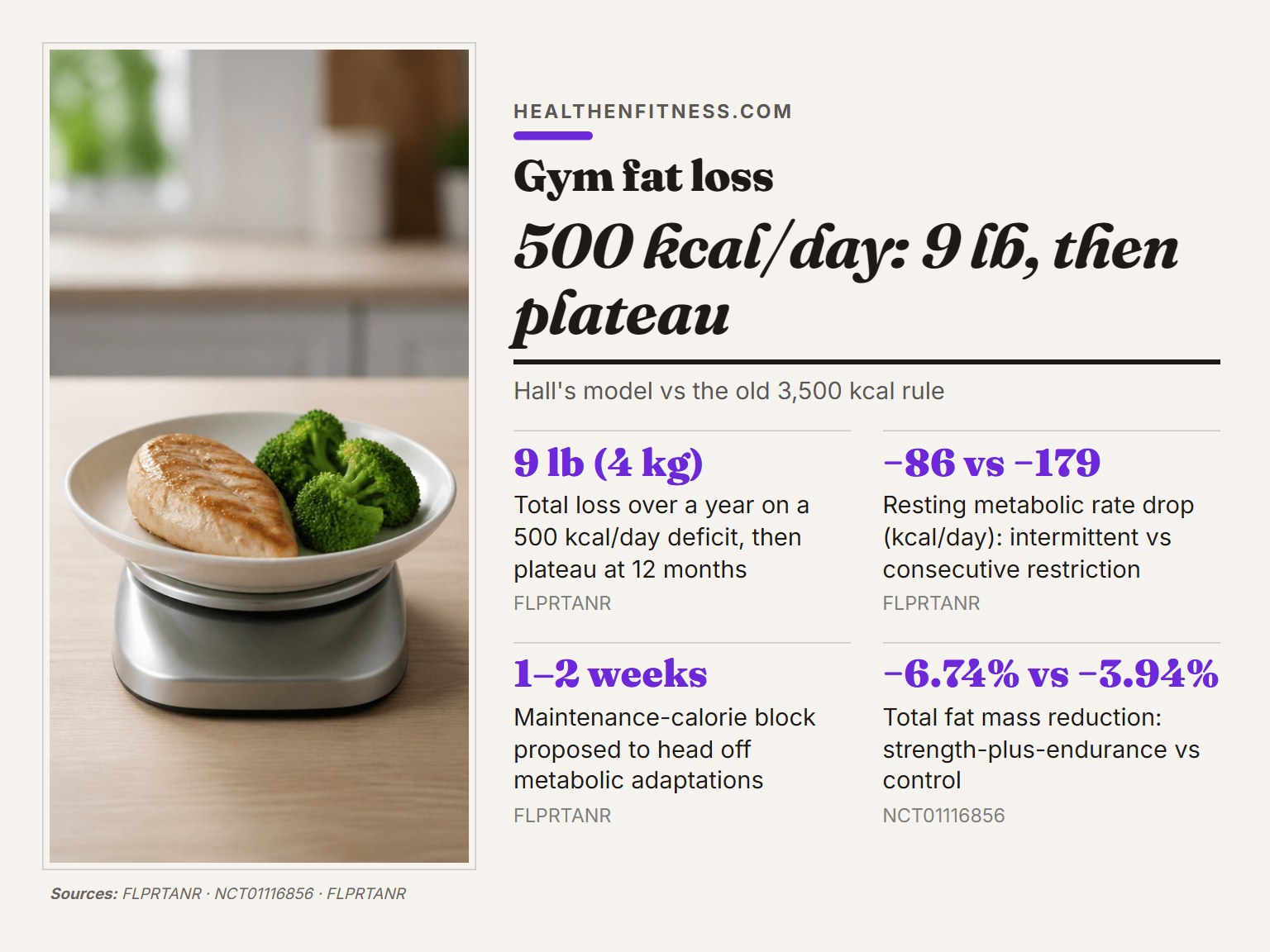
Hall et al. Put a number on the plateau, and it’s the most useful number in this whole pile. The old rule says a 3,500 kcal weekly deficit yields 1 lb (0.45 kg) of loss. Hall’s model says a person holding a 500 kcal daily deficit could lose about 9 lb (4 kg) over a year, then plateau at 12 months.
That gap between the static rule’s projection and 9 lb is the whole story of why people quit in month four.
Why the 3,500-Calorie Rule Overshoots
The static rule ignores metabolic adaptation. As you lose mass, daily energy expenditure drops, appetite rises, and non-exercise activity quietly falls. The deficit you built in week one is a smaller deficit by week twelve.
The MATADOR study tested a workaround. The intervention group ran 2 weeks of caloric restriction, then 2 weeks at maintenance, repeating until they’d completed 16 weeks of restriction spread over 30 weeks total. The control group ran 16 consecutive weeks. After adjustment for body composition, resting metabolic rate dropped 86 kcal/day in the intermittent group versus 179 kcal/day in the control group.
Start boring. A 1 to 2 week block at maintenance calories is the strategy the narrative review proposes for heading off those adaptations, and it costs you nothing but patience.
What a real deficit week looks like, in practice:
- Protein stays high. The 22-week trial prescribed 20% of energy from protein alongside 30% to 35% from fat and 50% to 55% from carbohydrate.
- The deficit stays modest. That same trial used 25% below measured daily energy expenditure, with individual prescriptions between 1200 and 1850 kcal.
- Support beats willpower. The trial built in counselling at baseline and 12 weeks plus five group education sessions, and the strength-plus-endurance group still came out ahead: 6.74% total fat mass reduction against 3.94% in controls.
For the food side in more detail, this diet for fat loss walks through the macro split. The fat loss strategies for resistance-trained athletes review is the source for the MATADOR structure and the maintenance-block idea.
I track my own weight on a scale that logs to my phone, and I only look at the seven-day average. Daily numbers swing on salt and sleep. The trend line is the only number that means anything.
How to Lose Fat at the Gym Without Living in the Gym
A week that survives a job and a family looks like a mix of lifting days and short cardio sessions. That’s the shape the evidence supports, and it’s the shape most people can hold for 10 weeks without white-knuckling it.
Before you start: Get a cardiovascular-risk assessment before any high-intensity interval work, since EASO grades HIIT a B specifically for that reason. Stop and get checked if you feel chest pressure, unusual breathlessness, or dizziness during a session. And if you’re returning from surgery or a serious injury, talk to a clinician before loading a barbell, because generic programming advice is a bad fit for a complicated history.
The order of operations, from someone who has gotten this wrong in every possible direction:
- Set the lifting days first. Full-body sessions each week, on days you can actually keep, with no exceptions. Everything else fits around them.
- Add cardio at a volume you’ll repeat. Two or three cardio sessions is a starting point you can build from, not a target to hit in week one.
- Set the deficit below your measured expenditure, not below your guess. The 22-week trial used 25% under measured daily energy expenditure. Most people overestimate what they burn.
- Hold the plan for 10 weeks before you judge it. The mode comparison doesn’t even work before that point, so neither does your opinion of it.
- Schedule a maintenance block. One to two weeks at maintenance calories, then back into the deficit. That’s the MATADOR structure in miniature.
Start smaller than you think you need to. A plan you follow consistently beats a perfect plan you abandon quickly.
The Weekly Skeleton
Lifting days, cardio days, and a full rest day. If a lifting day and a cardio day land on the same date, the fact sheet notes same-day versus different-day ordering made no difference to body mass or body-fat percentage.
If you’d rather not build the split yourself, this gym workout plan is already structured around full-body sessions, and these gym routines for weight loss give you a repeatable weekly template.
For the cardio slots, a rower, a bike, or a brisk walk all count. The meta-analysis of exercise for fat loss found no mode advantage once energy expenditure matched, so pick the one you don’t dread.
What to Do in the First Three Weeks
Keep the lifting loads conservative and add a little over time. Track two numbers: your seven-day average body weight and your top set on one main lift. If the weight is trending down and the lift is holding, the plan is working.
If the lift drops hard while the weight barely moves, consider easing the deficit. Ease off the cardio before you ease off the food, because the cardio is the easier lever to adjust.
I use a food-logging app because the protein number sits on the main screen where I can’t avoid it. That’s the whole reason. Whatever app you use, the point is seeing the number before the day ends, not after.
Frequently Asked Questions
How long does it take to lose fat at the gym?
Ten weeks is the first honest checkpoint, because trials shorter than that found no differences between exercise modes on any body composition measure. The 22-week strength-plus-endurance trial saw a 6.74% reduction in total fat mass in the training group against 3.94% in controls. Give any program at least that long before you decide it isn’t working.
Is cardio or weight training better for belly fat?
Three systematic reviews inside a 149-study overview reported visceral fat reductions with standardized mean differences from −0.33 to −0.56, and EASO gives moderate-intensity aerobic work a Grade A for visceral fat loss. Resistance training earns its Grade A for lean mass instead. None of these sources tested ab-specific training, so treat crunch-based promises as untested.
Do I need to train to failure to lose fat?
None of these sources compared failure training against non-failure training, so the evidence doesn’t settle that question. What it does show is that training duration, volume, and intensity weren’t associated with fat or lean mass change across 65 trials. Show up, do the work, and leave some reps in reserve.
How many days a week should I train to lose fat?
The 12-month maintenance trial in post-menopausal women used two to three supervised resistance sessions per week and found no significant difference in weight or fat mass versus control. That’s a useful ceiling to keep in mind: more sessions didn’t produce a bigger result in that group. A mix of full-body lifting days plus cardio sessions is a reasonable shape.
Can I lose fat without counting calories?
Every source here that produced fat loss ran an energy deficit. The 22-week trial prescribed 25% below measured daily energy expenditure, with individual prescriptions between 1200 and 1850 kcal. EASO puts expected weight loss from exercise training alone at no more than 2 to 3 kg. You can create a deficit without a food log, but you can’t skip the deficit.
The Bottom Line
The part most guides leave out: the cardio-versus-weights question only has an answer after 10 weeks, and the answer changes depending on whether you’re measuring kilograms of fat or kilograms of lean tissue. Aerobic work wins the first. Resistance work wins the second. Concurrent training gets you both, and the concurrent arm beat resistance alone by 1.09 kg of fat in the same meta-analysis.
One concession before you go. None of this applies cleanly if you’re training for a marathon or a triathlon, because the endurance demands change the recovery math entirely, and I’ve never coached anyone through that. It also doesn’t apply if you’re coming back from surgery. Get a clinician involved first.
If you take one thing from the deficit section, take the plateau. Hall’s model projects roughly 9 lb of loss over a year at a 500 kcal daily deficit, then a stall at 12 months. Plan the maintenance block before you need it, not after the scale stops moving.
Do this today: put your next lifting sessions on the calendar and pick a cardio slot to sit between them.
