
How to Use a Calf Raise Machine: Setup and Load Limits
This post contains affiliate links. As an Amazon Associate, we earn from qualifying purchases.
To use a calf raise machine, set the pad so your heels hang off the foot plate, put the balls of your feet hip-width apart, and press up through the toes. Before loading, read the rating: the True Fitness XFW5700 caps total load at 750 lb / 340 kg, body weight included.
That 750 lb figure is a combined ceiling, so a 200 lb lifter has 550 lb of plate budget left on that bench. Cybex frames the same question differently on the Prestige Calf 21120, publishing a 300 lb / 135 kg maximum user weight and a separate 405 lb / 184 kg maximum training weight. Two manuals, two accounting systems, one muscle.
What follows is the setup sequence the six manuals behind this article actually print, the load math that changes brand to brand, and the four adjustments that decide how to use a calf raise machine so it fits your body rather than fights it.
Key Takeaways
- Read the load rating before the plates. True Fitness rates the XFW5700 at 750 lb / 340 kg total, and that number already includes you.
- Heels off the plate, balls of the feet on it. Taurus prints it that way, and it’s the detail that changes the bottom of the rep.
- Skip the bands and chains on the XFW5700. That manual prohibits bands and chains outright, while Cybex prohibits dumbbells or other incremental weights except those provided by the manufacturer.
- Seat the pin and listen for it. A pin that isn’t fully through the hole is the one part of the setup that fails suddenly.
- Wipe the pad down after every session. The Taurus manuals put upholstery cleaning on the after-every-workout list.
How to Use a Calf Raise Machine: The Setup Sequence
Four adjustments happen before your first rep, and the order matters more than the settings themselves.
On a seated calf raise, the balls of the feet sit on the upper foot plate hip-width apart while the shoulder pads are adjusted to produce a comfortable stretch through the calf. The movement is a press down through the balls of the feet, rising onto the toes, which loads the gastrocnemius and soleus.
That’s the Cybex Prestige sequence, and the Taurus SESS7154 manual describes the same motion with a knee pad instead of shoulder pads. Both machines want the ankle to travel, not the knee.
Before you start: Check the cable or belt for fraying before you load anything, because Cybex tells users not to touch a machine with worn or damaged components. Confirm the weight pin is fully through the hole and is the manufacturer’s own pin. Keep your hands and clothing clear of the moving arm while it travels.
- Set the pad height first. On the Taurus SESS7154, pull the pin, slide the knee pad to height, release, and confirm it engaged in the adjustment holes. Skip the confirmation and the pad creeps down mid-set.
- Place the balls of the feet on the plate with the heels hanging off. Heels flat on the plate shortens the range and turns a calf raise into a toe press.
- Load the horn or select the stack. On a plate-loaded unit, slide one plate on at a time with both hands and finish with a collar. Skipping the collar is how a plate walks off the horn on rep eight.
- Press down through the balls of the feet and rise onto the toes. The Taurus manual says exhale on the way up and pause slightly at the top.
- Lower under control until the calves stretch. Inhale on the way down. Letting the weight drop turns the stretch into a bounce and hands the load to the Achilles.
- Get off in the right order. Step off the foot rest, pull the pin to lift the knee pad, then stand. Standing up first traps your legs under the pad.
Seated vs. Standing: Which Machine You’re Actually On
The True Fitness XFW5700 and the Cybex Prestige Calf 21120 are both seated units with shoulder pads. The Taurus SESS7154 is also seated but uses a knee pad over the thighs instead. The Taurus SL7032 Iso Standing Calf Raise is the odd one out, a standing unit where you load the frame rather than a seat.
The Cybex manual lists gastrocnemius and soleus as the muscles used. Every one of these machines trains both, so pick by what your gym has and what your knees tolerate in a seated position.
Why the 750 lb Placard Doesn’t Mean What You Think
Three manufacturers, three different ways of stating the same limit.
True Fitness rates the XFW5700 at 750 lb / 340 kg for user plus lifted weight combined, and separately notes the machine is rated on a 300 lb / 136 kg maximum user. Cybex publishes two independent numbers on the Prestige Calf 21120: a 300 lb / 135 kg maximum user weight and a 405 lb / 184 kg maximum training weight. Taurus states 150 kg maximum user and 100 kg maximum load on the SESS7154, again as separate figures.
| Machine | How the ceiling is stated | What it means at the stack |
|---|---|---|
| True Fitness XFW5700 | 750 lb / 340 kg total, user plus lifted weight | Body weight eats into the plate budget |
| Cybex Prestige Calf 21120 | 300 lb / 135 kg max user; 405 lb / 184 kg max training weight | Two separate limits, both apply |
| Taurus SESS7154 | 150 kg max user; 100 kg max load | The two numbers don’t add together |
A 250 lb lifter on the XFW5700 has 500 lb of headroom for plates. The same lifter on the Cybex has a 405 lb training ceiling that doesn’t shrink because of body weight. Same movement, different arithmetic.
Never add a machine’s user-weight limit to its training-weight limit and call that your ceiling. The manuals state them as separate limits, and the lower one binds first.
What most people get wrong: Treating the placard number as the weight they can load. On the XFW5700 the 750 lb figure already includes the person standing on it.
Which Foot Position Actually Works: Heels Off or Heels Flat?
Two Cybex manuals give different setup cues for the same muscle group.
The Prestige Calf 21120 asks for the balls of the feet on the upper foot plate, hip-width apart, with the shoulder pads adjusted for a comfortable calf stretch. The older Cybex Eagle Calf manual asks for feet shoulder-width apart with the seat set for a slight bend at the knee. Taurus goes further and tells you to place the balls of the feet so the heels hang off the rest entirely.
Here’s what each one actually says:
- Cybex Prestige Calf 21120: balls of the feet on the upper foot plate, hip-width apart, shoulder pads set for a comfortable calf stretch.
- Cybex Eagle Calf: feet shoulder-width apart, seat set for a slight knee bend.
- Taurus SESS7154: balls of the feet on the foot rest, heels hanging off the edge. That last detail is the one that changes the bottom of the rep.
The heels-off cue is the one Taurus prints, while Cybex Prestige asks for balls of the feet hip-width apart with shoulder pads set for a comfortable calf stretch and Cybex Eagle asks for feet shoulder-width apart with a slight knee bend. With the heels hanging off, the bottom inch of the rep is a stretch you feel up the back of the lower leg, not a push. With the heels planted, you’re mostly just lifting your toes.
What the Three Manuals Disagree About
Cybex and Taurus split on age rules too. The Taurus SESS7154 manual sets a hard minimum user age of 14. The Cybex Eagle manual has no numeric floor but states that children must not be allowed near the machine and teenagers must be supervised. The True Fitness XFW5700 manual in this set doesn’t state an age limit at all.
If you’re setting up a home gym with kids around, note that Taurus sets a hard minimum user age of 14, while Cybex Eagle states children must not be allowed near the machine and teenagers must be supervised, and True Fitness states no age limit.
The Three Adjustments That Decide Whether the Machine Fits You
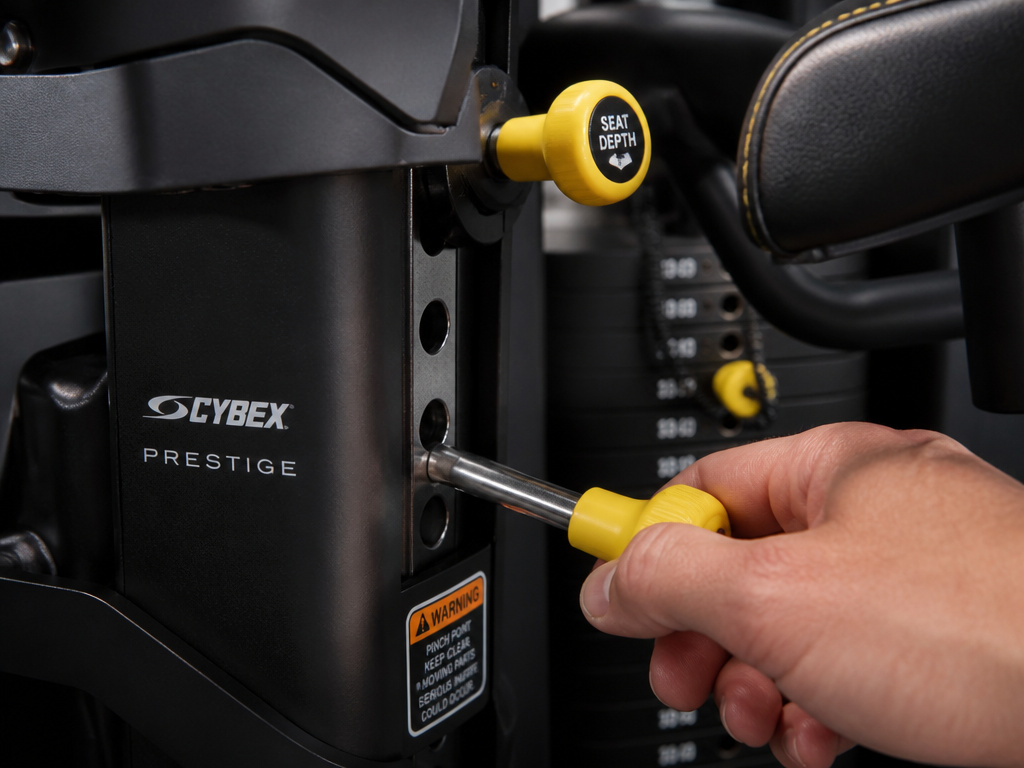
Three adjustment points get skipped on almost every calf machine, and on a Cybex Prestige all of them are marked in yellow.
That’s a deliberate design choice. Cybex states that every adjustment point on the Prestige Calf 21120 has yellow handles or knobs, so there’s no excuse for not finding them. Find the yellow handles or knobs, set the pad, then set it again after your first rep.
The pull pin must be fully engaged in the hole. If it isn’t fully through, it isn’t seated.
I check the pin twice now, once when I set it and once right before the first rep. It costs two seconds, and it’s the only part of the setup that fails suddenly instead of gradually.
Where this goes sideways: Finding the stack pinned in an elevated position. The Cybex Eagle manual tells you to leave the machine alone and get floor staff rather than use it that way.
The other adjustment nobody makes is the seat depth on a shoulder-pad machine. Set it too far back and the pad rides your neck instead of your shoulders, which pushes your hips forward and puts the load through your lower back.
How Much Weight Should You Actually Load?
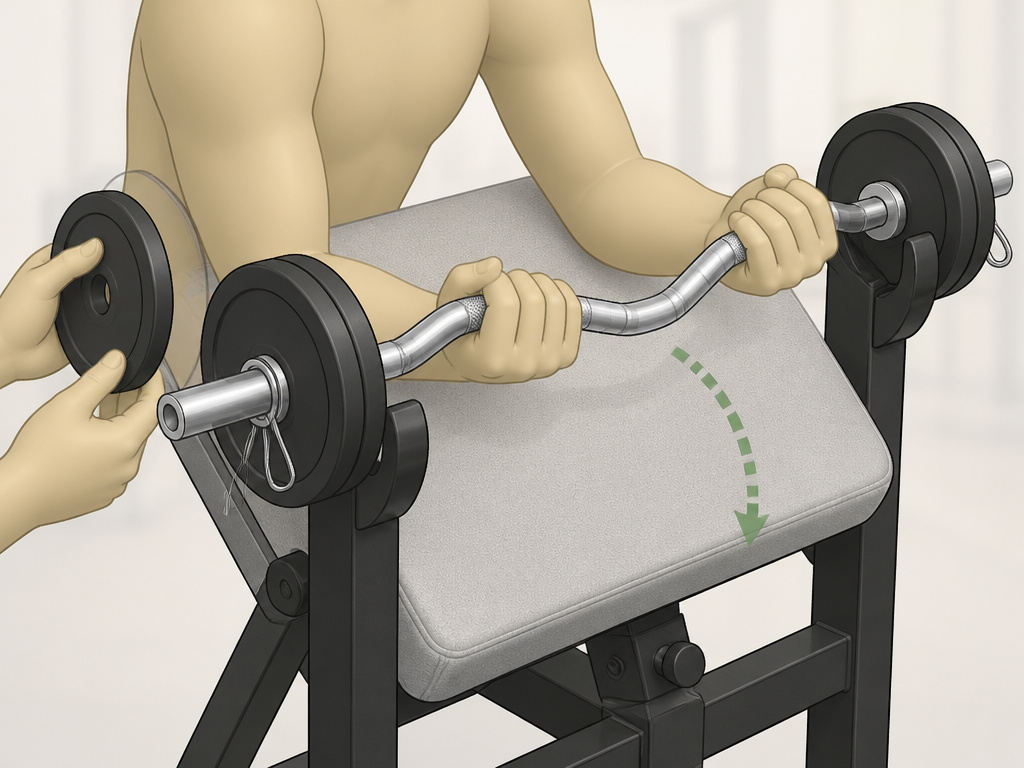
Standard 1-inch plates won’t seat at all.
| Machine | Rated capacity | Plate or stack requirement |
|---|---|---|
| Taurus SESS7154 | 100 kg max on the horn; 150 kg max user | 50 mm plates, 450 mm max diameter |
| Taurus SL7032 | 300 kg / 660 lb total; 150 kg per side | Olympic plates, not included |
| Taurus IT9516 | 134 kg / 295 lb | Selector pin, fully seated |
| Cybex Prestige Calf 21120 | 405 lb / 184 kg max training weight | 590 lb standard or 690 lb heavy stack |
Two things fall out of that table. First, plate-loaded and stack machines aren’t interchangeable in how you plan a session. Second, the Taurus SL7032 ships without weight plates at all, so a home setup needs plates bought separately before the machine does anything.
Skip this if: You’re planning to add bands or chains for extra resistance. The True Fitness XFW5700 manual prohibits bands and chains on that bench outright, and the Cybex Eagle manual prohibits dumbbells or other incremental weights except those the manufacturer supplies.
When to Stop Adding Plates
Stop when the rep slows down without you deciding to slow it. That’s the honest signal, and it shows up before your form does.
A calf workouts plan built only on machine raises runs out of new stimulus fast, because the pad fixes your range for you. Pair the machine with free-weight exercises for calves so the ankle works through a range nothing else is dictating.
Where the Machine Sits Matters More Than You’d Think
A gym floor at 6am in February, dry radiator air, synthetic carpet, and a hand on a steel frame. That’s the setup Cybex warns about.
It’s the only manual in this set that addresses static at all.
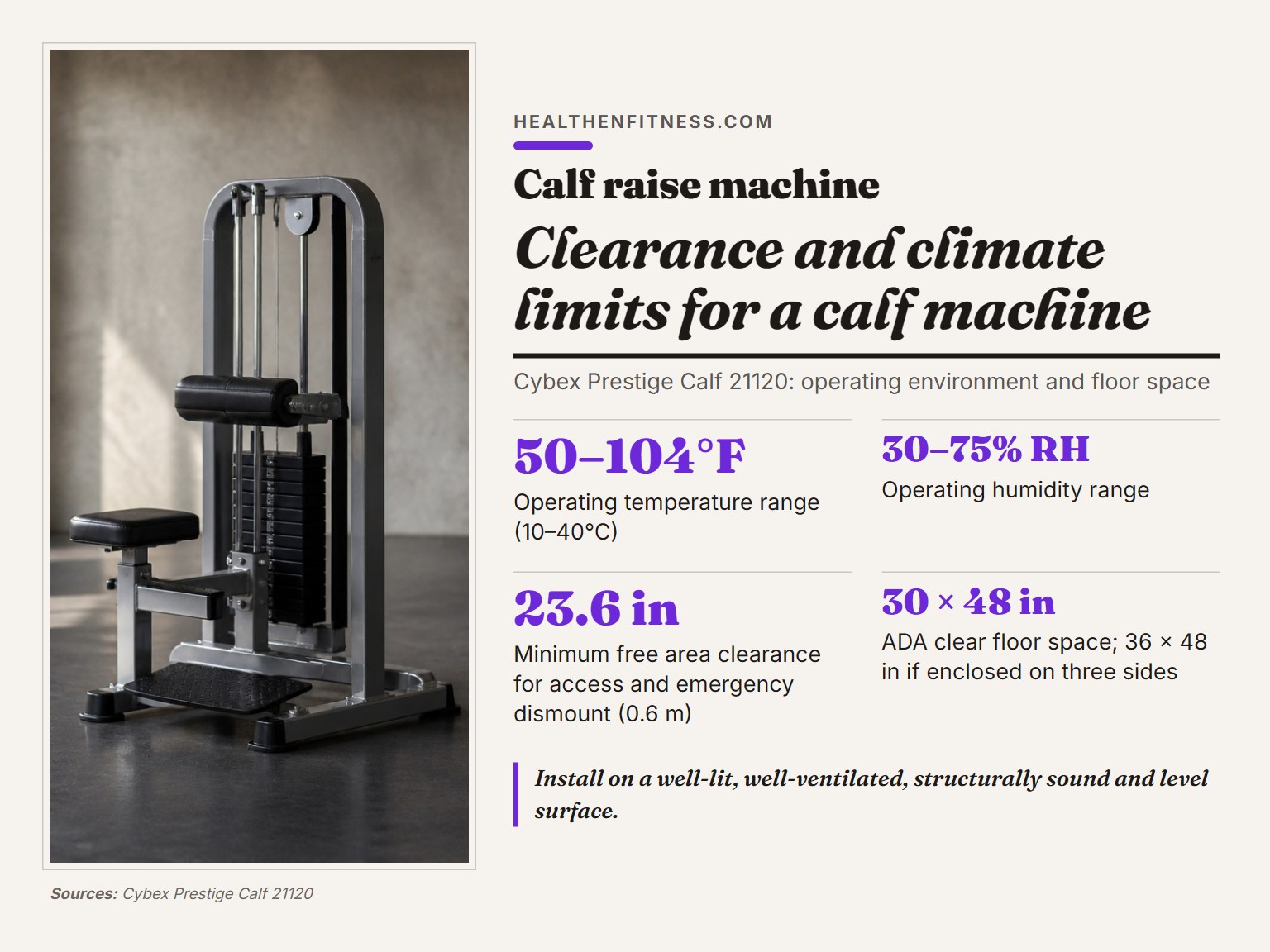
The environmental limits are worth knowing if you’re buying for a garage or a basement:
- Operating temperature: 50-104°F (10-40°C) on the Cybex Prestige.
- Operating humidity: 30-75% RH on the Cybex Prestige.
- Minimum clearance: 23.6 inches (0.6 m) of free area for access and emergency dismount.
- ADA floor space: 30 by 48 inches for at least one of each equipment type, widening to 36 by 48 inches if the space is enclosed on three sides.
If you’re laying out a floor, those clearance numbers apply to every gym machines for legs unit you place, not just the calf machine. Crowd one and you’ve crowded all of them.
The One Free-Weight Movement to Pair With It
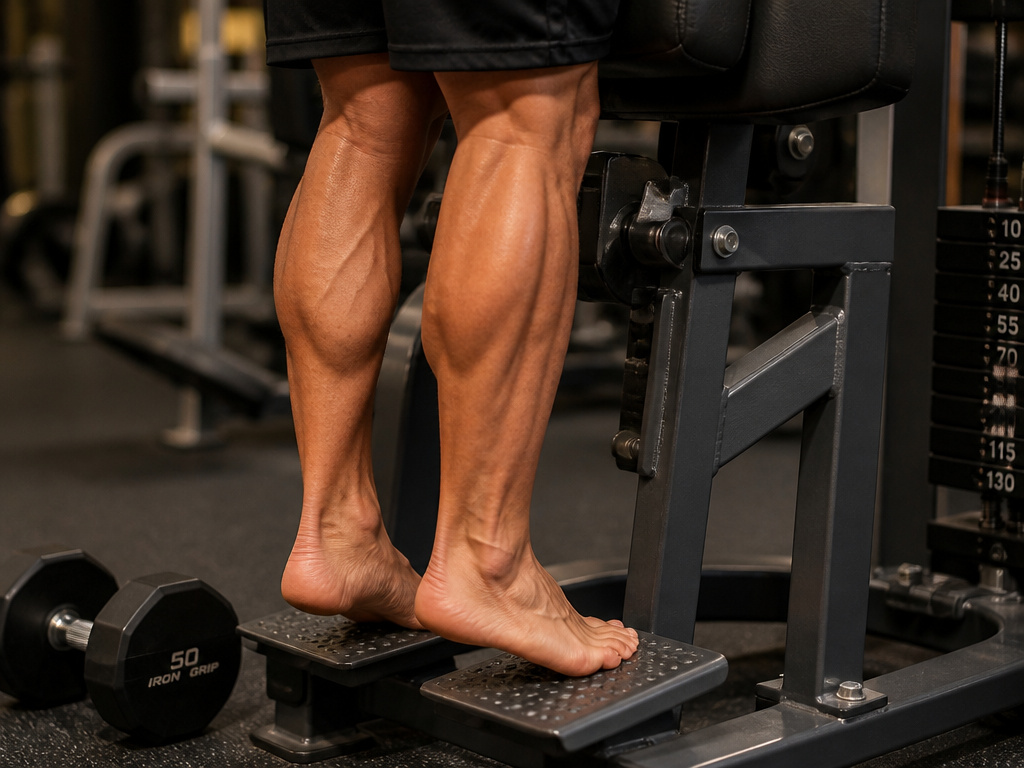
A calf raise machine earns its place, and it’s a better tool than the free-weight purists give it credit for.
Machines let you load a small muscle group safely without a spotter or a technique check every set. That matters for calves more than most, because the range is short and the loads get heavy fast. What the machine can’t do is teach you to control that range yourself.
So pair it. One free-weight calf movement per week, done standing, with the heel dropping below the level of the toe. Then one heavier machine set, and one slow set with a pause at the top.
A leg press machine handles the heavy quad work on the same day, and if you’re building a lower-body session around leg workout machines, the calf raise is the one that gets cut when time runs short. Don’t cut it. It’s four minutes.
Frequently Asked Questions
How do I set up a calf raise machine for my height?
Set the shoulder pads or knee pad so your joints line up with the pivot, then check that the balls of your feet sit on the plate with the heels hanging off. If your heels are flat on the plate, the pad is set too low or the seat is too far forward.
Should my heels hang off the foot plate?
Taurus instructs it directly, and it’s the cue that produces a real stretch at the bottom. Cybex doesn’t state it in those words but does tell you to lower the heels until the calves are fully stretched, which you can’t do with the heels planted.
Can I use bands or chains on a calf raise machine?
Not on the True Fitness XFW5700. That manual prohibits bands and chains outright. The Cybex Eagle manual separately prohibits dumbbells and other incremental weights except those the manufacturer provides, so check your specific machine’s placard before adding anything.
How much weight should a beginner load?
Start with the pad setup and no added weight at all, then add plates one at a time. On the Taurus SESS7154 the horn is capped at 100 kg, and on the XFW5700 your body weight counts against the 750 lb total, so the plate budget is smaller than the placard suggests.
Is a seated or standing calf raise machine better?
Both load the gastrocnemius and soleus, per the Cybex manual. Seated units are easier to set up consistently and don’t load the spine, which makes them the better default for most people. Standing units like the Taurus SL7032 suit anyone who wants the movement closer to a real standing calf raise.
Why does my calf raise machine shock me?
Static buildup, most likely. The Cybex Prestige manual notes users may feel a shock mid-workout and recommends raising the room humidity with a humidifier. Dry indoor air in winter makes it worse.
Before You Go
One threshold worth remembering: if your working set leaves the pin in the top few plates of the stack, the machine isn’t your limit. Your setup is. Go back and check the pad height, the seat depth, and whether your heels are actually hanging off.
And one thing to try this week. Before your next leg day, walk to the calf machine, set the pad, and do a single set of ten with no added weight. Count how far your heels drop and whether you feel it in the calf or in the front of the ankle. That one unweighted set tells you more about your setup than any article can.
Fair warning on the limits here: none of this covers rehab. If a calf or an Achilles is already sore, that’s a physio question, not a machine-setup question, and I’m not the person to answer it. Everything above is how to use a calf raise machine without guessing at the manual. The rest is showing up.
