
Incline vs Flat Bench Press: Which Should You Do?
This post contains affiliate links. As an Amazon Associate, we earn from qualifying purchases.
Incline vs flat bench press: the flat bench at 0 degrees loads the middle and lower chest hardest, while a 30-degree incline shifts emphasis to the upper chest. A 2020 study of 30 trained adults found upper-chest activity peaked at 30 degrees, mid and lower chest peaked flat, and the front delt took over by 60.
The pec major is one fan-shaped muscle with two heads, and the bench angle changes how much each one contributes. Tilt the pad up and the clavicular head, the part that runs along your collarbone, takes a bigger share. Go flat and the sternocostal head does most of the work. That shift shows up clearly on an EMG. Whether it turns into extra growth is where the research gets much messier.
What follows is the angle research laid out study by study, the one trial that actually measured growth and the caveat hanging off it, a triceps claim that gets repeated with no source behind it, and a two-session week you can repeat without wrecking your shoulders.
Key Takeaways
- Flat at 0 degrees loads the middle and lower chest hardest, and that activity drops as the pad comes up.
- 30 degrees is the best-supported incline for upper-chest activity, though other studies used 44 and 45 degrees and found an advantage there too.
- EMG measures electrical activity, not growth. The incline’s big activation edge did not show up as extra upper-chest swelling in a 13-man ultrasound study.
- The “50 percent less triceps” claim on incline has no traceable source and contradicts the angle data at 60 degrees.
- Two pressing sessions a week covers both angles; pick one as your main lift and rotate the order every couple of months.
What the Bench Angle Actually Changes
The pad angle changes two things at once: how much of the load the upper chest takes, and how much the front delt takes instead.
At 0 degrees the sternocostal head of the pectoralis major carries the largest share of the load. Raising the pad toward 30 degrees increases clavicular contribution. Past roughly 45 degrees, anterior deltoid activity climbs while all three pectoral regions fall, and the movement behaves more like a shoulder press than a chest press.
That summary comes from a 2020 study in the International Journal of Environmental Research and Public Health. Rodríguez-Ridao and colleagues put 30 trained adults through the bench press at five angles: 0, 15, 30, 45, and 60 degrees, all at 60 percent of their one-rep max. Every participant had at least a year of lifting experience and trained three times a week or more.
The clavicular head runs from the collarbone down to the upper arm, so it’s built to pull the arm up and across the body. Raise the pad and the bar path moves closer to that line of pull. That’s the mechanical reason the upper fibers contribute more as the bench tilts.
The sternocostal head, the bigger lower section, has less mechanical advantage as the pad comes up. Mid and lower chest activity was highest at flat and fell at 30 and 60 degrees in the same study.
Elbows flared wide and the bar landing high on the chest go together; you can see both from across the room. Getting the shoulder blades set back and down before the bar moves is what keeps the load on the chest instead of the joint, and it’s the first thing covered in any decent proper bench press form walkthrough.
Which Incline Angle Should You Actually Set?
Ever wonder why your gym’s incline bench has three notches and nobody on the floor can tell you which one to use?
Three numbers show up in the research, and they don’t agree with each other: 30, 44, and 45 degrees.
| Bench angle | What it emphasizes | Source |
|---|---|---|
| 0 degrees | Middle and lower chest | Rodríguez-Ridao 2020 |
| 30 degrees | Upper chest peak | Rodríguez-Ridao 2020 |
| 44-45 degrees | Upper chest, front delt rising | Lauver 2016; Chaves 2020; Albarello 2022 |
| 60 degrees | Front delt and triceps | Rodríguez-Ridao 2020; JPTS beginner study |
Rodríguez-Ridao’s group found upper-chest activity peaked at 30 degrees and fell off above it. A 2016 study in the European Journal of Sport Science by Lauver and colleagues found upper-chest activity higher at 44 degrees than at flat or 28 degrees, though across the full rep the differences between flat, 30, and 45 were not significant. Cabral and colleagues used 45 degrees and watched the excitation peak shift toward the upper chest.
So the honest answer is a range. Somewhere between 30 and 45 degrees loads the upper chest more than flat does. Past 45, the front delt takes over and you’re pressing with your shoulder.
Set the pad too steep and you can feel the work slide out of your chest and into the front of your shoulder, by the third or fourth rep.
If your gym’s incline bench only offers one steep setting, treat it as a shoulder press and get your upper-chest volume somewhere else. A bench that adjusts in small steps is worth the floor space, which is why the adjustable bench category exists at all.
If your gym’s incline has one notch and it looks steep, you aren’t choosing an angle. You’re choosing a shoulder press with a chest press label on it.
I ran the pad as steep as it would go for two years because steeper felt like more work. My front delts got the benefit.
Does Incline Bench Press Really Build More Upper Chest?
The strongest case for incline building more upper chest rests on a number that a well-known reviewer has publicly called an outlier.
What the Growth Trial Actually Measured
Chaves and colleagues ran the only trial in this set that measured actual muscle growth. Forty-seven untrained men pressed on a Smith machine once a week for eight weeks, eight to twelve reps to failure, with the incline set to 44 degrees. Only 30 of the 47, ten per group, produced usable muscle-thickness data.
The incline group gained 62 percent in upper-pec thickness against 32 percent for the flat group. Eric Helms of Stronger By Science called that “an unheard of increase that stands out as an outlier compared to other studies,” and noted the cause is unknown.
There’s a second caveat buried in the same trial. The researchers measured three chest sites, and only one of them showed a statistically significant difference between groups. The other two did not. The trial also found no significant difference in isometric strength between groups.
Why the EMG Numbers and the Ultrasound Disagreed
Albarello and colleagues took a different route with 13 resistance-trained men, pairing EMG with ultrasound swelling at flat and at 45 degrees. The incline produced about 34 percent greater clavicular EMG and the flat produced about 30 percent greater sternocostal EMG.
Upper-chest swelling came out similar between the two exercises. Flat produced roughly three times the mid-chest swelling. Helms’ read on that split is worth quoting: “EMG activity is useful in other ways, [but] it is limited in its ability to compare the hypertrophy stimuli between exercises.”
A smaller study of beginners published in the Journal of Physical Therapy Science found no significant difference in upper-pec activity across 0, 30, and 60 degrees at all. Fifteen participants with under a year of training, pressing three reps at 50 percent of max.
I still put incline work in most chest programs, and I’d hand it to a beginner without hesitating. What I won’t do is tell them it’s the only route to an upper chest, because the growth data is one small trial with an outlier result and nobody says that part out loud.
If you want more options than a barbell, the incline chest exercises list covers dumbbell and machine versions that hit the same angle.
Incline vs Flat Bench Press: The Head-to-Head
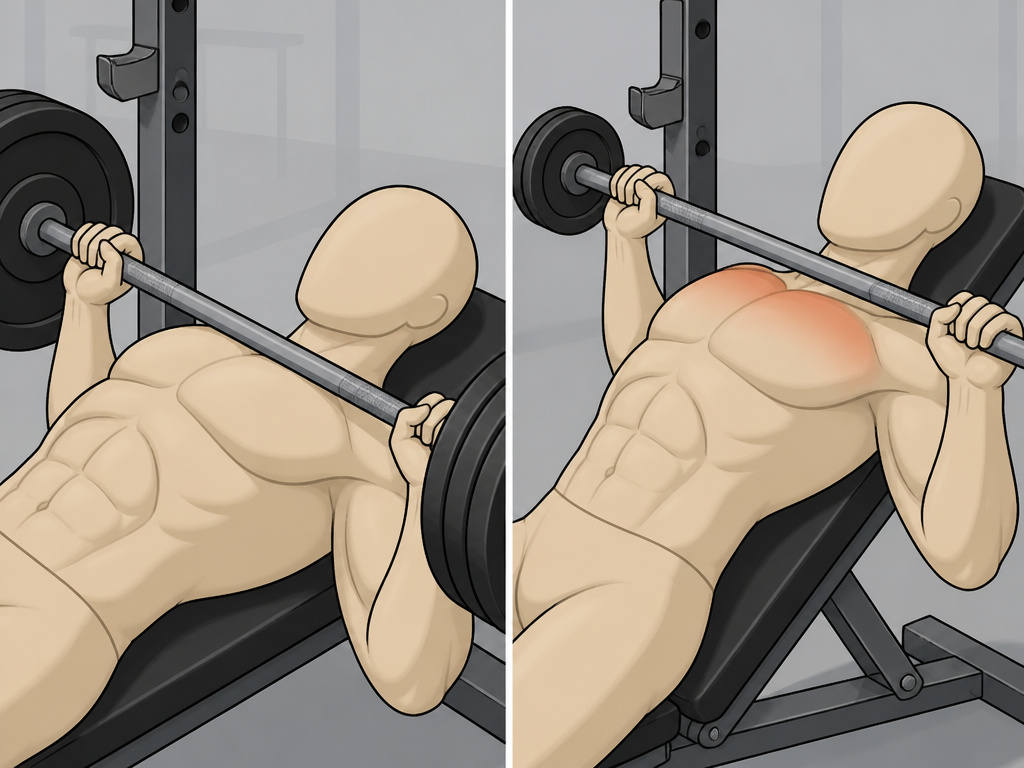
Flat wins on load. Incline wins on upper-chest emphasis. The rest is detail.
| What differs | Flat (0 degrees) | Incline (30-45 degrees) |
|---|---|---|
| Heaviest load | Most weight moved | Noticeably less |
| Chest emphasis | Middle and lower | Upper |
| Front delt share | Moderate | Larger, climbs with angle |
| Best use | Main strength lift | Second press or upper block |
| Evidence for growth | Solid overall | One small trial, mixed |
The flat bench press is the lift you can move the most weight on, and it’s the version tested in powerlifting competition. Most people press noticeably less on an incline because the front delt and the smaller upper chest do a bigger share of the work.
There’s no fixed ratio between the two worth chasing. Compare each lift only against its own log, because the loads aren’t interchangeable and a drop on incline says nothing about your flat number.
For most people the incline vs flat bench press choice is settled by what their week is missing, not by which lift is theoretically better. If every press you do is flat, the incline is the gap. If you already rotate both, you don’t have a gap to fill.
Pectoralis major ruptures in the case-report literature are tied overwhelmingly to heavy flat barbell pressing, not incline. The fair caveat is that flat is also where the heaviest loads go, so the two facts are hard to pull apart.
If the bar itself is the problem, the barbell vs dumbbell bench press comparison covers the trade-off, and a flat bench with proper safeties solves the solo-training problem better than a spotter you don’t have.
The Triceps Claim Nobody Can Source
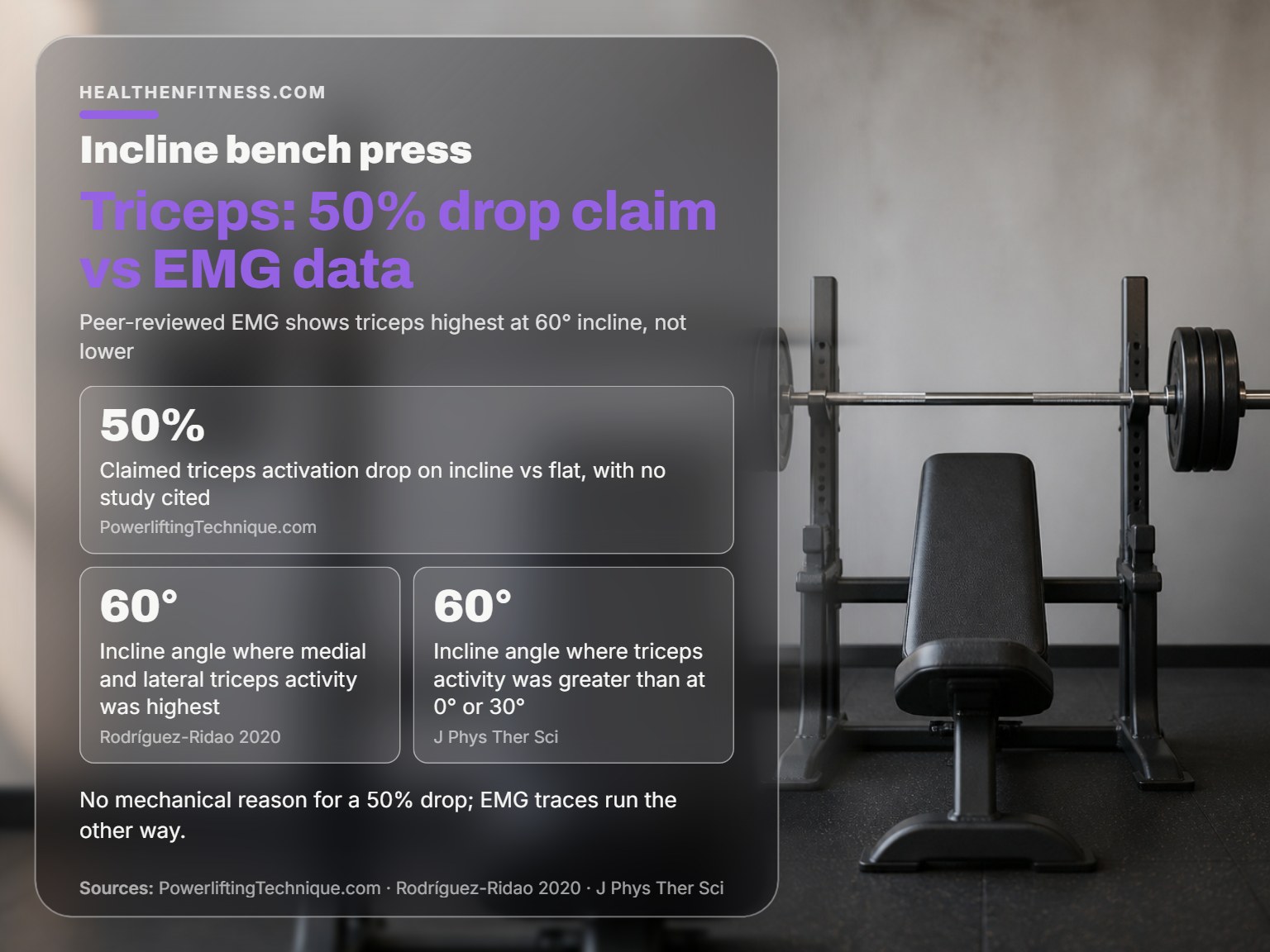
PowerliftingTechnique.com states that triceps activation drops by 50 percent on the incline compared with flat and decline.
Here’s what the peer-reviewed work actually shows:
- Rodríguez-Ridao 2020: medial and lateral triceps activity highest at 60 degrees, above both 0 and 30.
- Beginner study, Journal of Physical Therapy Science: triceps greater at 60 degrees than at 0 or 30.
- PowerliftingTechnique.com: a 50 percent reduction, with no study cited.
The triceps extend the elbow, and the elbow has to lock out every rep at every angle. A steeper pad shortens the bar path and changes the arc the elbows travel through, but there’s no mechanical reason for a 50 percent drop. If it were real, it would show up in the EMG traces, and those traces run the other way.
What most people get wrong: Choosing a steep incline to “protect the triceps” or “shift work onto the chest.” A 60-degree pad is a shoulder press, and the triceps are working harder there, not less.
If a claim about muscle activation doesn’t name a study, treat it as a coaching opinion. Some of those opinions are excellent. This one contradicts the data.
How to Fit Both Presses Into a Week You Can Repeat
You finish your last flat set, slide the pad up two notches, and the weight that moved fine a minute ago feels bolted to the floor.
That’s normal. Incline loads run lighter than flat loads for almost everyone, and the first session feels insulting.
I worked with a beginner who couldn’t do a single push-up from the floor. We put their hands on a bench instead, which is an incline push-up, and about three months later they strung together ten full reps. The angle did most of the work. So did showing up twice a week.
Before you start: A failed rep on a flat barbell bench with no safeties lands on your chest or throat, so set the rack pins or use a spotter on every heavy set. A steep incline pushes the bar path toward your face, which is why the pad should stay low enough that the bar still tracks over your collarbone. If a shoulder twinges on the incline, stop that session rather than pushing through it.
A Two-Session Week That Covers Both Angles
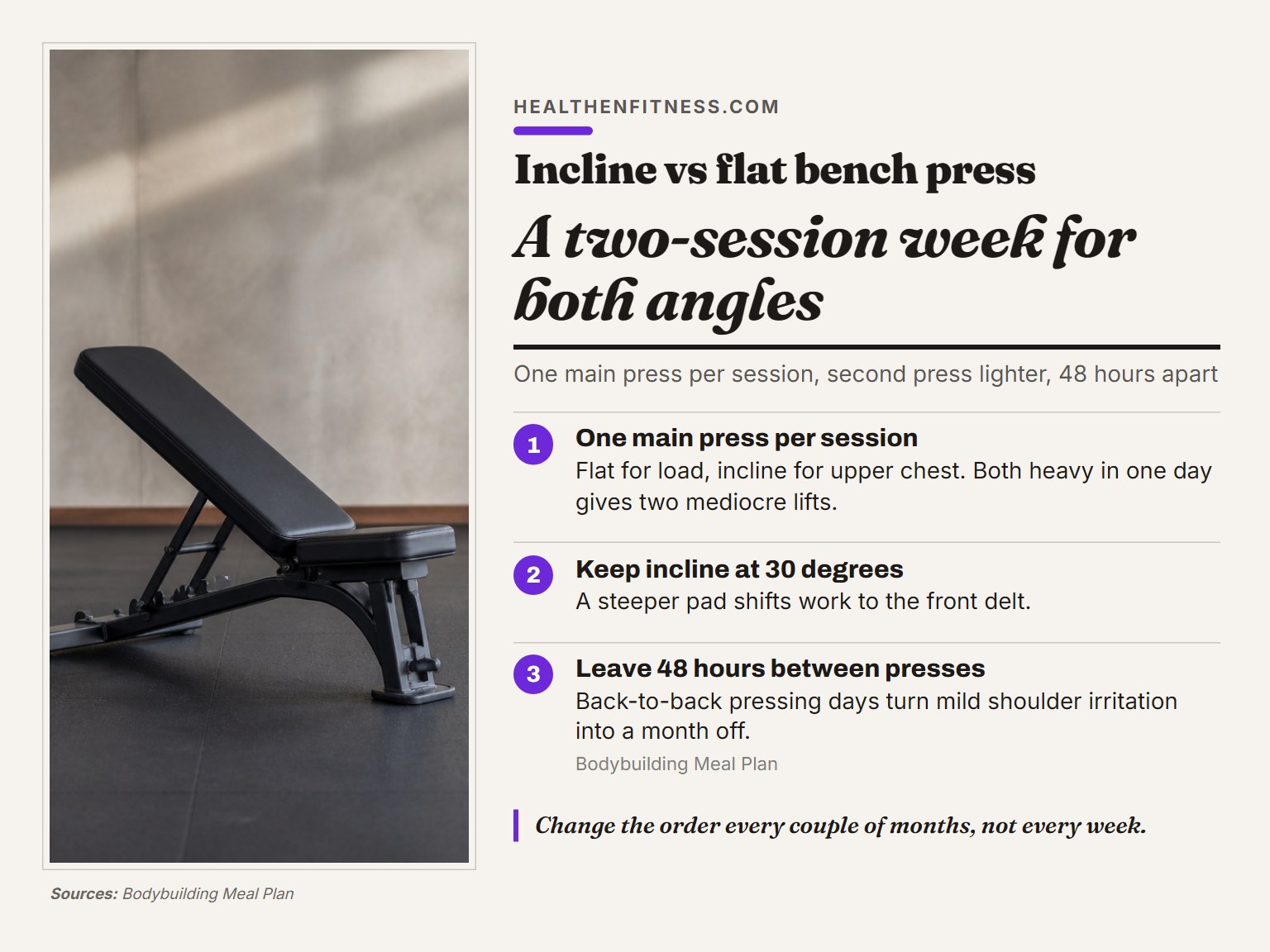
- Pick one main press per session. Flat if you’re chasing load, incline if the upper chest is the visible gap. Do both heavy in one day and you get two mediocre lifts and a cranky shoulder.
- Run the second press lighter, three sets of eight to twelve. Record which notch you used. Skip the note and next week’s session is guesswork.
- Keep the incline at 30 degrees if the bench allows it. A steeper pad shifts work to the front delt, and you’ll feel it before you see it in the mirror.
- Leave at least 48 hours between pressing sessions. Bodybuilding Meal Plan’s guide recommends this, and pressing on back-to-back days is how a mild shoulder irritation turns into a month off.
- Change the order every couple of months, not every week. Putting the incline first for a block gives it room to progress. Swapping weekly means neither lift gets a fair run.
A bench that adjusts in small increments is the piece of equipment that makes this work. The Rep Fitness AB-5200 and the Rogue Adjustable Bench 3.0 both hold a setting without wobble, which matters more than pad width. If you train at home, a home weight bench that goes flat and to 30 degrees covers everything here, and a Bowflex adjustable bench does the same job in less floor space.
I dropped long static stretching before lifting a few years back. Five minutes of dynamic work and the first working set feels ready; twenty minutes of holding stretches left me flat and slow.
When to Skip the Incline (and When to Skip Flat)
Both presses have situations where they earn no place in your week.
- Skip the incline if the front of your shoulder complains every time the pad comes up. Flat pressing and push-ups will hold the chest together while it settles.
- Skip flat barbell work if you train alone without safeties. A dumbbell press or a push-up variation fails safely, and a failed rep under a loaded bar does not.
- Skip both on a day when the shoulders are still sore from the last pressing session. Soreness that outlasts 48 hours is a scheduling problem, not a toughness test.
The decline bench press comes up in these conversations, and it’s optional. A 2016 study found the lower chest working about as hard flat as on a slight decline, so a decline bench press adds variety more than it fills a gap.
Easy to miss: No bench angle isolates the upper chest, and no setting guarantees a particular result. Treat the angle as a nudge in one direction.
If you’re new to the bar, a flat press or a push-up progression builds the whole chest while you learn to control the weight. Adding a second angle in your first month gives you more variables and less practice.
Frequently Asked Questions
Is incline or flat bench better for building chest size?
Flat loads more total muscle and allows you to move more weight, which matters for overall chest size. Incline shifts emphasis to the upper chest, and the growth evidence for that shift is one small trial with an outlier result. Most people get the best outcome running both.
What angle should I set the incline bench to?
Thirty degrees has the strongest support for upper-chest activity. Other studies used 44 and 45 degrees and found an upper-chest advantage there as well. Anything past 45 starts turning the movement into a shoulder press.
Can I do incline and flat bench in the same workout?
Yes. Put the lift you care about most first, then run the other at a lighter load for three sets of eight to twelve. Doing both heavy in one session leaves you with two half-finished lifts.
Does incline bench work your shoulders more than flat?
The front delt takes a larger share as the pad comes up, and it peaks around 60 degrees. At 30 degrees the shoulder contribution is moderate. That’s the trade: more upper chest, more front delt, less load.
Is flat bench bad for your shoulders?
Not inherently, but it’s where the heaviest loads go, and pectoralis major ruptures in the case-report literature are tied overwhelmingly to heavy flat barbell pressing. Elbows flared wide and a bar bouncing off the chest are the versions that cause trouble.
The Bottom Line
If your flat bench has moved steadily for a year and your upper chest still looks the same, the missing piece is probably angle rather than effort. Add one incline session at 30 degrees, keep every other variable the same, and give it a couple of months before you judge it.
None of this matters much if you’re pressing twice a week and sleeping five hours a night. Recovery beats exercise selection every time, and a bench angle can’t fix a schedule that never gives you room to adapt.
The one thing I’d push back on is the idea that flat bench is mandatory. Dumbbell presses and push-ups train the same muscles, they’re easier on some shoulders, and they fail more safely when you’re training alone. Pick the press you’ll actually repeat.
Do this today: set your incline pad to 30 degrees, load it lighter than your flat working weight, and do three controlled sets of eight.
