
Shoulder Stretches for Lifters: What Actually Works
This post contains affiliate links. As an Amazon Associate, we earn from qualifying purchases.
Shoulder stretches for lifters work best when you pick one and dose it daily: 3- to 30-second holds, per NSCA guidance. The sleeper stretch and the cross-body stretch both raise internal rotation range, but the sleeper stretch carries a documented potential for subacromial impingement, and a systematic review found it no better than nothing short-term.
The shoulder stretches for lifters dosing question is settled enough. Daily work, short holds, and a progression from 45 degrees of abduction toward 90 as symptoms allow. The harder question is which stretch, because the two most-prescribed options have a real disagreement sitting behind them.
What follows: the numbers from the actual trials, the two places where credible sources flatly disagree, the three stretches worth your time, and the specific shoulder that should skip the sleeper stretch entirely.
Key Takeaways
- Daily beats heroic: NSCA guidance for posterior shoulder tightness is daily stretching with 3- to 30-second holds, not one long Sunday session.
- The sleeper stretch is contested: coaching literature still teaches it, but a systematic review found it might not beat no intervention short-term, and the modified version carries a documented impingement risk.
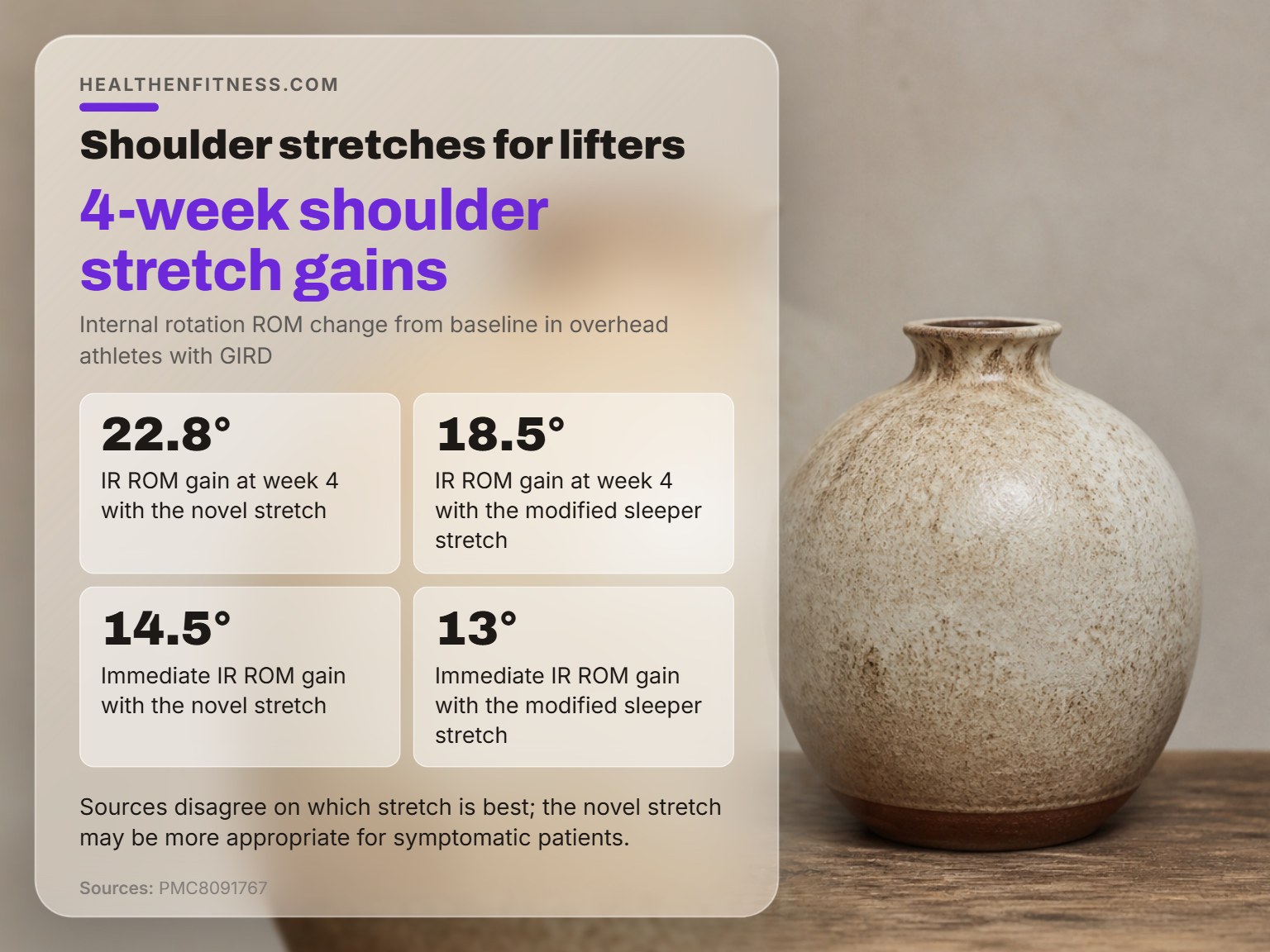
- Range gains are real but modest: in one trial, internal rotation improved 22.8 degrees with a novel stretch and 18.5 degrees with the modified sleeper by week 4.
- Pain is the tiebreaker: the novel stretch cut pain significantly (p=0.001), while the modified sleeper group did not reach significance (p=0.231).
- Warm up with load, not a stretch: save the long static holds for after training or a separate session.
What Does the Research Actually Say About Shoulder Stretches for Lifters?
Start with the number that gets quoted most: 22.8 degrees.
Internal rotation range in overhead athletes with glenohumeral internal rotation deficit improved by 22.8 degrees after four weeks of a novel stretch and 18.5 degrees after the modified sleeper stretch. Immediate post-stretch gains were smaller: 14.5 degrees and 13 degrees respectively, measured with a digital inclinometer. The trial enrolled 42 overhead athletes with a mean age of 25.9 years.
That comes from a randomized trial on GIRD stretching published in BMC Musculoskeletal Disorders. Glenohumeral internal rotation deficit, usually shortened to GIRD, is the clinical name for losing internal rotation at the shoulder compared with your other side. The trial ran 20 men and 22 women through four weeks of daily work.
The gap between the immediate number and the week-4 number is the useful part. Range you pick up in a single session fades within hours. Range that accumulates over four weeks of daily dosing tends to stick around.
Here’s where I’d slow down before you get excited. A separate systematic review of shoulder stretch RCTs found statistically significant improvements in internal rotation and horizontal adduction, then rated the overall certainty as very low under GRADE. Significant and certain are two different things, and the literature is honest about the difference.
One more wrinkle. That 42-athlete trial studied overhead athletes, not lifters. Throwing shoulders and pressing shoulders both lose internal rotation, but nobody has run the same protocol on a group of recreational bench-pressers. I’d treat the numbers as directionally useful and not gospel.
The Sleeper Stretch Problem: Two Credible Sources, Opposite Conclusions
You can find two respected sources saying opposite things about the same stretch, and both of them are arguing in good faith.
| Source | Position on the sleeper stretch |
|---|---|
| NSCA Strength & Conditioning Journal (2021) | Primary tool for posterior shoulder tightness; progress from 45 to 90 degrees abduction |
| Systematic review of RCTs (Mine et al.) | Might not be more effective than no intervention short term |
| RCT in overhead athletes (2021) | Modified version carries documented potential for subacromial impingement |
The NSCA prescription is specific and worth knowing even if you end up skipping the stretch. Begin at 45 degrees of abduction and progress toward 90 degrees as tolerated. That progression exists because the further your elbow drops toward the bench, the more the humeral head translates and the more the front of the shoulder gets crowded.
Where this goes sideways: Pinning the shoulder blade flat and cranking into the sleeper stretch on a shoulder that already pinches. The trial authors documented potential subacromial impingement with the modified version, and the pinch usually shows up on your next pressing day, not during the stretch itself.
The cross-body stretch has its own mechanical problem. The trial authors note it can’t stabilize the scapula or control glenohumeral joint rotation, which is exactly why they built an alternative, though the NSCA still prescribes the cross-arm stretch at a 90° shoulder angle as a recommended technique. That’s the same reason shoulder impingement from lifting so often traces back to a shoulder blade that wanders during pressing.
A 4-week trial of 67 patients with subacromial impingement syndrome found both modified cross-body and modified sleeper stretching beat a control group on pain, range, function, and disability (P<0.05). It also found no significant difference between the two stretch groups (P>0.05). So if you’re choosing between them for a sore shoulder, the honest answer is that the trial couldn’t separate them.
How Long Should You Hold a Shoulder Stretch?
Three seconds is the floor. Thirty is the ceiling.
The NSCA guidance for posterior shoulder tightness is daily stretching with holds somewhere between 3 and 30 seconds. That range is wide on purpose. Shorter holds suit the acute, feel-it-out stage. Longer holds suit the maintenance stage once you know the position doesn’t irritate anything.
Before you start: Stop short of any position that produces a sharp pinch at the front of the shoulder, because that’s the subacromial space closing rather than tissue lengthening. Keep the shoulder blade set against a wall or the floor so the humerus rotates instead of the scapula sliding. And never load a shoulder you just stretched hard, since the joint is temporarily less protected at end range.
Here’s the sequence I’d actually run:
- Set the shoulder blade first. Pin it against a wall or the floor before you move the arm. Skipping this turns a glenohumeral stretch into a scapular slide and you’ll wonder why nothing changes.
- Move to end range slowly, over about three seconds. Jerking into range triggers a protective guarding response and you end up stretching a muscle that’s actively fighting you.
- Hold for 20 to 30 seconds and breathe. Holding your breath raises tone through the whole shoulder girdle, which defeats the point.
- Come out under control and repeat 2 to 3 times. Bailey et al. And Mine K reported immediate range gains using 2 to 5 repetitions of 20 seconds to 1 minute, so the volume is smaller than most people assume.
- Log the date and the number. Without a record you’re guessing at progress, and guessing is how people stretch the same shoulder for a year with nothing to show.
If you want the warm-up side of this handled properly, the dynamic stretches that actually belong before a session are a different animal from the holds above.
The Three Stretches Worth Doing, and the One to Skip
Three earn a place in a lifter’s week. One earns a warning label.
Cross-Body Stretch at 90 Degrees
The NSCA prescribes the cross-arm stretch with the shoulder at 90 degrees of flexion. Lie on your side or stand with your back against a wall, bring the upper arm across your chest, and pull with the opposite hand until you feel it behind the shoulder. The wall version is better than the free-standing version because the wall does the scapular stabilizing the stretch can’t do on its own.
Modified Sleeper Stretch, With Caveats
Side-lying, shoulder at 90 degrees of flexion, elbow bent, and the forearm rotates down toward the floor. Start with the upper arm around 45 degrees of abduction rather than driving straight to 90. This is the one to skip if your shoulder already pinches, clicks, or aches the day after pressing.
The Clam-Shell Bridging Variant
This is the novel technique from the trial: passive glenohumeral internal rotation combined with a clam-shell bridge. It was built specifically to allow greater scapular stability without reproducing symptoms, and it produced the larger pain reduction in the data (p=0.001, d=2.18 versus p=0.231, d=0.46 for the modified sleeper). It’s more awkward to set up and it looks faintly ridiculous on a gym floor. Do it anyway if pain is your main complaint.
What to Skip
Skip the long pre-workout static routine. I’d also skip buying anything fancy for this. A TheraBand resistance band for the light external rotation work and a lacrosse ball pinned against the posterior shoulder, which the NSCA recommends for pinning down contractile tissue and producing a stretch earlier in the range, cover nearly everything. A Manduka PRO mat or a Gaiam yoga mat makes the floor work comfortable, and a TriggerPoint GRID foam roller handles the surrounding tissue.
I won’t put the sleeper stretch in a beginner’s program. The position asks you to relax into end range while your body weight pins the shoulder blade, and most people can’t tell the difference between a stretch and a pinch yet. Give it a month of cross-body work against a wall first.
The part nobody mentions: the cross-body stretch done free-standing lets the shoulder blade wing out and takes the stretch off the joint entirely. You’ll feel a pull across the back of the shoulder and get almost no rotation gain, then conclude stretching doesn’t work for you.
If your chest and front shoulder are the actual restriction, chest stretches belong in the same week.
Why Static Stretching Before You Lift Is the Wrong Order
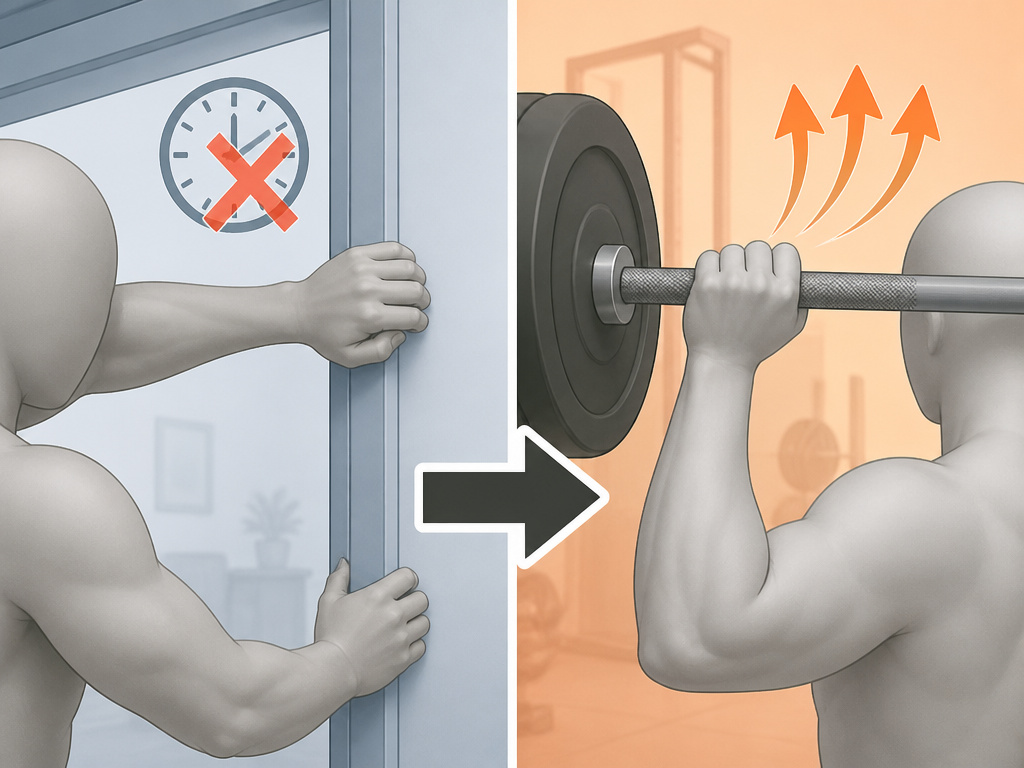
I stopped doing long static stretching right before lifting, and the reason was embarrassingly simple: it made me feel loose and then my first heavy sets felt weaker.
That’s a common report and it lines up with what the warm-up literature suggests. A static vs dynamic shoulder warm-up trial compared acute static and dynamic protocols in 25 athletes with shoulder impingement and 25 controls. Worth flagging the limit here: that trial studied only male athletes with impingement, so the acute effects may not transfer cleanly to a healthy lifter.
Fair warning: the “loose but weak” feeling is real and it’s not in your head. You get a floaty, warm sensation in the joint for maybe twenty minutes, then the bar comes off the rack and the shoulder feels like it’s working through wet sand. A few progressively heavier sets of the actual lift does more for readiness than five minutes of holding a doorway.
Save the static holds for after training or a separate evening session. That’s where the daily dosing from the NSCA guidance fits without costing you anything on your top set.
A Four-Week Progression That Fits Around Real Training
Four weeks is the shortest window worth judging, and it’s the window the trials actually used.
Run this alongside your normal training, not instead of it:
- Week 1: test and set a baseline. Lie on your back, upper arm at 90 degrees, elbow bent, and rotate the forearm toward the floor. Note roughly how far it goes and whether it pinches. Do the cross-body stretch for 3 sets of 20 seconds daily.
- Week 2: add the wall version. Move the cross-body stretch to a wall so the shoulder blade stays put. Add light external rotation with the TheraBand band, 2 sets of 15, as a control exercise rather than a stretch.
- Week 3: introduce the sleeper position at 45 degrees. Only if weeks 1 and 2 produced no pinch and no next-day ache. Hold 20 seconds, 2 to 3 times.
- Week 4: retest and progress the sleeper toward 90 degrees as tolerated. Compare against your week 1 note, not against how you feel that morning.
Four weeks is the shortest window worth judging. Anything less and you’re measuring yesterday’s warm-up, not a change in tissue.
If the shoulder still won’t rotate at week 4, the restriction may be coming from further down the chain. Thoracic mobility governs how much the shoulder blade can upwardly rotate, and a stiff upper back caps your shoulder mobility no matter how much you stretch the joint itself.
A 4-week pilot in CrossFitters combined soft tissue mobilization with a stretching protocol and treated it as a package rather than a single magic stretch. That’s the right mental model. One stretch done perfectly is worth less than three mediocre ones done daily.
When to Stop Stretching and Get the Shoulder Looked At
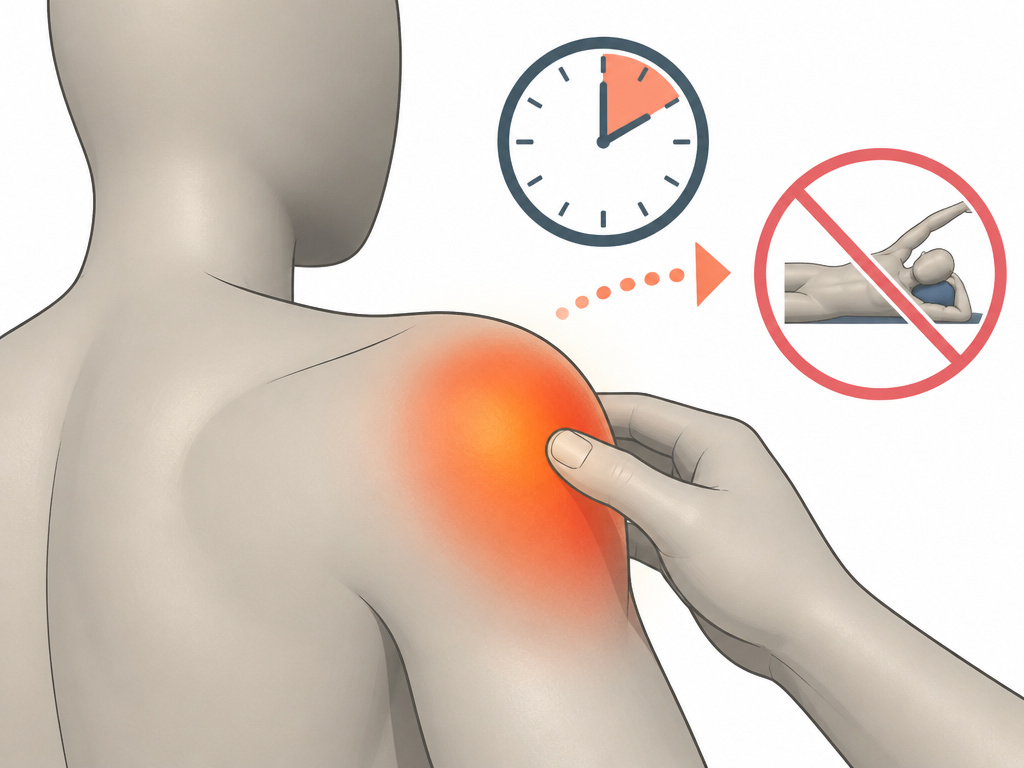
Some shoulder tightness is a tissue problem. Some of it is a warning light.
| What you notice | Likely driver | What to do |
|---|---|---|
| Sharp pinch at the front at end range | Subacromial crowding | Drop the sleeper stretch, test cross-body instead |
| Dull ache building the day after pressing | Load, not stiffness | Cut pressing volume before adding stretches |
| Range improves in session, gone by morning | Normal adaptation lag | Keep daily dosing for the full four weeks |
| Pain that wakes you at night | Not a stretching problem | Get it assessed by a clinician |
Easy to miss: Pain that arrives 12 to 24 hours after stretching rather than during it. That delay points at an irritated rotator cuff rather than a tight capsule, and pushing through it for another week usually makes the next session worse.
I’m not a clinician and I can’t diagnose anything. What I can tell you is that the difference between “tight” and “irritated” shows up in the timing. Tight tissue complains during the stretch and settles. Irritated tissue says nothing at the time and then makes itself known the next morning.
If that’s your pattern, rotator cuff exercises are the better starting point than more stretching, and building shoulder stability exercises into your warm-up pays off more than chasing range you can’t control.
Frequently Asked Questions
How often should lifters stretch their shoulders?
Daily, according to NSCA guidance for posterior shoulder tightness, with holds between 3 and 30 seconds. That’s a lower daily dose than most people expect. Two or three short holds done every day beats a long session twice a week.
Is the sleeper stretch safe?
It depends on the shoulder. The NSCA presents it as a primary tool with a progression from 45 to 90 degrees of abduction. A randomized trial documented potential subacromial impingement or symptom aggravation with the modified version, and a systematic review concluded it might not be more effective than no intervention short term. If your shoulder pinches, use the cross-body version instead.
How long before I see a difference in shoulder range?
Judge it at four weeks. That’s the window used in the trials, where internal rotation improved 22.8 degrees with a novel stretch and 18.5 degrees with the modified sleeper. Immediate post-stretch gains were smaller, at 14.5 and 13 degrees, which tells you most of the early change is temporary.
Should I stretch my shoulders before or after lifting?
After, or in a separate session. A crossover trial on static versus dynamic warm-up found acute differences in shoulder function, though it studied only male athletes with impingement. Practically, a few progressively heavier sets of the first lift gets you ready without the loose-but-weak feeling.
Does stretching alone fix a tight shoulder?
Not always. A meta-analysis rated the certainty of stretching benefit as very low under GRADE, and found that adding glenohumeral dorsal gliding to stretching outperformed stretching alone. If four weeks of daily stretching changes nothing, the restriction is probably coming from somewhere else.
The Bottom Line
This week, do one thing: before your next session, lie on your back, put your upper arm at 90 degrees, and rotate the forearm toward the floor on both sides. Note the difference and whether either side pinches. That single test tells you more about what to do next than any article can.
Two concessions before you go. First, the certainty behind all of this is genuinely low. A meta-analysis rated it very low under GRADE, and the trial with the best pain numbers studied overhead athletes, not lifters. Anyone who tells you the shoulder stretching question is settled is selling something.
Second, if your shoulder pinches rather than pulls, skip the stretching entirely for a few weeks and work on control instead. Range you can’t stabilize is range your body will take back.
Start smaller than you think. Three sets of twenty seconds, done daily, will out-perform anything ambitious you abandon by week two.
