
How to Do a Kettlebell Swing: Step-by-Step Form Guide
This post contains affiliate links. As an Amazon Associate, we earn from qualifying purchases.
To do a kettlebell swing, hinge at the hips with your feet parallel, hike the bell back between your thighs, then snap the hips forward so the bell floats to chest or shoulder height. Arms stay straight, and the bell travels because your hamstrings and glutes fired, not because your shoulders lifted it.
That last clause, the height the bell reaches, is where the instructions split. The American Council on Exercise says chest or shoulder height, a Marine Corps training video says shoulder height, and a published review citing Tsoutline says eye level and no higher. A 2025 hip-kinetics study sidesteps the argument by treating shoulder-height and overhead swings as two legitimate styles.
What follows is the order that works: the hip hinge first, then six steps, then the three faults that show up before anything else. The height argument and the load question get their own sections, because both change how you train.
Key Takeaways
- Learn the hip hinge before the swing. A glute bridge and a standing hip hinge in the warm-up do more for your swing than another set of swings.
- The bell goes to chest or shoulder height in the ACE standard, shoulder height in the Marine Corps standard, and eye level in the Tsoutline description. Pick one and stay consistent.
- Add weight before you add style. The 2025 hip-kinetics trial recommends changing kettlebell mass first, ahead of switching from shoulder-height to overhead.
- Grip is a forearm job. The brachioradialis and flexor digitorum hold the handle; the hips move the bell.
- Twelve minutes is enough to create a metabolic challenge, per ACE. Longer is not automatically better.
The Hip Hinge You Learn Before the Swing
A friend of mine in his fifties wanted to try kettlebells and was quietly worried about the weight room. We skipped the swing for the first session and did kettlebell deadlifts from the floor with a light bell. About six weeks later his hinge was clean, the bell was heavier, and I stopped assuming that day-one nerves predict anything.
The swing has two versions. The original competition version is a hip hinge with the feet parallel to each other. The other version includes a squat during the lowering phase. The hip-hinge version is the one taught as standard, and squatting on the way down is listed as a common mistake.
The muscles that move the bell when you learn how to do a kettlebell swing are the ones that extend the hip: the hamstrings (semitendinosus, semimembranosus and biceps femoris), gluteus maximus and adductor magnus. Grip is a separate job, handled by the brachioradialis and flexor digitorum in the forearm. That split explains why the deadlift comes first. A deadlift starts from a stop, so you can feel the hinge and fix it. A swing never stops, so a bad hinge just repeats faster.
The how to do a kettlebell swing teaching progression is short. The ACE two-handed kettlebell swing guide puts the glute bridge and the standing hip hinge into the dynamic warm-up to reinforce the pattern, and notes that some people need a few reps while others need a few sessions. Both are normal.
The kettlebell swing vs deadlift comparison covers where the two overlap and where they part, and the overlap is smaller than it looks.
How to Do a Kettlebell Swing: The Six Steps
Six things happen in this order: stand, grip, hike, snap, float, park.
Before you start: A bell that leaves your grip keeps traveling, so clear two arm-lengths of floor and keep pets out of the arc. Sweaty hands on a smooth handle slip, so chalk up or use a bell with a knurled handle. A loaded hinge is a poor place to discover a cranky lower back, so get a clinician’s opinion first if yours has a history.
- Set the feet parallel, shoulder width, with the bell 6 inches in front of you. That distance is the Marine Corps standard, and it exists so you hinge toward the bell instead of reaching for it with a rounded back.
- Grip the handle overhand with both hands, back flat, knees slightly bent. One hand on each side of the handle, thumbs wrapped around.
- Hike the bell up and back between your thighs. This is the loaded start. Skip the hike and the rep begins from a dead stop, which turns your swing into a slow deadlift with extra steps.
- Snap the hips forward. The hips make the momentum and the arms only carry it. Drive the hips and the bell comes up on its own.
- Let the bell float to chest or shoulder height with straight arms and a wrist that does not break. The Marine Corps standard is explicit on both: arms straight, no break at the wrist. A bent arm turns the swing into a front raise.
- Decelerate on the way down. The shoulder and upper-back muscles slow the bell and resist gravity as it returns, per the Tsoutline description. Let it fall and you are catching weight with your spine instead of your hips.
At the top of a rep the bell feels weightless for a beat. Your hands are just hooks. The motor is behind you.
If the handle feels like it is peeling your fingers open, the fix is where the bell sits in your palm. The kettlebell grip guide covers that in detail, and it matters more on a heavy bell than a light one.
How High Should the Kettlebell Swing Go?
Four sources, four answers, and each one is defensible inside its own context.
| Source | Top of the swing | What kind of document it is |
|---|---|---|
| American Council on Exercise | Chest or shoulder height | Certifying-body coaching guidance |
| U.S. Marine Corps (DVIDS) | Shoulder height | Official training standard, filmed at Quantico |
| Crimson Publishers review (citing Tsoutline) | Eye level, not above | Descriptive review of competition technique |
| Murphy and Riemann (2025) | Shoulder-height and overhead both studied | Peer-reviewed crossover trial |
The Marine Corps number is a standard a recruit is graded against, so shoulder height is one defensible target. The ACE page is coaching guidance, so chest or shoulder covers a range. The Tsoutline description comes out of competition technique, and the Crimson review notes that the swing is one of the oldest competitive sporting events in Russian history.
History is the other place the sources part. ACE dates the kettlebell to the late 1800s and its U.S. Reintroduction to the early 2000s, while the Crimson review dates kettlebell use in Russia to the 1700s. Both can be true depending on what you are counting.
Shoulder-Height vs Overhead: What the Study Measured
The 2025 kettlebell swing hip kinetics study put participants through 15 swings in four conditions: shoulder-height and overhead, each at 12 kg and 16 kg. Overhead swings produced significantly greater bell distance (95% CI of the difference, 17.5 to 25.1 percent of body height), greater peak velocity (0.56 to 0.74 m/s), greater hip peak power (1.6 to 4.1 W/kg) and more total work (0.104 to 0.527).
So overhead is the harder version of the same movement. The same paper’s practical advice is the part people skip: change kettlebell mass first, before you change from the shoulder-height style to the overhead style.
I hold almost everyone at shoulder height for the first couple of months. The overhead version loads the hip harder, and the trial that shows that used a small sample, so I am not going to pretend the numbers transfer to every lifter without a shrug. Learn the hinge, add weight, then argue about height.
Should Your Shins Stay Vertical?
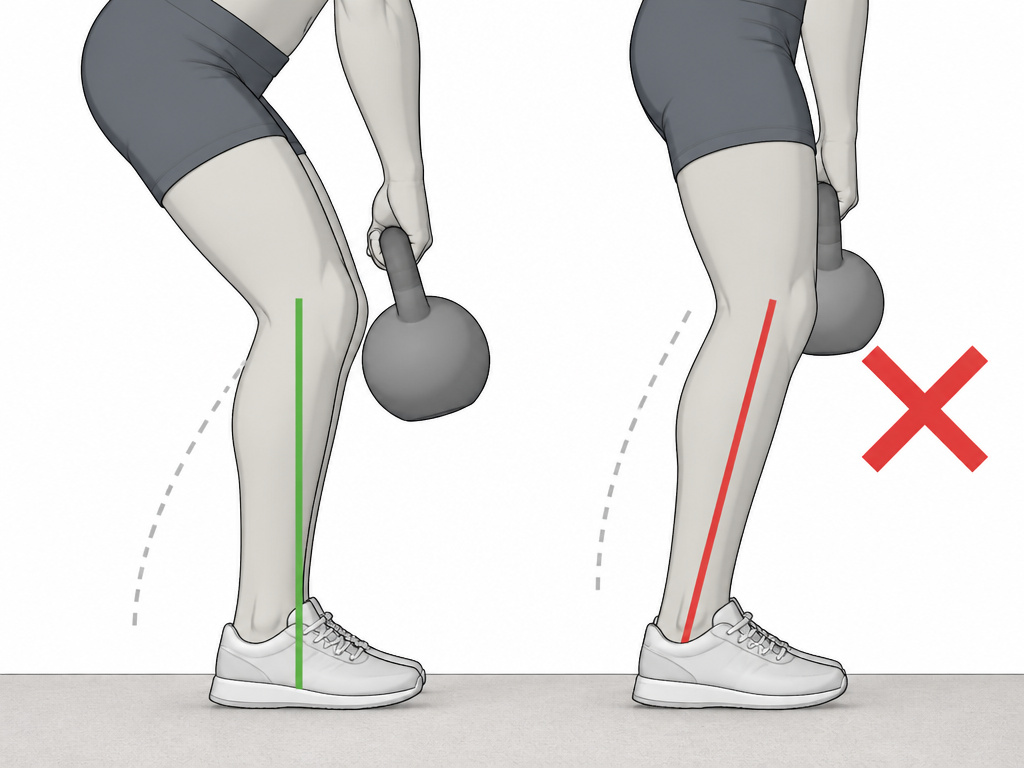
This one has a clear default and one honest exception.
ACE says the shins stay vertical and the knees stay slightly flexed, while Ross, Keogh and Lorenzen permitted self-selected ankle dorsiflexion to accommodate maximal effort. The reason is mechanical. A vertical shin keeps the movement at the hip, so the bell travels close to the body and the knees do not drift forward into a squat.
The exception comes from strength testing. Ross, Keogh and Lorenzen allowed self-selected ankle dorsiflexion so their subjects could give a maximal effort, which is a deliberate departure from the shins-vertical cue. That is a testing protocol, not a training cue.
Where this goes sideways: Chasing vertical shins by locking the knees. Do that for a few weeks and the hinge turns into a stiff-legged reach, with the bell dragging your shoulders forward at the bottom of every rep.
I have watched people lock their knees trying to hold the shins still, and the bell ends up swinging away from them on the way down.
The Load-First Rule: 3.6 kg Is the Number That Matters
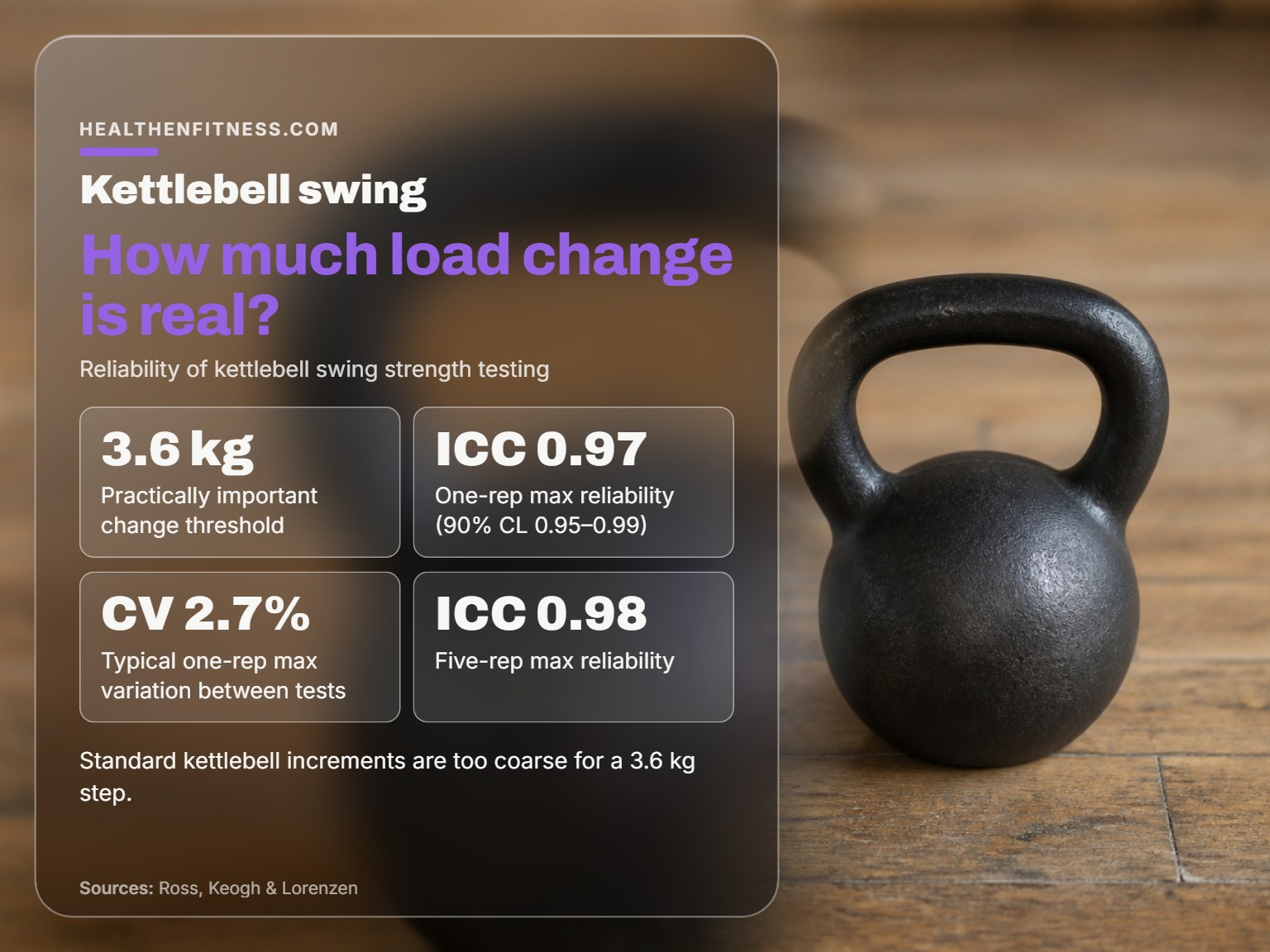
The smallest change in swing load that is reliably bigger than the noise in a strength test is 3.6 kg.
That figure comes from the kettlebell swing reliability study, which tested one-rep and five-rep maximums. The numbers are worth reading slowly. One-rep max reliability came out at an ICC of 0.97 (90% CL 0.95 to 0.99) with a coefficient of variation of 2.7%. Five-rep max came out at an ICC of 0.98 with a CV of 2.4%.
In plain terms, an ICC of 0.97 means two tests of the same person land in nearly the same place, and a CV of 2.7% means the typical swing between tests is under three percent.
What the Reliability Numbers Actually Tell You
Those numbers are good enough to program against. The same study found that isometric mid-thigh pull peak force correlated with swing one-rep max at r = 0.69 and with five-rep max at r = 0.75, so a general strength test tracks swing strength without teaching the swing.
The practical catch is equipment. Ross and colleagues needed a custom plate-loaded kettlebell because standard bells jump in increments too coarse for the protocol. Your gym has the same problem in reverse: the gap from one bell to the next is bigger than 3.6 kg, so every change you make is a real one.
Cast-iron bells are typically sold in standard jumps, and none of them can sell you a 3.6 kg step, because that is not how bells are made.
The kettlebell weight guide walks through picking a starting bell. The short version is that your first bell should be one you can hinge cleanly for five reps, not one you can just barely move.
The Three Swing Faults That Show Up First
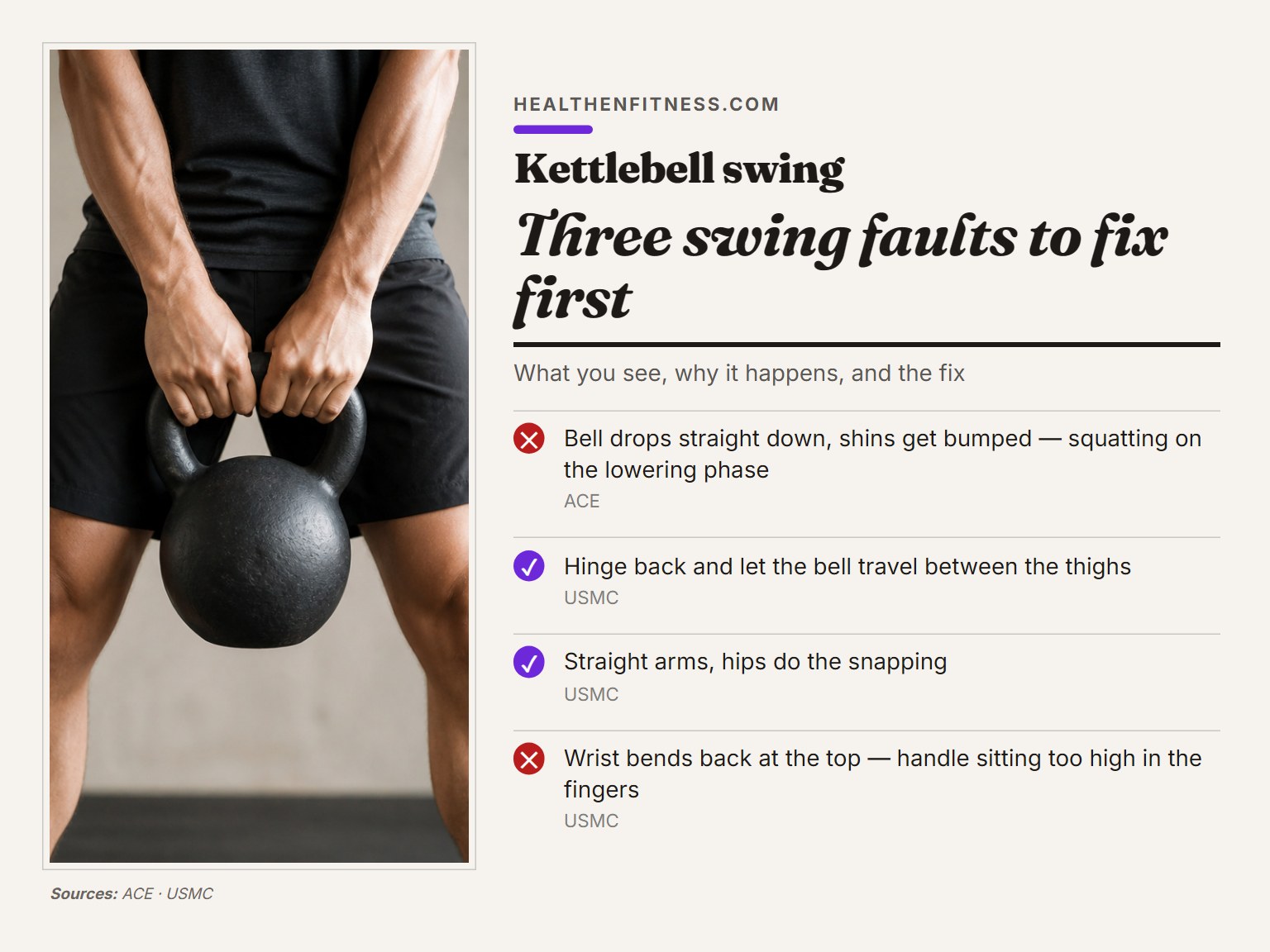
The bell drops straight down, bounces off a shin, and the whole rep looks like a squat holding a suitcase. That is the first fault, and ACE names it outright.
The Fix for Each Fault
| What you see | What is causing it | The fix |
|---|---|---|
| Bell drops straight down, shins get bumped | Squatting on the lowering phase | Hinge back and let the bell travel between the thighs |
| Bell drifts forward, away from the body | Lifting with the arms and shoulders | Straight arms, hips do the snapping |
| Wrist bends back at the top | Handle sitting too high in the fingers | Set the handle deep in the palm, knuckles forward |
| Lower back rounds at the bottom of the hike | Hinge range beyond what the hamstrings control | Shorten the hike and keep the back flat |
A squat-swing has a sound to it. The bell clangs off your shins or the floor instead of floating, and the rhythm is wrong before you can see anything.
The part nobody mentions: The arms-lifting fault gets worse when you are tired, because the shoulders take over when the hips slow down. If your last three reps of a set look different from your first three, end the set there.
My own first swings were a squat with a bell in my hands, and I did that for months. The kettlebell swing mistakes list covers the rest of them. Once a set holds together from first rep to last, the kettlebell clean and the kettlebell snatch are the natural next steps, and both are harder to rescue mid-rep.
What 12 Minutes of Swings Actually Does
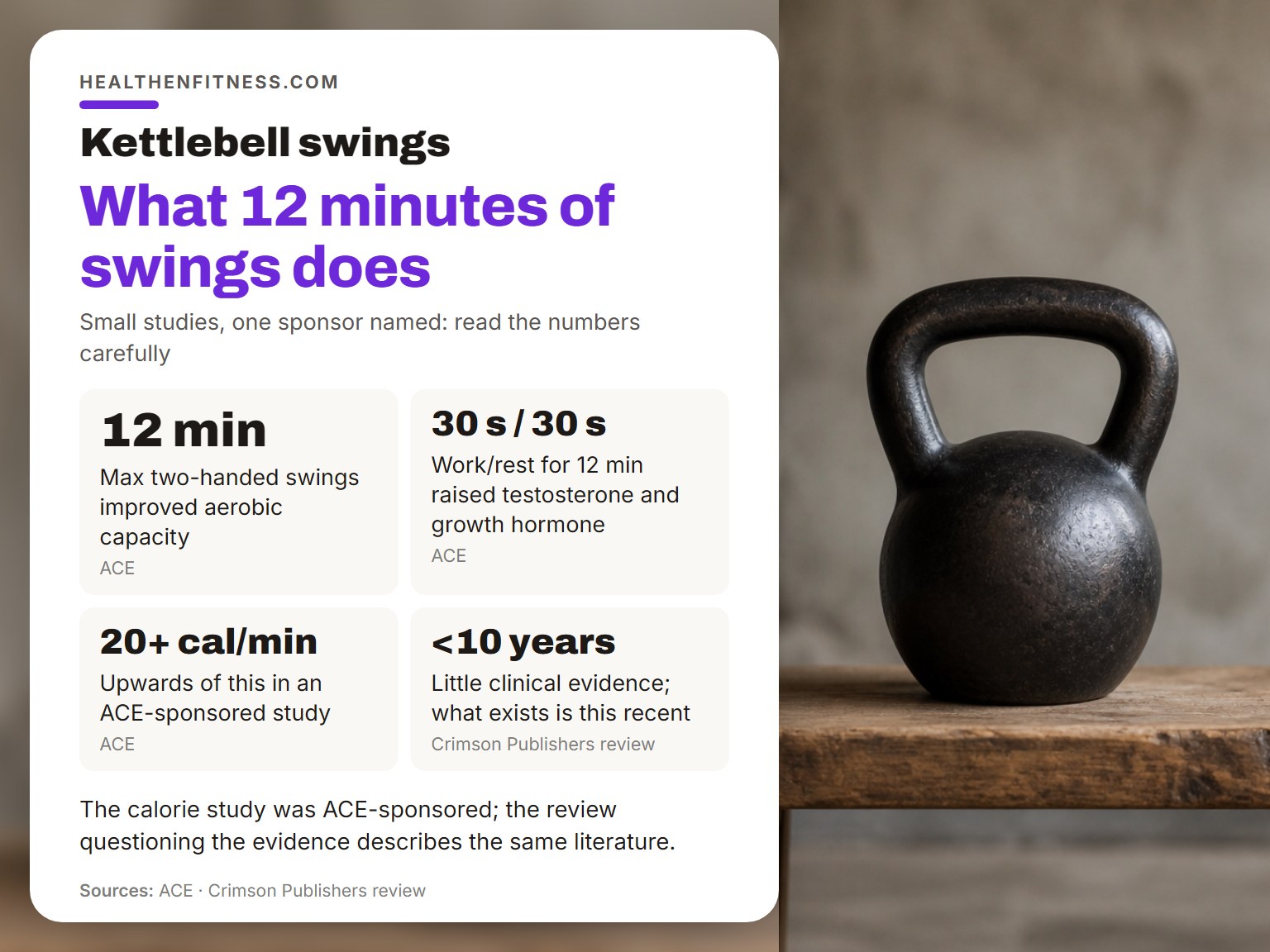
The metabolic case for the swing is better documented than the strength case, and the numbers come from small studies.
- Twelve minutes of as many two-handed swings as you can manage created a metabolic challenge sufficient to improve aerobic capacity, per ACE.
- Thirty seconds of swings and thirty seconds of rest, repeated for 12 minutes, elevated testosterone and growth hormone in a similarly designed study.
- Upwards of 20 calories per minute in an ACE-sponsored study of a standard kettlebell protocol.
- Little clinical evidence overall, per the Crimson review, which also notes that the evidence that does exist is less than ten years old.
That last bullet is the one to sit with. The calorie figure comes from a study ACE sponsored, and the review questioning the wider evidence base is describing the same literature. Small studies with named sponsors are worth reading carefully.
Twelve minutes of swings is a workout. Forty minutes of swings is a decision your grip will remind you about for three days.
The best kettlebell exercises for general fitness are hinges and carries, and the full body kettlebell workouts that hold up are built the same way: a few movements, done often.
The Adjustable Kettlebell Has One Rule You Cannot Skip
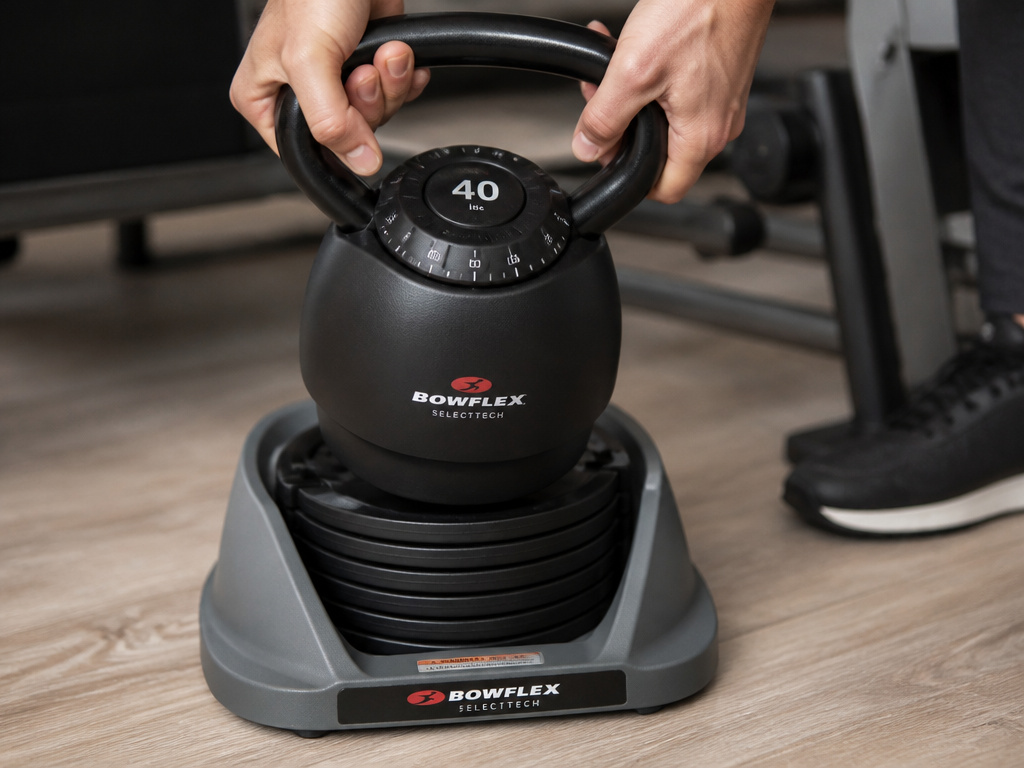
The Bowflex SelectTech 840 runs from 8 to 40 lbs (3.5 to 18 kg), and its manual is unusually blunt about the one thing that makes it different from a fixed bell.
Why the Base Has to Come Off
The SelectTech 840 cannot be swung with the base attached. The swing uses the bell alone, and setting the knob to maximum weight is required only to move the whole assembly, not to swing it.
The locking mechanism does two jobs. It stops the knob from rotating unless the handle is fully inserted and engaging the base, and it prevents deselecting or dropping weight plates when the bell is not in the base. It also prevents a partial selection where the plates are not fully supported.
When the knob settles into a detent you feel a click through your fingers and hear a light tick. That click is the only confirmation you get that the plates are fully selected.
Three checks before you swing an adjustable bell:
- The base stays on the floor. The bell comes out, the base does not.
- The knob has clicked into a detent. No click, no swing.
- The plates you did not select are back in the base in the correct order and orientation. Get that wrong and the handle will not seat on the next change.
Easy to miss: A plate left in the base the wrong way round will block the handle from fitting back in. The manual lists that as the first thing to check when the handle will not go down.
If you want one answer: a fixed cast-iron bell in a weight you can hinge cleanly for five reps. The kettlebell training for beginners guide covers the first month, and the adjustable can wait until you know your working weight.
Frequently Asked Questions
How many kettlebell swings should a beginner do?
The sources here do not publish a beginner dose, so I will give you a rule instead of a number. Start with sets of five crisp reps and stop while the last rep still looks like the first. Volume is cheap to add later, and a hinge you learned badly is expensive to unlearn.
Is the kettlebell swing bad for your lower back?
The swing is repeated hip extension under load, and ACE states plainly that proper form is essential for reducing injury risk. That is a statement about technique, not a guarantee. If your back has a history, get cleared before you load the pattern, and treat a rounded hinge as a stop signal rather than a style choice.
Should you squeeze your glutes at the top of a swing?
The gluteus maximus is one of the prime movers of the swing, so it is working through hip extension whether you think about it or not. A deliberate squeeze at the top is a cue, and none of the sources here describe it as part of the movement. Drive the hips and the glutes do their job.
Can you swing an adjustable kettlebell?
Yes, with one condition. The Bowflex SelectTech 840 manual is explicit that the bell is used alone and the base stays behind, and the locking mechanism only releases the plates when the handle is seated in the base. Check the detent click before every set.
How long does it take to learn a kettlebell swing?
ACE notes that some people need only a few reps to learn a hip hinge while others need a few sessions. That range is normal and it is about the hinge, not the swing. If the hinge is not there yet, no amount of swing practice will substitute for it.
The Bottom Line
One thing to try this week: put a glute bridge and ten standing hip hinges at the front of your next three workouts, before you touch a bell. That is the whole assignment. The swing will still be there when the hinge is automatic.
Here is the honest version. If you cannot hinge down to a bell on the floor with a flat back and nothing in your hands, the swing will not fix that. It will add speed to a pattern that is not there yet.
The one number worth carrying around is 3.6 kg, the smallest change in swing load that is reliably bigger than the noise in a strength test. If your gym’s next bell is a bigger jump than that, you will feel the difference. If it is smaller, you will not, and that is your cue to change reps instead of style.
And if you are training for competition rather than general fitness, none of this is enough. Girevoy sport has its own technique and its own coaching path, and that is a specialist’s job, not mine.
