
What to Wear to the Gym for the First Time: Start Simple
This post contains affiliate links. As an Amazon Associate, we earn from qualifying purchases.
To decide what to wear to the gym for the first time, pick a moisture-wicking top and bottoms, shoes matched to your activity, and cushioned sweat-wicking socks. Skip 100% cotton, denim, open-toed shoes, and jewelry. Loose fits suit walking and strength work; form-fitting suits running and cycling.
The cotton line is the one worth arguing about, and the sources genuinely do argue about it. A government health encyclopedia, a sports retailer, a trainer, and a studio chain all tell you to leave it at home. A 2022 peer-reviewed review looked at the same question and found few studies showing any real difference between natural and synthetic fabrics.
What follows walks through the what to wear to the gym for the first time question, covering fabric, fit, shoes, weather, and the small stuff you’ll be glad you packed, roughly in the order you’ll need it on the day.
Key Takeaways
- Most sources favor wicking fabric over cotton for sweaty work, though Di Domenico et al. 2022 found few studies showing a real difference between natural and synthetic fabrics.
- Match the fit to the activity: MedlinePlus suggests loose for walking and strength work and form-fitting for running and cycling, while Myprotein’s Cushman warns against loose clothes that could get caught when using machines.
- Get your shoes fitted once by someone who watches you walk, rather than guessing from a size chart.
- Leave jewelry and open-toed shoes at home. Both are named catch-and-trip risks in gym guidance.
- Pack a towel and a water bottle. You’ll want both before the session is half done.
Fabric First: What Actually Pulls Sweat Off Your Skin
Fabric does most of the work. A shirt that holds water against your back will wreck a session faster than any style choice.
Quick-drying fabrics are mostly synthetic: polyester and polypropylene. Labels to look for include moisture-wicking, Dri-FIT, Coolmax, and Supplex. Wool also keeps a wearer cool, dry, and naturally odor-free. Some garments carry antimicrobial treatments to fight sweat odor. Socks in a polyester blend reduce blister risk by staying dry against the skin.
MedlinePlus, the consumer health encyclopedia run by the US National Library of Medicine, spells this out in its MedlinePlus exercise clothing guide. The guidance is to pick fabrics that pull sweat away from your skin and dry quickly, and to treat moisture-wicking as the marker printed on the tag.
The Labels Worth Reading
Four terms do most of the signaling: Dri-FIT, Coolmax, Supplex, and the plain phrase moisture-wicking. Wool earns a mention too, because it keeps you cool, dry, and naturally odor-free without needing a synthetic finish.
The one addition worth knowing about is antimicrobial treatment. Some workout clothing carries it to fight odor from sweat. It won’t make a shirt last forever, but it buys you a session or two between washes.
Socks get their own rule. A polyester blend stays dry against the skin and cuts blister risk. A cotton sock soaks through and stays soaked.
| Fabric or label | What it does | Where it fits |
|---|---|---|
| Polyester or polypropylene | Pulls sweat off skin, dries fast | Most gym sessions |
| Wool | Cool, dry, naturally odor-free | Cooler rooms, longer sessions |
| Cotton | Holds sweat, dries slowly | Short, low-sweat sessions |
| Antimicrobial finish | Fights odor from sweat | Shared-equipment days |
| Polyester-blend socks | Stays dry, cuts blister risk | Every session |
A cotton tee feels fine until you sweat. Then it goes heavy and cool against your lower back, and it stays that way for the rest of the session. That’s the whole problem in one sentence.
If you want the shopping version of this section, the site’s gym attire breakdown covers specific pieces.
Does Cotton Really Deserve the Bad Reputation?
Here’s where the sources split, and the split is more useful than a tidy rule.
MedlinePlus is blunt: in general, it’s best to avoid cotton, because it absorbs sweat, dries slowly, and can leave you cold in cooler weather. Sports Direct says it probably wouldn’t recommend cotton to the gym because it isn’t moisture-wicking. Myprotein’s Simon Cushman, a personal trainer and university lecturer, advises avoiding high-cotton clothing because cotton holds onto sweat. Orangetheory tells first-timers to leave 100% cotton behind.
Then there’s the peer-reviewed side. A 2022 review by Di Domenico and colleagues looked at natural versus synthetic fabrics. It found that few studies have identified significant differences in thermo-physiological, perceptual, or performance measures between the two.
| Source | Position on cotton |
|---|---|
| MedlinePlus (US NLM) | Best avoided in general |
| Sports Direct | Wouldn’t recommend it; not wicking |
| Myprotein (Simon Cushman) | Avoid high-cotton; it holds sweat |
| Orangetheory | Leave 100% cotton behind |
| Di Domenico et al. 2022 | Few studies show a real difference |
The review’s own scope explains part of the gap. It covered studies of varying exercise durations. The studies varied in intensity and in environmental conditions. The authors note that the studies did not match real training demands. Most of the evidence sits below that line.
Cotton is a good fabric with one bad habit: it holds water. Wear it for a short, low-sweat session and you’ll be fine. Wear it for an hour of hard intervals and you’ll feel the weight by the end.
My own read: leave the 100% cotton tee in the drawer for a first session, but stop treating it as a character flaw. The blanket rule is a decent default dressed up as a law of physics.
Some gyms publish actual rules, and those are a different thing from advice. If you’re unsure whether yours has one, the gym dress code rundown covers what’s typically enforced.
Should You Wear Loose or Form-Fitting Clothes to the Gym?
Your first workout decides the fit, not your body type.
MedlinePlus splits it by activity. Loose-fitting clothing suits walking, gentle yoga, strength training, and basketball. Form-fitting, stretchy clothing suits running, biking, advanced yoga or Pilates, and swimming. It also suggests a mix, like a loose wicking tee with form-fitting shorts.
Nike’s guidance for indoor cardio lands in the middle: sweat-wicking clothing that’s neither too tight nor too loose. Myprotein’s Cushman says his own preference is loose, lightweight clothes, with a long-sleeved tee for warming up and cooling down.
The one place loose clothing is contested is around machines: Myprotein’s Cushman says don’t wear loose clothes that could get caught, while MedlinePlus says loose-fitting clothing is fine for strength training as long as it doesn’t catch on equipment. Cushman is direct about it: when you’re using machines, don’t wear loose clothes that could get caught, because safety comes first.
I’d take a loose tee over a compression shirt for a first session every time. You’ll spend half of it standing still, reading the placard on a machine, and nobody wants to do that in something that feels like a wetsuit.
The Fit Check Before You Leave
Run these three checks in your bedroom, not the changing room:
- Squat down and stand back up. If anything digs in or rides up, swap it now.
- Reach both arms overhead. A shirt that pulls out of your waistband on the first rep will do it on every rep.
- Tug the hem and let go. Anything that stays stretched has had it.
| Activity | Fit | Footwear |
|---|---|---|
| Walking, gentle yoga | Loose | Walking shoes or trainers |
| Strength training | Loose, nothing that catches | Stable trainers or lifting shoes |
| Running, cycling | Form-fitting, stretchy | Running shoes |
| Indoor cardio class | Neither too tight nor too loose | Shoes for the machine |
| Swimming | Form-fitting | None |
Where this goes sideways: A baggy hoodie or wide short near a cable stack or a leg press. The fabric feeds into the gap, the machine keeps travelling, and the pull lands in your shoulder or hip before you can let go.
One more voice in the mix: GirlsHealth.gov, run by the US Department of Health and Human Services, keeps a page on what to wear to work out aimed at younger readers, and it leans toward avoiding very tight clothing.
If you want outfit-level ideas rather than rules, the workout outfits collection and the gym outfits for women page both go further than this section needs to.
Shoes: Get Fitted Once, Then Stop Thinking About It
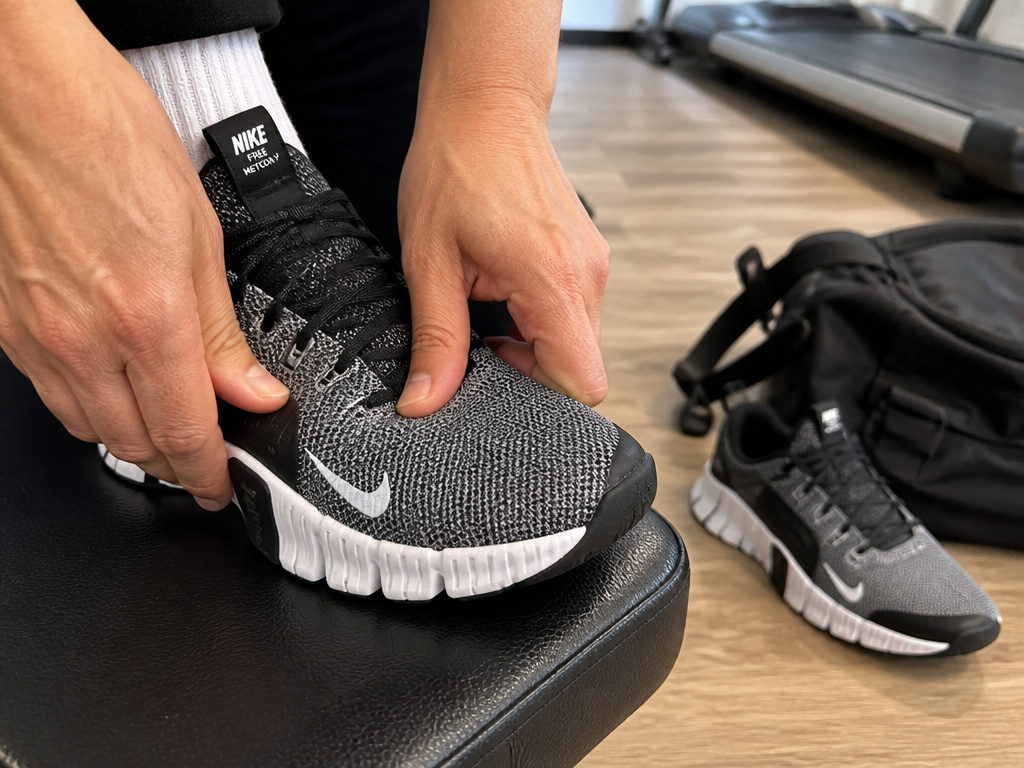
Scott Brown, Orangetheory’s Vice President of Fitness, puts shoe choice down to gait pattern, stride length, and overall body mechanics. His recommendation is a professional fitting, so you leave with the right size and model rather than a guess.
There’s a reason the fitting matters more than it sounds. The foot’s many bones, joints, muscles, ligaments, and tendons take the load of every step on a treadmill or a gym floor.
Brown’s fallback if a fitting isn’t available is simple: “look to initial step-in comfort which is one of the best predictors of a shoe being a good selection for an activity like Orangetheory.”
Why Shoe Type Matters More Than Shoe Brand
Three broad categories cover most gyms. Traditional weightlifting shoes have a hard sole, an elevated heel, and lateral support, which makes them good for deep squatting and poor for anything needing a flexible sole. Cross trainers have a stable sole with some pliability, built for a mix of activities rather than one. Running shoes are built for running.
Cushman’s own habit is running shoes for most activities and weightlifting shoes for lower-body and power work. Nike points first-timers toward a balanced trainer, naming the Nike Free Metcon 7 for its two-part midsole and webbing lace structure that locks the midfoot. For walking and recovery days, Nike suggests considering walking shoes, which spare your running shoes the extra mileage.
Then the replacement question. No source in the guidance reviewed here gives a mileage or month interval for gym shoes. MedlinePlus and the AHA Dress for Workout Success PDF both go by condition instead: replace them when they stop feeling comfortable or the soles look worn. Treat any fixed mileage figure you see quoted elsewhere as unsourced.
The test that matters is boring. Put the shoe on, stand up, and notice whether anything presses on the outside of your little toe or rubs at the heel. A shoe that blisters you in the shop will blister you on a treadmill, and Orangetheory’s guidance is that the right pair shouldn’t cause mid-workout cramping or blisters at all.
Cold, Sun, and Bugs: The Edges Most Guides Skip
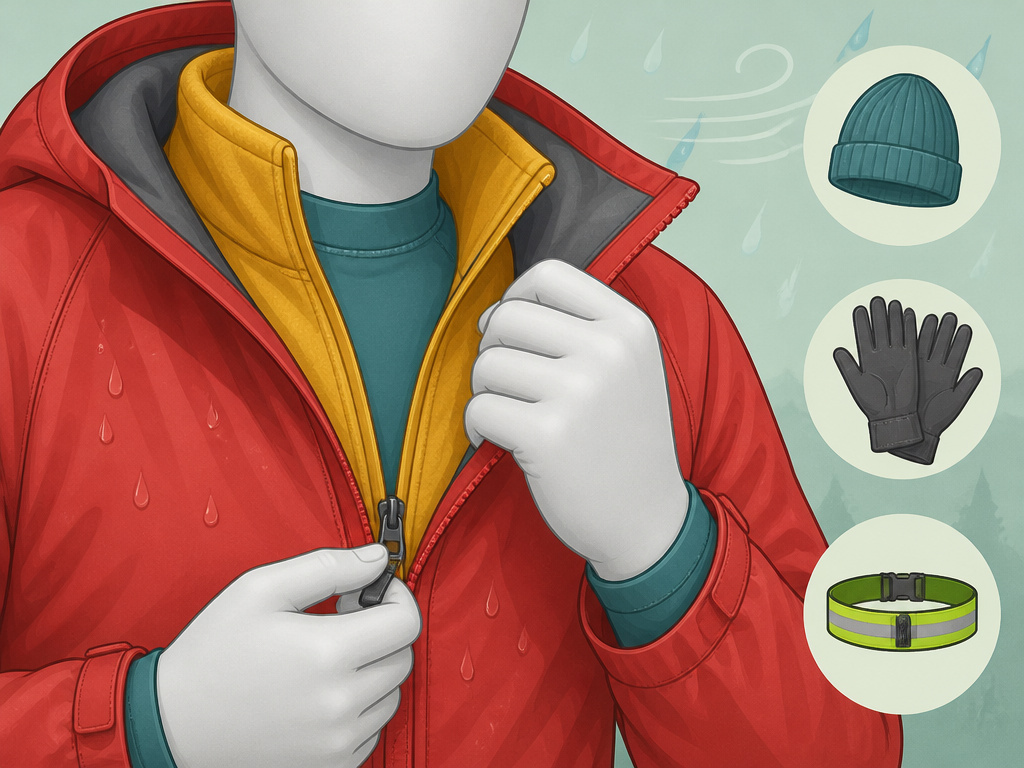
You step outside for a warm-up lap and the wind goes straight through your shirt. Five minutes later you’re back inside, cold and damp, and the session never really starts.
Layering for Cold Weather
MedlinePlus’s cold-weather procedure is a fitted wicking base layer, then a warmer layer such as a fleece jacket, plus gloves, a hat, and ear coverings. Take layers off as you warm up. If you’re running or walking outdoors, add a backpack so you can shed layers and carry a water bottle.
The outer shell matters as much as the layers. In rain or wind, look for a windbreaker or nylon shell labelled waterproof or water-resistant, and ideally breathable as well.
A shell that doesn’t breathe traps sweat against your base layer. You finish wetter than you’d have been in the rain, and the chill arrives the moment you stop moving.
For hot sun, MedlinePlus advises light-colored clothing that dries fast, and notes that sun-blocking clothes come with a sun protection factor label. You’ll often see the tag read UPF instead, so don’t be thrown by the second acronym.
Two more edges worth knowing:
- Reflective parts matter if you exercise early or late, so drivers can see you. A reflective belt or vest does the job if your clothes don’t have them built in.
- Wooded areas change the outfit entirely. Long sleeves and pants, pants tucked into socks, and insect repellent containing DEET or permethrin.
That long-pants point is where the guidance contradicts itself, and it’s worth saying so. Orangetheory tells first-timers to leave behind long pants that could drag and trip them. MedlinePlus prescribes long pants for wooded areas, and Myprotein recommends long sleeves and joggers for combat sports. The real rule is narrower: long pants that drag are the problem, not long pants.
What to Leave in the Locker
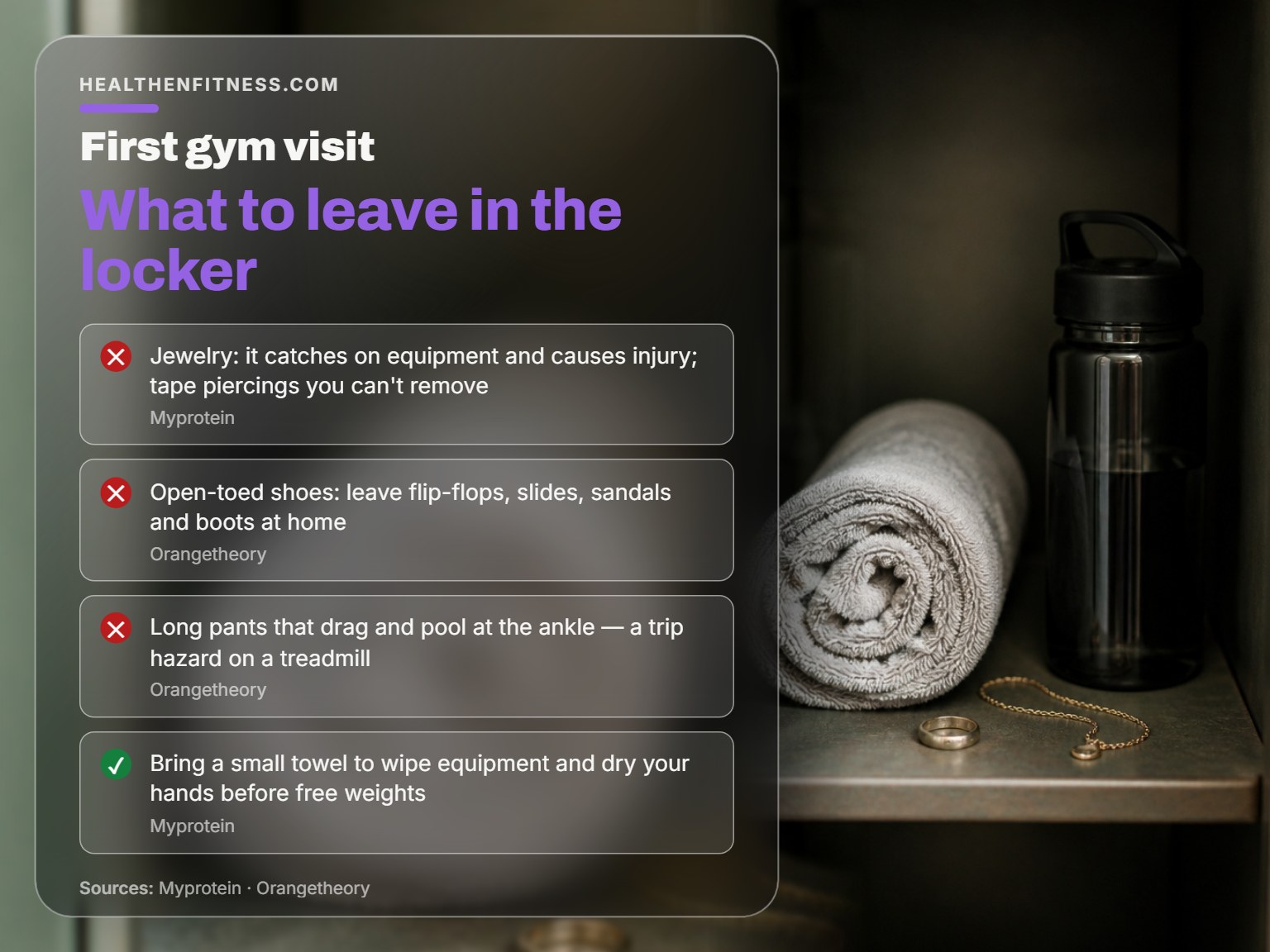
Three things get people hurt or turned away, and none of them are clothing choices.
Jewelry is the first. Myprotein advises removing as much jewelry and as many non-functional accessories as possible before training, because they catch and cause injury, and taping over piercings you can’t remove. Orangetheory’s version is to leave jewelry behind entirely, since it either gets damaged or catches on equipment.
Open-toed shoes are the second. Orangetheory lists flip-flops, slides, sandals, and boots as things to leave at home, for safety and comfort. Sports Direct says the same in fewer words: avoid jeans and open-toed shoes.
Dragging fabric is the third, and it’s the one people miss, though Orangetheory’s caution about long pants that drag contrasts with MedlinePlus’s advice to wear long pants in wooded areas and Myprotein’s long joggers for combat sports. Long pants that pool around the ankle are a trip hazard on a treadmill.
Easy to miss: A ring on a cable handle or a necklace near a lat pulldown. The metal catches, your skin doesn’t stretch, and you find out in the half-second before something gives.
What to Bring in Your Bag
- A small towel, which Myprotein recommends for wiping down equipment and Orangetheory recommends for drying your hands before grabbing free weights.
- A water bottle. Orangetheory recommends bringing a water bottle to class.
- Cushioned, sweat-wicking socks, which Nike lists as part of a complete gym outfit.
- A lock, if your gym doesn’t provide one.
The site’s gym bag essentials list and the what to bring to the gym checklist both cover the fuller version.
Your First Visit Should Be Short and Unremarkable
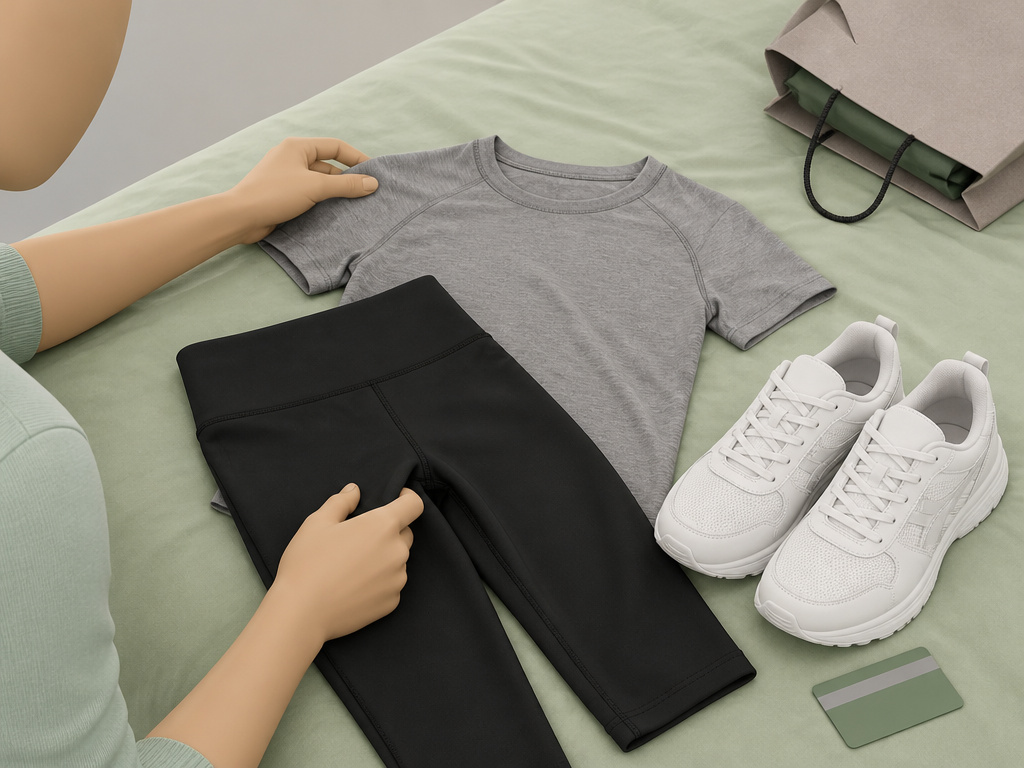
The people who quit in week three are usually the ones who went hardest in week one.
I’ve watched that pattern play out more times than I can count. Someone signs up, attacks the first session like it’s a final exam, and then can’t face the stairs for four days. By the third week the membership card is in a drawer. Now I tell people to start at roughly half of what they think they can handle.
The clothing version of that advice has the same shape. Pick three or four simple exercises, arrive at a quiet time, and walk the floor once before you touch anything. The outfit only has to do one job: let you move without thinking about it.
Two things I’d skip and one I wouldn’t:
- Skip the personal training package on day one. You don’t know enough about the gym yet to know what you want help with.
- Skip the new wardrobe. Sports Direct’s point is worth repeating: breathable leggings, a comfy t-shirt, and sturdy trainers are enough for a first visit.
- Take the free orientation or tour. It’s the fastest way to learn where things are, and it makes the room feel less anonymous.
If nerves are a bigger obstacle than the outfit, the gym anxiety tips are the better read. And if you want the wider picture of first time at the gym routines, that’s covered too.
Frequently Asked Questions
Can I wear regular clothes to the gym for my first visit?
Yes, if they’re sweat-wicking, breathable, flexible, and fit well. Sports Direct’s guidance is explicit that you don’t need new gear. Avoid jeans and open-toed shoes, and skip anything that drags or catches.
Do I really need special gym shoes?
Not necessarily special, but appropriate. Orangetheory recommends support, breathability, grip, and light cushioning, and suggests a professional fitting if you can get one. If a fitting isn’t available, judge by step-in comfort.
Is cotton really that bad?
It’s a fair-weather fabric for the gym. MedlinePlus, Sports Direct, Myprotein, and Orangetheory all advise against it because it holds sweat, while Di Domenico et al. 2022 found few studies showing a real difference between natural and synthetic fabrics. A 2022 peer-reviewed review found few studies showing a real difference between natural and synthetic fabrics, so the blanket rule is weaker than the evidence behind it.
What should I bring besides clothes?
Small towel, a water bottle, and cushioned sweat-wicking socks cover the basics. A lock is worth packing if your gym doesn’t supply one.
Should I wear loose or tight clothes?
Match it to the activity. Loose for walking, gentle yoga, and strength training. Form-fitting and stretchy for running, biking, and swimming. Around machines, keep it close to the body so nothing catches.
What should I leave at home?
Jewelry, open-toed shoes, dragging long pants, denim, and anything that’s mostly cotton. Tape over piercings you can’t remove.
The Bottom Line
Here’s the honest version: your first gym outfit needs to do three things. Wick sweat, let you move, and stay out of the way of the equipment. Everything above that is preference.
Deciding what to wear to the gym for the first time takes about ten minutes once you know the rules. Lay the outfit out the night before, then do one slow lap of the floor before you touch a machine. That’s it. The lap is the part that makes the room feel familiar, and the outfit is the part you’ll stop noticing by the second session.
If you’re still stuck between two options, pick the one you’d be comfortable sitting on the floor in. That’s usually the right answer.
