
How to Find a Gym Near You: Tour First, Then Sign
This post contains affiliate links. As an Amazon Associate, we earn from qualifying purchases.
To find a gym near you, search by area or use a near-me filter that returns facilities within 5 km, then narrow by price, rating, and open-now status. Call ahead about access and transit, tour at the hour you’d actually train, and read the contract before you sign anything.
The how to find a gym near you question narrows the search more than the equipment ever will. A facility far from home gets used far less than one on your walk home, and UNC Health’s guidance says it plainly: if the gym is too far, it decreases your chances of going. Everything after the search is about protecting the habit and the money you’re about to commit.
What follows is the order I’d run it in: search, phone call, tour, contract, first visit. Each step has one thing that trips people up, and none of them take long.
Key Takeaways
- Search within 5 km and filter hard. A near-me search caps at that radius, and the Rated 4+ and Verified filters cut a list of thirty down to five.
- Tour at the hour you’d actually train. NCHPAD and BBB both say to visit at your normal workout time, because a quiet Tuesday morning tells you nothing about 6 p.m.
- Keep the term at one year or less. NCHPAD advises against anything longer because of closure risk, while BBB pushes month-to-month or pay-as-you-go instead.
- Itemize every fee before you sign. Enrollment, annual, cancellation, and class surcharges all sit outside the monthly number on the sales sheet.
- Take the free orientation. NCHPAD’s guidance is that a group or personal equipment walkthrough should cost you nothing when you join.
The 5 km Search and the Filters That Do the Real Work
A directory search on GymCity returns gyms within 5 km of your location, and you don’t need an account to run one.
A directory search returns facilities within 5 km of a stated location. Filters narrow the list by price band, a 4+ rating threshold, open-now status, free-trial availability, women-friendly designation, verification status, and listed facilities. No account is required to run a search. Sort order changes the ranking, and hiding the map gives the list more room.
Near Me failing is almost always a browser permission, not a missing gym. Allow location for the site, or type your area into the Where box. If the list comes back empty, clear the filters before you conclude your town has nothing.
The filters are where the search earns its keep. Rated 4+ and Verified remove most of the noise in one click, and Open Now tells you whether a place is even staffed at the hour you’re searching. It helps to know what you’re filtering toward, so start from a shortlist of best gym options instead of clicking every pin on the map.
Search results also flatten a real distinction. A big box gym and a local gym differ less on equipment than on contract terms and staffing, and a boutique studio usually sells class packs rather than floor access. Decide which of those three you actually want before you start booking tours.
What Should You Check Before You Leave the House?
Two things happen before a tour: you read what other members say, and you make one phone call.
BBB’s advice is to read reviews and complaints and look at how each gym responds before you tour. A gym that answers a bad review with a date and a fix is a different operation from one that answers with a form letter.
The phone call is where NCHPAD adds something the other sources skip. It recommends phoning the facility specifically to confirm it can be reached by accessible public transport. BBB doesn’t mention calling ahead at all, so treat this as a gap you fill yourself rather than a contradiction.
Four questions worth asking on that call:
- “Which bus or train stop is closest, and is the route from it step-free?”
- “How many staff are on the floor at 6 p.m.?”
- “Is the equipment orientation free, and when does it run?”
- “What’s your quietest weekday window?”
That last one has a concrete answer. NCHPAD names 9 to 11 a.m. And 2 to 4 p.m. On weekdays as the off-peak windows when equipment waits drop.
Common mistake: Asking about crowding in general terms. Ask what the wait for a squat rack looks like at peak evening time on a Monday, and you’ll get a real answer or an honest shrug.
If you’d rather not wing the call, there’s a script for how to ask for a gym tour that covers the questions most people forget.
How to Find a Gym Near You Without Touring Ten of Them
A busy weekday evening. Every rack taken, a queue at the only platform, and a spin class spilling into the free-weight area. A Tuesday 11 a.m. Tour would have shown you none of that.
Both NCHPAD and BBB land on the same instruction here: visit at the times you’d normally work out. NCHPAD adds the harder rule. If a facility declines to give you a tour, consider looking elsewhere.
The smell hits first on most tours, rubber matting under a lemon disinfectant that doesn’t quite cover it. Listen for the weight stacks. A stack that drops with a hollow clank again and again means the floor is busy and the members are impatient, which is useful information.
I’d rather spend ten minutes standing still in the corner than twenty minutes being walked around. Watch how long people wait for a rack, not how shiny the machines are. The tour guide is selling; the queue isn’t.
The tour itself is worth taking slowly. The useful part is the ten minutes you spend standing still afterward, pretending to check your phone.
| What you notice | What it usually means | What to do |
|---|---|---|
| Wipe dispensers empty at 6 p.m. | Cleaning is nominal, not scheduled | Ask who cleans and when |
| Queue at one rack, machines idle | Layout is lopsided | Ask about peak-hour staffing |
| Staff can’t name a certifying body | The certification claim is vague | Ask to see the certificate |
| Nobody offers a walkthrough | Orientation isn’t standard | Request one before you join |
That third row matters more than it looks. NCHPAD says trainers and instructors should be certified through a national organization such as ACSM, ACE, or NSCA. UNC Health goes a step further and says the gym should require its fitness staff to be certified. If the person giving the tour can’t name either, you’ve learned something.
Is a Year-Long Gym Contract Ever Worth Signing?
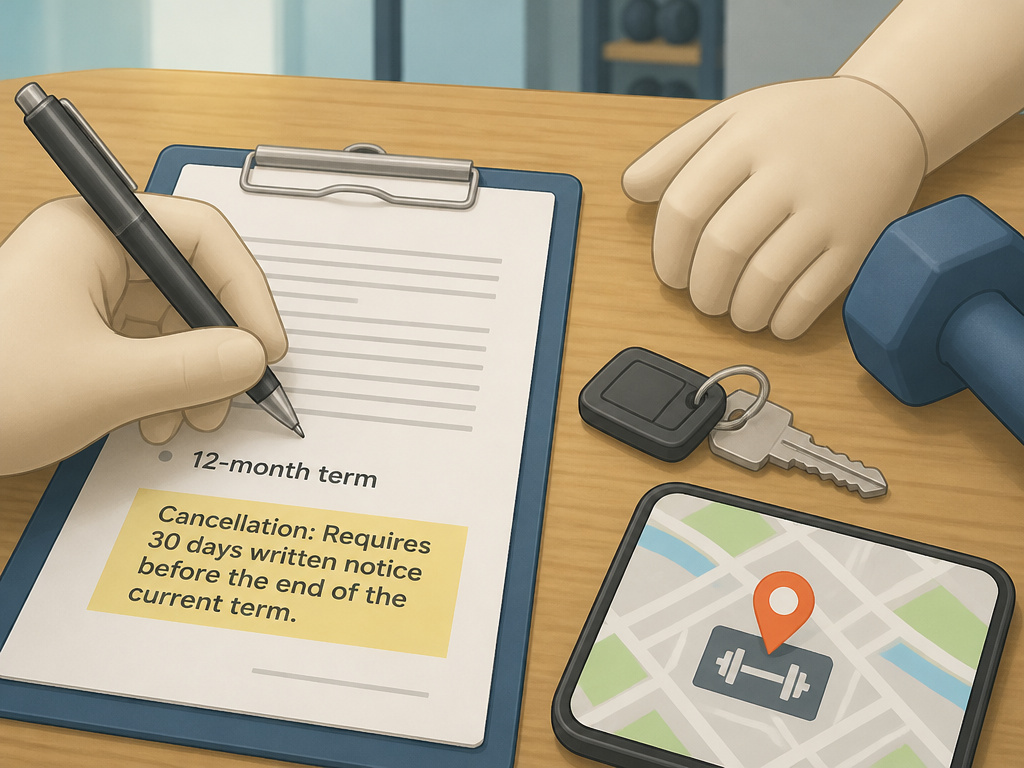
The two most careful consumer sources on this don’t agree, and the gap between them is worth knowing before you pick up a pen.
| Question | NCHPAD’s position | BBB’s position |
|---|---|---|
| Term length | Avoid terms beyond one year | No cap; month-to-month or pay-as-you-go |
| Flexibility | Opt out if you move | Membership freezes as the fallback |
| Free trial | Treats a day pass as neutral | Confirm a card number doesn’t convert it |
NCHPAD’s reasoning is closure risk: a gym that shuts down mid-term leaves you chasing a refund. BBB doesn’t set a term cap at all. It points at month-to-month, tiered, or pay-as-you-go structures and membership freezes as the flexible alternatives.
Here’s how I’d resolve it. If you’ve toured the place twice, know the location works, and the closure policy is in writing, a one-year term is defensible. If you’re new to the area, or the gym is new, month-to-month costs more per month and caps your downside.
What to Ask About Moving or Closure
UNC Health recommends asking, before you sign, what happens to your contract if the gym goes out of business and whether you can get your money back or transfer the membership. BBB lists the same question alongside auto-renewal terms and the exact cancellation method: in person, online, or by letter, plus how much notice you have to give.
Get all of it in writing. UNC Health is direct about that, including the notice period for cancelling.
Where this goes sideways: Signing a twelve-month term at a gym that opened six weeks ago. If it closes in month four, you’re a creditor in a queue, and the refund usually arrives after the next rent cycle, if at all.
None of this is fixed in stone. Membership pricing and terms get negotiated more often than people expect, and there’s a workable approach to negotiate a gym membership that starts with the enrollment fee rather than the monthly rate.
Fees That Show Up After You Sign
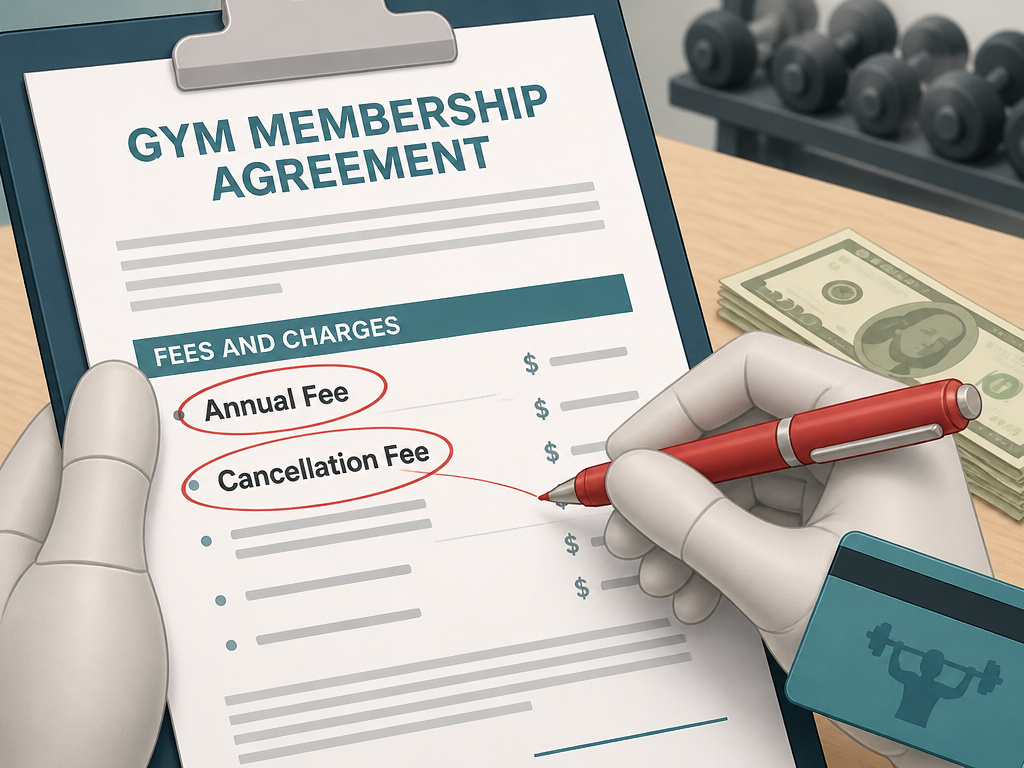
Four line items sit outside the monthly fee, and the sales sheet rarely leads with any of them.
- Enrollment fee. A one-time charge to start, sometimes waived and sometimes not, and always worth asking about directly.
- Annual fee. BBB flags this one because it lands months later, when you’ve stopped comparing.
- Cancellation fee. Ask what it costs to leave and how much notice you owe. If the answer is vague, that’s the answer.
- Class and personal training surcharges. NCHPAD notes that personal training fees for detailed advice average $25 to $75 per hour on top of your membership, while a general floor orientation should be free.
BBB adds a timing warning that catches a lot of people: introductory rates often go up after a few months. Find out the regular price before you sign, not the promo price. Ask about student, family, and employer discounts in the same conversation.
NCHPAD raises one more: if the equipment or facility isn’t accessible to you, ask for a fee discount. That sits in tension with BBB’s framing of fees as fixed line items to be itemized rather than negotiated, so treat it as a request worth making rather than a rule.
The Free Trial Trap
BBB’s warning is specific. Before you hand over a card number for a “free” trial, find out whether it turns into a paid membership. NCHPAD treats a day pass neutrally, as a low-risk way to evaluate a facility. Both can be true at once, and the difference is whether a card is involved.
If you’re comparing several places before committing, working through gym day passes across a week tells you more than three tours in one afternoon.
What Accessibility Checks Do Most Gym Searches Skip?
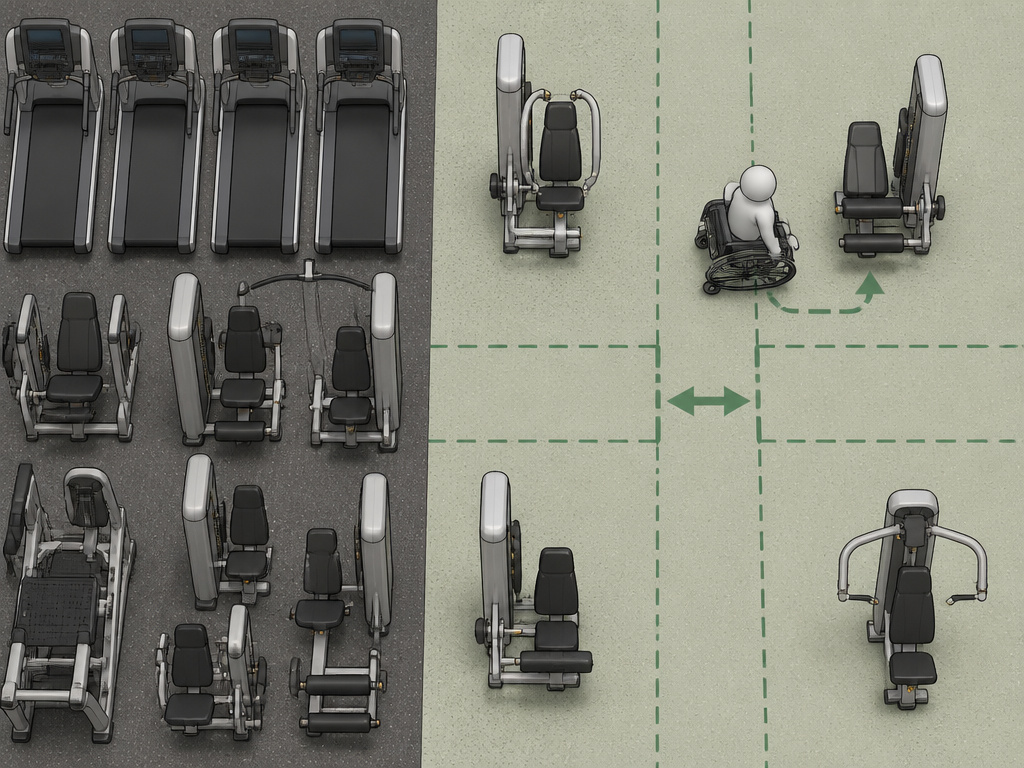
Spacing matters more than machine count, and almost no gym listing tells you either.
NCHPAD makes a point that inverts the usual heuristic. Fewer, more spread-out machines can beat a dense bank of equipment, because spacing lets you approach from either side and leaves room for a mobility device. Walk the floor and look at the gaps, not the inventory.
The rest of the checklist is physical. Are there ramps at entrances and exits? Clear paths to the equipment? Accessible parking, not just parking? Is the place clean, climate-controlled, and well-ventilated? NCHPAD’s choosing an accessible fitness center guide is the source for all of it, and it’s the only one of the four sources that raises accessibility as a first-order question rather than an afterthought.
Spacing Beats Density
A dense bank of machines packed close together looks impressive in photos and feels like a corridor in person. Four machines with a clear approach on both sides feels like a gym you can actually use.
Certification has an accessibility angle too. NCHPAD notes that trainers and instructors should be certified through a national organization such as ACSM, ACE, or NSCA. If you’re managing a condition, that’s the person to ask for by name.
The American College of Sports Medicine also publishes a selecting the right fitness facility handout aimed at the same decision, and it’s worth a skim before you tour.
Your First Visit Should Be Short and Boring
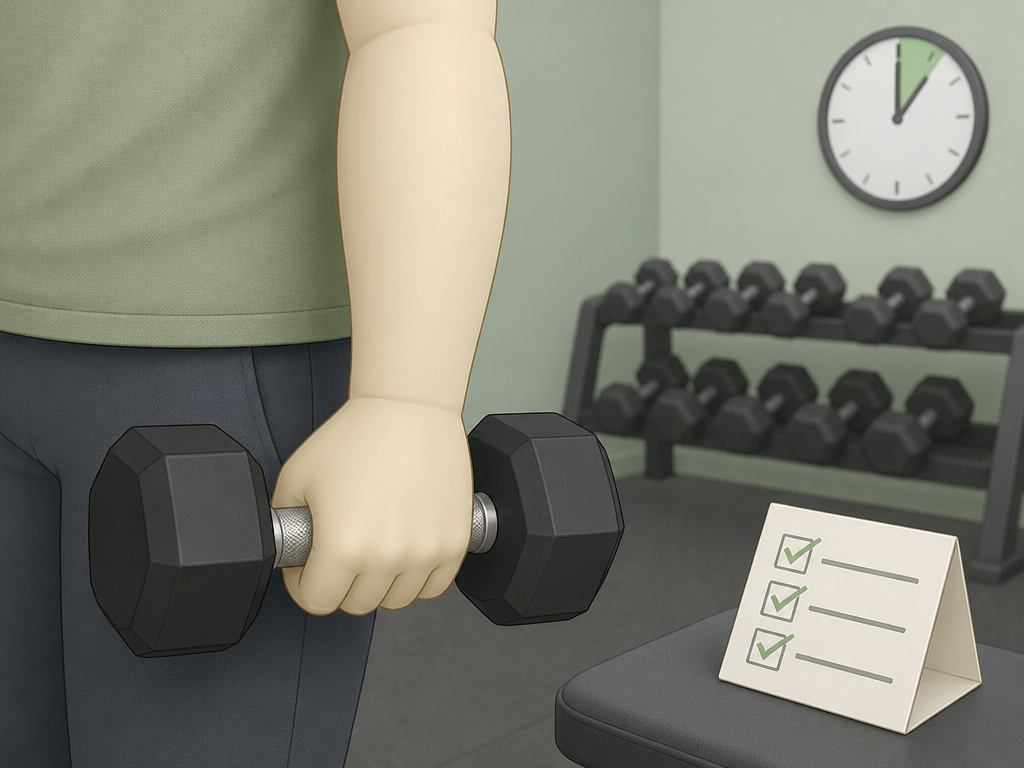
Keep it short and leave while you still feel good.
I did the opposite once. First day at a new gym, I ran a full push session, added a finisher because the room was empty, and spent the next four days walking like a man negotiating with a staircase. I didn’t go back for a while. That’s not a training problem, it’s a scheduling one, and it’s the single most common way a new membership dies in week two.
Before you start: Cold equipment plus no orientation is how form breaks down on the first set, so take the walkthrough before you load anything. Going to failure on day one buys you days of soreness and a reason to skip. And check the floor for wet patches near the treads, because a slick spot under a loaded barbell is the one hazard nobody warns beginners about.
- Walk the floor before you touch anything. Two laps, no weights. Skip it and your first set happens while you’re still hunting for plates, which is when people tweak something.
- Take the free orientation. NCHPAD’s guidance is that a group or personal walkthrough should come at no charge when you join. Decline it and you’ll copy whatever the nearest person is doing, pin settings included.
- Pick three exercises and stop. A squat, a press, a row. Adding a fourth on day one costs you the fourth visit.
- Leave one or two reps short. You should finish each set able to do two more. That’s how you walk out wanting to come back.
UNC Health describes what good onboarding looks like: a trainer working with new members four or five times to teach safe equipment use and hand over an effective beginner workout. Ask whether that’s included. If it isn’t, ask what the first session covers.
Three exercises you repeat beat ten you dread. A first visit is a scouting trip, not a test.
There’s a longer version of this if you want the whole ramp-up, covered in starting at the gym for the first time.
Frequently Asked Questions
How far should a gym be from my home?
Close enough that you’d go on a cold, dark evening. UNC Health’s guidance is to find a gym close to your home or workplace because distance decreases your chances of going. A near-me search caps at 5 km.
Is a free gym trial really free?
Sometimes. BBB warns that a “free” trial can convert to a paid membership if you hand over a card number, so ask directly whether a card is required and what happens on day eight. NCHPAD treats a day pass as a neutral, low-risk way to evaluate a facility.
What if the gym won’t give me a tour?
Walk away. NCHPAD’s rule is that if a facility declines to give you a tour, consider looking elsewhere. A gym that won’t show you the floor before you sign isn’t going to be more forthcoming about cancellation terms afterward.
How long should I sign up for?
NCHPAD advises against memberships that extend beyond one year because of closure risk. BBB doesn’t set a cap and instead points to month-to-month, tiered, or pay-as-you-go options and membership freezes. If you’re unsure about the location or the gym is new, take the shorter term.
Do I need to see a doctor before joining?
NCHPAD recommends a consultation with a health professional to set realistic goals, and says staff should offer a health questionnaire before you start using the facility to flag risk factors. If you have a health condition, NCHPAD recommends a consultation with a health professional to set realistic goals.
What should I bring on the first visit?
Water, a towel, and nothing you’d be upset to leave in a locker. Most gyms supply sanitizing wipes for shared equipment, and UNC Health’s guidance is that equipment should be wiped down after every use. Bring a lock if the locker policy is unclear.
The Bottom Line
One threshold decides most of this. If the gym is too far to reach easily on a normal weekday, the contract terms barely matter, because you won’t keep going.
So the first step this week isn’t signing anything. It’s running the 5 km search, picking three places, and booking tours at the hour you’d actually train. That’s it. Three tours, one phone call each.
Here’s the honest version of how to find a gym near you: the equipment is the least important variable. Contract length, cancellation terms, spacing on the floor, and whether the place is bearable at 6 p.m. On a Monday decide whether you’re still going in six months. I’ve signed two gym memberships I barely used. Both times I skipped the tour at my real workout hour, and both times I found out in week three.
Start smaller than you think.
